
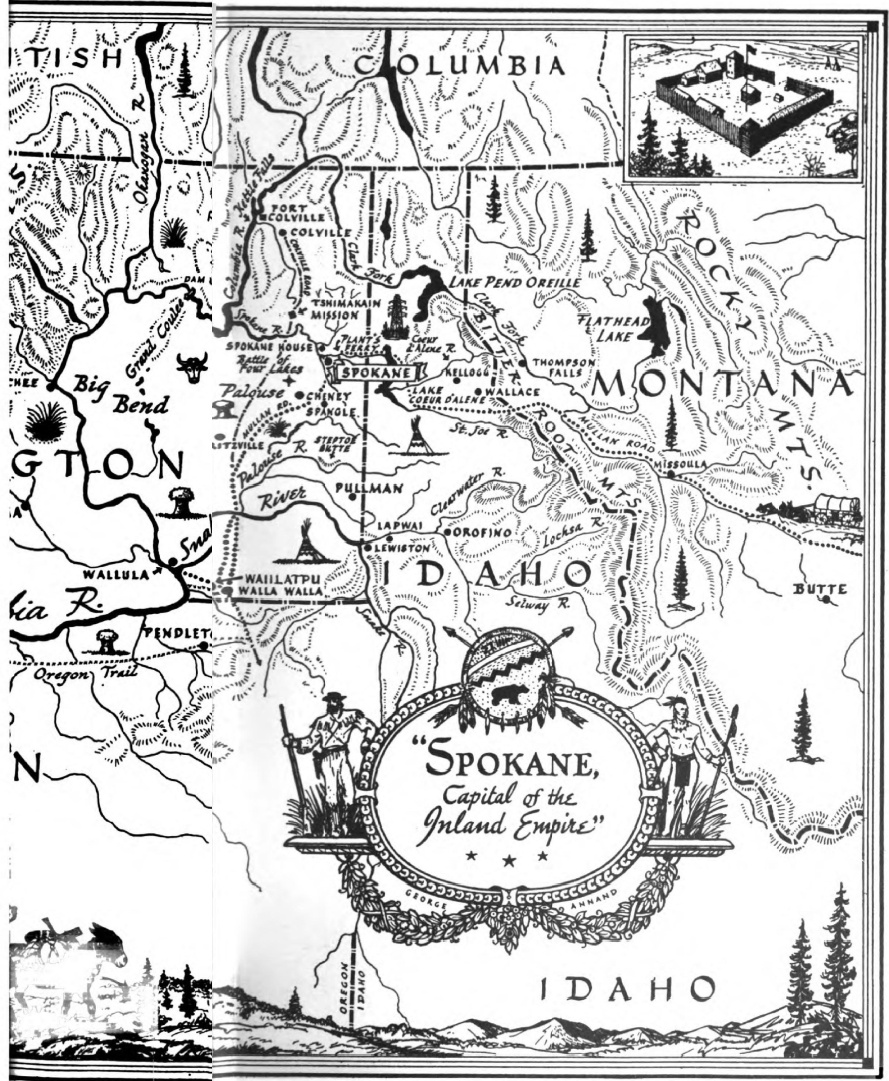
MAP
DEDICATION
To Laura
FOREWORD
REQUESTS coming to the author to write a book picturing the life and culture of Spokane during successive phases of its development from fur trade days to the attainment of municipal adulthood in the early years of the twentieth century posed a difficult problem. Such a book could be neither straight history nor fiction. It must stand somewhere between. How could that be done?
The best answer seemed to be to make the approach for the most part through characteristic people; not necessarily those best known to fame outside the immediate locality, nor even those whose influence was most salutary. Rather, people picked here and there because of their indigenous quality; folks through whose ways of life and local activities the reader might get the flavor of the community and, in common parlance, learn how it got that way.
Some readers will undoubtedly challenge the selection of characters. To such the reply must be either that these were individuals who seemed most likely to provide a balanced picture or whose activities have become a part of local lore. Several have already been made the subjects of well-documented published biographies, and in the case of one, the author herself has prepared a comprehensive biography yet to be published. It is from such sources that not a few pertinent facts and incidents informally set forth in the following pages have been drawn. To the biographers the author wishes to express here, as well as more explicitly in the pages that follow, both gratitude and a deep sense of obligation. She is also indebted to numbers of brief and less well-known sources such as pioneer reminiscences and diaries, city and county histories, commercial pamphlets, and informative articles found in the Washington Historical Quarterly (now the Pacific Northwest Quarterly), the Oregon Historical Quarterly, and related publications. Among newspapers largely drawn upon are The Spokesman-Review, The Spokane Chronicle, and The Washington Farmer. To the editorial staff of the last particular thanks are due for helpful suggestions. Other items have been contributed orally by friends of the author’s seventeen years of residence in Spokane, and by their friends to whom she was kindly directed and by whom she was without exception graciously received.
Thanks are also due the Spokane Public Library through whose Northwest Collection the author has been allowed to thumb her laborious way punctuated by calls for help graciously answered by the reference staff. The resources of the Bancroft Library at the University of California in Berkeley have also been used, thanks to the courtesy of that institution.
In the utilization of this rather formidable array of background and source material the author has endeavored to preserve a light touch. She hopes she has been accurate when dealing with facts; but the book is frankly directed toward the reader who is, or may be, interested in the development of the so-called Inland Empire and its capital city, but who lacks inclination, time or opportunity to make his way through the physically as well as rhetorically heavy tomes from which many of the following narratives have been extracted.
The author likes the Inland Empire, its sunshine, its lore and its laughter. She hopes you will too!
LUCILE F. FARGO
Berkeley, California
June, 1957
ROSS COX was lost. A member of Mr. John Jacob Astor’s first fur-trading expedition into the Spokane country, the red-headed Irish clerk had lain down, on an August day in 1812, for a noonday nap where a clump of sumach and wild berries by a little stream offered shelter from the broiling summer sun of the northern Palouse.{1} He was fatigued from the long trek overland from the Snake River, and the temptation to rest had been irresistible. Now, in the late afternoon, he woke with a start and looked about in dismay. The brigade had disappeared. Not a sign of it was to be seen anywhere. Cox shouted until he was hoarse, but no answer came. He was alone in an unknown land, without food, hatless, clad only in a gingham shirt, nankeen trousers, and worn moccasins, left behind to find his way as best he could.
There were those who said later that the young Irishman’s desertion by the brigade was a planned reprimand for his dilatory ways while on the march and his insubordination when called to account for frequent wanderings to view the scenery. Another explanation was that the party traveled in two sections each of which thought he was with the other. Whatever the reason, there was Cox, hungry, hatless, poorly shod, and worst of all, weaponless, with the late afternoon sun urging haste if he was to overtake the brigade before nightfall. He set off at once.
At first the trail left by horses and men was not hard to follow; but soon it disappeared in rocky ground. Cox climbed a hill and searched the landscape north, east, and west—to no avail. The rolling hills concealed all trace of his companions. He was unarmed, and had no means of knowing where to proceed.
Along the way, Cox’s eyes had been gladdened by the abundance of wild life. With a finger on a trigger he would not now have lacked for food; but his small arms were gone with the pack train and he had not even a knife. It was a grim prospect and one that the facile pen of the young clerk was later to make the most of. Quickly his lively imagination conjured up packs of wolves, angry families of bears, and, coiled beside each warm rock, a rattlesnake ready to strike.
Bears and wolves in the open country and at that time of year were undoubtedly a non-existent peril, but rattlesnakes there were; and without exaggeration Cox’s situation was serious. In sharp contrast with the noonday heat, nights were chilly in the hills, dew was heavy, and he had no means of starting a fire. Nor did he have sufficient knowledge of edible roots and berries to live off the land as satisfactorily as a man of more experience might have done. The youthful Astorian had only that year arrived at the mouth of the Columbia after a voyage around the Horn from New York, and he had plenty to learn.
What happened in the next two weeks is set forth with no lack of the dramatic in Cox’s own Adventures on the Columbia River.{2} When darkness came on the first night, it found him lying in the call grass with wisps of the same grass for blankets. The next day, he glimpsed two horsemen, whom he chased until he was worn out without either overtaking them or getting their attention. Breathless, he threw himself on the ground, only to hear a small rustling noise made by a rattle-snake which he managed to dispatch with a well-aimed rock. To continue sleeping in the never-ending grass was evidently perilous, but for lack of better shelter Cox bedded down in it on successive nights until his fingers became so lacerated from pulling the sharp blades for cover, and his soul so terrified by the rustling noises he regularly took to mean snakes, that he reluctantly tried other resting places. After several days of wandering, he came upon hills dotted with clumps of pine. Even here his perils seemed accentuated. One night he was frightened out of a hollow log by a bear that promptly clambered into the bed so precipitately vacated.
Daily as he wandered he quenched his thirst from chance streams or ponds; or, lacking these, he chewed the dewy grass. When his moccasins wore out he wrapped his bleeding feet in strips torn from his trouser legs. He came to small lakes; but “the stately goose and plump, waddling ducks” paddling about were not for him, since he lacked the means to kill them. The small deer wandering about were a further goad to his empty stomach. Only once did he manage a real meal, and that an unlovely one of half-picked bones of grouse and duck left about their campfire by a departing band of Indians.
It was not until the thirteenth day that the all but famished young Astorian came upon a meadow where horses grazed and a small column of smoke rose heavenward. Spying him, two Indian women fled, but they were soon replaced by the two men of their family who took the role of Good Samaritans, behaving, as Cox put it, “with affectionate solicitude.” They carried the half-dead white man to a hut, washed and bound his bleeding feet, and provided him with a meal of roasted roots and salmon.
From the friendly Indian family the young clerk learned by way of signs that they, with white men and other Indians, had been searching for someone who was lost, that he was undoubtedly the man they were looking for, and that the brigade was only a few hours away. This was wonderful news, but Cox was far too exhausted to proceed further at once. He accepted with alacrity the bed of buffalo and deer skins offered by his solicitous hosts and, stretched thereon, slept soundly until late the next morning, the thirty-first day of August, 1812.
Breakfast, like dinner, was chiefly of salmon. To the satisfaction of his hosts, Cox ate heartily and was forthwith taken across the Spokane River in a canoe and, wrapped in a deerskin, was mounted upon a horse. Thereupon the party moved forward at a smart trot. But alas for Cox’s two hearty meals! Salmon is rich food at best, and the white man’s stomach had been empty for days. In two hours of agony the unfortunate Irishman paid the price for his indiscretion and learned an unforgettable lesson. He also learned how kind a couple of untutored Spokane Indians could be.
When at last the white man was able to sit his horse again, the journey was resumed. Then, after about an hour, writes Cox,
...we arrived in a clear wood, in which, with joy unutterable, I observed our Canadians at work hewing timber. I rode between two natives. One of our men, named François Gardepie, who had been on a trading excursion, joined us on horseback. My deerskin robe and sunburned features completely set his powers of recognition at defiance, and he addressed me as an Indian. I replied in French, asking how our people were. Poor François appeared electrified, exclaimed “Sainte Vierge!” and galloped into the wood vociferating: “Oh mes amis, mes amis il est trouvé! Oui, oui, il est trouvé!” (Oh, my friends, my friends, he is found! Yes, yes, he is found!)
“Qui? qui?” asked his comrades; “Monsieur Cox, Monsieur Cox,” replied Francois; “le voilà! le voilà!” (There he is, there he is!){3}
Away went saws, hatchets, and axes, and everyone rushed to the tents where the little party had now arrived. Astonishment and delight at Cox’s miraculous escape were mutual, his Indian rescuers “were liberally rewarded, the men were allowed a holiday, and every countenance bore the smile of joy and happiness.”
That was not quite all, since it remained for the young man’s French-Canadian friends to retrieve and return to him his clothing which had the day before been sold at auction in the belief he was permanently lost.
The spot where Ross Cox came upon his fellow Astorians was an attractive parcel of land lying between the Spokane and the Little Spokane rivers just above the point where they join. On it grew scattered pine and other trees ample for shelter and fuel, while the rivers offered not only a ready water supply but also an abundance of fish. Moreover, as Cox had had occasion to learn, the Spokane Indian tribe, in whose territory the land lay, was both peaceable and friendly. The place was given the name of Fort Spokane. It seemed an ideal location for a trading post of Mr. Astor’s ambitious Pacific Fur Company.
Supervised by John Clarke, a partner and future bourgeois or resident-to-be under whom the brigade had made its way from the mouth of the Columbia River, the work of construction proceeded rapidly. Shortly, Clarke was able to point with pride at the new establishment with its seventy-foot mess hall, eighty-foot warehouse, and comfortable log dwelling of four rooms and kitchen for his personal use. As was customary, the whole was encircled by a stout paling of logs and “flanked by two bastions with loopholes for musketry.” Over all floated the flag of the United States.
Here Ross Cox quickly regained his strength and with others of the party spent a comfortable winter after completing whatever work was assigned them. Cox’s assignment was exploratory and involved a hazardous expedition deeper into the interior. His trip into the country of the Flatheads was a hard one, beset with many dangers. From it he was more than happy to return to the post “in time to partake of the New Year’s festivities,” including juicy roasts of horseflesh washed down with a sufficiency of excellent drink. On horseflesh the little Irishman had at first looked with definite distaste, but he was now a discriminating gourmet where equine steaks were concerned. “A horse for the table,” he scribbled, “should not be under three years or above seven,” and he added that a domesticated animal provided far the best roasts and steaks.
Life was not dull at Fort Spokane. There were deer to shoot, as well as other game, fat salmon and fighting trout to catch. There was good reading—for the fur traders did not venture into the wilderness without food for the mind. Along with barrels of rum came Shakespeare and Scott. In such an atmosphere, young gentlemen like Cox, well-educated and of good family, found that time passed “agreeably enough.”
Nor was a man at Fort Spokane limited in his social contacts to members of his own outfit. Within hailing distance lay Spokane House, a trading post of the Canadian Northwest Fur Company. Two years before the arrival of the Astorians, David Thompson, famous geographer and explorer for the Canadian Northwest Fur Company, had sent Scotch Finan McDonald and half-breed Jacques (otherwise Jaco or Joco) Finlay to build a post for the company at the confluence of the Spokane and Little Spokane. This they had gone about with a will, and when Thompson came by in 1811 he called the new post Spokane House, the word “house” being the customary term used by the Northwesters to designate a trading post. He established the latitude and longitude of the spot scientifically and accurately, as one of the greatest British geographers might be expected to do, and “left a small assortment of goods to continue the trade” with the inhabitants of some forty tents. Then for good measure as a far-seeing representative of his company, on his way back to headquarters he halted long enough at the junction of the Snake and the Columbia near Pasco to tie around a pole a notice accompanied by the British flag:
Know hereby that this country is claimed by Great Britain as part of its territories, and that the N. W. Company of Merchants from Canada, finding the factory for this people inconvenient for them, do hereby intend to erect a factory in this place for the commerce of the country around.
D. Thompson. Junction of the Shawpatin [Snake]
River with the Columbia. July 9th, 1811.
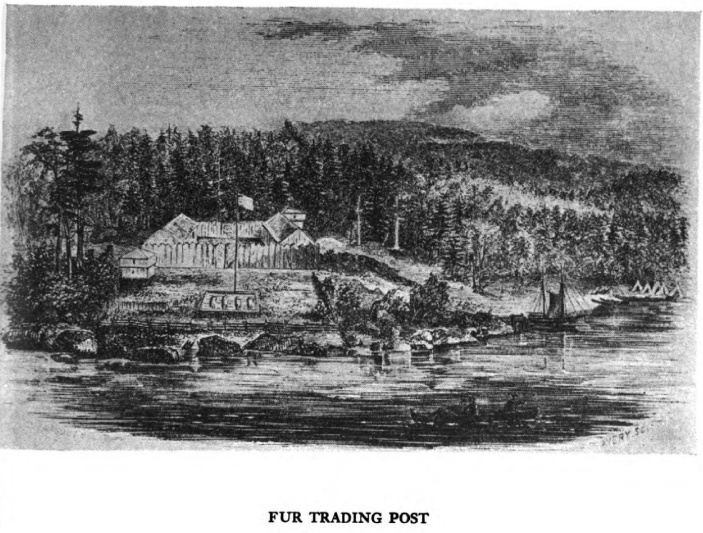
So it came about that a year before the arrival of the Astorians, the first white business venture in the Spokane area was already a going concern with the goods of civilization for the first time readily accessible to the Spokane Indians. Not only that; due notice had been given other traders to keep out—a notice which, however, the Astorians had seen fit to disregard.
Goods for Spokane House had at first to be brought all the way from Fort William some 2,000 miles to the east on the shores of Lake Superior. McDonald and half-breed Joco had only a small stock with which to start operations, but they began at once to build up goodwill. With their Indian wives they settled down to cultivate the friendship of the hundreds of red men who each year camped roundabout to catch and dry a twelve-month supply of salmon, to exchange news and gossip, and to gamble.
This was an excellent start; but to make sure of the success of their venture, the Northwesters sent additional representatives into the Spokane area to build up trade with outlying districts and to take over the business routines of the post itself. When the Astorians arrived, John George McTavish, one of the Northwest Company’s canniest traders, was the resident in charge with matters well in hand.
In spite of the underlying contest, relations between Spokane’s earliest business houses were friendly. They were rivals; but the rivalry was that of the chessboard rather than of open battle. Each outfit sent Indian scouts to find the native trappers and to buy up the best pelts; each tried to beat the other to the most likely locations for feeder posts. Yet although the officials thus planned and moved craftily in the game of check and countercheck, the clerks, hunters, and canoe men attached to the two establishments, and even the head traders themselves, swapped stories and tobacco and fraternized in friendly fashion with only the occasional flare of temper to enliven fireside gossip.
There was, for example, the affair of Pillet versus Montour. The former was a clerk of the Astor group, the latter a clerk of the Northwesters. They decided to settle their differences with pistols and seconds in the time-honored way of civilized gentlemen. At the conventional six paces both fired, each registering a hit—one, as gleefully reported by Cox, “in the collar of the coat, and the other in the leg of the trousers.” The tailor, going competently to work, speedily healed both wounds.
At Spokane House, life moved along according to the well-established customs of the Northwest Company, and in most respects the social life of Fort Spokane followed the same pattern. Neither company left anything undone which could reasonably be expected to add to the comfort and pleasure of life in the wilderness. Vegetable gardens were started. On both tables were “savory steaks” of bunchgrass fed Indian ponies known as Cayuses. Other hearty food was set out with unsparing hand, accompanied on occasion by liquor imported the long distance inland.
Trading arrangements were also similar. Both posts allowed the Indians to barter furs for guns and ammunition, thus assuring greater proficiency in Indian hunting, to say nothing of the profit involved—a good gun worth about one pound seven shillings at wholesale netted twenty beaver skins, each worth some twenty-five pounds sterling. Both refused to sell to the Indians the much-coveted fire-water, a wise gentlemen’s agreement to that effect being strictly adhered to.
Clarke, who was in charge of Fort Spokane and was an ex-Northwester himself, had a notion that a dashing air and jaunty costume might add to prestige. So he went importantly about accompanied by several blustering aides who sported feathers in their caps and were at all times ready to challenge, fight, or bully. He gathered the Indians together with a great deal of fanfare and made them an impressive speech. He gave a ball for his men. It was important to impress everybody with the magnificence of the Astor enterprise.
Spokane House also staged balls and had its complement of gay and picaresque costume. On its dancing floor of a frosty night were to be seen French-Canadian canoe men “in plume and sash and gaily colored capote,” Scotch gentlemen in plaid and tartan, and guests from Fort Spokane or Astoria itself bedizened with such bits of finery as a frontier taste or the fashions of the period suggested. White women there were none, and it must have been some time before the girls of the Indian village became acceptably skillful partners. However, the hornpipe required no partner; and it was always possible to tread out waltz or quadrille to the music of fiddle or flute with a burly male companion.
Unfortunately for Mr. Clarke, and unknown to his feather-bedecked aides and bright young gentlemen like Cox and another “scribbling clerk” named Alexander Ross, events were in progress that were to bring a speedy end to Fort Spokane and the immediate Yankee advance into the fur areas of the interior. When word of the War of 1812 between Great Britain and the United States finally reached the Pacific Northwest, matters quickly came to a climax.
It was John George McTavish, Clarke’s neighbor and rival, who returned from a visit to Fort Winnipeg with news of the conflict. Breaking in upon a conference between Clarke and “perpetual motion” McKenzie, a visiting Pacific Fur Company partner, McTavish handed them a copy of President Madison’s proclamation. The timing could not have been more propitious for the “delighted messenger of bad news.” McKenzie had come to Fort Spokane disgruntled with events at his post among the Snake Indians and was only too glad to have further excuse for his determination to give it up. Hastily he departed to cache what pelts he had collected. Then he hurried down the Columbia with news of the war. On reaching Astoria, January 17, 1813, he found the partner in charge there, Duncan McDougall, in a state of panic. The Company’s ship Beaver had failed to return from a trip up the coast northward. The small size of the Astoria staff made the situation precarious. Food was in short supply. There were other worries. Together, McDougall and McKenzie agreed that the only thing to do was to abandon the entire Pacific Fur Company enterprise not later than the following spring.
This was the death knell for Fort Spokane; but Clarke did not know it, nor did his men, for he had kept his own counsel about the war and McKenzie’s decision to abandon the Snake post. After all, reasoned Clarke, his post was not in the doldrums, he was comfortably fixed—and who knew how the war would turn out? So he went his pompous way, entertaining, drinking from his silver goblet with a magnificent air, and generally making light of what might become a serious situation. When in spring the time came for his brigade to start seaward with a goodly supply of pelts, he set forth, with the treasured cup in its special locked case, to meet his fellow partners and their brigades at the mouth of the Walla Walla and to proceed with them to Astoria.
On the way, the cup was stolen by Indians who had concluded that the white chief’s concern for his shining silver mug must indicate it was “great medicine.” The execution of the thief did not add to the Indians’ love for the whites and was to have unfortunate repercussions later.
At the Walla Walla camp, Clarke fell in with McKenzie again and learned facts that were eye openers. Nevertheless, great was his surprise and that of his clerks to find on arriving at Astoria that McDougall, discreetly pushed by McTavish, had some nine days earlier announced the abandonment of the Pacific Fur Company enterprise and was busily preparing to depart on July 1, 1813, a whole year earlier than had at first been planned.
Clarke and others of the partners urged in vain against the move. Did they not realize, argued McDougall, that there was a war on? That because of a blockade by Great Britain no ship flying the stars and stripes could possibly make port at Astoria? That rumor had it their own ship, the Beaver, was without doubt blocked up in Canton, China? That a British vessel bearing letters of marque was even then on its way from England to seize the Astoria establishment at the mouth of the Columbia? In the face of such odds, what could they do but make the best of a bad situation by selling out to their rivals, even though the sale would net no more than a third of the value of their holdings, including the winter’s pack of furs?
The deal was completed at once. With the signing of the necessary papers on the first of July, 1813, Fort Spokane, miles away in the interior, ceased to exist, and Spokane House emerged as the sole fur trading establishment in the immediate neighborhood. With enterprising kindness, the Northwesters at Astoria offered to pay with horses for the Astor holdings there if the Astorians so desired. This would facilitate the long journey back to the Atlantic Coast. Many of the Astorians, however, had no desire to cross the continent. The fur trade was in their blood, they wanted to stay with it. In no time at all not a few had signed up with their former rivals; among them Ross Cox and that other clerk with a facile pen, Alexander Ross, both of whom returned to the interior to earn their living and to set down for future historians the further fortunes of Spokane House, and the busy annual routine of trading post life.
Merchandise which at first had come overland to the interior post from Fort William now arrived at the mouth of the Columbia in sailing ships. Along in June or July, the calicoes, beads, cutlery, firearms and a medley of other articles selected to appeal to savage taste started up river in canoes and boats known as bateaux, along with the year’s supply of staple foods, drink, tobacco, powder, musket, and ball. For upward of six hundred miles, French-Canadian crewmen paddled up stream and portaged around rapids to the mouth of the Spokane, stopping only for food and sleep or at the insistence of Indians along the route, who soon found ways to exact tribute of tobacco and trinkets before allowing the white man’s boats to proceed.
Arrived at the Spokane, goods were transferred to pack animals by which they were borne the remaining miles to Spokane House. Here the waiting hunters and traders made up their packs and got under way for the Kootenai, Flathead, and Snake River regions, and the rest of the merchandise was stored for bartering when the Indians came in with skins, venison, or fish.
Preparations for the winter occupied everyone remaining in the post. While clerks busied themselves with inventories and accounts, others whitewashed and repaired the buildings, put stores in order, opened and aired bales of furs. Or they cut, brought in, and piled huge stocks of firewood; gathered, cleaned, and boiled the gum to calk leaking boats; burned wood into charcoal for the blacksmith’s forge; and stacked wild hay.
Spring saw the return of the wandering traders and trappers. Clerks counted pelts and totted up accounts, and the voyageurs once more took up their paddles to steer precious cargoes down the winding and often foaming Columbia to ships waiting with sails set for New York or London, perhaps by way of Canton, China.
Throughout the year, hours at the post were long, tasks tough and numerous. However, life was healthy, hearty, and in many ways satisfying.
What was true of the post in the way of hard work and circumscribed existence was even more true in the case of the hunters and trappers who returned to it yearly bearing their pelts. In a very real sense they were servants of the Company. Although free to wander the streams and forests, they were compelled to keep traps within definite limits set by the Company. Though not so announced, settlement of the country or free residence therein apart from the Company was to all intents and purposes forbidden. When a trapper entered the Company’s employ, it was part of the bargain that he was to be returned home at the end of his period of service; but the Company usually managed to extend this term until the man was incapable of further work. Moreover, the general conviviality of the year-end celebration, when grog stores were thrown open, usually sufficed to relieve a man of the better part of his year’s earnings if it did not actually leave him in debt—a debt possible of payment only through remaining in the Company’s employ—which meant signing up for another two years.{4}
Like most members of the fur trading regime in the Pacific Northwest, clerks like Cox and Alexander Ross made for Spokane House whenever there was opportunity. For, off main trails and water routes though it was, the post did not cease to maintain and enlarge upon its reputation as a social center. The original buildings had been largely abandoned, at least as living quarters, in favor of the larger and sturdier buildings of the old Astor “Fort.”{5} Accommodations were ample, each class being provided with separate quarters. There were bedrooms, living rooms, kitchen and pantry, cellars, mess room, a counting room, and a commodious ballroom with plenty of attractive Indian girls waiting to dance. “No females in the land,” wrote Ross, were “so fair to look upon as the nymphs of Spokane; no damsels could dance as gracefully as they; none were as attractive.” But, he concluded, “Spokane House was not celebrated for fine women only; there were fine horses also. The race-ground was admired, and the pleasures of the chase often yielded to the pleasures of the race.”{6}
When racing was the order of the day, betting ran high. The Indian races were particularly colorful, women riding along with the men. The ponies were descended from Mexican stock. The saddles were of stuffed deerskin, those of the women having pommels contrived of antlers. As many as twenty-five or thirty riders might run a five-mile heat, guiding their mounts with a touch of hand on neck and urging them on with ear-splitting yells as the pebbles burst in showers from beneath the flying hoofs.
To all these attractions were added those of an abundant table, laden with potatoes, cabbage, turnips, and other “succulents” grown in the post garden, as well as game and fish. No wonder independent hunters and trappers, explorers, men of science and the titled aristocrats of the fur-trade all came to the famous establishment whenever opportunity offered.
For the resident bourgeois, life was that of a feudal lord. Though far removed from the joys of civilization, he led, on the whole, a pleasant and satisfactory existence, if the word of young Ross is to be taken for it. He “rambles at pleasure, enjoys the merry dance, or the pastime of some pleasing game; his morning ride, his fishing rod, his gun, and his dog, or a jaunt of pleasure to the environs in his gay canoe”{7} occupied his leisure. He dispensed justice, entertained with open hand, dealt understanding but firmly with the Indians. They in turn accepted his overlordship with little question since the presence of the post had made them prosperous.
The bourgeois was inclined to look complacently upon, if he did not actually arrange, the informal but often permanent alliances between Indian girls and members of the post, not excepting himself. For the Indian women of the interior were naturally kindly and hard-working, readily took on the garments and manners of civilization if encouraged to do so, and as pseudo-wives ministered affectionately and skillfully to the wants of their white lords and half-breed children. The presence of woman, expatiated Ross,
brightens the gloom of the solitary post; her smiles add a new charm to the pleasures of the wilderness. Nor are the ladies deficient in those accomplishments which procure admiration. Although descended from aboriginal mothers, many of the females...are as fair as the generality of European ladies...while...their delicacy of form, their light and nimble movements, and the penetrating expression of the “bright black eye” combine to render them the objects of no ordinary interest....On holidays the dresses are as gay as in longer-settled countries, and on these occasions the gentleman puts on the beaver hat, the ladies make a fine show of silks and satins, and even jewelry is not wanting.{8}
About the post and in the home of the bourgeois, children of mixed blood played happily. Their situation upon growing up was the most unfortunate flaw in the scheme of things, especially if they had acquired to some degree the white man’s education as well as his way of life. To revert to tribal life was a step backward; at the white level more doors were closed than open.
Only occasionally was the prevailing friendliness between the Spokanes and the fur traders marred, and then chiefly by way of passing incidents which not infrequently had a humorous side. At times the traders even had opportunity to learn lessons of simple dignity and common sense from their Indian neighbors. Trader McDonald was a case in point. Six feet four, his red hair untouched by barber’s shears, and with a proficiency in Gaelic, English, French, and Indian languages that enabled him to swear vociferously in half a dozen tongues at once, this well-educated Scot had a Spokane wife and two children and lived peacefully in the Indian village with his wife’s family except when his temper got the better of him.
One day, dinner at Spokane House was interrupted by two breathless messengers. “Come! Come!” they urged. “Mc-Donald is going to fight a duel with a chief!”
At the scene of conflict, the spectators found the burly Scotchman brandishing a shotgun before the unperturbed chief. Cox set down the story.{9}
“You rascal, you toad, you dog!” shouted McDonald; “will you fight?”
“I will,” came from the chief in temperate tones, “but you’re a foolish man. A chief should not be passionate. I always thought the white chief’s men were wise.”
“I want none of your jaw,” blazed McDonald. “I say you cheated me. You’re a dog! Will you fight?”
“You are not wise,” replied the chief. “You get angry like a woman; but I will fight. Let us go to the woods. Are you ready?”
“Why, you d—d rascal,” retorted McDonald, “what do you mean? I’ll fight you here. Take your distance like a brave man, face to face, and we’ll draw lots for the first shot, or fire together, whichever you please.”
“You are a greater fool than I thought you were,” remarked the placid Indian; “whoever heard of a wise warrior standing before his enemy’s gun to be shot at like a dog. No one but a fool of a white man would do that.”
“What do you mean? What way do you want to fight?”
“The way all red warriors fight. Let us take our guns and retire to yonder wood; you place yourself behind one tree, and I will stand behind another, and then we shall see who will shoot the other first!”
“You are afraid, and you’re a coward.”
“I am not afraid, and you’re a fool.”
“Come on then; d—n my eyes if I care! Here’s at you your own way.”
At this point, writes the chronicler, the highly amused onlookers came between the contestants and put an end to the war of words and the impending duel. To this it may be added that good feeling so far returned that more than once thereafter the Scotchman joined his Indian friends on raids into the country of their enemies on the far side of the Rockies, the Blackfeet. McDonald loved a good fight.
The annual arrival of the brigade from the coast was eagerly awaited by the Indians. Assembled in a circle in the courtyard, the Spokanes viewed with joy the kegs and bales unloaded from the pack train. Stepping into the circle, members of the brigade smoked with the Indians the friendly calumet and presented each with a portion of tobacco.
Thereupon, up rose the chief. “My heart is glad to see you,” were his opening words. Then, if the brigade had been late in arriving, he lectured those of his young men who had begun to murmur against the whites because of the long delay. “See,” he told them, “you are great fools not possessed of patience. Go now and show our joy at again meeting our friends; and tomorrow let all our hunters go into the plains, and upon the hills, and kill birds and deer for the good white men.”
The ideal relations pictured by Cox and Ross as existing between Spokane House and the Indians must be accepted with several grains of salt. Nevertheless, much that is pleasant can be recorded about the dealings of the Northwesters with the Spokanes, who were treated more fairly and, justly by the company than by many of the adventurers and settlers who came later.
For one thing, the early prohibition against selling liquor to the Indians was steadfastly adhered to. But with their furs and services the Spokanes could buy other coveted articles from the white man’s store—calicoes and woolens, eye-catching ornaments of glass and brass, knives and other cutting tools, imported tobacco, better liked than the native weed, and strange new things to eat. Such treasure in hand, they bartered favorably for buffalo robes with tribes further east and for horses from their neighbors, the Nez Percés. Commercially they were in clover; and like all successful traders, they liked it. Never did the inroads of adventurers and settlers in later years and the losing struggle against the military forces sent to subdue them succeed in erasing from the minds of the Spokanes the halcyon days of the fur trade at Spokane House.
That those days did not last was no fault of the Indians except for the fact that they were essentially a peaceable people of the plains, who lived on fish and camas root and developed no great liking for going far afield in search of valuable furs in view of the ever-present likelihood of running into powerful enemy tribes. There were other deterrents to continuing the post. Over and beyond Indian ineptitude and unwillingness was the handicap of isolation. Spokane House was off the main lines of transportation and there could be slight justification for maintaining a post notable chiefly for its social attractions. Finally, the older Hudson’s Bay Company was steadily edging into the field of the Northwesters.
By 1821 the rival companies formed a merger, and with that the pageant of Spokane House soon came to an end. The curtain was finally rung down by two of the best-known officials of the Hudson’s Bay Company: Governor (later Sir) George Simpson, and Chief Factor Dr. John McLoughlin. Coming all the way up from Vancouver, they inspected and decided upon the final disposition of the famous establishment. Governor Simpson himself fixed upon a site for a new trading post a little above Kettle Falls on the Columbia to be known as Fort Colville, and to that place were transferred in 1826 the last remnants of movable property. Spokane House was gone. Not even a picture or a sketch of the establishment is known to exist. It is said that the same Joco Finlay who had put up the first buildings was allowed use of the place as a home for himself and his sizable family, and that on his death about 1830 he was laid to rest in the burying ground not far distant among the pines. Reverend Samuel Parker, the missionary explorer, noted only a lonely bastion when he camped on the site in 1835. A hundred years later, all that could be seen were cellar holes.
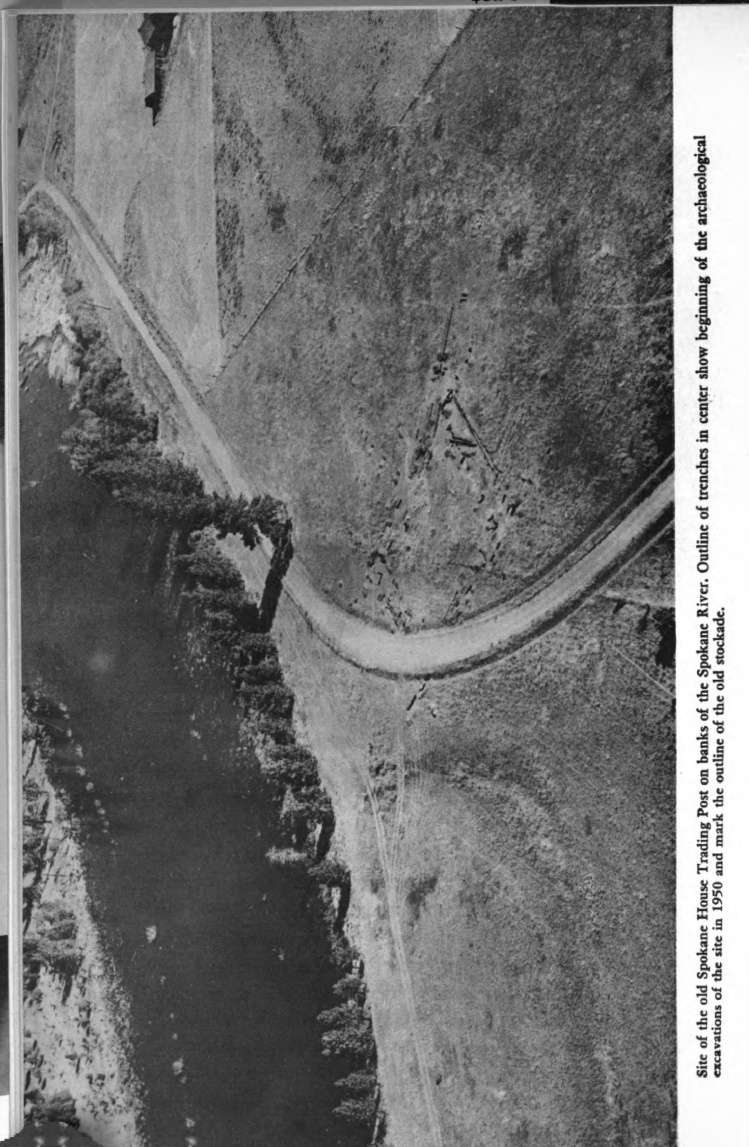
Today a tract of a hundred and twelve acres including the site of Spokane House is one of Washington’s state parks.{10} It is reached by a pleasant nine-mile drive along a highway bordering the northern edge of the scenic gorge of the Spokane River below the falls. Where a side road leaves the highway, a sign points to a meadow at the foot of a steep, wooded hill. Through the meadow the Little Spokane gurgles or rushes, in season. Not far from the bank of the stream stands a rapidly disintegrating log structure built in two sections with connecting roof, the logs held together by wooden pins. This is not a remnant of Spokane House but a crumbling farm building, the oldest in Spokane County, put up after the fur trade epoch. No trace remains of the old stockade or the warehouses and living quarters it once protected. But the sun shines and the birds sing and if the season is right the salmon trout still play in the clear water. It is a pleasant spot on which to pause and remember how, more than a century ago, two kindly Spokanes played the Good Samaritan to a famished red-head clerk, and to conjure up in imagination the hearty, rollicking life of Spokane’s first business center.