
CLOSE to where a little creek empties into the Spokane River some twenty-five miles downstream from the falls lies a small, crescent-shaped plain known to the Indians as “the place of springs.” To this spot on the 20th day of March, 1839, came a little cavalcade of two white men, their wives, a blue-eyed baby four months old, a cow to provide him with milk, and an escort of Spokane Indians headed by Chief Big Head.
The baby was Cyrus Hamlin Walker, the first boy of white parentage born west of the Rockies who lived to maturity. All the way from Waiilatpu, the Whitman mission near Walla Walla, Washington, tiny Cyrus had journeyed by horseback on a pillow held in the lap of his father, Elkanah Walker. It had been a perilous trip for so small a child. Once on the way the only shelter from a heavy rain had been a thorn bush beneath which Mary Richardson Walker had changed her baby’s rain-soaked garments while vainly trying to protect him from the downpour. Another day, after a twenty-mile ride, Mary found her child so cold his feet were “swollen like a puff” and his mouth so sore he fed with difficulty. Nevertheless, after fifteen days of hard riding and uncomfortable camping, the child, his parents, and their fellow missionaries, Reverend and Mrs. Cushing Eells, rode down a pine-clad hill to “the place of springs.”
Their faces alight with anticipation, the two white women gazed at the lovely little plain that was to be their home. Their husbands had been there before them. The preceding fall, they had erected, with the willing help of the Indians on whose land they were to dwell, a pair of log cabins some fourteen feet square. As yet the cabins were without roof, flooring, or fireplace; yet to the travelers from New England the cabins meant home, and to cheerful Mary Walker, they looked “quite comfortable.”
Mary was in the habit of keeping a diary.{12} It is still in existence and the entry for May 4th reads, “Commenced housekeeping.” There had been an interim during which the two women had stayed in Fort Colville at the invitation of Archibald McDonald, the Hudson’s Bay factor, until the cabins at Tshimakain could be made more livable. Fireplaces, roofs of boughs and mud, shelflike wall beds of rough boards on which could be placed ticks filled with grass or straw, a table made from boards laboriously packed from the Fort and laid on stakes set in the ground—such were the living quarters for two recent brides! It was Mrs. Eells who wrote home that for dining service each of the four adults had a tin dish, a knife, fork, spoon, and plate, just the meager outfit with which they had crossed the plains. While they had been guests at Waiilatpu and Mary plied her needle in preparation for approaching motherhood, she had kept her grandmother’s shears hanging beside the window. In a letter home, she hoped that “grandma’am has sent me her big puter platter as that would come without being broken.” The platter did arrive later, as well as a few other household treasures. But for the present the two brides did with what they had and settled down to housekeeping in the first civilized homes in the Spokane country presided over by white women.
Tshimakain lay at the northern apex of a triangular ‘Oregon mission” sponsored by the American Board of Commissioners for Foreign Missions, an organization representing the Congregational, Presbyterian, and Dutch Reformed churches. Waiilatpu, where the Eells and Walkers had sojourned temporarily after the long trek on horseback across the western plains and through the Rockies, was at the southern point of the triangle. At the eastern end was Lapwai on the Clearwater in Idaho, where Reverend Henry Harmon Spalding and his wife labored with the Nez Percé Indians. In everything but material equipment the Tshimakain station made an auspicious start. It was close to the well-traveled trail between Colville and Walla Walla, and was the home site of a friendly chief and his people, who for a number of months each year made camp there. From March to November a procession of related tribes crossed the little plain on their way between winter camps and the prairies where the indispensable camas grew, or to favorite locations for hunting and fishing. Stationed here at Tshimakain, the two men of the mission easily made contact with the nomadic groups as they passed through, or rode with them to their temporary camps. Or, while one rode, the other remained at home, teaching and preaching.
The immediate area was not important to the fur trade. Therefore, Scotch Presbyterian Factor McDonald regarded the coming of the two families with equanimity, and even went out of his way to offer hospitality and essential provisions. Mrs. McDonald and the American women got along famously. While at the Fort, Mary had written her husband approvingly of their “nearly white” hostess with her brood of nice-looking children. Mrs. McDonald, she added, was learning from her guests to prepare Yankee dishes “such as toast, custards, puddings, ginger bread and the like,” and, in return, joined her husband in piloting them to points of interest—the “shoots” of the Columbia (Kettle Falls); the Indian village adjoining the Fort, with its lodge for Christian worship.
Nevertheless, Elkanah Walker wrote the American Board cautioning, with Yankee perspicacity, against too much publicity for the Hudson’s Bay factor’s good deeds and generous attitude. It would be easy to make trouble for the well-intentioned Scotchman with his Company. The boundary line between the United States and Canada was unsettled, and the policy-makers of the Hudson’s Bay Company knew that the arrival of missionaries might well be the first step in an American colonization capable of tipping the balance favorably for the United States. It was well to be discreet.
Among McDonald’s kindnesses the year before the women came had been his advice on the location of the mission and his efforts to prepare the way for it with the Indians. Through his good offices Chief Big Head of the Spokanes agreed to assist in putting up buildings, cultivating the ground, and supplying fish; for the Spokanes had not forgotten the prosperity which had been theirs in the days of Spokane House and were happy to welcome white people again. It would give the tribe face among their neighbors; and perhaps with more knowledge of the white man’s methods and magic they themselves might become strong and prosperous. Quite possibly, for many these were more impelling motives than desire for the spiritual satisfactions of an alien religion. On the other hand, a number of the Indians had been impressed with the Christian religion as observed by both Protestants and Catholics connected with the fur trade and had had instruction in it from. Spokane Garry, a chief who as a young man had been educated in a Protestant mission school at Red River (Winnipeg).{13} Others may have been in touch with tribes farther east who had told them of “a religion better than theirs” taught by “Black Robes” and revealed in the white man’s “Book of Heaven.”{14}
Whatever the reasons for the Indian welcome, it was helpful. With the aid of an interpreter religious services were inaugurated at once, while a multitude of practical matters were being attended to. It was necessary to sow grain, put in a garden, build a barn, start raising cows and poultry. Elkanah Walker even had a vision of grinding his own wheat with a mill wheel to be installed at a favorable drop in the creek. It would obviate the necessity of carrying grain the long miles to Fort Colville or Waiilatpu.
The Flathead language must be mastered, the Spokanes being a tribe of the Flatheads. It would be difficult, for no one had ever compiled a Flathead dictionary, much less a grammar. Yet somehow whites and Indians must be able to communicate with each other, and, in spite of doubts on the part of the mission board, the Walkers, at least, were sure this meant their learning the Indian tongue rather than the reverse procedure. “To teach a rude and uncivilized people the language of a civilized and polished nation is unnatural,” wrote Elkanah. And practical Mary, who had served a brief term at schoolteaching before her marriage, echoed in her diary that she could not see it was “much better to come here and attempt to teach English than to go into Baldwin City and attempt to teach French; [so] we must acquire the language and make the hymns before they [the Indians] have any to sing.
Yet how find the time? Elkanah worried a good deal about the inroads of practical affairs on hours which should be given to study. But he was a hard student, and sitting with his Indian tutors made good progress in Flathead while learning a great deal about Indian mentality and keenness of wit. When he admonished Big Head that following the white man’s way of life and eating his food would aid materially in learning the white man’s words, the old chief listened respectfully, but his return advice was not without guile. Observing his white friend in difficulty with a Flathead word, Big Head sought his own matted locks with dirty fingers and extracted a small something which he proffered coaxingly. “Here,” he said, “you eat him; get Indian words no trouble.” Elkanah Walker was a sober-minded man, but he told this story with relish.
Without waiting for complete mastery of the language, both Walker and Eells went about the business of sowing the seeds of salvation among the Indians after the manner of Puritan New England, which traditionally emphasized education along with redemption. Classes for religious instruction were soon under way with what would have been gratifying attendance except for the constant coming and going of the Indians in search of food.
To supplement the religious work at the station, the men of the mission were soon undertaking arduous horseback journeys in all kinds of weather to preach and give instruction wherever the Indians were encamped. On these journeys they carefully observed and set down for their Board and for future generations the culture and habits of the Indians as well as their mental processes and religious practices. They also made sage observations on the economic resources and future development of the region. Walker, noting that there was “no want of water priveleges,” predicted a great manufacturing development and thought that commerce with the islands of the Pacific was more than a possibility. Climate and soil were, in his opinion, well adapted to herding. Great stands of timber suggested a profitable lumber industry. About agriculture he was less confident, in spite of the success of the little mission farm. Generally speaking, the soil was too dry.
Unlike the Catholic fathers, who in neighboring areas provided the Indians with a ritual of imaginative appeal and entered intimately into Indian life by adopting their ways, eating their food, and smoking with them about their campfires, the Protestant missionaries remained somewhat aloof, They did not encourage the Indians to camp in their immediate neighborhood at Tshimakain—probably a wise precaution from the standpoint of health and sanitation and the welfare of their families, yet open to misinterpretation. There was something of superiority and patronage in the missionary approach. To them the Indians were learners and probationers to be taught, admonished, and finally saved through the grace of God, did they but repent of their sins and abandon their heathen ways and traditional religious practices. Among the interpreters particularly helpful in the early years was Spokane Garry, who had started a school near the falls of the Spokane and engaged in missionary work on his own initiative some time before the arrival of the Tshimakain families. He read to his pupils from the Bible and he also put certain of them through the Minor Historical Catechism. As an interpreter, he was noted by Walker to be particularly proficient in picturing the agonies of the damned in the nether world.
So stern a gospel did not readily take. “These are truths which they hate,” wrote Walker to his Board. “The red gentleman dislikes as much to be told he has a wicked heart as does the white gentleman.” Nor was Walker without sympathy for the savage confronted with the problem of adjustment to a new way of life. Without question, it was important for the tribes to cease being nomads; but, “It is as hard and unnatural for them to lead a settled life as it would be for a New England farmer to change & lead a wandering life.” First they would have to be led to see that only as they became tillers of the soil would they be able to escape being wiped out. To teach them that was one of the important duties of the mission.
To teach anything it was important to have textbooks, and at Lapwai there was fortunately a printing press. It had come all the way from an American Board mission in Hawaii and was the very first press to be set up in the Northwest. On it had been printed in 1839 Nez Perces First Book, a primer. Transportation via pack train and a fall down a precipice had deprived the press of some of its type, but the little book served so useful a purpose among the Nez Percés that it fired the ambition of the Tshimakain group to produce books in Flathead, a language understood by the Spokanes. Elkanah Walker must have been justifiably proud when, on December 12, 1842, he returned from Lapwai with a primer for the Spokanes which Eeils and he had rendered in Flathead and for which he, a complete novice, had set the type. Mary found many misprints in the sixteen-page booklet, but thought it looked “pretty well,” and one evening she “stitched, pressed and binded” eight copies.
By the next spring her husband and Spokane Garry were progressing with a translation of the Ten Commandments, later printed at Lapwai. Walker also translated the first ten chapters of Matthew, the manuscript for which included a brief Spokane-English dictionary.{15}0 Hymns were written but never published. The Indians were fond of music and soon learned to sing sacred songs in place of some of the “profane” French ditties they had picked up from the fur traders. One such hymn was written by Cushing Eells, words and music. Eleven bars in length, slight in range, simplicity itself, the Indians loved it:
Thanks [to] Thee, Jehovah,
We not dead, we all alive,
We sing, we pray.{16}
For years this was sung by the Spokanes, and travelers heard it in other Indian camps as far away as the Rockies.
Effective educational work demanded a school building, and there was also need for a well-built church edifice in which services could be conducted more effectively than in the open air or a rude shelter. So it was that by 1844 work was under way on a building designed for both purposes. Here school was proudly opened on November 12 of the same year. The initial enrollment was only twelve, but what of that? Instruction heretofore given informally to groups or to loosely organized classes utilizing a blackboard blackened by a mixture of skim milk and soot could now be systematized and strengthened under a schoolhouse roof. As for the curriculum, it included not only religious instruction, but reading, spelling, arithmetic, and music.
While education and religion thus moved forward, food, shelter and clothing continued to demand a large share of missionary time. Most of the Indians, though good-natured and willing, were as unreliable as children when it came to carrying through a consistent program of farm work, building, or even household service. Mary’s diary contains an entry to which many a modern housewife will say a fervent “Amen.” The Indian girl who helped about the Walker home had taken French leave; but, wrote Mary, “Thus far I miss the trouble of the girl as much as the help. Felt this morning I could sing as heartily as any Methodist, ‘There’s better days a-coming, For I feel it in my soul.’”
From the start it was realized that long-continued dependence on the Hudson’s Bay Company for the bulk of mission supplies was impracticable, while Waiilatpu with its farm and mill was too far away. Moreover, as frequently urged by Walker, it would advantage both mission and Indians if the latter could be induced to take up agriculture and learn to live a settled existence. Since Walker himself was a farm lad before entering the ministry and since his wife was a practical-minded farm woman, it is no wonder that a good farm was soon in operation. Chickens clucked about the place to the amazement of the Indians who failed to see why anyone would bother with poultry raising when wild fowl a-plenty might be had for the shooting. Cows munched on the meadow grass and gave down milk which in Mary’s skillful hands became butter and cheese (in which deer rennet was utilized). A garden provided excellent vegetables, and the fields furnished grain for man and beast. These missionaries had indeed come “with a quart of wheat in one hand and a Bible in the other.”
While the farm was developing, housing was improved. It was alien to New England common sense to put up indefinitely with a roof of boughs and mud that leaked and fell in, or living space but fourteen feet square with Mother Earth for floor and deerskins for windowpanes. Health had to be considered, as also the demands of hospitality, even at the neglect of preaching and the expenditure of weeks of unremitting physical labor with unskilled Indian help. The Walker cabin was soon provided with an extra room. Some years later Mary wrote to the folks back in Maine that she and her family were now in their “rather livable” new house. Mrs. Eells also reported a new house when, after a disastrous fire, the Eells home was rebuilt. It is to be regretted that no pictures exist showing the interior of Mary’s “livable” house, for apparently it resembled in many ways a modern rustic home. It boasted a living room, dining room, kitchen, “buttery,” cellar, attic chamber, two fireplaces for heat and a third for cooking, and the luxury of two bedrooms—all whitewashed or painted and having real glass in the windows. Hawaiian tapa cloth and Indian mats graced the walls of both houses. Bookshelves in the Walker home held a number of volumes on natural science as well as a complete Shakespeare and other classic titles. While most of the furniture was home-made and home-painted, a few cherished household treasures which had finally come round the Horn and up the Columbia provided, in what Mary called their “wilderness,” a breath of faraway New England. It is small wonder that homesick visiting gentlemen left Tshimakain with reluctance after inscribing in Mary’s autograph album heartfelt expressions of gratitude and praise for all that these pioneer homes represented.
Even as attention had to be given to housing, so it must be given to clothing. “That’s just like Mary Richardson—riding off across the plains on a wild buffalo!” had exclaimed an outraged Maine neighbor on the eve of Mary’s departure. And though Mary may have worn the buckskin breeches prescribed by a member of the caravan to prevent chafing from the long horseback ride, there is no doubt that plenty of petticoats and a flowing skirt descended in seemly fullness from her waist as she sat her side saddle. No matter how primitive the conditions, it was not in the tradition of Protestant missions for wives to disregard a proper refinement of dress, nor for children to go about clad like little savages. “A lady should have [a] good green merino or pongee dress, a strong cloak, and a loose calico dress to wear when she does not want her cloak,” wrote Mrs. Eells in a letter describing the proper wardrobe for a respectable female crossing the plains. Mary had the pongee, for she records making it over, and her delaine too, while stopping at Waiilatpu on the way to Tshimakain. She had also spent long hours with her needle contriving dainty garments for her first-born. On visits to Colville, for visits between that place and Tshimakain soon became established custom, she and Mrs. Eells scanned with interest the more than year-old fashions in equally old newssheets; and, with an eye to making up or making over, gaily unwrapped the bundles of clothing and yard goods that came from the outside world. So successful were they in these enterprises that visitors seldom forgot to report on the nearness and tasteful refinement of clothing worn by these ladies of the wild.
At Tshimakain it was literally true that “while Adam delved...Eve span.” If a cart was needed, the men made the wheels by hand. A homemade plow was put together by Walker. For neither Walker nor Eells was it unusual to cover the long miles to Fort Colville on horseback bearing wheat to mill and returning with flour, supplies, and precious packets of often long-delayed mail brought up the Columbia by the fur brigades.
The small details of hard manual labor which fell to the lot of the women come from Mary’s diary. Of the two women, she was the more robust. So to the daily round of cooking, mending, and keeping clean—Mary had a passion for cleanliness—and the frequent bearing of children she added a multitude of chores. As a girl on the Maine farm she had found “cleaning tripe” at butchering time the height of drudgery. “Surely,” she had exploded in her diary, “I was meant for nobler work than this.” But at Tshimakain, as Ruth Karr McKee has so sympathetically brought out in editing the diary,{17} “cleaning tripe” as represented by dirty, heavy, frequently disagreeable and “unwomanly” tasks filled a large share of her waking hours. In the absence of the menfolk, she mended chimney, windows, and hearth, and her tub when it fell apart; she helped with milking and the care of livestock or took entire charge when necessary. With fingers raw from heavy work she corded her own bedstead and picked over feathers for the indispensable feather bed. She raised tomatoes and peas, made soap and dipped candles, laid brick. When there was sickness in either home or in the Indian village she did double duty as doctor and nurse, usually with success except in cases where the Indian medicine men interfered. Elkanah got “nitre and Ipecac” on the inside of a sore throat, pepper and vinegar on the outside, and at night a hot rock at throat and feet—and made an excellent recovery. On occasion, Mary could be her own obstetrician, though Dr. Whitman came when he could. The entries in the diary covering such events are laconic:
Rose about five. Had early breakfast. Got my housework done about nine. Baked six loaves of bread. Made a kettle of mush and have now a suet pudding and beef boiling. My girl has ironed and I have managed to put my clothes away and set my house in order. May the merciful be with me through the unexpected scene. Nine o’clock P.M. was delivered of another son.{18}
This was her third child, and three more were to arrive before she left Tshimakain. Four days after the “blessed event” thus recorded, Mary Walker was dressed and sitting up; and two months later, babe in arms and a cow accompanying the little cavalcade to provide milk for the children, she was on her way horseback to the annual mission meeting at Waiilatpu.
Fully to appreciate such exploits it must be borne in mind that both Mary Walker and Mrs. Eells were cultured, well-educated women. The latter had graduated from a female seminary at Weathersfield, Connecticut, and Mary had managed to attend classes without formal credit at Maine Wesleyan Seminary, Kent’s. Hill, presumably reserved for men only. The results had been highly satisfactory. Concerning her accomplishments, Professor Merritt Caldwell of the Seminary had written the mission board that “To an apparent firmness of physical condition...there is added...a very vigorous intellect.” He also wrote approvingly of Mary’s literary ability, and mentioned her “correct knowledge of several solid branches of learning,” including Natural History, Chemistry, Botany, Mental Philosophy, and some knowledge of Mathematics, French, and Spanish. Of these, science and literature were easily her favorites. Riding the long miles of the Oregon trail she had written home how much the way was shortened by the company of plants and minerals; and as a sojourner in a far land she proved to be a keen observer. Into her diary, and later in long letters to that same Professor Caldwell went the names of new plants and flowers, notes on geological formations, and delighted observations on the natural wonders of the West. She even made of herself a taxidermist and found time in her busy days to mount the strange birds and small animals encountered roundabout the mission station. Sometimes her enthusiasm for the beauty that met her eyes found expression in verse. But verse was not Mary’s forte. She was at her best in letter writing and the composition of reports. It is probable she prepared for Elkanah’s copying most of the highly informative reports he sent to the mission board.
No wonder that Mary Walker was at times decidedly vexed at the frank and constant admonitions of missionary husbands to the effect that keeping house and looking after the physical comfort and welfare of spouse and children marked the boundaries of proper female activity. Praying in public in the presence of men was unseemly, engaging in formal educational work with the Indians open to question. Elkanah even objected to the avidity with which Mary took to reading in her few hours, though The Christian Mirror, Andrew Fuller’s Memoirs, and Frances Trollope’s Domestic Manners of the Americans—the last “disgustingly interesting” as the diary frankly records—would seem to be innocent enough, even if read on a Sunday. Mary was a very human young woman trying hard to be a proper wife and saint, and sometimes she gave up and “had a good bawl.” This cleared the atmosphere and sent her briskly back to the daily grind—and to her never-relenting efforts at further education for herself, her rapidly growing family, and the Indian women whom she taught to sew, to cook, and to keep clean, though without much success in the last-named area.
Out of experience Mary came to the wise conclusion that teaching by example was more effective than teaching by precept. There was no difficulty at all about the former, since the Indians were totally lacking in any regard for privacy and constantly stood about watching what went on inside and outside the missionary homes. The bathing and dressing of small Cyrus while a row of eyes peered between chinks in the logs was an everyday occurrence which Mary hoped might be an object lesson. When she set out the suds left over from the family wash and saw how it was pounced upon by the waiting squaws for purposes of bodily cleanliness she prayed it might be an incentive to more hygienic living. Someday, perhaps, they would ask how to make the magic something that foamed with cleansing whiteness in her tub and then how gladly she would introduce them to the art of soap-making with grease and ashes!
While the almost continuous presence of uninvited Indian guests made for friendliness and broke the loneliness of isolated existence for the missionary women left for long periods without the companionship of even their husbands, the coming of a white visitor was a welcome event. At first guests came chiefly from Fort Colville or from Waiilatpu, as when much-traveled Dr. Whitman arrived on mission business or to exercise his medical skill, often badly needed. From the Fort, as long as they were stationed there, came the McDonalds somehow to be squeezed into the narrow confines of the missionary homes. It was not according to New England ideas of hospitality to put up guests for the night without sheets, pillows, or quilts, to say nothing of bedsteads; but Mary and Mrs. Eells soon learned that such niceties were not expected. Visitors brought their own bedding of skins and blankets and stretched out where there was room. Four walls and a roof to keep out storm and cold were luxuries enough.
As time went on and news of the mission spread, guests increased in number, many drifting in without warning, others coming according to plan. In the latter group were members of the missions at Waiilatpu and Lapwai who came for consultation or for the annual meeting. Somehow they were tucked in; and if the party included women there might be a meeting of the Columbia Maternal Association, the first women’s club west of the Rocky Mountains and, according to a survey made by today’s General Federation of Women’s Clubs, the second in point of time in the United States.{19} Organized at Waiilatpu on a fall day in 1838 when Mary Walker was first there, it had just enough members to fill essential offices, and two left over. The faded pages of the original minutes, constitution, and by-laws of this unique organization devoted to perpetuating in the Pacific Northwest the culture and spiritual flavor of home life in New England are preserved in the archives of Whitman College in Walla Walla. They reveal that meetings were to be held on the second and last Wednesdays of each month, at which time papers on the proper bringing up and religious education of children were to be read. Since the members would soon reside a hundred or more miles apart, those not able to attend were to engage in prayer, meditation, and reading on these dates, receiving the papers later as circulating letters. It soon developed that the personnel of the organization was not unlike that of a modern club. “Have you written to Mrs. A. T. Smith upon the subject of writing on a subject for our Maternal meeting?” queries Mrs. Whitman of Mrs. Walker in 1842. “I hear she feels herself somewhat neglected as all the other members have been written to about it.”
The world at large and the United States in particular was waking up to the importance of the “Oregon country” during the years when the Eells and the Walkers lived at Tshimakain. Before they left, “Fifty-four forty or fight” had become an American slogan in the boundary dispute between the United States and Great Britain. Explorers, scientists, artists and occasional hardy immigrants found their way through forest and mountain pass and over the rolling Palouse into the upper reaches of what is now known as the Inland Empire,{20} and not a few looked in at “the place of springs.”
One day, just as Mary Walker was finishing her evening chores in the absence of her husband and getting her children to bed, two important visitors arrived—members of the Wilkes Exploring Expedition sent out by the United States Government. Lieutenant Robert E. Johnson and Mr. Henry Maxwell had left the main party at the mouth of the Spokane River in mid-afternoon of that June day in 1841 and had covered thirty-five miles on horseback to make a call. That they did ample justice to the impromptu meal Mary and Mrs. Eells set before them may be taken for granted, nor is it hard to imagine that the talk extended far into the night. For Mary, the scientific chatter was “manna to a fainting soul,” and she contributed to the occasion by turning over to her guests a specimen of soda and several minerals she had collected.
The visitors left in the morning, but Lieutenant Johnson and his immediate party returned a few days later, catching Mary at her milking as they came in. Her chagrin must have been at least somewhat mitigated by the gallant assertion of one of the men that “the most pleasant sight he had seen in Oregon was a lady milking her cows.”
This time the men of the mission were at home to share their knowledge of the country and its inhabitants with the members of the expedition. Meantime, the ladies busied themselves as good housewives should. Nevertheless, they probably managed to have their say, and from the nature of the gracious notes left in Mary’s memory book by the departing scientists there is room to believe she played a prominent role—though of course not too obviously, or even consciously. With men of science Elkanah Walker’s wife was not only at her ease, but at her best.
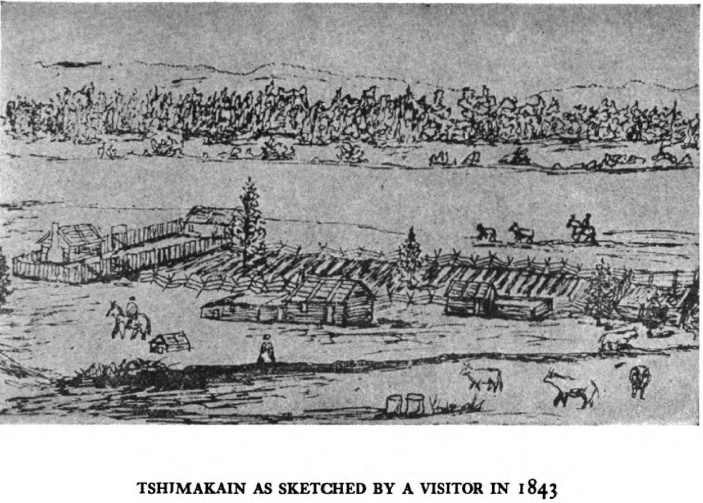
One day a German botanist appeared. For the entire winter of 1843-44 Karl Andreas Geyer made the Walker home in Tshimakain his headquarters. In the end he wore out his welcome and had to be sent on his way; not, however, without making of his hostess an enthusiastic collector for whom the pressing of plants for her herbarium became a lasting hobby. The fulsome entry left in her autograph album by this pioneer botanist of the Northwest had the proportions of a philosophical essay and included a short poem inscribed in English, German, and Bohemian—whether as a compliment to Mary’s linguistic ability or a display of his own it is hard to say. Of even greater interest today is his sketch of Tshimakain, in which cows and Indians on horseback vie for interest with a stake-and-rider fence and the five or six log structures that made up the little settlement. (See illustration facing p. 32.)
Two more accomplished artists were entertained at the mission in 1847. Paul Kane, a Canadian was set down by Mary as a “clever but ungodly man without much learning”; he did, however, give her considerable information about birds. The other painter was Paul Mix Stanley, who appears to have done chiefly Indian portraits, later unfortunately destroyed by a fire in the Smithsonian Institution in Washington. Delayed at the mission by rain, he busied himself with a portrait of the Walker’s little daughter, Abigail. Before the likeness was finished, poor Abigail came down with the measles, but the kindly man of the brush returned to complete one of the earliest, if not the very earliest, extant portrait of a white person painted in the Northwest—a serious-faced little girl in a blue merino dress. There is also a portrait of Elkanah done by the same artist and pronounced by the subject very good. Residents of the Spokane country do well to remember Tshimakain as the repository of its first civilized art as well as the location of its first American homes and center of scientific learning.
Among the names inscribed in Mary’s album was that of Peter Skene Ogden, a distinguished member of the fur trade who became a real friend. Then there was the leader of a Canadian immigrant band one hundred and twenty-five strong bound for the Cowlitz. “Thus we see that Oregon is fast filling up,” reads Mary’s diary. A Catholic priest who had arrived in 1840 with Factor McDonald was entertained hospitably. While the Tshimakain missionaries might heartily believe in and as heartily preach a conventional and uncompromising Protestant gospel, they were more tolerant toward those of other faiths than some of their confreres and far from being unmindful of the demands of hospitality. The conversion of Factor McDonald to Catholicism failed in any way to disrupt cordial relationships; and although occasional visits to the Spokanes by Catholic missionaries with their differing religious practice tended to impede the work at Tshimakain by confusing the Indians, the missionaries there could still in 1843 write a newly appointed Indian agent that in the end the red men must be left to judge for themselves whose course, Protestant or Catholic, “was most consistent with the word of God and propriety.”{21}
From the standpoint of evangelism the Tshimakain mission had been discouraging from the start. It was not enough to have been good neighbors, to have established lasting friendship, and to have taught the Indians by precept and example how to adjust themselves to ways of life consistent with the white civilization sure to overtake them. According to the stern religious standards to which the missionaries subscribed, failure was written large over the entire enterprise. After nine years, not an Indian had been “converted” or deemed sufficiently regenerate to receive the rite of baptism and be admitted to church membership.
Yet over the years Tshimakain had become to the Eells and the Walkers a beloved spot. Children shouted and played in the sun, or, gathered around the Walker table, “made a little party in the dining room by themselves.” Tomatoes grew in the garden, young apple trees sent from Waiilatpu by Dr. Whitman put out sturdy branches, woodbine reminiscent of New England was beginning to climb the rough log walls. Someday white immigration would cease to bypass the northeastern portion of what is now Washington. Granted disappointing results where the Indians were concerned, should not representatives of the Protestant church be on hand to guide and inspire the immigrants when they came? The missionaries at Tshimakain were sure they should be. They were such representatives, they had their homes, they were practically self-supporting. Why not stay?
Others of the tripartite mission wondered whether service to white settlers had not best be concentrated for the present at points where such settlers were already fairly numerous. Growing difficulties and dangers were pointed out. The Indians were definitely alarmed and resentful about white immigration. With superior weapons the newcomers were depleting the land of game. They settled here, there, and everywhere, without so much as a “by your leave.” The resultant Indian unrest created a most dangerous situation for whites as isolated as those at Tshimakain.
Actually, resentment among the Indians was keener around Waiilatpu than at Tshimakain, partly because the former was so close to the Oregon trail and lay in such a fertile valley that settlers were more numerous. Nevertheless, the families at Tshimakain were not lacking in awareness of Indian unrest. Old Big Chief was often sullen and uncooperative. Sometimes there was thieving. Spokane Garry had ceased to be of much use. He said his tribesmen made fun of him for imitating the whites, and that was hard to take in view of the sensitiveness of the Spokanes to ridicule. Most dangerous of all was the resentment of the medicine men over the intrusion of the missionaries into the precincts of Indian magic and healing. Did not they, the medicine men, bring the salmon up the river and make the snow fall deeply so that deer might the more readily be overtaken? Did they not restore the sick to health with their incantations and dances? The last was an extremely touchy point, and the one at which the missionaries probably most seriously offended. When Mary Walker found an Indian woman ill, she administered simple remedies and gave advice. In common humanity she could do no less. But it was dangerous practice. It raised the ire of the Indian healers and put Mary’s life in jeopardy, for the traditional penalty for failure in an effort to cure the sick was death to the would-be healer.
One spring night in 1847 a letter arrived at Tshimakain from Dr. Whitman. The American Board was negotiating for the Methodist mission at The Dalles, a strategic location on the Oregon trail. If the negotiations were successful, would it not be well to abandon Tshimakain? Much good might have been done there, but did not the region farther south offer the greater opportunity for the present? Why should not the Walkers go to The Dalles, and the Eells remove also?
It was late when this completely upsetting message was received. There was little sleep for the adults at Tshimakain that night. To leave or not to leave? Pro and con went the discussion, then and later. It continued until the annual meeting of the missionary group in June.
Neither Walker nor Eells wished to make the change, and, after Walker made an exploratory trip southward of some six hundred miles on horseback, both men decided they would not leave. They had spent long years in mastering the language of the Spokane Indians and learning their ways of living and thinking. There was still hope for their salvation. They were personally friendly. What if at times many were childishly annoying and uncooperative? Patience and kindliness might yet bring results. A reason for staying, perhaps not too openly urged, had to do with finance. The annual stipend of $300 for each of the mission families was totally inadequate to support them; but provided, as at Tshimakain, with good homes and an excellent farm, they could get along.
Perhaps it was Mary Walker who in the end cast the deciding vote. Ordinarily she was ready for any contingency, no matter how difficult or at what personal inconvenience. This time it was different. She was a mother, and she was again with child. She announced firmly that to make the proposed move would imperil her life. What would happen to her flock of little ones if she were to be taken from them? The Eells and the Walkers decided to stay.
Life went on peacefully. In the last days of November the artist Stanley completed his portrait of Abigail and went on his way to Waiilatpu. On December 6 the Eells and Walker children were having a glorious frolic indoors at the Walker home, riding stools as their fathers rode horses. The fun was at its height when an Indian messenger arrived. Such postmen always created a sensation. Play stopped abruptly and all gathered around Elkanah Walker to hear the news. As he glanced over the message even the children were frightened at the whiteness of his face. He read aloud, his voice shaking. Dr. and Mrs. Whitman had been murdered at Waiilatpu by the Cayuse Indians. So had other members of the mission. An accompanying letter from Stanley, who had just missed arriving at Waiilatpu during the massacre, reported that at that moment the murderous band might be on their way to Lapwai to continue their butchery. They might also proceed to The Dalles. Dr. Whitman had been attending the Indians during the current epidemic of measles and some of them had died. Perhaps the surviving Indians thought the white medicine man had used poison. The letter did not say so, but the families at Tshimakain knew that Dr. Whitman might only have paid the medicine man’s traditional penalty for failure to cure.
What to do? Go, or stay? Where could they go? If they stayed, what would the Spokanes do—remain loyal to their white teachers or turn against them? A day of fasting was decided upon, and Elkanah wrote to John Lee Lewes, the factor at Colville who had succeeded McDonald. Lewes’s reply was an urgent invitation to the two families to move to the Fort.
It was the Spokanes who decided the matter. They were consumed with anger, both at what the Cayuses had done and at the very idea of removal. Were not the missionaries their friends, come by their invitation, and therefore to be protected? Let the Cayuses try to get at the whites at Tshimakain! They would do so over the dead bodies of the Spokanes. Did the missionaries think they were cowards?
The missionaries did not. They decided to stay.
Slowly the days dragged by, filled with rumor and devoid of further authentic news. Christmas came and went, and on the last day of the year John Richardson Walker first saw the light of day. He was the Walker’s sixth child. It was the twentieth of January before another express arrived from Fort Walla Walla, the trading post seven miles from Waiilatpu. It included a letter from Spalding, successfully escaped from Lapwai, urging secret and speedy departure to Colville. When its contents were made known to Chief Big Head he would have nothing to do with the idea. Were he and his people to be made the laughing stock of all the neighboring tribes? A people too frightened or too mean to protect their friends?
Again the missionaries stayed on, even when a crafty half-breed Cayuse visited the Spokanes to spread false rumors and stir up trouble. He had fled Waiilatpu at the approach of American soldiers and wanted the northern tribe to join the Cayuses against all Americans. His arguments were of no avail. The Spokanes stood firm.
By March the worst was over. An American military expedition had won a small victory over the Cayuses, impressing the Spokanes by the ability of the white men to triumph over an enemy whose fierceness the Spokanes themselves had good reason to respect. Nevertheless, the missionaries decided the only prudent thing to do was to abandon Tshimakain, at least for the present. So, lacking only five days of nine years since Mary Walker had ridden into “the place of springs” with her three months’ old babe, she packed the little leather trunk with which she had crossed the plains and rode out, again with a small infant to care for. Painfully she said good-by, her heart like lead. The men might talk of returning, but she knew in her heart it was the end.
It was the end. After a few days at Fort Colville the men went back to do their spring plowing, and again in April to plant and sow. It was a brave but fruitless gesture. When a detachment of American troops arrived from the lower country, to convoy the mission families down the Columbia to the comparative safety of the Willamette valley there was nothing to do but go with them. The disconsolate Indians were promised that if ever it became possible their white friends would return. A few domestic utensils of slight value were distributed as keepsakes, and the missionaries rode away. Factor Lewes at Colville took over the mission livestock and arranged to have such belongings as could not be transported by pack animal sent down river by boat. So it was that the portrait of a little girl in blue found its way to Oregon along with a handful of other treasures brought from faraway Maine or painfully produced at Tshimakain. Left behind were the neatly whitewashed houses, fences, and barns, the fields of growing grain, the school, and a sorrowing Indian village.
The Walker children grew up in the Willamette valley, where Mary, confronted with a “new-fangled” cookstove in lieu of a fireplace, wondered if she would “ever be able to cook anything in it,” and Elkanah, practically penniless and with a large family to support, began again from scratch.{22}
Meantime the Spokanes hopefully awaited the return of their teachers. Not stopping at that, they sent members of the tribe down the Columbia to urge it. After three years, Walker did make a journey up the river. The United States Government needed his services as interpreter and offered to make him Indian agent at a salary of $750 per year. He knew the Spokanes would not fail to welcome him; and though at The Dalles he learned from Chief Big Head that Mary’s beloved “new house” was in ashes, the Eells home was still intact and whoever came could live in that. But the country roundabout still lacked any considerable number of settlers. There were no schools, and he and Mary were concerned for the education of their children. The Cayuse Indians continued definitely hostile. At Tshimakain a white family would now be more than ever cut off from civilization. To return did not make sense. Regretfully, Elkanah Walker had again to turn his back on the north country.
More years rolled by. Washington Territory came into existence and in 1853 its first governor headed an exploring party, some members of which passed through “Chemakane Mission.” Among them was the artist Stanley who had missed being murdered at Waiilatpu with the Whitmans by staying over with the Walkers to finish a little girl’s portrait. The sketch which he now made of the abandoned farm shows most of the buildings still standing; and Governor Stevens in his report noted not only that Walker had been an excellent farmer, but that among the Indians his name “is now mentioned with great respect.”
With respect, yes. But for farming, the Spokanes as a tribe had no great love. Some of them cultivated tentative patches, and a few had become excellent agriculturalists; for the majority, plowing a field or caring for cows and chickens still went against the grain. Why bother with wheat and milk and eggs when salmon, camas, and grain furnished sustenance for man, and the horses which bore the braves on their hunting and fishing expeditions waxed strong on the waving bunch-grass?
Nor had civilization made much headway amongst the tribe in the continued absence of their teachers, though friendship remained, and respect for the white man’s religion in so far as it was understood. When, in the later fifties, Washington Territory east of the Cascades flamed into Indian war, chiefs Big Star and Garry argued long and hard against participation in the strife fomented by the Yakimas, Coeur d’Alenes, and others, and urged by their own young men. Unfortunately, the efforts of their older chiefs failed to deter many of the tribe from joining in a campaign in which they suffered a disastrous defeat. The Spokanes returned to their villages a broken people who had watched the summary punishment meted out to certain of their leaders and the destruction of some eight hundred of their horses by the forces of Colonel George Wright.{23} Visiting them in 1862 and later, Cushing Eells found scattered groups holding services in which they sang the songs of missionary days and listened to the exhortations of Spokane Garry. Catholic missions at Peone Prairie, just out of Spokane, and in the Coeur d’Alenes and at Colville were drawing many Indians into the Catholic fold, but for the Spokanes the religion of the “black robes” had little appeal. In 1873 Spalding came to Tshimakain from Lapwai to baptize over two hundred adults and eighty-one children of Spokane Garry’s flock, and Cushing Eells, returning with his family to spend his later years in his beloved Inland Empire, not infrequently found members of the tribe among his white congregation. Also, as he moved about, he frequently came upon them holding Christian services of their own to which he was joyously welcomed.
When homesteaders finally found their way to “the place of springs” and the country roundabout, the Spokanes had not even a reservation to which they might retire. They became not only a broken but a scattered and homeless people, forgotten for years by a negligent Great Father in Washington.
Meantime, bells began to peal from the New England steeples of hopeful little Congregational churches throughout the Inland Empire. Cushing Eells was never satisfied to settle down for long as pastor of one flock. His feet in the stirrups, his saddlebags for pillow at night, and his purse frequently empty, he rode the bunchgrass hills and fertile valleys for years, meeting with the scattered Indians, preaching to the settlers, organizing churches, and somehow managing to present many a band of the faithful with a sweet-toned bell when a house of worship was achieved. To all he became known as “Father” Eells. For a few years he served as county superintendent of schools in Whitman County. But church bells and teachers’ certificates were not the only mementoes left behind when in 1893 he passed away. Best known of all is the Inland Empire’s oldest liberal arts college. On a visit to Waiilatpu not long after the massacre there, this indefatigable New Englander had resolved upon the organization in Walla Walla of Whitman Academy, later to become Whitman College.
As for Tshimakain, it is today plain Walker’s Prairie with only a monument by the roadside near the village of Ford to mark the locality where two American missionaries with their wives established the first civilized homes in the Spokane country among as childlike and peaceable a group of Indians as ever inhabited a western valley.