
ONE DAY in 1883 a man by the name of Andrew J. Pritchard walked into the office of The Spokane Falls Review and threw on editor Dallam’s desk a buckskin poke, filled, according to the editor, with gold nuggets as big as peas and flat discs as big as the inside of one’s palm. These, Pritchard said, were samples of free gold which he had taken from a creek in the Coeur d’Alene mountains in Shoshone County, Idaho.
There had been previous discoveries in Shoshone County. In 1860, E. D. Pierce had found gold near its southern end where a mining settlement named for him had flourished for a time thereafter. It was rumored that precious metal had also been found farther north. Pritchard himself had been in and out of Spokane Falls since 1879 between prospecting trips in the Coeur d’Alene section of the Bitterroot range. The results of these trips he had kept pretty much to himself, save for letters to friends known as Free Thinkers belonging to an organization called the Liberal League. With them he hoped to start colonies on streams where he had found encouraging evidences of gold. In line with this plan, he had called his first lead{78} on the South Fork of the Coeur d’Alene River “Evolution.” The nuggets laid on Dallam’s desk were, however, from a creek tributary to the North Fork soon to be known as Pritchard’s Creek.
Unfortunately for the colony plan, the news in Pritchard’s letters to members of Liberal Leagues in the Rockies and elsewhere had leaked out. The Rathdrum Courier had carried it; and when copies of The Spokane Falls Review headlining Pritchard’s discoveries on the North Fork found their way to places as far distant as Saint Paul, Denver, and Salt Lake City, hordes of miners, prospectors, and adventurers headed for the Coeur d’Alenes. Extravagant claims in a circular issued during the summer by the Northern Pacific added to the stampede. From Oregon and California and from all over Washington Territory gold seekers and camp followers arrived by rail, boat, stage, cayuse, or on foot. From Montana and points farther east they poured in via the Northern Pacific to Thompson Falls, then on foot over the Bitterroots. They panned and rocked the mountain streams, staked new claims and jumped those of Liberal Leaguers already on the ground anxiously attempting to hold claims for members not yet arrived.
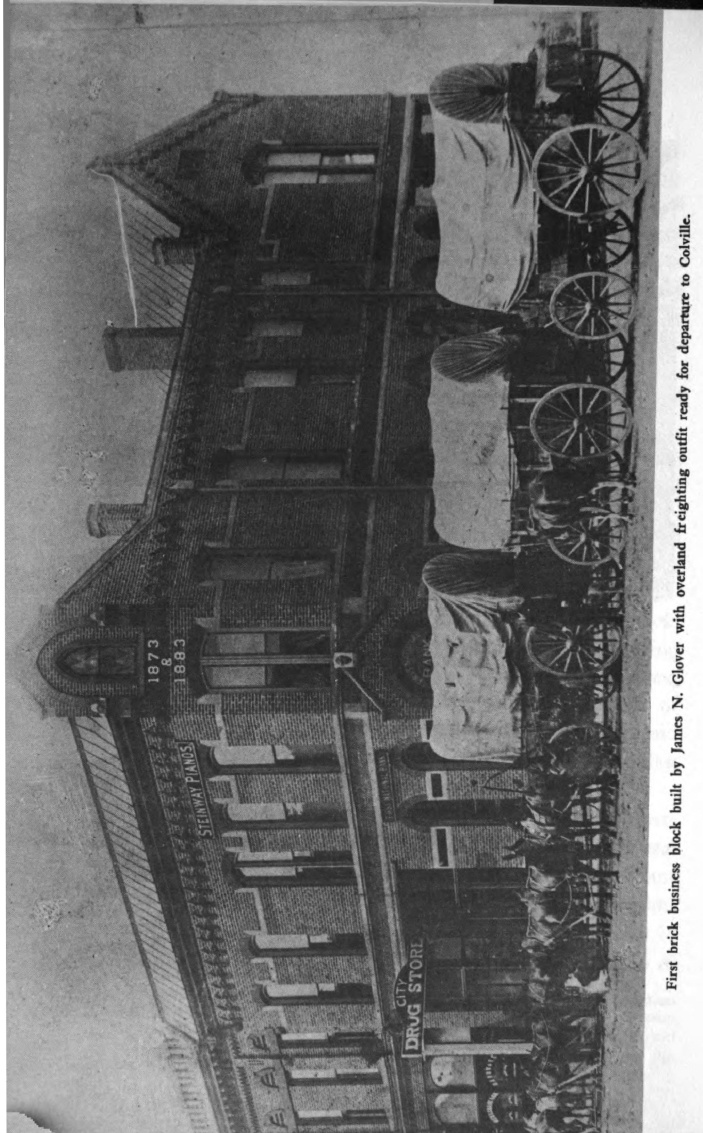
Almost overnight Spokane Falls became an outfitting point. Business boomed as it had never boomed before. Stores could not get supplies fast enough. The “corral” of the California House was filled nightly, and hostelries of every description invited with crude signs.
By the winter of 1883, a stage line from Spokane Falls, operated in competition with one from Rathdrum, was transporting passengers to the town of Coeur d’Alene whence they were carried by steamer up Coeur d’Alene lake and river to Kingston, not far from where still stands near Cataldo the old church of the Sacred Heart.{79} Met at Kingston by a train of horses, they mounted saddle and rode three miles to the Mullan Road, along which they continued over the divide to Eagle City, the first town in the placer area. There city lots had been laid out in four feet of snow, and gold rush conditions de rigueur prevailed: tent hostelries and shacks flanked by snowbanks; exhorbitant prices, such as flour at a dollar a pound and bacon at the then outrageous figure of sixty to eighty cents; plenty of “rotgut” and better brands of hard liquor; parlor-house girls with whom to dance, and other females of more dubious virtue with whom to consort; the usual assortment of card sharks.
Because of the snow, little could be done in the way of prospecting or mining until spring. So the owners of shovel and pan gambled away everything they owned except those two implements and the clothes on their backs, bought grub “on tick,” slept in their blankets in canvas pens, and watched for letters brought in pickaback at twenty-five cents apiece. Meantime the businessmen of Eagle City prospered, as did a similar group in neighboring Murray, another camp. Packers, merchants, traders, promoters, and proprietors of saloons and dance halls laid the foundations for fortunes which later greatly enhanced the material wealth of Spokane. Among them were “Dutch Jake”. Goetz (nobody ever called him Jacob), saloonkeeper, and Jim Wardner, plenipotentiary extraordinary of high finance.
Jim hailed from Milwaukee, Wisconsin. Although too much of a gadabout ever to be numbered among Spokane’s permanent citizens, he belongs in its story because many of his exploits as set forth in his far from modest autobiography{80} were based in Spokane and have become a part of its financial folklore. “If there was anything,” wrote a sprightly woman who knew him, “from a pack train to gold-bearing tradewinds that Jim Wardner did not attempt to handle...it was because he never heard of it or could not imagine it.”{81} The popular saying was chat his wildcat operations included a black-cat ranch on which he made money from the sale of fur.
It was in New Orleans where Jim was selling butterine for a Chicago firm that news of the Pritchard discoveries came to him like “a magnetic needle which pointed...the way to a quick fortune and marvelous experiences.” Shortly before this, he made a small fortune in the Black Hills by buying “most of the eggs in southeastern South Dakota and northwestern Iowa”—understatement was never one of Jim’s shortcomings—at four dollars and fifty cents a dozen and selling them for fifteen dollars. However, this, to Jim’s mind, was simply pin money compared to the deal he now envisioned in Idaho. Wiring his Chicago firm to put aside forthwith two hundred packages of butterine for the Coeur d’Alene mining trade, he boarded the first train north. In Chicago, he billed the two hundred oleaginous packages to Thompson Falls in Montana, and kissing his wife a hasty good-by took train for the Far West himself.
This was the early spring of 1883. At Thompson Falls, Wardner heard that Eagle City and Murray were the focal points of “the wide-eyed stampede to reach the new diggings.” The trail to Murray, the men told him, was twenty-five miles up and fifteen down, with snow too deep for pack animals. With the coming of summer his two hundred packages of substitute butter would be oil. Besides, Jim was in a hurry. Nobody could tell where or when a new strike might strip Murray of its population as some said had already happened to Eagle City. Jim had a toboggan built, and for two months hauled butterine up the twenty-five miles by hand and then coasted the remaining fifteen miles into camp, where the price of a pound of butterine reached heights to make the eyes of a present-day grocer bulge.
Whether it was the disappearance of natural refrigeration in the form of snow or Jim’s perpetual urge to try something new that pushed him out of the butterine business is immaterial. At all events, early summer found him freighting at twenty-five cents per pound Thompson Falls to Murray. He had abandoned his toboggan for a dog team, soon supplemented by forty mules.
With the wealth flowing from his fling at the transportation business, Jim helped to organize the Potoxsi Ditch Company, to carry water to rich new diggings. This also proved profitable. Nevertheless, two years after his arrival in the Coeur d’Alenes, Jim was seized with an irresistible nostalgia. He longed for wife and family, the peace and slow motion of his own Milwaukee, its beer and skittles. Why stay longer in the rough and ready West? He was a rich man, he could do what he pleased. He would settle down with the family who had too long endured his fly-about career. In Bill Guse’s saloon, Jim said a few sentimental good-bys mixed with plenty of whiskey, and hit the trail for the outside world.
While leaning temporarily against a lamp post to recover his equilibrium, Jim met a “mud-spattered man on a blown and foam-flecked horse.” Jim was not too addled to grasp the implications of the news brought by this courier, a man he knew to be thoroughly reliable. Over on the South Fork of the Coeur d’Alene River a strike had been made by a prospector known as Kellogg, a strike not of placer gold, but of silver, “outcroppings of the greatest blowout of argentiferous galena ever known,” to quote Jim’s own panegyrics. Back to Bill Guse’s saloon the two men hurried, Jim’s nostalgia vanishing like a cloud on a sunlit day. Over a full bottle, he soon obtained from the courier directions to the new diggings: “Follow trail to the Mullan Road. Turn left. Six miles along, look for big blazes on tree to the right. Leave horse there and hoof it two miles up creek.”
Warmed and fortified by the whiskey under his belt and armed with two extra bottles in his blankets, Jim mounted bronco Baldy, “the best all-round trail hitter” he ever owned. In due time he arrived at journey’s end—not Milwaukee, but what is now Kellogg’s Gulch, a canon leading up from the city of Kellogg.
Fraternizing at Kellogg’s camp over the two bottles of whiskey unrolled from his blankets, Jim soon had the story of the strike. Mr. Noah S. Kellogg (Jim notes in his narrative that in camp the “handle” was never omitted from the elderly prospector’s name) had earlier in that year of 1883 been grub-staked by two men in Murray named Cooper and Peck to prospect for gold on the South Fork. The grubstake had included a burro, more familiarly known to Inland Empire history as a jackass. Accompanied by this lowly burden bearer, Kellogg set forth. He was an experienced prospector, writes Jim, and carefully worked up streams and gulches. Yet in spite of painstaking search, no gold was found. Summer gone, Kellogg decided there was nothing for it but to find the burro and return to Murray empty-handed. That pesky little jackass, he said, was always wandering away, and as usual was nowhere in sight. Kellogg set out to find him. And then it happened! Scarcely had he started the search when he came upon the most astonishing sight he had ever laid eyes on—an outcropping of glittering galena running right up both sides of the gulch! So glamorous was the sight, reports Jim, that even the jackass was standing bemused, ears forward, eyes glued on that marvelous chute that reflected the sun like a mirror.
There may be room for doubt about the burro’s exact pose, but it is in keeping with the rest of Kellogg’s tale as retold by Jim, and also by other narrators who for years stoutly maintained that it was the jackass who really made the greatest strike ever recorded in the Coeur d’Alenes. Be that as it may, the long-eared, pensive little beast played so large a part in subsequent legal proceedings that his memory is to this day perpetuated in the Spokane mining world in a multitude of ways. Calendars, stationery and advertisements bear his likeness. His scrawny, flop-eared form cast in Coeur d’Alene metal adorns the desks of mining engineers. Even the early route to the mines became a monument to his memory. It was known as the Jackass Trail.
But to proceed with Jim’s narrative. When Kellogg returned to Murray too excited to bother with the jackass, which had apparently stopped gazing long enough to lose himself again, the old prospector found himself in trouble. The sackful of ore spread before his sponsors looked like lead instead of gold. Cooper and Peck were furious. They had told him to search for gold. Who was he to tell them that these dingy samples might mean more than a gold mine? He had not only squandered their grubstake of eighteen dollars and seventy-five cents in cash, but he had lost the burro. The two outraged investors in mining luck all but kicked Kellogg out the door.
Kellogg, however, knew a great deal more about ores than his disgruntled employers did. He took his samples to Phil O’Rourke, also of Murray, who instantly recognized a likeness to ores that had made Colorado famous. Supplied with cayuses and provisions by “Dutch Jake” Goetz, O’Rourke and Kellogg returned with all speed to the locale of Kellogg’s find. There they retrieved the burro and took him along with them up the gulch to the chute. They threw away the location notice posted by Kellogg for his earlier sponsors and himself and posted a new one bearing the names Kellogg and O’Rourke. On O’Rourke’s suggestion they then and there named the future mine the Bunker Hill.{82}
When the two men got back to Murray with their story and their samples, the camp went wild. Just where was this phenomenal strike? O’Rourke and Kellogg were vague. It was up a gulch leading from the South Fork. Everybody started for the South Fork. Dutch Jake and Con Sullivan secretly led off with careful directions furnished by Kellogg, but missed the trail, and Dutch Jake turned back disgusted. Sullivan was more persistent and finally found the site of the Bunker Hill. There he posted an extension notice on the opposite side of the gulch, thus metamorphizing the future mine into the Bunker Hill and Sullivan.
All this Jim Wardner learned over his two bottles of whiskey. The story was exciting enough, but when he finally gazed on the shining outcropping, he exhausted all the adjectives in his extensive vocabulary. To him it was more than evident that he ought instantly to get his fingers in this pie. Indeed, it was imperative. He hurried down the creek that ran along the floor of the gulch and sought out a prominent tree. On the smooth surface of the trunk where he had cut away the bark he penciled and signed a “full and complete location of all the water in the stream.” Having done this, he inveigled Con Sullivan into signing as a witness. Too late, Con realized what this location notice would mean to the owners of the Bunker Hill and Sullivan. Without water they could do nothing. Jim was reasonable. If they would take him into the partnership, he would not only furnish water but capital for development—provided, of course, assays justified development of a mine a hundred miles from a railway and a thousand from a smelter.
The assays did. Made in Spokane Falls from samples trans-ported in the tied-up legs of a pair of Sullivan’s breeches, they inaugurated a mining development in the Coeur d’Alenes that surpassed anything that had gone before. Spokane Falls, where business had lagged when the placer rush to Eagle and Murray declined, took on new life.
While prospectors, miners, day laborers, and promoters throughout the Coeur d’Alenes and points far removed raced for the South Fork, Jim Wardner continued along his financial way with marked acumen. He sold corner lots in the brand new town of Wardner at a profit of ten thousand dollars. He established a bank in a shack outfitted with a portable safe and a cashier’s cage of chicken-wire netting. The safe was largely window-dressing, for it held only what might be considered a day’s supply of currency and gold dust, the real capital being cached away in a Spokane Falls bank where it was credited to Jim’s account. On the infrequent occasions when a heavy depositor in the Bank of Wardner demanded his entire balance without warning, Jim had to execute a series of financial handsprings to meet the crisis and forestall a run. Although his methods included ways that were somewhat dark and tricks undoubtedly vain, he put them over with a “smile that was childlike and bland.” The bank never went broke; nor did Jim ever cease to be a financial philosopher. “All [of us],” he wrote, “were riding along on an endless chain of destiny, working in a groove forged by the Almighty,” to which he added with cheerful dolor that “when the chain is severed by the drum of time, down we go to the dump of Eternity.”
It was, however, a considerable time before “the dump of eternity” opened before Jim. For many years he continued to ride on destiny’s fast-moving financial chain; a chain which, in the case of the Bunker Hill and Sullivan, took on quite a number of other passengers. Among them were Cooper and Peck, the men who had been indirectly responsible for its discovery. The state of mind into which these two were plunged by their miscalculation can be imagined, Kellogg had been their agent. They had dismissed him; and with him had gone, more than likely, their claim to the mine. But there was still the jackass. Kellogg and O’Rourke had retrieved him on the return journey up the gulch and had taken him along with them to the site when they had posted the new location notice in O’Rourke’s name. The little beast still belonged to Cooper and Peck. He provided but a tenuous link in their chain of financial destiny, but a link which, according to another narrator, was reinforced by the lucky finding of the original location notice carelessly thrown away by Kellogg. When the matter was taken to court, the judge ruled that the real discoverers of the Bunker Hill and Sullivan lode were O’Rourke, Kellogg, and the jackass.{83} On that basis, he awarded Cooper and Peck as owners of the jackass an interest in the claim which, when the mine was sold in 1887 to an Oregon capitalist for over a million dollars, proved to be extremely worthwhile. The sale netted them seventy-six thousand dollars, to O’Rourke’s two hundred thousand, Kellogg’s three hundred thousand, Sullivan’s seventy-five thousand, and so on in lesser amounts through the list of partners. It only remains to say that Jim Wardner profited handsomely, for in negotiating the sale, he took care to have it include his several water rights and a contract for extracting thousands of tons of ore.
Discovery and development of the Bunker Hill and Sullivan was only the beginning of a quartz mining rush to the Coeur d’Alenes. Prospect holes and productive mines everywhere scarred the hills and gulches roundabout today’s North Idaho communities of Kellogg, Wallace, Burke, and Mullan. The output of the mines was chiefly silver and lead, products which rapidly outdistanced placer gold. By 1889 the total value of all metals produced had reached two and a half million, and this figure was nearly doubled the following year. Capital had come in, largely from the East. Rail transportation along the South Fork was soon available, first by way of a narrow-gauge line built by Daniel C. Corbin of Spokane Falls.{84} This line operated as an initial link in a rail and water transportation system utilizing Coeur d’Alene river and lake boats, and finally the Northern Pacific railroad, to bring into Spokane Falls thousands of tons of mine products for shipment to smelter or mint. Meantime extensive mineral discoveries in the Colville valley and in the region of Lake Pend Oreille added their quotas of business to the city.
Spokane Falls mushroomed. Lumber mills sprang up along the river to turn out the timbers and other building materials demanded for the development of camp and town. By 1887, flour mills were producing three hundred barrels a day. Ten banks reported deposits of more than two million dollars. From mountain canon and mining camp poured in lucky discoverers of pay dirt, husky lumberjacks, and men of the pick, to spend quickly acquired riches in the saloons, gambling dens, and other attractions of the city’s Midway strung along the waterfront. Came also promoters, engineers, owners of mills—for weekends in good hotels, a round of the stores and shows, and a fling at roulette or poker in some high-class “resort.”
Nor was all the influx from the mines of so transient a character. Men who had made their pile arrived to invest in real-estate or banking and to build for themselves expensive mansions on Spokane Falls’ hillside Fifth Avenue. From a community numbering possibly a thousand in 1884, the city in five years had gathered a population variously estimated up to twenty-five thousand, definitely threatening to submerge its sturdy pioneer economy.

A promoter’s eye view of “the magic young city of the Inland Empire,” suddenly become “the metropolis of eastern Washington,” is provided through Spokane Falls, Illustrated,{85} a pamphlet issued in the late summer of 1889, Here are pictured business blocks of brick and granite along streets “broad and level, lying upon a bed of gravel as hard as the heart of Pharaoh.” Arched entrances, fancy cornices, turrets, and towers abound. Beyond plate-glass windows lie offices bearing the impressive sign “Private.” Intricate grillwork surmounts the glass partitions and a decorative sunburst tops the built-in mirrors above a fireless fireplace. Flights of ornate staircases guarded by scrollwork balustrades lead to balcony offices.
The triumphs of residential architecture already gracing the south hill are given detailed attention, inside and out. Towers and cupolas rise above mansard or steeply pitched roofs, and a Swiss chalet nestles against a rocky cliff. The elegant interiors have been opened to the camera. They glitter with chandeliers, and with brass andirons below mantels crowded with bric-a-brac; the floors blossom with “orientals.” Plate-glass windows draped with heavily fringed tapestry admit a chastened sunlight; sofas buried under pillows and “throws” offer a hemmed-in repose.
Naturally, the business and professional men whose ample purses entitle them to these offices and homes are not overlooked. Here they are—with flowing beards, sideburns, horsetail mustaches, cutthroat collars, and, of course, heavy gold watch chains festooned across their proper vests.
Not so much is revealed about the rest of the city: the shanty town still lying along the river front, and the small homes among the pines on the flat below the hill. It was to be a third of a century or more before Spokane would come to number among its proudest boasts the prevalence of modest but comfortable privately owned homes. They were there, however, even in the late eighties.
Nowhere was the reader of Spokane Falls, Illustrated left in doubt about the glorious future awaiting the entire “rustling population in a rustling city.” The county seat, so humiliatingly lost to Cheney only a few years since is now back by vote of the people. The Holly system is at last in operation, pumping the “clear blue waters of the river” to home and office. “Streetcars propelled by horses, others by motor, and one line by cable” transport citizens to their homes on hill or flat or in rapidly blossoming suburbs. Hacks, omnibuses, Gurney and hansom cabs are available for social events or picnics. Several bridges built on wooden trestles span the river whose waters are churned above the falls by a small steamer. The Washington Water Power Company has been organized with a capital of a million dollars and the Edison Electric Illuminating Company is building on the property of the local company a station which when completed “will be the largest west of Denver and possibly the most complete...in the United States.” Already enough current is being generated to illuminate the city’s broad business streets with powerful arc lights, as well as to light offices and homes.
The California House, become the Windsor, vies with two other first-class hostelries, prices two to four dollars per day, meals included. There are eighteen churches, nine public buildings, four parks, a hospital, three cemeteries, three colleges, a Sisters school, two “select” schools and four public ones, the fortunes of the latter being presided over by a board whose chairman is “a university graduate and gentleman of leisure.” A public library organized by a group of women is in operation as are ten Christian and benevolent societies and three musical organizations.
High-class entertainment is not lacking. Spokane Falls, “ever a good show town,” has for two years been blessed with an Opera House in which “the very latest dramatic productions and operas have been presented to the people of the metropolis by the best companies on the road.” When the new Auditorium Opera House is completed it will be the “grandest and most complete...on the Pacific slope, apart from San Francisco.” Concordia Hall, owned by the Concordia Singing Society, “which includes the very best vocal talent in the city,” is available for balls, amateur theatricals, church sociables and related forms of entertainment. Persons interested in horse racing no longer line a gravelly street to egg on yelling Indian braves astride scrawny cayuses. They go to the excellent driving park at the new fair grounds (later to become Corbin Park) there to cheer their favorites and gamble on them at will.
Best of all is the railroad situation. The eyes of Eastern and Middle West railroad builders are at last focused on Spokane. The Northern Pacific already offers a through line to the coast and a northward connection with the Canadian Pacific. A score or more of short feeder lines, mostly locally financed, are already in operation or under construction. They radiate in all directions to bring the products of mine, orchard, and ranch to the new transportation center for shipment to markets hitherto untouched.
What an inventory, and what a city to live in!