
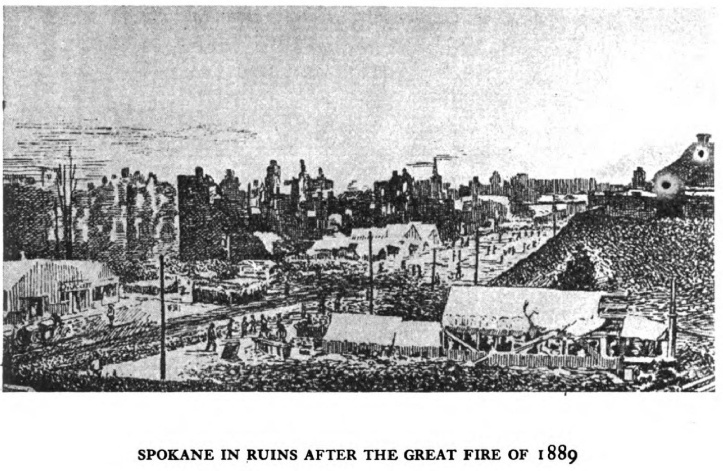
ALL COMMUNITIES have fires, and some have one so devastating it is forever after known as “The Fire.” Spokane’s occurred in 1889. The day was Sunday, August the fourth. Nobody was greatly alarmed when a puff of smoke burst from the roof of a lodging house on Railroad Avenue neighboring the Northern Pacific passenger and freight depot. The air was already full of smoke from a forest fire raging in the Coeur d’Alenes; it was toward evening, and the townsfolk were either in the act of sitting down to a late chicken dinner or recovering from the effects of an after-church gorge. John Fisken, engineer of the electric light and power company, scarcely stopped to look as he sauntered along the street. Nothing to worry about, that little blaze; half a dozen men armed with buckets could take care of it.
The city’s well-drilled volunteer fire company came on the run, dragging a hose cart. Quickly they made connection with a convenient hydrant.
There was no answering gush, not even a trickle—with the roof already ablaze and the river blocks away—too far for a bucket brigade to save the situation. What was wrong at the pumping station? Hurried investigation revealed that the superintendent of the waterworks system was out of town and the man in charge either asleep at the switch or unfamiliar with the mechanism of the pump.
By the time darkness fell the whole town knew what it was in for. The fire was out of control. Dynamite was being freely used, but demolition had little effect. Folk who had run from hotels, lodging houses, and transient abodes of less respectability to watch the conflagration ran back again to save what they could, as shifting breezes carried torches of flame this way and that.
Without pause, the flames roared through the flimsy wooden structures of the business district and on to the river. There the sawmills and lumber piled on the southern bank caught fire and sent crimson embers soaring on the wind to the north shore. Dispossessed folk who had crowded in frightened procession across the wooden bridges on foot or in wheeled vehicles of every description, bearing with them such possessions as they could scramble together, eyed this new development with horror. Would not even the river put a stop to the devastation?
All the giant powder remaining in town was hurried to the north side to raze strategic buildings there, and this, together with a change in the fickle wind, brought results. By nine o’clock the fire was under control and the refugees on the north shore were beginning to stream back over the two remaining bridges. Safely across, they beat their way through smoking ruin to what had been hotel rooms or places of business, or joined the crowd milling about the Northern Pacific tracks hoping to get away on the midnight train.
By twelve o’clock, martial law was in force and order came out of chaos. It was a sad order, however. The scene daylight revealed was heart-breaking. Thirty-two blocks in the heart of the business district had been destroyed. People who lived in residential sections still had their homes; but the floating population of hotels and rooming houses had nowhere to go. Chances for a continued livelihood looked dim for both groups.
Spokane was patently down; but the event proved it was not out. Thanks to the continuance of telegraphic communication, mail, and train service, help came to the blackened city from everywhere—immediately, and more than was needed. Tents arrived from Fort Sherman in Coeur d’Alene and from Walla Walla. Bedding and wearing apparel appeared out of nowhere. Food poured in by the carload until bacon was corded “like wood in a forest” and the unloading and care of ham, canned goods, and delicacies—pickles and preserves had not been overlooked—required the services of a large force of men. Money also flowed in; thousands of dollars by wire, mail, and express. Insurance adjusters appeared on the scene as if by magic to set up office under canvas roofs. At a joint meeting of citizens and city council, the superintendent of the waterworks was “permitted to resign,” new fire apparatus was ordered by wire, arrangements were made to substitute horses for man power on fire-fighting equipment, and the purchase of an electric fire alarm was voted.
Spokane Falls rubbed its eyes. Perhaps, after all, the fire had been a blessing. It had cleared the way for permanent structures to take the place of shoddy makeshifts. Insurance payments would help, considerable Coeur d’Alene mining wealth already awaited investment. Before nightfall of the day after the fire, three banks had purchased business corners at one thousand dollars per front foot.
While the fire was still burning, Holly, Mason, Marks and Company, wholesalers, had contracted for lumber to erect a temporary building. By the following Thursday the roof was in place and a stock of building materials and tin utensils, ordered by wire and received by express, was on sale.
Sam Crow, junk dealer, reinstated himself in business with his wife’s help and a couple of sewing machines. The machines were all that he had been able to save from the fire; but plenty of straw was to be had from farms roundabout, and ticking could be bought by the bolt and imported. Until the machines wore out from constant use, Sam and his wife manufactured straw mattresses for a tent population only too ready to buy.
Louis Davenport entered upon a career that led him eventually to the construction and ownership of the Inland Empire’s most famous hotel. A young chap, he had only just arrived from Nebraska by way of California and Oregon with seventy-five cents in his pocket and had taken a restaurant job as a means of replenishing his capital. When the restaurant went up in flames, he was obliged to do something in a hurry. So he possessed himself of a waffle iron and set up shop on the street as a “waffle foundry.” Such is the background of the still distinguished Davenport Hotel.
While business was thus taking shape, a committee on relief was busy. It was resolved that any keepers of hotels, lodging houses, and restaurants, or dealers in supplies who raised prices would forfeit their licenses, and that anyone who was offered employment and refused it would be notified to leave town.
That these excellent resolutions were well carried out is open to question. Graft occurred, especially in the misappropriation of relief supplies. The city fathers won the soubriquet of “Ham Council” because of the number of hams and other packing-house products that somehow found their way into the cellars of certain councilmen.
The winter following the fire was an extremely hard one for many citizens in spite of the work of restoration under way in every quarter. Not only that, but the chilly city “in tents and on runners” bore upsetting visible evidence of social changes that were well under way even before the fire. The handsome cutters and double sleighs of English or French design and the elegant Russian models that competed for the right of way along icy streets with everyday vehicles mounted on homemade runners were signs of the social contrasts rapidly accruing from the mining advance. Spokane Falls as a community emerging from a homespun childhood into irresponsible youth reveling in expensive new clothes was a source of deep concern to the conservative element in its population.
Among the quick-witted who had been able to capitalize on the fire were “Dutch Jake” Goetz and his pal Harry Baer. They had arrived from the Coeur d’Alenes shortly before with some two hundred thousand dollars of mining camp wealth and, as additional capital, possessed well-established reputations as gamblers and proprietors of bars and gambling joints.
Of the two, Dutch Jake was the better known because of his spectacular methods and an open-handedness that not only won for him the everlasting gratitude of the recipients of his bounty, but caused him to be regarded with a large degree of tolerance and even downright affection by others who had little use for his business. Wrote a newspaper friend, Dutch Jake “was one of the most reckless, indifferent and bighearted men that ever rode a mule or mixed a cocktail.” Whenever or wherever a miner had appeared at Jake’s bar with a pokeful of nuggets, he had quickly been helped to dispose of his hoard in ways highly satisfactory to his appetite if not always to his gambling instinct. But if luck went back on him, the next time he spent a summer in the mountains with pick and pan or rocker and returned broke to face a hard winter, Jake cheerfully extended credit and let him soak up the warmth of the saloon stove daily, and even nightly if financial embarrassment was such as to preclude even the slight comfort of a bed on the ground under the canvas roof of the camp “corral.”
Word of Jake’s exploits had arrived in Spokane ahead of him. His marriage to Louisa Knuth{86} had been the best-publicized social event of Eagle City’s entire history. In neighboring Murray, Adam Aulbach’s ambitious sheet, The Murray Times, had run an advertisement inviting everybody to attend both ceremony and feast. Notices were posted on trees along the trails. Jake’s pal, Baer, was scheduled to furnish the supper, a feast which, he reported, brought the prospectors out of the hills like woodrats. Chinese lanterns flickered from ropes stretched the length of the three blocks along which the wedding procession passed on its way to Union Hall to the music of “Marching through Georgia” played by a brass band. As an added fillip to the occasion, exuberant miners left the bar and climbed the side of the gulch to explode sticks of dynamite.
Jake had a live-and-let-live attitude toward clergymen, but classed them along with lawyers and doctors as persons to be avoided except in case of extreme need. For the wedding there was no such need, since there resided in Eagle City two justices of the peace fully capable of performing a marriage ceremony devoid of flummydiddle. To save hard feelings, Jake decreed that the toss of a dollar would decide which justice should tie the nuptial knot. That done, the winner retired to worry out the best ritual he could invent without recourse to religious sources.
How the wedding had to be delayed a few days until Louisa’s trousseau had arrived from the East is a matter of history. So too are the events announced in the “Order of Exercises”:
First. Music by the band as the bridal party marches to the front. Second. Address of welcome by Professor Inglesby. [A commentator remarked that it turned out very dry.]
Third. Song by the choir, “My Country ‘Tis of Thee.”
Fourth. Marriage ceremony, Justice [also State Senator] J. P.
Klein officiating.
Fifth. Congratulations.
Sixth. Music by the band.
Seventh. Adjournment to the Louisville Hotel for supper (price one dollar).
Eighth. Reassemble in the hall for dancing.
N.B. Everyone expected to make a night of it.
Owing to the inexperience of red-faced Justice (and State Senator) Klein, the ceremony limped at times. However, His Honor came through with the essentials.
“Jake,” he queried, “you do promise to dake Louisa all your lifes and dake care of her and do shust as you would be done by, so help me Got?”
When Jake had replied with a sturdy affirmative and Louisa had followed with her “Yes,” Justice Klein came to a relieved ending:
“Now, Jake, shust put the ring on her finger hand and you got her.”
When Jake and Baer—and of course Louisa—arrived in Spokane Falls in the late eighties, the partners invested most of their two hundred thousand dollars in an ornate, four-story structure which they opened as bar, theatre, dance hall, and gambling resort de luxe. The fire wiped them out. All that remained was an inadequate insurance policy. However, Jake was not a gambler for nothing. He was ready with the motto that in time came to be embroidered on his shirt fronts and painted on the cover of his spare tire: “Don’t tell ‘em; Keep going.” With what insurance there was, he and Baer bought a tent which they set up on a likely corner and opened for business as usual.
The Spokane police force and members of the city council were not at that time spending sleepless nights over saloons and gambling resorts, and the proprietors of the tent establishment had little fear of interference. Both were old hands at the business. Down in Wallula where they had run a gambling joint before going into the Coeur d’Alenes, Jake had been accustomed to open the evening’s festivities by tossing a hundred silver dollars into the air about the bar. When the scramble for the coins subsided, the games began. Jake was not averse to joining in, and his participation was definitely to the advantage of the firm, since he had a habit of winning. For years he preserved as precious relics the famous poker hands which came his way in Wallula and elsewhere, each carefully tied up and labeled with date and place.
In the huge tent in Spokane Falls there might soon be seen upward of a thousand men playing at varied games of chance and making more or less frequent visits to the bar. If a steak promised to add the desired fillip to a game of faro, it could be ordered and devoured on the spot.
Jake was seldom in trouble, for his honesty and open-heartedness won him many friends. Harry Baer was less fortunate. There was the shooting affair in the snowy street just outside the tent the winter after the fire. Friends claimed it was by accident or in self-defense that Baer shot and killed a bystander who interfered as Jake’s partner was ejecting a troublesome patron. At any rate, the coroner’s jury found the killing “perfectly justifiable,” and later Baer was acquitted by the superior court. Nevertheless, this affair was the straw that finally broke the backs of law-abiding citizens. They protested loudly that there was getting to be far too much violence in the city and too much evasion of the law by officials charged with enforcing it. Something had to be done.
The result was a Law and Order League, fostered by the Young Men’s Christian Association and the churches and aided by a belligerent press. For a time the organization rode high on the wave of public indignation. A number of gambling establishments were closed and Goetz and Baer undoubtedly had a tight squeeze. Nevertheless, they somehow pulled through the furious but short-lived moral campaign without much loss of business, and even with added prestige in some quarters as a better than average “den of iniquity.”
The further history of Goetz and Baer goes beyond the gay nineties, but is too entertaining to be dropped here. Five years after the fire, the two had accumulated enough money to erect on the site of the present Coeur d’Alene Hotel a resort that made the headlines. It was of a lavish elegance never forgotten by those who saw it. From the basement quarters devoted to down-and-outers to the gorgeous dance hall on the fourth floor it was steam-heated and ablaze with gas and electric lights. French mirrors reflected the latest in fixtures above the polished, solid cherry bar on the first floor. The barroom was further adorned with a portrait of Jake’s Coeur d’Alene friend, Jim Wardner, painted on a circular canvas three feet in diameter in a six-inch frame of variegated gold and silver. The description is furnished by the proud subject himself, who takes pains to add that the whiskey dispensed at the bar was “as pure as Dutch Jake’s character.”{87} In memory of the Bunker Hill and Sullivan episode, a lifelike oil of the famous jackass hung on the wall.
In a clubroom on the third floor, Lady Luck could be wooed through every known game of chance, including keno run by electricity—in itself worthy of headlines. No minor was allowed here, and married men who, to Jake’s watchful eye or those of his assistants, appeared to be wooing Lady Luck with a degree of recklessness inconsistent with the support of a family were advised to go home and stay away. Jake was a firm believer in good homes; he had a satisfactory one himself with Louisa as his life partner and was not going to allow any irresponsible husband to blame the Goetz and Baer establishment for failure to provide for his “vimmin-folks and schildren.”
That no current form of amusement or entertainment might be lacking under their roof, the partners further provided a theatre where vaudeville and fancy dancing—very fancy indeed—invited the tired businessman to laugh and relax.
The basement was an institution in itself—a kind of Salvation Army flophouse with salvation left out. Jake was never happy to cater to wealth alone. “I aind’t got no use for millionaires,” he was wont to say. On the contrary, he always made a place for those of empty purse, asking no questions and taking them as they were—especially if they were miners. In his basement the most bedraggled derelict was given a good meal at the lunch counter and if necessary provided with a blanket, in which, after a bath, he was privileged to roll up for the night on the floor.
Although Jake was inclined all his life to lump lawyers, millionaires, and preachers together as more or less useless excrescences on the social scene, his attitude toward all was tolerant. Jim Wardner was a periodic millionaire, but he was always welcomed, as were others in the same class. Preachers were welcome too if they wanted to come. In fact, on at least one occasion Jake personally invited a trio of them to do so. It was a Sunday afternoon in November when Jake’s special guests, a visiting evangelist accompanied by a Methodist and a Presbyterian minister, arrived at the theatre barroom to hold a religious service. Sunday afternoons in the winter had, as Jake noticed, become a bit tedious to the crowd loafing about, and a revival meeting would do no harm and would undoubtedly liven things up. So he had the mechanical pipe organ played to gather the crowd and provided further inducement by turning on the winking lights of the electrical fountain. When four hundred patrons had gathered to listen to the unusual guests, it seemed foolish to close the bar, so the service progressed to the clinking of glasses, the hurrying feet of waiters, and orders for assorted liquids given more or less sotto voce. Throughout, Jake took the part of kindly and gracious host. No heads were broken, everybody concerned got plenty of publicity, and Jake had added another to the already lengthy list of attractions sponsored by the resort over which he and Baer presided.
Bushy eyebrows beetling above his strong but kindly features, Dutch Jake steadfastly adhered to his personally imposed moral code while an increasing string of unique exploits kept him constantly in the public eye. He became almost as well-known outside Spokane as in. It is recorded that one day Uncle Sam’s post office routed to him, without delay, a letter from a jokester addressed simply to “Dutch Jake, Somewhere in the U.S.A.”
Of outstanding satisfaction to Jake was his annual picnic. This was heralded by the press as one of the events of the summer season and took place at a lake or near-by resort the first Saturday and Sunday in August. Food, drink, and transportation were included in membership of the Go To Hell Club, a sponsoring organization of which Jake was the guiding spirit. The opening event, a parade through the streets of Spokane, was featured by the periodic firing of a cannon. Once this came near putting an end to all of Jake’s picnics, for, in loading the piece with powder from shotgun shells, someone neglected to take out all the shot. When Jake took cheerful aim and fired at an office window crowded with applauding friends, they were showered with glass from the splintered windowpane above their heads. Luckily, no one was hurt, but report had it that Jake himself was a near casualty from fright.
“Vimmin folks” were barred from the picnic until Sunday afternoon. In the meantime husbands and unattached males made uproariously merry—though under strict rules. The bar was open for twenty minute periods only, at half-hour intervals. Bar tenders were not allowed to drink, and any guest who so far forgot the rules and regulations as to get drunk was promptly tied to a tree to sober up.
By 1910, the Goetz and Baer resort had become the Coeur d’Alene Hotel, a change in line with other happenings in a city by that time well on the road to respectability and definitely concerned with the habiliments of culture. Since Jake was a natural “greeter” who thoroughly liked meeting new people—and studying them—he was equally successful as hotel proprietor and as manager of a gambling parlor. The hotel business, he announced, was the nicest he ever got into. He continued his private flophouse in the basement. Above, in far more sumptuous quarters, he cheerily welcomed, housed, and fed more prosperous guests and on their departure presented them with his The Hotel with a Personality, a piece of literature in which he took extreme pride.
Among those on the hotel payroll was a clergyman. “That’s funny, aind’t it?” Jake was wont to say. “I aind’t got no use for them, undt still I got a house preacher for the hotel. I dond’t like ‘em. Ven I die, the Elks they can take care of me. But it dakes all kinds of peebles to make a vorldt, and preachers they got a place like the rest of us.”
Some of Jake’s encounters with visiting celebrities became Spokane classics. At a Chamber of Commerce luncheon given in honor of Ida Tarbell, famous author of the History of the Standard Oil Company, Miss Tarbell spoke enthusiastically of the accomplishments of equal suffrage. That was too much for Jake. “Vimmin’s place,” he rose to his feet to protest in no uncertain terms, “is the home.” Equal suffrage was something to be reckoned with in Washington at the time, and when Jake developed his thesis at length, it was to the vast entertainment of the assembled guests. Apparently Miss Tarbell shared their enjoyment. At any rate, she took no offense at Jake’s fulminations. Shortly after her departure for Oregon there came a courteous note bearing her signature and thanking Jake for his gift of a copy of The Hotel with a Personality. “Py golly, that’s a fine letter, aind’t it?” was Jake’s beaming comment as he turned the missive over to a local newspaper with careful explanation of his point of view: “Veil, I didn’t mean to pick no fight vid her the oder day....She’s a greadt voman und a goot voman, it’s easy to see that. I choost dond’t agree vit her t’eories, that’s all. She tinks vimmin’s suffrage is all right. I dond’t. I t’ink it’s the ruination of the goundtry. She’s got her opinion. I got mine. That’s all right. Sure.”
Jake lived to be seventy-three, happy in his hotel and in his homelife with Louisa and the son she had presented him. “The United States has been goot to me so many years,” he said, “I should be goot to her.” Concerning preachers he underwent a slight change of heart; or at least he had the satisfaction of finding one to his liking. Over on the north side, a two-fisted Congregational minister from Canada was filling the church with men of a Sunday evening. He was also unwittingly paving the way for his own entrance into local politics and the mayorship, after a hard-won fight for adoption of a commission form of government to replace what had long been a shoddy political setup. Jake liked the straight-out-from-the-shoulder Reverend Mr. Hindley. He could admire that sort of man even though he might disagree with him violently. When Jake died, the Elks “took care of him” as he wished; but in accordance with his request the north side preacher delivered the funeral sermon. Jake, he said, never cheated, was kind to those in trouble. He was a square shooter. He lived according to his code.