
ONE DAY in the early nineties, Grandpa Foster sat in his rocking chair intently peering out the front bay window into the gathering dusk. It was nearing the hour for the lamplighter and the old man did not intend to miss him this time. Queer, he thought, how that man came and went and you never caught him at his job. Mysterious-like. But tonight——
Suddenly the arc light swinging above the street corner burst into brilliance—and not a sign of a man with match or torch! Grandpa sank back into the rocking chair with a sigh of disappointment. Was something the matter with his eyes that he always missed that man?
Spokane and the Inland Empire in Grandpa Foster’s time included quite a few who lacked experience in the uses of electricity. Most, however, were younger and more agile in acceptance of scientific wonders than the old man rocking by the window. Unlike him, they tended to gloat rather than to puzzle over what the discoveries of faraway Mr. Edison had brought to the Western city by the falls. Why, all you had to do was to have your house “wired.” Then, with the pull of a cord or the pressure of a finger on that contrivance they called a “switch,” the multicolor glass shade on the study table or the bulb swinging from the sitting-room ceiling blazed with light. As for outdoor illumination, every visitor agreed that Spokane was the best-lighted city of its size he had ever seen. Of course, that held for the downtown section only. If you lived some distance away you had to depend chiefly on moonlight or the gleam of kerosene lamps from your neighbors’ windows. Electric light could not be sent very far from the power station. To be sure, the arc lights did sputter and flicker, but not nearly so much as the old-time kerosene lamps on posts.
Something like half a century has passed since Spokane’s arc-light era. Somewhere along the way an electric sign began to gleam brightly along the top of a substantial red-brick building overlooking the final leap of the falls. “Electric Service Since 1889,” it read. Still there, the sign suggests a quiet tale in marked contrast with the better known yams of Spokane’s rambunctious adolescence. It is the story of how the city on the rush-and-tumble river became the Pacific Northwest’s earliest hydroelectric center.
From the time when David Thompson followed the course of the “Skeetshoo” from its source in Lake Coeur d’Alene to Spokane House,{96} newcomers with eyes to see had remarked with wonder the abundance of water power in the river’s cascades and falls. Here and there someone had put it to use: Benjamin with his muley saw, Glover with a better one, Post with his mill wheel. By and large, however, the cascades meant little more than wheels turning in the current to give direct impetus to machinery that sawed or ground, or which, at a far guess, might someday power the looms of a textile industry rivaling that of New England.
By the middle eighties, quite a number of water wheels were operating small lumber and flour mills scattered along the water’s edge. There, however, the utilization of power from falling water stopped. Drinking water was pumped from wells by hand, carried from the river by a bucket brigade in case of fire, or delivered to homes in barrels or oversized tin cans rattling and slopping over in the beds of horse-drawn wagons. As in most of smalltown America, merchants lighted the wicks of smoky kerosene lamps to display their goods of an evening; housewives trimmed wicks and shined chimneys; entertainers in respectable upstairs halls, as well as black-face comedians in less elite surroundings, carried on in the dubious refulgence of tin reflectors attached to oil-burning footlights. True, Thomas A. Edison had in the eighties created the first electric light and power station in New Jersey; but not many small communities had the natural power, the funds, or the initiative to revolutionize in a hurry their long-established methods of illumination.
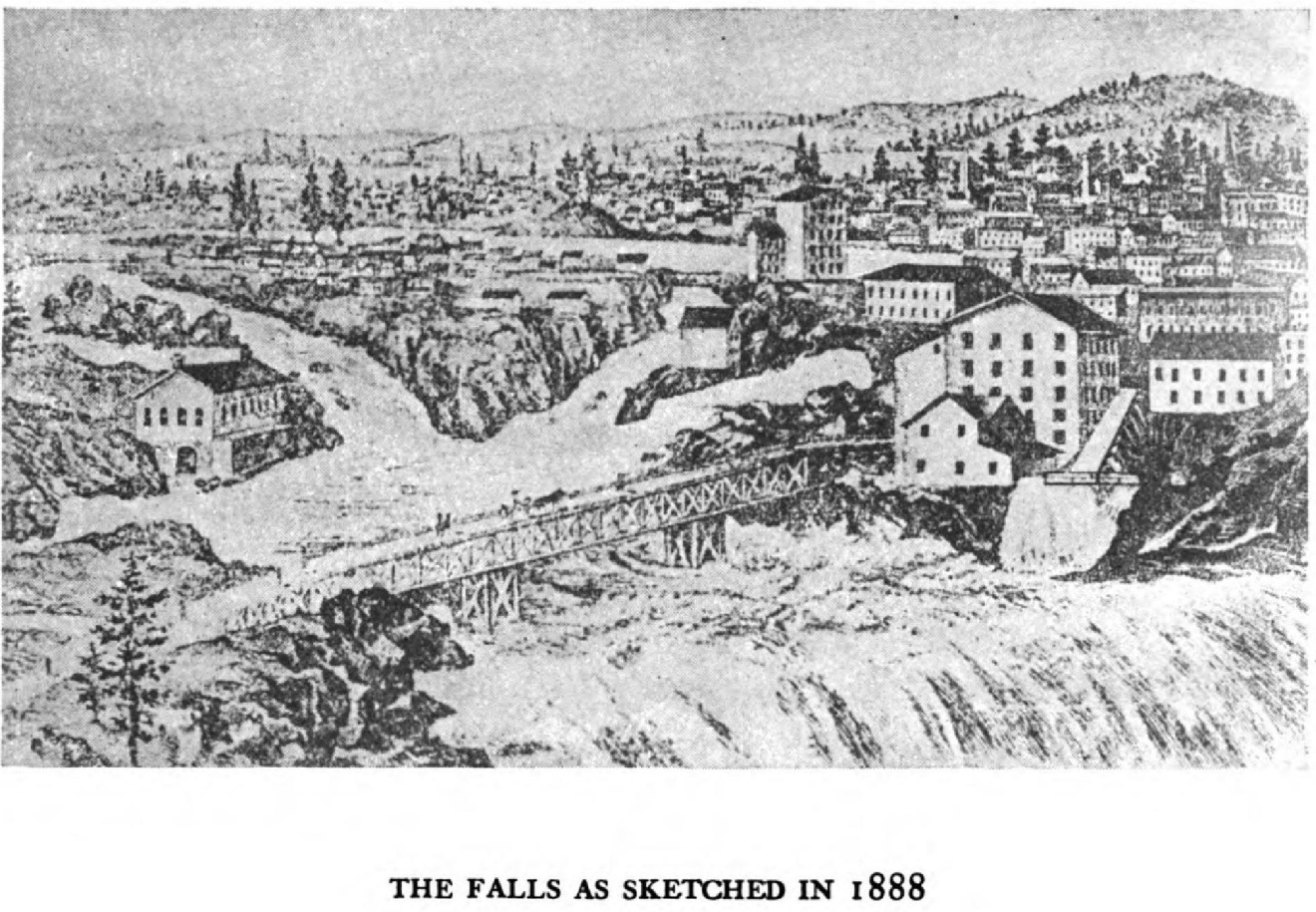
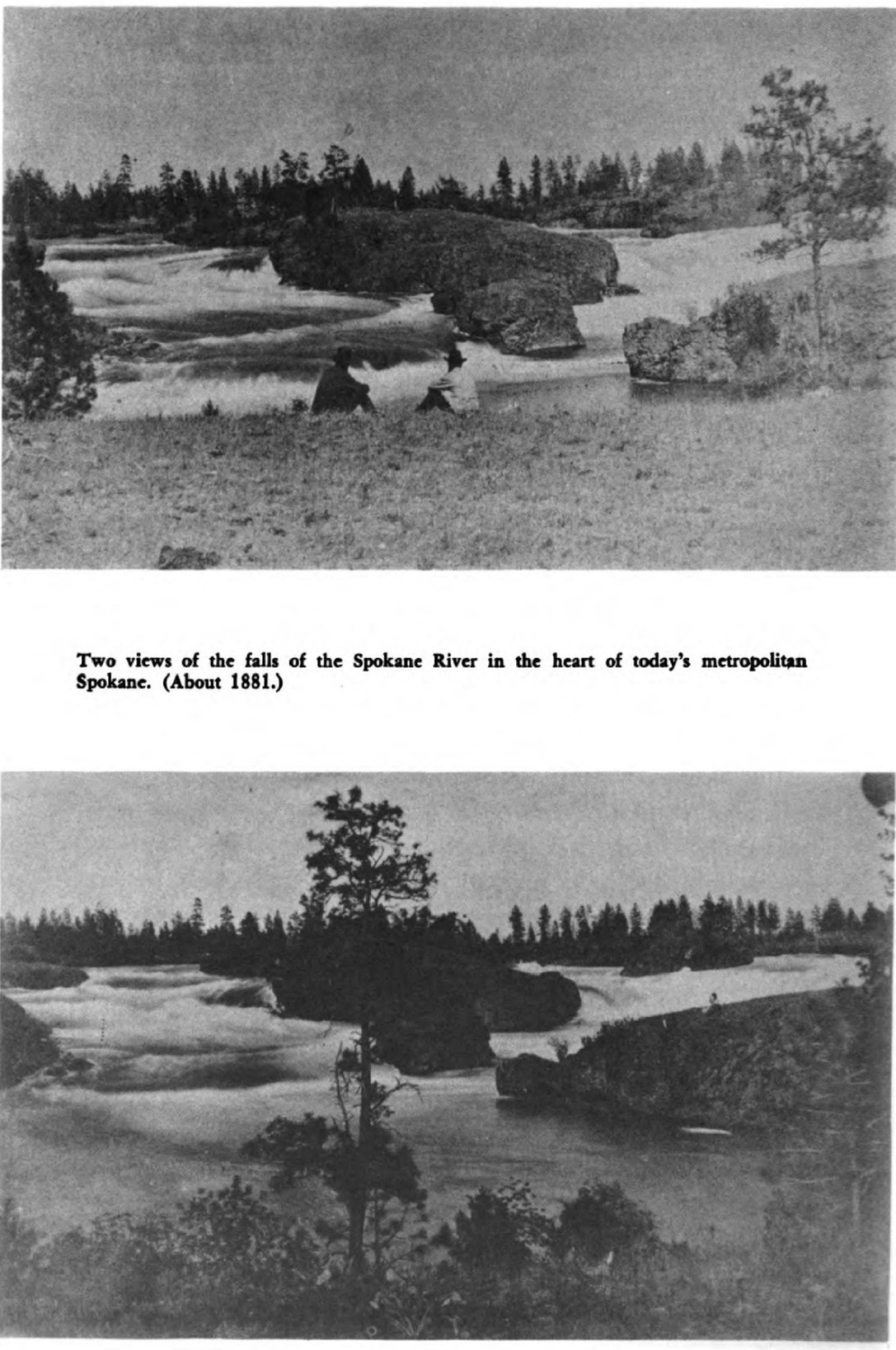
Spokane Falls, of course, had no lack of natural power. A competent engineer had early estimated the gross horsepower of the falls at ninety thousand, enough, he said, for twice the spindles, machines, and manufacturing plants of all New England. Money was scarce, but initiative the community had always possessed in abundance. When a man named George A. Fitch learned that an electric light plant consisting of a small dynamo with capacity sufficient to operate twelve arc lights could be purchased second-hand from a steamship operating out of Portland, Oregon, he secured without too much difficulty a contract from the constituted authorities in Spokane Falls to light the streets with electricity, bought the steamship plant and shipped it to the Falls. By September 2, 1885, Fitch possessed the first franchise issued by the city for an electric lighting system.
The dynamo was soon installed in the basement of a flour mill known as the C & C (Clark and Curtis). Driven by what engineers called a hurdy-gurdy wheel, the first hydroelectric plant in Washington Territory began transforming water power into electric current. In a matter of weeks, proud citizens moved about at night in the glare of ten sputtering arc lights—and immediately demanded more. The nine lamps swinging high above strategic corners along the way from the river to the Northern Pacific railroad station and a lone one spotlighting, across the river, the main road that led northward were obviously only a beginning. That was agreed. Leading businessmen undertook the organization of the Spokane Falls Water Power Company. Early in 1886 they bought out Fitch, placed a contract for an Edison plant to be shipped the long miles from New Jersey, and signed a lease for a site and water power on the north bank of the river close to the end of what is now the Post Street bridge.
When the new plant began operating, current moved across the river via an uncovered feeder line extending from the station to a high rock pile, thence under the sidewalk of the wooden bridge, and on from pole to pole to its terminal in the business center. Unfortunately for the stability of the current, Spokane Falls had the usual assortment of small boys interested in experimentation. When one of them discovered that a piece of fine wire dropped across the feeder line through a crack in the bridge would result in a most satisfactory display of fireworks, the not infrequent result was a short circuit that plunged the entire business district into darkness.
The new Spokane Falls Water Power Company had a high sense of civic responsibility; it could be relied upon for special service in any activity of community importance. Not long after the Company’s debut, arrangements for the appearance of the Jeannie Winston Opera Company were under way. A theatre of unfinished lumber and canvas was readily improvised, but the problem of lighting frustrated the sponsoring committee. The Water Power Company came to the rescue. With the permission of mayor and council, two arc lights were removed from the streets and installed in the theatre on an extended circuit. The Committee sighed with relief. The last obstacle to a successful performance by a famous company seemed to have been overcome.
On the appointed evening the audience gathered, the arc lights were turned on, and the opera got under way as planned. What happened next had not been planned. John B. Fisken, the then Water Power Company engineer, records the episode in his reminiscences.{97} It was a summer evening. Some of the plentiful June bugs hovering about the street lights found their way into the tent. When one of the invaders lighted on an interior arc, weird shadows moved over the scenery producing the effect of antediluvian monsters about to devour the cast. Whether the situation was harder on singers trying to ignore the imminence of sudden death, or the audience respectfully trying to restrain its merriment the chronicler does not report. But apparently the cast never faltered and the opera moved on to a glorious finale with no casualties save those demanded by the plot.
Shortly after engineer Fisken had taken charge of the Company’s generating plant, he recommended its removal from the basement of the mill to a more favorable location. High water, it was found, could and did put the dynamo out of commission for considerable periods of time during which the town reverted in a big way to kerosene and candles. But how finance the move recommended by the Company engineer? The Coeur d’Alene mines were still mostly prospects, and expanding business in Spokane Falls itself required most businessmen to plow profits back into their own firms. The directors of the Water Power Company decided to send an envoy East to interest capital there and also to get in touch with the Edison Electric Light Company. Aside from securing the capital, the most important outcome was a license agreement under the terms of which the Edison Company became a small stockholder and the local company was reorganized as the Edison Electric Illuminating Company of Spokane Falls.
A site for a new power station was immediately acquired from the C & C mill, and the mill agreed to supply the required water power. When the new plant was installed, it proved to have four times the capacity of the earlier one, but both its installation and subsequent operation presented engineers and operators with assorted varieties of grief. To begin with, work was delayed by one of the coldest winters in Spokane history, that of 1887-88. When at last current began to be produced, a forgetful miller provided new complications. Every once in a while when shutting down the mill, he cut off the flow of water to the electric power plant, killing the current. However, the city still had its kerosene cans and so took in its stride the vagaries of its much-prized electric lighting system.
For the engineers there were other troubles, as when something went wrong with the machinery and repair work had to be carried on below the flume in winter cold, as streams of icy water poured down the necks of the crew. On such occasions, a messenger was deputized to rush a bottle of whiskey to the workers. Combined with a certain hardiness of physique, this was presumed to prevent death by exposure. As a matter of record, the men lived to tell the tale long years after.
So far in Spokane Falls, electric current was being utilized for purposes of illumination only. Back East, however, the electric motor had been invented, and news of experiments in its use drifted westward to good purpose. At the Windsor House, cord upon cord of wood had to be cut by hand to feed the many heating stoves. Perhaps a motor could be rigged up to operate a circular saw. The hotel management thought it possible. When the proposition was laid before engineer Fisken, the Scotchman “took a wild chance” and assured the hotel owners that their idea was quite practicable. However, when the installation was finally agreed upon, the canny engineer, none too sure the contrivance would work, took pains to set up the motor himself.
News that the thing did work spread like wildfire. Over in the office of the Spokane Chronicle, it was decided to change the press from hand power to electric power. Similar installations followed rapidly. Spokane was launched as the hydroelectric center of the Inland Empire.
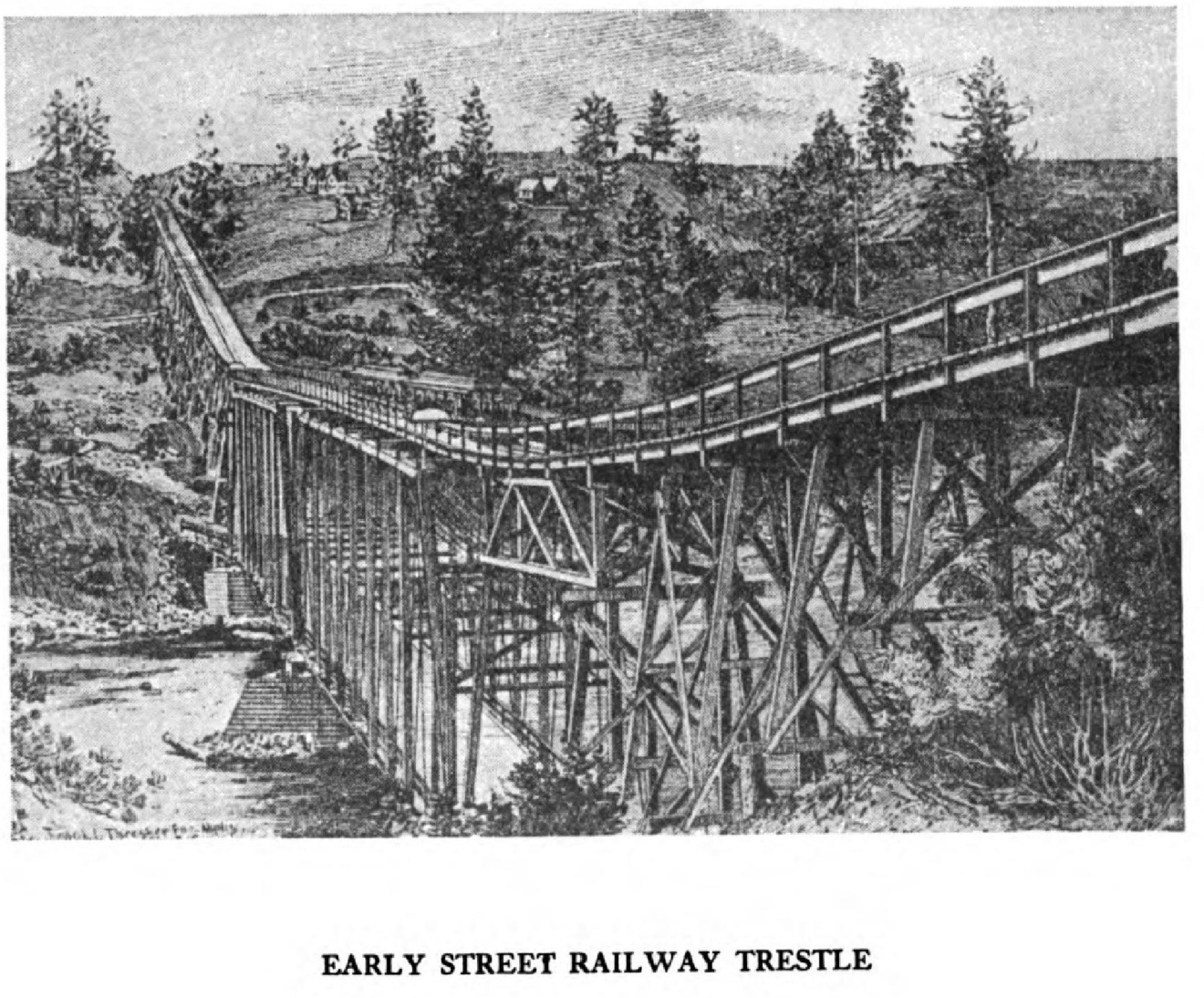
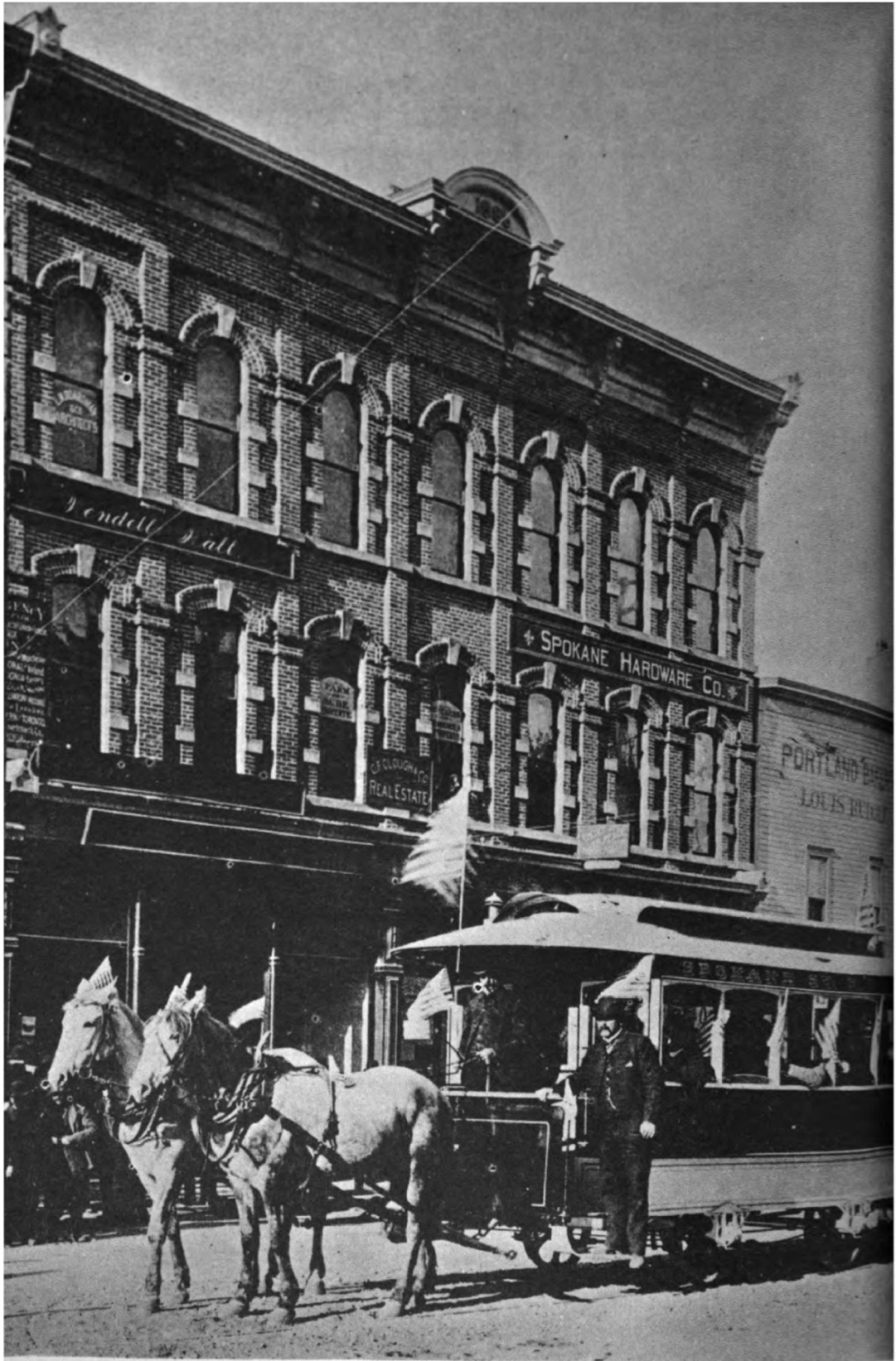
Service to residential districts was soon under way, though this took time, since in 1888 the community already sprawled over a territory large enough for a city several times its size. It had its south side, its north side, and an assortment of hopeful additions well removed from the business center, with extensive vacant areas between. Its favorite outdoor pleasure resort, known as Twickenham Park, was also well removed—a low-lying, wooded plot below the bluff where the river begins a great S curve several miles north and west of the falls. Obviously, some sort of public transportation was needed to that point and others, and shortly several street-railway lines were in operation. They were variously powered. An ambitious Spokane Street Railway Company inaugurated, with a celebration and free ride for mayor and councilmen, a mile-long horse-car line running to Browne’s Addition, a flourishing real estate development. Not to be outdone, Francis Cook, the city’s first newspaper editor, now turned realtor, organized the Spokane and Montrose Motor Transit Company. Up the south hill to Cook’s Addition cars powered by steam soon moved over a narrow-gauge track. A line crossing the river on a high double-deck bridge carried passengers to the baseball grounds in Twickenham Addition. Its cars were crowded on baseball days but ran almost empty at other times. A cable line ran south and east. The Ross Park Railway was the most ambitious venture—an electric line. It proceeded east and north to the city limits after crossing the river, had its own generating plant, and was equipped with all the latest conveniences and gadgets, including Pullman cars and gilt balls atop such center poles as did not burgeon with cluster lights.
The Edison Electric Illuminating Company read in street-railway developments great possibilities for an extension of its own services. Horses, steam, and cable would soon be outmoded. Electrification of all lines was the obvious next step, and the Company should be ready to take over. That, however, would require far more power than the flour-mill plant could supply, and the local management decided that the purchase of the lower falls where the river dropped some seventy feet and the erection of a much enlarged generating plant at that point were both indicated.
Unfortunately, the Eastern stockholders did not concur. Spokane Falls was far away; its boom was a Western boom and might not last. It would be useless to invest more funds. The sensible course was to continue as was needed.
The retort of the local directors was, in effect, “We know the possibilities here as you do not.” Local capital became available as local pride was touched. March 13, 1889, a new company was incorporated to buy the site by the lower falls and erect a power plant there to supplement the one at the mill. It was called the Washington Water Power Company, and so it has been known ever since.
While the essential dam and headgates were under construction, Spokane Falls had its great fire. Engineer Fisken watched the little blaze develop into a big one and ordered the flourmill station shut down. He also ordered its dynamos lowered into the river, assuming that later they could be fished out and dried. However, before the order could be carried out the wind changed and the station seemed to be safe. So the dynamos remained in place and all hands set to work to save precious arc lights, including those hanging in stores, for they were scarce and difficult to replace. Into the pandemonium of the downtown district scurried the linemen of the Company to quarter the district as hounds quarter a field. There was no time to hunt for stepladders. “When an arc light was seen dangling from a store ceiling, a lineman [made]...a running jump and a clutch at the lamp—and down would come lineman, lamp, coils of wire—beneath a shower of plaster, or with a ripping of boards.”{98}
All but a few of the lamps thus salvaged were carefully stowed away below the Company’s office in the basement of a building deemed to be out of harm’s way—only to be reached by the roaring flames a little later. The only stock in the basement that came through safely was a quantity of arc light carbons. All the poles in the path of the fire were burned and the wire later salvaged would not, wrote engineer Fisken later, have made a good load for a Ford truck.
On a corner where there was only one building to burn, a single pole stood untouched. This was exceptionally fortunate; for running to that particular corner was the main lead from the generating station, which had also remained intact. Early the morning after the fire, all available men went to work to restore service. From the strategic blackened pole on the corner they strung baling wire, barbed wire, line wire still hot, wire of every sort. Trees, bridges, mined walls and the corners of surviving buildings were utilized for support. And that night street lights outside the burned district and two within it burst into brilliance at the usual hour. Folk who went through the fire long remembered the encouragement those flickering lights spread in a blackened world.
The fire past, the Washington Water Power Company resumed construction of its dam and generating plant. What happened is told in a Company publication:{99}
Winter had scarce relaxed its clutches in the first months of 1890 than work was pushed on the new dam....No time was lost...machinery was hurried into place in order to get the construction under way before the spring flood of the river. The increasing flow of water was expected at any time during a wide period, for the engineers had yet to acquire the knowledge and experience which enables the present-day hydraulic specialists to predict almost when every separate snowflake will be transmuted into water and find its way to the river....
Throughout the chill days, crews of men worked feverishly, bricks and stones and mortar and timbers were assembled—teams of horses tugged at lines from block and tackle and derrick and the dam took form. [With] the soft days of spring...the torrent rose swiftly and work was suspended—but not before the dam was half done.
Unhappily, the site foe the dam and headgates had been ill chosen. Now, with the dam half completed, it became obvious the site would have to be abandoned for one farther down stream. This was a blow, but there was nothing for it but to make the change.
Meanwhile the level of the river rose rapidly...and for many days the torrent careened over the basaltic base of the falls while engineers, with cool and calculating gaze, waited the moment to bridle the torrent.
Work was resumed promptly after the passing of high water. But even while this dam was rising the managing officials of the company pondered over reports from their superintendent—[the old] dynamos were whirling at their top speed. More power was needed—more power.”
It must be furnished at once; and to take care of the immediate situation a small makeshift station supplying one hundred and thirty additional kilowatts was put into operation. Arc dynamos installed in the existing cable railway powerhouse added fifty more. Meanwhile, the main power station took form. It was located at water’s edge almost at the foot of the present Monroe Street bridge; a site it still occupies, enlarged and improved, with the great concrete bridge arching above. Steel penstocks—gigantic tubes—coiled gracefully down the south banks of the falls and yawned into the powerhouse. Teams of horses and crews of men tugged the turbines into place at the maws of the penstocks. Crowds gathered around railway flatcars to inspect the new dynamos—six Edison machines—that were soon lowered.{100}
Completion of this station sounded the death knell of smaller ones. All larger dynamos—later known as generators—were moved to the new location and smaller ones sold. The total capacity of the new station was now eight hundred and ninety kilowatts, considered ample in those years, but ridiculously small when today a single lumber mill uses up that much electricity, and more.
By the time abundant current began to flow from the new station, several of the street railways were ready to use it—or to sell out to the Washington Water Power Company. The first to sell was the Ross Park line, and with the acquisition of this elegant bit of railway furniture the Company was launched on its career as owner and operator of what became the city’s chief street railway system—a career that lasted until gasoline filling stations came to pocket so much of the money once dropped in fare boxes that car tracks were ripped up in favor of municipally owned and gasoline-propelled buses.
It was some years before the Washington Water Power Company paid dividends. Nevertheless, it went doggedly ahead with new construction and new prospects. It extended residential lighting service. Through its street railway system it acquired Twickenham Park and converted it into an amusement park which included as a leading attraction an outdoor swimming pool. To this ultramodern aquatic wonder the ladies and gentlemen of the social four hundred, as well as those of lesser station, came, to disport themselves—garbed, of course, with becoming modesty.
In spite of non-existent dividends, the Company began lowering rates to consumers, a practice consistently followed for six years as unit costs of production became lower and the directors acted on the theory that cheaper service meant increased demand. Both Company and stockholders had the kind of faith in the future which from the beginning had been a Spokane Falls characteristic. How could they doubt now? The big thing was for the Company to provide service in small ways as well as large. Financial rewards would come later.
One of the small ways had to do with the lighting of the Northwest Industrial Exposition, that exciting civic enterprise on everyone’s mind in 1891. The huge frame structure built to house it was too far away from the then terminus of the electric lighting system to make extension of the circuit practicable. Nevertheless, electric lighting was imperative for a project designed to exploit in every possible way the resources and advantages of life in the Inland Empire. As in the case of the opera company, the engineers of the Washington Water Power Company proved equal to the occasion. They removed two dynamos from the power station, belted them to a sawmill engine on the Exposition grounds, and there was light!
Progress was not easily achieved, but the Company met and mastered its difficulties. By 1893 demands for current necessitated the installation of additional generators to increase capacity by more than a third. Of even greater importance was the introduction of alternating current, a change destined to play a major part in the development of electric service throughout the Empire because of the far greater distance electric current could now be sent.
From the point of view of timing, the expansion was not altogether fortunate. When the financial panic of 1893 struck, demands for service fell off to a point where for the first time some of the Company’s generators took a vacation and the stockholders received a picayune dividend of three-fourths of one percent. A movement in 1897 in the direction of municipal ownership of street lighting did not help matters, even though it fell through. Two years later, profits vanished entirely, and the Company was forced to default on its bonds. But thanks to a committee of three headed by a financier of parts who was also a stockholder, the Company dug itself out. An assessment of ten dollars per share was levied and met. Completely reorganized in 1899 on a sound financial basis, the Washington Water Power Company, with William Augustus White as president, was ready to capitalize fully on its varied investments and improvements.
Not the least of the latter was the alternating current hitherto used chiefly for residential service. Electric power was now for the first time transmitted outside the city on a line running to the adjoining village of Hillyard. The publicity incidental to this extension of Company service brought prompt results in the form of a call for help from the Coeur d’Alenes. If power could be sent nine miles to Hillyard, why not a hundred miles to mines at Burke?
Such a thing was all but unheard of. The engineering staff did discover, however, that a California company had operated a line at thirty-thousand volts over a distance of seventy-five miles. Perhaps the Washington Water Power Company could operate one of double that number of volts over a distance of a hundred miles. The skeptics said it couldn’t, but the Company said it would try. After all, its business was service.
Charles P. Steinmetz came into the situation as consultant. The electrical wizard of Schenectady approved the blueprints laid before him by the Company president and the line was built, first with a potential of forty-five thousand volts, later sixty thousand. It was the second line ever know to be operated at so high a voltage, and it was a success.
Long-distance transmission was now an accomplished fact. As from the beginning, water power was superlatively abundant from the falls at Spokane to the mouth of the river and going to waste in lesser streams in areas contiguous to the city. Local capital became increasingly available for purposes of expansion. The market for electric service spread about in all directions. Small towns craved, for their streets and stores, the globes of soft light that would outmode the shelf arcs that blinded the eyes and added nothing to aesthetic appearance! Small farmers and big ranchers were ready to welcome the singing wires that brought light to homes and stables and current to milk the cows and operate the separators. Mines, smelters, lumber camps and lumber mills, print shops, foundries, industries of every sort both large and small, were equally hospitable to the “juice” that spelled new methods and more effective machinery. Electric interurban railway lines were soon to be built. Eventually, a transcontinental line, the Chicago, Milwaukee and St. Paul, was to be in the market for power to pull its trains across the Bitterroots. Spokane itself initiated such widespread application of electricity to everyday living as later to become a nationally acknowledged leader in the domestic use of electricity. The stage was set to make the city the electric distributing center of the Inland Empire, if not of the entire Northwest. On the part of the Washington Water Power Company, three goals were preeminent: continued development of water power resources; alertness in spotting and preparing for new demands; and, far from least, maintenance of the friendly public relationships that had characterized it from the start.
These goals were largely met. Step by step, new hydroelectric stations were either constructed or purchased and developed: Post Falls; Little Falls; Long Lake with its one hundred seventy foot high spillway dam, highest in the world when completed in 1915; Nine Mile; Chelan; Kalispell. The steam plant which the Company had operated for a time on an emergency basis was disposed of when adequate hydroelectric power became available. The entire properties of a number of smaller companies were purchased and incorporated into the central system. Eventually there were to be hook-ups with other leading systems—but that goes beyond the present story.
In 1906 a commercial department was organized, complete with special manager, industrial engineer, four commercial representatives, four residential representatives, and an electric-sign specialist.{101} If demand for any sort of service was slow in developing, they developed it. If consumption of current varied widely at different periods during the day or time of year, they set to work to equalize it. Show-window lighting at night, they reasoned, would not only help to equalize the load, but would give the town a more up-and-coming appearance. So there was instituted a “till midnight burn,” a “two o’clock burn,” and an “all night burn” system of flat rates for sign and display lighting, the Company turning on lights at dusk and switching them off at the time designated. The fact that an occasional less than scrupulous customer was discovered using double the lamp size agreed upon failed to put an end to the plan.
Wiring after a house was built was far more expensive than wiring during construction; but not all homebuilders saw their way clear to paying even the modest cost of wiring (ten dollars and fifty cents), especially if electric lines had not yet reached the immediate neighborhood. To meet the situation, the sales department worked out with contractors and jobbers a cooperative plan. “Wiremen agreed to wire any and all houses secured on a contract for a flat fee, [the] Washington Water Power Company paid the contractor cash for the job,” and subsequently the home owner reimbursed the Company in easy installments.
Arc lights set far apart in a good many residential sections of the forty-square-mile area of Spokane in the early nineteen hundreds were far from providing adequate illumination. Lack of tax funds and a regrettable tendency on the part of certain councilmen to pay political debts by providing lighting for their particular districts without regard to conditions elsewhere did not help matters. So the sales department thought up a plan. If residential customers could be prevailed upon to burn ten-candle-power porch lights all night at a cost of fifty cents per month, the situation would be at least somewhat improved. A campaign was inaugurated and soon a thousand little porch lights helped the populace find its way about after dark.
The newspapers were induced to take a hand in increasing the home use of electricity. The Spokesman-Review began selling electric table lamps through annual subscriptions augmented by the sum of five cents per week, and all over town housewives gratefully contributed the weekly nickel that did away with the messy cleaning, trimming, and shining of the parlor lamp. Electric flatirons became popular when offered as premiums with subscriptions to the Chronicle. The Washington Water Power furnished the irons and watched with interest the rise in the Tuesday morning peak load.
The Company went all out for demonstration. New gadgets were displayed and operated in its own salesrooms and in store windows. If the early nineteenth century equivalents of gremlins caused trouble, young electrical engineers scotched them. “Daylight kitchens at night-time” became more than a slogan when trained electricians sent out by the sales department took down outmoded drop-cord lights and installed new tungsten ceiling lamps in frosted globes. If the household liked the innovation, the lamp became a permanent fixture for nine dollars and seventy-five cents, payable in installments if the buyer so desired. Although electric ranges and water heaters came into use more slowly because of high-cost manufacture and other deterrents, the Company was by 1920 supplying current to more electric ranges than any other public utility company in the United States. Spokane’s summer temperatures frequently ran high. It would be nice to have a cool oven in the kitchen. Many a timid or ultraconservative housewife capitulated after seeing a range oven topped by a bowl of garden-fresh flowers disgorge a well-cooked meal.
There were no strikes. The Company began to make money—too much money, some people said. Criticism of this sort did not, however, make much headway in the face of increasingly favorable rates and the widely accepted invitation extended to consumers to invest in stock and share in profits. After all, the Washington Water Power Company was in a peculiar sense Spokane’s baby: originally organized by local businessmen, heavily promoted by local capital, giving employment to many workers who liked the city and their jobs and lived in their own homes.
Like all privately owned public utilities, the Washington Water Power Company has from time to time been under fire from various quarters. Spokane has owned its own waterworks system from the start and many have thought it should own a hydroelectric plant. So far, such ownership has not come about, even though recent legislation in the state has tended to encourage it.
With the passing years the entire Pacific Northwest has witnessed an unparalleled hydroelectric power development. Local companies like the Washington Water Power Company have become links in far-reaching transmission chains and have tended to be incorporated into great corporate systems or holding companies. In this process, some have almost completely lost their individual identities. In the case of the Washington Water Power this has not yet happened. When, in the spring of 1928, common stock ownership was acquired by a sub-holding company of the New York Electric Bond and Share, the fact that preferred stock remained in the hands of Inland Empire residents helped to perpetuate local pride and interest in Company affairs. What changes the development by Uncle Sam of unprecedented electric energy at Bonneville and Grand Coulee on the Columbia may eventually bring about is anyone’s guess, although recently in the Pacific Northwest demands for electric power have exceeded the combined output of privately owned and government-owned generating facilities during short winter periods. Whatever the outcome, Spokane is an electric city. “Electric Service Since 1889” has made it that.