
“WHAT A STRANGE TOWN!” So wrote an observant woman traveler the spring after the fire when chinooks had vanquished ice and snow.{88} A decade earlier she had seen Spokane Falls as a pioneer settlement with a population struggling to reach “even that degree of grandeur.” Now the population touched the thirty thousand mark, while the sole reminders of the fire were piles “not of burnt rubbish, but of fresh building materials which obstruct the broad avenues.” No more shacks; instead, solidly built structures of native stone, steel, and locally manufactured brick, put up at costs running from thirty to a hundred and fifty thousand dollars. Three to seven stories in height, they were fashioned “after the most elegant modern styles.” Including improvements under way, the city boasted a two hundred and fifty thousand dollar opera house, a hotel, costing nearly as much, “a handsome post-office, cable and electric street railroads, electric and gas lighting,...waterworks and every other appliance of a luxurious civilization.” It bragged as never before about the power available from the falls, and the presence of “seven railroads radiating to all points of the compass.” The sumptuous residences pictured in the pre-fire Board of Trade brochure remained standing among the pines or saluted the world from rocky eminences. For the new homes under way, local firms were selling larger orders of costly furniture than in any other community in the state. The costliness, the visitor thought, might be at least partly due to high freight rates; for even as a growing railroad center, Spokane suffered from being an interior city, ineligible, according to railroad management, for the terminal rates accorded coast cities to meet the competition of ocean-borne commerce. But transportation problems aside, the fact remained that in Spokane Falls no one seemed to lack money for the purchase of luxuries.
Garbed in adolescent splendor, the city now plunged into a period of inflation common to the entire Inland Empire. Rival banks, cities, and newspapers throughout the area were, writes Enoch A. Bryan,{89} expanding to the limit of an easy credit situation resulting from an influx of European and Eastern capital in response to high interest rates. County courthouses all about were going up on bond issues passed by big majorities. Waterworks and sewers were being constructed on credit. School districts borrowed on inflated property valuation to erect expensive buildings. Private enterprise vied with public in building street railways and lighting systems to areas as yet without homes or residents. Hotels were built to provide for prospective rather than immediate guests. Washington and Idaho state legislatures, egged on by the railroads, sent to the Columbian Exposition in Chicago expensive exhibits carefully planned to stimulate immigration.
Under a new charter, Spokane Falls early in 1891 was renamed the city of Spokane, with the “Falls” left off. Scarcely had the reincarnated community begun to capitalize on its new status when there exploded the nationwide panic of 1893. Inevitably, its impact fell upon the city by the falls with full force. Mortgages held by Eastern and Dutch capitalists were foreclosed, wheat reached a low of thirty cents a bushel in the country roundabout, several banks collapsed and others escaped ruin by the narrowest of margins.
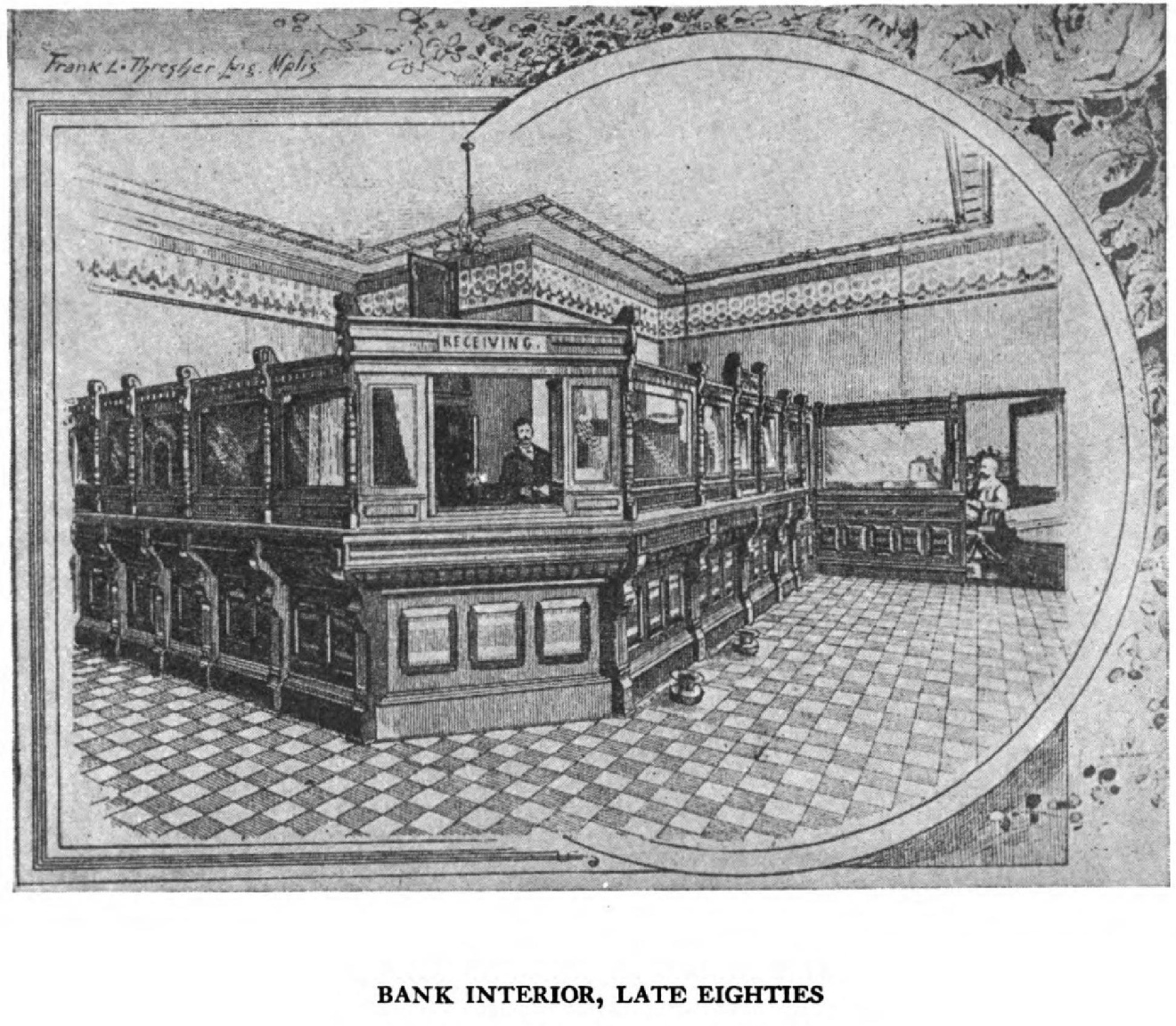
While banking had never been conducted in Spokane itself quite as primitively as in Jim Wardner’s tent and chicken-wire institution in the Coeur d’Alenes, shoestring banking enterprises had always been in order. Anthony M. Cannon, one of the men to whom Glover sold his store, had quickly improved on the latter’s tin box. Scarcely had the partners moved in when, to the dismay of Warner, Cannon stuck out a sign reading “Bank of Spokane Falls.” Capitalized at one thousand dollars with funds borrowed from a sister-in-law, it was Spokane’s first real bank. It started a train of similar enterprises, one of which was organized by Glover.{90}
In neighboring localities, banks almost as bizarre as Wardner’s had carried on for years with the Falls’ financial institutions as backlogs. There was the Bank of Ruby, a hundred and sixty miles away up in the Okanogan country. About it Wardner wrote with as much relish as of his own financial exploits.{91} Sam Lichtenstadter was president, board of directors, and cashier, all in one. The bank was in his store. Having put in a safe and a home-made “cage,” Sam ordered a large supply of artistically lithographed pink checks, payable to bearer at a Spokane Falls bank. When depositors began bringing in nuggets and pokes of gold, Sam’s plan was to present each one with a pink check drawn against Sam’s Spokane Falls account. An early depositor who demanded cash in exchange for his two hundred and fifty dollar hoard of nuggets might well have put Sam out of business, for he not only lacked that much ready cash but could not even write a check because the supply of pink ones had not yet been delivered. However, the president of the Bank of Ruby met the situation neatly. He explained that this was a bank of deposit only. While the mystified and somewhat doubting would-be depositor cogitated over this, a mining operator who was leaving town came in with a sizable deposit—in cash. Laughter in his eye, Sam turned to the holder of the nuggets. Wasn’t he rather slow to see through a joke? A “bank of deposit only,” why, that was nonsense! Of course cash could be had for the nuggets. Here it was; and Sam handed it over.
The arrival of the pink checks by express prevented further embarrassments. Before long, some three hundred thousand dollars’ worth of the checks, payable to bearer, were legal tender all over the countryside and in neighboring British Columbia, with the result that the checks seldom got to Spokane Falls. Only occasionally up to the panic year of 1893 did Banker Sam get into other tight situations, and from all of them he extricated himself with speed and aplomb. A mine buyer who appeared one day with a draft for ten thousand dollars was told it would have to be cashed at a discount of 5 percent because of the cost of bringing coin the more than a hundred miles from Spokane. However, personal checks could be had in any fractional amounts desired. When, on inquiry, the holder of the draft found that Sam’s pink checks circulated with all the freedom of gold certificates, he conformed to local usage and departed like everyone else with a purseful of Bank of Ruby currency.
Sam’s bank ceased to function about 1895, whether as a result of the general crash or for other reasons is not clear. At any rate, it did not die insolvent. The twelve hundred and fifty dollar balance in the account of one elderly rancher who refused to visit Ruby to turn in his pink checks was thoughtfully sent him by special messenger.
In Spokane, the panic reduced some banks to devices almost as unique as Sam’s. On the day a run was started on the Glover bank, a young chap named Kelly, who had recently gone into business as a truck gardener and was later to rise to local fame and financial competence as proprietor of the Kelly Gardens, stood in line with a hundred other depositors. He could not afford to lose his small savings. As he waited anxiously, shifting from one foot to the other, the bank’s big front window was suddenly thrown open from within, displaying piles of well-filled money bags; a poster announced that the window was ready to operate as a supplementary cashier’s desk. The young truck gardener eyed the display. “Shucks!” he said, and walked away. So did most of the others in the long line.
Almost simultaneously, a member of the Exchange National’s staff was pushing along the street toward that bank a wheelbarrow loaded with gold pieces. This also had the desired psychological effect.
Compared with other parts of the nation, Spokane’s season of panic and hard times was short-lived. The wealth flowing from the Coeur d’Alene mines plus rapid improvement in transportation and consequent immigration were the factors chiefly responsible. Within three years, the city resumed its interrupted activities as “the mining capital of the United States.” Fortune hunters, capitalists, investors, engineers, mine executives, mining machinery salesmen, men of the legal profession acquainted with mining law, camp followers—a colorful, happy crowd—filled streets and hotel lobbies, swarmed into saloons, and buttonholed each other to discuss new “strikes” or listened eagerly for tips which sent them hurry-skurry to the local mining exchange. So many wildcat and salted mines attracted the unwary that the Spokesman-Review took pains to warn against investment without careful investigation. Occasional raw deals were aired in court. But on the whole, more money could be made from speculation than from the dividends of producing mines. So thought the many; then why not gamble? The wild scramble went on.{92}
Headquarters for this crowd was at the sign of “Ye Silver Grill” in the new Spokane Hotel. “When you come, ye traveler,” it read, “drop your cares and enjoy a Silver Grill evening of tempting foods at moderate prices and dance to the perfect rhythm of Leo Kailin’s Silver Grill Orchestra. Splashed with rich reds, greens and golds, a color scheme from the very carefree heart of Pleasure’s Palette, the new Silver Grill will enrich your stay with its charm, its food, its music and its friendly atmosphere.”
Day laborers from the mines had their own places of rendezvous. Flocking into town of a weekend, they found abundant hospitality: saloons, open round the clock regardless of any constituted authority; flashy dance halls; painted ladies who paraded by day in open carriages preceded by a brass band; gambling resorts of every description, including Dutch Jake’s establishment where the pick-and-shovel crowd was as welcome as the representatives of high finance.
Adolescent Spokane was sowing its wild oats with a vengeance. Yet beneath all the recklessness and mining exuberance, stable business was taking shape, new industries were opening up, the jobbing trade was making rapid strides. Walla Walla lost forever any hope of being the metropolis of the Inland Empire.
Rapid growth of transportation facilities, together with generous publicity, had been and were primarily responsible for this type of business development. By the end of the century the city boasted two transcontinental railroads, the Great Northern and the Northern Pacific, and another East-West link via the Oregon Railroad and Navigation branch of the Union Pacific system. The Great Northern joined Spokane with the port of Seattle and so gave impetus to earlier dreams of a great Oriental trade—dreams which the indefatigable Jim Hill was soon taking steps to realize. The Oregon Railroad and Navigation Company offered for its part a water-level grade to Portland far more expeditious than earlier boat and barge connections. All three roads drew produce from the back country through locally built feeder lines that cobwebbed the Spokane area. Superabundant Palouse wheat yields, which as late as 1890 had Iain piled in sacks on the ground beside the tracks because the existing railway lines lacked facilities to keep pace with agricultural development, now went to market without disastrous delay. A giant lumber industry got under way as forests of white and yellow pine, long untouched save to meet local needs, began to fall in response to the demands of a developing export trade. Apple orchards bloomed increasingly in the fertile Spokane valley, as rosy samples found their way to the Middle West to stir a growing demand.
Railroad publicity was something to intrigue the well-to-do as well as the discouraged farmer of the East and Middle West, but particularly the latter. In the Inland Empire, they learned, was black soil so deep that the possibility of depletion was to be laughed at, and a climate with real winter, which was, however, over and done with by February or March. Buttercups burst into bloom on the very heels of the snow-dispelling chinook. Reading this effulgent literature as well as the output of state and local promotional agencies, the Middle West decided the Inland Empire had everything to offer. Of course, there was less free land than earlier, but Indian reservations would be opened up and other acreage was still inexpensive. “Pick up and move!” shouted the printed page, and newspaper advertisements underlined the ease with which the East-West transfer might be accomplished:
TAKE THE DINING CAR ROUTE!
The Northern Pacific Road to all points
east and south of Spokane Falls
The only line running
Pullman Palace and Free
Colonist Sleeping Cars
Pick up and move they did—particularly Scandinavian families and other rural groups fleeing the blizzards and cold of Minnesota and the Dakotas; but other sturdily American groups also.
Spokane had never been lacking in booster stunts of its own. Its newspapers and Board of Trade seldom if ever missed an opportunity to publicize the city and its tributary areas through the printed page. There were citizens, however, who thought print should be supplemented and backed up by visual demonstration. Herman Bolster was among them. The apples, peaches, pears, cherries, and vegetables grown so successfully in the Spokane valley and neighboring areas should be seen, not merely read about. Spokane ought to have a fruit fair; and Mr. Bolster decided it was going to have one. If farmers and orchardists were blind to what was needed, as some were known to be, he would show them. If they weren’t enterprising enough to bring in their oversize squash and potatoes and red-cheeked Jonathans, he’d go and get them. He’d even dig the potatoes if necessary. A committee was formed, prizes were offered, and Mr. Bolster, rattling around over the dusty roads in his horse-drawn equivalent of a Ford truck, made good on his promises. He hired the Borchert Orchestra of four ladies to dispense sweet music at twenty-five dollars per day in the vacant warehouse which housed the fair. For an admission price of ten cents most of Spokane and much of the adjacent Inland Empire saw a display that was an eye opener even to them. The fair lasted four days and closed with a surplus of six hundred and thirty-one dollars and thirty-eight cents. It need scarcely be added that it was repeated the next year, the year after that, and so on annually, each occasion being bigger and better than the last. One-cent-a-mile railway excursion rates brought in hordes of visitors to enjoy the parades and banquets for exhibitors; to see what sunshine, good earth, and hard work had produced and farm wives had preserved in shining glass jars; to gaze at a Goddess of Plenty presiding over all. Not until the structure burned down did the fair go out of business, and then only to be incorporated into a mammouth Spokane Industrial Exposition dreamed up by the Board of Trade.
Since no available building was large enough to house the proposed Exposition, it was decided to erect one. On a parcel of land donated for the purpose just out of the business center a huge frame structure soon took shape, while industrious scribes prepared a fifty-six-page illustrated brochure full of pictures, statistics, superlatives, and portraits of Spokane’s outstanding businessmen.
At a critical stage in construction while the building still lacked a roof, the carpenters struck. Labor troubles had been developing rapidly in the Coeur d’Alenes, where the Western Federation of Miners had been gaining a control which a few years later was to lead to the riots climaxed by the dynamiting of the Bunker Hill-Sullivan mine. But in Spokane, labor relations had been for the most part friendly. There were unions, but their activities had been largely educational and social. They supported, not too well, a labor newspaper, The Weekly Industrial World. Together with the energetic club women of the town, the Carpenter’s Union and the Spokane Typographical Union had inaugurated a Union Library Association, forerunner of a free public library housed in a Carnegie building.
The striking carpenters did not ask for a great deal—no increase in their three-dollar-a-day wage, but a reduction of hours from ten to nine. To begin with, they had struck the Spokane Milling Company only. Then a week later the strike had spread to a theatre building. Up to this point the union had had most of the community behind it. Hours were long, the private firms involved could and should do better by their workers. But to hold up a public enterprise which meant money and glory was another matter. “All good citizens are requested to report at the Exposition building tomorrow morning at 7 o’clock, with or without tools, to do whatever is in their power to aid in completion of the building.” This was the printed appeal of the Exposition directors.
Off came coats and cravats as bankers, businessmen, councilmen and everyday citizens reported for work, three hundred and fifty strong. Some two hundred skilled workers released from their jobs by private employers soon joined the ranks. The ladies of the town served lunches, work on the three-story building with its double-decker roof progressed merrily, and the Exposition opened on time, flags flying from cupolas and poles, and a crowd of twelve thousand in attendance.
With this auspicious start the Exposition became an annual affair lasting until this building, in turn, went up in flames. Attendance ran into the tens of thousands, Inland Empire products were advertised far and wide.
Spokane exhibited its youthful capacity for team work in other ways. Throughout the period of “hard times” it maintained a Bureau of Immigration. The Bureau learned that an offer of a thousand acres of land and free water might bring an army post to Spokane. At a mass meeting it was decided to try for the prize. An emissary to the national capital returned with the word that a considerable sum of money as well as land and water would be needed. This was discouraging. Large contributions of land were, of course, readily available. When had Spokane boosters failed to come through with such donations to bring in a desirable business or institution? A few financiers still had enough money in solvent banks to sign up for cash contributions, but the required sum of fifteen thousand dollars seemed beyond reach.
In this emergency, the ladies came forward. With a home-talent concert they earned twelve hundred dollars. Still not enough. Thereupon they proposed a Fort Christmas Tree, to which everybody in the community was asked to bring a gift of some kind. The response was beyond expectation. An old lady with nothing to contribute but her skill with flour and rolling pin brought a mince pie. Someone donated a sure cure for rheumatism; someone else, music and painting lessons for a month. Offers of a month’s board and tickets to the skating rink were also placed under the great tree. Everybody sold tickets and everybody bought. Upon Santa’s arrival, coupons redeemable in presents were distributed from two big chums. The tree yielded forty-five hundred dollars and, when the necessary red tape was unwound at Washington, Fort George Wright was established in the great bend of the river.
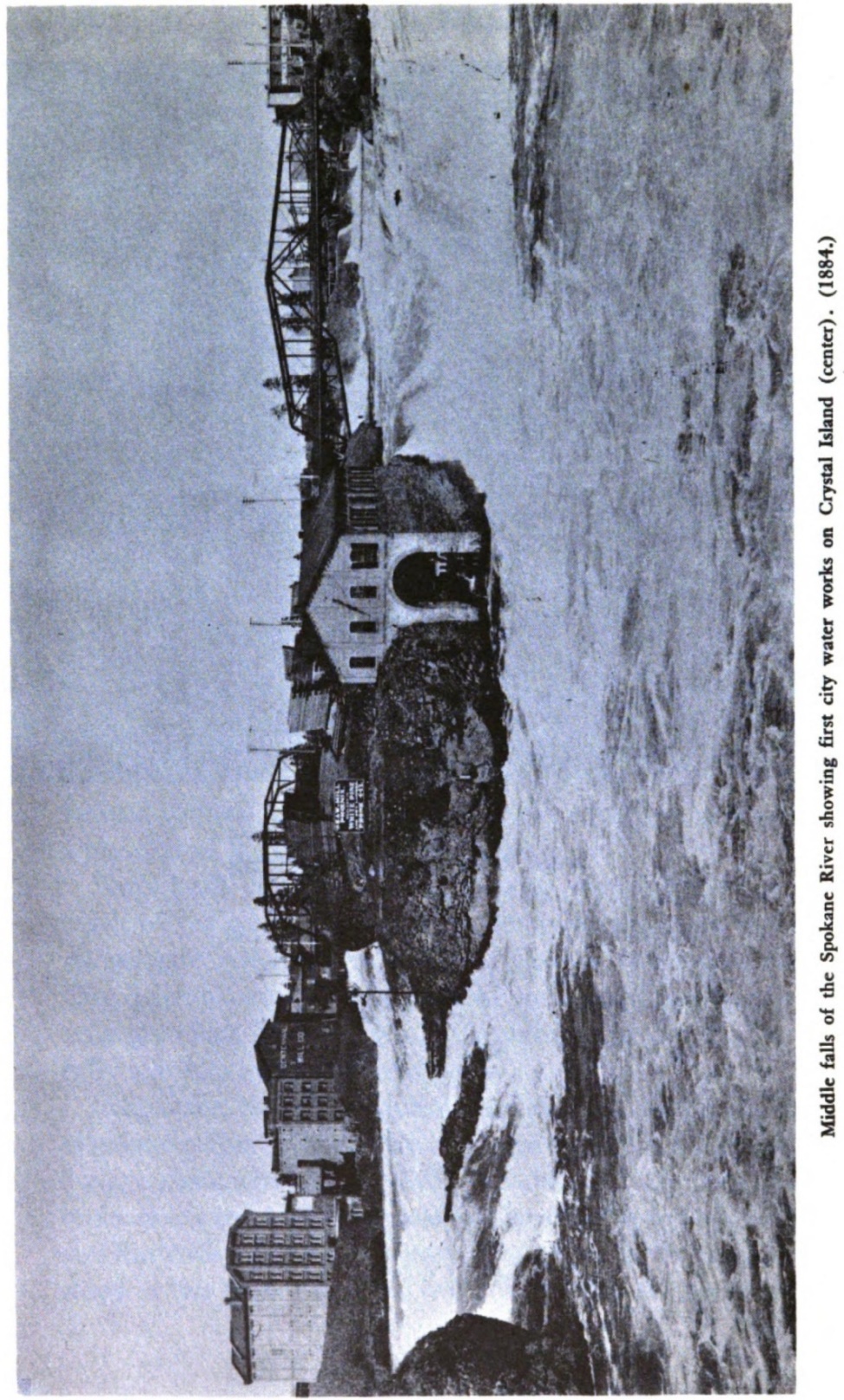
In spite of the two or three years of financial set-back, the later inroads of the Spanish American War, and the frivolities of the gay nineties as a whole, the robustious city by the falls made solid progress. By the end of the century, a number of ironworks, foundries, and shops were turning out mining machinery and metal materials. There were fourteen lumber mills and lumber manufacturing concerns. In flour milling the city held first place west of the Rockies, with no rival from Alaska to Mexico.{93} Wholesale and jobbing concerns developed a thriving trade in canned goods, groceries, dairy products, hardware, agricultural implements, books, and stationery. There was a gas plant and a telephone company, the latter boasting three thousand phones. Probably most important of all was the rapid development of hydroelectric power by the company whose story makes a chapter in itself.{94} At long last the neglected falls were being harnessed on a large scale. To this was largely due the industrial advance.
Education continued to progress. In neighboring communities two state institutions were getting solidly on their feet: the College of Agriculture (now Washington State College) in Pullman in the Palouse, and a State Normal School (now Eastern Washington College of Education) at Cheney. In the city of Spokane itself, a period of crowding, corruption, and quarreling in the public schools finally came to an end, thanks to wise administration by a competent superintendent and the co-operation of public-spirited citizens. A bond issue provided needed buildings, including a fine new high school. Superintendent Bemiss was as progressive as the up-and-coming city. Manual training was introduced, physical culture was emphasized, free textbooks were provided, and libraries were placed in each of seventeen new buildings. Pride in its public schools became a Spokane habit, a habit never since lost.
Privately supported boarding schools were also coming along. By 1895, ever active Episcopal Bishop Lemuel H. Wells let it be known that the city would soon have a young men’s academy. Nor was this all. Saint Mary’s Hall, a school for girls earlier known as All Saints School, was to be moved to a beautiful private residence in Browne’s Addition where, with Mrs. Wells as principal, it would be completely reorganized and refurnished. There, only six years later, it was to become Brunot Hall, an educational institution whence the daughters of socially minded parents emerged with the earmarks of culture and the social graces in which public schools were popularly supposed not to specialize.
That culture and social graces were demanded in the nineties in the city itself the local newssheets took pains to emphasize:
Spokane Falls [reported the Spokane Globe not long after the fire] is far beyond the conception most people unacquainted with the powers that are working a grander civilization in the West entertain....Refined, intellectual and energetic, the people that have taken up their homes in this charming wonderland would add luster to the most cultured court of the period. Our women are the pictures of health and the embodiment of taste...entertaining and sociable....During the winter season the ball-room and the theatre are the most popular amusements. No distinction is drawn between the rich and their less favored fellow-citizens. It is not Western, you know.
The ladies were not merely gifted socially, so the newspapers took pains to inform the world at large. They supported clubs devoted to literature, music and art. They organized an Art League which eventually became an art school staffed by local teachers, where pyrography and china painting were among the subjects taught. They were interested in every good work. The Ladies’ Benevolent Society saw to it that the city’s needy and homeless were cared for. It succeeded in erecting a Children’s Home, and, before the end of the century, in organizing a Women’s Exchange through which those slim of purse could supplement income by the sale of homemade items, particularly food and fancy work. Every church—and there were many—had a Ladies’ Aid or Guild devoted to other forms of charitable and religious work, while not a few followers of Frances E. Willard wore their white ribbons proudly and on occasion spoke up valiantly for temperance, law, and order.
For the men there were lodges galore—Masons, Odd Fellows, Elks, Good Templars, and the rest—and clubs, social, athletic, sporting, commercial, mutual benefit. Spokane was nothing if not gregarious.
Theatre-going, as so often mentioned, amounted to a passion in the new metropolis of the Inland Empire. Almost from its beginning the city had been known as a good show town, and many are the tales told of the varied theatrical attractions available within its limits.{95} With the advent of the railroads, the crude and very earthy entertainment offered in dives and upstairs saloon halls, as well as the shows put on by barnstorming troupes traveling the bunchgrass in their own conveyances and performing wherever the chance of an audience appeared good, were supplemented, though not replaced, by “variety” shows, later designated by the more elegant name “vaudeville.” Many were sponsored by circuits that tended to feature talent rather than liquor and lewdness as a means of entertainment and gained further respectability by playing in public halls above stores rather than in saloons.
On occasion, realism ran rampant, sometimes with unexpected results. Once a docile but frightened horse was led up three flights of stairs to appear in person on a Spokane Falls stage. He made a great hit, and all went well until the time came to return him to terra firma. At that point he balked. He definitely refused to descend the stairs fore-feet first. His ultimate return to street level hind-quarters first was an unscheduled feature which provided as good entertainment as the show itself. On another occasion, the honest-to-goodness flames playing against a background of poorly insulated scenery not only filled the room with smoke but scared the owner of the building into precipitately turning in a fire alarm. The audience scrambled pell-mell down three flights of stairs to the safety of the out-of-doors, only to return later to see the finish of the show and get their money’s worth.
Big Bertha, manageress of the American Resort, later the Casino, put on a welcoming stunt each night that rivaled the show itself. Bertha, as her name suggested, was “of generously upholstered proportions” and as the audience came in could be observed sitting in an ornate chair placed on a platform directly back of the orchestra pit. At the proper moment, a hand derrick was wheeled out on the stage, a line was made fast to the platform on which Bertha sat enthroned, and two husky stage hands turned a winch which lifted platform, chair, and beaming manageress bodily into the air and deposited the ensemble upon the stage. Safely established on this commanding elevation, Bertha made a welcoming speech, and the advertised show was on.
The “variety” was admittedly an improvement on earlier theatrical forms, but real ladies and the town’s more “respectable” citizens were inclined to raise their eyebrows at these still dubious performances. Straight drama was quite another matter. Announcement of Frank Mayo’s appearance in Davy Crockett at Concordia Hall was greeted with enthusiasm, in view of newspaper comment that the play “deals with the simplest and purest affections, and has a pleasing effect upon the nature.” Ticketholders swarmed into the Falls City Opera House to see Katie Putnam in East Lynne, to listen to Emma Abbott’s Opera Company in Bohemian Girl, and to enjoy others of the “very latest dramatic productions and operas presented by the best companies on the road.” Nor did support of the “better” things stop here. To house the Jeannie Winston Opera Company in the late eighties, public-spirited citizens went so far as to erect a temporary frame and canvas structure, and the city council did its part by authorizing the removal of several arc lights from the streets to provide illumination.
Completion at the beginning of the nineties of the long-awaited Auditorium Block had put an end to such expedients. The event was heralded in the daily news as an accomplishment of outstanding civic importance. Nor were newspaper panegyrics without justification; for occupying most of the lower portion of the five-story brick structure was a theatre so large and so elaborately appointed as to outdo any other palace of dramatic art in the entire Northwest, Portland and Seattle not excepted. Although privately built by J. J. Browne and Anthony M. Cannon, those two early promoters who had held on to their corner lot since the days when they had paid Jim Glover thirty-two hundred dollars for half of his entire Spokane Falls property, the community took the theatre to its heart as completely as a modern city embraces its civic auditorium. Orchestra, dress circle, balcony, and gallery offered accommodation for some fifteen hundred persons of modest means or less, while tiers of boxes provided appropriately gilded settings for evening gowns, ostrich plumes, aigrettes, furs, and jewelry to compare favorably with the best in Denver, Chicago, or even New York. So bragged the news. As for the stage, its dimensions were adequate to handle the cast and the most massive scenery belonging to any traveling company! And handle them it did: Sarah Bernhardt and accompanying cast in La Tosca; spectacles like Ben Hur with the famous chariot race; Richard Mansfield in Hamlet; and most of the other big names of the theatrical world who ventured so far west with supporting casts. Between times, local talent maintained the flow of money through the ticket window and helped to raise money for worthy causes.
From all points of view, the “gay nineties” were nowhere in the nation gayer than in Spokane. It was an adolescent city. Civic manhood was on the way but had not yet arrived.