
ON THE WESTERN BORDER of Hangman Creek, just north of the towering arches of a magnificent concrete bridge that now spans the stream, once huddled two or three Indian tepees. Above and about the bench of land where they stood were rocks big and little, excellent ammunition for mischievous boys staging a thoughtless raid with well-aimed stones and boulders sent crashing down into the tepees. If the barrage was successful it might bring into the open a short, wrinkle-faced old Indian wrapped in his blanket, and with him a stalwart squaw, his daughter. As the marauders beat a hooting retreat, Nelly shook a fist at their backs and old Spokane Garry{24} shrunk back into his tepee in silent dejection.
Garry was the eldest son of Illim-Spokaneé, head chief of the Sin-homan-naish or salmon-trout-people. At the beginning of the nineteenth century this was a large and powerful tribe, later known as the Middle Spokanes.{25} Illim-Spokaneé himself was widely known and respected by the early fur traders, who named after him the tribe, the river they fished, and the country they inhabited. It was probably thus, though with several variations in spelling, that all finally acquired the name “Spokane.”{26}
Sir George Simpson, in charge of Hudson’s Bay affairs west of the Rockies when Garry was a boy, took a more than commercial interest in the Spokanes and neighboring tribes. He found them intelligent as well as friendly, a people who lived simply but well on fish and camas root, moving from fishing grounds to camas prairies as the season dictated. It would be worthwhile, he thought, to try the experiment of sending certain of their young men to an eastern school in the hope they might return as teachers of their people. “Pick for me,” he requested Alexander Ross, “a promising boy of the Middle Spokanes and another of the Kootenais” to be sent to the Protestant mission school conducted at the Red River Settlement (Winnipeg).
When Ross put Simpson’s request before Illim-Spokaneé and a chief of the Kootenais, they cogitated earnestly and called several councils on the matter. Sir George, they reasoned, was a good and kindly man. It would profit the Indians to know more of the ways of such men, blessed as they were in the knowledge of many useful arts, skillful in the hunt, successful in trade. Theirs must be a remarkable God to provide them with such gifts and such knowledge. In their school the Indian boys might not only learn new skills but win favor with that God and, as Ross had pointed out, return to pass on to their people what they had learned.
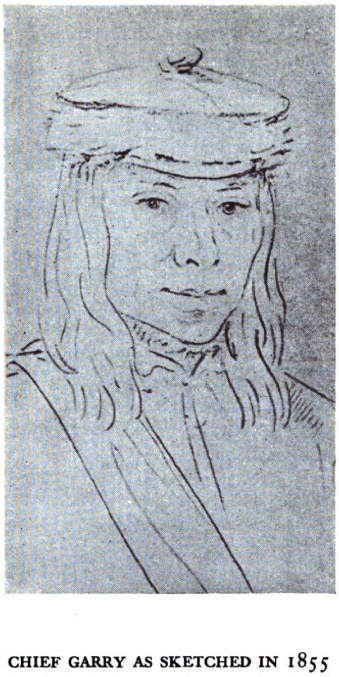
Illim-Spokaneé decided to send his own eldest son and future chief to Red River. The chief of the Kootenais made a like decision. “You see,” they proudly explained to Ross, “we have given you our children, not our servants or our slaves, but our own. We have given your our hearts, for our children are our hearts.”{27}
As schoolboys, the two young Indians acquired English names. One became Spokane Garry and the other Kootenai Pelly, thus perpetuating the names of certain officials of the Hudson’s Bay Company. Pelly died at the school; but for five years Garry studied under white teachers, learning to speak, to read, and to write English, and, some say, French. He came away a convert to Christianity and a good interpreter. The latter accomplishment, added to his native gift for rhetorical expression, was in time to make him an outstanding figure in councils between whites and Indians, and also, as the missionaries at Tshimakain were to learn, a religious orator of parts.
Besides languages, Garry acquired at the school considerable knowledge of agriculture. He also acquired some of the veneer of civilization, including the white man’s shirt and pantaloons, though for topcoat he clung throughout his life to his blanket.
About 1830 when the young chief was some nineteen years of age, he returned to the Spokane country full of zeal to carry on as teacher and preacher. His enthusiasm and willingness to be helpful were so great that other chiefs in gratitude presented him with two wives. In effect he became chief of the Upper as well as the Middle Spokanes.
Just below what is known in Spokane as the North Hill, he at once started a school. The site was by Drumheller’s Spring (now Euclid and Maple Streets). There he prevailed upon his fellow tribesmen to put up a twenty by fifty foot building; and there in winter for several years he read the Bible to his pupils old and young, put them through the Minor Historical Catechism, taught them the Ten Commandments and how to pray to the Christian God. Also he instructed them in some of the arts of agriculture: how to raise wheat and garden vegetables such as they had seen growing at the trading posts.
On the surface he was successful. But there began to be murmurings. After all, he was but a youth. It was not for a stripling to advise his elders on matters of religion and food. As at Tshimakain later, questioning arose. Had not the salmon in the river and the camas on the prairies always provided ample provender? Were not the hills carpeted with grass on which their ponies waxed strong? Nor were such practical considerations the end of the matter. Was there not an element of the sacrilegious in Garry’s teaching? The earth was their mother. To tear her flesh with a plow or scar it with fences was a desecration that might well invite the anger of the gods.
Fortunately, not all of Garry’s pupils criticized or made fun of his new-fangled ideas. In time, quite a few were cultivating gardens and growing grain. Nor did Garry lack for converts to the new religion. Many of his tribesmen became his devoted followers. “He told us,” reported Curly Jim, “there was a God up above. If we were good, then when we died we would go up and see God.” White men, Garry told them further, had learned about this God through a Book—the very Book from which he read to them. Undoubtedly, thought Garry’s pupils, it was Big Medicine; but its teachings were hard. They must not steal; they must not kill. They must keep all the Ten Commandments. To disobey any meant facing the fires of Hell, in depicting which Garry was a past master. Nevertheless, numbers of the Spokanes continued to attend the school at Drumheller’s Spring which went on intermittently for a few years as the necessities of food gathering permitted. Meantime, Garry’s fame spread. Members of the Colville, Okanogan, Flathead, and Nez Percé tribes came to visit him and to ponder his new teaching.
When the missionaries arrived at Tshimakain, Garry’s relations with them were polite if not cordial. He helped them master the Spokane tongue, he translated their sermons until they could speak for themselves, and he worked with them on the translation of parts of the Bible. Yet at times his co-operation was, to say the least, lukewarm. Cushing Eells and Elkanah Walker were not particularly gifted in the art of sympathetic understanding. Undoubtedly, Garry felt that at times they took the spotlight from him; also that when co-operation was demanded there might well be more of it on their side. He needed their help and encouragement as much as they needed him, for his religious enthusiasm was already beginning to wear thin in the face of Indian backsliding, disaffection, and ridicule. Another cause for discouragement was the progress of the Jesuit fathers in their missionary work among the tribes of the interior. As Catholics, their converts told the Spokanes the religion expounded by Garry was heretical, and the Spokanes reacted by scolding and ridiculing their young chief. Hurt to the quick, Garry had given up his school. He was “jawed” too much, he said. Sir George Simpson, visiting his protégé in 1841 found him unkempt and unclean, his hands full of filthy cards with which he was gambling with others of his tribe. He was not even polite in greeting his benefactor, and his manner was so sullen the Hudson’s Bay official made off in disgust reflecting on the uselessness of trying to civilize the red man. Simpson’s report on the encounter made sorry reading. It is well to remember, however, that the keenness of Sir George’s disappointment may have caused him to exaggerate Garry’s backsliding.{28} Like other reformers, the young Indian chief was human. He was far from being the first to retire like the prophet of old to sit for awhile under his particular juniper tree feeling sorry for himself.
He did not sit there indefinitely. After Tshimakain was abandoned, he kept the flames of Protestantism burning among his people as best he could. When in the early sixties the Jesuit fathers undertook to establish a mission near Garry’s home among the Upper Spokanes,{29} he called for Protestant missionary aid and himself undertook camp meetings and revivals to hold his converts in line. In this he was not unsuccessful, for, as already noted, by 1873 Henry Harmon Spalding, still carrying on as a missionary in Idaho, came at their request to confirm them in their faith and to baptize a large number as Protestant Christians.
On the agricultural side, Garry’s efforts also produced lasting results. When Governor Stevens arrived in the Spokane country in 1853, he was pleased and astonished at the progress some of the Spokanes had made under Garry’s tutelage plus the example of Tshimakain. Garry himself, reported the Governor, was a man of judgment, vision, and reliability, with great influence over his people. He had recently contracted for a flour mill on the Little Spokane, and he had flour, sugar, and coffee on hand in sufficient quantity to supply the Governor’s party. That was something to write to Washington about—as was the appearance of Garry’s lodge as reported by members of the party who visited him. It was neat and comfortable beyond anything they had yet seen; his family were dressed in the costume of the whites; the chief himself extended the hospitality of his home with a cup of tea or coffee and bread.
At Stevens’ request, the Spokane chief, together with one of his brothers, became members of the Governor’s party for the length of its stay in the Spokane area. Garry supplied the expedition with horses and sent through important messages for the Governor. Later, he carried mail all one winter for Captain Mullan, an engineer on Stevens’ staff who had been commissioned to build the road that came to be known by the young builder’s name.{30}
Like all the Indians of the interior, Garry was by now distinctly worried about white immigration. The Spokanes had several main camps which might be called home spots in the wide territory which they claimed as theirs; that is, from the head of Tshimakain Creek to the mouth of the Spokane; down the south bank of the Columbia to the mouth of the Okanogan; south to the head of the Snake watershed; east to about the present Post Falls and Rathdrum. But they also wandered at will over a much larger area bent on hunting or bartering, or for pleasure alone. They had many horses; and with the prosperity initiated by the fur trade and the produce of gardens and fields, as well as the food provided by nature, they lived easily and pleasantly on the land and wished to continue doing so.
So far they had had no quarrels of any consequence with white men. But they had not failed to recognize danger signals. Members of the Sinclair party of immigrants noted in Mary Walker’s diary had settled on Spokane lands. Cattlemen with as many as six or seven hundred head of cattle and nearly as many horses had wintered in the Spokane valley.{31} Miners bound for Colville gave small attention to Indian rights. When, at a great council held in Walla Walla in 1855, Governor Stevens proposed depriving the interior Indians, including the Spokanes, of large areas of their lands and placing them on reservations, several tribes at once broke into open warfare, among them the Yakimas.
Although present at the Walla Walla council, Garry took no part because there was to be a separate council for his people and those farther north. When that came about he opened his heart. It was a bad heart, he said, more bad than good, for if Stevens did not succeed in making peace with the Yakimas, trouble was sure to come. War would flood into the Spokane country “like the waters of the sea” and white blood would be shed where it had never been shed before at the hands of the Indians. Some might be spilled by his own young men, he hinted. They were hard to control, and none of the Spokanes were happy at the idea of being confined on a Nez Percé reservation, as had been suggested at the Walla Walla council. At that council, he told Governor Stevens, “I thought you spoke bad. Then I thought you would strike the Indians to the heart.” He added that the Spokanes knew something of the advantages in schools and shops and farms, aspects of reservation life emphasized by Stevens. But it was not worth abandoning their lands to secure such advantages. “If,” said Garry, “you had asked the chiefs themselves to mark out a piece of land—a pretty large piece—to give you, it would not have struck the Indians so to the heart.”{32}
Throughout the council, Garry pleaded for his people with simple eloquence:
When you look at the red men, you think you have more heart, more sense, than these poor Indians. I think that the difference between us and you Americans is in the clothing; the blood and the body are the same. Do you think that because your mother was white and theirs dark, that you are higher or better? We are dark, yet if we cut ourselves the blood is red, so with the whites it is the same, though their skin is white. I do not think we are poor because we belong to another nation. If you take the Indians for men, treat them so now. If you talk to the Indians to make peace, the Indian will do the same to you. You see now the Indians are proud. On account of one of your remarks, some of your people have already fallen to the ground. The Indians are not satisfied with the land you gave them....If those Indians had marked out their own reservations, the trouble would not have happened. If you could get their reservations made a little larger they would be pleased. If I had the business to do, I could fix it by giving them a little more land.{33}
The council, though stormy, ended on a friendly note, even though it did not make Stevens retreat from his plan to place the interior Indians, including the Spokanes, on small reservations; nor did it prevent troops from later invading the Spokane country in pursuit of the enemy Yakimas, whose warriors, as Garry had warned, mingled with the Spokanes and incited them to war. At the conclusion of the council, the Spokanes provided fresh horses for the Governor’s party, gave up some of their own rifles needed by Stevens to arm his small force, and offered to escort the party as far as the Snake River.
The ensuing correspondence between Chief Garry and the Governor is revealing. “As for us, we are for peace,” wrote Garry, adding that he had heard the Nez Percés were talking war and that made him uneasy since they stood to gain nothing by it. He had heard, he noted, that Stevens “talked hard” about the Spokanes, but he didn’t believe it. It was all the Yakimas’ doings, “for they want me to go to war by all means; but I would rather be quiet. When we meet next we can have a good understanding together, for I will keep nothing from you and expect the same from you.”{34}
To this Stevens replied he did not believe the stories about Garry and was happy that Garry was not being misled by the stories against him. “The Spokanes,” Stevens added, “have always been good Indians.”
To Major-General John Wool the Governor later set forth Garry’s position in detail:
The letter of Garry, chief of the Spokanes, is a most plaintive and earnest call for help, so his hands may be strengthened in keeping his people to their plighted faith; and the coincidence is remarkable that this Indian chief, a white man in education and views of life, should ask me to do the very thing I have urged upon you; for you will remember, in my memoir, I urged that the troops in operating against the Indians, should be interposed between the friendly and hostile tribes, to prevent those now friendly from joining in the war. I have, sir, studied the character of these Indians, and my views as to the influence upon the friendly Indians, of the mode of carrying on the war against the hostiles, are confirmed by the only highly educated Indian of either Oregon or Washington, and the head chief of the very tribe in reference to which I have made this recommendation and felt the most solicitude.{35}
Had Garry and Stevens had their way, the Spokanes might have remained completely outside the devastating wars that followed close on the heels of this correspondence. Unfortunately they did not, and things went from bad to worse. Unscrupulous whites stole cattle and supplies from friendly Indians, Indians pilfered and carried out stampedes. Irritation and anger surged into bloodshed. Indian “atrocities” grew in number and gruesome detail as they reached white families by word of mouth. Indian men, women, and children, the just with the unjust, were shot at and killed. Finally, Colonel Steptoe, marching his troops through the Palouse country in search of thieves, crossed the Snake into Spokane territory. When word spread through the Indian grapevine that this was an invasion, Garry and others of the chiefs rode into the Colonel’s camp. What had he come for? Did he not see what the friendly Indians would think?
Returning to his people, Garry reported to them and also to neighboring groups that the soldiers did not want to attack them. They were merely passing through. This was true, for Colonel Steptoe purposed going quickly north to Colville in response to a frightened appeal from that quarter.
Most of Garry’s people believed him. Neither they, the Pend Oreilles nor the Coeur d’Alenes wished to put an end to fifty years of friendly intercourse between themselves and the whites. But Indian communities were not unlike white ones. They had their high-spirited, daring, and impatient young bloods who could not be restrained. In spite of everything Garry could do or say, and he said much, a few Spokanes joined in an attack on Steptoe.
When that officer was defeated near the butte bearing his name and obliged to retreat across the Snake, outraged military officials decided upon immediate reprisals and announced that the leaders responsible for the attack must be surrendered at once for punishment.
Again Garry interceded for his people. “When the fight was over,” he wrote General Clark, who was in command of the Department of the Columbia, “I was thinking all the time to make peace, until I was told that Colonel Steptoe had said, ‘I won’t make peace now with the Coeur d’Alenes and Spokanes. I will first shoot them and then, when they shall be very sorry, I will grant them peace.’ Hearing that, I thought it was useless for me to try to make peace.”{36}
Turn over their friends and members of their families to the Colonel to be shot without trial the Spokanes would not. Neither would the Nez Percés. It was contrary to every instinct of loyalty, and they knew of too many cases where Indians had been strung up or shot on slight evidence, or at least with slight understanding of their codes of ethics. How could General Clark expect them to become informers in face of the fact that the government he represented had never made any consistent effort to understand the Indian point of view about giving up tribal lands? It was unjust, Garry protested, that Indians should be punished, without a hearing, for violations of laws with which they were not familiar or which cut across traditional codes. Once more he reminded his white enemies that if only they would take the Indian chiefs into their confidence and deal with them like men the matter of white settlement could be adjusted.
Quite probably Garry overestimated the innate good will and reasonableness of the interior chiefs as a whole, for by this time they were disillusioned as to the kindly intentions of the strangers they had once welcomed; but what he said was true of himself. He was far too intelligent a man to underestimate white power. He foresaw the inevitability of ultimate defeat. But he thought the Spokanes should be allowed to retire with dignity, having had some voice in the decision of their fate. In view of their long record of friendliness, they should at least be consulted as to which of their lands they should give up and where they should go.
Such talk was useless. It not only fell on the deaf ears of the whites, but was beyond the grasp of many of his own people. In September, 1858, a punitive force under Colonel George Wright met the forces of the allied interior tribes, including a good many Spokanes, in the Four Lakes district some fifteen miles southwest of Spokane. There within four hours, the Indians were routed. Wright was a competent officer, his force was armed with a new long-range rifle. Five days later, after a running fight covering fourteen miles, the white troops camped on the present site of Fort George Wright, leaving behind them a decisively beaten foe.
Three of Spokane Garry’s brothers and a brother-in-law were among the Indians who lost their-lives in the fighting. Stricken, but still an apostle of justice, Garry spoke again. The Spokanes, he insisted, should not all be made to suffer for the mistakes of the hot-heads among them. But Colonel Wright was heading an expedition bent on retribution. Punishment was his business. Curtly he directed Garry, “Go tell your people and all other Indians to come in at once—men, women, and children—and lay down their arms.” If they did not, he added, he would fight them until none were left.
Without more ado, the Colonel moved his troops up river toward Liberty Lake, taking time along the way to hang a Spokane chief who had come into camp and surrendered. Then, to inflict punishment where it would hurt most, he not only had his men slaughter outright eight or nine hundred captured Indian horses, but ordered the soldiers to burn buildings filled with grain wherever found.
To a Spokane, his horses were his bank account. He not only rode them for pleasure and for profit; they were the coin with which he traded for buffalo hides and paid his gambling debts. The loss inflicted by Colonel Wright was irreparable. Small wonder that a “peace” treaty was shortly signed for the Spokanes by their chiefs, including Garry and Big Star. The occasion was a council held on Latah Creek; the date September 23, 1858. In the days immediately following, the Latah acquired a new name. From pine trees on its bank, ten Indians were hanged. To this day the stream is called Hangman Creek.{37}
Garry was still the most respected and best-known chief among the Spokanes. He also continued to have the respect of many whites, including certain army officers and Indian agents who in the course of their dealings with him became familiar with his sterling qualities. Patiently he went about the task of reconstructing the life of his people. The year following their defeat, he wrote General W. S. Harney, commanding officer of the Department of Oregon and Washington, that the Spokanes were “ready and willing” to sell their lands and have roads made through their country. Wherever they were sent, they wished to have an Indian agent and soldiers live near them for protection. For himself, he hoped the reservation to which they might be assigned would be located where they would neither disturb white settlers nor be disturbed by them.
General Harney forwarded Garry’s letter to the proper office in Washington, D.C., enclosing a covering message of his own. In justice to the Spokanes, he wrote, their humble request for protection and a spot where they could live undisturbed should be granted.
Duly these letters were called to the attention of the Secretary of the Interior, but nothing came of them. With other chiefs and Father DeSmet, Garry attended a conference on Indian affairs held in Vancouver. Afterwards, the chiefs spent some time visiting about the state as Uncle Sam’s guests. Nothing came of that either. Poverty-stricken, disinherited, with no spot officially theirs, the Spokanes did the best they could, living from hand to mouth—and rapidly deteriorating.
After fifteen years, another Commanding officer had a conference with Garry at the falls of the Spokane and curtly ordered him to be good. In 1877, at a Council growing out of the Nez Percé war under Chief Joseph, a war in which the Spokanes had refused to become involved, Garry was promised that if his people remained at peace they would be well provided for. But they never were.
The year 1880 saw another futile council involving some three or four thousand Indians and eventuating in the usual specious promises. The following year it was made known to the assembled Spokanes that they could have their choice; either take up land in severalty, or go on a reservation west of the Columbia in an area they had never called theirs. Individuals among them were already engaged in fanning, and others might undertake to become agriculturalists. But move to a reservation west of the Columbia the tribe would not. It was asking too much to expect them to herd with tribes who were their traditional enemies. In the absence of a reservation of their own they would continue as they were, getting along as best they could on land not yet overrun by whites. In the face of their determination, the government at Washington did not insist. Out of the long war with the Nez Percés, caused by removing that tribe from their ancestral lands, Washington had learned a few things.
Garry was growing old, but he was still no fool. In 1887 he made a last and again useless attempt to have a reservation definitely assigned to his people. In the meantime, he himself had lived on and competently farmed an excellent piece of land somewhat east of what was to become the town of Hillyard. Under the agreement finally entered into during the 1887 negotiations, title to such homesteads was supposedly assured the Indians, especially if they became citizens, which Garry attempted to do. Meantime, he enclosed his parcel of land with a log fence and improved it in every way.
Garry was a good farmer, but he liked fishing too. One day during the fishing season he went with his family to a temporary Indian camp on the Spokane River. His fields were in crop, harvest time was yet to come, he could conscientiously join his tribesmen in securing the salmon which still formed so large a part of their subsistence. Perhaps he might also confirm them in the Christian faith.
Word came that his claim had been jumped. When he hurried back to his home and land he was ordered by the white men in possession to get off and stay off. All his efforts to regain possession were fruitless. Legal procedures proved as futile as argument. The newcomers had filed on the land and their claims were allowed to stand in spite of the evidence inherent in Garry’s improvements, his fence, his growing crops. What was one Indian more or less, even though he happened to be a “good” Indian?
Dispossessed and unable to secure another farm, the little, old chief returned to life in a tepee. He had been a man of substance, with many horses, a small herd of cattle, and a modest income derived from the barter or sale of farm produce, often to pioneer whites who without the products of his farm would have been considerably put to it to provide themselves and their animals with sufficient food. The pension of one hundred dollars a month promised him in one of the agreements entered into with the government had not arrived. It never did arrive. His horses became the prey of passing miners who took them away without bothering to pay. One after another, his cattle had to be killed to supply food for his family, reduced first to a blind wife and a stalwart daughter and finally to his daughter Nelly alone, who helped eke out their existence by washing clothes for white settlers in the village growing up by the falls of the Spokane. There the short, “pot-bellied, shriveled, blear-eyed old man” shivering in the blanket that topped his dingy civilian clothes as he rode or led through the streets his ancient white horse was eyed disdainfully by newcomers unacquainted with his past. He was just another dirty old savage better out of the way. White boys not only rolled boulders into his camp on Hangman Creek, but found other means of annoyance, as thoughtless boys will.
All along, life for the Spokane Indian chief who as a youth had been the first of his tribe to secure a white man’s education had been a series of bitter disappointments. In later life, rival chiefs had at times foresworn his counsel. William Three Mountain was one. While Garry was still trying to secure a tribal reservation, William had headed a doubtful homesteading experiment on Indian Prairie six miles below Deep Creek Falls. Thanks to Thomas Henry Cowley, devoted friend of the Spokanes, the colony survived despite Garry’s open opposition.{38} Another rival was Chief Whistle-Possum (Lot) who finally accepted for the Lower Spokanes a small territory at the mouth of the Spokane River ambitiously announced as the Spokane Reservation, though it took care of but a fraction of the tribe.
No wonder that the dignity and determination with which as a young man Garry had attacked the problems of his people gradually gave way to a sorrowful acquiescence, shared by those who were his friends but mistakenly identified as sullen bitterness by such as observed only his gruff manner and stern features.
Garry was seldom bitter. Along the way, many white men had spoken ill of him, and some still did. He had been bumptious, insolent, and an instigator of Indian unrest, they said. Careful investigation has shown the majority of such complaints arose from hearsay or from pique on the part of jealous Indians or covetous whites who held the too common belief that all Indians were “vipers and varmints,” or who resented the little chief’s proud bearing and ability to plead his cause with the logic and skill of a well-trained lawyer.
Toward white men who met him on anything like even terms and treated him fairly, Garry’s attitude was perennially friendly. No saint, he admitted his shortcomings frankly. In the main they were surprisingly like the failings of many of his white detractors. Garry gambled. With the Spokanes to do so was as natural as breathing and as little regarded as a sin until missionary teachers told them otherwise. The little chief was no wastrel, and there is no reason to believe he was either a professional or a perennial gambler. Sometimes he drank too much “fire-water.” He liked liquor but usually kept his appetite under control. Once he did not and his indulgence put him in jail for the night. His remark next morning was laconic. It served him right, he said. He had no business to get drunk.{39}
When life on Hangman Creek finally became intolerable for the old chief and the two or three Indian families who camped there with him, the owner of a tract of land near Indian Cañon came to the rescue by granting them the privilege of moving there. It was in this camp that the weary son of Illim-Spokaneé, head chief of the Middle Spokanes to whom Spokane owes its name, said his last prayers in 1892 and departed for the Heaven prepared, as he steadfastly believed, for good Indians and upright white people alike. A Presbyterian minister preached the funeral sermon and friends laid him to rest under a little wooden cross in a white man’s cemetery.
So passed Spokane Garry.{40}