
ON A SUNNY DAY in the early nineties a stout-wheeled wagon lumbered through the mingled bunchgrass and sagebrush that painted the Big Bend a monotonous grayish green. Protruding some distance in the rear was an oaken coupling pole which held front and back wheels together. Perched precariously on the pole was a boy aged some nine years. From this vantage point he had gazed, sadly back at his beloved Blue Mountains when, a few days earlier, with father and mother he had left the Walla Walla valley behind.
The family sojourn in the valley had been a happy time for Joey Ashlock. There had been plenty of other children to play with. In the old Union schoolhouse he had absorbed his three “R’s” with avidity—particularly reading, for he was even at that early age a devoted lover of the printed page.
Now all these pleasant circumstances and companionships were left behind for good; nothing remained but wistful memories. However, the family trek across the bunchgrass would soon be at an end and Joey, like any normal boy, turned his thoughts to the future hopefully. It would mean new playmates and perhaps an even nicer school. There would be new schoolbooks to read and study—and a lovely new home—one of their very own! Joey’s father and mother had talked so much about the latter that Joey had a very clear picture of it in his imagination. “There would be a nice white house, a windmill, a creek with lots of trees and shade, and fish and birds’ nests; there would be lots of ducks and geese and guineas and turkeys—all stealing nests in the brush....There would be lots of children to play with.”{51} Waiting to welcome Joey and his parents would be the kindly people who had prepared the home for them.
What Joey really came to was a double-boarded, one-room shanty built with ax, saw, and hammer. There was no studding between the walls, and no air space to shut out winter cold which might, and on occasion did, go to twenty degrees below zero.
Joey was disappointed, though he kept the keenest of his disappointment to himself. For, strangely enough, Father and Mother Ashlock seemed to think this was about what could be expected. At any rate, they regarded the situation calmly, and even with a trace of exhilaration. It was stark, it was crude, and it would be rugged. But what of that? Here was opportunity; a farm and a home of their own. For these they were willing to go through lonely, silent winter days; to work their fingers to the bone if need be; to forego for a while the trappings of a civilization pretty well left behind—frequent mail, newspapers, well-made clothes, music, church, the companionship of near neighbors.
Joey’s school did not materialize until he was eleven. Instead of a creek with clear pools there were mudholes. For playmates there was for a long time not even a dog; only birds, pigs and chickens, and little animals of the bunchgrass and sagebrush. Among the last were squirrels—and these, alas, turned out to be such enemies that they had to be snared or shot to death.
On occasion Joey’s father and mother fared back to Walla Walla in the wagon to purchase food, clothing, and farm supplies. The journey took days; and meantime somebody had to stay behind to look after pigs and chickens and herd the few cattle. Necessarily, that somebody was Joey. Left through the long, lonesome days to his own devices, the boy made many discoveries. Most notable find of all was a cache of old newspapers and periodicals of lurid content in a deserted cabin whose walls were lined with similar products of the printing press. Joey read them all; from the top of the pile in the corner to the bottom, and from ceiling to floor, skipping nothing.
When his parents came back at last, the wagon loaded with root vegetables and fruit, it was Joey’s seemingly endless task to cut the latter for drying. The peaches, pears, and prunes he halved with a sharp knife and spread in the sun on boards mounted on sawhorses. Big apples cut in eighths he also laid out in the sun. It was a messy, sticky job; not half so interesting to Joey as to the wasps, bees, and occasional hornets that swarmed about the feast and left not a few redly painful lumps on the boy’s hands and arms and any other accessible parts of his anatomy.
While still in the process of growing up, this boy of the Big Bend bunchgrass had several narrow escapes on foot and on horseback from the ever-present rattlers lying hidden among the rocks or clumps of grass. Mounted on his cayuse, he slipped and slid down the rocky wall of Grand Coulee to view with the wide eyes of a teenager life as lived in a stockman’s rendezvous, where saloon, dance hall, and a store displaying wares laboriously freighted in, relieved of their wages the Rattlesnake Jacks and Sure-Fire Bills who came loping in from the plateau. Sometimes the saloonkeeper or a stock baron staged a ten-gallon party. Then Joey soaked up the music of fiddle, accordion, and Jewsharp with appreciative ears, as he peered curiously at festivities that distrust of his adolescent feet or possible parental disapproval kept him from joining.
All this and more Joey Ashlock, grown to manhood and a career in journalism, put into his Ups and Downs of a Bunchgrass Boy, an autobiography appearing in the forgotten pages of The Washington Farmer. Save in the charm of its telling it is not an unusual narrative. The experiences of the Ashlock family varied only in date and detail from those of other settlers lured to the Big Bend and the Palouse by the generous provisions of the Homestead Laws. The first of these in 1862 had set forth that anyone who was head of a family or who had arrived at the age of twenty-one, and was a citizen of the United States, or had filed his declaration of intent to become one, could become the owner of a whole quarter section of land for a cash outlay that was ridiculously small, if he lived on and cultivated the quarter for five years. Subsequent enactments reduced the term to three years and permitted filing on three hundred and twenty non-irrigable, untimbered acres, or twice that amount of stock-raising land. Tempted by the prospect, families began moving into the northern Inland Empire a few at a time, and then in greater numbers, as access became easier, free land elsewhere less abundant, and the stories of marvelous crops increased in numbers and allure. From Minnesota, the Dakotas, and near-by states came Scandinavian farmers enticed by milder climate as well as free land; from the South, groups fleeing the aftermath of Civil War; from the Willamette valley and up from California, pioneers born with itching feet and an urge to try their luck on virgin soil.
As the Ashlocks found, making a living on the land opened for settlement was, however, beset with difficulties. While a goodly number of early “sod-busters” won through to financial competence and comfortable living, and some to wealth, many gave up in disgust or utter defeat. In the Big Bend especially, plenty of acreage was scabland, glacier scraped, and with soil too thin for anything but grazing. The deep and potentially fertile soil of other areas could not be made to produce without irrigation on a large scale or without the application of special techniques in dry land farming, both matters of the still distant future. If a family was fortunate enough to have selected a claim abutting on small lakes or water courses where physical conditions were propitious, there were still other difficulties to face: Indian unrest; lack of, or inaccurate, surveys; jealousy on the part of stockmen; and always, a lonely and rugged life.
How serious a menace to settlement Indian hostility became in the period between the fifties and seventies can be guessed from the story of Spokane Garry. Indian raids and military campaigns followed each other in rapid succession, and the settlers lived in fear and uncertainty.
Inadequate surveying and sketchy political organization were serious handicaps. How could the settler be sure another might not claim his land when the boundaries of his three hundred and twenty acres were marked chiefly by rocks, rills, or ridges? Possession might be, and usually was, nine points of the law, but with the General Land Office in Washington thousands of miles away and its “local” offices a distance of several days journey, securing justice when possession proved inadequate might be so long-drawn-out a process as to be wholly impracticable.
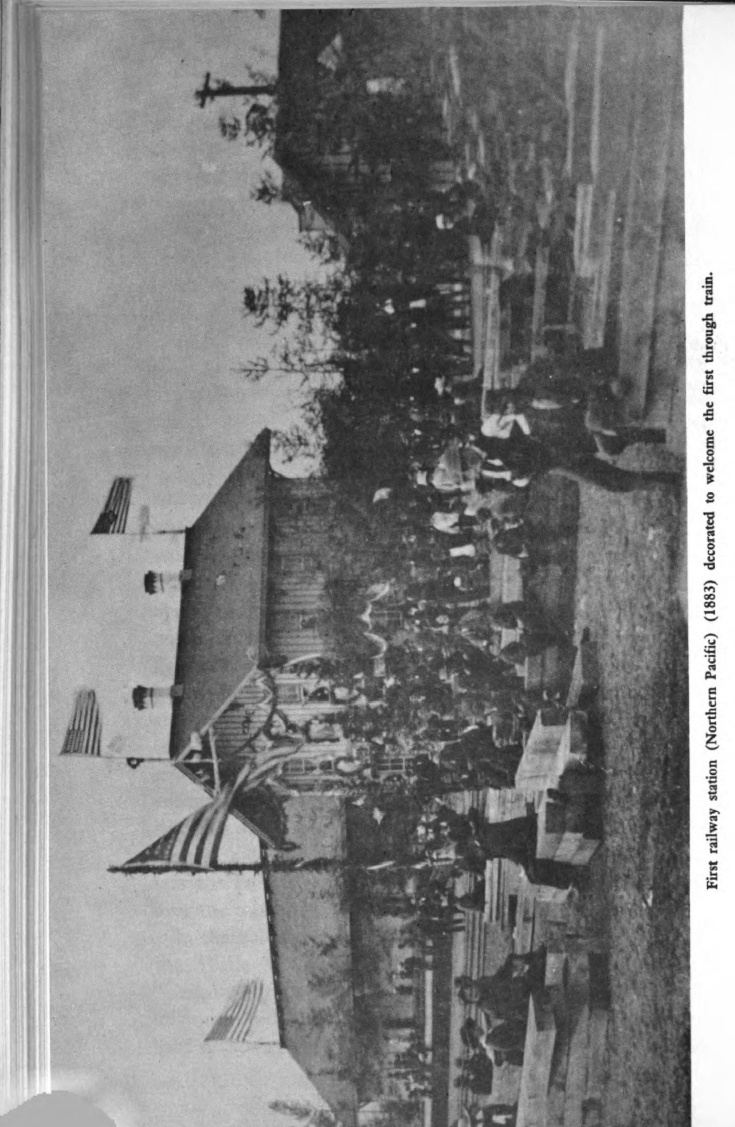
Lack of transportation was so critical for the “sod-buster” that as time went on “We want roads” rose like a schoolboy chorus from the ranches and ran like a theme song through successive petitions to the United States government. Wagon roads helped, but railroads were vitally necessary where population was so sparse and markets great distances away. Even after the railroads came, there was still trouble. Rates were high, elevator space lacking; or the road failed to run where the settler had supposed it would and he was left as far as ever from transportation.
Between stockmen profiting by the free grass of the open range and the farmers turning the bunchgrass under the sod there was waged for years a “cold war” flaring into regrettable “incidents.” A thousand head of cattle would “accidentally” be stampeded through a field of growing grain, or a band of blanketed and feather-decked cowboys would simulate an Indian raid. Other forms of persecution were invented to scare away the faint-hearted. Organized farmers retaliated with gunfire, or efficiently disarmed the make-believe Indians and collected damages by sequestering their cattle.
Fences that might have cut down such encounters were slow in appearing. Many a settler lacked the funds to string miles of barbed wire, and anyway, it was the stockman’s business to keep his herds out of cultivated land. As for the stockman, he loathed the cruel strands in which he found his flocks and herds entangled.
By 1880 the feud had reached such an impasse that, at the November election, citizens in certain counties in Washington were asked to express their wishes on ballots reading “For fence law” and “No fence law,” the results of the voting to be turned over by county auditors to members of the legislature “as a guide for future legislation in regard to fence laws in their various counties.” Thus is said to have originated in Washington Territory the idea of the referendum.{52}
On the Big Bend plateau and the hills of the Palouse annual rainfall is inadequate for agricultural purposes and many years were to pass before wheat growers from the Middle West mastered the techniques of dry farming and allowed fields to lie fallow each alternate year to collect moisture. Then, of course, they could ignore the cloudless skies. But not until then. Many a settler seeded the deep volcanic soil of his claim only to see the fresh green fields of spring wither away under the summer sun.
The Ashlock story points up the problem of isolation, both social and geographic. Women and children particularly suffered from the lack of human contacts. As the housewife molded her bread and stoked the kitchen stove, she worried over the welfare of loved ones back home, whose letters came with maddening lack of speed. As late as the seventies, long after the rumble of a train meant mail to the outside world, letters were still being delivered to postmaster Cowley at his bridge on the Spokane by horsemen who drew up their sweating Cayuses with the flourish of early California post riders, tossed off the mail sacks, mounted fresh horses after a hasty meal, and were off in a whirl of dust to the shouts of men who must cover long miles on horseback before letters and newssheets could be placed in the hands of waiting families and friends.
Unexpectedly cold winters which brought disaster to the stockman’s flocks and herds were not so generally a homesteader’s catastrophe, though they helped to make his life grim and often damaged his small domestic herds. More greatly feared by the sod-busters were summer catastrophes. The Kansas farmer who in 1877 announced he was going out west because grasshoppers were making more headway in his part of the world than he would ever make could not possibly foresee that six years later hordes of big black crickets would swarm out of the earth in the Big Bend to destroy his crops. Nor could he see himself, armed with a shovel, helping to encircle his own and his neighbors’ fields with pits some five rods apart, into which men, women, and children, working day and night with brooms, finally swept the invaders and destroyed them.
Prairie fires were a danger feared equally by stockmen and dirt farmers. Starting in a small way, flames roared through the bunchgrass or licked up fields of grain. At times there seemed to be no end to untoward events; but the pioneer stock was hardy, persevering, and perennially hopeful. They worked hard, lived simply, and accumulated knowledge as they went along, vastly helped in later years by the out-reaching services of the state Agricultural College at Pullman and other agencies of agricultural education.
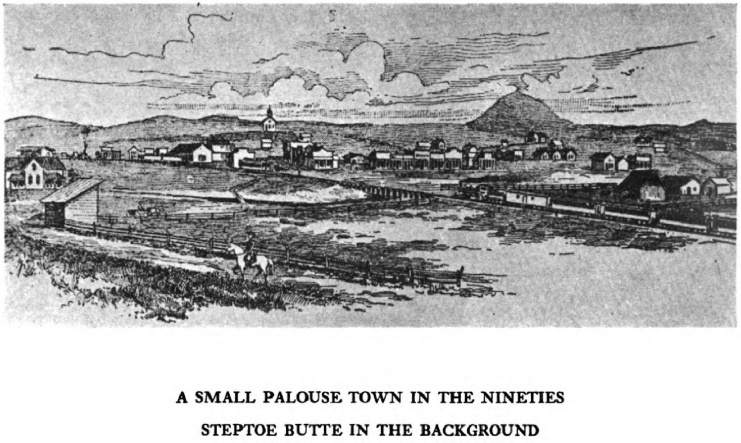
Slowly but surely, population grew. While Spokane was still a town of no significance, thriving little farm communities came into being: Spangle, a short distance south; Ritzville and Davenport, to the southeast and west; Colfax, halfway to Walla Walla; others, too. They were not much to begin with; just spots where an enterprising settler or ex-miner or packer put up a crude shelter, provided food and liquid refreshment for weary packers and post riders, and provender for their animals. As time went on, stage drivers and passengers were entertained in what passed for a hotel and bought tobacco or pins at a general store. Invariably a school was started—these Northwesterners were avid for education. An enterprising lawyer hung out his shingle above the door of a board shanty or a lean-to attached to the store; perhaps a doctor too. It is unnecessary to elaborate. Growth was the familiar story common to pioneer communities all over the western United States.
In the Palouse, where the stage route over what had been the Walla Walla-Colville trail passed Steptoe Butte, one “Cash-up” Davis established a hostelry. With his pockets full of money, he had arrived as James E. Davis in a country where hard cash was proverbially scarce. When making a purchase he never failed to announce with finality the sum he would pay, “cash up.” Outside his hotel and store, for he soon ran both, was “the biggest watering trough in the upper country,” a rendezvous for men, horses, and cattle, until in later years the arrival of a railroad in his territory deprived him of most of his two-footed guests.
From the start, the Palouse’s new innkeeper was an affable and impeccable English host. Well-padded with flesh, round-faced and snowy-haired until in later years he became bald-pated, Cash-up strutted about in his Prince Albert, his boiled shirt decorated with a shiny gold collar button in place of a cravat; or, coattails fluttering, he danced a hornpipe with seamanlike precision. To his hostelry came not only passing travelers, but wagonloads of Palouse folk young and old. On the smooth floor of his upstairs dance hall ranch owners and ranch hands, ladies in late Victorian styles with a home-made look and farm girls in ruffled lawns and dimities danced the night away to the strains of “the greatest stringed orchestra in the upper country,” consisting of brothers Cy and Andy Privett, who energetically tapped out the measure with the right foot as they sawed away on their fiddles.
The story of this hostelry goes beyond the bunchgrass era. When progress in the form of steel rails and locomotives arrived in Cash-up’s section of the Palouse and put an end to the usefulness of his watering trough, the rotund innkeeper, ever resourceful in meeting new emergencies, acquired the top of the adjacent butte and erected thereon an imposing resort—spelled with a capital “R.” On the first floor, surrounded by a gallery, were a dance pavilion, a stage, and dressing rooms. Guest rooms occupied the second floor. Rising above all was a cupola housing a reading room and an observatory where visitors might pick out their homes or other familiar landmarks as their eyes searched the endlessly rolling hills through the lens of a telescope. Cash-up built a road to his resort on top of the butte, but the way proved too steep and long for most tourists and the country a bit too new to support so ambitious an establishment. Patronage fell off and the old man spent his declining years there in solitary grandeur. If he had had his wish he would have been buried on his mountain-top in a grave of his own digging. But relatives laid him away more conventionally in a cemetery. The great house was left to the mercy of packrats and weather until it finally went up in flames.
The wind no longer ripples a sea of grass on the Palouse hills. Today’s second or third generation rancher steers a tractor-dragged plow or harrow over the deep, black soil of his mechanized eastern Washington wheat ranch. He is proud of his fields, enriched by hard work and science and of his herd grown sleek on the baled nutriment of sweet-smelling alfalfa. To a noted traveler looking down from a plane high above, this is “the loveliest thing in nature” he ever saw, a cultivated landscape rich with color, “deep copper, buttery chrome to gamboge to faun,”{53} drenched with sun and finger-waved by plow and combine.
Few of the early sod-busters had either the facile pen of a John Gunther{54} or the time to engage in panegyrics. But among those who had eyes to see, scarcely one failed to perpetuate in some manner awareness of the self-renewing bunchgrass “green in the spring, dry in midsummer and reviving in the autumn.” This almost worshipful awareness is to be found in letters and reminiscences and heard in the speeches of pioneers at old-settlers picnics.
It was a Dry Creek homesteader who hit upon a wholly different means of expression. Hiram Gregg began breaking up the sod of his farm in the early eighties and soon all but one hill of his expansive acres waved with heavy yields of wheat. That one hill broke rudely into the cultivated landscape, for Hiram left it in native grass, a strange symbol for all the world to see. Mighty queer to waste good land that way, his neighbors thought. Mighty queer. All that fine wheatland doing nobody any good! Plowed and seeded, it would yield goodness knew how many bushels. Virgin soil had been known to produce as much as fifty or sixty per acre. Hiram must be crazy.
To jokes and argument Hiram turned an equally deaf ear. He continued to leave the hill in wild grass just as he had found it—to be plowed under, if ever, by a grandchild grown to manhood in a later generation. There was something about that grass—something that Hiram could not put into words.{55} He communed with his bunchgrass and left it at that.{56}
It remained for a Spokane man to capture with his pen the message of the grass. He sat in an editor’s chair, but his feet always kept contact with Mother Earth. Like Hiram Gregg, Edwin A. Smith had come to the Northwest early enough to see it in pristine loveliness and to cherish an abiding affection for the sun-lit and windswept herbage with which it was clothed. On the first day of October, 1931, there appeared in The Washington Farmer a little editorial signed with the familiar “E.A.S.” and headed “The Serenity of the Bunchgrass”:{57}
Next lot to my house in Spokane is in bunchgrass. This lot has not been materially disturbed by man for untold ages.
Have lived next to this lot for 19 years, and every spring the bunchgrass on the lot has been a sea of green, brightened by the deep-rooting sunflowers.
Whatever may be the consequence of the dropping of the gold standard in Great Britain, whatever may be the downs and ups of the stock exchange in New York, whatever may be the out-come of the ambitions of Japan in Manchuria, or the result to India of Mahatma Gandhi’s visit to London, I expect to see the bunchgrass on the lot next to mine a sea of green next spring, and each coming spring until the return of prosperity induces some neighbor to “improve” the lot by plowing and digging, sowing to lawn grass and planting to shrubbery, and never thereafter be sure of what a spring shall bring forth either to himself or to the lot.
I know that as I “improve” the outer edges of my lot next to the bunchgrass I am inducing the dandelions, the Chinese lettuce and the pigweed to take possession, that I have to irrigate and cultivate and fertilize with all the sad contingencies of neglect, while the bunchgrass grows serenely along-green in the spring, dry in midsummer and reviving in the autumn, year after year.
I am wondering in these days of unrest and deep concern how something of the serenity of the bunchgrass on the lot next to mine might come into my own life and the life of my neighbors.