
NEW SAW MILL
WE LEARN that there has been erected during the past winter a fine new sawmill, at Spokane Falls, fifteen miles below Kendall’s bridge, and is now in complete running order and prepared to furnish all kinds of lumber. This enterprise will supply a long felt want by the settlers of that vicinity. The proprietors are Messrs. J. J. Downing and S. R. Scranton.
So read an item in the Walla Walla Union on March 16, 1873. At long last Spokane Falls was actually on the map as “a local habitation and a name.” No longer was the term to denote merely a scenic feature—a point at which the Spokane River foamed, ruffled, and capered over and about crenelated brown rock in a series of cascades preliminary to a final dramatic plunge into the deep cañon through which the stream made its still turbulent way to join the Columbia. The place was now the seat of a white settlement where a noisy little “muley saw” turned by an overshot wheel set in the rushing water screeched its way through great logs, converting them into crude timbers and rough boards.
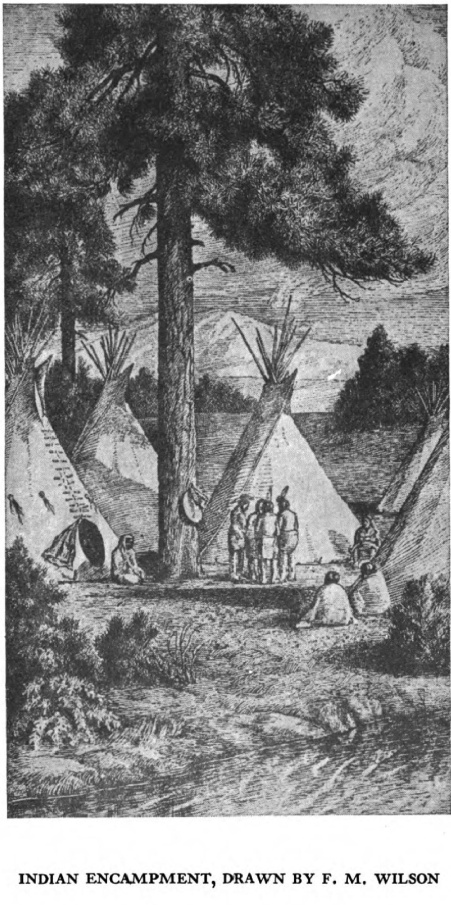
A settlement? Well, yes, since there appears to be no better word to apply to a spot where a few, or even a very few, individuals have taken up their abode with some idea of permanency, At Spokane Falls it was a very few; just Scranton and Downing, together with Scranton’s wife and stepdaughter, and one other man, R. M. Benjamin by name, who was also accompanied by his family. Scranton and Downing were cattlemen who held squatters’ claims on the land bordering the south side of the falls. Benjamin, arriving a trifle later, had bought a third interest in their claims, largely “on tick,” and had installed the saw. That was all there was of Spokane Falls aside from Indian groups who had a camp at the foot of the falls and others near by.
Roundabout on prairies and the margins of small lakes and waterways was a scattering of other settlers whose names have been perpetuated in the geography of the area.{58} Constituting the outer fringe were the stockmen and wheat growers of the Palouse and the Big Bend, and homesteaders on the road to Tshimakain and Colville. Presumably a good many of these might need the products of the Downing and Scranton saw; but for other supplies they would still have to look to more populous centers like Colfax, Dayton, and Colville, and the then metropolis of the Inland Empire, Walla Walla, at that very time agog over the prospect of becoming the terminus of Dr. Dorsey S. Baker’s “strap-iron railway.” This was to be the Inland Empire’s first rail line, thirty-one miles in length, and designed to connect Walla Walla with Wallula on the Columbia, where waiting Oregon Steam Navigation boats bound for Portland would pick up freight and passengers.{59}
Although Dr. Baker’s line was not yet in existence, its imminence, added to the fact that the site of Spokane Falls was still bypassed by the Mullan Road and the Walla Walla-Colville trade route, boded no good for the success of the new sawmill. True, there were persistent rumors that the Northern Pacific railroad would come to Spokane. This road, authorized in 1864 and provided by a willing government with generous land grants, was now actually under construction—a long way off, but moving closer. These rumors, rather than any immediate prospect of a big lumber business, were very probably the principal reason for the Scranton and Downing venture. When the Northern Pacific did arrive, they would be there; in on the ground floor, so to speak.
Unfortunately, the failure of Jay Cooke the year after Scranton and Downing set up in business at the falls threw the entire railroad project into confusion. This was discouraging enough, but there were other drawbacks to continued residence. Downing soon made up his mind that the Spokane valley possessed but limited agricultural value. The soil was gravelly and very dry, good for nothing but grazing. That certainly did not make for a thriving trade center. There was water power galore; but there must be something to grind or manufacture before an industry could be established; and there must be people to buy the products of the mill if transportation to outside markets was non-existent or prohibitively expensive. The final discouragement was the discovery that the small saw Benjamin had installed in the river was inadequate to cope with the great logs floated to it. Downing was soon ready to abandon business and leave the development of the settlement to someone with more faith or more willingness to gamble on the future.
That someone was on his way. James A. Glover, of Salem, Oregon, age thirty-six, was of pioneer stock. One day in the early spring of 1873, he and his friend N. W. Matheny set out from Salem to see what the southeastern corner of Washington Territory and the neighboring section of Idaho looked like and had to offer in the way of business and healthful climate. Like the miners of the previous decade, but with more comfort, they came by steamer up the Columbia and the Snake to the head of navigation at the small trading post of Lewiston. From thence they set out on horseback over the famous Lewiston hill. It will be no surprise to present-day motorists that it took them three hours to get to the top, leading their horses. At the foot of the hill on the far side where a small creek joined the Snake lay what looked to them like the Garden of Eden—the farm of the missionary, Henry Harmon Spalding. Corn was already knee high; onions, lettuce, and other spring vegetables grew temptingly, as they still do in that part of the world.
The travelers decided to stay over night. No one was home, but what of that? On the frontier it was unwritten law that one took shelter wherever it offered, with the understanding that all must be left in order and the supply of fuel replenished.
Next day, when Spalding returned, he greeted Glover and Matheny cordially, and, out of his intimate acquaintanceship with the interior, directed them to the Spokane country. They were soon in the saddle and off for Colfax, the only settlement between the Spalding farm and Colville. Somewhere a good many miles beyond Colfax lay Spokane Falls, which they might hope to come upon if not misdirected.
The sun shone brightly all the way, the air was wine, the bunchgrass waved greenly, settlers living ten or fifteen miles apart were hospitable and gave directions, as did a little man on horseback whose saddlebags held the mail for the country lying between Lewiston and Lake Pend Oreille. Latah Creek (the name Hangman Creek was not yet in consistent use) was full to overflowing when they reached it, but they found a way to cross and at last, from the top of a hill where the air was filled with the scent of pine needles, their eyes first took in the Spokane valley, at that time of year gaudy with the yellow of dwarf sunflowers. The day was Sunday, May eleventh, the year still 1873.
For Jim Glover it was love at first sight. By the time he had eaten his third meal cooked over an open fire of chips and dry wood with the roar of the falls for music he was completely infatuated. A walk upstream, a trip across in an unsteady canoe hollowed from a pine log, followed by a brief survey of the north side gave an added boost to his enthusiasm. He would stay in this place, come what might. Jay Cooke might fail, bringing down Henry Villard and the Nonhem Pacific with him, but the falls would still shout their message of power, there was gold in the mountains near at hand, there were forests to be made into lumber. It was impossible to believe that resources such as these could possibly fail to win recognition, and that quickly.
When Downing offered to sell out, it did not take Glover long to say he would buy, even though title to the property was by no means secure—surveys might reveal that the land was one of the sections granted by the United States government to the Northern Pacific railway. Another complication lay in the fact that Benjamin was presumably a part owner in the property, although after making a small down payment, he had been unable to complete the purchase. However, Downing said that $2,000 would swing the deal and Glover had the $2,000. He would take a chance. Paying over the money, he became the owner of what is now the business center of Spokane plus valuable river frontage. When today’s residents speak of Glover as the “Father of Spokane” they like also to remember that, in acquiring his property, Spokane’s first businessman stipulated that there should be refunded to Benjamin, a poor man with a large family, the $400 he had paid in.
Leaving Scranton temporarily in charge of his purchase, Glover hurried back to the Willamette valley with his friend Matheny to buy a larger mill. There he also entered into a partnership with Matheny and C. F. Yeaton, another Salem man. The mill acquired, Glover started his partners back with it, together with a mill-wright and two assistants. Besides the mill, Matheny and Yeaton took along a batch of household goods including an organ for Mrs. Yeaton, all of which were freighted in by wagon the last eighty-five miles. Distance did not count: Spokane Falls was to be the partners’ home town as well as a business center; their womenfolks, soon to follow, were entitled to whatever would make a crude sitting-room look and seem like home.
Glover, shortly following his partners northward, found the tiny settlement at the falls in high excitement and his business associates in a state of consternation. The man Scranton, still owner of the land adjoining Glover’s as well as part owner of the original mill, was in hiding. He was accused of acquiring horses by extra-legal methods and the place was full of constables searching for him. Glover learned the location of Scranton’s hideout before the officers of the law did. Guided by a friendly go-between, Glover found the alleged horse-thief on the north side of the river lying on a buffalo robe in a thick bunch of blackthorn, his weapons beside him. Spokane Falls, he realized, was no longer a healthy place for him. In a fifteen-minute conversation it was agreed that he was to sell out, actual transfer of the property to be made that night at eleven o’clock in Downing’s house. At the appointed hour, Scranton appeared, the papers were signed, payment was made, and the urgently sought-for seller departed hastily, leaving Jim Glover and his partners securely in possession of all the original Scranton and Downing holdings—provided, of course, the land did not turn out to be a Northern Pacific grant.
The mill was rebuilt and enlarged to a capacity of more than thirty-five thousand feet of lumber; a capacity, as the event soon proved, far too great for local consumption. However, the new owners did not at once realize this. Happy in the knowledge that the saw would no longer balk at heavy logs, they put it to work getting out lumber for houses, and for a store with living quarters for the Glover family in the rear.
Glover was a born trader, so naturally the store was to be his. He was not unmindful of the fact that the white population was too small to make merchandising profitable. But there were the Indians: not merely the impoverished Spokanes living camp fashion here and there, but Coeur d’Alenes who had a reservation of their own and many of whom, thanks to the tutelage and example of the Catholic fathers long among them, were frugal, industrious, and even prosperous.
Astutely, the new storekeeper adjusted stock and business methods to the desires and habits of his red-skinned customers, soon his friends. He was fair, they discovered; his scales did not cheat. The first large groups came directly after snowfall, when hunting and trapping had been good. They brought in marten skins chiefly, and sat about the stove on their haunches, silently smoking. Not until toward midnight were they ready to trade; but once started, they kept at it until all their furs were bartered, perhaps more than a thousand dollars’ worth. Later in the season they came with deerskins, buffalo robes bartered from the Sioux east of the mountains, and beaver, muskrat and other pelts by the thousands, as well as robes of black and brown bear. All these except the few needed by the settlers Glover shipped to Portland, Vancouver, or Victoria, British Columbia.
Only two articles of trade desired by the Indians were refused them: liquor and ammunition. Glover had these; but in small supply. A barrel of whiskey, sometimes referred to as “snakebite,” was kept for use in case of encounters with rattlers and was boarded up in a closet lest the Indians discover it. There was ammunition sufficient for the occasional loading of the old shotgun which the proprietor of the store sometimes found it necessary to aim at a four-legged marauder or which he willingly lent to an Indian whenever a deer for the family kitchen.
As the months passed, growth in white population was far from being what the partners had hoped. For a time it actually declined in spite of continuous and sometimes novel efforts to keep it moving upward.
“Who owns this here land?” demanded a newcomer just arrived from beyond the eastern mountains. “Mostly it belongs to a fellow called Uncle Sam,” was Glover’s reply. “It’s yours for the asking,” he added, scenting an addition of at least one to the future census record.
The newcomer dug a hole two feet deep with his pick. Into the hole he poured a bucket of river water—and watched it promptly disappear. “Mister,” he announced, “you and Uncle Sam can keep the whole lot and caboodle of it. When I file on land it’s got to be good soil with a clay bottom. No gravel for me.”{60}
The booster tactics of the partners were not limited to talk. They built several log houses and offered them to newcomers rent free. The Reverend Henry T. Cowley, a Protestant missionary who came with his wife and family in response to a request from the Spokane Indians for a pastor and teacher, occupied one of these cabins until with Indian help he could build his own home. Spokane Falls thus acquired its first resident clergyman.
To fill essential public offices it was necessary to hold an election, even though the choice of candidates was strictly determined by availability. Glover’s home was chosen as the polling place, preregistration of prospective voters was not required, and length of residence not inquired into. It was enough that a man came to the polls with a desire to vote. That Glover was elected coroner and justice of the peace owed nothing to the fact that the election was held in his home, or to any other effort at wire-pulling. His house just happened to be the most convenient place and Glover the most available man. The ballots counted, the Reverend Mr. Cowley was delegated to ride the eighty miles to Colville in the middle of December to deliver the returns to the county seat. While there, Mr. Cowley secured a teaching certificate so that, for the time being, he might conduct a public school for white children. He also performed the ceremony which made the commander of the garrison a benedict and which, presumably, helped to defray the expense of the trip.
Glover’s duties as coroner and justice were not onerous. The climate was healthful, the population young, vigorous, and for the most part, law-abiding. On the whole, administration of law and order for a number of years smacked more of humor than tragedy. Only occasionally was there sufficient blood and thunder to provide material for a first-class thriller. Not a little of it was invented by fun-living citizens for the edification of credulous newcomers. Nor were the Indians averse to participating in the fun; young buck Curly Jim thoroughly enjoyed the joke of allowing himself to be tied and brought into town as a bad Indian.
Considerable time passed before the community boasted a “calaboose.” Dr. Henry Masterson, a veterinarian, who came to act as peace officer largely on a voluntary basis, was wont to clap wrongdoers into the cellar of his home for safekeeping. There Curly Jim was one night locked up, this time with cause. He had chased a settler out of his shack, and not as a joke. On being brought from the cellar next day, he tried to break away, but was neatly overpowered by his far older jailer with a wrestling trick. Curly was so filled with admiration that he forgot to be angry and from the time of his release never missed an opportunity to run after and greet with a hearty handshake the “skookum Boston man” who had been clever enough to knock him down.{61}
The Reverend Mr. Cowley’s term as public schoolteacher was short. As soon as practicable, his white pupils were turned over to another teacher while he devoted himself to the Indians. Since the days of Tshimakain and Chief Garry’s try at schoolteaching, there had always been Spokanes who wanted an education. Now, thanks to hard-working Chief Enoch and the coming of Cowley they were again to be provided with a school. Farmer Enoch gave the land both for the Cowley home and for a twenty by thirty foot school building. On the latter the Indians were soon at work with materials from the sawmill, partly donated by the owners and partly contracted for by the Indians themselves. That the Indians were never able to fulfill the terms of their contract was not held against them by their white creditors, who realized how poor they were and how little conception they had of what a contract meant. In any case, a well-run Indian school was a valuable community asset. For one thing, it begot Indian friendship—something that might well prove useful. The Spokanes were finished as warriors, but other tribes were not.
Soon after Cowley’s arrival he, together with Glover, Yeaton, and an attorney by the name of L. S. Swift, held a school election in which “Glover, Yeaton and I elected ourselves school directors and Swift clerk, and I was employed as teacher.” In telling the story, Cowley adds that in the absence of any other available place, a public school was opened in his own home, with six pupils enrolled for a three month term. Before the three months was up, the school was transferred to the home of a housewife who took over as teacher. By modern standards that must have been a large undertaking in view of the limited space in the village homes of that day, but somehow it was managed, and for the three months during which school was in session the Reverend Mr. Cowley and his successor between them collected the munificent sum of sixty-seven dollars for their services as teachers.
For lack of funds as well as of pupils, three years went by before a public school building was erected.{62} Yet in spite of the difficulties involved in maintaining even the semblance of a public school, Spokane Falls did not lack for a dreamer who could see it as a center of higher education. That dreamer was a presiding elder of the Methodist Episcopal Church. Visiting the locality in 1875, the Reverend S. G. Havermale was so impressed by the scenery, the water power, and what to him as to Jim Glover was the practically certain future industrial development of Spokane Falls, that he not only made it his home but envisioned it as the seat of a privately endowed institution of learning. To assure a site, Havermale pre-empted a section of land which included Big Island, the parcel of ground above the falls now known by his name. As it happened, the dream of a Havermale College or Academy was never realized; but the would-be founder reaped very substantial financial benefits from his idealistic investment in Spokane real estate.
In common with pioneer communities throughout the United States, Spokane Falls saw to it from the start that the greatest of the national holidays was properly celebrated. The first Fourth of July was the “real thing.” The orator of the day was imported from Colfax. Men, women, and children rode in. from fifty or sixty miles away, bringing bedding, provisions, and fishing tackle, for a stay of several days. The local ladies had sewed a homemade flag which floated from a pole near the store. Along the river banks fishermen pulled in the salmon trout by the dozen. Others, old as well as young, danced on a floor of rough boards beneath a pine-scented bower of fir and pine boughs supported by a tamarack framework. Indians peeped through the foliage and, after the white folks had left, staged a special performance of their own.
When a likely stranger came to town or the hopeful founder of a new business enterprise had settled elsewhere without due consideration of the superior advantages of Spokane, Jim Glover did more than point out the generosity of the national government in the matter of land. He dangled before their eyes as bait parcels of his own holdings. The most outstanding success achieved by this method, as well as the most costly in land, was the luring of Frederic Post. It was one of Jim Glover’s favorite yarns.
Things were like this, he said. Spokane Falls stood in dire need of a flour and grist mill. So, for that matter, did he, for all the flour he sold in his store had to be hauled from Waitsburg, miles away. Just over the line in Idaho had settled that man Post, a practical German millwright who had both knowledge and machinery. Why shouldn’t Post come to Spokane Falls with his wife and five fine daughters and set up as a miller there? The family as well as the mill would be valuable assets. The only trouble was that Post was the most sought-after man in the area, since no flour mill existed for miles in any direction and every little hamlet with water that would turn a wheel was in the market for one.
Glover tried varied inducements, but Post declined each lure. Very well, it was going to take expensive bait to land this fish. Glover offered an outright gift of forty acres fronting on the south bank of the river from what is now Monroe Street to Post Street (so-named, later on, for the miller himself). All Glover reserved was a small square, the city block on which the much-acclaimed Auditorium Theatre was afterward to be built. The forty-acre bait worked. Post accepted the land and Spokane Falls acquired its flour mill.
That was far from being the end of the story, however. Miller Post wanted the theatre parcel as well as the land about it and in 1876 scraped up $350 and bought it. The financial strain proved to be too great, however, and shortly the worried miller approached Glover with the word that he was broke. “You’ll have to take back the land,” he said. Glover in his turn declared insolvency, but he took back the land. This initiated a chain of transactions in which the coveted parcel, serving as a kind of pawn by which each man bailed the other out of successive financial predicaments, passed back and forth five times, always at the initial price, until it was disposed of finally to the future builders of the theatre.
What with friendly Indians, two mills, a store, two resident clergymen, a school, an academy in the offing, half a dozen or so pioneer homes presided over by educated white women, and a healthy community spirit, Spokane Falls seemed set for rapid growth. But it refused to grow. By 1876 Yeaton and Matheny were ready to quit, and did so, both selling out to Glover, who was still determined to stay. His decision to do so was undoubtedly bolstered by the disappearance of the fear that had always been in the back of his mind—fear that the land presumably his might turn out to belong to the Northern Pacific railway.
The end to this particular anxiety had come unexpectedly. On a bright June morning a Spokane dismounted at the store, his horse in a lather. The Indian was frightened, for sporadic uprisings of hostile tribes aroused concern among the reds as well as among their white neighbors. Now, announced the shaking messenger, white men had come Latah way carrying chains and big medicine on three legs. What had they come for? Did they mean harm to the Spokanes?
Glover could guess their errand. Mounting the nondescript steed tethered near by for emergencies, he rode out to meet Till Sheets and his surveying party.
“Hey, we’ve finished over in Crab Creek and thought mebbe you would like to give us a job,” was the gist of Till’s greeting.
Glover assured the surveyor nothing would suit him better. He added that so far as his land was concerned he “didn’t know whether he was afoot or horseback,” but he had plenty of grub and would gladly feed the crew while they found out for him.
The outcome of Till Sheet’s survey was perfect. Glover’s Section 18 was not railway land, the lines ran just about where he hoped they would. Some of his property lay on the north side of the river along what is now Broadway. He owned a portion of the falls and water power on both sides, including the present site of the Centennial flour mill. The occasion was well worth celebrating. The barrel of whiskey so long boarded up in the store was broken out and all drank their fill regardless of future perils from rattlers. Nor was the celebration ill-advised. A year later, government surveyors confirmed Till Sheet’s findings.
The lawful owner of Section 18 was now ready to carry out a project on which his heart had long been set—he would lay out the future city of Spokane amid the sunflowers and bunchgrass. But there was no civil engineer at hand to carry through the technical phases of such a project, and Glover lacked the money. Times were hard—very hard. Homesteaders who might have been customers of the sawmill and store could buy neither lumber nor drygoods. Their crops had been destroyed by crickets. The white colony at the Falls was too small to support the store, and by 1877 the supply of Indian furs had all but ceased, so that if sales were made to the Spokanes at all they must largely be on promises to pay—sometime. Such sales Glover had continued to make, particularly when a brave discovered the scanty supply of pelts he had managed to get together would not buy sufficient provisions to keep his family from starvation. The Indians knew that the storekeeper kept no record of such transactions and might forget. They, however, seldom did. As soon as it was humanly possible they paid up; in one case a ten dollar debt was settled after an equal number of years. Such honesty was heart-warming, but did little to keep a storekeeper solvent.
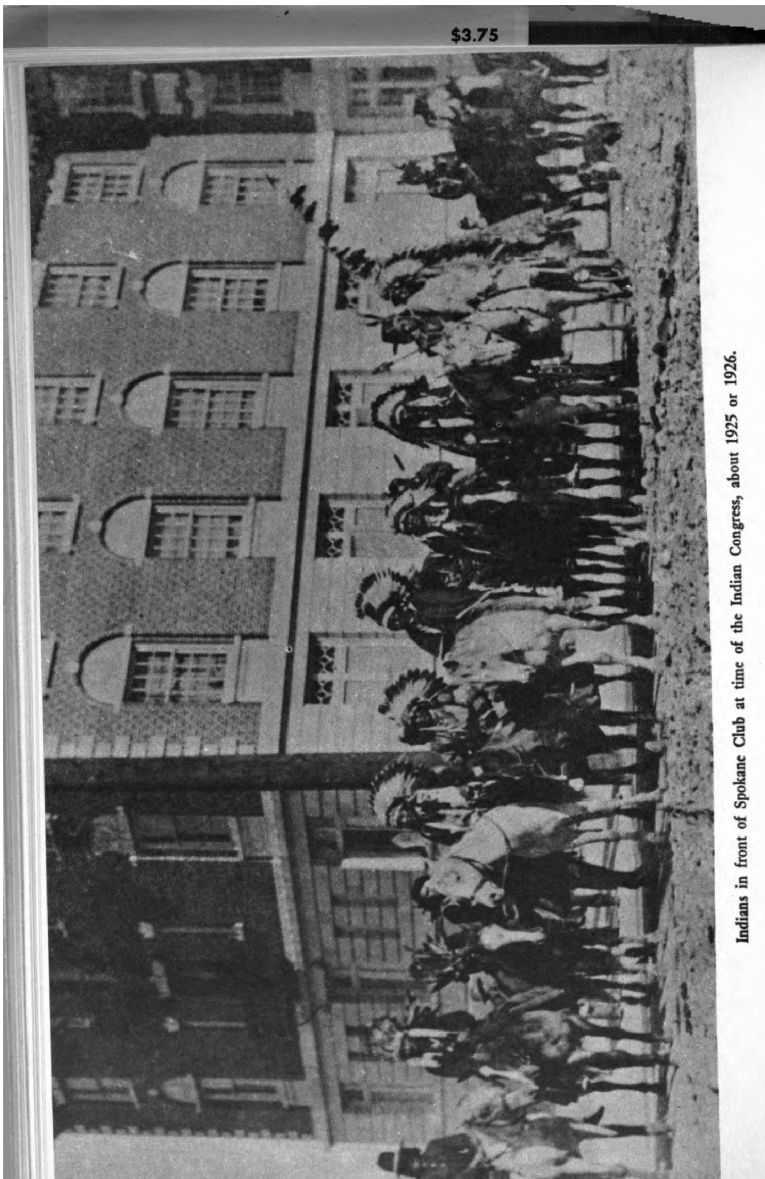
Not all the residents of Spokane Falls felt as secure in Indian friendship as Glover. True, many of the Spokanes in Cowley’s school might be devout and childlike in their Christianity, confessing their sins openly, making good for their misdeeds as best they knew how, and trusting their teacher and other white friends to settle disputes and difficulties. Some, like Enoch, were excellent farmers. But you never knew, reasoned jittery whites. What would prevent even the Spokanes from going berserk if the opportunity offered?
When in 1877 a band of Nez Percés camped in the neighborhood of the store and word went round they were trying to stir up the Spokanes, the settlers became panicky, their fright increasing as nightly the war drums beat longer and louder and the yells of dancing braves rose higher.
Elsewhere the Nez Percés were definitely on the war path, led by Chief Joseph. He and his followers had every moral reason to rebel against the long-continued pressure from government and settlers which had first resulted in removal of the tribe from their ancestral home in the Grand Ronde valley in eastern Oregon, and later from reservations accorded them by treaty.{63} Chief Joseph’s running fight was successful at first. Word of it had been drifting into Spokane Falls by rumor and the weekly mail, but Glover discounted the danger until the continuing local war dance convinced even him that trouble was definitely brewing.
On Glover’s invitation, the white population, with the exception of the Post family and men remaining up to watch, began sleeping in his home. This was the situation when one night a long procession, led by a blanketed figure and plainly visible in the bright moonlight, came creeping along the trail from Four Lakes.
Indians on the warpath, was Glover’s first thought. But no. His ears corrected his eyes, as he caught the rattle of wagon wheels and knew these were no Indians. The blanketed figure was an old man wrapped in a bedspread and the cavalcade was made up of fifteen or twenty terrified settlers intent on crossing the river to barricade themselves on Havermale Island. The swift-flowing water thereabouts should, they figured, make the Indians loath to attack in the face of gunfire.
Glover and his neighbors fed the frightened group and when daylight came helped them raft themselves and their belongings across the river where trees were soon being felled for breastworks.
Some of the people at the Falls also considered fortifying themselves on the island, but Glover had another idea. He called in a few of the old Spokanes, among them Enoch and Curly Jim. As he had surmised, they were as concerned as were the whites about what was going on. They agreed that if the Nez Percés succeeded in stirring up the hot-headed younger Spokane braves there would be war. That meant disaster, but what could they do?
“My friends,” said Glover, “white soldiers are near. They will come if I ask them. If you don’t want that to happen, send away these meddlesome Nez Percés before noon.”
Cowley, Father Cataldo, and others whose work lay chiefly in the outskirts and among the neighboring Coeur d’Alenes were offering similar advice. The Nez Percés disappeared before noon.
What Glover had said about the proximity of troops was pure guesswork, but it happened to be true. The following day ten companies of General O. O. Howard’s command from across the eastern mountains marched into Spokane Falls, where two companies remained for six weeks. At a council on the island called by General Frank Wheaton, Chief Saltese, representing the Catholic mission Indians, said that if forced into war his tribe would be on the side of the whites.
Shortly after the departure of the troops, General William Tecumseh Sherman rode in with a small escort. The little community put its best foot forward. The General and other guests were entertained at lunch at the Glovers. There the Civil War hero stoutly asserted that there were no good Indians and that the settlers should be prepared to fight at any time, since troops could not always be at hand. When missionary Cowley cited the case of Enoch in rebuttal, Sherman said he would like to meet the old chief and went home with Cowley to do so. But like many another, the General was hard to convince. Yes, he agreed, Enoch had an excellent farm, his hands were work-worn, his attitude was kindly and generous-hearted, he treated his wife well. But——The General departed with a warning to Cowley that he was wasting his time in trying to teach Indians.
One reason for Sherman’s presence in the area was the decision of the War Department to erect a fort thereabouts, and just prior to his arrival at Spokane Falls the General had decided upon a site at the lower end of Lake Coeur d’Alene.{64} This was a heavy disappointment to the Falls community. It protested vigorously but failed to change the General’s mind. However, he did order Companies H and I to return and take up winter quarters at the Falls after he had left. With this crumb instead of the whole loaf it coveted, the crestfallen village had to be satisfied.
Against all reason, the crumb was enough to put Spokane Falls on its financial feet. Quarters for the troops and a house for their commanding officer set the sawmill going at an unprecedented rate. Demands from Coeur d’Alene helped. Business boomed at the Glover store and post office, for through the store mail was distributed as well as supplies. Post’s flour was in greater demand. Real estate boomed as people began moving in, sure of protection. Doc Masterson established a hostelry to supplement his income as veterinarian. To the unlovely building with its bare plank table, its rooms with plank or dirt floors, and its half barrel of river water in which floated several bars of soap for purposes of ablution, he gave the ambitious name of The Western House.
Best of all, Glover’s long-envisioned town site was soon laid out by Glover himself with the aid of a recently arrived jeweler named Rima, who professed some acquaintanceship with compass and chain. When the plat was filed in Colville early in 1878, the city of Spokane was at long last definitely taking shape. To Glover’s plat the city owes the names of its most important business streets, and, more important than that, their unusual breadth, for the Father of Spokane stipulated a width of one hundred feet. The only exception represented a compromise with the Northern Pacific railway, reportedly well on the way to Spokane Falls. The width of Sprague Avenue, tactfully named for the general superintendent of the western division, was cut to seventy-five feet. Because the original survey was not fully accurate, the plat had to be surveyed a second time. The city’s first realtor compensated early purchasers of bunchgrass lots by deeding them extra strips to make up for discrepancies. After all, land was of small value, and good feeling between neighbors was worth more than a few extra dollars in Glover’s personal bank, a tin box kept in his store.