
2
Dirt, trash, scuffs, scratches. The desert-battered surface of Luke’s landspeeder, and the worn, washed-out fabric of his farmer’s clothes, bound and belted against the sand. Han Solo’s outfit, a collage of trophies and souvenirs from a past on both sides of the law, from the Imperial Academy to the Corellian spacers, and his customised ‘piece of junk’ pirate ship. This is the aesthetic of the Rebels. A make-do-and-mend approach, in a time of galactic war. An attitude of improvisation, of rolling with the punches, of striking, scattering and moving on. The Rebels are freedom fighters, or terrorists, depending on your point of view: they are potentially everywhere, and hard to pin down. Leia can give up the location of a previous base on Dantooine, knowing the Empire will find only deserted buildings and footprints. They establish a new headquarters on the moon of Yavin, and at the start of the next film have not only relocated to the ice planet Hoth, but are ready to evacuate again.38 In The Empire Strikes Back, the Falcon evades the Imperials by waiting until a Star Destroyer dumps its garbage, and floating out with the refuse; an echo of their previous strategy in Star Wars, when Leia blasts a hole in the wall of a pristine Death Star corridor and the rescue team follows her into a trash compactor. The Rebels not only discover the rubbish that the Imperials’ sleek white surfaces usually keep hidden; they immerse themselves in it and escape by hiding in their enemies’ waste, knowing the Empire will, primly, never look at its own dirt.39
A character’s attitude towards trash, dirt and junk defines their place on either side of the film’s key opposition between rough, improvisational energy and cold, clean formality, and the distinction is not quite so simple as Rebel versus Empire. See Threepio ‘can’t abide those Jawas. Disgusting creatures’,40 and Leia scorns the bolted-together hulk of the Falcon: ‘You came in that thing? You’re braver than I thought.’41 Some of this disdain can be put down to competitive banter between the kids and Han Solo – Luke calls the Falcon a ‘piece of junk’ because Solo has just humiliated him in the cantina, and Solo’s blustering mockery of Leia (‘The garbage chute, what a really wonderful idea! What an incredible smell you’ve discovered …’) is part of their ongoing, aggressive flirtation.
However, Leia and Threepio, despite their alliance with the Rebels, are not from the same sphere as Han and Luke, and this difference is expressed in their appearance and manner. Leia is a diplomat and adopted into the royalty of Alderaan, a peaceful and wealthy society; Threepio is a protocol droid on a consular ship, under the charge of an Alderaanian captain. Both characters, although Leia is secretly engaged in the overthrow of the Empire and Threepio has little understanding of his own position or the surrounding conflict, belong to the culture of the old Republic – a world of moneyed elegance, poise and etiquette – rather than the rougher world of Tatooine homesteads and Corellian pirates. Luke and his uncle, after all, are accustomed to buying their droids second-hand from Jawa junk merchants.
Luke and Han, making their way as a farmboy and smuggler respectively in Tatooine’s dusty culture, have no political engagement with the Rebel Alliance until later in the story – initially, Luke just wants to get off-world through the Academy,42 and tells Kenobi he can’t get involved in any galactic struggle,43 while Solo simply wants to clear his debts – but both have the instinctive hatred for the Empire born from the experience of a colonised, brutally policed people, rather than based on principle in an Alderaanian ivory tower. Luke exclaims ‘it’s not as if I like the Empire, I hate it’, and Solo, who has just lost a hold full of spice and gained a price on his head because of an Imperial boarding party, lies automatically to the cantina stormtroopers, and shoots them dead without hesitation. Han and Luke begin the story as rebels by nature, rather than by conscious choice.
By contrast, Leia’s mannered response to her capture by the Empire – ‘I should have expected to find you holding Vader’s leash. I recognised your foul stench when I was brought on board’44 – is in keeping with the stilted conventions and delivery of Queen Amidala and the Jedi, in the prequel trilogy’s Republican society, while Threepio’s easily smudged gold plate makes him suited to Alderaanian palaces and clinical consular ships rather than farms and cantinas. Indeed, Threepio is redundant on Tatooine, and unnecessary, even offensive to its locals. Luke’s Uncle Owen, a no-nonsense farmer, remarks disparagingly that he has no need for a protocol droid, while Obi-Wan, living quietly in a desert hut, can’t remember ever owning a droid. The Mos Eisley barman even throws him out; he accepts hammerheads and walrus men, but not Threepio’s kind. In Luke’s first appearance, a scene deleted from the final cut, he owns a Tatooine-style robot – a primitive device called Treadwell, little more than a stick on wheels and light years away from the gleaming, humanoid Threepio. Threepio, cast out of his spacecraft into the desert, is not just on the wrong planet, but in the wrong film; he is a Metropolis (1927) robot in hopeless exile from the city, and wandering into The Searchers or Lawrence of Arabia (1962).45
Both Leia and Threepio, tellingly, are at home on the Death Star. Leia is undaunted by Tarkin and Vader, exchanging cold insults with her enemies, and even in prison, fits the clean white interior of the Imperial environment. Threepio just becomes another Death Star droid, and unlike Han and Luke, can talk plausibly to stormtroopers without any disguise or play-acting. On the other side of the conflict, the sandtroopers of Tatooine have adopted a customised uniform and trained native desert lizards, the Dewbacks, as police mounts; their white armour is scored and grubby with sand. They may not be a welcome presence in Mos Eisley, but they fit into the battered, improvisational milieu, just as Han Solo’s antagonist Boba Fett, the bounty hunter with a uniform modified by trophies and scars, is his counterpart rather than his opposite.46 The real opposition between the two key aesthetics of Star Wars – warm, rough creativity and cold, formal surface – is represented by Solo and Vader: they confront each other only once, at the precise middle point of the trilogy, in a Bespin dining room during The Empire Strikes Back. The moment presents another clash between different styles, between two of Lucas’s borrowed genres – the dark-casqued samurai facing the cowboy – and offers a far more shocking contrast than the confrontation between Vader and Leia as political foes in the previous film, or, in the next film, between Vader and Luke as duelling Jedi.
Already, then, we can see that the fable of Star Wars allows for considerable ambiguity and movement between its polar oppositions, as signified through the relationship between two aesthetics: rough-edged versus smooth surface, raw energy versus order, and at its most basic, dirty versus clean. The narrative arc of the trilogy includes Threepio’s loosening up until he can tell stories in Return of the Jedi and more significantly, Vader’s trajectory towards his battered and burned redemption while Luke, more controlled, hard-edged and formal – with a mechanical hand under his black leather glove – comes dangerously close to replacing his father as the Emperor’s soldier. Of course Leia and Han compromise into a couple, with him accepting the need for discipline and responsibility, and her becoming less rigid, more playful.
Even within the shorter story of Star Wars itself, Han accepts a role within the Rebel order, with everything that implies – the rituals of the Rebel Alliance are inherited from the old Republic, from Alderaanian custom, and as we shall see, are disconcertingly similar to those of the Empire – while Leia becomes more of a sassy wisecracker after joining Luke and Han’s gang, most obviously when she improvises a route ‘into the garbage chute, flyboy’.
Star Wars falls into three acts of unequal length. In the first, until the rescue team’s entry to the Death Star, the Rebels and Imperials are physically distant, and we visit them in alternating scenes where the contrasting aesthetics are immediately obvious: the gleaming, black or white metal corridors of the Tantive IV or the Death Star, or the bustling, organic, adobe-and-sand environments of Tatooine.
The briefest glimpse of a freeze-frame would instantly reveal, from its colour scheme, whose world we are in, whether cold monochrome or warm earth.47 As noted, Leia’s formal dress and manner blends perfectly with the Imperial aesthetic at this point, and Threepio, though out of place in the desert, was deliberately designed to reflect the sand planet; the place where, in fact – though his memory of it is wiped – he was constructed in the prequel trilogy. As Lucas explains:
Leia is dressed in white and is part of the technological world – black, white and gray. She has a spaceship, but she would’ve been a stranger if she’d gone to Tatooine, the natural world: tan, brown and green … [it] was a creative decision to make Threepio part of the people, earth side, which was an esoteric idea, but I liked it.48
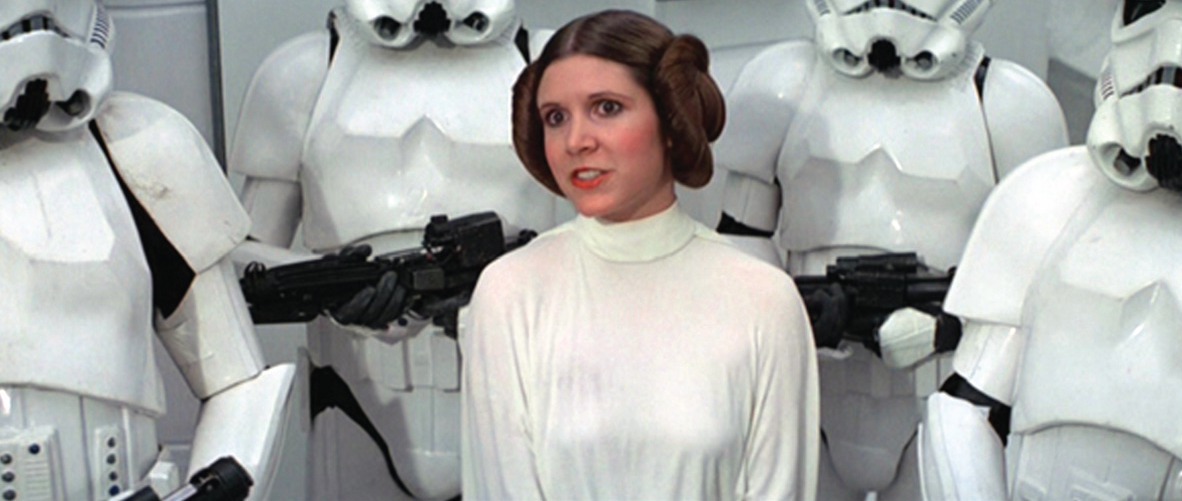
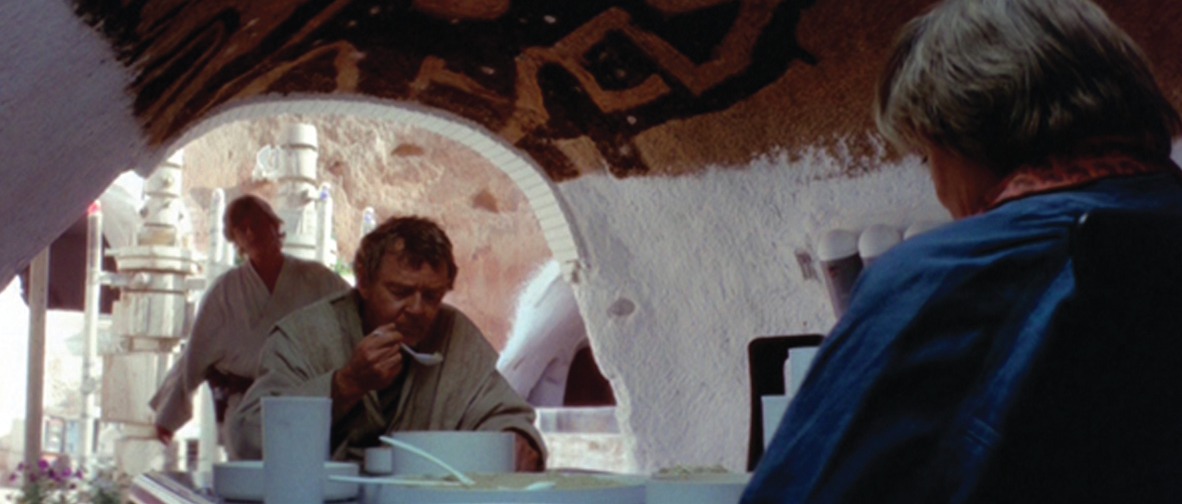
The cold Imperial aesthetic; the warm earth tones of Tatooine
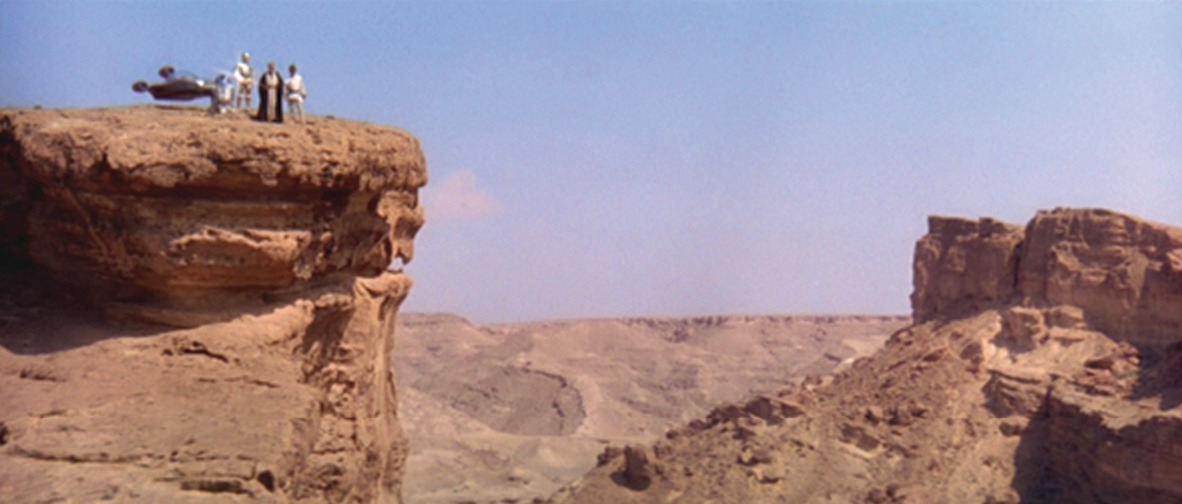
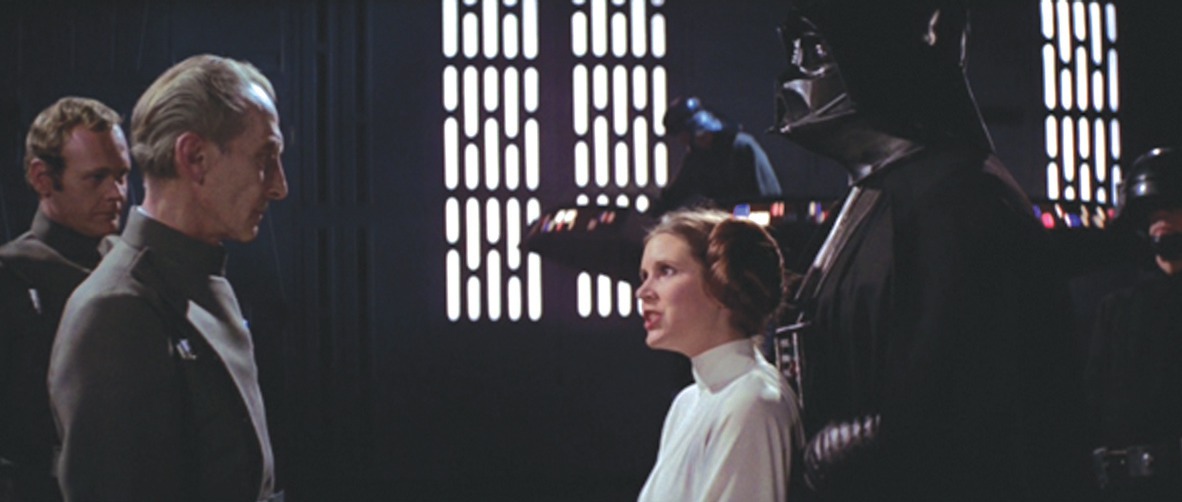
Tatooine’s natural rock formations; the man-made world of the Death Star
In the film’s second act, the Rebels infiltrate the Death Star and subvert it from the inside on multiple levels: its architecture, its communications, its formal structure and uniform, but also in terms of the camerawork associated with the Empire. Lastly, the Rebels undermine the Death Star from the inside again, not by attacking it directly but by sneaking torpedoes into its exhaust port – as before, using the Empire’s overlooked waste channels – and by adopting the military precision and discipline of their enemy. As noted above, it is this ordered ritual, inherited from the old days of the Republic through Alderaanian tradition, which unsettles any clear distinctions between the Empire and the Rebel Alliance in the final scene, and lays the seeds for the further complication of the boundaries between ‘good’ and ‘evil’ in the following films.
This disruption of boundaries is the focus of my final chapter, ‘Border Crossing’.
* * *
In May 1977, Time magazine described Star Wars as a compilation of ‘Flash Gordon, The Wizard of Oz, the Errol Flynn swashbucklers of the ’30s and ’40s and almost every western ever screened’;49 an analysis echoed in part and in a different context by Fredric Jameson’s famous article from 1988 on the ‘nostalgia mode’, which explains the pleasure of the film in terms of its reinvention of the ‘Saturday afternoon serial of the Buck Rogers type’.50
Indeed, my own previous writing on Star Wars has located the film’s power and enduring influence in its distillation of icons, myths, motifs and occasionally, entire scenes from the greatest films of the twentieth century, from The Wizard of Oz (1939), The Searchers and The Dam Busters to Metropolis and The Hidden Fortress (1958); a rush of cinema in a super-compressed form.51 This explanation also chimes with Umberto Eco’s definition of cult film,52 during his case study of Casablanca (1942) and its use of ‘intertextual frames’ and archetypes:
The term ‘archetype’ … serves only to indicate a preestablished and frequently reappearing narrative situation, cited or in some way recycled by innumerable other texts and provoking in the addressee a sort of intense emotion accompanied by the vague feeling of a déjà vu that everybody yearns to see again. […]
[With Casablanca] the authors mixed a little of everything, and everything they chose came from a repertoire that had stood the test of time. When only a few of those formulas are used, the result is simply kitsch. But when the repertoire of stock formulas is used wholesale, then the result is an architecture like Gaudi’s Sagrada Familia: the same vertigo, the same stroke of genius. Every story involves one or more archetypes. To make a good story a single archetype is usually enough. But Casablanca is not satisfied with that. It uses them all.53
Star Wars uses them all, and in the figure of Han Solo, a one-man transit point at the corner of a bar in colonised territory, it also uses Casablanca.54
The powerful jolt of pure, classic cinema that Star Wars manufactured, concentrated and shot into the heart of a million seven-year-olds in 1977 goes some way, I think, towards explaining its immediate impact and effect. But it does not explain the longevity of the film’s appeal – the immediate queues for repeat screenings, the laserdisc, video and DVD sales, the success of the Special Editions twenty years on, the official Expanded Universe of games, comics and novels, and the unofficial fan fiction, fan films and fan communities that continue to celebrate and explore Star Wars over thirty years since its first release.
The answer to this lies, I believe, in Eco’s other requirement for a cult object:
The work must be loved, obviously, but this is not enough. It must provide a completely furnished world so that its fans can quote characters and episodes as if they were aspects of the fan’s private sectarian world … so that the adepts of the sect recognise through each other a shared expertise. […]
A [cult] movie … must be already ramshackle, rickety, unhinged in itself. […] It must live on, and because of, its glorious ricketiness.55
Star Wars creates this sense of a ‘furnished’ world that we are only visiting; a world that was alive before we arrived, carries on in the background while we focus on the main characters, and continues after we leave. A handwritten note on Lucas’s yellow pad, dating from early 1975, stresses this intention. ‘Expand world = behind every man must be a complete world. Customs, friends, enemies, goals, family, responsibilities, rules, religion.’ His aim was familiarity tinged with strangeness:
a desire to re-create the feeling of disorientation he’d felt as a student watching films from different cultures. Lucas imagined what it would be like to watch a foreign film as if it had just washed up on the shore – all of its customs, history, language, and mannerisms strangely exotic, somewhat familiar, but not explained …56
Specifically, Lucas had his own experience of watching Kurosawa in mind:57 an immersion into customs that the characters understand, but that we, as visitors to the culture, must piece together. The status of a ronin and the reason he cannot take a follower, the importance of heritage and clan belonging, the code of honour in war; all go unspoken in The Seven Samurai (1954), and only become clear to the viewer in context, as the story progresses. The same is true of Godard’s Alphaville – which directly shaped the design and culture of the Death Star – with its casually dropped references to Civil Control, previous and ongoing military conflicts and the mysterious Outer Countries.
Lucas had adopted the approach in THX 1138, whose rigid future world is also governed by enigmatic classifications and castes that the characters refer to in shorthand: ‘I have to,’ says LUH, ‘he’s a G-34’, and we understand the general meaning if not the detail.58 Even American Graffiti drops the viewer into a distinct culture with its own rules, cliques and quick-fire slang – ‘If the prize is you, I’m a ready teddy.’ ‘Well, get bent, turkey.’
Star Wars, Marcus Hearn suggests, ‘demonstrates Lucas’ penchant for cultural disorientation’,59 and strives for ‘a flawless evocation of an entirely imagined society’.60 The key idea, according to Lucas, was that
you’re introduced to a world you’ve never seen before. One of the premises is that I would assume this is a natural world for everybody, so I wouldn’t dwell on setting this up, trying to explain what a droid is and so on.61
‘George wanted spaceships that were operated like cars,’ remembers producer Gary Kurtz. ‘People turned them on, drove them somewhere, and didn’t talk about what an unusual thing they were doing’;62 while production designer John Barry explained that Lucas wanted the film to ‘look like it’s shot on your average, everyday Death Star or Mos Eisley spaceport’.63
Star Wars creates a world, then, where characters refer offhand to Bocce and to Tosche Station, to the T-16 skyhopper and the XP-38 landspeeder, without having to explain the background to us or to their companions. It is a world where Artoo-Detoo’s carbon-scored bodywork, like Luke’s battered speeder and the ‘special modifications’ Han has made to the Falcon, bear testament to previous adventures. It is a world where characters share knowledge of events long before the story took place, such as the Clone Wars, and of places we have never seen, and are never shown. Threepio mentions the Spice Mines of Kessel, and Solo, a spice smuggler, boasts about the Kessel Run, but the link is left to our imaginations.
And imagination has made those links, filled in those gaps. Kessel, never shown in the Star Wars saga, has been depicted in spin-off novels, fan films and PC games.64 The Star Wars Encyclopaedia from 1998 retroactively explains Solo’s apparent error in boasting that he’d made the Kessel Run in ‘less than twelve parsecs’,65 while contemporary online sources like Wookieepedia go further, offering not just a detailed account of glitterstim spice’s effects and derivation, but noting that one of the cantina band members, the Bith Figrin D’an, was an addict.66 Thanks to official merchandise and amateur fandom we can now discover, in seconds, what the XP-38 looked like, what model it replaced and which Sullustan corporation manufactured it.
Arguably, thirty years of speculation and spin-offs, not to mention the three prequels with their graphic depiction of the Clone War, have filled in the gaps and ‘fixed’ the rickety text, reducing all its pleasurable mysteries to a dense but somehow uninspiring background. Perhaps fandom, and fan-driven Expanded Universe novels, have now over-saturated Star Wars with backstory and sequels – the extended saga currently includes not just the birth, but the death of Leia and Han’s children – but in 1980, it was this sense of only glimpsing a rich, rough, diverse world that brought me into the ICA cinema with a notepad and felt pens, to frantically sketch and jot down observations from my second viewing. That, I believe, is what brought people back to Star Wars, and kept them involved in its mythos; the sense that there was much more to see and to discover. And this sense was almost entirely focused on the aesthetic I associated above with the Rebels, Han and Luke; the shabby, bustling world of Tatooine, where a vehicle’s damage and a character’s accessories – or a minor figure walking past the camera – suggest a wealth of other stories. A film centred on the Star Destroyer and Death Star – or indeed on Leia’s consular ship – with their clean uniformity, identikit corridors and rigid patterns of behaviour, would offer far fewer hooks for further imagining, and gaps for speculation. Tatooine – which in effect is more the Rebels’ base than the regimented, military HQ we later see on Yavin – is the focus of George Lucas’s ‘used universe’ aesthetic.
According to Garry Jenkins, ‘Lucas had a clear idea of the look he wanted’ even by early 1975, when he asked Ralph McQuarrie to prepare the production art.
He had been struck by how dirty the Apollo missions had been when they returned from space. In his mind’s eye he saw his corner of the cosmos as a grubby, lived-in place. Its technology may be more advanced, but it would not mean it could not break down, get rusty or need a visit to the interplanetary equivalent of a car wash. In his briefings to McQuarrie … and his other design artists, Lucas had asked them to move away from the pristine world of the spaceships in 2001. His catchphrase was ‘used space’.67
‘George has this idea about a used universe,’ recalled sound recordist and engineer Randy Thom. ‘He wanted things in his films to look like they’ve been worn down, rusted, knocked about. He didn’t want things to look brand new.’68 Lucas explicitly told the design crew to ‘dirty everything up’69 – but only on one side of the conflict. ‘George wanted all the Rebel ships to look secondhand, old and beat up,’ said production artist Joe Johnston.’70 He wanted them to look like they weren’t as well built or well designed as the Imperial ships.’ (The stormtroopers referred to below must surely be the Tatooine desert squad, rather than the spotless, polished Death Star soldiers.)
To emphasize the contrast between the gleaming black and gray of the Imperial fleet’s interiors and the vessels of the Rebel Alliance … they added rust and grease to the Falcon and other ships […] technicians also nicked, scraped, scuffed, and scarred R2-D2, as well as the white armor of the stormtroopers. Before each take, actors rolled in the dust until their clothes looked as if they’d slept in them.71
This approach may have been initiated by Alec Guinness, who – as a veteran actor and a Knight of the Realm – was treated with reverence on the set, but who, perhaps remembering the sand-blasted, windblown aesthetic of Lawrence of Arabia, turned up for his first days’ work, lay down on the desert floor and rolled around until his white robes were appropriately dirty.72
John Baxter suggests that Lucas’s vision of a ‘used universe’ has its origins in the early 1960s, when Lucas started hanging around the car-racing culture of Northern California. In this ‘new, pragmatic world … all that counted were your skills, your capacity for action. Life wasn’t for reflection: it was for use.’73 Lucas, an academic underachiever clashing with his father in a conservative small town, finally found something he was good at, and a potential escape from Modesto. He offered his skills as a mechanic and became the sidekick of a glamorous, older sports-car driver. The pleasures of taking things apart, understanding their workings and rebuilding them better made their way into American Graffiti, in the figure of hot rodder John Milner, and in turn, clearly shaped both Luke and Han Solo.
Luke, while dutifully obeying his uncle’s restrictions and doing his chores, whether it’s cleaning droids or staying on for another harvest, is clearly kicking against the boundaries of his flat, humdrum lifestyle: the only social scene is Tosche Station, a dull block of a building in the middle of the desert where the listless local kids treat Luke – or ‘Wormie’ – as an annoying pest.74 With his big brother and role-model figure – aptly, named Biggs – off-planet with the Academy, Luke spends a lot of time alone, and clearly knows his way around astromech droids like Artoo, as well as the Tatooine technology of macrobinoculars, rifles, landspeeders and T-16 skyhoppers. A few steps up the ladder, Han’s successful career as a smuggler is based around improvisation, creativity and an intimate knowledge of the Millennium Falcon, from its hidden compartments to its unreliable hyperdrive. Han’s pride in his modified, customised heap of junk echoes the teenaged Lucas’s investment in his own first car: his dad had caved in and bought a feeble Fiat Bianchina, which Lucas souped up into ‘an approximation of a lean, mean machine. The Fiat, never very attractive, now looked ungainly and foreshortened – a “weird little car”, in the words of one friend – but George loved it.’75
On the production side, the Star Wars designers, model makers and special-effects engineers also worked in a spirit of improvisation and experiment, piecing together ideas from other people’s junk and testing the limits of newly constructed equipment, like a cross between Chewbacca and the Jawas. John Dykstra even built a new motion-control camera from bits and pieces of older machines. The Dykstraflex could follow a precise trajectory towards, for instance, a miniature TIE fighter, and then repeat the exact movement again to capture the path of an approaching X-Wing. The two shots would then be superimposed with other layers into a composite dogfight. ‘We took archaic cameras,’ Dykstra remembered, ‘built before we were even born, and we created hybrids of them by bolting different parts together. Nobody else was inventing cameras to make films in 1975. We were there when a genre was being born and reborn.’76
The team at Lucas’s new effects company, Industrial Light and Magic, were engaged in a similar construction of hybrids, ‘cannibalizing model kits in order to make spaceships. They used fragments of Kenworth Tractors, Kandy-Vans, Panzer Kampfwagens, and even Ford Galaxy 500 XLs.’77 A prototype of Vader’s outfit was ‘a practical make-do amend’, in the words of costume designer John Mollo: ‘we put on a black motorcycle suit, a Nazi helmet, a gas mask, and a monk’s cloak … it was a little fashion show’.78 John Barry describes how, searching for props, he went ‘into the junk business’. ‘The comlink is in fact part of a faucet. The handle of the lightsaber is a very old photographic flash unit … Luke’s binoculars are an old Ronoflex.’79
The sound design, masterminded by Ben Burtt, was also a creative composite and integral to the plausibility of the ‘used universe’.
Lucas told Burtt to forget the electronic fizzes and sizzles of conventional science fiction soundtracks. As much as possible, all the sounds were to be natural. He wanted the spaceships’ motors ‘to sound real, to sound squeaky and rusty’.80
Burtt carried his Nagra tape recorder around the Los Angeles Zoo, LAX, military bases and his own apartment, composing a ‘sound fabric’ for Star Wars. He mixed the sound of take-offs, rifle ranges and strafing runs into an armoury of sounds for the Rebel and Imperial war machines, created Chewbacca’s speech from a cinnamon bear, a walrus, seal and badger, and developed the threatening buzz of light sabres from, fittingly, the static of a TV set and the motor of a film projector. ‘The sounds of the real world are complicated and kind of dirty,’ Burtt explained. ‘They simply cannot be reproduced on a synthesiser.’81
Lucas had stressed the importance of sound design to his films since USC, when he realised that an interesting soundtrack could draw students from the corridors into the screening room.82 THX 1138: 4EB matched its visual superimposition of static, graphics and optical effects with a sound collage of garbled radio broadcasts and distorted signals,83 and the feature version, even more ambitiously, privileged sound as equal to picture in a ‘cubist’ relationship. ‘What we tried to do was detach the images; the stories and the themes, and the sound and the images, were all slightly different views of the same thing, seen simultaneously.’84 American Graffiti also experimented with sound, using a different record as the backdrop to every scene and, as noted in the previous chapter, ‘worldising’ the sound through a makeshift process whereby Murch and Lucas walked in slow circles behind Lucas’s house, one holding a microphone and one a speaker, recording the music in an open environment to introduce ‘atmos’ and realistic texture. This backyard experiment and spirit of home-made making-do is entirely in keeping with the creative collage of the Rebel aesthetic; the kind of attitude that buys a second-hand junk droid and fixes it up, or bolts special modifications and customised add-ons to a battered freighter.
To an extent, Lucas was also part of the inventive cannibalisation and poaching that created Star Wars; retaining a passion for editing, he had composed a prototype of the final dogfight sequences from every war movie he and Gary Kurtz could videotape from television,
so we had this massive library of parts … The Dam Busters, Tora! Tora! Tora! … 633 Squadron and about forty-five other movies. We went through them all and picked out scenes to transfer to film to use as guidelines in the battle.85
In pre-production, of course, Lucas had patched together motifs, scenes, even lines of dialogue and character names from a range of sources, but during the often stressful and exhausting production process, he found himself in the role of distant manager, more a cold disciplinarian than a creative maverick – more an Emperor than a Rebel.
Lucas had been adamant that Star Wars needed his own special-effects shop with his own people, separate from Hollywood and its unions. ‘That was one of the control things,’ recalled ILM’s Tom Pollock.86 However, the crew, from Dykstra on down, were wild cards – Dykstra half-joked that his first requirement for ILM’s Van Nuys offices was a swimming pool87 – a motley crew of specialists like the Mos Eisley cantina regulars. Some were ‘art or industrial design students’, some were ‘high school or college dropouts or burnouts’, and only a couple were ‘hired thanks to their unique skills’, according to ILM production manager Bob Shepherd. ‘In fact, almost all the people in the model shop … were people I scrounged up wherever we could find them.’88 Lucas’s role as the innovative kid who broke rules and found new ways of making things work had been supplanted by the younger generation at ILM, who now enjoyed the luxury of creative goofing-off while Lucas wrangled with the responsibilities of direction. ‘There was no dress code, no time clock and virtually no organisation. It was Dykstra’s show – the crew’s loyalty was largely to him, not Lucas.’89 To Dykstra and his crowd, Lucas became the strict father, largely absent – until he turned up to check on their progress.
In summer 1976, Lucas visited the Van Nuys headquarters and found to his horror that ‘ILM had already spent half its budget but had just one acceptable shot in the can’.90 He was immediately struck by chest pains, was hospitalised overnight and emerged with a new determination to force production onward, even if it involved brutal streamlining. ‘After more acrimonious discussions with Dykstra, and an appalled tour of the ramshackle Van Nuys installation, Lucas removed him from day-to-day supervision.’91 Lucas’s USC buddy, Matthew Robbins, commented that ‘George, who was very much his father’s son in terms of business, felt he was being ripped off.’
Lucas instigated a new, more rigorous regime, bringing in production supervisor George Mather to impose order, personally supervising ILM’s work twice a week and sacking his editor, John Jympson. ‘I tried to get the editor to cut it my way and he didn’t really want to, and so I had to let the editor go. I was behind schedule,’ the director remarked.92
Staff at ILM came to dread his arrival to look over the weekend’s work. Progress was accepted without comment, failure with contempt. Passing people in the corridor, Lucas ignored them. To reduce conversations still further, he had three rubber stamps made up which he slammed on the drawings that crossed his desk.93
‘Lucas was now the boss. His cool, calculating, sometimes remote manner could not have presented a starker contrast to Dykstra’s free-wheeling philosophy.’94 As a distant, cold and fearsome disciplinarian, tormented by his own chest pains as he strode the corridors, enforcing a strict timetable and sacking staff who let him down, Lucas had become the Darth Vader of Return of the Jedi who pays a surprise visit to the unfinished Death Star and growls at the commanding officer, ‘I’m here to put you back on schedule.’ The comparison is not just a neat conceit; it demonstrates Lucas’s need for absolute control, and his discomfort with human interaction, which led him – despite his drive for rebellion against the old studio system, his creative, inventive streak, his penchant for getting his hands dirty with machinery, and his liking for the idea of warm, human community – to a fascination with and investment in the Empire, as well as the Rebels.
This central contradiction is most apparent in the documentary approach that shaped the filming of Star Wars. Lucas’s fascination with documentary dates back at least to the summer of 1964, when he graduated junior college and hung around the race tracks filming with an 8mm movie camera – a gift from his father. To Baxter, Lucas’s immediate affinity with observing life through a lens – and sometimes cutting out people altogether, to focus solely on objects – stems from his social awkwardness and anxieties.
Lucas discovered the pleasures of watching, ideally through the lens of a camera. People didn’t ask awkward questions when you filmed them; they just let you be. And, seen through the camera, they themselves came into sharper focus. You could observe, comment, categorize, without saying a word. What Lucas found more interesting than human beings, however, were objects. […] His early student films would all be about cars. He shot them from a distance and up close, noticing the reflections on a polished fender or a windscreen; or clipped photographs from magazines and cut between them to create a narrative that bypassed performance. The idea of directing actors was, and would remain, distasteful.95
Lucas preferred to create his films alone, in isolation, through editing, and he treated footage of human beings just as he had the photographs from Life magazine that he had animated in his first student short – as raw material to be given meaning in the cut. During the 60s he was inspired by the new, raw and vibrant cinema enabled by lightweight camera equipment in both the US and France: the vérité documentaries of Robert Drew (Primary, 1960) and D. A. Pennebaker (Don’t Look Back, 1967) as well as the freewheeling fictions of the French New Wave. Godard visited USC for a guest lecture in 1966,96 just when Lucas’s interest in him peaked; after that point, Lucas began to see Godard’s cinema as unpolished, and aimed for higher production values in his own work.97
While Lucas, in a characteristic contradiction, developed his own style that combined rough energy with glossy surface and tight cutting – his next film was 1:42.08 – USC’s students and staff were, Baxter reports, caught up in the new aesthetic. ‘The fashion for hand-held cameras, natural light, real locations and sound recorded “live” spread through them like a virus.’98 As Lucas’s contemporary Randy Epstein acerbically commented about the spirit of the time,
A real film-maker didn’t write his or her film. They put a camera on their shoulder, sprayed the environment with a lens; they Did Their Own Thing, Let It All Hang Out, and anything they did was beautiful, because Hey, you’re beautiful.99
Lucas’s talent for car mechanics, and his nascent interest in film-making, had already led him into contact with cameraman and racing aficionado Haskell Wexler, who, like the New Wave directors, applied the hand-held, low-light and lightweight aesthetic of documentary shooting to drama. Wexler’s Medium Cool (1969), in which a fictional story collided with real-life footage of Vietnam riots, prompted Lucas to consider a similar approach to a war film, shot when actual battles were taking place.100 In the event, Coppola turned the idea into Apocalypse Now (1979), and Lucas went on to make what Walter Murch called ‘a film from the future, rather than a film about the future,’101 THX 1138.
The feature version of THX was, like the student short that preceded it, influenced by Alphaville’s use of contemporary locations to suggest a plausible future; partly for authenticity, and partly because it saved on the budget. Financial and time constraints, as well as aesthetic choices and his continuing admiration for vérité, shaped Lucas’s guerrilla-documentary approach to his science-fiction narrative, but his decision to shoot scenes once, using multiple camera set-ups, was also prompted by his reluctance to deal with the actors and crew.
He shot as much film as he could of each sequence, using one camera for close-ups, a second for the master shot of the entire scene, and sometimes a third camera for another angle. Lucas rarely filmed a scene several times – occasionally he would film the rehearsals and print them. ‘I’m very documentary in style, just set up the cameras and shoot the scene,’ Lucas says. ‘I like the actors to play against each other and not the camera, so I put the cameras off in the corner where they won’t be intrusive.’102
Interacting with large groups of strangers was ‘a concept foreign to Lucas’, and his documentary distance enabled him to stand back on the margins. He tried to shoot his own first feature as he’d filmed Mackenna’s Gold: from the sidelines. ‘I’m not very good with people, never have been,’ he admitted. ‘It’s a real weak link for me.’ Actors were chosen who could work without close guidance, sparking off each other and developing their own performance. ‘My life is too short to put up with a lot of trouble from my cast.’103
Lucas took the same approach to American Graffiti. Wexler lit the exteriors by boosting the available light – streetlamps and car headlights – and Lucas shot his cast of relative unknowns using a grainy stock, deliberately aiming for a grittily authentic feel.104 The camera set-ups followed the pattern for THX, with two operators covering each scene, and the actors left to play their scenes as an ensemble with only minimal guidance from the director. ‘I shot the film very much like a documentary,’ Lucas explained.
I would set the scene up, talk to the actors about what was going to happen, where they were going to go and what they were going to do, set the cameras up with long lenses and let the actors run through the scenes with each other.
Actor Ron Howard recalled Lucas’s distant style of direction and filming:
Often we couldn’t tell where the cameras were. You didn’t know if it was a long lens getting you in close-up at any given moment. If you asked George, he wouldn’t tell you, and would just say keep doing the scene. […] So at first it was disorienting – but ultimately it was incredibly liberating. When I saw the performances, I realized that he’d achieved a complete honesty and naturalism that made all the characters so real.105
In a seeming paradox, Lucas’s physical and emotional distance led to a warm, authentic tone, with performers bouncing off each other, creating a group chemistry that the camera neutrally observed. Lucas then assembled the rough material into his story – the first cut was three and a half hours long – deliberately choosing the takes with accidents and minor flubs. The actors still remember Lucas instructing them to repeat a scene until they messed up a detail, then deliberately including that version in the final movie: the opening shot, for instance, shows Charlie Martin Smith failing to stop his bike in time and banging into a trash can, while Candy Clark fumbled her line ‘did ya get it’, and was incensed that Lucas refused to allow her another try at the dialogue. The last big ensemble scene after Bob Falfa’s car crash was shot while the sunrise lasted, in one take; the actors were left, unprepared, to improvise while two cameras rolled.106 ‘I wrote this script,’ Lucas told them – not strictly true, as his stilted dialogue had been loosened up by Willard Huyck and Gloria Katz – ‘so I’m giving you free rein to change any line you want. Say it how you’d say it.’
The rough-edged, natural warmth, chemistry and community of Star Wars’ Rebel band was engineered in exactly the same way; by Lucas standing back and letting his cast, chosen for their sparky interactions during casting sessions, banter together. He announced in 1975 that during the casting for Star Wars, ‘I’m looking for magic. What else can I say?’
Hamill and Ford ‘condensed their lines to something like conversation’ even in screen tests, and Ford in particular – notorious for telling Lucas ‘you can type this shit, but you can’t say it’107 – improvised both his Han Solo costume108 and several lines of dialogue. Hamill recalled that he was shocked when he first saw Ford’s copy of the script, with lines crossed out and new dialogue in the margins. ‘He had an amazing way of keeping the meaning but doing it in a really unique way for his character.’ To Lucas, who knew he had little talent for writing natural speech – Huyck and Katz had reworked his final draft of Star Wars, too109 – repeating the script word for word was not a priority.
Lucas’s lengthy explanation of his intentions for Star Wars, again during 1975, demonstrates clearly that his approach was identical to the successful technique of American Graffiti, and that in many ways his ideas remained unchanged since the 1960s.
I’m trying to make a film that looks very real, with a nitty-gritty feel, which is hard to do in a film that is essentially a fantasy. […] I like cinéma vérité; it’s one of my real loves. […] I like to have that edge of reality because I want the movies to make you believe they are real. I try to do it with the acting, too. It’s more improvisational and linked to the style I use in directing, which is to have more than one camera and lead back away from the people, so that the actors essentially play the scenes themselves. The cameras are onlookers, and you aren’t right in there. People aren’t acting to cameras, people are acting to each other. I won’t really demand that they get the lines right. They can play as much as they want with what they’ve got, which makes for a much more casual, sometimes much more intense interaction between actors rather than just having every little piece be perfect and done to the camera.110
As with American Graffiti and THX, Lucas relied on the stars to do their job, largely without his interference and guidance. ‘If the part is cast properly and you have a really good actor, he can do it … life is too short for crazy actors.’111 In the central group of Hamill, Ford and Fisher, Lucas managed to recreate the playful energy of the French New Wave and the bantering camaraderie of a Howard Hawks Western or war film – not through the casual, laid-back camerawork of the former or the traditional approach of classical Hollywood, but simply by casting the right combination of actors and giving them a relatively free rein while his cameras observed them.112 The deleted Tatooine scenes, edited by John Jympson in summer 1976 before he was sacked, give a sense of the lengthy, distant takes Lucas originally filmed:113 a sequence showing Luke talking to Biggs about the Academy and the Rebellion covers the two actors in long shot and only cuts after one minute and twenty-six seconds. The introduction of Luke and his robot Treadwell opens with a nine-second extreme long shot of distant figures and a landspeeder, then cuts to a long shot, which it holds for a further ten seconds; in the original version of the cantina scene, the camera observes Han across the bar-room as a distant figure, obscured by the bodies of stormtroopers.
‘In essence,’ Jenkins suggests, Lucas ‘had hired the leading trio to play themselves.’ Hamill, in fact, modelled Luke on Lucas’s softly spoken manner – he expected a rebuke, but the director simply judged it ‘perfect’114 – while the sardonic, arrogant Ford would announce on set that he intended improvising, warning Lucas ‘Stopme if I’m really bad.’115 The scene where Solo ad libs his responses to questions on the Death Star intercom, then blasts the whole equipment deck – ‘boring conversation anyway’ – was invented on the spot, as was one of Ford’s lines to Luke in the Falcon: ironically, ‘don’t get cocky’. While Fisher and Hamill took a more reverent attitude towards the script – Fisher, like her character, took the lines seriously at first, and rehearsed them diligently every night116 – the hours of waiting around on the Death Star set with Ford bonded all three in a resigned fatigue that sometimes broke into manic hilarity, pranks and in-jokes; the making-of documentary Empire of Dreams (2004) shows Luke and Leia kicking their feet on the edge of a Death Star chasm, looking just like bored twins, and the gang in the Millennium Falcon cockpit whooping it up as though they’re about to go on a family vacation. Their rapport overflowed into the scene where Luke first embraces Leia after the Death Star’s explosion, and explodes in joyful squeals that almost sound like ‘Carrie’; and into the final medal sequence, where their winks and grins threaten to disrupt the ceremony.
Lucas saw Skywalker as ‘a pesky little brother’ to Han Solo, and Leia as the annoying little sister – ‘she’s sort of a drag and she’s a nuisance’;117 but in fact, rather than sibling banter, the off-screen relationships developed into sexual tension. Fisher and Ford, Baxter reports, ‘became intimate … Hamill, hot for Fisher himself, was resentful’. Again, though Lucas had declared that he ‘didn’t want sexuality in his fairy tale’,118 his casting, rather than the direct influence of his direction, had inadvertently created the chemistry of a New Wave film: in this case, Truffaut’s Jules et Jim (1962).
However, as with the ILM mavericks, Lucas remained remote, preoccupied and unamused by the actors’ japes. Troubled by the film’s slow and expensive progress, continuing wrangles with the crew and his own health problems, he failed to crack a smile when Ford pretended to munch on the scrap metal of the trash masher, or when Hamill sang out ‘pardon me George, could this be Dia Noga poo poo?’119 At the end of a take, he would call down from his position on a crane, with his characteristically curt advice: ‘Faster and more intense.’120 He was worried about losing control of the schedule, the effects and the sets – ‘I cared about every single detail’121 – and as bad luck plagued the making of Star Wars, Lucas became even more antisocial. On one particularly painful occasion, Hamill remembers, the director took his cast to lunch at a Chinese restaurant. ‘Nobody said anything.’122
Again, then, this is one of the central paradoxes of Star Wars. Lucas had deliberately pushed himself, with American Graffiti, into making a warm, youthful, human movie shot using the naturalistic, documentary approach he had aspired to since his first student films. He was aiming for a loose, casual energy; the sense of community, energy and banter he had enjoyed and admired in the French New Wave, the American Western and war movies, and even in Kurosawa’s samurai films. He achieved that tone by casting actors who could bounce off each other, creating group chemistry while the camera stood back and simply recorded. Yet Lucas was still deeply uncomfortable with social situations – even with a cast lunch, let alone sexual tension and risqué in-jokes – and the goofy banter of his cast, like the laid-back attitude of his ILM technicians, was just another threat to his control over production. Lucas was caught in a contradiction: he wanted that loose improvisational energy in the picture, but when it ran wild after the word ‘cut’, it disrupted his nervy need for tight organisation, and it made him anxious on a personal and professional level.
Lucas had successfully created, just by keeping to the sidelines and letting his actors do their work, what he called ‘a kind of effervescent giddiness … a whole lot of humor and craziness’.123 But he wanted to regain control, and solitude; and he found both in the editing room.