
3
George Lucas wrote Star Wars under a portrait of Sergei Eisenstein – not Eisenstein on set, engaging with camera operators and actors, but Eisenstein holding up a strip of film to the light; the director as editor.124
Lucas decided early on in his career that the editor was in control of the film. His early influences at USC all, in diverse ways, stressed the importance of cutting to the creation of meaning. Vérité cinema, like Haskell Wexler’s work and the French New Wave, created stories from the raw material of street-shot footage, developing Lucas’s interest in documentary and documentary-style fiction; the experimental animation of the Canadian Film Board,125 Stan Brakhage and Jordan Belson, 126 all of whose films Lucas watched and studied in the mid-60s, relied primarily if not entirely on the solitary labour of the artist-editor. Lucas’s first student film, Look at Life, demonstrated that movement, rhythm and a form of political statement could be constructed by one young man, patiently cutting and sticking short lengths of film together on a Steenbeck, with no need for any other crew, actors, or human interaction.
Look at Life was shaped most directly by Arthur Lipsett’s visual poem made out of documentary scraps, 21-87 (1964) – ‘I was extremely influenced by that particular movie,’ Lucas recalled127 – but both Lipsett and Lucas’s films could also be read as Eisensteinian ‘intellectual montage’. The Soviet montage cinema was still revered at USC when Lucas joined, not least because the previous Dean of School, Slavko Vorkapich, had worked with Eisenstein in the 1920s, and it directly shaped the curriculum. ‘Vorkapich’s influence was everywhere at the school,’ Lucas remembered. ‘We focused a lot on filmic expression, filmic grammar. I was not into storytelling. I was into trying to create emotions through pure cinematic techniques.’128Marcus Hearn recognises the combination of these different cinematic schools in THX 1138: 4EB. Describing it as a ‘sophisticated successor to Freiheit’, he identifies the film as ‘clearly informed by the vérité and montage techniques he came to adopt while at USC’. Of course, in many ways these approaches to cinema were leagues apart, but Lucas found their overlap in the key role of the editor; a role which suited his two key motivations for absolute control, and for minimal interaction with other people. ‘Let someone else work with the people,’ was his attitude, according to fellow student Dave Johnson. ‘People are just objects.’
It is the editor, Lucas learned, who determines ultimately what the filmgoer sees … he sat for hours running long lengths of celluloid through his white-gloved hands, marking his cuts with a grease pencil, the scent of splicing glue dominating the small cubicle where he worked. To Lucas, writing or shooting a film didn’t control the final product – editing did.
[…]
Lucas honed his editing skills because he was so weak at writing. He concentrated on visual films, abstract exercises, documentaries, and cinematic tone poems that could be constructed in the editing room, rather than on a typewriter. ‘My feeling at that time was that scripts were for the birds,’ Lucas recalls. ‘I disdained story and character; I didn’t have anything to do with them.’129
As discussed in my earlier chapter, though, Lucas did not restrict himself entirely to avant-garde experiment and documentary. Freiheit and 1:42.08 both rapidly draw the viewer into engagement with their central character, the boy sprinting for his freedom and the driver struggling against the racing car and his lap time. Both also draw on another form of editing; the template established by classical Hollywood, which focuses on a protagonist’s emotional responses – aiming for an emotional, rather than an intellectual response in its audience – and creates a clear, coherent sense of the character’s relationship to physical space.
Similarly, THX 1138: 4EB, while it combines all the techniques that Lucas had picked up during his undergraduate career – mixing vérité and montage with the abstract imagery, static and shapes of experimental animation – diligently follows continuity editing conventions in the later sections, after a deliberately confusing introductory sequence. We are, as in Freiheit and 1:42.08, invited to identify with the titular character through close-ups of his face, and shots are linked according to Hollywood rules of spatial relations: a controller peers into a scope, and we see his POV of THX 1138; THX’s race through an underground garage is constructed from mid-shots and long shots linked through matching on action, keeping to a consistency of direction; THX opening a door is cut smoothly with a shot of THX entering a room. Perhaps significantly, the hero of THX is also the editor – Dan Natchsheim played the main part, and then cut the film.
Note that while Lucas claims he was ‘not into storytelling’, his stated aim was not, primarily, to evoke an intellectual response, but ‘to create emotions through pure cinematic techniques’. Unlike Godard, Lucas had no intention of progressing to the more Brechtian, self-reflective cinema of Tout va bien (1972); and Lucas’s first short animation is the closest he comes to the intellectual montage of Eisenstein’s October (1927). As THX 1138: 4EB, Freiheit and 1:42.08 in particular demonstrate, USC had also introduced Lucas to the work of D. W. Griffith, Alfred Hitchcock, Orson Welles and David Lean,130 and he cites William Wyler and John Ford alongside Godard as two of his key influences in 1964.131 Even Kurosawa, whose work Lucas admired for its foreignness and fascinatingly alien social structures, was a fan himself of John Ford; The Seven Samurai is, on one level, an emotionally riveting action film.
Between graduation and the production of Star Wars, three experiences hardened up Lucas’s approach to editing, and confirmed his need for absolute control over his work. In 1967, Lucas was hired to cut a documentary about President Johnson’s trip to the Far East, and he resented the restrictions imposed upon him.
Editors had to discard footage of President Johnson’s bald spot and the First Lady’s prominent profile. Politcally, the footage had to be consistent with American foreign policy, and Lucas was criticized for the way he edited Johnson’s visit to South Korea. […] Lucas was angry enough to abandon a possible career as an editor: ‘I realised that I didn’t want other people telling me how to cut a film. I wanted to decide. I really wanted to be responsible for what was being said in a movie.’132
The experience showed Lucas that to retain control, he needed to shift his focus to direction. Yet he suffered greater pain when Warners took THX 1138 from him, insisting on cutting four minutes. The edit was a deliberate power-play, a bullish response to Lucas’s submission of an apparently uncommercial movie,133 ‘and in doing so, [Warners] turned Lucas’ mistrust of corporate Hollywood into resentment’.134 Like a recurring nightmare, history repeated itself with the completion of American Graffiti; even with Coppola furiously defending the picture during negotiations with Universal, the studio insisted on four and a half minutes of cuts.135 To Lucas, it was worse than having a limb amputated; in a brutal metaphor, he compared it to watching his baby’s fingers being cut off with an axe. ‘They say, “Don’t worry. Nobody will notice. She’ll live, everything will be alright.” But I mean, it hurts a great deal.’136
Lucas became even more determined to do things his own way, even if it involved making cuts of his own; and in this context it is easier to understand his decision to fire editor John Jympson.
I don’t think he fully understood the movie and what I was trying to do. I shoot in a very peculiar way, in a documentary style, and it takes a lot of hard editing to make it work … you want things to be right, and people will just not listen to you and there is no time to be nice to people, no time to be delicate.137
Lucas hired Richard Chew to start redoing Jympson’s footage, and in the meantime, started cutting the Death Star dogfight scenes himself, with the help of his wife Marcia; because of course, George Lucas had even married an editor.138
‘This was the moment Lucas had been working toward for more than three years – to have the raw material that he could meld into a cinematic experience.’
I really enjoy editing the most … it’s the part I have most control over, it’s the part I can deal with easiest. I can sit in my editing room and figure it out. I can solve problems that can’t get solved any other way. It always comes down to that in the end. It’s the part I rely on the most to save things, for better or worse. Everybody has their ace in the hole – mine’s editing.139
Star Wars is overwhelmingly cut according to mainstream Hollywood convention. There is little confusion about the spatial relationship between characters or the consistency of their direction from one shot to the next. There are no jump-cuts, no direct addresses to camera and, with minor exceptions discussed below, no jarring violations of the 180-degree line. Star Wars, unlike some of Lucas’s earlier work such as Look at Life and anyone lived in a pretty (how) town, and to a greater extent even than the more accessible narrative fictions of his student years, THX 1138: 4EB and Freiheit, follows the dominant conventions of continuity editing, designed to draw the viewer into the diegesis and keep him or her emotionally involved with no disruptions; the process of filming and editing is elided, made ‘invisible’.
Indeed, Star Wars lifts shots, cuts and brief sequences from previous mainstream cinema, and they fit smoothly into the film, rather than shifting into a self-conscious stylistic homage. The scene where Luke discovers his aunt and uncle’s homestead burning seems directly to borrow an alternating sequence of three shots (young man approaches and gazes in horror/long shot of the carnage from his point of view/back to young man’s reaction) from Ford’s The Searchers, when Martin Pawley, who like Luke has been led away from the family home, returns to find it raided.
David Lean’s Lawrence of Arabia seems to shape the framing and composition of several Tatooine sequences; the first shot of the desert expanse, with two small figures approaching down the frame over the dunes, is almost identical in both films, and Lean’s depiction of the vast, empty terrain is echoed many times in the early scenes of Star Wars. Approaching strangers – a Jawa transport, or a Harith rider – are spotted miles away across the sand, as dots on the horizon; Luke – like Lawrence – uses binoculars to check the advance of distant Bedouin; and the view from a rocky outcrop over the bleak landscape – whether looking out towards Mos Eisley or Wadi Safra – is so similar in both films as to be virtually interchangeable.
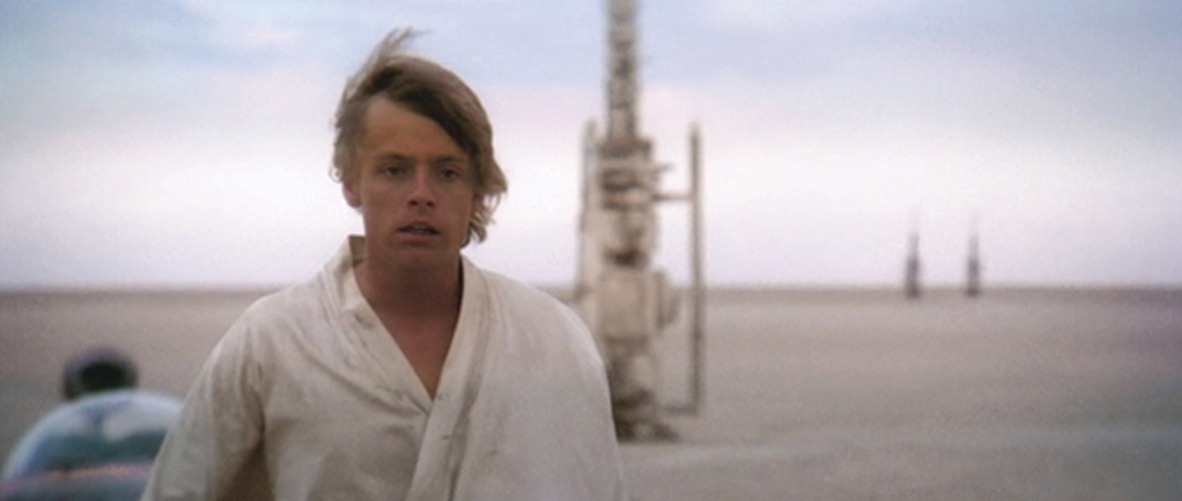
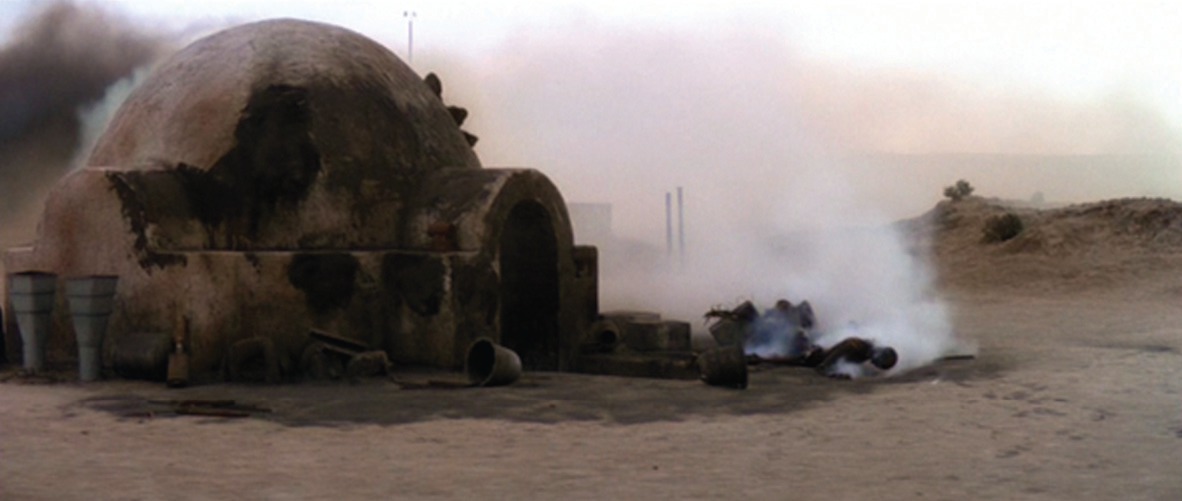
Luke discovers the burning homestead; Luke’s point of view
As a third example of direct homage, Michael Kaminski’s Secret History of Star Wars website includes a detailed and fully illustrated account of Lucas’s apparent borrowings from Kurosawa, including – as was the case with The Searchers – a chain of shots that seems lifted in its entirety from The Hidden Fortress and only minimally adapted. The duel between Darth Vader and Obi-Wan Kenobi, Kaminski demonstrates, follows the exact pattern of Toshiro’s Mifune’s staff fight:
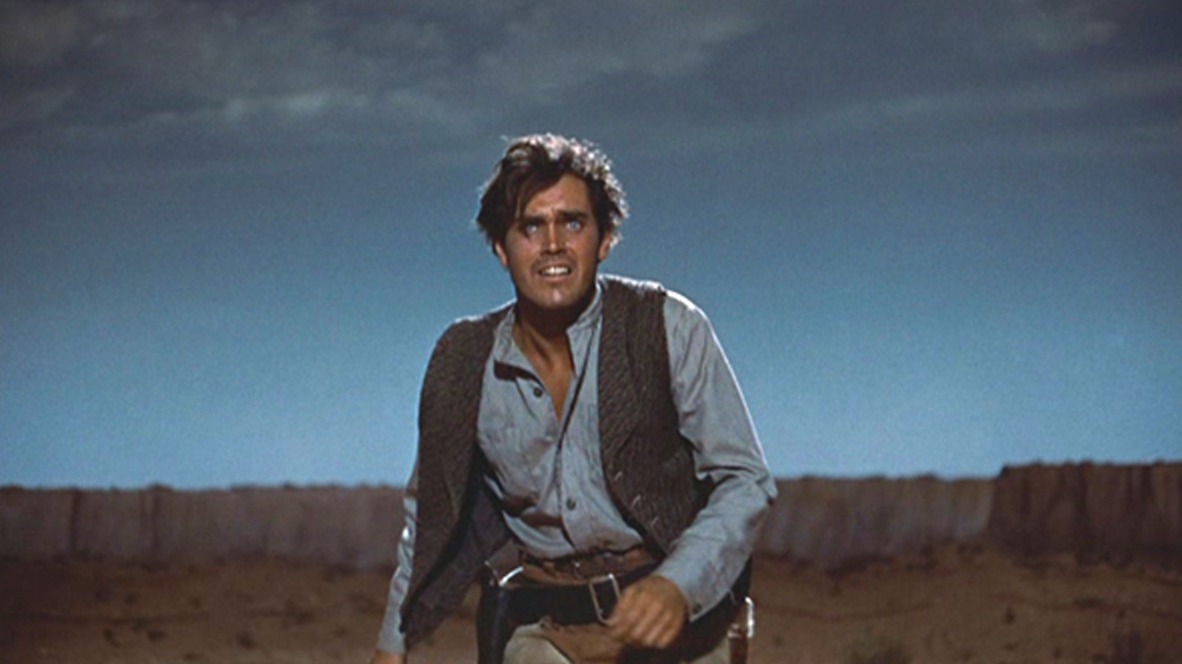
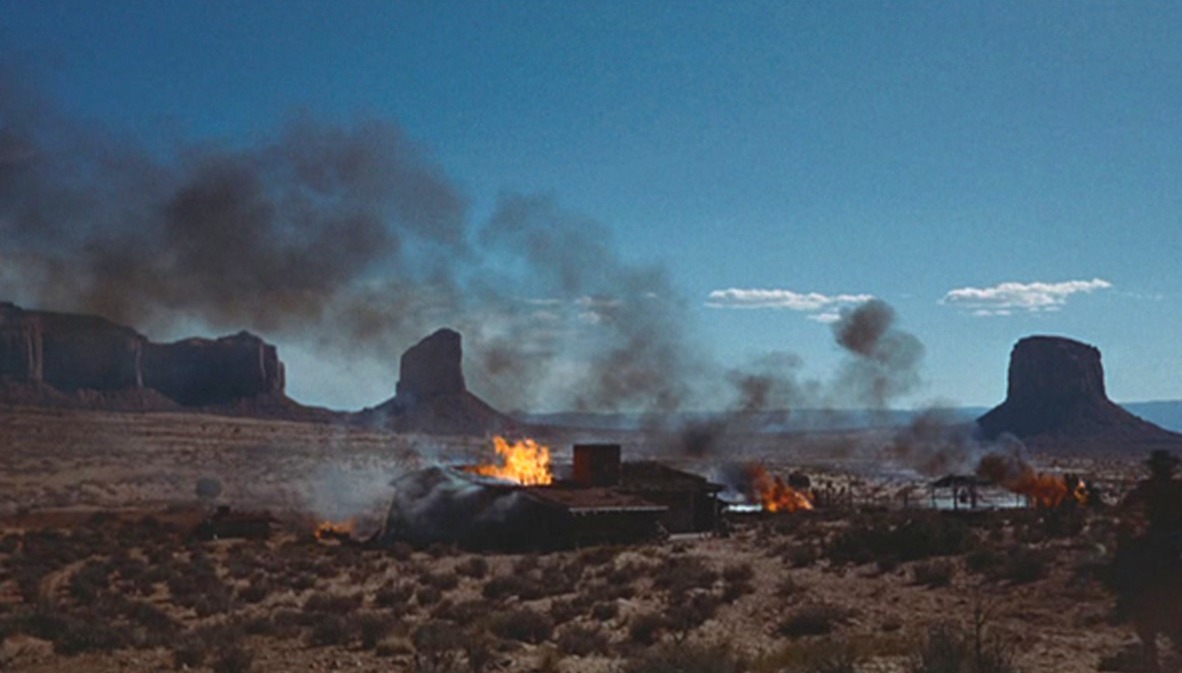
The Searchers: Martin Pawley discovers the burning homestead; Martin’s point of view

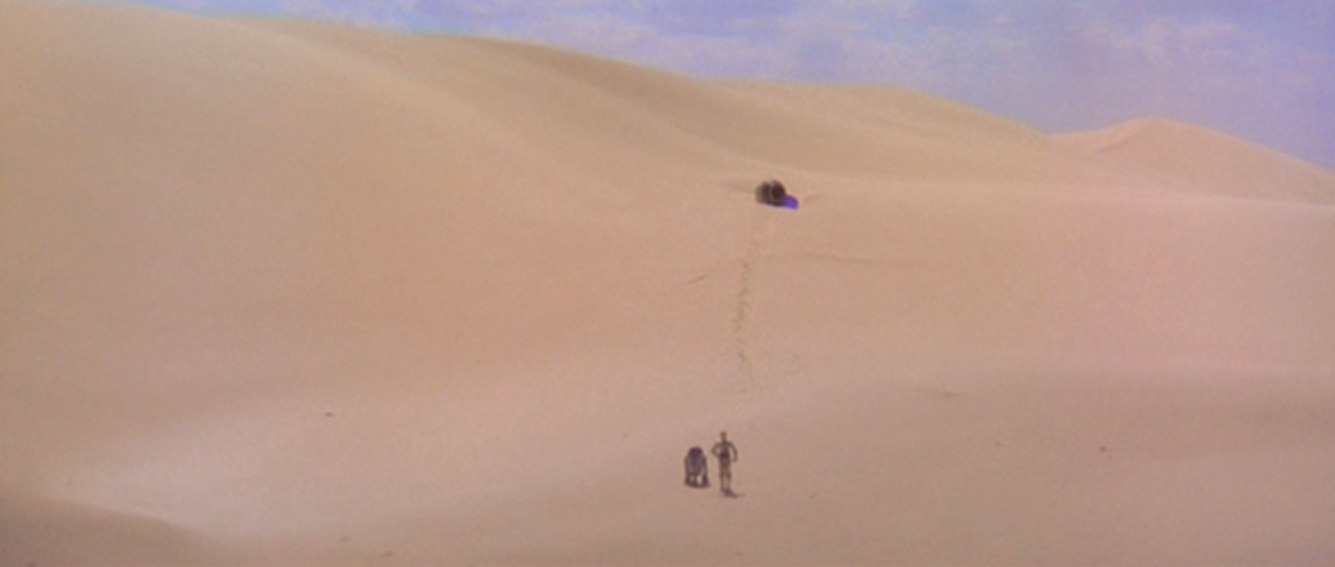

Lawrence of Arabia: desert landscape, distant figures; Star Wars: crossing the dunes; Lawrence of Arabia: surveying the territory
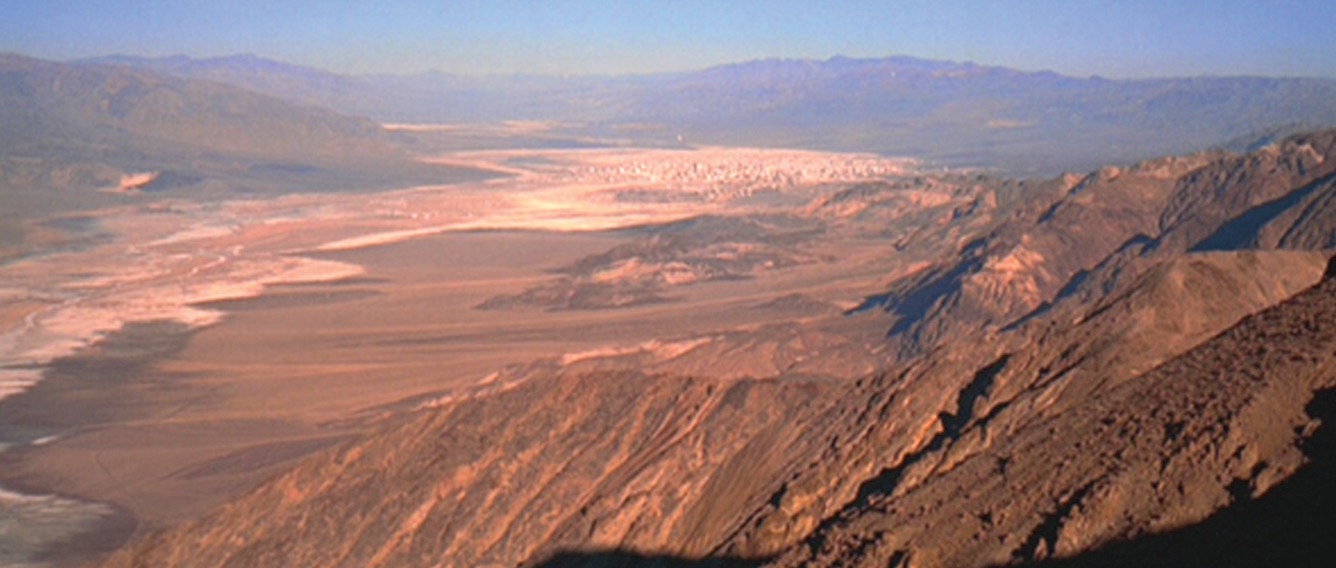
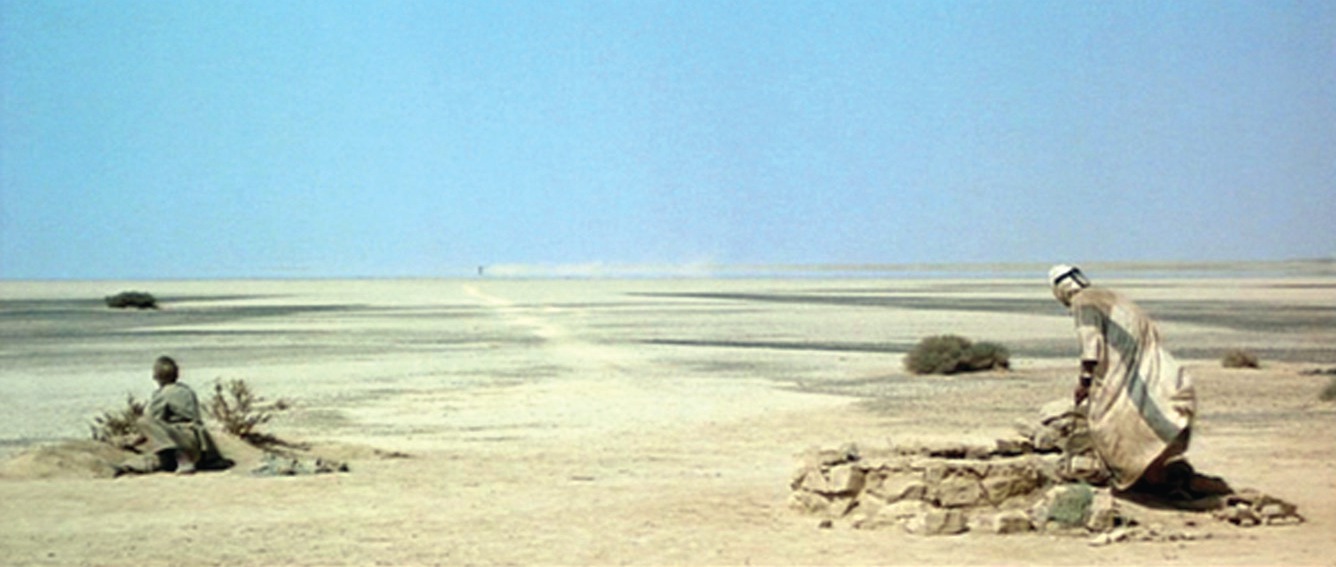
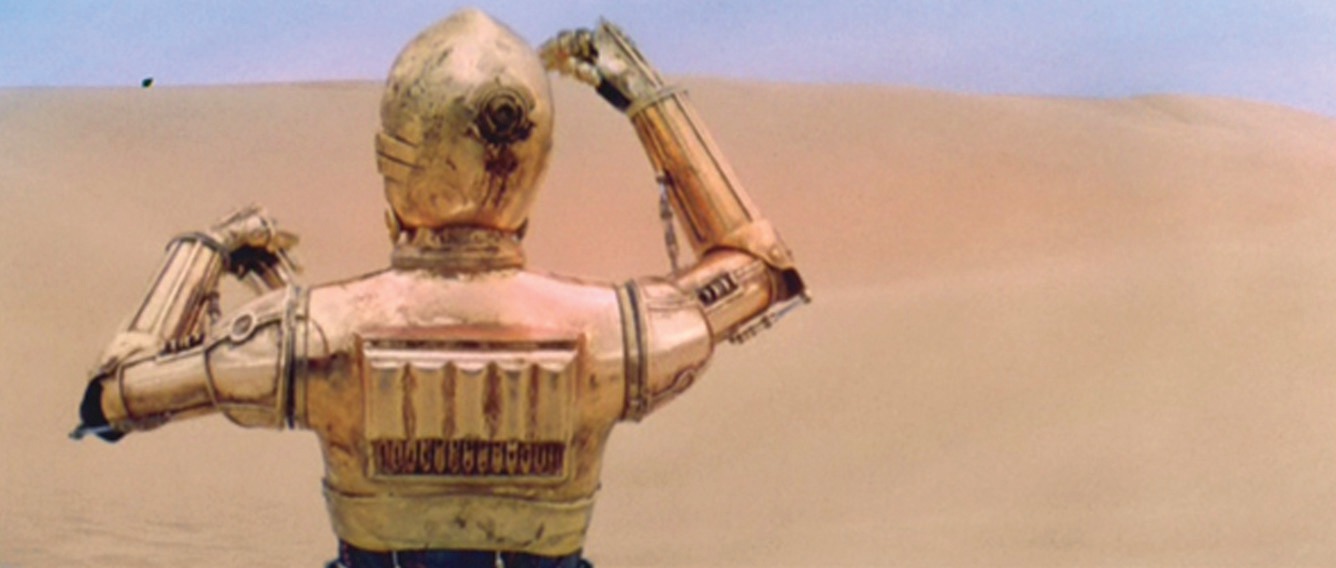
Star Wars: looking towards Mos Eisley; Lawrence of Arabia: a rider approaching; Star Wars: ‘a transport, I’m saved!’
an establishing tableau, composed identically across both films, followed by a precisely matched rhythm of three subsequent shot/reverse shots as the opponents warily advance, and climaxing, in both cases, with the warriors’ weapons clashing in diagonals across the frame.140
While Lucas has never confirmed whether the cases discussed above are intentional, shot-for-shot pastiches, he made no secret of the montage of war movies he used as a primitive ‘animatic’ to show the ILM technicians what he wanted from his space dogfights, and to serve as temporary footage while the effects were in production.141 The official Lucasfilm documentary, Empire of Dreams, shows clips from unspecified war films alongside the sequence of the Falcon blasting through a TIE fighter pursuit squad on its escape from the Death Star, suggesting a direct, almost frame-to-frame correspondence between the shots. Abandoning Jympson’s edit, Lucas asked Chew to prepare him a new rough cut, and then, in Chew’s words, decided ‘to get his hands dirty’ and regain control over his film’s meaning. ‘It was too hard to explain what I wanted,’ Lucas explained, ‘so I just cut the whole thing.’142
The attack on the Death Star trench is clearly modelled on the final scenes of World War II movies such as The Dam Busters and 633 Squadron (1964),143 where a crack team of pilots faces the challenge of flying down a narrow passage under enemy fire from the ground and the air, to hit a small target with specially designed bombs and bring down a massive Nazi installation. The entire last act of Star Wars precisely echoes the narrative conventions of these two films in particular: the briefing, where officers display maps of the target and host a question-and-answer session, is followed by the milling camaraderie of pilots before take-off and then the attack run itself, which almost comes as a release. More specifically, Star Wars directly follows the editing pattern from these earlier films, building a suspenseful rhythm between POV shots from the cockpit, reaction shots of each individual pilot, exterior shots of the planes swooping (and crashing), and constant reminders of the enemy cannon fire. The tension is heightened further by cross-cutting back to the control room, where officers and communication staff – and in Star Wars, Princess Leia – wait helplessly and follow the battle at a distance, through diagrams and radio messages; a technique that Lucas may have adapted from D. W. Griffith.
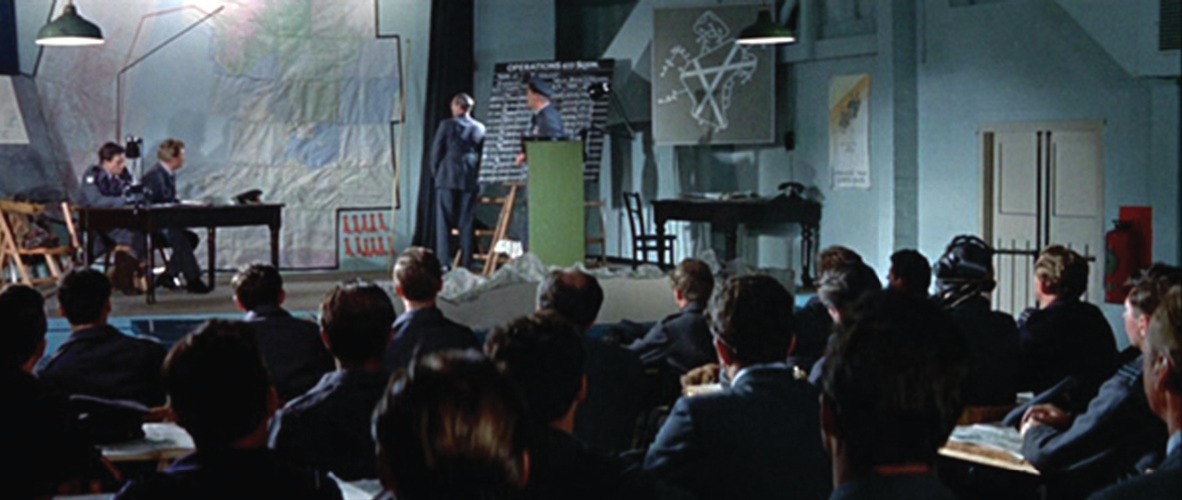
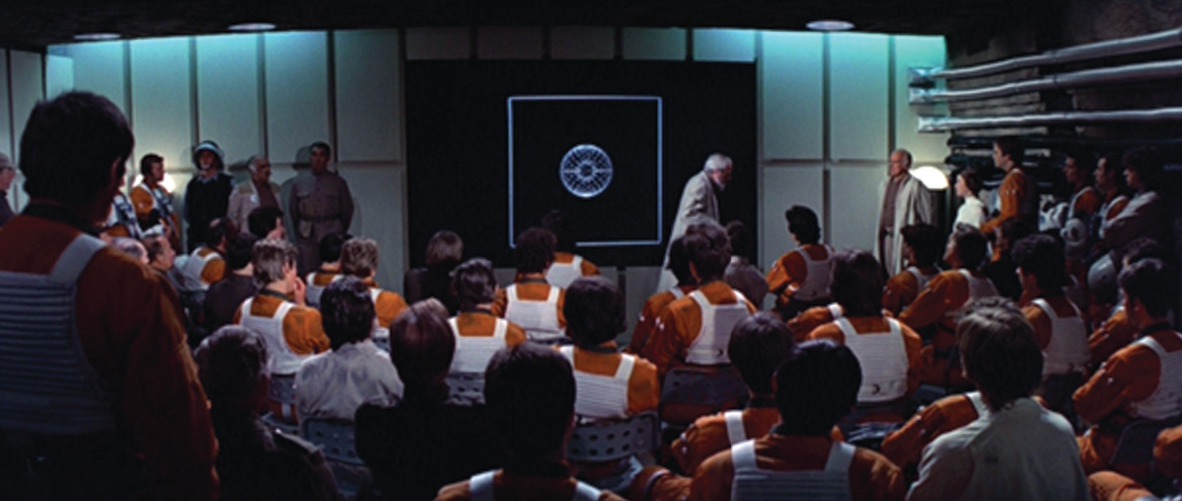
633 Squadron: mission briefing; Star Wars: Rebel war room
On an even closer and more detailed level, Lucas tried to recreate the movement of light in the cockpit shots of his war movies.
The one thing in the footage that makes it real is that the key lights change all the time. Even when they’re just flying along in a straight line, the light is never sitting there. It’s always rotating and moving. It’s really a nice feeling, even if it’s illogical.144
A close examination of the equivalent shots in Star Wars shows the effect in motion: within the space of a second, a key light slides up the shoulder of a pilot and over his helmet, dancing across the enclosed space of the cockpit.
In light of Star Wars’ adherence to continuity editing and its direct, sometimes blatant borrowing from Hollywood or Hollywood-influenced cinema, it is easy to see why the existing histories of George Lucas’s career represent it as a break from his earlier, ‘experimental’ work and a move into the mainstream. However, I have already suggested that the boundaries between Lucas’s earlier work, his first two features and Star Wars are more ambiguous than might be supposed. Lucas had engaged adeptly with continuity editing since his student films, and all his features, from THX to Star Wars, continue his early interest in documentary-style shooting: multiple coverage with distant cameras, leaving the construction of narrative and meaning to the editing room; an embracing of creative improvisation in his actors’ performances; and of course, the sense of a ‘used universe’ that the movie visits briefly, only ever capturing part of its diverse and alien richness.
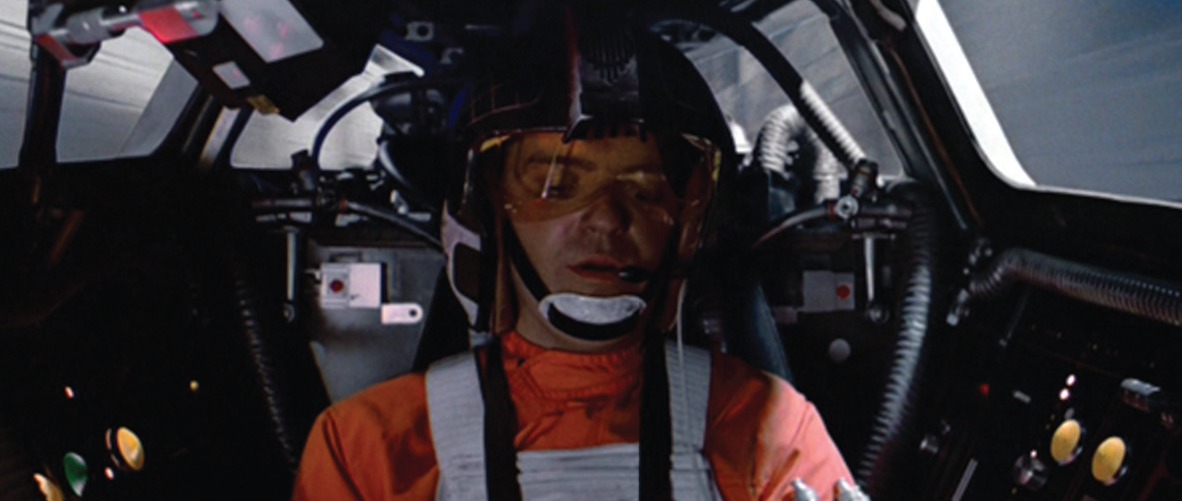
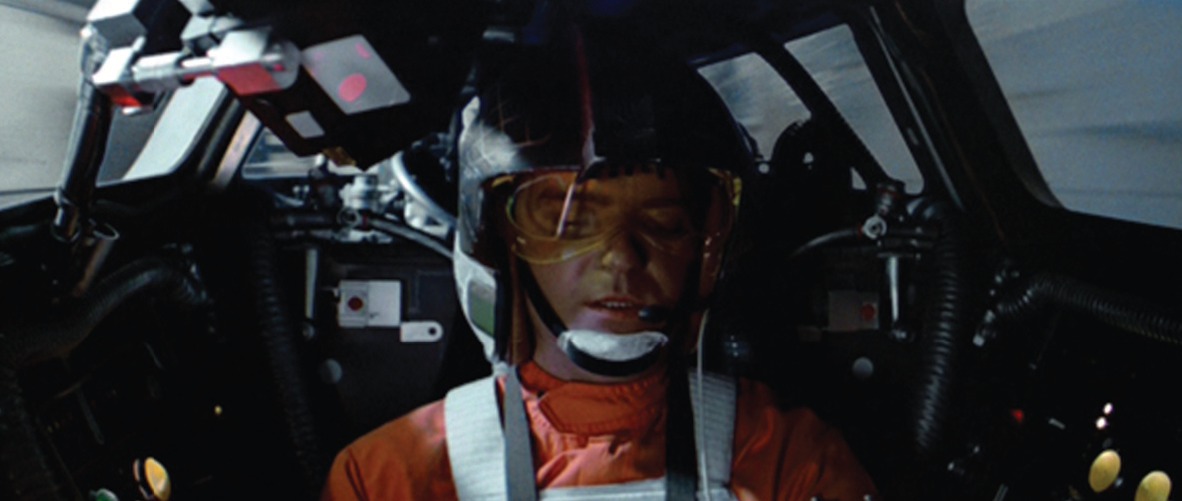
Star Wars: cockpit in shadow; changing key light
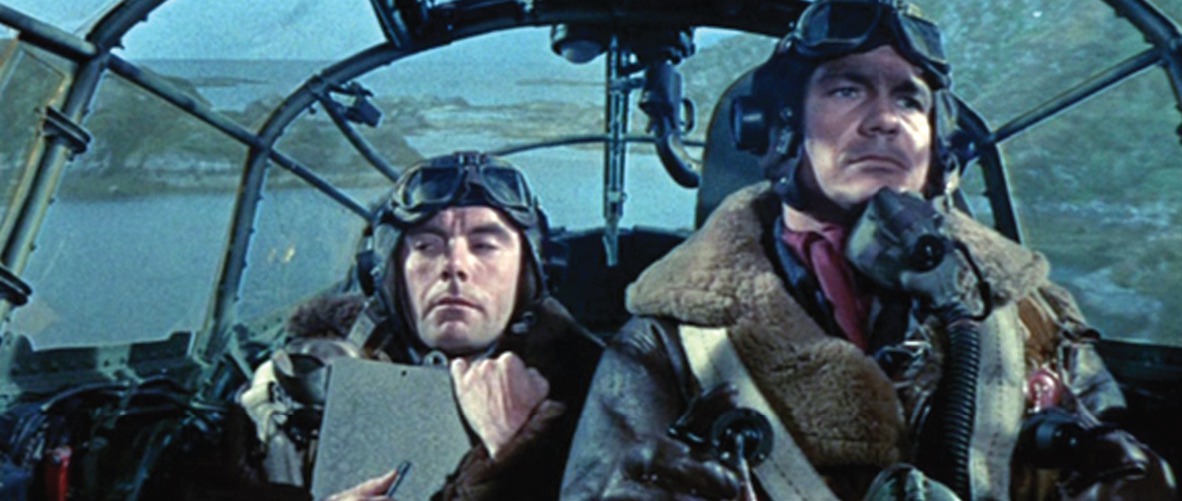
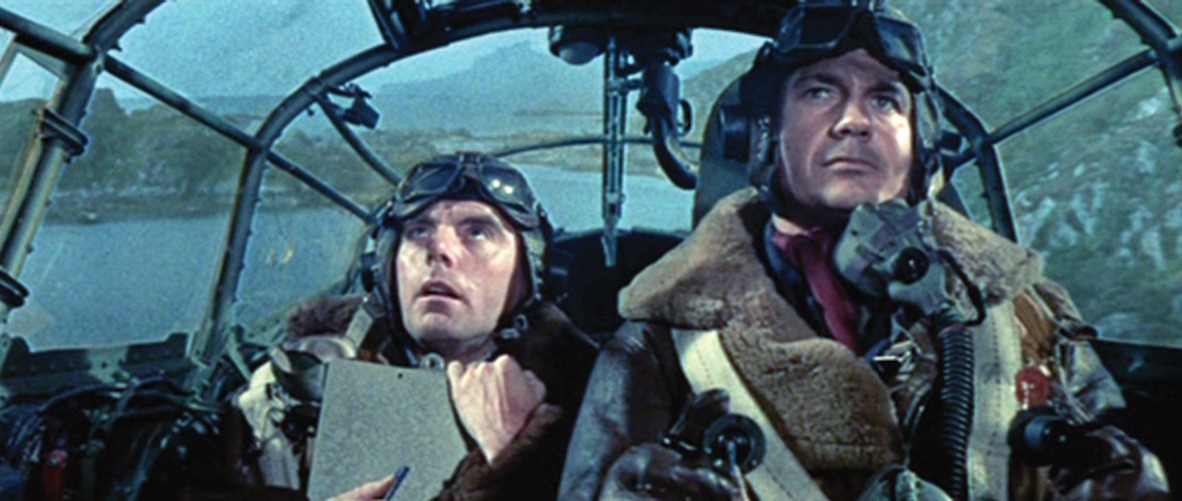
633 Squadron: patterns of shade; light and movement
We can also see, in Star Wars, the continuation of Lucas’s earliest experiments with sound layering – the echoing, ‘worldised’ tracks of American Graffiti and the ‘cubist’, contrapuntal audio effects of THX 1138, which in turn echoed the urgent soundtrack of distorted orders and reports in the original THX and the pontificating about freedom, filtered through radio static, that concludes Freiheit. In Star Wars, Lucas had Ben Burtt create a collage of familiar sounds in new combinations that, like the pieced-together props and the scuffed costumes, gives the sense of dropping in on a convincing, fully operational universe rather than a set at Elstree or an exterior crowded with crew members.145 When Owen calls Luke for breakfast, for instance, we hear the gentle hum of moisture vaporators that form the constant, subliminal soundtrack to farm life on Tatooine. The Death Star has its own background rumble, the deep, thunderous workings of a machine the size of a moon, which is overlaid with anxious updates from its troops, some audible – ‘We think they may be splitting up, they may be on levels five and six now, sir’ – and some, like the surveillance reports in THX, merely a crackle of background conversation, a reminder of staff routines and system checks.
On a visual level, aspects of Star Wars also recall Lucas’s student interest in formal experiment and abstract cinema. As noted, Lucas had encountered the new ‘underground’ cinema – Stan Brakhage, Jonas Mekas, Robert Breer and Jordan Belson – on his visits to San Francisco in the mid-60s,146 at jazz clubs, in beatnik coffee shops and at makeshift screenings,147 and had been introduced to the experimental films of the National Film Board – Norman McLaren, Arthur Lipsett, Claude Jutra – while at USC. Most obviously, Lipsett’s 21-87 had inspired Look at Life, and McLaren’s Neighbours (1952), a fable about the futility of war that uses stop-motion to animate its two actors, clearly inspired Lucas’s anyone lived in a pretty (how) town, whose characters blip out of existence when photographed. The idea of actors as objects particularly appealed to Lucas, as will be discussed more fully below.
Star Wars contains at least one deliberate homage to this 1960s underground; Leia’s cell block is 21-87. More fundamentally, Lipsett’s assemblage of scraps into a montage poem seems to inspire Lucas’s creative approach to collage, layering and found objects – whether pictures or sound, whether poached from existing sources or deliberately battered until they look like worn-out junk – and the work of the experimental animators showed Lucas that whole worlds could be created through a solitary, dedicated engagement with celluloid and an editing machine, with no need for actors or other interference. McLaren’s A Phantasy (1952), for instance, depicts an unreal, ever-changing environment through cut-outs, while Brakhage plunged the viewer through inner and outer space by painting directly onto film and layering strips of celluloid together optically. Lucas would have seen his Dog Star Man sequence, which appeared out of numbered order – Part I (1962) was followed by the Prelude, Part II (1963), then Part VI and Part III in 1964.
This approach to cinema, with the editor as creator holding total control over the final result, in a direct and intense relationship with both picture and soundtrack, remained Lucas’s ideal; the actual process of feature-film production was a painful compromise. What he really wanted was to transfer his ideas directly onto the film stock; and he wanted it enough to struggle through what, to him, was the horrific trial of working with actors, crew, effects teams and budgets. ‘I always see images flash into my head, and I just have to make those scenes,’ he said of his visions for Star Wars. ‘By God, I want to see it. That image is in my head, and I won’t rest until I see it on the screen.’148
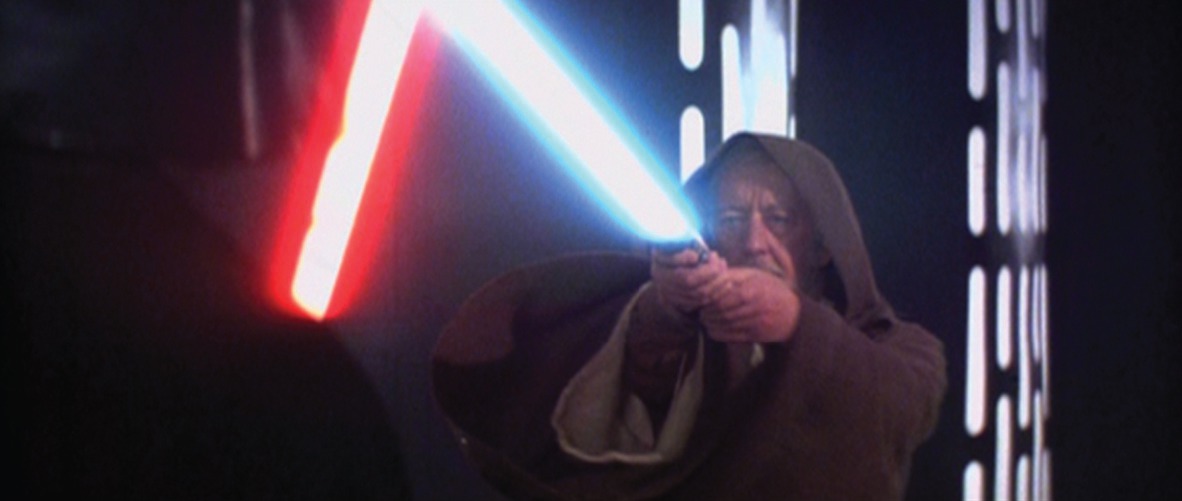
CGI, finally, brought Lucas closer to this aim, allowing him to govern the construction of whole cities and crowds through computer simulation in the Special Editions and, to an even greater extent, the prequel trilogy. Yet even the original Star Wars, with its more limited technology, sometimes recalls experimental 1960s animation. All its sequences of ships hurtling through space, shooting bolts of energy at each other, are, after all, optically created through the layering of various film strips, just as Brakhage did with his cosmic, mythic collages or McLaren did with his Mosaic (1965), which superimposed two previous shorts. The laser shots and clashing sabre blades of Star Wars are simply rotoscoped – drawn on over the footage, frame by frame, as in Brakhage’s or McLaren’s animation – and the explosion of stars into radiating lines as the Falcon zooms into hyperspace recalls Jordan Belson’s Allures (1961), which Lucas saw screened on the ceiling of the San Francisco planetarium.149 The computer graphic displays that interrupt and comment on the Death Star trench attack – like the neon symbols and signs that crop up like a digital chorus through Alphaville – are also simple, animated diagrams of shifting geometry: circles overlapping with grids, dotted lines swooping through gaps.
For brief seconds, Star Wars shows us patterns of brightly coloured light, arrangements of shapes or psychedelic swirls. Paused during its sequences of galactic war, Jedi combat or hyperspace travel, it could almost pass for a work of abstract animation.150
These glimpses of Lucas’s continued interest in experimental animation, in the middle of his first mainstream blockbuster, are fascinating; but they are only brief glimpses, and even the sense of vérité documentary was reduced from the raw footage of Star Wars to the final cut. Richard Chew and George Lucas’s editing tended to trim the long takes of the original shots – discussed in the previous chapter with reference to the deleted Tatooine sequences – to a far snappier rhythm. The Bazinian realism of the cut Tatooine scenes, where the camera simply watches neutrally from the margins for minutes on end, becomes a more Eisensteinian edit that, for instance, chops up the leisurely original takes of the cantina scene into brisk, lively montage. Kenobi’s brief fight with the bully and his friend Walrus Man151 is, in fact, cut according to the specific methods Eisenstein demonstrates in Battleship Potemkin (1925), where the combination of two shots (swinging sabre + injured opponent)
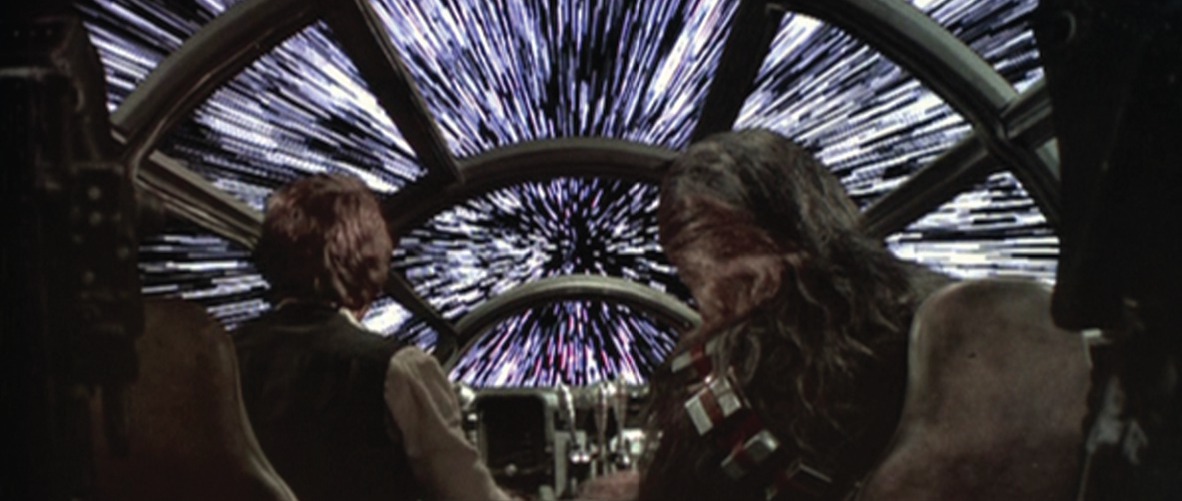
Entering hyperspace; blades of bright colour
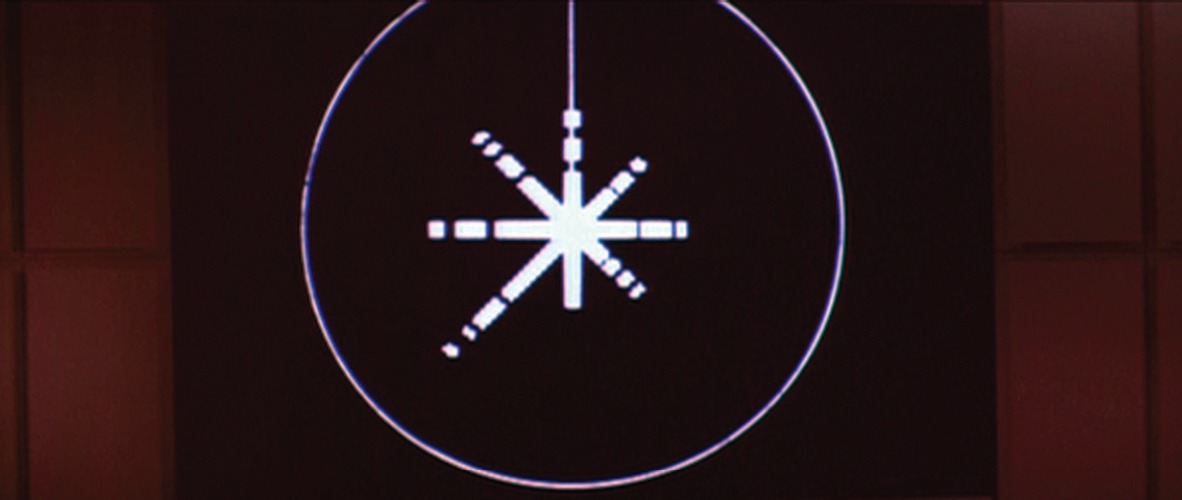
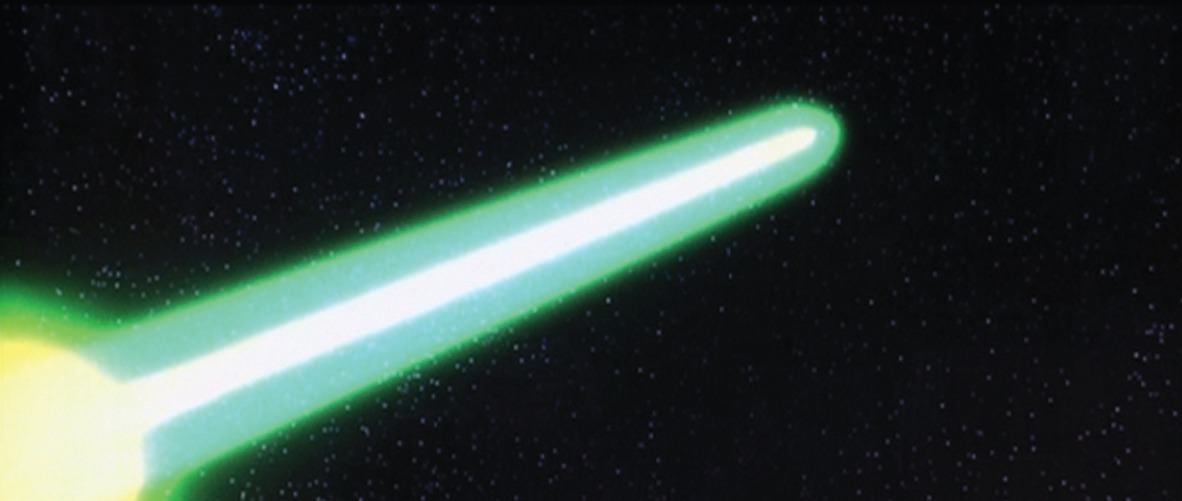
The Death Star in diagram; laser blast as abstract image
creates our understanding that the sabre caused the injury, without us ever seeing physical contact.152 The idea that Soviet montage directly influenced Lucas’s editing of Star Wars is not far-fetched: according to Rinzler, Lucas deliberately employed the Kuleshov effect153 in the scene where Luke finds the burning corpses of his aunt and uncle. Hamill wanted to fall on his knees sobbing, but Lucas advised a quieter, more restrained performance, knowing that the joining of Hamill’s blank stare with the POV shot of his destroyed home and family would, as Kuleshov had discovered, create the meaning ‘shocked grief’.154
A sense of vérité’s raw authenticity is still evident in some scenes, despite the efficient Lucas/Chew edit. The moments in Star Wars when Ford’s playful departures from the script slip through into the final cut, and the winks and smiles between the central actors lend their scenes a warm, natural chemistry, retain a feeling of life observed and unaffected. There is also a rougher documentary feel to the unsteady shots when Luke or Artoo are being watched at a distance, through gaps in the rock, by Tatooine’s bandits and scavengers, and also in the later Mos Eisley scenes; the first shot of Luke and his companions meeting an Imperial checkpoint is observed from across a busy street, with droids and passers-by, out of focus in the foreground, constantly blocking our view.155
For the most part, though, Lucas’s approach to editing was tight, controlled and disciplined. Paul Hirsch recalls the test Lucas set him when he was hired to join Richard Chew: he was given a four-minute Jympson cut, and encouraged to use alternate takes not just to slice the scene down to three minutes, but to get ‘more in it’.156 As noted in the previous chapter, Lucas enjoyed the idea of loose naturalism. He liked the idea of the camera just hanging out on Tatooine, watching Biggs, Luke, Camie and Fixer chat and flirt like the young, beautiful kids in Godard while the camera watched them for as long as it took, and cut when the conversation was over. He liked it enough to shoot those scenes. They represented the part of him that had enjoyed the relaxed, laid-back gatherings of the 1970s, the part of him that tried to recreate the warm and mutually supportive film-making community of Coppola’s American Zoetrope company.157
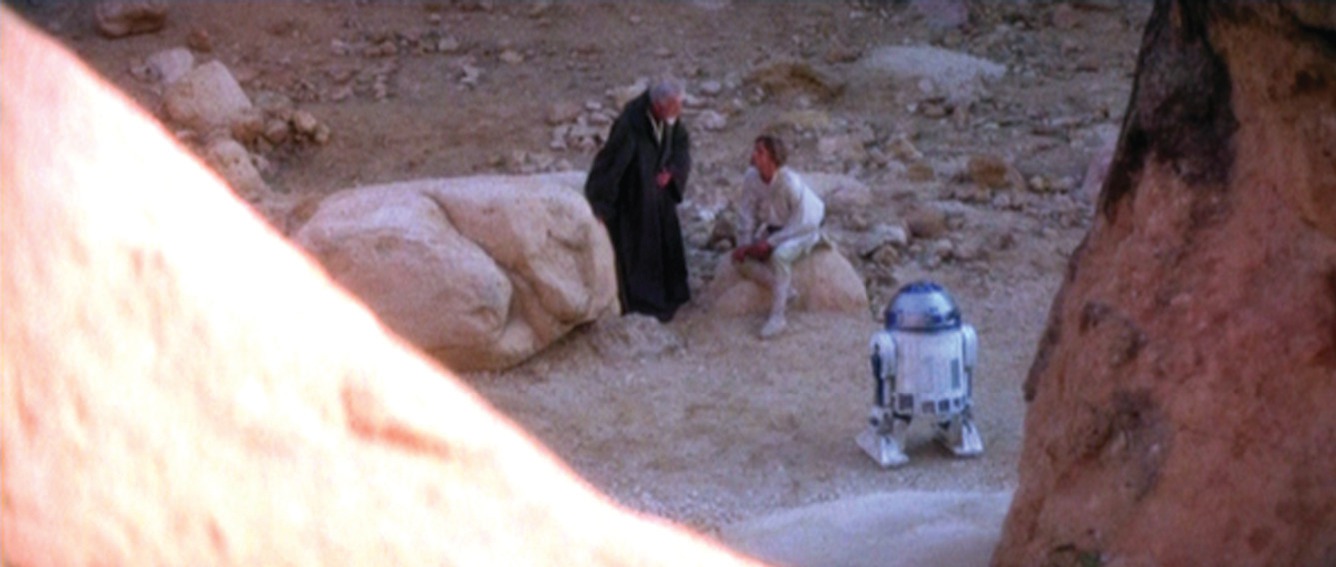
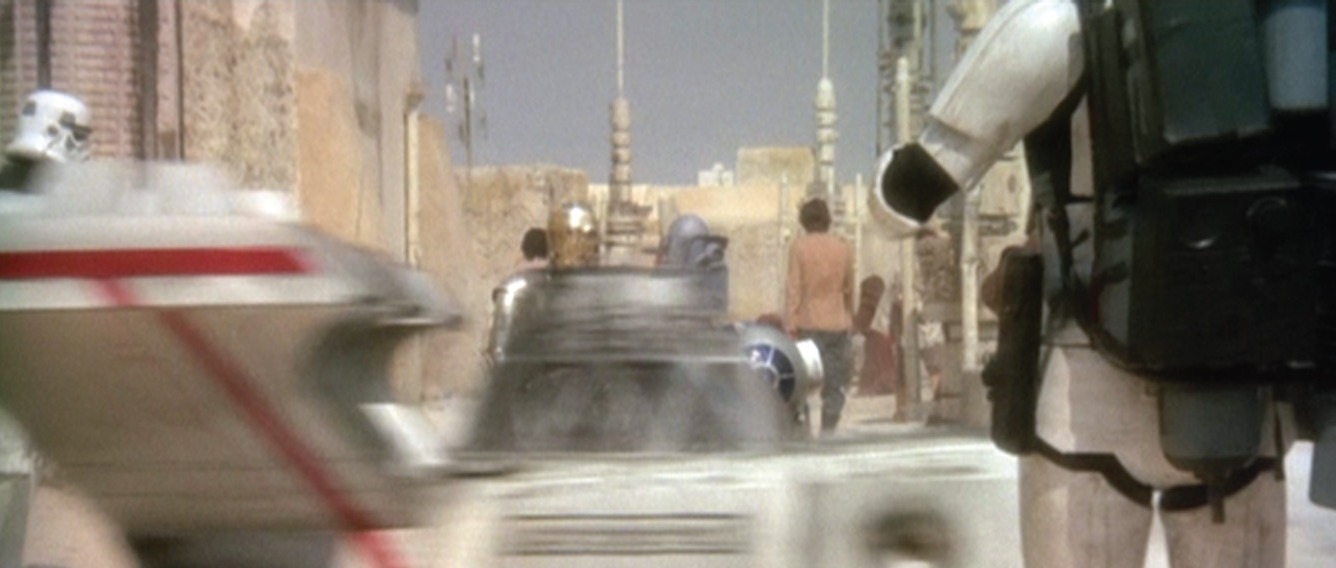
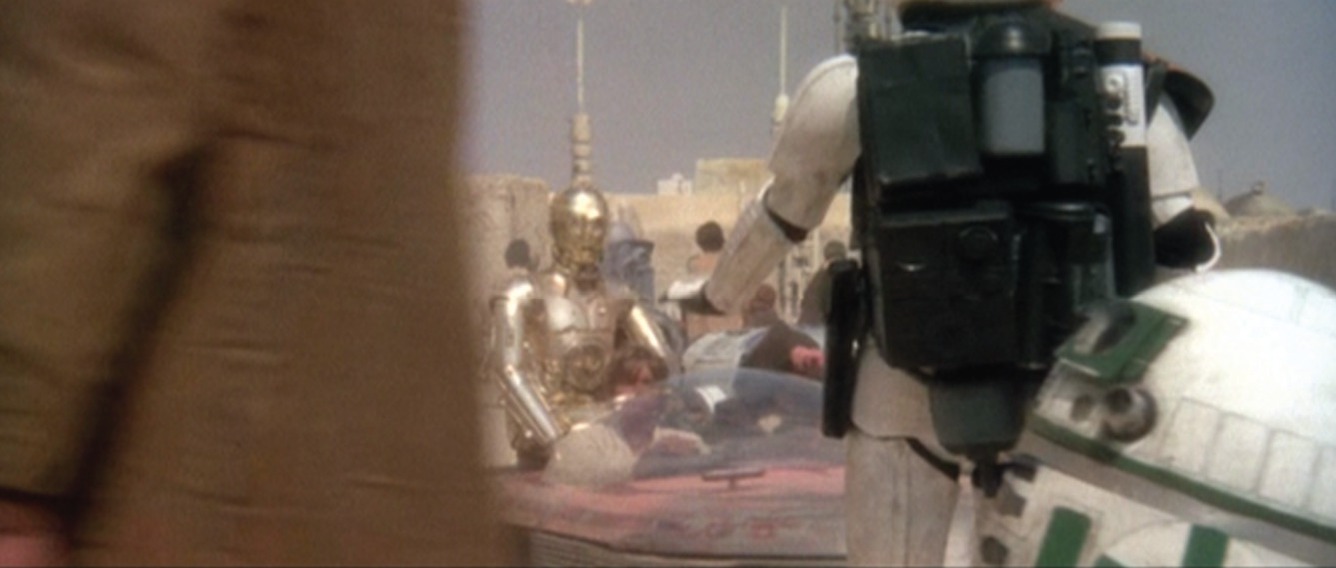
Watching through the rocks; traffic passes the camera; Mos Eisley, documentary style
Yet Lucas found it difficult to maintain easygoing ideals while struggling with the emotional pressures and physical challenges of keeping his production on track; and just as he had become a remote disciplinarian on the set, barely dealing with crew or actors except to curtly approve or fail their efforts, so he approached the raw footage of Star Wars with harsh efficiency, paring it down until only glimpses of a looser, more casual cut remained. He was the ‘general’, as Richard Chew saw him, ‘of this huge army’.158 Again, though on one level Lucas genuinely identified with the creative, community feel of the Rebels – or the idea of the Rebels, although his social awkwardness had never allowed him to be fully comfortable with this kind of group in practice – the experience of directing brought him into far closer affinity with the cold, distant and alienated leaders of the Empire.
Lucas had already shown a talent for leading armies, far earlier in his career. For the USC version of THX, he assembled a team from the Navy and Marine Corps cameramen he had been teaching part-time. ‘All at least ten years older than him, and mostly resentful of having anyone teach them their business, the sailors were contemptuous of almost all civilians, but particularly of hippie students.’159 Lucas cannily marshalled them into two competing groups and set them technical challenges; the men responded with immediate and total loyalty. ‘Within a week, those tough navy guys were licking George’s boots,’ said Dave Johnson. ‘… They were following him around like puppy dogs.’160 John Milius judged it ‘a brilliant piece of generalship’.161 He was an efficient, no-nonsense leader, and becoming steadily more like his father, who had responded to Lucas’s rebellious decision to go to USC by shrewdly offering him the tuition fees as a salary and keeping his son on the books as a paid employee.162
Military discipline, for Lucas, took much of the strain out of directing; a crew that didn’t argue back or goof off eased the difficult process of getting the pictures out of his mind and onto a movie screen. In THX, he even reduced his actors – some of whom doubled as crew – to interchangeable, numbered drones, prefiguring the clones of the Star Wars prequel trilogy and the nameless, numerically coded troopers of the Death Star. If he had to work with people, he preferred to have them operating like cogs in a machine. Recall Baxter’s comment that Lucas found objects more interesting than human beings,163 and Lucas’s own attitude, according to Dave Johnson: ‘Let someone else work with the people … . People are just objects.’
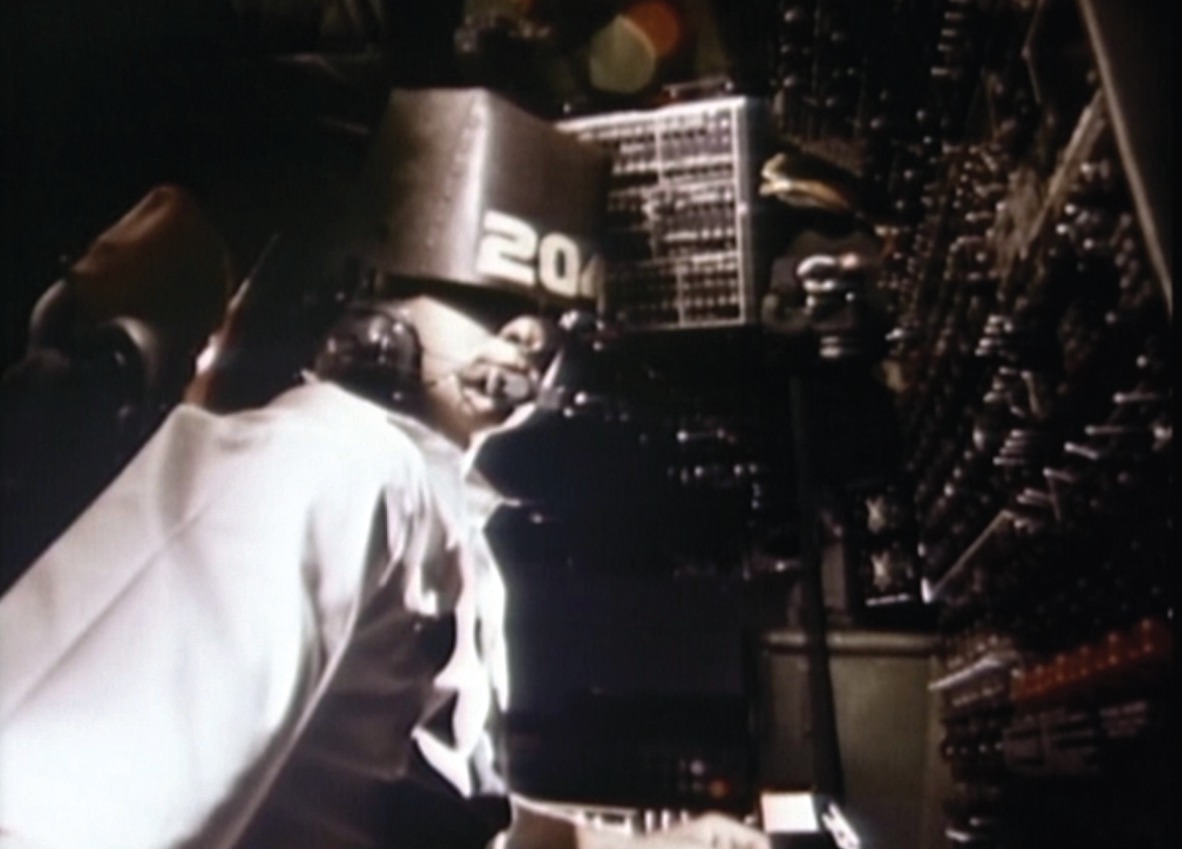
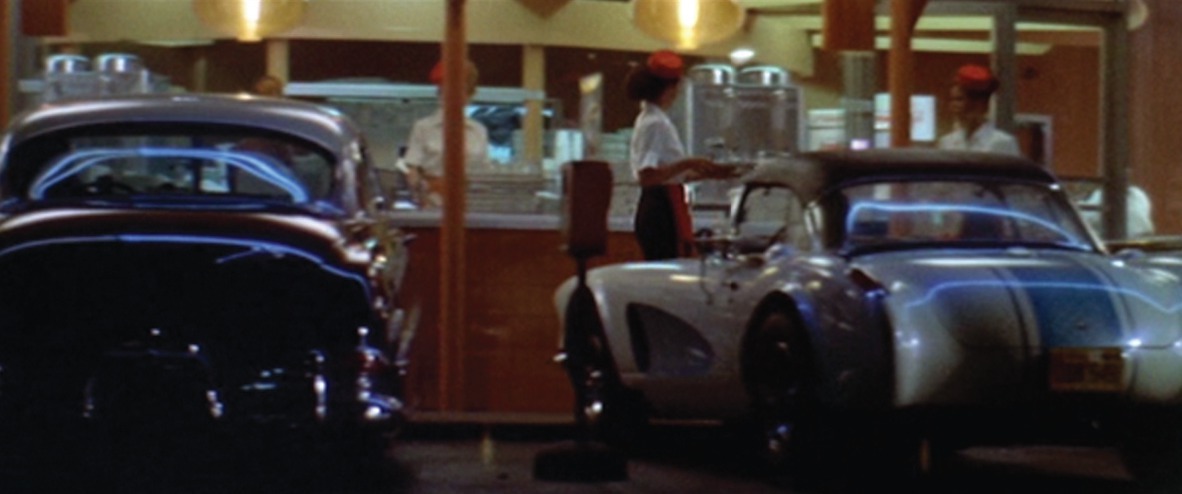
THX 1138: 4EB: part of the machine; American Graffiti: gleaming bodywork
Lucas’s first student films had celebrated the shiny surfaces of machinery – the leisurely reflections of Herbie and the yellow flash of 1:42.08’s race car. In THX 1138: 4EB he put a bucket-sized helmet on an actor’s head, hiding half his face, then labelled him ‘204’ and sat him in front of a giant dashboard. In American Graffiti, despite his intention to make a warm and casual story about a group of kids, Lucas’s camera lingered on the gleaming bodywork of parked vehicles.
Lucas found his objects of desire again in Star Wars, not in the beaten-up and patched-together accessories of the Rebels but in the polished, pristine aesthetic of the Empire: the clean, white armour that made the Imperial troops look like blankly identical robots; the perfectly drilled formations of those troopers, who in long shot became arrangements of white on black, patterns rather than people; the anonymous gunners who destroyed Alderaan, their identities shielded by casque-like visors that reflect only the lights of their control room, and of course Darth Vader, a man-machine whose moving parts, in this film, are entirely concealed in a gleaming black shell.164
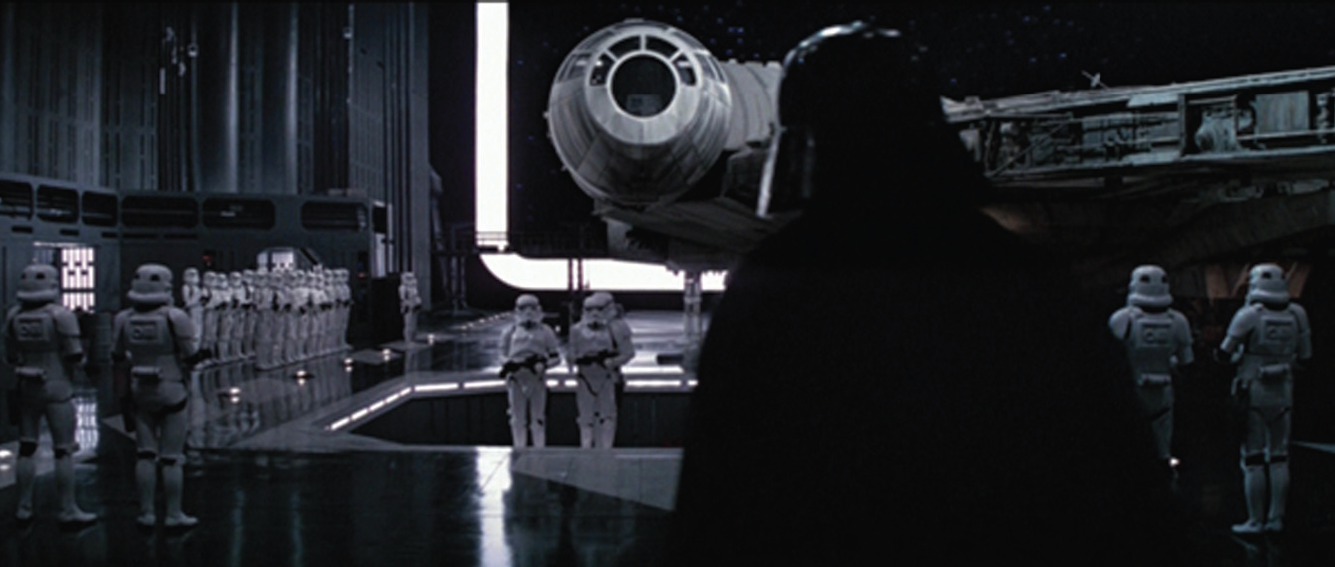
Surfaces of the Empire
George Lucas’s first ever movie was a stop-motion cine film of plates, stacking themselves up and then unstacking.165 He liked objects, and order, and control. He was, on one level, deeply invested in what the Empire looked like and represented, in its clean and shiny surfaces and its formal, rigid structure. But because he was trying to make a straightforward fable about good and evil, he had to let the Rebels’ casual, careless improvisation into the structure he secretly admired, to disrupt it, and destroy it.