
4
Most [Star Wars] games, like the popular Rebel Assault CD-Rom, put the player in the position of a fighter in the forces led by the heroes … but the Tie Fighter game casts the player as a member of the Empire forces. As one adult player, a pony-tailed programmer from San Francisco told me, this recruitment into the forces of the Empire can be a source of intense fascination. ‘I got totally identified with the Empire and its goals of maintaining order. I found myself hating the rebels because they brought disorder. It really freaked me out. I could see right away how I could become a great fascist.’166
This final chapter explores the conflict between the Rebel and Imperial approaches and aesthetics, which are kept separate, in alternating scenes between colour-coded worlds – cold monochrome surface versus rough, sandy clutter – until the Millennium Falcon enters the Death Star. The Imperials’ capture of the Falcon ironically enables the Rebels’ infiltration and subversion of the Imperial system; just as, in a later inversion, the Falcon’s apparent escape from the Death Star finally leads the Imperials, via a homing beacon, to the Rebel base. In the film’s final act, the Rebels employ military discipline to match and outwit the Imperials, and in the very last scene, the ritualised ceremony to crown the Rebel victory unsettles the distinction between the Imperials’ association with ‘order’ and the Rebels’ with casual, improvised creativity – setting up an uncertain relationship between these two apparent oppositions that will continue to trouble the sequel and the prequel movies.
George Lucas, like the ‘pony-tailed programmer’ who surprised himself by identifying with the Imperials, privately cherished the order of the Death Star, with its hierarchies, its structure, its neat shininess, its efficiency. It was the kind of system he wanted to be running; a system where telling people what to do was impersonal, like giving a machine instructions, where you could issue an order and know it’s going to be carried out, with no answering back or goofing off. The Rebels, as the gamer discovered, disrupt that calm like a virus in a computer, like a disease within a body; like Lemmy Caution, the brash American agent, in the sterile European world of Alphaville; like Harrison Ford, Carrie Fisher and Mark Hamill on Lucas’s set.
‘We were all goofin’ around,’ Hamill admits on the making-of documentary, Empire of Dreams. ‘And tryin’ to make George crack, cause he really looked like he was ready to burst into tears.’ We see the Rebels racing through a Death Star doorway, only for Lucas to mournfully tell them that the shot was ruined because of a microphone in frame. Ford and Hamill advance on the director chanting ‘and? And? And?’ then explode into disappointed groans, echoing ‘the mike was in picture!’ while Fisher whoops sarcastically. Lucas forces a pained smile. ‘That, to him, was really inappropriate humour at the time,’ Hamill concludes. ‘’Cause I’m sure he’s in the zone, and seeing what he wants to do, and we’re just like actors trying to stave off boredom.’
Yet Lucas, despite his own need for discipline and structure and his preference for objects over people, also wanted to make something that ran counter to those personal urges – something warm, human, fun and innocent – and so he let the Rebels run riot, while the Empire tries to control and at one point, literally crush them. The Death Star scenes are fundamentally about this conflict between two oppositional approaches, one of which comes naturally to Lucas, and the other which he struggles to embrace.
* * *
Though the Empire gains the upper hand by dragging the Millennium Falcon into its control with a tractor beam, Han and Luke’s creative improvisation turns this imprisonment to their advantage. After inventively using Han’s secret compartments to smuggle themselves, they successfully enter the Death Star system by disguising themselves as soldiers with a Wookiee prisoner, becoming temporarily part of the Imperial structure where people, for the most part, look like robots, and non-humans are a despicable cultural other. ‘Where are you taking this … thing?’ spits the Imperial commander. ‘Prisoner transfer, from cell block 1138?’ Luke replies helpfully. The Imperial narrows his eyes. ‘I wasn’t notified. I’ll have to clear it.’ He signals to his inferiors, helmeted troops who approach Chewbacca – and all hell breaks loose.
The brief exchange demonstrates the Rebels’ approach to the rescue of Princess Leia and their subsequent escape from the Death Star, which combines a subversive use of the system with a more direct attack on specific nodes in the Imperial network. Luke, as we see, adapts readily to the Imperial system of codes and numbers. As the Falcon sits like a crusted rock in the middle of the clean-angled Death Star hangar, we hear a constant background of announcements in the Imperial discourse: ‘Unlock 1, 5, 7 and 9. 316, report to control.’ Within seconds, Luke is dressed in trooper uniform and taking the role of ‘TK421’, tapping his helmet to indicate a bad motivator; he subsequently invents a cell-block number and sounds plausible enough to convince a commander. Like Artoo, who can plug into a single terminal and ‘interpret the entire Imperial network’, obediently flashing up maps of the Death Star and its seven tractor-beam locations, Luke speaks the Empire’s language. He was, after all, planning to leave home to join the Imperial Academy, before presumably following Biggs’s example and jumping ship for the Rebellion; he knows about playing the game.167
Han, on the other hand, may have Imperial service in his Expanded Universe history, but he turned his back on it long ago to become an independent pirate and smuggler. His approach contrasts with Luke’s from the moment they infiltrate the Death Star. Luke opts for disguise – he even keeps his mask on when rescuing the princess – while Han and Chewbacca resort to brute force and blaster fire at the first opportunity. ‘You know, between his howling and your blasting everything in sight, it’s a wonder the whole station doesn’t know we’re here,’ Luke complains. ‘Well, bring ’em on!’ Solo replies. ‘I prefer a straight fight to all this sneakin’ around.’ Right outside the cell block, Han hisses that Luke’s plan is ‘not gonna work’; while the Imperials run a tight hierarchy, the Rebel team – such as it is – bickers and gripes like kids on a family outing.
Of course, the plan does work, and Luke’s strategy remains tightly pinpointed rather than randomly aggressive. Presumably following his previously agreed approach, he and Solo take out the Imperials in the cell-block control room, but then, as shown in a series of close-ups, they destroy eight separate cameras, damaging the clearly extensive surveillance system that – as the constant background commentary of checks and orders demonstrates – holds together Imperial discipline.
When Han is called on to deliver a status report himself, he is less adept than Luke at finding the right mode: he fumbles for official-sounding terminology, and when his improvisation about weapons malfunction and reactor leaks runs out, resorts to his blaster for an emphatic full stop, attacking the system rather than subverting it. He winces at his failure, realising he’s brought more troops instead of holding them off as promised, but retains his clumsy, endearingly foolhardy approach; later he rashly blasts energy bolts off the magnetically sealed walls of the trash compactor, risking the ricochet, and chases troopers with a wild battle cry towards a dead end, buying time for Luke and Leia. ‘He certainly has courage,’ Leia muses. ‘What good will it do us if he gets himself killed?’ Luke replies.
Leia, like Kenobi – as already suggested – comes from a different world to Luke and Han. Kenobi has lived as a hermit since the days of the Old Republic, preserving the conventions of an era eighteen years earlier, when the Jedi flourished; Leia, as the adopted daughter of Alderaanian monarchy, has clearly grown up in a society that retains the Republic’s cool formality and precise, elegant social rules. Though her family name suggests ‘organic’ and the military base she now calls home is a temple on a forest world, Princess Leia Organa begins Star Wars as a self-possessed diplomat whose clipped diction and reserved manner – like her white gown and cinnamon-bun hairstyle – signify Alderaanian rules and ceremony, and give her more in common, initially, with the equally uptight Tarkin than with the lounging scoundrel Solo.
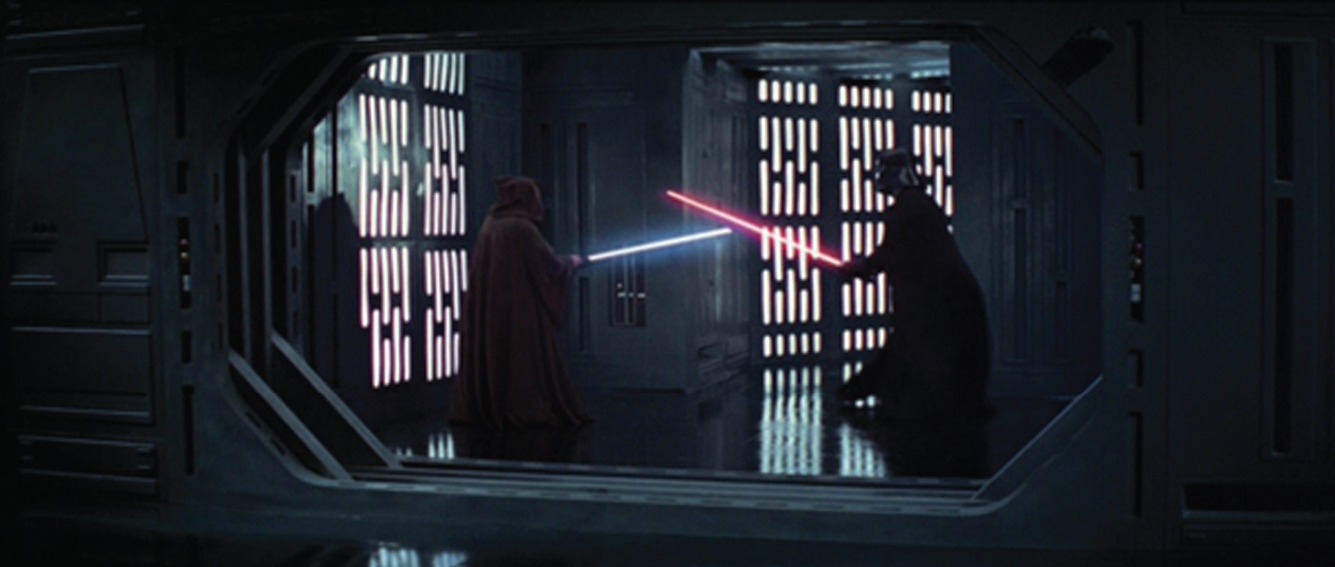
Kenobi’s final battle
Kenobi, rather than changing, accepts that his time is over. His final scene is a formal duel with Vader, slow and careful like two men remembering the steps to an old, ritualised dance; it even takes place within a frame, in tableau as if on a theatrical stage. This is Obi-Wan’s last performance.
Leia, by contrast, loosens up during the escape from the Death Star. As noted above, her trajectory throughout the trilogy crosses over with Han’s as he becomes more socially responsible – both moving towards the point in Return of the Jedi where he accepts the position of military general and she dons a flowing, folksy dress in the Forest of Endor, and they can finally form the trilogy’s romantic couple. It is Leia who orders Han ‘into the garbage chute, flyboy’, and though her attempt to pull rank as a princess and senator clashes with his stubborn self-sufficiency – he mocks her Alderaanian position as ‘your worshipfulness’ – by the time they reach the Falcon, she is bantering like a Howard Hawks heroine. ‘Didn’t we just leave this party?’ Han grumbles, seeing his ship still under guard; Luke and Leia arrive, out of breath, and Han barely glances at them as he asks ‘What kept ya?’ ‘We, ah, ran into some old friends,’ Leia shoots back sardonically. Like her earlier dig about the Falcon – ‘You came in that thing? You’re braver than I thought’ – Leia’s quick-fire dialogue and twangy delivery at the end of the Death Star episode are a world away from her earlier, tight-lipped ripostes to Tarkin and Vader.168
The Rebels’ passage through the Death Star – Han and Chewie’s violent assault in particular, rather than Kenobi’s quiet journey169 and Luke’s more subtle infiltration of the system – obviously disrupts the Imperials’ cold, clean and shiny mise en scène: blaster fire destroys the surfaces of consoles, revealing their smoking innards, and punches holes in the sleek, grey corridors, exposing the hidden garbage network. But it also plays havoc with film form. As an example, the early scene where Tarkin announces the end of the senate opens with a precisely symmetrical shot/reverse shot figure and moves through a smooth dolly that circles the round table. The camerawork here is both very much in keeping with the polished decor and the icy exchanges of the Imperials, and in direct contrast to the jerky shots with unfocused foregrounds when we cut to the Tatooine desert and the bustling streets of Mos Eisley.
However, the subsequent Rebel attack on the cell block breaks the room up into disorienting fragments – quick close-ups from diverse angles that make no effort to retain spatial coherence and, unusually, ignore the 180-degree line of continuity editing. It becomes almost impossible to keep track of who is shooting and in which direction; the effect is simply of choppy chaos. Similarly, the scene where Han defends the cell block after blasting the communicator begins with a shot of Chewbacca that – again in an unusual if not unique camera move within Star Wars – whip-pans across to Han as he shouts ‘Get behind me, get behind me’. Solo’s wildly destructive transit through the battle station, then, wrecks the staid and measured camerawork associated with the Imperials.
The Empire, in turn, or rather, its instrument the Death Star, attempts to exercise control over the Rebels not just by hunting and tracking them, but by literally crushing their resistance. The trash masher steadily reduces the space available to the Rebels, compressing the frame of the image into an ever-narrowing rectangle. The Rebels are, as discussed earlier, associated with junk and garbage, while the Empire is uniform surface: the image of the slick, dark walls closing down the cinema screen, squashing the improvisational, creative energy of the rescue squad – as they try every method available of blocking the walls – and compacting the messy, miscellaneous shapes of the mise en scène, with its dirty costumes, borrowed uniforms and constantly shifting layers of trash, is a perfect evocation of the opposition between the Imperial machine and the humans attempting to sabotage it.170
In the attack on the Death Star trench, we finally see the Rebels as a military organisation, rather than a small gang of adventurers. The Rebel system is less formal than the Imperials’ – at the briefing, pilots politely interrupt their general, in an open dialogue unthinkable between a stormtrooper and his commander, and the Tannoy messages request ‘all flight crews, man your stations’ rather than directing people through alphanumeric code. Even the X-Wing call signs – Gold Leader, Red Five – are mixed with first names or nicknames such as Biggs, Wedge and Porkins, marking the Rebel army as more casual and human than its Imperial counterpart, where soldiers respond to ‘TK421’.
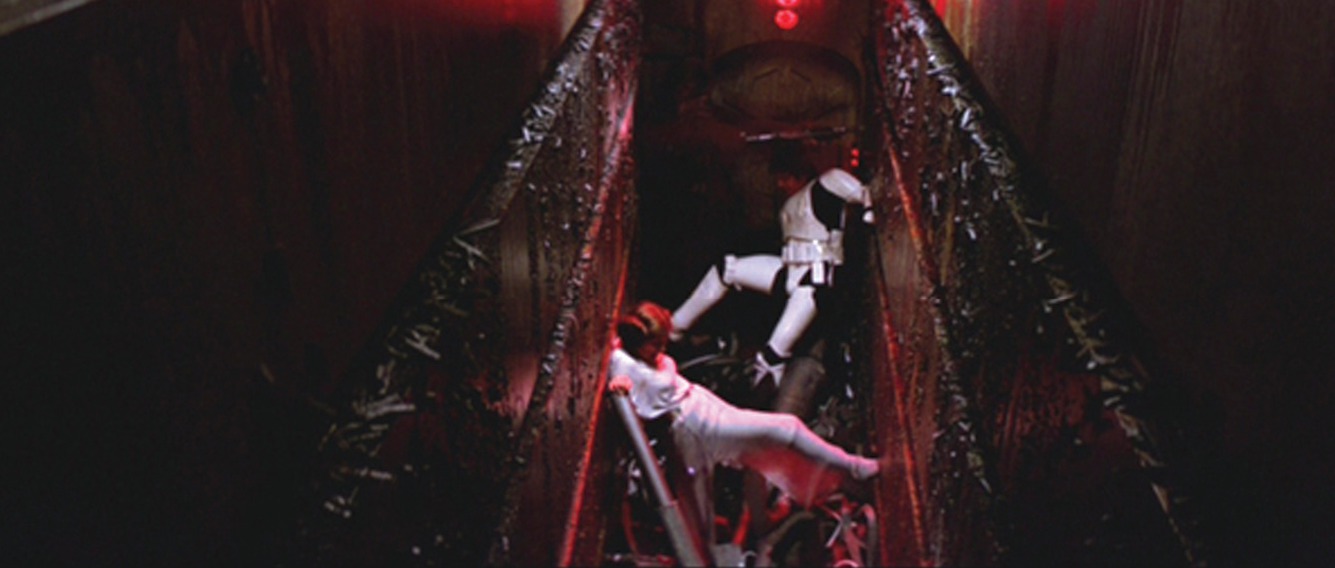
Crushing the Rebellion
The Rebels, then, move towards a middle ground in this sequence, between the previous, more clearly oppositional terms of rough, improvisatory creativity versus rigid, disciplined order. Luke is incorporated into the military system, taking on a uniform and a call sign, while Han, the rogue element, opts out and is excluded from this act until the finale. The attack on the Death Star is co-ordinated through diagrams and digital charts, echoing those we last saw within the Death Star itself; when the perspective cuts from the Rebels’ graphic representations of the battle to those of the Imperials, only the more advanced, sophisticated Imperial technology distinguishes the two. The Rebel control room, where Leia nervously tracks the pilots’ progress across these abstract diagrams of space, echoes with announcements that, again, are reminiscent of the Death Star interior. Rebel teams surrounded by winking lights and switches mirror their Imperial opposites in everything but the concealing, casque-like helmets: we are reminded of the Rebels as individuals, rather than as interchangeable, anonymous troops.
While the Rebel pilots retain a degree of informality – they are, after all, volunteering for this fight and flying alongside their buddies – their dialogue is terse and efficient, in contrast to the banter of previous scenes with the Death Star rescue gang. The X-Wing radios report ‘Heavy fire, boss, twenty-three degrees,’ and ‘Three marks at two-ten’; Wedge exclaims ‘Look at the size of that thing!’ and is told ‘Cut the chatter, Red Two.’ Inside the Death Star, meanwhile, sirens wail and Imperial discipline is once again disrupted, with stormtroopers clattering and stumbling down the corridors; as the cannons fire, we even glimpse an Imperial gunner covering his ears and cowering. Hits on the battle station’s surface explode into the interior, cluttering it with debris and blurring its clean lines with smoke.
Of course, though, the trench run is only successful because Luke decides to fly solo, dropping out of the Rebel communication network and its technological support system to trust in the Force, and because Solo, by contrast, rejoins the group effort, rescuing Luke at the last minute. Fittingly, our last shot of Vader shows the camera spinning around his cockpit as he struggles for control, in a final disturbance of Imperial order and a continuation of Han’s disruptive effect; and just as appropriately, Vader clearly regains his balance by the end of that shot, sailing smoothly and defiantly, perfectly centreframe, into a clear black sky.
The blurring of boundaries between the previously clear-cut oppositions of raw Rebel creativity and Imperial discipline is emphasised by the very last sequence, the silent spectacle of the medal ceremony.
Although Lucas claims that he had not seen The Triumph of the Will (1935) for fifteen years before the making of Star Wars, and that ‘the end of the movie is just what happens when you put a large military group together and give out an award’,171 the composition of the establishing shot is strikingly similar to Riefenstahl’s documentary celebration of the Nazi congress at Nuremberg. Even leaving aside this specific parallel with historical fascism, the sequence is surprising in its coding of Rebel victory as regimented, ritualised, uniform, disciplined and ordered – precisely the qualities the film has previously associated with the Empire.
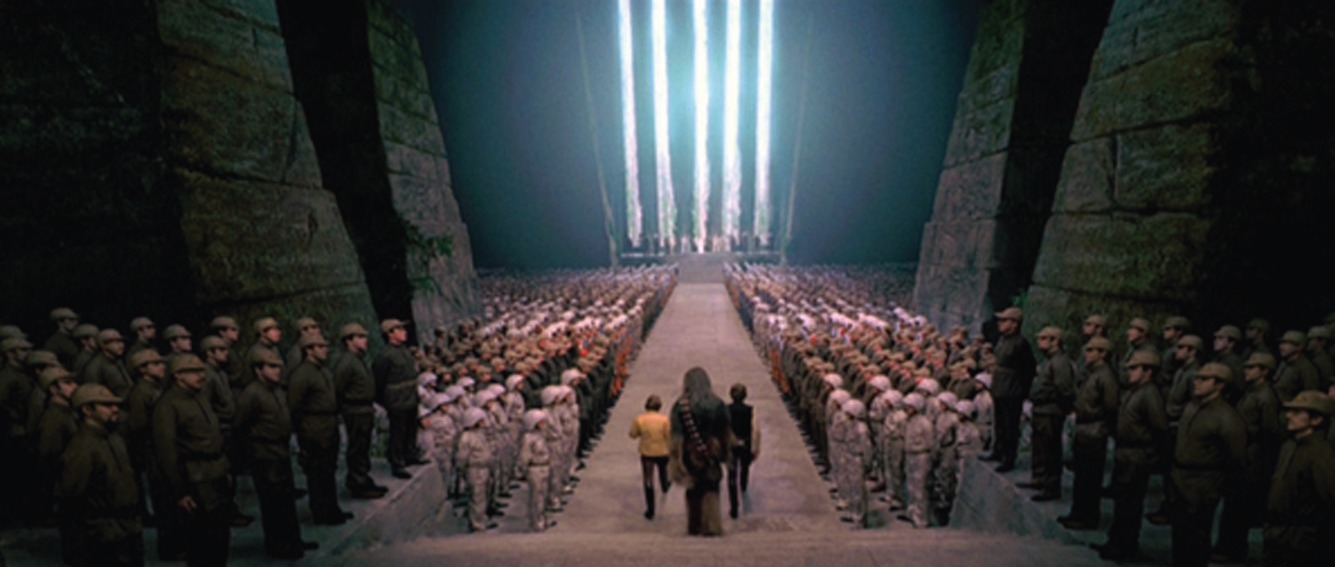
The medal ceremony
However, a spirit of play and improvisation creeps in as the main characters exchange glances in close-up; Luke struggles to keep a straight face but grins at Leia, who smiles back and tries to swallow it when Han smirks at her. As such, the Rebel gang introduce a sense of banter even into a silent scene, and threaten to sabotage the formality of the ceremony just as they undermined the Death Star’s system. Lucas, of course, could have cut these shots where the cast’s chemistry showed through, but he allowed, even embraced it, just as he welcomed a degree of improvisation and fumbled dialogue throughout his first three features, to provide the naturalism that, despite his best intentions, never came easily to him. In this scene, Lucas finally balances his preference for ordered composition and people as neatly arranged objects with his conflicting desire to capture natural warmth, humour and life unaffected.
Yet the medal ceremony has broader connotations in terms of the Star Wars saga, and Lucas’s broader vision of the relationship between the two opposing sides. I have been using the word ‘Rebel’ for convenience, but this, within the story-world, is the disparaging Imperial term; the movement is more properly called the Alliance to Restore the Republic. Its purpose is to bring about a return to the era of the Jedi, represented in this film by Kenobi, and the elegant, formal society represented, at least initially, by Leia. By the last scene, Leia has lost some of her stiffness, and struggles to keep her composure; but this silent parade and medal ritual is clearly an attempt to recall and retain the customs of an older world, specifically the lost world of Alderaan.
Star Wars, through Leia and Kenobi, hints at what the Alliance is seeking to restore through its overthrow of the Empire. The Republic, we learn from Kenobi, allowed the Jedi to flourish as warriors and spiritual guardians; if we take Leia as representative of the society she is fighting to preserve and Alderaan as that society’s last bastion, then the Republic was based around both monarchical birthright and a political senate – a senate which is dissolved at the start of the film by Tarkin – a culture of ritual (medals, ceremonial hairstyles) and precise manners, a world of diplomacy but also of hierarchical rank.
The prequel trilogy of 1999–2005 reveals this world in full detail, and also reveals Lucas’s more complex design across the six films. The depiction of the Old Republic in The Phantom Menace is consistent with what Star Wars leads us to expect; it shows us the Jedi as a galactic police force, protecting a young monarch who subsequently becomes senator. Queen Amidala’s dress, make-up, hair and manners represent a formal extreme, but the Jedi and the Republic’s politicians are equally stilted and governed by strict codes of behaviour. The following two episodes, however, demonstrate that the ceremonial order of the Republic – with its elaborate, redundant social and political ritual – and the spiritual order of the Jedi, grown complacent and set in its ways, allows and enables the rise of the Imperial military order. Indeed, Attack of the Clones reveals that the Republic literally creates the Empire’s army. The film’s final sequence, a silent visual spectacle to a martial score,172 recalls the Star Wars medal ceremony – and, again, The Triumph of the Will – as the camera sweeps over ranks of identical clone troopers. This is the Republic’s army, and it fits precisely with their aesthetic of neat uniformity and grand ceremony, but it also, in an uncanny dynamic, both prefigures and echoes the rows of Imperial troops we remember from the original trilogy. Because the films were released out of their numbered sequence, the prequel scene gains a dramatic irony. We have already seen the episodes that follow, and know what the characters do not – that they are inadvertently building the Empire. The ships that rise above the ranked masses are not individualised, customised hot rods like the Falcon, but sleek daggers, prototypes of the Imperial Star Destroyers.
This perspective casts the end of Star Wars in a new light. The prequels show that the Empire grew from the Republic’s order, and so the mission to restore that old system of structure and ritual, represented by the medal ceremony, seems like a return to the same familiar cycle; and the ceremony itself, with its obvious parallels to the military rally that concludes Attack of the Clones, less of a cause for celebration. The New Republic will surely be little different from the Old Republic, which spawned the Empire – and in their shared penchant for hierarchy and rank within military, monarchic or spiritual orders, their displays of identical troops, their clean lines and symmetry, the systems offer little to choose between them.
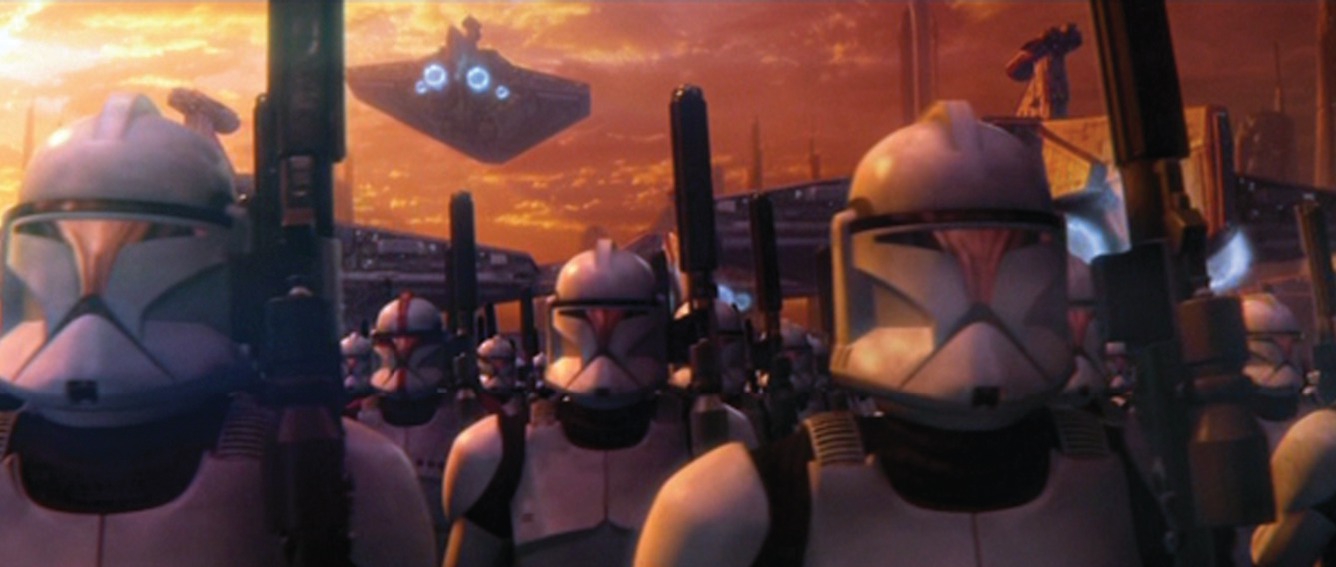
Attack of the Clones: rise of the Empire
This is the pattern suggested by Lucas’s saga as a whole – not a straight clash between good and evil, or even the character arc of Anakin Skywalker’s rise, corruption and salvation, but a cycle between apparently oppositional but in fact worryingly similar social structures, the Empire and Republic. Corruption, within Lucas’s model, does not appear from outside, but festers within, emerging when a complacent society allows it to flourish; it can rise again if it is not checked and controlled, as Luke does with his urges towards hatred and revenge, or it can be exorcised, as Luke does by saving his father and destroying the Emperor. The original trilogy – and the six-film sequence – ends in Return of the Jedi with a looser, more playful celebration on another forest planet, but the question remains: is the Republic really worth restoring, and what, if anything, would prevent the process from starting again once Leia achieved her aim of rebuilding her parents’ society?
This concept of the Republic and Empire locked into a circular relationship over generations of galactic warfare – a struggle to restore the previous culture, which in turn created its own successor – suggests a bleaker picture than that of Star Wars itself, which as discussed presents a satisfying clash between clear-cut contrasts, and only unsettles those boundaries in its final scenes. The prequel trilogy is flat for this reason: it depicts one society, the Empire, emerging from a previous society, the Republic, whose members enable the rise of the new order precisely because the nascent Empire is too similar to the existing culture for it to be detected. Rather than the conflict on all levels that the cowboy Han Solo introduces when he enters the Death Star – in the actor’s cocky improvisation, in his scruffy, customised costume and ship design, in the effect the character’s presence has on the way Imperial interiors are shot and edited – we are shown well-meaning diplomats carefully debating policy with wily diplomats, highly trained Jedi in elaborately choreographed duels with highly trained Sith, computer-generated robots fighting computer-generated clones.
The prequel trilogy is a war of like versus like, order versus order. It represents the triumph of Lucas’s drive for total control over his production, and the achievement of his aim to transfer the pictures in his head, with minimal interference, onto the screen. It represents Lucas’s victory in containing and excluding the rogue energy of actors, special-effects mavericks and idiosyncratic crew members. It represents his triumph over the unpredictability of analogue camera equipment, mechanical props and real locations with their troublesome climates. It is hardly surprising that The Clone Wars, his feature-length spin-off of 2008, did away with those aspects completely and relied entirely on CGI.
Lucas’s need for control, and his preference for an ordered system where he could work with objects – or obedient followers – won the battle. With the prequel trilogy, he achieved what one side of him had wanted since he first started making films. Perhaps he pushed aside or repressed the liking for naturalism, human warmth and documentary truth that also had shaped his earlier work, and in Star Wars had fuelled the central conflict; perhaps he convinced himself that those qualities were still present in the stilted humour and slapstick of the prequel trilogy’s greenscreen actors and CGI monsters. Lucas’s recent interviews, which obsessively rewrite the history of the production process and the saga’s evolution, just as the series of Special Editions and DVD versions rework the detail of the narrative world, overriding and repressing any contradiction, are no longer a reliable document of his authorial intentions or reflections; but the 2005 documentary Empire of Dreams offers a moment of honest self-awareness.
What I was trying to do was stay independent … but at the same time I was sort of fighting the corporate system, which I didn’t like. And I’m not happy with the fact that corporations have taken over the film industry. But now I find myself being the head of a corporation. So there’s a certain irony there, in that I’ve become the very thing that I was trying to, uh, avoid. Which is basically what part of Star Wars is about.
Lucas is, as he recognises himself, now closer to the Emperor than to the young director who made The Emperor in 1967. His vision of history in the Star Wars saga suggests that when one side achieves victory, it is only a matter of time before the cycle turns; and perhaps, as he has promised interviewers and colleagues but never managed, the other side of Lucas as a director will, now his grand saga is complete, come back into the ascendant.
It is now over thirty years since the first release of Star Wars. Lucas has got what he wanted; and arguably, lost much of what he had to offer. But in 1977, when he hated film-making but struggled through illness and arguments, overcoming his anxieties and pushing relentlessly to get those impossible pictures from his head to the screen, dealing with his own conflicting desires for human community and solitude, order and creativity, discipline and play, he somehow, not despite but because of the battle, achieved greatness.