

Break the cycle of shame.
We were given the freedom to be transformational and the permission to do anything. If we’re working to solve for increasing opportunity and access for African American students, that means we’re trying to disrupt the discourse and the legacy of our entire society so we can do almost anything…. We have the permission to be transformational. We have the permission to do something different. We have the permission to listen to our kids and respond to them.
—Emma Dunbar, principal
In working with oppressed and marginalized students, you feel like you can’t make any mistakes and like there’s no time to waste. “All eyes on me like 2pac.” I used to transfer that dehumanizing stress to my staff. It used to be terrifying to make a mistake. But then I started letting go of the pressure to be right all the time, or to have all the answers. I allowed myself and my staff to innovate, to liberate, and we started getting somewhere. That begins with vulnerability.
—Joe Truss, principal and racial equity coach
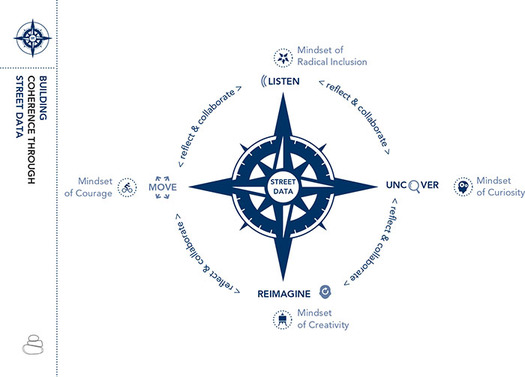
We are almost there, folks! The last few chapters introduced you to a pedagogy of voice (Chapter 5), a framework for building instructional coherence (Chapter 6), and Carrie’s public learning model for educators (Chapter 7). In this chapter, we revisit the equity transformation cycle (see Figure 8.1), exploring how this process can help us embrace vulnerability and progress over perfection as we strive to transform our school and organizational cultures. We get down on the street level to see how leaders at all levels move in ways that restore trust and dismantle racism and other forms of oppression by collecting street-level data, centering voices from the margins, and reimagining current reality with stakeholders.
 Description
Figure 8.1 Equity Transformation Cycle
Copyright © 2021 by Shane Safir. All rights reserved. Reprinted from Street Data: A Next-Generation Model for Equity, Pedagogy, and School Transformation by Shane Safir and Jamila Dugan. Thousand Oaks, CA: Corwin Press, Inc., www.Corwin. com. Reproduction authorized only for the local school site or nonprofit organization that has purchased this book.
While school transformation requires coherence, coherence alone won’t transform a pedagogy of compliance into a pedagogy of voice or an oppressive culture into an antiracist one. We need to shift our core mindsets and ways of working together so that we are constantly, relentlessly, purposefully gathering data at the margins. We must continue to prioritize the least heard voices while learning to listen deeply and in culturally affirming ways that convey, “I am here to learn from and alongside you. I am a partner, not an expert. I see you as the singular individual you are, and I want to hear your story and your song.” Gathering street data is a practice of humanization and liberation, not a technical act done by “data-driven” educators.
What if you engaged in the equity transformation cycle—listen, uncover, reimagine, move—gathering street data at every step to see if your vision is translating into practice? What if you leveraged instructional leadership at all levels to slowly reorient the entire system around student voice and choice? This is the messy, dynamic process of transformation—the good stuff that cannot be leapfrogged by grasping for test scores, incremental goals, or external vision statements.
In the culture you are building, educators must feel safe to try new things and even to fail. In a way, safety is the wrong word, making failure seem like a quiet, closeted pursuit—a pedagogical “don’t ask, don’t tell.” More pointedly, we need to break the cycle of shame associated with failure. Shame has a fractal bent to it: When teachers feel ashamed of their inability to “meet standards,” “hit targets,” or implement a new practice, this trickles down to students who begin to privatize their learning challenges. This dynamic can have a spirit-crushing effect on students of color, students with learning differences, and other historically marginalized groups who may have internalized messages of inferiority from the dominant culture. Feeling isolated in their struggles, they may disengage in class, stop coming to school, or even drop out.
In Chapter 2, Jamila defined white supremacy as a system of beliefs and structures that can infiltrate the ideologies and actions of educators, including BIPOC staff. Shame is a key tool in the playbook of white supremacy culture (WSC), which manifests in our schools and organizations in myriad ways: from racialized tracking of students into remedial classes to discipline policies that disproportionately punish Black and brown students to grading systems that sort students of color down the achievement ladder, and teacher-student micro-interactions that convey racist, colorist, sexist, xenophobic, homophobic, and ableist messages. If we are unaware of its tenacious presence, white supremacy culture will sink our equity efforts.
In their powerful article, Jones and Okun identified thirteen characteristics of white supremacy culture that act as implicit standards without being named explicitly inside an organization (Jones & Okun, 2001). To break the cycle of shame and liberate a pedagogy of student voice, we have to pay close attention to the four features outlined in Table 8.1: perfectionism, either/or thinking, power hoarding, and defensiveness. Recognizing how these elements play out will deepen our equity work and help us amplify the voices of students and educators of color.
Table 8.1 White Supremacy Culture: Four Characteristics That Promote Shame and Their Antidotes

|
Perfectionism |
|
|
Looks like
|
Antidotes
|
|
Either/or Thinking |
|
|
Looks like
|
Antidotes
|
|
Power Hoarding |
|
|
Looks like
|
Antidotes
|
|
Defensiveness |
|
|
Looks like
|
Antidotes
|
Table adapted from Okun and Jones, 2001.
For teachers of color, the pervasiveness of white supremacy culture can activate stereotype threat (Steele & Aronson, 1995). As leaders of all backgrounds, we have to create adult cultures characterized by public learning, public failure, and radical inclusion—where struggles and mistakes are not just tolerated, they are embraced. To resist the grip of white supremacy culture, we must deprivatize our practice and break the cycle of shame. This begins with vulnerability.
THE CORE STANCE OF VULNERABILITY
Vulnerability is the birthplace of love, belonging, joy, courage, empathy, and creativity. It is the source of hope, empathy, accountability, and authenticity. If we want greater clarity in our purpose or deeper and more meaningful spiritual lives, vulnerability is the path.
—Brené Brown
The core stance of this chapter is vulnerability. Resisting white supremacy culture means resisting perfectionism, either/or thinking, defensiveness, and power hoarding and choosing imperfection, multiple ways of knowing, openness and reflection, and power sharing. At the center of this path lies vulnerability, defined by qualitative researcher and author Brené Brown as an unstable feeling of uncertainty, risk, and emotional exposure that we get when we step out of our comfort zone or do something that forces us to loosen control (B. Brown, 2015). When we embrace vulnerability, we allow ourselves to sit with other people’s pain and struggle as well as our own. We learn to tolerate our mistakes and failures rather than anesthetize ourselves to them. This is key to embracing the path of street data.
I want to acknowledge that being vulnerable is harder than it may sound. “Just be vulnerable! Open your classroom (or school) to regular observation; ask your students what they think of your teaching (or staff of your leadership); share your worst moments with colleagues. Admit that you uphold white supremacy in subtle ways.” Notice what you feel in your body when you hear these suggestions. Do you tense up? Freeze? Want to run out the back door, close this book, or shout, “Hell, no!” These classic stress responses signal the depth of fear, shame, and denial inculcated through the one-two punch of white supremacy culture and the test-and-punish era. Educators have been blamed for society’s woes and ridiculed for having an easy job where one can just “phone it in.” BIPOC teachers have been isolated or denigrated for speaking out about inequities. All of us have been called upon to uphold the cloak of purportedly color-blind policies and rhetoric. It’s going to take time to rebuild the resilience needed to be vulnerable with each other. You may need to cry, scream, journal, meditate, and more to heal. Know this: Healing is a critical element of the street data paradigm.
In the rest of this chapter, we revisit the street data cycle (or more formally, equity transformation cycle) as a dynamic process that enables vulnerability and moves us toward a pedagogy of voice. I will share concrete strategies you can use to collect data, unearth root causes, and monitor progress. While many of these approaches can be applied to parents and families, we will keep our focus here on internal stakeholders: staff and students. I hope you feel empowered to try, fail, learn, adapt, thrive, heal, and grow together.
Voices From the Street Principal Joe Truss

I was in my third year as principal of an urban middle school. This was the first year we were rolling out project-based learning (PBL), to the whole school. Folks were worried, skeptical, and somewhat resistant. There were a lot of challenges to the idea of doing PBL and some conversation about whether it was against the union contract. I felt like I was trying to move a boulder all by myself. Folks thought they were going to be evaluated on the quality of their teaching, relative to expert-level PBL. Teachers thought they were going to “be in trouble” if they failed. This is where the perfectionism of white supremacy culture took over, and I realized that the best counter is compassion.
I remember saying directly to the staff, “Thank you for being up for this challenge, for overhauling your curriculum, team-teaching, or jumping in to plan cross-curricularly.” I added, “You aren’t going to be evaluated on how good of a PBL teacher you are. We are all learning; the point is to learn, to try, to reflect.” I could feel the tension release, like someone opened the front door of your house after baking all day. I added, “Of course I will give you feedback and I want to see movement, but I want to see movement on experimentation, movement on trying deeper learning practices. You have to try; you don’t have to be an expert yet.” I even eliminated evaluations for the previous year, since we were experimenting with PBL, and I didn’t want evaluations to hinder creativity and risk-taking. Finally, I remember sharing that I too was in a learner stance: attending conferences, reading books, and talking to my coaches about leading a PBL initiative. This took extreme vulnerability on my part and letting go of control. As a principal, I am supposed to have the right answers, a master plan, and rule with an iron fist: Power Hoarding 101. But that doesn’t work with school transformation. Instead, the process needs to be inclusive, democratic, and collaborative. I wasn’t prescribing how to do PBL; I was saying, “We are going to figure it out together.”
Three years later, after some extensive instructional leadership team development, we are still figuring it out, together—now with the effort led by teachers.
EQUITY TRANSFORMATION CYCLES: LOITERING ON THE STREET
To know exactly where you’re headed may be the best way to go astray. Not all who loiter are lost.
—Sue Monk Kidd, The Book of Longings
Think about the equity transformation cycle as a positive form of loitering on the street. Instead of speed-walking through school buildings and classrooms checking off tasks, lean into the luxury of slowing down and absorbing the little stories you encounter in the corridors and stairwells. Become an ethnographer rather than a building or classroom manager. Listen with a mindset of radical inclusion to cultivate awareness of students’ micro-experiences at the margins of your community. Uncover with a mindset of curiosity to understand root causes and build capacity to analyze street data. Reimagine with a mindset of creativity to design with those at the margins as you dream together beyond the boundaries of current imagination. And move with a mindset of courage to take antiracist, equity-driven action, however imperfectly, always pausing to reflect.
If you are struggling with where to start, consider designing a local survey (map data) to assess patterns of inclusion/exclusion and equity/inequity. Panorama Education has developed a powerful equity and inclusion student survey with questions like, How often do you have classes with students from different racial, ethnic, or cultural backgrounds? How fairly do adults at your school treat people from different races, ethnicities, or cultures? How confident are you that students at your school can have honest conversations with each other about race? How well does your school help students speak out against racism? How connected do you feel to the adults at your school? Overall, how much do you feel like you belong at your school? (Panorama Education, n.d.)
As pain points arise from the data, you may choose to focus your first cycle on students with learning differences, LGBTQ+ students, African American students, Latinx students, long-term English Learners, ELs, or any group of children for whom your equity compass and existing data signal, STOP and listen deeply. No matter where you begin, keep these questions in mind:
· What is the student (or adult) experience being revealed to you?
· What are the student’s (or adult’s) strengths, assets, and sources of cultural wealth?
· What is getting in the way of the learner’s well-being, cognitive growth, and agency?
· How might racism and white supremacy culture be at play here?
When gathering street data, it is important to manage your reactions, namely the emotional distress and urge to defend that can accompany hearing uncomfortable truths. A defensive response to candid street data takes us right into the belly of white supremacy culture and may catapult a return to “doing equity” rather than breathing through the emotional complexity of how to shift our mindsets and practices.
Listen With a Mindset of Radical Inclusion

Conversations with leaders and teachers sparked the question, Why do we have to wait to get student perspective? How do we use something like empathy interviews to get a better understanding of where students are at?
—Chris Maldonado, deeper learning coach, San Francisco
EMPATHY INTERVIEWS
Empathy interviews, a cornerstone of design thinking, help us listen for how a person feels and perceives the equity challenge we are trying to address, as well as access their creative thinking around how to approach it. These interviews are typically one-on-one for thirty minutes up to an hour—ideally in-person, but over the phone or video can work as well. Whatever format you use, study the speaker’s body language, tone, and emotional reactions as well as capture their words. Remember: where vulnerability is at play, nonverbal cues (55 percent) and tone (38 percent) account for a vast majority (93 percent) of the meaning conveyed, not the spoken word (only 7 percent!) (Mehrabian, 1981). We are hardwired to read each other’s subtle, implicit messages, which is why so-called microaggressions can be so damaging. You might even decide to pair up and have a partner take notes so that you can fully listen with all your senses.
In preparation for empathy interviews, identify at least five focal students or adults whose voices will bring insight to the equity challenge at hand. Next, craft a set of five to eight open-ended questions that prepare you to listen far more than talk.1 During the interviews, encourage storytelling (“tell me more about …”) to prevent generic responses and continually observe body language. If the speaker falls silent, allow them time to reflect and compose their next thought. Be sure to buffer your interviews with at least ten minutes to breathe, stretch, drink water, snack, and re-center yourself. This is an opportunity to practice humble, culturally affirming listening, which requires that we are rooted in our intentions and open in our demeanor. After the interviews, reserve at least ten to fifteen minutes to reflect on the data, either journaling or in dialogue with a colleague.
1 In The Listening Leader (Safir, 2017), I shared the 90/10 rule from my community organizing days with the San Francisco Organizing Project: Listen for at least 90 percent of the meeting and talk for no more than 10.
See Appendix 8.1 for an example of an empathy interview transcript that includes my think-aloud in the right-hand column.
Co-generative dialogues
The structures in place in traditional urban classrooms do not lend themselves to giving students a voice or a space in which to be valued and respected for their experiences. Students who populate urban schools are generally beholden to a “pedagogy of poverty” that rewards them for being docile and punishes them for being overly vocal or expressive. In response … many learn to repress their voices in order to not make any trouble.
—Christopher Emdin
Co-generative dialogues, or cogens, are another powerful way to listen with a mindset of radical inclusion. Developed by educator-scholar Christopher Emdin, cogens serve as an emancipatory practice inspired by two rituals: the hip-hop cypher and the culture circle. Emdin defines a rap cypher as a codified style of communication that many urban students of color (who Emdin calls the neoindigneous) use on street corners to engage in playful, dynamic dialogue. A culture circle, first described by Brazilian educator and philosopher Paulo Freire, is an informal space where adults who were learning to read and write came together to share their understandings of the world and their place within it (Emdin, 2017). From these models, Emdin coined the pedagogical practice of cogens: simple, informal conversations between a teacher and a small group of students with the goal of providing feedback and co-generating a plan of action.
If you want to work with this strategy, prepare yourself for critical feedback. Cogens require us to be ego-distant, resisting the pull to defend our current practices and choosing vulnerability and openness to student perspectives. Revisiting the stance of deep listening from Chapter 4 will help! Note that the cogen structure can be equally transformative for school and district leaders to use with teachers and principals.
Here are a few steps to experiment with cogens as a listening strategy:
· Identify a group of four to five students (or adults) who represent a cross-section of perspectives, demographics, and ability levels. Be sure to include some of the least heard voices.
· Arrange an initial meeting, outside of class time, and make a personal invitation to each student: “I am working on improving my teaching (or leadership) and really value your perspective.”
· Set ground rules for the discussion, such as “Only one person speaks at a time,” “Everyone has an equal voice,” and “If you have a critique, offer a suggestion.”2
· Brainstorm issues the group could work on together. Take deep breaths and listen deeply for what is said and not said. Invite candor from participants.
· Invite the group to choose a small classroom (or leadership) issue to work on together. Ask for their ideas around how to improve the issue.
· Meet with the group at least four times, roughly once a week, or until you all feel successful at improving the identified issue. In the final session, celebrate impact and reflect on learning: “What was this experience like for you? What did we learn together?”
· Invite a new, representative group into a new cogen with you. Rinse and repeat!
2 Emdin notes that urban youth who have participated in a rap cypher know the rules of engagement, which easily extend to the cogen. For example, the idea that only one rapper has the mic at a time lines up beautifully with the cogen norm of one speaker at a time.
Uncover With a Mindset of Curiosity

As we gather street data through listening, we enter the “uncover” phase of the cycle. This is the moment when we step back from the data and peel the layers to reveal hidden narratives and patterns, including root causes of inequity. Diagnosing root causes will help us evade the boomerang trap in Chapter 2, where we revert to past practices to protect ourselves from the pain and vulnerability of change. It’s easy to get pulled back into default ways of teaching, leading, and being; fear drives us there. Shouldering up with colleagues to use the tools described in the following section will keep your feet planted firmly on the street, unpacking the stories that emerge on each block.
STREET DATA ANALYSIS: A SIMPLE PROTOCOL
Analyzing your fresh collection of street data will help you distill themes and patterns. Like any qualitative researcher, you’ll need a highlighter (or several in different colors!) and maybe a pair of scissors to cut and sort the data. There are plenty of tech platforms to support more sophisticated approaches to data combing, but I prefer good, old-fashioned highlight, cut, and sort. The most important thing at this phase is to slow down, feel all your feelings, and check your assumptions, staying grounded in what the data actually says. Table 8.2 offers a basic protocol for analyzing street data.
Table 8.2 Street Data Analysis Protocol

|
Time: Minimum 45 minutes to an hour Roles:
Preparation: If needed, have copies of the data available, plus highlighters and scissors. Consider having participants review the data in advance to expedite the observe step. |
||
|
Time |
Protocol Steps |
Facilitator Tip |
|
10 minutes |
Connect (check-in, community circle, or dyad3): What was the process of gathering this street data like for you? What do you predict the data may reveal? |
Frame as an opportunity to practice vulnerability. Go first to model vulnerability. |
|
15 minutes |
Observe: What are we hearing from our students (or colleagues)?
|
Frame the importance of staying low inference. Provide an example of a low-inference versus a high-inference statement.4 |
|
20 minutes |
Interpret: What does this data reveal about the experiences of our most vulnerable learners (or community members)?
|
Use a poster, whiteboard, or shared digital document to track the group’s discussion. |
|
5 minutes |
Feel: What feelings does this data evoke for you?
|
Ask people to resist the tendency to self-anesthetize in the face of discomfort or pain. |
|
10 minutes |
Reflect/consider (possible questions): What matters about this data? How does it (or doesn’t it) stand up to our vision? Where is our greatest opportunity? What will help us learn more? What will help us move toward the pedagogy of voice? What steps or actions might come next? |
To bridge to the reimagine phase, offer possibilities for next steps—for example, another round of data-gathering; a team focus group with some of the students; an invitation to the students to meet and brainstorm approaches to the issues at play. |
3 For a reminder on this structure, revisit the Chapter 4 description of listening dyads.
4 A low-inference statement might sound like, “Four of the 5 students we spoke with said they feel afraid to raise their hands and speak in class.” A high-inference version might sound like, “Most of the students feel uncomfortable in their classes.”
Case Study: Uncovering Black Students’ Literacy Experiences

Emma Dunbar, a principal in San Francisco, leads a large, comprehensive middle school with a persistent achievement gap—“Historically,” she shares, “a fifty-percentage point gap in English and Math performance between the highest-achieving students and our African American students.” As an equity-designated school, Emma enjoys district support and resources to address systemic inequities. In August 2019, she engaged me and Jamila to introduce her entire staff to the street data model and from there, Jamila began to coach her in facilitating schoolwide equity transformation cycles.
Aligned with the district’s graduate profile, Emma’s school had set a priority around increasing student connectedness to school. Listening to street data from teachers, she noticed a tendency to focus on student connections outside the classroom—clubs, teams, extracurriculars. As an instructional leader, she had to reset her sights on the equity challenge she wanted to solve: creating success and opportunity for African American and Latinx students. She knew this challenge required drilling down to the classroom:
We can offer clubs and places to find affinity and to explore identity … those are really important and need to exist, but the majority of a student’s day is inside the classroom. What are the moves? What are the adjustments in curriculum? What are the adjustments in structure? Where are our kids of color feeling included and valued and a part of the classroom community?
In September, Emma helped her instructional leadership team (ILT) conduct empathy interviews with Black focal students5 around their classroom literacy experiences. The ILT analyzed the empathy interview data, highlighted excerpts of student voice, and zeroed in on a key theme: the connection between oral tradition and academic conversation for many African American learners. Focal students articulated that they felt most comfortable and most enjoyed classes where they could share their ideas, but they overwhelmingly lacked the opportunity to do so. Through this process, academic conversation had risen to the top as a missing, yet crucial area of culturally responsive pedagogy. These conversations helped the ILT shape a sharper set of interview questions and a core stance to guide their work: “ Literacy means that everyone is a literacy teacher, and equity means that we ask, How is everyone becoming an equity-focused literacy teacher?”
5 Focal students is a strategic approach to engaging in cycles of inquiry that help educators “go small to go big.” By closely studying the experiences of a handful of learners, we discern patterns and root causes that catalyze larger shifts in practice, systems, and learning conditions.
Next, ILT members met with their respective grade-level teams and asked teachers to identify two focal students, including at least one African American learner, with whom to do empathy interviews. They asked colleagues to use the newly revised questions and to record their notes. Before jumping into the work, however, ILT members took their colleagues through a reflective process to open space for vulnerability:
· ILT framing: Remember that our focal students as a school are African American as well as Latinx, English Learners, and students with special needs.
· Journal reflection
o Think of a student who you are trying to reach.
o What are some of the literacy skills that they need to develop?
· Share out to get a sense of patterns of struggle and to promote vulnerability.
· Set a goal
o Remember that our goal is to help focal students become strong readers, writers, speakers, and listeners. Review the schoolwide instructional rubric for structured talk and academic conversation:
· What’s one area or practice you could work on this year?
· In which strategies here have you had success?
· Which strategies would you like to learn more about?
With this framing in place, teachers across the school set out to do empathy interviews.

|
ILT’s Empathy Interview Questions (Mid-September) |
Revised Empathy Interview Questions for Grade-Level Teams (Mid-October) |
|
|
Data from schoolwide empathy interviews continued to reinforce the importance of academic conversation for all focal students but particularly for African American scholars. This bridged into the reimagine phase, as departments began to send representatives to an academic conversation training with author Jeff Zwiers and pilot different approaches. At the same time, Emma engaged focal students in what are typically adult-only processes: learning walks and instructional rounds. As Emma has continued this work, she finds it necessary to keep staff vulnerability in the front of her mind. The work requires strategy and a focus on helping staff resist shame in the process.
EQUITY LEARNING WALKS AND INSTRUCTIONAL ROUNDS: STUDENTS AS COLLEAGUES
If we want to understand the student experience, we need student observers by our side. When it comes to perceiving subtle micro-interactions in the classroom, students have the keenest eyes. Learning walks and instructional rounds exist in various forms in most schools. The pivot here is to engage students in these processes from the get-go, investing in their development as instructional leaders. I can’t offer you an exact number, but your ratio of students to adults should trend toward more students over time. Invite students to articulate their lenses and questions by asking, “What should we be paying attention to when we walk into classrooms?” As young people build capacity to engage in these processes, consider bringing parents into the mix as well.
An equity learning walk is an informal series of classroom observations with an explicit equity lens. The learning walk team might look for
· Patterns of participation, broken down by race, gender, ELL status, and so forth
· Patterns of teacher feedback (i.e., affirmative versus negative interactions with students), broken down by race, gender, ELL status, and so forth
· Small-group peer interactions that manifest implicit biases and microaggressions, or microaffirmations—small acts of inclusion that add up to an overall feeling of inclusion for everyone
· Actual use of academic language by English language learners (given that oral production is critical to developing fluency)
To maximize the impact of this strategy, build a simple learning walk tool that is grounded in your equity imperative and instructional values. Use the six simple rules of a pedagogy of voice if they serve you! The San Francisco middle school network we met in Chapter 6 has three strategic priorities: literacy, deeper learning, and African American student achievement and belonging. The learning walk tool they built directly reflects these priorities with space for observers to capture a Likert scale rating (0–4, with only an exemplary “4” described) and narrative notes for each. You’ll also see a specific section to capture data on Black student engagement. While the network uses a Google Form for leaders to capture this data, it’s fine to print hard copies as well.
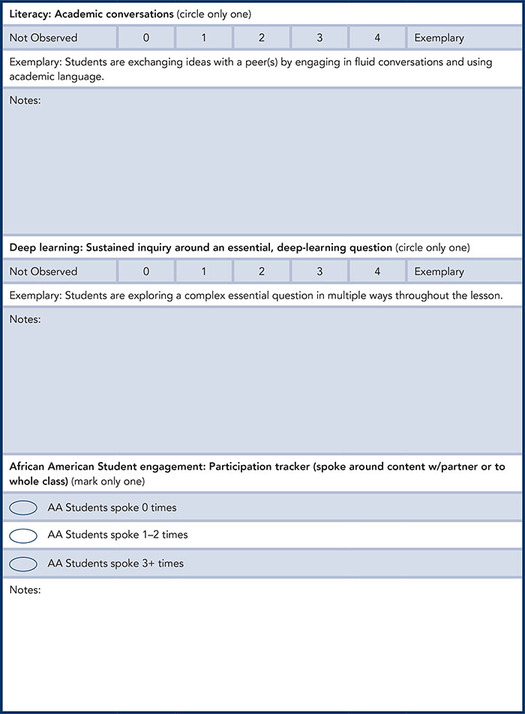
Figure 8.2 Middle School Leadership Team Look-Fors
Instructional rounds, a practice developed by Elizabeth City, Richard Elmore, and their colleagues at Harvard University, takes participants through a robust process of observing, analyzing, and making meaning of classroom street data (City et al., 2009). Elmore envisioned rounds as a professional-learning design for school leaders (mainly superintendents), but we propose to use it at a district or school level with students as colleagues and co-observers. Though the full extended process may be more appropriate for secondary students, I would consider inviting third through fifth graders on modified instructional rounds. You can learn about rounds by reading Elmore’s work, and Table 8.3 offers an example of an observation tool you might use with students during rounds. See Appendix 8.2 for a process guide to instructional rounds.
Table 8.3 Instructional Rounds: Observation/Scripting Form

|
Room: _______ Subject: __________________________ Grade: __________________ |
||
|
School’s Problem of Practice Example: How are students equitably engaged in reading, writing, and academic conversation?
|
||
|
Student Actions |
Teacher Actions |
Notes and Questions |
Source: Tool developed by Davina Goldwasser, San Francisco Unified School District.
As you invite students into these processes, keep a few things in mind:
· As with cogens, engage students who represent a diversity of experiences and backgrounds—not just high performers.
· To center voices from the margins, engage students who are often referred out of class or choose to leave class because they find the hallways more rewarding.
· Aim to visit around three classes each time to get a triangulated data set. Let students know we are “going small to go big”: we will study a few examples to uncover patterns.
· Before the learning walk or instructional round, bring student and adult participants together to share the purpose, goals, and tools. But don’t stop there!
· Ask students: What else should we be looking for as we observe? What data points should we track that will help us understand how equity and racism play out in the classroom? Invite them to name less obvious data like nonverbal signals and tone.
· Afterwards, facilitate an inclusive debrief with students. Set a clear ground rule that each time an adult speaks, a student gets the mic next. Teach students how to analyze the data!
Reimagine With a Mindset of Creativity

As we uncover hidden narratives, the question becomes, what are we going to DO about it? At this point, it is seductively easy to tap or appoint an equity “expert” (remember Jamila’s Lone Ranger of Color and Great White Hope tropes?) to come up with solutions in isolation. This is where power-sharing, the antidote to white supremacy culture’s power hoarding, comes into play. We have to expand our planning and decision-making tables to include students, parents, paraprofessional staff, community elders, and other marginalized voices. To avoid the traps of the equity warrior (nesting equity with a single champion) or siloing equity (locating the work in a separate policy or team), we need to come together to reimagine current reality.
These next few strategies will help you enter the imaginative space with students. Young people have answers for us if we choose to listen. In a phenomenal piece for Next Generation Learning, educator Young Whan Choi (2020) talks about engaging students to help him lead a week-long project-based learning (PBL) institute for one hundred educators. He frames three ways to center student voice in teacher professional learning: setting the vision, reflecting on classroom learning experiences, and giving input on planning effective PBL units.
STUDENT-INFORMED CURRICULUM
Young Whan had long considered himself an advocate for student voice but realized that he had failed to engage this resource at a critical point of impact: curriculum design. He writes, “Later in the week-long institute, we invited planning teams to invite a student to join them for a critique and revision session. Students were paid for their time and valued as consultants. They were given time during the professional development to sit down with teachers and listen to curriculum pitches. Teachers produced a small slide deck with information such as the essential question, the authentic product students would produce, and some of the key learning activities. Students provided feedback on what they thought would engage them and their peers.” Feedback from participating teachers was overwhelmingly positive.
In addition to giving feedback on unit plans, students of all ages are perfectly capable of designing and leading lessons. Imagine inviting your second graders to pair up and rotate leading a community circle once a week. As an English teacher, I designed an instructional routine called Read and Lead to foster student agency and literacy. Students paired up to study a segment of the class text (we were reading Beloved and then Othello at the time) and design an interactive lesson for a small group of peers. Each pair had the opportunity to teach a lesson in which their peers would not only participate but would also provide feedback. It was so much fun, and I watched many a shy learner build moxie and confidence. The process also created a common language around teaching and learning in the classroom.
STUDENT-DRIVEN PD
Students are the best gauge as to whether instruction is interesting and relevant and pushes them appropriately, and student voice can reshape teacher professional development in radical ways. What if you invited a diverse group of third, fourth, and fifth graders to join PD for an afternoon? Small groups of students would meet with small groups of teachers to share what helps them learn, what makes them feel frustrated in class, and what contributes to feelings of inclusion or exclusion. One high school in Des Moines, Iowa, decided to try joint student-teacher professional learning. In their first attempt, administrators brought forty-five students into conversation with seventy-two teachers around how to make learning more culturally inclusive and engaging (Superville, 2019). The school’s equity coach worked with the students behind the scenes to prepare them for this opportunity, including dress rehearsals with feedback. The dry run was so successful that soon, nearly one hundred students attended a staff PD to help teachers sharpen their lesson plans and make instruction more relevant.
It’s worth noting that this initiative grew out of a local equity imperative around chronic absenteeism for Black boys. While the school’s average absentee rate was 35 percent, for Black boys, it was 56 percent. This equity gap in attendance was linked to discipline referrals, and an initial set of empathy interviews revealed that students were skipping class for distinct reasons: “They didn’t think teachers cared if they showed up, and many classes had no connection to their lives, experiences, and communities.” There is no way to solve this complex challenge without centering the voices, stories, and experiences of students.
STUDENT DESIGN CHALLENGES
Another way to reimagine instruction, school culture, and systems is to ask students to take on a design challenge in small groups. Put out a broad call to action for small groups of students to take up one of the following charges:
· Design the first week of school around the principle of radical inclusion
· Design an ideal school day that would promote well-being
· Design an equity-centered homework, tech, or attendance policy
· Design a project to highlight your community’s cultural wealth
· Design an antiracist discipline policy
Be sure they have time, ideally a budget, and an authentic audience to present their ideas to.
STUDENT-LED CONFERENCES
Student-led conferences (SLCs) are a final, incredibly potent way to center student voice and share power. While the format may vary, SLCs always put students in the driver’s seat of family-teacher conversations about learning. They create opportunities for students to share, reflect on, and explore evidence of their growth and learning. As such, SLCs are most powerful when tethered to a graduate profile or a performance assessment system, like portfolio defenses, as described in Chapter 6. Figure 8.3 includes a sample student self-assessment rubric and reflection from the middle school network we’ve been following.

Figure 8.3 Student Reflection Questions for Student-Led Conferences
MOVE WITH A MINDSET OF COURAGE: WHERE THE RUBBER MEETS THE ROAD

The equity transformation cycle is where the rubber meets the road in our efforts to enact equity and deep learning for every child. We may talk the talk, but will we walk the walk? As we shift toward moving the work, we have an opportunity to get courageous and orient ourselves in a whole new direction. We may get sucked toward navel-gazing equity, keeping the work at the level of self-reflection without fundamentally changing instruction or school systems, or we may find ourselves in the blanket equity trope—investing in a program or curriculum rather than in the capacity of our staff. Now is the moment to resist the traps and tropes! It’s time to take action, tolerate the possibility of failure, and embrace vulnerability.
Safe-to-fail experiments are your friend here: small, four- to six-week “hacks” that disrupt business-as-usual and give you fresh street data to study. You’ve listened at the margins, uncovered underlying patterns and roots causes, and reimagined (or flipped!) the proverbial table to center and collaboratively design with voices from the margins. Now give yourself permission to try something new. You can draw on any of the ideas in the reimagine section of this chapter as well as those in the table that follows. According to the National Equity Project (NEP) and the d.K12 Lab Network, “Oppression thrives on risk-averse behavior. It’s important to fail fast. Small changes can have large effects, AND hacking oppression requires longshots” (Anaissie et al., 2016). Here are a few examples:

|
School Culture |
Classroom/Pedagogy |
Family Engagement |
|
Start every day for a week with a mindfulness meditation. See if discipline issues and behavior shift. Form listening circles with groups of six staff people, focused on healing. Every staff meeting, allow circles to meet and reflect, using the deep listening guidelines in Chapter 4. Organize a student-led antiracism campaign. Fund it! |
Instead of Author’s Chair, try a Story Chair: Every day or every meeting, a new child or adult gets to share and reflect on their story, including their identities, hopes, dreams, and struggles. Get rid of your desk! Seriously, though, try having a classroom or office for a few weeks with no desk to sit behind, only round tables. Transform power through physical space. |
Do a positive phone call campaign. Each day, call one parent of a child at the margins and celebrate something specific about the learner. Be sure to also ask the caregiver, “What do you want me to know or understand about your child?” Do a cultural wealth teach-in. Ask parents to come to class to teach a twenty-minute lesson on anything they are passionate about. Be sure it’s clear they don’t need to have a college degree or be “professionals” to participate. |
In closing, here are my three words of advice to you: Just start walking. The street is vibrant and full of color and texture and story. The path is jagged and perfectly imperfect. Your power to transform teaching and learning lies in your willingness to walk the path, arm and arm with colleagues, and increasingly with students and parents—acutely attuned to the songs of your students: each one different, each one beautiful, each one its own story waiting to be born …
GETTING UP CLOSE AND PERSONAL: REFLECTION QUESTIONS

1. How do you see white supremacy culture playing out in your context? What are you willing to do to disrupt it?
2. Reflect on a time where you were vulnerable around your practice. How did that feel? What will it take for you to continue to grow your vulnerability muscle?
3. Which step of the equity transformation cycle—listen, uncover, reimagine, move—most calls your attention right now and why?
4. Which strategies laid out in this chapter do you want to try next? Make a simple plan for doing so and hold yourself accountable to it.

|
Strategies I plan to try |
Potential roadblocks |
Ways I’ll get support to stay the course |
Descriptions of Images and Figures
Back to Figure
The illustration titled building coherence through street data is described as follows:
A compass with the text Street data at the center shows the following components:
1. North: Mindset of Radical Inclusion: Listen
2. East: Mindset of Curiosity: Uncover
3. South: Mindset of Creativity: Reimagine
4. West: Mindset of Courage: Move
5. Between every two components: reflect and collaborate.