
By Carrie Wilson
For the past decade, Lead by Learning (formerly Mills Teacher Scholars), a community-facing program of the Mills College School of Education in Oakland, California, has built a network of partner schools and districts that seek to foster a pedagogy of voice among educators as a method to provide more equitable learning experiences for students. Carrie participated in the program as a high school English teacher and now leads the program’s development efforts. The Aspen Institute’s report How Learning Happens called out the work of Lead by Learning as a promising practice in supporting adults’ social and emotional capacity building in service of students’ learning. This chapter shares Lead by Learning’s central practice of public learning.
Mobilize a pedagogy of voice for educators.
Cheryl, the principal at Brookmont High, perceived the staff culture at her school as a “bulletin-board culture.” Teachers were great at presenting their best work, but when it came to sharing the uncertainties they faced in the classroom, few stepped up. Cheryl realized that this mirrored the student experience: Teachers tended to emphasize students’ polished end-of-year exhibitions and focused less on the vulnerability and complexity of learning. In both settings, the classroom and the adult learning space, Cheryl saw a reluctance to ask questions and voice uncertainties, so she decided to dedicate fifteen minutes of each staff meeting to practicing public learning—an opportunity to shine a light on a dilemma or challenge and think it through collaboratively with the benefit of street data.
One of the most powerful public-learning experiences of the year was when Maria, a ninth-grade teacher, shared classroom data and a dilemma with colleagues. In order to figure out how to strengthen her students’ writing, Maria captured audio recordings of several writing conferences. She wanted to listen closely to what her students had to say about writing but was surprised to discover her own biases emerging in the conferences. With students she considered “less capable” writers, she did a lot more of the talking. With students she considered “skilled" writers, she gave them more space to find their voices and articulate their ideas. Through looking at the data with colleagues, Maria realized the equity issue before her: Her unconscious biases were stripping emerging writers of their voice and agency as learners. “They didn’t judge me,” Maria says of her colleagues. “They listened and then asked what would help me to create more equitable writing conferences.”
(Lead by Learning, 2020 p. 31)
In the story above, Maria’s colleagues conveyed what Shane described in Chapter 5 as a teacher practicing the pedagogy of voice with their students: “I see you. I believe in you. You are safe to grow and thrive here. I want to hear your voice.” These core values and beliefs are fundamental to antiracist work and uncovering implicit biases. These beliefs give Maria the opportunity to grow professionally in service of her most marginalized students.
Such values do not just happen. They are intentionally created by leaders and teachers working together to create better learning opportunities for their students. Like the equity work that Jamila describes in Chapter 2, enacting these values is a continuous journey and requires that we mobilize a pedagogy of voice for educators, with many of the same principles Shane outlined for students in Chapter 5. The practice of public learning provides a street-level way forward to center our attention on our learners, adult and student. It anchors adult conversation in student experience and deepens teachers’ capacity to more clearly envision their goals around abstract ideas—like agency, academic discussion, and evidenced-based writing—and to connect those goals to concrete instructional moves.
The purpose of this chapter is to explain how the practice of public learning builds adaptive expertise and facilitates a pedagogy of voice for educators so that they, in turn, can enact this shift for their students. I unpack the practice of public learning as an antiracist practice—a backbone tool for street data—including the theory behind the practice, the elements of the practice, and some ways to get started with the practice. Additionally, I will include examples that illustrate how communities of educators go beyond monitoring satellite data proficiency to activate street data in order to better understand the needs of students. I use the term “educator” broadly to include after-school staff, coaches, teachers, and leaders.
THE WHY OF PUBLIC LEARNING: SYMMETRY, AGENCY, AND ADAPTIVE EXPERTISE
As long as we “teach” educators through a pedagogy of compliance, we will reproduce a pattern of passivity that leads to privatization of practice and stymies our equity work from the start. Recall Jamila’s Superficial Equity trap in Chapter 2: When we fail to take into account complexity and local context and build deep equity fluency, we generate behavioral shifts in the absence of mindset shifts. Lacking a space for public learning and reflection, we get superficial instructional shifts at best that fail to produce the intended outcomes. How do we create a culture of curiosity, agency, vulnerability, and exploration for educators so that they, in turn, can provide that to their students?
The design principle of symmetry (Mehta & Fine, 2019) dictates that what we want for our students, we must provide for our educators. Symmetry has proved challenging for public education systems. Although neuroscience has established the importance of curiosity and engagement for students and adults (Immordino-Yang, 2016), education systems continue to struggle with how to activate this science in their designs for educator professional learning. Many districts’ professional-learning plans remain tethered to distant satellite dashboards instead of rooted in the real-time dynamic experiences of learners in the classrooms—what we call street data. Educators are asked to prepare for and track progress on districtwide assessments as opposed to cultivating awareness of what’s happening for students inside moments of instruction. As a result, we lose access to the complex human experience of learning, and our definitions of improvement and learning are severely constrained.
PEDAGOGY OF VOICE REQUIRES AGENCY AND ADAPTIVE EXPERTISE
Agency, or as Jim Knight calls it, “autonomy” (Knight, 2015), is as critical to the transformational learning for adults as it is for students. Agency is particularly crucial in creating change agents within systems of oppression who are willing and ready to address systemic racism. When professional-learning spaces model the domains of agency described in Chapter 5—identity, mastery, belonging, and efficacy—our adult-learning conversations move from the abstract to the contextual, from the general to the specific, from the content standard to the student’s daily lived experience. And when this activation is public and routine, it establishes a new way for colleagues to work together so that they can facilitate a pedagogy of voice for their students.
PUBLIC-LEARNING PRACTICE: A PEDAGOGY OF VOICE FOR EDUCATORS
The practice of public learning creates a routine structure for educators to share their uncertainties, analyze street data, and invite colleagues to challenge their ideas and interpretations.
Public learning mobilizes a pedagogy of voice in two important ways:
1. As a process for acknowledging complexity by giving voice to educator uncertainty and understanding. Public learning provides a space for teachers to clarify their goals for students and adapt their instruction in response to the current reality of student experience (Senge, 2009). Public learning serves as a vehicle for creating the conditions for adults to deeply learn in service of their students. Deep learning emerges in parallel form at the classroom and adult collaboration levels.
2. As a catalyst for professional-culture change. Public learning positions both student voice and educator curiosity about the student experience at the heart of professional learning. The practice normalizes a new way of working together across a school or organization. Dedicating your team to the routine of public learning creates the opportunity for symmetry and lasting change. As public-learning practices ripple through the system, a culture of public learning emerges.
Too many leaders and teachers have stagnated inside a system that does not acknowledge the complexity of teaching and learning, valuing instead only a routine expertise knowing the best practices, staying on the pacing guide, and fixating on standardized test scores and other satellite data as the primary indicators of learning. Leaders with the desire to build a culture of adult learning are often stuck in ways of working together that prevent them from addressing implicit biases and transforming their practice.
Voices From the Street Educators

Following are some examples of narrative street data that suggest stagnant cultures of routine expertise:
· “We have a culture of nice—we politely agree with each other. We cannot challenge each other’s ideas.”
· “Everyone’s teaching practice is privatized. We’re not permitted to comment on each other’s instruction.”
· “Our teachers talk about their plans but no one really talks about what they’re unsure about, so nothing is up for discussion.”
· “There is really never any discussion of implicit bias and how it operates in our school.”
· “We aren’t using classroom data to figure out how we can improve; we just keep planning together.”
· “Our collaboration time is spent discussing events and the bathroom policy, not the learners’ experience in their classrooms.”
· “The teachers just won’t change their plan regardless of whether it’s working for their students are not.”
· “We don’t have time to learn.”
Now read back over this list and consider how the culture in these schools might undermine deep equity work. Leaders and teachers with a desire to transcend this way of interacting consistently ask, “What can I do to change the conversation and have people work together in ways that will transform their instruction?” This question itself reveals part of the problem. The question should be, “What do I need to believe and value to have people work together in a way that deepens their understanding and changes their instruction?” The shift from “doing” to “believing and valuing” is monumental. As Jamila discussed in Chapter 2, we cannot “do equity” any longer; we need to transform our fundamental ways of being. And to enact what Jamila describes as an “unwavering commitment to a journey” of equity, we need practices that inspire and guide educators into new ways of being. We need practices that help us recognize and move beyond the traps and tropes that stymie our efforts to create excellent learning opportunities for our Black and brown students. Public learning is a key mobilizing practice for addressing implicit bias and oppressive structures.
A WINDOW INTO PUBLIC LEARNING
The practice of public learning elevates the curiosity, awareness, and care needed to build effective adult learning. It explicitly and continuously shines a light on the adult social-emotional capacities and ways of interacting required to support deep adult learning. It assumes that adults, like students, must continuously learn about themselves and systematically reflect on their growth and evolution. This is especially true for white teachers who must continually work to understand their privilege, which is largely invisible if left unexamined.
Public learning can happen in dyads (groups of 2) or in triads (groups of 3). It can happen fishbowl style, with a small group discussing an instructional dilemma in the middle of a room full of listening educators, and it can happen in a grade-level team. It could happen at a district office or a county office. Most importantly, the practice of public learning is intentional and public, and it deepens over time. Whereas it often begins as a fishbowl activity, over time it frames a new way of being and learning together.
Experiencing Public Learning
The best way to understand public learning is to experience it. Take this public learning example of Sam, Kendrick, and Cheryl, who are computer science teachers at a large public urban high school. Imagine that you are sitting around the fishbowl listening to their conversation. Notice the implicit mindsets that allow this conversation to lead to moments of learning. What evidence do you see that Sam’s colleagues value and support his learning?
Scenario: Sam is curious about how to better support his students’ problem-solving. He has brought street data to his computer science team collaboration: a video recording of himself helping students engage in problem-solving, a core competency in computer science. The colleagues watch two short clips from Sam’s conversations with his “focal students,”1 Myleah and Alex, before entering into a discussion.
1 A focal student approach is a practice that allows teachers to see individual learners and their individual approaches to learning. It supports a deep dive, an asset-based stance, an opportunity to ground abstract goals in a student’s lived experience.
Kendrick: One thing I noticed in the videos is Alex had a longer session with Sam than Myleah.
Sam: Well, Myleah described the problem so well; I knew she knew how to fix it. So I turned the recording off and just said, “Go fix it.”
Cheryl: What about with Alex?
Sam: With Alex, I’ve been confused about his process, what he does to try to solve a problem. So I helped him understand the problem.
Kendrick: Did you think you ended up helping him understand the problem?
Notice that Sam feels comfortable saying “I’ve been confused.” This vulnerability is essential in a learning culture. Also notice that the statement itself reflects Sam’s perception that it is his professional responsibility to understand Alex’s process. Here, Kendrick opens up a public thinking and learning opportunity for Sam, connected to Sam’s stated goal of “helping students understand the problem.” If you had heard Kendrick ask this question in person, you would note his tone of sincerity and openness. Rather than lead Sam to a predetermined conclusion, he gives Sam a chance to understand his own goals for students.
Next, notice how Sam arrives at a sharper understanding of what he is doing and connects that to his goals for his students—in this case, student agency:
Sam: [Pause] I think so. I mean … I, well I can see I talked a lot more with him than with Myleah. I didn’t really understand what he was trying to do, so I just gave him that suggestion of what to move where. [pause] I guess I just gave him part of the answer, so he could move on.
Cheryl: What do you ultimately want Alex to do when he gets stuck?
Sam again admits his confusion, and Cheryl creates the opportunity for Sam to get clear and visualize success for Alex. This is a pivotal moment in how public learning creates a pedagogy of voice for educators in service of students. Note that Alex’s ability to access deeper learning in Sam’s classroom depends on Sam’s clarity around what success would look like. Through articulating his vision for Alex, Sam establishes a professional commitment to meeting Alex’s learning needs and begins to explore what instructional moves will support Alex’s growth.
Sam: I want him to have some strategies for moving forward on his own. Now I’m thinking I talked too much in response to him having a hard time. [pause] OK, now I’m thinking I need to figure out what strategies would help the students who are having a hard time move[ing] forward on their own without me giving them an answer or telling them how to move forward and robbing them of their thinking. (Lead by Learning, 2020)
Notice how Sam freely acknowledges a misstep in his teaching! This is the essence of public learning and requires real vulnerability and courage, which only exist in a context of trusting relationships. This awareness will allow him to better support Alex and other students in the future. Cheryl and Kendrick’s questions helped reveal a blind spot for Sam; Sam hadn’t realized that he was preventing his struggling students from learning to solve the problems on their own.
In Culturally Responsive Teaching & the Brain, Zaretta Hammond distinguishes between dependent and independent learners (Hammond, 2014). She explains that culturally responsive teaching requires us to allow students the opportunity to productively struggle in order to become independent learners. The symmetry in this example is striking; Sam is able to learn how to support his students to become more independent learners because his colleagues afford him the opportunity to engage in productive struggle. At the end of this interaction, Sam arrives at a question that will propel him through his next phase of learning. Sam’s ability to feel energized as he clarifies his vision and develops a deeper understanding of what is happening for students is critical to building an adult-learning culture.
In this street data story, I unpacked for you the implicit mindsets and explicit moves that allowed this learning experience to unfold for Sam. Imagine yourself sitting on the outside of the fishbowl: how would you answer these questions:
· What struck you about this interaction?
· What did Sam seem to believe and do that made this a learning experience? What social and emotional competencies did he demonstrate?
· What did the listeners, Kendrick and Cheryl, do that made this a learning conversation? What social and emotional competencies did they demonstrate?
· What role did the street data play in making this a learning conversation?
This meta-moment cultivates awareness and intentionality, building the capacity for you to engage in such conversations on your own.
CULTIVATING CURIOSITY AND BUILDING ADAPTIVE EXPERTISE
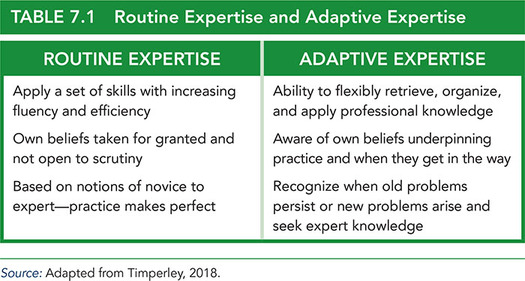
Enacting a pedagogy of voice for adults and students depends upon our ability to foster the curiosity of learners like Sam. Sadly, professional learning in many systems is synonymous with telling people to “do” things, and “supporting learning” means making sure they did it. Helen Timperley, a New Zealand scholar-practitioner urges us to recognize the kind of professional learning that is aligned with the complex work of teaching. Her work resurfaces the concept of adaptive expertise versus routine expertise (LeFevre et al., 2019). With this distinction, Timperley makes the widely accepted point that effective teaching is not solely routine and technical work; it is complex, adaptive work demanding constant attunement and responsiveness (2018). Yet, too many designs for educator learning reflect a sole focus on routine expertise. While building routine expertise is essential to good teaching, it is only one part of the equation. Table 7.1 illustrates the two approaches.
Table 7.1 Routine Expertise and Adaptive Expertise
|
Routine Expertise |
Adaptive Expertise |
|
Apply a set of skills with increasing fluency and efficiency Own beliefs taken for granted and not open to scrutiny Based on notions of novice to expert—practice makes perfect |
Ability to flexibly retrieve, organize, and apply professional knowledge Aware of own beliefs underpinning practice and when they get in the way Recognize when old problems persist or new problems arise and seek expert knowledge |
Source: Adapted from Timperley, 2018.
In the United States, we have long had an educational system that solely values routine expertise. The bar for what qualifies for educator learning reflects a singular focus on building routine expertise—follow the program manual, implement the best practices, stay on the pacing calendar, and track proficiency levels. Though called “professional learning communities,” these common collaborative learning structures tend to be monitoring and planning structures (supporting routine expertise) as opposed to spaces that hold the complexity of teaching by supporting meaning-making.
Public learning helps us move from solely supporting routine expertise to cultivating adaptive expertise. I cannot overstress the role of intentionality and awareness in realizing the possibility of public learning. New ways of being and working do not simply happen. They are intentional and practiced. In the Power of Transformative Practice, Maina and Haines (2008) distinguish between default and intentional practices. Default practices are what we automatically do. Intentional practices are “those that we choose to do in order to transform the way we show up in the world” and are an essential element of antiracist work. Intentional practices give us the opportunity to “increase choice and alignment with values” (Maina & Haines, 2008). Routine expertise is a default way of approaching learning for many teachers and leaders. The practice of public learning presents an opportunity to normalize a new way of working with each other, shaking off the default practices that currently define and limit the way colleagues collaborate.
While it seems obvious to say that intentional practices require intentionality, it is necessary to emphasize that mobilizing a pedagogy of voice for educators requires us to pay attention to what we don’t normally pay attention to. When observing a public-learning conversation, the practitioners on the outside of the fishbowl tend to get swept up in the content of the conversation—the reading strategies, the student work—and struggle to notice ways their colleagues are interacting or the architecture the conversation. When participants are asked to take a “meta-moment” to consider the implicit mindsets, language, and even body language that allow the conversation to promote learning, they realize that they hadn’t thought so much about these things as the content of the conversation. It is precisely that level of intentionality—asking, “What just happened? What made this a learning conversation?” And, “How did that feel?”—that helps build our awareness and breaks us out of our default practices.
ELEMENTS OF PUBLIC LEARNING
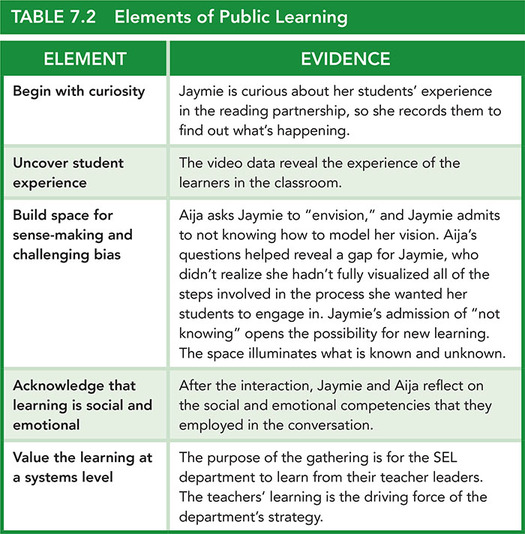
There are five core elements of the practice of public learning, which animate the work of the street data cycle (see diagram at the end of this chapter).
· Begin with curiosity: shines a light on the experience of learning and promotes a listening stance by openly inviting the presence of uncertainty, complexity, curiosity, vulnerability and wonder
· Uncover student experience: centers the voice of the adult learner on understanding students’ learning experience through relevant street data
· Build space for sense-making and challenging bias: acknowledges (1) the messiness of making sense of what success looks like and where the students are in relation to the goal, and (2) the unavoidable presence of implicit bias, which is made visible through inviting multiple perspectives
· Acknowledge that learning is social and emotional: insists upon collective, explicit reflection on the social and emotional aspects of adult learning to continually deepen and strengthen the learning practice
· Value the learning at a systems level: sits inside of a system that values practitioner learning and knowledge-building. This value is an essential part of fueling the motivation to continually learn while carrying out the challenging work of teaching
Let’s unpack how these elements show up in a public-learning moment.
Scenario: First-grade social and emotional learning (SEL) teacher leader Jaymie and her district coach Ajia sit in the middle of a fishbowl surrounded by other elementary teachers. The teachers have been brought together by the district’s SEL department for a professional-learning day. The SEL department is interested in learning how teachers are thinking about SEL competencies within the instructional routines they are using. This, in itself, exemplifies that teacher learning is valued at a systems level.
Prior to this exchange, everyone in the room watched a two-minute clip of Jaymie’s English learner focal students in their partner-reading conversations. The clip uncovered the learners’ experience in Jaymie’s classroom. Jaymie has been focused on how to make reading partnerships more meaningful and address the social and emotional competencies that are required in the partnership.
Jaymie: An end goal would be that when students are reading, and they think of something, they’re able to pause and share with their partner whatever they’re thinking. But, I don’t know how I’m going to get there yet.
Aija: If you could envision what came right after the “Did you know ____?” sentence stem, what would you like to see?
Jaymie: I guess just back and forth about the statement that that person made.
Aija: [pause] And how might you model that?
Jaymie: [long pause] That’s a good question … I’m not sure. Because it seems like whenever I see it, it’s just happening on its own, and I don’t know how they’re doing it.
Aija: It sounds like a next step for you is thinking about the back and forth that you want to see and how to design a mini-lesson or instruction showing students the back and forth after the sentence stem (Lead by Learning, 2020, p. 31).
At the end of this public-learning session, the facilitator asks participants on the inside and outside of the fishbowl to step back for a moment and consider a series of reflection questions. The reflection questions are intended to build awareness of the intersection of social and emotional competencies and learning. This pause activates intentionality and is a critical part of shifting from our default practice of solving each other’s problems to a more intentional practice of supporting our colleagues’ knowledge-building.
Applying the lens of the elements, let’s unpack that interaction:
Table 7.2 Elements of Public Learning
|
Element |
Evidence |
|
Begin with curiosity |
Jaymie is curious about her students’ experience in the reading partnership, so she records them to find out what’s happening. |
|
Uncover student experience |
The video data reveal the experience of the learners in the classroom. |
|
Build space for sense-making and challenging bias |
Aija asks Jaymie to “envision,” and Jaymie admits to not knowing how to model her vision. Aija’s questions helped reveal a gap for Jaymie, who didn’t realize she hadn’t fully visualized all of the steps involved in the process she wanted her students to engage in. Jaymie’s admission of “not knowing” opens the possibility for new learning. The space illuminates what is known and unknown. |
|
Acknowledge that learning is social and emotional |
After the interaction, Jaymie and Aija reflect on the social and emotional competencies that they employed in the conversation. |
|
Value the learning at a systems level |
The purpose of the gathering is for the SEL department to learn from their teacher leaders. The teachers’ learning is the driving force of the department’s strategy. |
The two examples I have shared thus far focus on teachers’ learning; yet these same elements support leaders to engage in public learning.
Voices From the Street Principals
Here is a window into the practice of public learning in an urban elementary school principal community of practice:
Julie is the principal of an elementary school in East Oakland. She is in her first year as principal after teaching for many years. As the public learner, she shares a copy of the mid-year survey (map data) from her staff that provides insight into how they feel about her leadership across a series of topics. While the scores are quite high, they are all lower than the same time in the previous year when there was a veteran leader. Jen, a facilitator, asks Julie, “Where do you want to take this? What area can we dig into?” Julie decides that she wants to talk about how to improve in the area of communication. She says she feels like a good communicator, so she can’t see the weakness. Jen follows up with, “Is there a teacher that you trust who can help you see what you can’t see on your own? Do you feel safe enough to talk about this with her? She could be an amazing partner in supporting your learning.”
In this example, Julie starts with Level 2 map data in the form of a survey. Through public learning and Jen’s skillful facilitation, Julie arrives at a key next step: gathering street data in the form of an interview with a teacher she trusts who can provide critical friendship and feedback.
GETTING STARTED WITH PUBLIC LEARNING
How can leaders begin to shift from a culture of compliance, focused solely on satellite data, to a culture of public learning, which centers student voice, cultivates curiosity, and moves professional learning beyond the low bar of implementing “best practices” to a high bar of cultivating practitioner knowledge about how their students learn?
I want to offer a few ways you can get started with public learning that leverage the power of street data.
Do a Collaborative Time Audit
A great way to get started is to gather street data on how collaborative time is currently spent in your system. Everyone claims to want a learning culture; yet when we ask people to inventory the way they spend their time (e.g., learning versus planning, tracking proficiency, and doing), the learning tends to get the smallest slice. In fact, when we ask this question, leaders and educators often realize they are spending all of their time planning, sharing, tracking proficiency, and doing and no time deepening their understanding of their learners or making sense of their collective vision.
Provide Teachers a Model of What Public Learning Looks Like
One of the best ways to begin practicing public learning is to provide teachers with a model of what it looks like to engage in public learning. Prepare and gather street data ahead of the exercise. Grab a quick video clip of students working collaboratively, copy a student’s writing assignment—anything that will provide information. The fishbowl-style conversation that I discussed earlier provides a common experience for the group to think about public learning together. It also builds trust and community. Here are a few tips from our playbook, Leading by Learning: A Playbook for Creating the Conditions for Adult Learning:

· In advance of the public-learning session, invite a teacher to be the “public learner” and share a student learning dilemma. Consider choosing a colleague who is open to sharing uncertainties.
· Help prepare your public learner:
o Ask them to collect street data artifacts from two to three focal students that shed light on the dilemma.
o Ask them if there is anything that they feel worried about in discussing their uncertainty and data with colleagues.
· Open the session by framing the purpose of public learning as valuing the complex process of figuring out how to best serve our students and seeing our students from an asset-based lens.
· Invite the public learner to share their student-learning dilemma and street data. Ask them to think aloud about what the data reveals about student understanding.
· Assume the role of the listener in the conversation, asking the public learner questions to support their learning:
o What is your learning goal for students?
o What would success look like if students were meeting this goal? What would students be feeling, thinking, doing?
o What do you notice in your data?
o What does your data tell you about your students’ progress toward your goal?
· Ask the group to discuss what they notice about the data, speaking from an asset-based stance.
· Return to the public learner and ask them what they’re thinking now.
· Express gratitude to the public learner and acknowledge that it isn’t easy to share uncertainty in front of colleagues.
· Provide time for teachers to try on the process in pairs or trios, giving everyone a chance to be the public learner.
· Invite all teachers to think about the public-learning experience in small groups:
o What was it like to be the public learner?
o What was it like to be in the role of the listener?
o How did the public learner’s thinking change during the conversation? What social and emotional competencies did you observe?
As a Leader, “Go Public” With Your Own Learning
Going first and trying it out yourself signals to teachers that you’re learning alongside them, fosters symmetry of practice, and allows you to develop empathy as you experience first-hand what you want teachers to experience. Consider these tips (Lead by Learning, 2020):
· Be honest with teachers about a professional dilemma you are facing.
· Model a learning stance by wondering aloud about your uncertainties related to the dilemma.
· Discuss what information might better help you understand what’s happening for your learners.
· Model looking closely at that information to see what it reveals about learning.
· Invite teachers to share their perspectives on your thinking and data. Encourage them to ask clarifying and/or probing questions to help you move forward.
This experience, in addition to modeling vulnerability, will provide you with rich street data on teacher perspectives.
PURSUING THE SPIRIT OF PUBLIC LEARNING
Oftentimes when schools implement new practices, leaders focus on following the instructions rather than pursuing the spirit of the vision. I want to close with some important pitfalls to avoid along with some guiding ideas to keep in mind as you embark on your public-learning journey.
The Magic Is in the Mindset
In our years of leading colleagues through public learning, we always begin by saying that “the magic is not in any protocol or plan that we hand out; rather the magic is in the mindset of the people who are sitting down to engage in that protocol.” While the practice of public learning is a concrete method for transforming the adult-learning culture, this tangible practice relies on a set of mindsets that arises from the belief that learning is the heart of strong teaching.
Be Careful Not to Make This One More Thing
One of the mistakes we made early on in our partnerships with schools was that we didn’t put enough emphasis on the principal’s ability to message the work of public learning. Trying out the practice should be communicated in a way that illustrates its alignment with the school’s vision of equity for student learning and professional growth for teachers. Be cautious that teachers don’t experience this as (yet another) disembodied activity they are being asked to do.
This Is a Learning Practice, Not an Accountability Tool
While public learning can foster professional responsibility through understanding and shared learning, it will not hold that power if used as an accountability tool. A principal once remarked to me after a teacher shared her uncertainty, “Well, she should have already known that.” In order to build an adult-learning culture, the principal will need to shift her mindset to reflect, “Figuring out what you don’t know is an important first step forward.”
Safety in Public Learning Is Not Equally Accessible to All People
There are adult equity issues in public learning. It is far less risky for some people because of position, gender, or race to name what they don’t know. I was in a public-learning session where we were debriefing the experience and a district coach who is a woman of color said, “I cannot be the public learner. At my job, I cannot yet share what I am uncertain about. It doesn’t feel safe for me.” She had tears in her eyes as she told me this and shared that she defaulted to hiding what she wasn’t certain about. I told her that most of us were doing this, as evidenced by the way we accept talking about complex issues as if they are straightforward and easy to solve. I asked her if she knew one person with whom she could practice public learning and if that ally could help her begin to normalize the practice at her site. It is important for leaders to acknowledge and name the reality of this inequity.
Continue to Bring Attention to the Mindsets, Process, and Feelings
There is resistance to repeatedly slowing down inside of an overworked system of doers. Busy people don’t want to pause and consider how something felt emotionally or how implicit bias could be at play. Our feedback surveys are often full of suggestions for “spending less time on the public learner portion of the session” and “more time for individual work.” Adults often feel the same way as students about practice: “I don’t like to practice. I already know how to talk to my colleagues.” We have learned over the years to balance time spent on cultivating intentionality and metacognition around the practice with time spent doing the practice.
The practice of public learning embodies the belief that an educator’s agency and voice are essential to professional learning and therefore invaluable to the system’s quest for educational excellence and equity. My mentor and the original designer of the practice of public learning, Dr. Anna Richert, was an incredible advocate for honoring the learning of practitioners. As a high school teacher who engaged in Dr. Richert’s early inquiry group at Mills College, I would bemoan that my learning about my particular students felt small and insignificant. She would reply, “But how can you say that? No one else can know these things about your students in your classroom. It’s so important that you seek the answers to these questions, that you build this highly contextualized knowledge. It will be life-changing for the students that you teach.”
GETTING UP CLOSE AND PERSONAL: REFLECTION QUESTIONS

1. Which of the ideas from Chapter 7 stood out to you?
2. When you reflect on your professional-learning opportunities, to what extent do they go beyond routine expertise to also build adaptive expertise?
3. In what spaces could you imagine introducing and using public learning? What would it take to get this started?
4. How might public learning support you and your colleagues to address your site or district equity goals?
5. What might get in the way of starting the practice of public learning and why?