
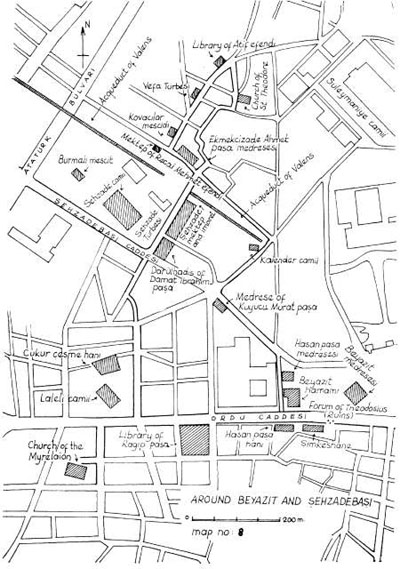
9

We will begin this stroll in Beyazit Square, which may fairly be said to be the centre of modern Stamboul. Indeed this square has been one of the focal points of the city for more than 15 centuries. In late Roman Constantinople this was known originally as the Forum Tauri, named after the colossal statue of a bull that once stood there. In 393 the square was rebuilt by the Emperor Theodosius I, the Great, and thenceforth it was called the Forum of Theodosius. The Forum of Theodosius was the largest of the public squares in Byzantine Constantine. It contained, among other things, a gigantic triumphal arch in the Roman fashion and a commemorative column with reliefs showing the triumphs of Theodosius, like that of Trajan in Rome. Colossal fragments of the triumphal arch and the commemorative column were found during reconstruction of Beyazit Square in the 1950s, and are now arrayed on both sides of Ordu Caddesi next to the two hans on one side and Beyazit’s hamam on the other. Notice the enormous Corinthian capitals and the columns curiously decorated with the lopped-branch design that we have seen on a column in the Basilica Cistern. Fragments of the commemorative column have also been revealed built into the foundations of the hamam, where they produce a startling effect. There we see the figures of marching Roman soldiers, some of them ingloriously standing on their heads!

At the very beginning of Ordu Caddesi, we see the remains of two enormous hans, each of which lost its front half when the avenue was widened in the 1950s. They were left in ruins, but both of them have since been restored and are once again functioning as commercial buildings. The one to the east is Şimkeşhane, and was originally built as a mint by Mehmet the Conqueror. The mint was later transferred to Topkapı Sarayı and Şimkeşhane was used to house the spinners of silver thread. The han was damaged by fire and then rebuilt in 1707 by Râbia Gülnüş Ümmetullah, wife of Mehmet IV and mother of Mustafa II and Ahmet III. The han to the west was built about 1740 by the Grand Vezir Seyyit Hasan Paşa. Both were handsome and interesting buildings, especially the latter. It is still worthwhile walking round them to see the astonishing and picturesque irregularity of design: great zigzags built out on corbels following the crooked line of the streets.

Some few hundred metres farther on down Ordu Caddesi, and on the same side of the street, we come to the külliye of Ragıp Paşa. This delightful little complex was founded in 1762 by Ragıp Paşa, Grand Vezir in the reign of Mustafa III. The architect seems to have been Mehmet Tahir Ağa, whose masterpiece, Laleli Camii, is a little farther down Ordu Caddesi and on the opposite side of the avenue. We enter through a gate on top of which is a mektep, or primary school, now used as a children’s library. Across the courtyard, surrounded by an attractive garden, is the main library; this has been restored in recent years and is now once again serving its original purpose. From the courtyard a flight of steps leads to a domed lobby which opens into the reading-room. This is square, the central space being covered by a dome supported on four columns; between these, beautiful bronze grilles form a kind of cage in which are kept the books and manuscripts. Round the sides of this vaulted and domed room are chairs and tables for reading. The walls are revetted in blue and white tiles, either of European manufacture or strongly under European influence, but charming nevertheless. In the garden, which is separated from the courtyard by fine bronze grilles, is the pretty open türbe of the founder. Ragıp Paşa, who was Grand Vezir from 1757 until 1763, is considered to have been the last of the great men to hold that office, comparable in stature to men like Sokollu Mehmet Paşa and the Köprülüs. Ragıp Paşa was also the best poet of his time and composed some of the most apt and witty of the chronograms inscribed on the street-fountains of Istanbul. His little külliye, though clearly baroque in detail, has a classic simplicity which recalls that of the Köprülü complex on the Second Hill.
BODRUM CAMİİ (CHURCH OF THE MYRELAION)
We now continue along Ordu Caddesi and take the second turning on the left, just opposite Laleli Camii. We then turn right at the next corner and at the end of this street ascend a flight of steps onto a large marble-paved terrace. Just beyond the far left corner of the terrace we see a former Byzantine church known locally as Bodrum Camii, or the Basement Mosque, because of the crypt that lies beneath it. The building was excavated in 1964–6 by Professor Cecil L. Striker of the University of Pennsylvania, who identified the church as the Myrelaion, “the place of the sacred myrrh”, built by the Emperor Romanus I Lecapenus (r. 919–44) at the beginning of his reign along with a monastery of the same name. Beneath the church he built a funerary chapel, where he interred his wife Theodora after she died in 922. Next to the church and monastery Romanus also erected a palace on the substructure of an earlier Roman edifice, known as the Rotunda, beneath the marble terrace we see today. The church was converted into a mosque late in the fifteenth century by Mesih Pasha, a descendant of the Palaeologues who converted to Islam and led the forces of Mehmet II in their first and unsuccessful attack on Rhodes in 1480. The building was several times gutted by fire and was restored in 1965–6, along with the chapel beneath it, and it is once again serving as a mosque, while the Rotunda has been rebuilt as a subterranean shopping mall, with its entrance on the south side of the terrace opposite the mosque.
The most distinctive aspect of the exterior of the Myrelaion is the array of half-cylindrical buttresses that project from the west façade and the sides of the narthex and naos, articulating the internal bay divisions. The dome sits on a high cylindrical drum penetrated by eight round-arched windows. The church and the funerary chapel beneath it are of the same design, namely the four-column type so common in the tenth and eleventh centuries, with a three-bay narthex to the west and to the east the apse flanked by the sacristy and the prothesis, the chapel where the Eucharist was kept.
The funerary chapel can be visited in the company of the imam. A fragmentary fresco can be seen in the bema, the lower part of a panel depicting a female donor kneeling before a standing figure of the Virgin Hodegitria.
The Rotunda was excavated in 1964–5 by R. Nauman and is described by Striker in his book on the Myrelaion. Its external and internal diameters are 41.8 and 29.6 metres, respectively, with walls of finely cut aslar blocks now standing to a maximum height of 3.4 metres. The roof was originlly supported by some 75 columns. The Rotunda seems to have been in ruins when Romanus decided to build his palace on its substructure, erecting his church and funerary chapel just next to it. During the excavations of 1964–6 a fragmentary sculpture in porphyry was discovered in the Rotunda by the Turkish archaeologist Nezih Firatlı. Firatlı showed that this fragment, which we have seen in the Archaeological Museum, was part of a foot of the group of the Tetrarchs that now stands outside the south-west corner of the Basilica of San Marco in Venice.
LALELI CAMİİ
We now return to Ordu Caddesi where we are confronted by the imposing complex of Laleli Camii, built on a high terrace. This is a very frivolous mosque, perhaps the best of all the baroque mosques in the city. It was founded by Mustafa III and built between 1759 and 1763 by Mehmet Tahir Ağa, the greatest and most original of the Turkish baroque architects.
Before we visit the mosque itself we might take a stroll through the galleries below it, a veritable labyrinth of winding passages and vaulted shops. In the centre, directly underneath the mosque, is a great hall supported on eight enormous piers, with a fountain in the centre and a café and shops round about. The whole thing is obviously a tour de force of Mehmet Tahir to show that he could support his mosque apparently on nothing!
The mosque itself is constructed of brick and stone, but the superstructure is of stone only; the two parts do not seem to fit together very well. Along the sides run amusing but pointless galleries, the arcades having round arches; a similar arcade covers the ramp leading to the imperial loge. The plan of the interior is an octagon inscribed in a rectangle, all but the western pair of supporting columns being engaged in the walls; the latter support a gallery along the west wall. All the walls are heavily revetted with variegated marbles, yellow, red, blue and other colours, which give a somewhat gaudy effect. In the west wall of the gallery there are panels or medallions of opus sectile, in which are used not only rare marbles but even semi-precious stones such as onyx, jasper and lapis lazuli. A rectangular projecting apse contains the mihrab of sumptuous marbles. The mimber is of the same materials, while the kürsü or preacher’s chair is a rich work of carved wood heavily inlaid with mother-of-pearl – altogether an extravagant and entertaining decor!
Like all of the other imperial mosques, Laleli Camii was surrounded by the many attendant buildings of a civic centre, some of which have unfortunately succumbed to time. On Ordu Caddesi there still remains the pretty sebil with bronze grilles and the somewhat sombre octagonal türbe in which are buried Sultan Mustafa III and his son, the unfortunate Selim III. On the terrace inside the enclosure is the imaret. This is an attractive little building with a very strange plan indeed, quite impossible to describe: it must be inspected. Unfortunately, the other institutions in the külliye – the medrese and the hamam – have disappeared.
The street just to the east of the mosque, Fethi Bey Caddesi, leads at the second turning on the left to a fascinating han which probably belongs to the Laleli complex. This was formerly known as Çukur Çeşme Hanı, the Han of the Sunken Fountain, but its present residents call it Büyük Taş Han, the Big Stone Han. The plan of this too is almost indescribable. We enter through a very long vaulted passage, with rooms and a small court leading from it, and emerge into a large courtyard, in the middle of which a ramp descends into what were once the stables. Around this porticoed courtyard open rooms of most irregular shape, and other passages lead to two additional small courts with even more irregular rooms! One seems to detect in this the ingenious but perverse mind of Mehmet Tahir Ağa. The han has now been restored and houses a restaurant and shops.
Leaving the han, we turn left and continue along Fethi Bey Caddesi for about 100 metres until it intersects Fevziye Caddesi; there we veer right and continue for another 100 metres until we come to Şehzadebaşı Caddesi, where we turn left. The broad avenue on which we are now strolling follows the course of the ancient Mese, which turned to the north-west after leaving the Forum Tauri. The modern avenue takes its name from Şehzade Camii, the great mosque which we see looming up ahead. Before we visit the mosque, however, let us continue past it for a little way so as to look at two monuments of some minor interest.
THE BELEDİYE AND THE MEDRESE OF ANKARAVI
MEHMET EFENDI
Just past Şehzade Camii on the left side of the avenue we see the huge building of the Belediye, or Municipality, the headquarters of the civil government of Istanbul. Erected in 1953, it is of the glass and aluminium variety and not bad of its kind, except for a curious arched excrescence on the lower part of the building which looks like a hangar for airplanes. From the roof of the higher part, one has a fine view of the surrounding district. Behind this building is the little medrese of the Şeyh-ül Islam Ankaravı Mehmet Efendi, founded in 1707. This has recently been restored and is now used as part of the Economics Faculty of the University. It is a small and attractively irregular building, chiefly of red brick, with a long, narrow courtyard, at the far end of which is the lecture-hall reached by a flight of steps.
BURMALİ CAMİ
Crossing now to the opposite side of Şehzadebaşı Caddesi, we find in front of the west wall of the Şehzade precinct a pretty little mosque, recently restored, called Burmali Cami. It was built about 1550 by the Kadı (Judge) of Egypt, Emin Nurettin Osman Efendi. Although of the very simplest kind – a square room with a flat wooden ceiling – it has several peculiarities that give it a cachet of its own. Most noticeable is the brick minaret with spiral ribs, from which the mosque gets its name (burmah = spiral); this is unique in Istanbul and is a late survival of an older tradition, other examples of which are to be found at Amasya and elsewhere. Then the porch is also unique: its roof, which is pitched, not domed, is supported by four columns with Byzantine Corinthian capitals. The reuse of ancient capitals also occurred in the earlier architecture of Bursa and among the Selçuks, but it is very rare indeed in Istanbul. (Bayan Cahide Tamer, the architect who so ably restored the mosque, found the original Corinthian capitals so decayed and broken as to be unusable in the restoration, but she was able to find in the Archaeological Museum four others of the same type with which she replaced the originals.) Finally, the entrance portal is not in the middle but on the right-hand side. This is usual in mosques whose porches are supported by three columns only – so as to prevent the door being blocked by the central column – but here there seems no reason for it. The interior of the mosque has no special features.

The great mosque of the Şehzade has been looming up before us for some time and we must now visit this magnificent complex systematically. The main entrances are on Şehzadebaşı Caddesi. The complex consists of the mosque, several türbes, a medrese, a tabhane or hospice, a public kitchen and a primary school.
Şehzade Camii, the Mosque of the Prince, was built by Süleyman the Magnificent in memory of his eldest son, Prince Mehmet, who died of smallpox in the 22nd year of his age in 1543. As Evliya Çelebi wrote of Prince Mehmet: “He was a prince of exquisite qualities and possessed of a piercing intellect and a subtle judgement. Süleyman, when laid up with the gout, had fixed on him in his mind to be a successor to his crown; but man proposes and God disposes; death stopped the way of that hopeful youth at Magnesia, from whence his body was brought to Constantinople.”
Süleyman was heartbroken at the death of his beloved son and sat beside Mehmet’s body for three days before he would permit burial to take place. When Süleyman recovered from his grief he determined to commemorate Prince Mehmet by the erection of a great mosque and pious foundations dedicated to his memory. Sinan was commissioned to design and build it and began work almost immediately, finally completing the project in 1548. Sinan himself called this his “apprentice work”, but it was the work of an apprentice of genius, his first imperial mosque on a truly monumental scale.

Sinan, wishing from the very first to centralize his plan, adopted the expedient of extending the area not by two but by four semidomes. Although this is the most obvious and logical way both of increasing the space and of centralizing the plan, the identical symmetry along both axes has a repetitive effect which tends towards dullness. Furthermore, the four great piers that support the dome arches are stranded and isolated in the middle of the vast space and their inevitably large size is thereby unduly emphasized. These drawbacks were obvious to Sinan once he had tried the experiment, and he never repeated it.
The interior, then, is vast and empty; almost alone among the mosques, it has not a single column; nor are there any galleries. Sinan has succeeded in minimizing the size of the great piers by making them very irregular in shape: contrast their not unpleasing appearance with the gross “elephant’s feet” columns of Sultan Ahmet. The general effect of the interior is of an austere simplicity that is not without charm: Milton’s very un-Horatian “plain in her neatness” might well describe it.
As if to compensate for this interior plainness, Sinan has lavished on the exterior a wealth of decoration such as he uses nowhere else. The handsome courtyard avoids the defect of that of the Süleymaniye (see Chapter 10) by having all four porticoes at the same height, at the expense of sacrificing to some extent the monumentality of the western façade. The şadırvan in the centre is said by Evliya to be a contribution of Murat IV. The two minarets are exceptionally beautiful: notice the elaborate geometrical sculpture in low relief, the intricate tracery of their two şerefes, and the use of occasional terra-cotta inlay. The cluster of domes and semidomes, many of them with fretted cornices and bold ribbing, crowns the building in an arrangement of repetition and contrast that is nowhere surpassed. It was in this mosque, too, that Sinan first adopted the brilliant expedient of placing colonnaded galleries along the entire length of the north and south façades in order to conceal the buttresses, an arrangement which, as we will see, he used with even greater effect at the Süleymaniye: here the porches have but one storey, while at the Süleymaniye they have two. This is certainly one of the very finest exteriors that Sinan ever created; one wonders why he later abandoned, or at least greatly restrained, these decorative effects.

Behind the mosque is the usual walled garden of türbes, but the türbes themselves are very unusual indeed, for they provide a veritable historical museum of the two best periods of Turkish tiles, the first extending from the time of the Conquest up until about 1555, and the second and greatest from 1555 up till 1620. The türbes in the precincts of Haghia Sophia are larger and grander, but their tiles, magnificent as they are, are all much of the same date and style, as are those of the Süleymaniye. Here, on the other hand, the buildings are of sufficiently different dates to cover the whole span of the great age of the Iznik kilns, together with a few of those produced at a later period at Tekfur Saray. Unfortunately, these türbes are not open to the public, except for that of Destarı Mustafa Paşa.
The first and largest türbe in the centre of the garden is, of course, that of the Şehzade Mehmet himself. It is octagonal, the faces separated by slender engaged columns; the stonework is polychrome, panels of verd antique with inscriptions being inset here and there in the façades, while the window frames and arches are picked out in terra-cotta. The dome, which is double, on a fluted circular drum, is itself fluted. The small entrance porch has a fine pavement of opus sectile. It is a very handsome building in the decorated style of the mosque itself.
The inscription in Persian verse over the entrance portal, which gives the date of the Prince’s death, A.H. 950 (A.D. 1543), suggests that the interior is like the garden of paradise. It is indeed – all apple green and vivid lemon yellow – for it is sheathed in tiles from the floor to the cornice of the dome. These are almost the last and by far the most triumphant flowering of the middle period of Iznik tiles, done in the cuerda seca technique. Tiles in this technique and in these colours are extremely rare. They were first manufactured at Iznik in about 1514, when Selim I brought back a group of Persian craftsmen after his conquest of Tabriz, while the latest known examples, in the lunettes of the windows of Kara Ahmet Paşa Camii on the Seventh Hill (see Chapter 16), date from 1555. Other examples are in the mosque and türbe of Selim I (see Chapter 13) himself, some here and there in the Saray, and in the porch of the Çinili Köşk, and that is about all. Thus the türbe of the Şehzade contains far and away the most extensive and beautiful collection of tiles of this rare and lovely type.
The tile decoration of the interior was clearly designed as a whole. Panels of floral design separate the lower tier of windows; in the lunettes above them are inscriptions framed in arch-shaped borders; in the spandrels between these appears an occasional boss in faience. Above, a continuous series of large panels, each spanning two windows, contains a long inscription; then comes the upper tier of windows framed in floral panels with a lovely medallion between each pair of windows. The ground is in general apple-green, sometimes dark blue; on this are designs of leaves and flowers in lemon yellow, turquoise, dark blue, white, and a curious unfired pinkish-mauve; the colours are separated by the thin, almost black line of the cuerda seca. The whole effect is lyrically beautiful, truly like a garden in paradise, making this türbe a masterpiece unrivalled of its kind.
And the beauty of the türbe is not limited to its ceramics, for the upper row of windows contains some of the most perfect of Turkish stained-glass in rich and brilliant colours. Some of these are, alas, broken and damaged, but several remain entire; only in the Süleymaniye is there so extensive and brilliant a display of Turkish stained-glass of the sixteenth century. The dome, supported on a deep cornice of stalactites with a frieze of trefles, preserves its original arabesque painting: a great medallion in the crown with a circle of leaf-like forms in rich brick-red from which a sort of cascade of smaller medallions and lozenges rains down nearly to the cornice. Since one must perforce use superlatives in describing this building, one might venture the view that this is the very best painted dome that survives in the city. Still another unique feature of the türbe is the very curious baldachino over the Şehzade’s cenotaph. It is of dark walnut wood, supported on four legs beautifully inlaid with ivory in a style that seems almost Indian; above this is a sort of openwork box of interlacing polygons, made of the same wood without inlay. One wonders if the box-like structure may not be intended to represent the Kaaba at Mecca, so that the effect would be that the Prince had been buried in the most holy place on earth. On his left is buried his daughter Humaşah Sultan; on his right his crippled brother, Prince Cihangir, who died in 1553 from love of his elder half-brother, the unfortunate Prince Mustafa, put to death by their father Süleyman.
Just to the left and behind the türbe of the Şehzade is that of the Grand Vezir Rüstem Paşa. This türbe is also by Sinan and it too is completely sheathed in tiles from floor to dome; but here everything is a little wrong. The building is too high for its diameter and too small to support the overwhelming quantity of tiles; and the tiles themselves, though beautiful, are just too early to display the full perfection of the Armenian bole technique. Rüstem evidently had a passion for tiles since not only his türbe but his mosque is entirely revetted with them; but he was unfortunate in his date, for he died in 1561, just ten years before complete mastery in the new technique was achieved. Here the most gorgeous panels are those between the lower windows; vases with a deep blue mandorla of flowers rising out of them. Between the lower and upper windows is a continuous inscription – white on dark blue – and between the upper windows floral tiles without an overall pattern. The drawing and composition are firm and good and the colours – on a white ground, dark blue, turquoise, a little green and red – are clear and vivid (all but the red, which in many tiles is muddy or brownish). There is no doubt that this türbe suffers greatly by comparison with that of the Şehzade and with that of Ibrahim Paşa nearby.
To this we now proceed – it is just opposite the south-west gate – passing in front of the unadorned türbe of Prince Mahmut, son of Mehmet III. The Grand Vezir Ibrahim Paşa, son-in-law of Murat III, died in 1601 and his türbe was completed in 1603; it is by the architect Dalgıç Mehmet Ağa. This türbe almost equals that of the Şehzade in splendour and perfection. It is octagonal and fairly plain on the exterior, though two marble panels on either side of the entrance portal, carved with elaborate floral and arabesque designs in low relief, are unusual and lovely. Inside, it is another bosk of the paradisical garden, but with a very different colour scheme: white, intense blue, turquoise and scarlet. Here the walls to the top of the lower tier of windows are of marble with a surbase of flower tiles. Between the two rows of windows there are two continuous friezes of calligraphy, white on dark blue, divided by a deep band of interlaced polygons in scarlet on a white ground. The effect is astonishing but beautiful, and there is nothing quite like it in existence. The upper windows are divided by superb floral panels predominantly turquoise picked out in scarlet. All the tiles are absolutely perfect in technique, the Armenian bole standing out boldly in relief and displaying its scarlet colour at its most intense: notice the spots of it in the curliques of the calligraphy, like liquid drops of blood.
This türbe, too, has almost an embarras de richesses: between the lower windows are cupboards with carved wooden doors; open these and you will find the interiors also lined with tiles. These were evidently added later, for some of them, one suspects, are from the Tekfur Saray kilns, but very good examples of the work. The two cupboards on either side of the door have tiles with an unusual and attractive Chinese cloud pattern; the other have the more ordinary floral designs. The dome, too, preserves its original painting, with elaborate arabesques and flowers on a terra-cotta ground; it is rather heavy and more cluttered than that of the Şehzade, but far finer than any modern imitation. Ibrahim Paşa’s cenotaph is the usual wooden box, but beyond it are two tiny tombs for his son and daughter, of gaily painted marble.
There are two other türbes in the garden, those of Hatice Sultan, daughter of Murat III, and of Fatma Sultan, granddaughter of Prince Mehmet, but these are unadorned. There is, however, one more remarkable türbe to be visited, but it is outside the garden just opposite the south door of the mosque by the entrance to the outer precinct. It is that of Destari Mustafa Paşa, dated by its inscription to A.H. 1020 (A.D. 1611). This has now been restored and is open to the public. It has the unusual form of a rectangle, like two other türbes built by Sinan: one for Pertev Paşa at Eyüp (see Chapter 18), the other for Ahmet Paşa in the garden of Mihrimah Camii at the Edirne Gate (see Chapter 17). Unlike these, however, this one preserves its roof a low central dome flanked at each end by a shallow cradle-vault. The effect is very pretty. The walls between the windows are revetted with tiles, still of the best period; they are perhaps not quite so stunning as those of Ibrahim Paşa, but they contain a lot of Armenian bole at its most brilliant.


The medrese of the Şehzade foundation is on the far side of the precinct, at the north-west corner. It is a handsome building of the usual form. The south side, facing the mosque precinct, has a portico but no cells. Opposite the entrance, instead of the usual dershane, is an open loggia, the lecture hall itself being in the centre of the east side; opposite, a passage between two cells leads to the lavatories. The building has been well restored and is again in use as a residence for university students.
In line with the medrese but farther east is the kervansaray which now serves as a science laboratory for the adjacent Vefa Lisesi. This building is probably not by Sinan, though obviously contemporary or nearly so, with the rest of the complex. It has no door into the mosque precinct but is entered from the other side. It is L-shaped, the bottom stroke of the L consisting of a long, wide hall, its eight domes supported on three columns down its length; perpendicular to this is a block of eight cubicles with two spacious halls giving access to them. This interesting building is in good shape and makes a fine science laboratory.
Between the reservoir tank and the wall of the türbe garden a gate in the east wall of the precinct leads out into a side street, Dede Efendi Caddesi. Opposite, to the left, are the primary school and public kitchen of the complex. The primary school, or mektep, is of the usual type. The public kitchen, or imaret, consists of a spacious courtyard, on one side of which are three double kitchens and a large refectory, its four domes supported on three columns. This is a charmingly proportioned and gracious building. It is now used as a storage place; but the fabric is in good condition and one may hope that a more worthy use can be found for it.
As can be seen even from this necessarily inadequate description, the whole complex of the Şehzade is a triumph, and every one of its component parts has a brilliance and an interest of its own.

Turning back towards the main street we find on the left opposite the türbe garden a very pretty medrese, with a grand sebil at the corner. Built by the Grand Vezir Nevşehirli Ibrahim Paşa, son-in-law (damat) of Ahmet III, it is dated by its inscription to A.H. 1132 (A.D. 1720) and thus comes just between the end of the classical period and the beginning of the baroque; it has pleasing characteristics of both. At the end of the façade stands a large domed chamber surrounded by an attractive raised portico; the entrance portal is in the centre between them. The chamber to the left served as the library; that to the right was the dershane of the Dar-ül Hadis or School of Tradition, which is what the medrese was. Later the dershane was turned into a mescit, or small mosque, by the addition of a minaret. The far sides of the courtyard are partly lined with porticoes with cells beyond them, but these are irregularly placed after the baroque fashion. The building is in good condition and part of it is now used as a clinic. Outside, at the corner, is an extremely handsome sebil, a favourite with painters and etchers; it was still in use as a fountain up until recent years, but now it is closed. Behind this is a pretty graveyard in which is buried the founder of this fine little külliye. Ibrahim Paşa served as Grand Vezir under Ahmet III from 1718 till 1730, during the golden years of the Tulip Period. That delightful epoch ended on 20 September 1730, when the Tulip King was deposed and his chief minister, Ibrahim Paşa, was strangled by the Janissaries.

We now walk back down Dede Efendi Caddesi, passing on our right the medrese of Ibrahim Paşa and the mektep and imaret of the Şehzade külliyesi. On our left we see the Vefa Lisesi, built by the architect Kemalettin Bey in the 1920s. In its precincts are two ancient buildings, one of which, the Şehzade tabhane, we have already described. The other is the library of Damat Şehit Ali Paşa, built early in the eighteenth century. The founder, Ali Paşa, was called Damat (son-in-law) because he married Fatma Sultan, daughter of Ahmet III, and Şehit (martyr) because he was killed in the battle of Peterwaredin in 1716. Fatma did not grieve long for Ali, for a few weeks after she heard of his death she married Nevşehirli Ibrahim Paşa, whose külliye we have just seen down the street. Ali Paşa’s library is raised on a high substructure and approached by a long flight of steps; it consists of only two rooms, the larger of which is domed. It is not in use at present.

At the next corner we turn left on Kovacılar Caddesi and immediately on our right we see another ancient Ottoman building. This is the handsome medrese built some time before his death in 1618 by Ekmekçizade Ahmet Paşa, son of an Edirne baker, who rose to the rank of Defterdar (First Lord of the Treasury) and Vezir, and died one of the richest men in the Empire. Until a few years ago the medrese was a ruin, inhabited by gypsies, but now it has been partially restored. Those who like variations on a theme will be pleased to note some anomalies: the right side of the court is occupied by the usual dershane, next to which, however, is a türbe of the same size, making the courtyard a bit lopsided. Both still preserve remnants of a rather good painted decoration in domes and pendentives, a rich red with deep green meander patterns. Even in its half-restored condition this is an interesting monument and well worth a visit.
PRIMARY SCHOOL OF RECAİ MEHMET EFENDİ
We continue in the same direction along Kovacılar Caddesi past the next intersection and on our left we see a half-ruined Ottoman building. This is the sibyan mektebi, or primary school, of Recai Mehmet Efendi, First Lord of the Treasury and Keeper of the Seal under Abdül Hamit I. The upper floor is built of alternate courses of brick and stone, but the entire ground floor is sheathed in an elaborately decorated marble casing. In the centre is the projecting curve of the sebil with three fine bronze grilles between the columns; on the left is the ornate entrance portal, while balancing this on the right is a çeşme. A long decorative inscription over the sebil gives the date of foundation as A.H. 1189 (A.D. 1775). Unfortunately, the level of the ground has risen considerably since then and this imposing façade has been somewhat swamped and belittled by it. But in spite of this and the poor condition of the fabric, it remains one of the more elaborate and charming of the small Ottoman primary schools.
Returning to the last intersection, we now turn left onto Kâtip Vefa Caddesi. Immediately on our left we pass the famous Vefa Bozahanesi, where the stroller might want to stop for a refreshing glass of boza. (Boza is a drink made from millet, once a great favourite of the Janissaries.) Notice the silver cup in a glass case on the wall; it is preserved there because Atatürk once drank from it.
Just beyond the Vefa Bozahanesi is a little mosque called Mimar Mehmet Ağa Camii. This was built in 1514 by Revani Şuccağ Efendi who was Sürre Emini, or official escort, of the annual embassy to Mecca. It is a small square building of brick with a dome; it is of no great interest, but has a pretty fluted minaret. The mosque was well restored in 1960, a little too much perhaps.

A short way down the street we come to Vefa Camii, the small mosque from which the street and the district took their name. This is a brand new mosque erected on the site of the original Vefa Camii, built in the late fifteenth century. All that is left of the original mosque complex is the türbe of its founder, Şeyh Muslihiddin Vefa, dated A.H. 896 (A.D. 1491). In years past Şeyh Vefa was one of the most popular folk-saints in Istanbul, and even today a few old women occasionally come to pray at his türbe. (Officially there are no saints in Islam, but Istanbul abounds with the tombs and graves of holy men canonized only by the reverence accorded them by the pious poor of the city.) Although Şeyh Vefa was one of the most renowned scholars of his time (we are told that he was well versed in all of the 70 sciences of Islam), he decided quite early in life that he would devote himself entirely to the welfare of the poor. He therefore expended his fortune to build a pious foundation which included a mosque, hamam, primary school, imaret and kervansaray, where the poor could be assured of food and shelter for as long as they were in need. All of these benefactions have now disappeared, although the pious poor of modern Stamboul still come to pay their reverence at Şeyh Vefa’s tomb.
LIBRARY OF ATİF EFENDİ
Just beyond Şeyh Vefa’s türbe, on the same side of the street, we come to the library of Atif Efendi. Of all the Ottoman public libraries in the city this is the most charming and original. Built in 1741–2 and constructed of stone and brick, it is baroque and consists of two parts, a block of houses for the library staff and the library itself. The former faces the street and its upper storey projects en cremaillère, that is in five zigzags supported on corbels. Three small doors lead to the lodgings while a large gate in the middle opens into a courtyard or garden, on the other side of which stands the library. This consists of an entrance lobby, a room for book storage, and a large reading-room of astonishing shape. This oblong area, cradle-vaulted like the other rooms, is surrounded at one end by a series of five deep bays arranged like a fan. A triple arcade supported on two columns divides the two parts of the room; on the exterior this fan-like arrangement presents seven faces. Near the entrance to the reading-room the entire vakfiye, or deed of foundation, of the establishment is inscribed on a marble plaque. The library of Atif Efendi is altogether a fantastic and delightful building!
KİLİSE CAMİİ (CHURCH OF ST. THEODORE)
If we take the street just opposite the library entrance, Tirendaz Sokağı (the Street of the Archer), we come immediately to a little Byzantine church with a prettily fluted brick minaret. Converted into a mosque soon after the Conquest, it is called Kilise Camii, literally Church Mosque, a linguistic amalgamation of Christianity and Islam. It was identified by Gyllius as the Church of St. Theodore, but nothing is known of its history. The inner narthex and the church itself, which is of the four-column type, are to be dated some time between the tenth and twelfth century, when this type was predominant. But the most attractive part of the building is the outer narthex with its façade. Constructed of stone, brick and marble, its elaborate design and decoration proclaim it at once as belonging to the last great flowering of Byzantine architecture in the earlier fourteenth century. In the south dome of the outer narthex there were some fine late mosaics of the type of those at St. Saviour in Chora (Kariye Cami, see Chapter 14), but these have now almost vanished. The narthexes contain some handsome columns, capitals and door-frames which appear to be reused material from an earlier building probably of the sixth century. And if you climb up into the minaret you will see set into the parapet of the şerefe the fine figure in low relief of a peacock, probably taken from a Byzantine fountain that is known to have stood nearby.
Leaving Kilise Camii we turn left and then right onto a street that we follow until we come to the rear of the medrese of Ekmekçizade Ahmet Paşa, which we visited earlier. There we turn left on Kovacılar Caddesi, which we follow for about 200 metres before returning right on the first through street on the right. This leads through a picturesque arched gateway under the Valens Aqueduct and out onto a large open area on the other side. There we see another former Byzantine church, this one of considerable interest.
KALENDERHANE CAMİİ
The church was converted into a mosque by Fatih under the name Kalender Hane, since it was used as a tekke by the Kalender dervishes. It was once identified as the Church of St. Mary Diaconissa, more recently as that of St. Saviour Akataleptos, and now, as the result of an archaeological study and restoration by Cecil L. Striker of Dumbarton Oaks and Doğan Kuban of Istanbul Technical University, as that of the Theotokos (Mother of God) Kyriotissa. The church is cruciform in plan, with deep barrel vaults over the arms of the cross, and a dome with 16 ribs over the centre. It originally had side aisles communicating with the nave, and galleries over the two narthexes. The building has proved to date, not from the ninth century, as was formerly supposed, but to the late twelfth. It still preserves most of its elaborate and beautiful marble revetment, making it one of the most attractive Byzantine buildings in the city, now once again serving as a mosque.
The most sensational discovery made during the archaeological study of the building is a fresco cycle of the life of St. Francis of Assisi in a small side chapel. This was executed during the Latin occupation of the city, probably about 1250, and is the earliest cycle of the life of St. Francis anywhere in the world, painted only about 25 years after his death. It shows the standing figure of the saint with ten scenes from his life and anticipates in many elements the frescoes of Giotto at Assisi. Other discoveries include a mosaic of the “Presentation of the Christ child in the Temple” dating probably to the seventh century, and thus the only pre-iconoclastic icon ever found in the city. Finally a late Byzantine mosaic of the Theotokos Kyriotissa came to light over the main door leading to the inner narthex, thus settling the much disputed dedication of the church. These paintings have been removed from the church and are now on exhibit in the Archaeological Museum, in the gallery devoted to Istanbul Through the Ages.
Excavations under and to the north of the church have revealed a whole series of earlier structures on the site. The earliest is the remains of a Roman bath of the late fourth or early fifth century, including a trilobed room, a circular chamber, and evidence of a hypocaust. This was succeeded by a basilica of the mid-sixth century built up against the Valens Aqueduct and utilizing the arches thereof as its north aisle. Finally, to the south of this, was built in the pre-iconoclastic period another church, part of the sanctuary and apse which were incorporated in the present building. Sections of the opus sectile floors of these earlier buildings were found under the floor of the existing apse.

Leaving the church we walk out to Şehzadebaşı Caddesi and turn left. (The last section of the street on which we are walking is called Cüce Çeşmesi Sokağı, the Street of the Dwarf’s Fountain.) A short distance along and on the right side of the street we see a small triangular medrese. This elegant little complex was built in 1606 by Kuyucu Murat Paşa, Grand Vezir in the reign of Ahmet I. Murat Paşa received his nickname kuyucu, or the pit-digger, from his favourite occupation of supervising the digging of trenches for the mass burials of the rebels he had slaughtered. The apex of the triangle is formed by the columned sebil, with simple classical lines. Facing the street is an arcade of shops in the middle of which a doorway leads to the courtyard of the medrese. Entering, we find the türbe of the founder in the acute angle behind the sebil, and at the other end the dershane, which, as so often, served also as a small mosque. This building has been taken over and restored by Istanbul University; the courtyard has been roofed in and used as a small museum, while the dershane contains a library.

Continuing along and passing the new University building, we turn right and soon come to another medrese complex, now the Istanbul University Institute of Turkology. This is a baroque building founded in 1745 by the Grand Vezir Seyyit Hasan Paşa, the same who built the han we saw earlier. It is curiously irregular in design and raised on a rather high platform so that on entering one mounts a flight of steps to the courtyard, now roofed in and used as a library and reading-room. In one corner is the dershane-mescit, which has become the office of the Director of the Institute; in another is a room designed as a primary school; this and the cells of the medrese are used for special library collections or as offices. Outside in the street at the corner of the buildings is a fine rococo sebil with a çeşme beside it.
After leaving the medrese we continue walking along the same street, which soon veers left and ends in a flight of steps beside Beyazit’s hamam. We descend and find ourselves once more in the chaos of Beyazit Square, back at the point where we began our stroll.