

8

The region between Beyazit Square and the Galata Bridge is the principal market district of the city. This is one of the oldest and most picturesque quarters of Stamboul, and the tumultuous streets are full of clamour and commotion, with cars, trucks, carts and porters forcing their way through the milling crowds of shoppers and pavement vendors. Although colourful and fascinating, this neighbourhood can be somewhat wearing for the stroller, for it is often difficult to find one’s way in the narrow, winding streets, most of which are not identified by signs, and one is continually fleeing to avoid being knocked down by herculean porters or run down by a lorry. And so, before beginning this tour, one is advised to prepare oneself, as do the Stamboullus, by having a bracing glass of tea in Çınaraltı, the old outdoor çayevi in Beyazit Square.
While sitting in the teahouse one can observe some of the streetside shops and markets which are so characteristic of this district. The street at the far end of the square is called Bakırcılar Caddesi, the Avenue of the Copper-Workers, where most of the coppersmiths of the city make and sell their wares. We will find that many of the streets in this district are named after the tradesmen and artisans who carry on their activies there, as they have for centuries past.
Leaving the teahouse, we pass through the gate beside the mosque (the Gate of the Spoon-Makers) and enter the Sahaflar Çarşısı, the Market of the Secondhand Book Sellers. The Sahaflar Çarşısı is one of the most ancient markets in the city, occupying the site of the Chartoprateia, the book and paper market of Byzantium. After the Conquest this became the market for the turban-makers and metal-engravers, at which time it was called the Hakkaklar Çarşısı, named after the latter of those two guilds. At the beginning of the eighteenth century, during the reign of Sultan Ahmet III, the booksellers set up shop here too, moving from their old quarters inside the Covered Bazaar. In the second half of the eighteenth century, with the legalization of printing in the Ottoman Empire, the booksellers greatly increased their trade and came to dominate the market, which from that time on came to be named after them. During the nineteenth and early twentieth century, the Sahaflar Çarşısı was one of the principal centres in the Ottoman Empire for the sale and distribution of books. In the past half-century, however, the establishment of public libraries and modern bookshops has diminished its importance and it now lives on in honourable old age as a market for secondhand books. It is one of the most picturesque spots in Stamboul; a pleasant, vine-covered, sun-dappled courtyard lined with tome-crammed shops, with stalls and barrows outside piled high with a veritable literary necropolis. The guild of the booksellers in this market is one of the oldest in Istanbul; its origins, like those of many other guilds in the city, go back to the days of Byzantium. In the centre of the square there is a modern bust of Ibrahim Müteferrika, who in 1732 began to print the first works in Turkish.
We pass through the Sahaflar Çarşısı and leave at the other end through an ancient stone portal, Hakkaklar Kapısı, the Gate of the Engrayers. We then turn right, and a few steps farther on we find on our left one of the entrances to the famous Kapalı Çarşı, the Covered Bazaar.

Most foreigners, and indeed most Stamboullus, find the Covered Bazaar one of the most fascinating and irresistible attractions of Istanbul. No directions need be given for a stroll through the Bazaar, for it is a labyrinth in which one takes delight in getting lost and finding one’s way out, after who knows how many purchases and other adventures. As can be seen from the plan, it is a fairly regular structure – which makes it even more maze-like and confusing in practice. It is a small city in itself: according to a survey made in 1880 the Bazaar contained at that time 4,399 shops, 2,195 ateliers, 497 stalls, 12 storehouses, 18 fountains, 12 mescits or small mosques, as well as a larger mosque, a primary school and a türbe. The number of commercial establishments would appear to be about the same now, in addition to which there have been added several new institutions, including half a dozen restaurants (the best is the Havuzlu Lokanta), innumerable teahouses, two banks, plus a toilet and information centre for lost tourists.
The Bazaar was established on its present site and covering almost the same area by Sultan Mehmet II, a few years after the Conquest. Although it has been destroyed several times by fire, the most recent in 1954, the Bazaar is essentially the same in structure and appearance as it was when it was built four centuries ago. The street-names in the Bazaar come from the various guilds that have worked or traded in those same locations now for centuries. Some of these names, such as the Street of the Turban-Makers and the Street of the Ağa’s Plumes, commemorate long-vanished trades and remind us that much of the fabled Oriental atmosphere of the Bazaar has vanished in recent decades. A century ago the Bazaar was more quaint and picturesque, and stocked with more unusual and distinctive wares than it is today. But even now, in spite of the intrusion of modern shoddy and mass-made goods, there is still much to be found that is ancient and local and genuine. Shops selling the same kind of things tend to be congregated together in their own streets: thus there is a fine colonnaded street of oriental rug-merchants, whose wares range all the way from magnificent museum-pieces to cheap modern imitations. Here too are sold brocades and damasks, antique costumes, and the little embroidered towels so typically Turkish. There are streets of jewellers, goldsmiths and silversmiths, of furniture-dealers, haberdashers, shoemakers and ironmongers. In short, every taste is catered to; one has but to wander and inspect and bargain. Bargaining is most important; nobody expects to receive the price first asked, and part of the fun consists in making a good bargain. Almost all of the dealers speak half a dozen languages, and there is little difficulty in communication. But time is essential: a good bargain can rarely be struck in a few moments – often it requires a leisurely cup of Turkish coffee, freely supplied by the dealer.
In the centre of the Bazaar is the great domed hall known as the Old Bedesten. This is one of the original structures surviving from Fatih’s time. Then, as now, it was used to house the most precious wares, for it can be securely locked and guarded at night. Some of the most interesting and valuable objects in the Bazaar are sold here: brass and copper of every description, often old and fine; ancient swords and weapons, antique jewellery and costumes, fine glassware, antique coins, and classical and Byzantine pottery and figurines. As we might expect, not all of the antiquities sold in the Bedesten are authentic. Nevertheless, many of the imitations are of excellent workmanship, for the craftsmen who made them often belong to the same guild as those who did the originals, using the same tools and techniques as their predecessors.

If we leave the Bedesten through the Gate of the Goldsmiths we will notice above the outer portal the figure, in low relief, of a single-headed Byzantine eagle. This was the imperial emblem of the Comneni dynasty, which ruled over Byzantium in the eleventh and twelfth centuries. This has suggested to some that the Old Bedesten was originally of Byzantine construction, although most scholars are agreed that it was built in Fatih’s time. In his Seyahatname, Evliya Çelebi describes this eagle and gives us his own original view of its significance: “Above the Gate of the Goldsmiths there is represented a formidable bird opening its wings. The meaning of the symbol is this: ‘Gain and trade are like a wild bird, which if it is to be domesticated by courtesy and politeness, may be done so in the Beclesten’.”
The Gate of the Goldsmiths opens onto Inciciler Sokağı, the Street of the Pearl-Merchants. If we follow this street and take the third turning on the right, we will soon come to one of the gateways of the Sandal Bedesteni. This is often called the New Bedesten because it was built some time after Fatih’s Bedesten, perhaps early in the sixteenth century, when the great increase in trade and commerce required an additional market and storehouse for valuables. The Sandal Bedesteni is far less colourful in its activities than the Old Bedesten, for it is almost empty most of the time. But for that reason we can examine its splendid structure more easily, with its 12 massive piers, in four rows of three each, supporting 20 brick domes. The best time to visit the Sandal Bedesteni is on Monday and Thursday at one o’clock in the afternoon, when the rug auctions are held. These auctions take place in what looks like a little odeum in the centre of the Bedesten, where rug merchants and spectators, many of them canny Anatolians, sit and bid upon the rugs, carpets and kilims which the sellers exhibit on the floor. At those times one can recapture something of the old Oriental atmosphere of the Covered Bazaar.
We leave the Kapalı Çarşı by the door at the far end of the Bedesten. Turning right on the street outside, we see on our left an arcade of finely built shops which forms the outer courtyard wall of Nuruosmaniye Camii. These shops were originally part of the Nuruosmaniye külliyesi and their revenues were used to help pay for the upkeep of the mosque and its dependencies. These shops have recently been restored in an attractive manner and are now once again performing their original function.
NURUOSMANİYE CAMİİ
At the end of the arcade of shops we come on our left to the gate of the courtyard of Nuruosmaniye Camii, just opposite Çarşı Kapı, one of the main entryways to the Kapalı Çarşı. This is one of the most attractive mosque courtyards in the city, shaded by plane-trees and horse-chestnuts, with the mosque on the left and the various buildings of the külliye – the medrese, library, türbe and sebil – scattered here and there irregularly. The courtyard is a busy one, situated as it is beside one of the main gates of the Bazaar, and is much frequented by beggars and peddlers. Now and then one sees here one of the itinerant folk-musicians called aşıklar, who recite and sing their own poetry and songs while playing upon the saz. The aşıklar follow a tradition which is many centuries old, and are among the last survivors of the wandering bards and minstrels of the medieval world. Their songs and poems are concerned with all aspects of Turkish life, including politics, which is why they are so often in trouble with the police. But in the end the aşıklar (their name literally means ‘Lover’) always sing to their peasant audiences ballads of life and love in Anatolia, and so their songs are generally sad.
Nuruosmaniye Camii was begun by Sultan Mahmut I in 1748 and finished in 1755 by his brother and successor, Osman III, from whom it takes its name, the mosque of the Sacred Light (Nur) of Osman. It was the first large and ambitious Ottoman building to exemplify the new baroque style introduced from Europe. Like most of the baroque mosques, it consists essentially of a square room covered by a large dome resting on four arches in the walls; the form of these arches is strongly emphasized, especially on the exterior. In plan, the present building has an oddly cruciform appearance because of the two side-chambers at the east end, and it has a semicircular apse for the mihrab. On the west it is preceded by a porch with nine bays, and this is enclosed by an extremely curious courtyard which can only be described as a semicircle with seven sides and nine domed bays! At the north-east corner of the mosque an oddly-shaped ramp, supported on wide arches, leads to the sultans loge. (Note that a large number of the arches here and elsewhere in the building are semicircular instead of pointed in form, as they are generally in earlier mosques.) The whole structure is erected on a low terrace to which irregularly placed flights of steps give access.
Nuruosmaniye Camii is altogether an astonishing building, not wholly without a certain perverse genius. But its proportions are awkward and ungainly and its oddly-shaped members seem to have no organic unity but to be the result of an arbitrary whim of the architect. (He seems to have been a Greek by the name of Simeon.) Also the stone from which it is built is harsh and steel-like in texture and dull in colour. All things considered, the mosque must be pronounced a failure, but a charming one.

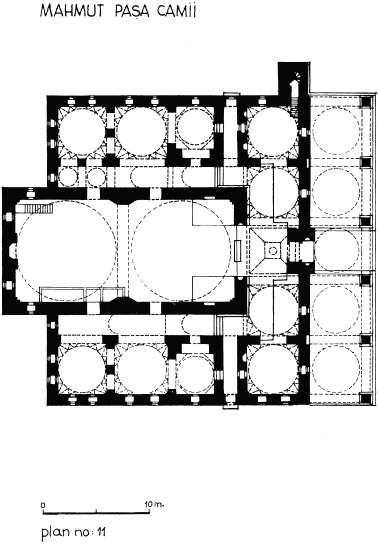
Leaving the mosque courtyard by the gate at the far end, we turn left on the street outside. A little way along, just past the first turning on the left, we veer right into a picturesque little square, one side of which is lined with old wooden houses. This is the outer courtyard of Mahmut Paşa Camii, one of the very oldest mosques in the city. Mahmut Paşa Camii is interesting not only because of its great age, but because it is a very fine example of the typical Bursa style of mosque structure. Built in 1462, only nine years after the Conquest, it was founded by Fatih’s famous Grand Vezir, Mahmut Paşa. This distinguished man was of Byzantine origin: his paternal grandfather, Philaninos, had been ruler of Greece with the rank and title of Caesar. Mahmut Paşa’s contemporary, the historian Kritovoulos, gives this attractive picture of him: “This man had so fine a nature that he outshone not only all his contemporaries but also his predecessors in wisdom, bravery, virtue and other good qualities... He was enterprising, a good counselor, bold, courageous, excelling in all lines, as the times and circumstances proved him to be. For from the time he took charge of the affairs of the great Sultan, he gave everything in this great dominion a better prospect by his wonderful zeal and his fine planning as well as by his implicit faith in and good-will toward his sovereign.” He was in addition a great patron of learning and the arts, especially poetry. He was put to death by the Conqueror in 1474.
The general plan of the mosque resembles fairly closely that of Sultan Murat I at Bursa. Essentially it consists of a long rectangular room divided in the middle by an arch, thus forming two square chambers each covered by a dome of equal size. On each side of the main hall runs a narrow, barrel-vaulted passage which communicates both with the hall and with three small rooms on each side. To the west a narthex or vestibule with five bays runs the width of the building and is preceded by a porch with five bays.
Let us look at some of the details. The porch is an unfortunate restoration, in which the original columns have been replaced by, or encased in, ungainly octagonal piers. Over and beside the entrance portal are several inscriptions in Arabic and Osmanlı (Old Turkish) verse giving the dates of foundation and of two restorations, one in A.H. 1169 (A.D. 1755) and another in A.H. 1244 (A.D. 1828). The ugly piers are undoubtedly due to this last restoration, since they are characteristically baroque. The entrance portal itself clearly belongs to the same period. On entering one finds oneself in the narthex – a most unusual feature for a mosque, found only once or twice at Bursa and at the Beyazidiye here. The vaults of the narthex are interesting and different from one another. The central bay has a square vault heavily adorned with stalactites. In the first two bays on either side smooth pendentives support domes with 24 ribs; while in the two end ones the domes are not supported by pendentives at all, but by a very curious arrangement of juxtaposed triangles so that the dome rests on a regular 16-sided polygon. Other examples of this odd and not unattractive expedient are found in the west dome of Murat Paşa Camii (see Chapter 16) and in one or two other mosques which belong to the same early period.
The two large domes of the great hall of the mosque have smooth pendentives, rather than the stalactited ones usually found in these early mosques. The mihrab and mimber and in general all the decoration and furniture of the mosque are eighteenth century or later and rather mean in appearance. This is a pity since it gives the mosque a rather unattractive aspect, so that one finds it difficult to recapture its original charm. In the small side-chambers some of the domes have smooth pendentives while others are stalactited. The function of these side-rooms, almost universal in mosques of this type, was for long a puzzle. The solution has been provided by Semavi Eyice, who shows that they were used, here and elsewhere, as a tabhane, or hospice, for travelling dervishes.
Leaving the mosque, we retrace our steps to the intersection outside the courtyard. There, down a short alley on the left, we see a little graveyard in which stands Mahmut Paşa’s magnificent and unique türbe. The türbe is dated by an inscription to A.H. 878 (A.D. 1474), the year in which the unfortunate man was executed. It is a tall octagonal building with a blind dome and two tiers of windows. The upper part of the fabric on the outside is entirely encased in a kind of mosaic of tile-work, with blue and turquoise the predominating colours. The tiles make a series of wheel-like patterns of great charm; they are presumably of the first Iznik period (1453–1555), and there is nothing else exactly like them in Istanbul.
Leaving the türbe, we take the narrow street directly opposite, Kılıççılar Sokağı, the Street of the Sword-Makers. This is one of the most fascinating byways in the city, and is one of the very few surviving examples of an old Ottoman bazaar street. The left side of the street is lined with an arcade of ancient shops which were once part of the külliye of Nuruosmaniye Camii. On the right side of the street we pass a number of shops and ateliers which are part of the Çuhacılar Hanı, the Han of the Cloth-Dealers. The Çuhacılar Hanı was built in the first half of the eighteenth century by Damat Ibrahim Paşa, Grand Vezir in the reign of Sultan Ahmet III. It is not as grand as some of the other old hans in this neighbourhood; nonetheless it adds to the distinctively Ottoman character of the surrounding streets. We enter the han through an arched gateway halfway down the street and find ourselves in the cluttered inner courtyard, which is lined with an arcade of shops and ateliers. If we leave the han by the portal in the far left-hand corner, we will find ourselves just opposite one of the gates of the Kapalı Çarşı. We turn right here and after a few steps we pass through an arched gateway over the street and enter Mahmut Paşa Yokuşu, one of the principal market streets of Stamboul.

About 250 metres down Mahmut Paşa Yokuşu, we come to a turning on the left where we see an imposing domed building. This is a part of the Mahmut Paşa Hamamı, one of the two oldest baths in the city, dated by an inscription over the portal to A.H. 871 (AD. 1476). (The Gedik Ahmet Paşa Hamamı, described in Chapter 7, may possibly be a year or so older, but it is not dated.) This was originally part of the Mahmut Paşa Külliyesi, and, as always in these interdependent pious foundations, its revenues went to the support of the other institutions in the complex. Like most of the great hamams, it was originally double, but the women’s section was torn down to make room for the neighbouring han. We enter through a large central hall (17 metres square) with a high dome on stalactited pendentives; the impressive size of the camekân is hardly spoiled by the addition of a modern wooden balcony. The soğukluk is a truly monumental room covered by a dome with spiral ribs and a huge semidome in the form of a scallop shell; on each side are two square cubicles with elaborate vaulting. The hararet is octagonal with five shallow oblong niches, and in the cross-axis there are two domed eyvans, each of which leads to two more private bathing cubicles in the corners. Like all of Mahmut Paşa’s buildings, his hamam is a very handsome and well-built structure. For a time it fell into disuse and then served as a storage depot, but it has been restored and now serves as a market hall.


On leaving the hamam a somewhat complicated detour leads to an interesting monument. We take Sultan Oda Sokağı, the street which leads off to the right from Mahmut Paşa Yokuşu directly opposite the hamam, and follow it for about 200 metres to its end; then we turn left and then left again at the second turning. This brings us to the medrese of Rüstem Paşa, designed by Sinan and erected, according to an inscription, in 1550. It has a unique plan for a medrese. The courtyard is octagonal with a columned portico of 24 domes and a şadırvan in the centre. Behind this the cells are also arranged in an octagonal plan, but the building is made into a square on the exterior by filling in the corners with auxiliary rooms – baths and lavatories. One side of the octagon is occupied by the lecture hall, a large domed room which projects from the square on the outside like a great apse. This fine and unique medrese has been beautifully restored.
BYZANTINE SUBSTRUCTURE ON
CEMAL NADIR SOKAĞI
From here we can extend our detour to another interesting monument nearby. (This is part of the charm and trouble of strolling through Istanbul: one is continually being diverted by the prospect of another fascinating antiquity around the next corner.) Leaving the medrese, we retrace our way for a few steps and take the first turning on the left. This almost immediately brings us to a step street, Hakkı Tarık Us Sokağı. At the bottom of the steps we turn left on Cemal Nadir Sokağı and immediately to our left we see a massive retaining wall with two iron doors and barred windows. (The doors are locked, but can usually find a local who has the key.) This is perhaps the most astonishing Byzantine substructure in the city, consisting of a congeries of rooms and passages, 12 in all, every size and shape. There is a great central hall, 16 by 10.5 metres in plan and about six metres high, whose roof is supported by two rows of six columns, with simple but massive bases and capitals. From this there opens another great room, 13 by 6.7 metres, that ends in a wide apse. A series of smaller chambers, one of them oval in shape, opens from each of these large rooms and from the passages that lead off in all directions. The whole thing is like an underground palace and must clearly have been the foundation of something very grand indeed. However, all attempts to identify this structure with some building mentioned in Byzantine literature have been inconclusive.
We now retrace our steps back to where our detour began, outside the Mahmut Paşa Hamamı. There we continue downhill along Mahmut Paşa Yokuşu to look at some of the old hans which line the streets of this neighbourhood. There are literally scores of ancient hans in this district. Evliya Çelebi mentions by name more than 25 that already existed by the middle of the seventeenth century, and many others were built during the next 100 years; some go back to the time of the Conquest and many are built on Byzantine foundations.
KÜRKÇÜ HANI
About 100 metres downhill from the Mahmut Paşa Hamamı we see an arched gateway on the left side of the street; this is the entrance to the Kürkçü Hanı, the Han of the Furriers. This, too, is a benefaction of Mahmut Paşa and is the oldest surviving han in the city. Unfortunately, part of it is in ruins or has disappeared and the rest is dilapidated and rather spoiled. Originally it consisted of two large courtyards. The first, nearly square, is 45 by 40 metres, and had about 45 rooms on each of its two floors; in the centre was a small mosque, now replaced by an ugly block of modern flats. The second courtyard to the north was smaller and very irregularly shaped because of the layout of the adjacent streets. It had about 30 rooms on each floor and must have been very attractive in its irregularity; unfortunately it is now almost completely ruined.
BÜYÜK YENİ HAN AND KÜÇÜK YENİ HAN
Leaving the Kürkçü Hanı, we continue down Mahmut Paşa Yokuşu and turn left at the next street, Çakmakçılar Yokuşu. Just beyond the first turning on the left, we come to a massive gateway which leads to another Ottoman han: this is the Büyük Yeni Han, which means literally the Big New Han. It is called new because it was built in 1764, just a youngster in this ancient town, and big because it is: the second largest in the city after the Büyük Valide Han, which we will see presently. Its great courtyard must be over 100 metres in length but very narrow and tall. Unfortunately, it has been divided in the middle by what appears to be a later construction which much diminishes its impressive length. Nevertheless, its three storeys of great round-arched arcades are very picturesque. It was built by Sultan Mustafa III and is one of the best extant examples of the baroque han.
Just beyond the Büyük Yeni Han is a much smaller one of about the same date. This is the Küçük Yeni Han, or the Small New Han, also a construction of Sultan Mustafa III. If you look up at this point you will see the most curiously-situated mosque in the city, perched on the roof of the han. This strange little mosque, which bears Sultan Mustafa’s name, has an almost Byzantine-looking dome and a pretty minaret. It is much frequented by the merchants and workers in the market district.
BÜYÜK VALİDE HANI
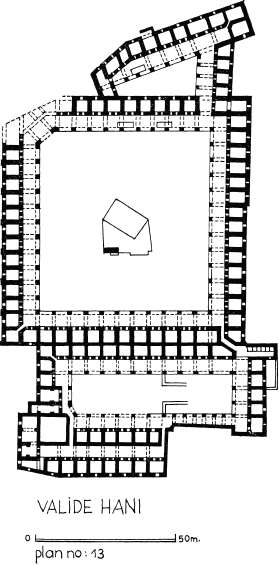
A little farther up Çakmakçılar Yokuşu and on the opposite side, we come to the entrance to the grandest and most interesting of all the hans in the city, the Büyük Valide Hanı. This han was built by the Valide Sultan Kösem, mother of sultans Murat IV and Ibrahim, shortly before her death in 1651, apparently on the site of an older palace founded by Cerrah Mehmet Paşa. We enter through a great gateway into the first courtyard, small and irregularly shaped because of the alignment of the han relative to the street outside. From there we pass into the main court, a vast area 55 metres square surrounded by a double-tiered arcade, the innumerable chambers of which are now given over to every conceivable form of industry and commerce. Although the entire han is now in a state of appalling squalor and dilapidation, it is nonetheless still impressive and extremely colourful.
A vaulted tunnel leads from a corner of the main court into the inner court, which because of the lay of the land is set at a lower level than the rest of the han. This court now houses a weaving-mill. At the back of this courtyard we see the remains of a Byzantine tower which is built into the structure of the han. This has traditionally been called the Tower of Eirene and is thought to date from the middle Byzantine period, but the evidence for this is very uncertain. This tower appears as a prominent feature of the city skyline in the drawing made by Melchior Lorichs in 1559, where it is shown much taller than it is at present. The lower room of the tower is part of the weaving mill which occupies this part of the han, while the upper room is fitted out as a mosque, with a pretty ribbed dome; the mosque is now disaffected and serves as a storage room.
It was in this han, or rather in the palace which preceded it on the same site, that was established one of the first printing presses in the city. This was set up in 1567 by one Apkar from Sivas, who went to Venice to procure type in the Armenian script. This was not the first printing press in the city, however, for the local Jews had a press as early as 1494, the Greeks not till 1624, the Turks only in 1727, although books in Turkish had been printed long before this time in western Europe.
At a corner of the inner courtyard, an archway gives exit to an open area outside the han. Just opposite we see the large mosque of Ibrahim Paşa, one of the most ancient in the city. This mosque was founded in 1478 by Çandarlı Ibrahim Paşa, Grand Vezir under Sultan Beyazit II, who died during the siege of Lepanto in 1499. The mosque was in ruins for many years and was restored in the early 1970s; however, the restoration has wantonly destroyed all that was original in the structure and it is now hardly worth even passing mention.
We now follow the path which leads off to the left between the han and the mosque and soon find ourselves on another bustling market street, Uzun Çarşı Caddesi, or the Avenue of the Long Market. This follows the course of the Byzantine street called Makros Embolos which led from the Forum of Constantine to the Golden Horn, down the valley between the Second and Third Hills. The Greek name means Great Colonnade and the street was indeed lined with columned porticoes on both sides. But today the street is mean and squalid, although always crowded and picturesque. For this is the site of the Secondhand Clothing Bazaar, where the poor of the city sell one another clothes. It is said that, if you are clever enough, you can stroll through this bazaar, sell all the clothes you are wearing, and buy them back farther down the street at a small profit.
As we walk down Uzun Çarşı Caddesi, we might take a short detour along the first street on our right, Riza Paşa Yokuşu. A short way down this street on the right side we come to a handsome nineteenth-century building which houses the Redhouse Press, undoubtedly the oldest established publishing house in Istanbul. Originally founded in Malta by Daniel Temple in 1822, it set up shop in Istanbul 30 years later and moved into its present quarters in 1872. The Press is named after Sir James Redhouse, whose pioneering Turkish-English dictionary was first printed here in the years 1880–90; the most recent edition of this monumental work was published by the Redhouse Press in 1983. The first edition of this guide was published here in 1972.

Returning to Uzun Çarşı Caddesi, we continue on downhill. At the first turning on the right we see one of the several insignificant but very ancient mosques which are found in this area, Yavaşça Şahin Camii. Yavaşça Şahin was a captain in the fleet of Sultan Mehmet II at the time of the Conquest; he built this mosque soon afterwards, though the exact date is unknown. It was badly damaged in the fire of 1908 but was well restored in 1950. It is one of a small group of early mosques that form a distinct type, in which the front porch has only two domes, and the entrance portal is consequently shifted off centre under the south dome. Within, a square chamber with a blind dome resting on an octagonal drum is supported by a series of triangles, making a 16-sided base. It is an odd type but not unattractive; unfortunately in this case the porch was not restored because of the impertinent intrusion of a shop.
SAMANVEREN CAMİİ
Just opposite Yavaşça Şahin Camii, a street called Ağızlıkçığı Sokağı leads steeply uphill. At the first corner on the left is a very ruined but ancient mosque called Samanveren Camii which was founded by a certain Sinan Ağa, an inspector of straw (hence the mosque’s name) in the time of the Conqueror. Though once in a very advanced state of decay, the mosque has been restored. It is a quaint and interesting building of brick and stone construction; what is left of the original minaret has some curious leaf-like decorations in brick. The mosque itself was on the first floor and it was entered by a staircase which has now disappeared; a little courtyard led to the prayer-room which was covered by a wooden roof.

Across from Samanveren Camii, a street with the picturesque name of Devoğlu (Son of the Giant) rambles downhill to the north; if we take the second turning on the left we come to another ancient Ottoman building. This is the medrese of Siyavuş Paşa, wedged in an angle of the hill above and very irregular in structure. Round about are the cells of the medrese, most of them with their domes more or less intact, though the colonnade in front of them, if there ever was one, has wholly disappeared. The dershane, unusually, is in a corner immediately to the right of the once-handsome entrance portal. This medrese was constructed some time before his death in 1601 by Siyavuş Paşa, brother-in-law of Murat III and three times his Grand Vezir. It is incredible to think that his magnificent palace, built by Sinan, was in this immediate neighbourhood, now a run-down market and industrial quarter.

Returning to the Street of the Giants Son, we continue on downhill until we come to another ancient mosque. This is Timurtaş Camii, which has now been completely restored. It is very like Samanveren Camii; thus it is built over a vaulted ground floor and is of the same brick and stone construction, with a large wooden porch. Its minaret is unusual; instead of having a balcony, it is entirely enclosed and four small grilled openings are left towards the top through which the müezzin calls to prayer. It is thought that Samanveren Camii originally had the same type of minaret: they seem to be almost twin mosques. The exact date of neither is known, but both belong to the age of Fatih.
TAHTAKALE HAMAMI
If we now turn right along Kantarcilar Caddesi, we immediately see an enormous double bath, Tahtakale Hamamı, which also belongs to the age of Fatih. The hamam was for many years years used as an ice plant and cold storage warehouse, but recently it has been restored and converted into a shopping mall. The camekân, which from its great size must have been very impressive, is almost square in plan, 16.70 by 16.25 metres, covered by a huge dome on a low drum. The hararet is also large and has a high dome.

We now find ourselves back on Uzun Çarşı Caddesi, where we turn left and continue on downhill for a short distance. Just to the right of the next intersection rises Rüstem Paşa Camii, one of the most beautiful of the smaller mosques of Sinan. This mosque was built in 1561 by Rüstem Paşa, twice Grand Vezir under Süleyman the Magnificent and husband of the Sultans favourite daughter, the Princess Mihrimah. The rise of Rüstem Paşa began in the autumn of 1539, when he was engaged to marry Mihrimah. At that time he was governor of Diyarbakır, where his enemies tried to prevent him from marrying the princess by spreading the rumour that he had leprosy. But when the palace doctors examined Rüstem they found that he was infested with lice; consequently they declared that he was not leprous, for accepted medical belief was that lice never inhabit a leper. He was allowed to marry Mihrimah and Süleyman appointed him Second Vezir. Five years later he was made Grand Vezir, an office that he held from 1544 to 1553 and again from 1555 to 1561, during which time he became the wealthiest and most powerful of the Sultan’s subjects. Thus it was that Rüstem came to be called Kehle-i-Ikbal, the Louse of Fortune, from an old Turkish proverb that says: “When a man has his luck in place even a louse can bring him good fortune.”
The mosque is built on a high terrace over an interesting complex of vaulted shops, the rent from which went to maintain the foundation. Interior flights of steps lead up from the corners of the platform to a spacious and beautiful courtyard, unique in the city. The mosque is preceded by a curious double porch: first the usual type of porch consisting of five domed bays, and then, projecting from this, a deep and low-slung penthouse roof, its outer edge resting on a row of columns. This arrangement, although unusual, is very pleasant and has a definite architectural unity.
The plan of the mosque consists of an octagon inscribed in a rectangle: the dome rests on four semidomes, not in the axes but in the diagonals of the buildings; the arches of the dome spring from four octagonal pillars, two on the north, two on the south, and from piers projecting from the east and west walls. To north and south are galleries supported by the pillars and by small marble columns between them.
Rüstem Paşa Camii is especially famous for its very fine tiles which almost cover the walls, not only on the interior but also on the façade of the porch. One should also climb to the galleries where the tiles are of a different pattern. Like all the great Turkish tiles, those of Rüstem Paşa came from the kilns of Iznik in its greatest period (c. 1555–1620) and they show the tomato-red or “Armenian bole” which is characteristic of that period. These exquisite tiles, in every conceivable floral and geometric design, cover not only the walls, but also the columns, mihrab and mimber. Altogether they make one of the most beautiful and striking mosque interiors in the city.
Just to the east of Rüstem Paşa Camii, a few steps down Hasırcılar Caddesi, we find a han whose origins may go back to early Byzantine times. This is the Hurmalı Han, the Han for Dates; it has a long, narrow courtyard which one authority ascribes to the sixth or seventh century. There are a great many ancient hans in this neighbourhood, but they are for the most part decayed and cluttered, and almost nothing is known about them but their names.
BALKAPAN HAN
Continuing east along Hasırcılar Caddesi for a few more steps we take the next right and then in the middle of the block turn left into a large courtyard. We are now in the Balkapan Han, the Honey-Store Han. Evliya Çelebi tells us that in his time this was the han of the Egyptian honey-merchants. The han is chiefly interesting for the extensive Byzantine vaults beneath it: these are reached by a staircase leading down from a shed in the middle of the courtyard. Great rectangular pillars of brick support massive brick vaulting in the usual herringbone pattern, covering an area of at least 2,000 square metres. This basement is used today, as it probably was originally, for storage of all kinds of goods. The vaults and superstructures on ground level were doubtless one of the many granaries or storage-depots which are known to have existed in this area from at least the fourth or fifth century.
Returning to Hasırcılar Caddesi, we turn right and continue along until we come to the Spice Bazaar. Once inside we turn left and after passing through the Bazaar we find ourselves in the great square before Yeni Cami. Here, having completed our stroll through the principal markets and bazaars of Stamboul, we might be inclined to stop at the fish or vegetable markets of Eminönü and do a little shopping ourselves.