
11

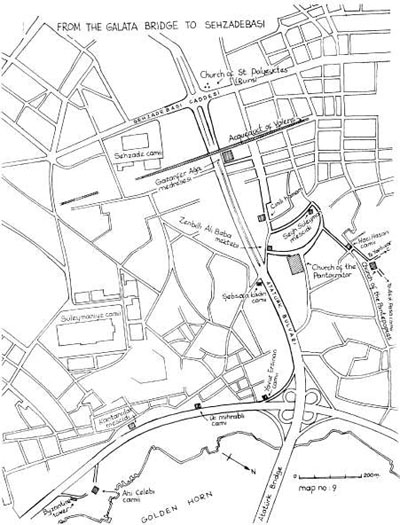
Once more we begin our stroll at the Galata Bridge, this time to begin walking up the shore of the Golden Horn before heading up hill to the district called Şehzadebaşı, just to the north of the Şehzade mosque. The first part of our stroll takes us through the oldest market area of the city, a rough and colourful quarter that is stubbornly resisting attempts to modernize it.
THE PRISON TOWER
The part of the market district just above the Galata Bridge and between the shore road and the Golden Horn is known as Zindan Kapı, or the Prison Gate. This waterfront quarter was one of the oldest and most picturesque neighbourhoods in Istanbul, but in the early 1970s almost all of its buildings were demolished in a project designed to create parks along the shore of the Golden Horn but which here resulted only in a scabrous parking lot. One of the few surviving monuments is an ancient tower behind a late Ottoman commercial building known as the Zindan Han. This is by far the largest of the few surviving defence towers of the medieval Byzantine sea-walls along the Golden Horn. The tower was for centuries used as a prison (in Turkish, zindan) by both the Byzantines and the Ottomans, particularly for galley slaves. Within the tower, known to the Venetians as the Bagno, is buried a certain Cafer Baba, who, according to legend, came to Constantinople as the envoy of Harun al-Rashid to the Empress Eirene (r. 797–802), but was here imprisoned and died; his grave was rediscovered and restored after the Conques and is to this day much venerated. According to Evliya Çelebi: “Cafer Baba was buried in a place within the prison of the infidels, where to this day his name is insulted by all the unbelieving malefactors, debtors, murderers, etc. imprisoned there. But when (God be praised!) Istanbul was taken, the grave of Cafer Baba in the tower of the Bagno became a place of pilgrimage which is visited by those who have been released from prison and who call down blessings in opposition to the curses of the unbelievers.” The tower was restored in 1990 and the supposed grave of Cafer Baba on the ground floor of the tower was opened to the public as a Muslim shrine.
Just beyond the Zindan Han are the shattered remnants of an arched gateway from the medieval Byzantine period. The identity of this gate is uncertain, but in early Ottoman times local Greeks referred to it as the Porta Caravion (the Gate of the Caravels), because of the large number of ships which were moored at the pier nearby, the ancient Scala de Drongario. This pier, known as the Yemiş Iskelesi, or Dried Fruit Pier, was still in use up until the mid-1980s, but then it was demolished along with the rest of the Zindan Kapı quarter, which was for many centuries the principal fruit and vegetable market of the old city but is now only a fading memory.
THE MOSQUE OF AHİ ÇELEBİ
Passing the gateway, we soon find ourselves in front of an ancient mosque, Ahi Çelebi Camii. This mosque was founded at an uncertain date by Ahi Çelebi ibni Kemal, who was Chief Physician of the hospital of Fatih Mehmet and who died in 1523 while returning from a pilgrimage to Mecca. The building is of little architectural interest, aside from the fact that it was apparently restored at one point by Sinan. Its principal interest to us is its association with Evliya Çelebi, whose Seyahatname, or Book of Travels, we have so often quoted in our guide. One night in Ramazan in the year 1631, when Evliya was 20 years old, he fell asleep and dreamt that he was in the mosque of Ahi Çelebi. While praying there, in his dream, he was astonished to find the mosque fill up with what he described as “a refulgent crowd of saints and martyrs,” followed by the Prophet, who gave him his blessings and intimated that Evliya would spend his life as a traveller. “When I awoke,” writes Evliya, “I was in great doubt whether what I had seen was a dream or reality, and I enjoyed for some time the beatific contemplations which filled my soul. Having afterwards performed my ablutions and offered up the morning prayer, I crossed over from Constantinople to the suburb of Kasım Paşa and consulted the interpreter of dreams, Ibrahim Efendi, about my vision. From him I received the comfortable news that I would become a great traveller, and after making my way through the world, by the intercession of the Prophet, would close my career by being admitted to Paradise. I then retired to my humble abode, applied myself to the study of history, and began a description of my birthplace, Istanbul, that envy of kings, the celestial haven and stronghold of Macedonia.” But such beatific visions are denied to the modern traveller, who must now resume his stroll through Stamboul, heading up the main highway that leads along the bank of the Golden Horn between the two bridges.
KANTARCILAR MESCİDİ, KAZANCILAR CAMİİ, AND SAĞRICILAR CAMİİ
As we walk along the left side of the avenue we pass in turn three little mosques which are among the very oldest in Istanbul, all of them built just after the Conquest. The first of these that we come to is Kantarcılar Mescidi, the mescit, or small mosque, of the Scale-Makers, named after the guild whose artisans have had their workshops in this neighbourhood for centuries. This mosque was founded during Fatih’s reign by one Sarı Demirci Mevlana Mehmet Muhittin. It has since been reconstructed several times and is of little interest except for its great age.
The second of these ancient mosques which we pass, about 250 metres beyond the first, is called Kazancılar Camii, the mosque of the Cauldron-Makers, here again named for one of the neighbourhood guilds. It is also known as Üç Mihrablı Camii, literally the mosque with three mihrabs. Founded by a certain Hoca Hayreddin Efendi in 1475, it was enlarged first by Fatih himself, then by Hayreddin’s daughter-in-law, who added her own house to the mosque, so that it came to have three mihrabs, hence its name. The main body of the building, which seems to be original in form though heavily restored, consists of a square room covered by a dome resting on a high blind drum, worked in the form of a series of triangles so that pendentives or squinches are dispensed with. In the dome are some rather curious arabesque designs, not in the grand manner of the sixteenth or seventeenth centuries nor yet in the degenerate Italian taste of the nineteenth; they are unique in the city and quite attractive both in design and colour. The deep porch has three domes only, the arches being supported at each end by rectangular piers and in the centre by a single marble column. The door is not in the middle but on the right-hand side, so as not to be blocked by the column; this arrangement, too, was common in the preclassical period, but there are only a very few such examples in the city. To the south of the main building is a rectangular annexe with a flat ceiling and two mihrabs; it is through this annexe that we enter the mosque today. According to one authority this section is wholly new; possibly, but as far as form goes, it might well be the dwelling house added by Hayreddin’s daughter-in-law.
The third mosque is found about 150 metres farther on, a short distance before the Atatürk Bridge. This is called Sağrıcılar Camii, the mosque of the Leather-Workers, which guild once had its workshops in this area. The building is of the simplest type, a square room covered by a dome, the walls of stone. It was restored in 1960 with only moderate success. But although the mosque is of little interest architecturally, its historical background is rather fascinating. For one thing, this is probably the oldest mosque in the city, founded in 1455 by Yavuz Ersinan, standard-bearer in Fatih’s army during the final siege of Constantinople. This gentleman was an ancestor of Evliya Çelebi; his family remained in possession of the mosque for centuries, living in a house just beside it. Evliya was born in this house in about 1611 and there, 20 years later, he had the dream which changed his life (and immeasurably enriched our knowledge of the life of old Stamboul). The founder himself is buried in the little graveyard beside the mosque. Beside him is buried one of his comrades-in-arms, Horoz Dede, one of the fabulous folk-saints of Istanbul. Horoz Dede, or Grandfather Rooster, received his name during the siege of Constantinople, when he made his rounds each morning and woke the troops of Fatih’s army with his loud rooster call. Horoz Dede was killed in the final assault and after the city fell he was buried here, with Fatih himself among the mourners at his graveside. The saints grave is venerated to this day.

We now come to Atatürk Bulvarı, the broad highway which leads from the Atatürk Bridge up the valley between the Third and Fourth Hills. We turn left here and about 300 metres along on the left we come to a rather handsome baroque mosque, Şebsafa Kadın Camii. This was built in 1787 by Fatma Şebsafa Kadın, one of the women in the harem of Abdül Hamit I. It is of brick and stone; the porch has an upper storey with a cradle-vault and inside there is a sort of narthex also of two storeys, covered with three small domes. These upper storeys form a deep and attractive gallery overlooking the central area of the mosque, which is covered by a high dome resting on the walls. To the north of the mosque is a long mektep with a pretty cradle-vaulted roof.
Directly across the avenue from the mosque you can see a huge retaining wall whose lower part contains a row of arched niches. This is a huge cistern that was part of the monastery of the Pantocrator, built by the Emperor John II Comnenus in the second quarter of the twelfth century on the Fourth Hill above the present avenue.
The whole area above the mosque on the east side of Atatürk Bulvarı is occupied by the Istanbul Drapers’ and Furnishers’ Bazaar, a complex of modern shops and offices built in the years 1959–66 by the Municipality. The general conception shows more imagination than one expects to find in a municipal project, but it does not seem quite to come off in detail. Large blank surfaces from place to place are enlivened by panels of mosaics and ceramics in abstract designs done by such leading modern artists of Turkey as Bedri Rahmi Eyüboğlu and the ceramist Füreya.
In the centre of this shopping-centre we come upon an ancient little graveyard which has recently been restored. Among the tombstones there we see one bearing the name of Kâtip Çelebi (1609–58). Kâtip Çelebi, one of the most enlightened scholars of his age, was the author of at least 23 books, along with many shorter treatises and essays. His last and best known work was The Balance of Truth, where he writes of the beatific vision in which the Prophet inspired him to go on with his work. This reminds one of Evliya Çelebi and the remarkable vision which he had in the mosque of Ahi Çelebi, some 500 metres removed from Kâtip Çelebi’s grave and three decades earlier in time. What a town Ottoman Stamboul must have been in those days, to inspire visions such as theirs.
PRIMARY SCHOOL OF ZENBELLİ ALİ BABA
We now cross Atatürk Bulvarı and take the stepped pathway beside the road which winds uphill directly opposite the mosque. A short distance up the hill, at the second turning, we find a small mektep in a walled garden. The mektep has recently been restored and is now used as a children’s library; it is a very pleasing example of the minor architecture of the early sixteenth century. It was built by the Şeyh-ül Islam Ali bin Ahmet Efendi, who died in 1525. The founder is buried beneath a marble sarcophagus which stands in the mektep garden.
THE CHURCH OF THE PANTOCRATOR
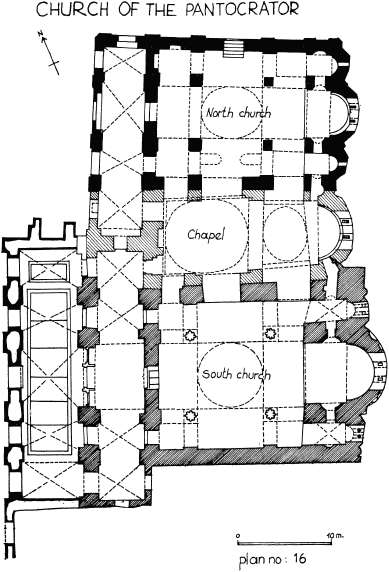
Taking the street to the right past the entrance to the mektep, we come almost immediately to a picturesque square lined on three sides with old wooden houses. On the eastern side of the square we see the former monastery church of the Pantocrator, known locally as Zeyrek Camii. The Pantocrator is a composite building consisting of two churches and a chapel between them; the whole complex was built within a period of a few years, between about 1120 and 1136. The church was converted into a mosque soon after the Conquest by Molla Mehmet Zeyrek and came to be called Zeyrek Camii. The mosque is now confined to the south church.
The monastery was founded and the south church built by the Empress Eirene, wife of John II Comnenus, some years before her death in 1124; it was dedicated to St. Saviour Pantocrator, Christ the Almighty. In plan the church is of the four-column type, with a central dome, a triple apse, and a narthex with a gallery overlooking the nave. (The columns have as usual been removed in Ottoman times and replaced by piers.) This church preserves a good deal of its original decoration, including the marble pavement, the handsome doorframes of the narthex, and the almost complete marble revetment of the apse. Work by the Byzantine Institute has brought to light again the magnificent opus sectile floor of the church itself, arranged in great squares and circles of coloured marbles with figures in the borders. One of these, which the imam of the mosque will uncover, is a panel tentatively identified as one of the labours of Samson. Notice also the curious Turkish mimber made from fragments of Byzantine sculpture, including the canopy of a ciborium. One of these spolia has been identified as a sculptural fragment from the church of St. Polyeuktos, whose ruins we will see later on this itinerary. The investigations of the Byzantine Institute discovered also fragments of stained glass from the east window, which seem to show that the art of stained glass was a Byzantine rather than a western discovery.
After Eirene’s death her husband John decided to erect another church a few metres to the north of hers, dedicated to the Virgin Eleousa, the Merciful or Charitable. It is somewhat smaller but of essentially the same type and plan as Eirene’s church, and here again the columns have been replaced by piers. When this church was finished, the idea seems to have struck the Emperor of joining the two churches by a chapel, dedicated to the Archangel Michael. This is a structure without aisles and with but one apse, covered by two domes; it is highly irregular in form to make it fit between the two churches. Parts of the walls of the churches were demolished so that all three sections opened widely into one another. John also added an outer narthex, which must once have extended in front of all three structures, but which now ends awkwardly in front of the mortuary chapel. The middle church was designed to serve as a mortuary chapel for the Comneni dynasty, beginning with the Empress Eirene, who was reburied there after its completion. Her verd antique sarcophagus was opened up and robbed by the knights of the Fourth Crusade when they sacked Constantinople in 1204. Her looted sarcophagus stood outside the Pantocrator up until the middle of the last century, when it was removed to the exonarthex of Haghia Sophia, where it is preserved today.
A programme of restoration and study of the Pantocrator has been undertaken by Professor Robert Osterhaut of the University of Pennsylvania and Professors Metin and Zeynep Ahunbey of Istanbul University. The roof and domes have been restored, while a start has been made on restoration of the interior and an archaeological study of the structure.
One of the derelict Ottoman structures behind the Pantocrator has been rebuilt and renovated by Rahmi Koç, and is now a superb restaurant-café known as the Zeyrekhane. The large terrace of the Zeyrekhane, part of which is adorned with ancient architectural fragments, commands a sweeping view of the first three hills of the old city above the Golden Horn, an ideal place to have lunch before continuing to explore the Fourth Hill.

What may perhaps be the only surviving part of the monastery of the Pantocrator stands about 150 metres to the south-west of the church. To find it we take the street which leads off from the far left-hand corner of the square and follow it to the first intersection. Following the street which leads around to the left, we come immediately to a tiny, tower-like building known locally as Şeyh Süleyman Mescidi. This may possibly have been one of the buildings of the Pantocrator monastery, perhaps a library or a funerary chapel. The lower part is square on the exterior and octagonal above; within, it is altogether octagonal, with shallow niches in the cross-axes; below is a crypt. This strange building has never been seriously investigated, so that neither its date nor identity are known.
HACI HASAN MESCİDİ
Returning to the last intersection and crossing it, we continue on in the same direction along Hacı Hasan Sokağı. At the end of this street, about 100 metres along, we see on the left a tiny mosque with a quaint and pretty minaret. The people of the district call it Eğri Minare, the Crooked Minaret, for obvious reasons. It has a stone base at the top of which is a curious rope-like moulding. The shaft is of brick and stone arranged to form a criss-cross or chequerboard design, which is most unusual, perhaps unique in Istanbul. The şerefe has an elaborate stalactite corbel and a fine balustrade, partly broken; but it seems a little too big in scale for the minaret. The mosque itself is rectangular, built of squared stone and with a wooden roof; in its present condition it is without interest. The founder was the Kazasker (Judge) Hacı Hasanzade Mehmet Efendi who died in 1505; the mosque therefore must belong to about this date.
THE CHURCH OF ST. SAVIOUR PANTEPOPTES
If we turn left beyond the mosque and then right at the next corner into Küçük Mektep Sokağı, we see a Byzantine church at the end of the street. This is Eski Imaret Camii, identified with virtual certainty as the church of St. Saviour Pantepoptes, Christ the All-Seeing. This church was founded about 1085 to 1090 by the Empress Anna Delassena, mother of the Emperor Alexius I Comnenus and founder of the illustrious Comneni dynasty which ruled so brilliantly over Byzantium in the eleventh and twelfth centuries. Anna ruled as co-emperor with her son for nearly 20 years and during that time exerted a powerful influence on the affairs of the Byzantine state. In the year 1100 the Empress retired to the convent of the Pantepoptes and spent the remainder of her life in retirement there. She died in 1105 and was buried in the church which she had founded. The church was converted into a mosque almost immediately after the Conquest. For a time it served as the imaret of the nearby Fatih Camii, and thus it came to be known as Eski Imaret Camii.
The building is a quite perfect example of an eleventh-century church of the four-column type, with three apses and a double narthex, many of the doors of which retain their magnificent frames of red marble. Over the inner narthex is a gallery which opens onto the nave by a charming triple arcade on two rose-coloured marble columns. The church itself has retained most of its original characteristics, though the four columns have as usual been replaced by piers, and the windows of the central apse have been altered. The side apses, however, preserve their windows and their beautiful marble cornice. The dome too, with 12 windows between which 12 deep ribs taper out towards the crown, rests on a cornice with a meander pattern of palmettes and flowers. The exterior, though closely hemmed in by the surrounding houses, is very characteristic and charming, with its 12-sided dome and its decorative brickwork in the form of blind niches and bands of Greek-key and swastika motifs and rose-like medallions.

The northern slope of the Fourth Hill in this area is rather thickly dotted with small mosques, many of them ancient but few of much interest; some are in a state of ruin or near ruin; others have been restored, often quite badly. We will mention just two in the vicinity of the Pantepoptes; but it should be understood that they are of minor interest and one could be forgiven for passing up these detours.
The first of these mosques is reached by taking Şair Baki Sokağı, the continuation of Küçük Mektep Sokağı, the street which brought us to the Pantepoptes. The mosque is two blocks along on the right, at the corner of Esrar Dede Sokağı. This mosque, constructed of alternate rows of brick and stone, was built in 1564. It is called Aşık Paşa Camii, Aşık Paşa having been a poet of the time of Orhan Gazi, long before the Conquest; it was built for the peace of his soul by one of his descendants, Şeyh Ahmet Efendi. Beside it is a tekke, also called after Aşık Paşa, built somewhat earlier – about 1522 – by a man called Seyyidi-Velâyet Efendi, but in the same general style; and opposite the mosque stands the grand türbe of the founder. Although not exactly planned as a complex, these buildings in their walled garden nevertheless have an attractive unity; a moderate amount of tactful restoration could make them one of the more charming of the minor classical groups.
YARHİSAR CAMİİ
Returning to the Pantepoptes, we turn right off Küçük Mektep Sokağı immediately after the church. If we follow this street past the intersection and two blocks farther along, we will come on our left to an ancient mosque at the corner of Kadı Çeşme and Şebnem Sokaks. This is Yarhisar Camii, the second oldest mosque in the city, apparently pre-dated only by Sağrıcılar Camii, which we saw earlier on our tour. According to the register of pious foundations (Hayrat Kaydi) this mosque was built in 1461; its founder Musliheddin Mustafa Efendi was Judge of Istanbul in Fatih’s reign. It was once a handsome edifice, built entirely of ashlar stone, its square chamber covered by a dome on pendentives, preceded by a porch with two domes and three columns. It was burned in the great fire of 1917 which consumed most of this district, but even in its ruined state it was a fine and dignified structure. In 1954–6 the building was restored, with a thin veneer of brick and stone, à la Byzantine, covering the original structure, and the interior was redecorated. In our opinion the restoration was unfortunate: it obscures what was still attractive, and is not true to the spirit of the original structure.
Returning to the Pantepoptes, we now retrace our steps to Şeyh Süleyman Mescidi. (Those who don’t care to follow the same route back might look for an alternative way through this run-down but picturesque old neighbourhood.) Once arrived at the mescit we continue on past it to the end of the street. There we find ourselves once again on the stepped path which led up from Atatürk Bulvarı, a little way above the mektep of Zenbelli Ali Baba. Here we turn right and continue uphill along Itfaiye Caddesi.
ÇİNİLİ HAMAM
A short distance along on our left we come to an ancient hamam of considerable interest. This is Çinili Hamam, the Tiled Bath, an early work of Sinan: it was built in about 1545 for the great admiral Hayrettin Paşa, known in the West as Barbarossa. It is a double bath, the men’s and women’s sections lying side by side and the two entrances, rather unusually, being in the same façade: the plans are almost identical. In the centre of the great camekân is an elaborate and beautiful marble fountain with goldfish swimming in it. The narrow soğukluk with two little semidomes at each end leads to the cruciform hararet, where the open arms of the cross are covered with tiny domes, the rooms in the corners each having a larger one. Here and there on the walls are small panels of faience and the floor is of opus sectile. In the camekân fragments of a more elaborate wall a revetment of tiles of a later period may be seen. A half-century ago this fine hamam was abandoned and fell into a state of decay, but now it has been restored and is now once again in use.
MEDRESE OF GAZANFER AĞA
Beyond the hamam, Itfaiye Caddesi widens and becomes quite pretty, with a double row of plane trees shading the open stalls of a colourful fruit and vegetable market. We follow this avenue for a few blocks and then turn left just before the aqueduct, taking the street which runs parallel to it.
Just before we come to the intersection with Atatürk Bulvarı we see on our right a small classical külliye built up against the aqueduct. Established by Gazanfer Ağa in 1599, it includes a small medrese, the türbe of the founder, and a charming sebil with handsome grilled windows. Gazanfer Ağa was the younger brother of Cafer Ağa, whose medrese we saw next to Haghia Sophia. He was Chief of the White Eunuchs in the reign of Mehmet III. Gazanfer was the last of the White Eunuchs to control affairs in the Saray, for after his time the Chief Black Eunuch became the dominant figure. He and his brother were born in Chioggia, in the lagoon south of Venice. They were captured by pirates in their youth and, after being castrated, they were sold as eunuchs in the Istanbul slave market, where they were purchased to serve in Topkapı Sarayı, thus beginning their illustrious careers as the last two great Chief White Eunuchs. Gazanfer Ağa was executed in 1603, having involved himself too deeply in the affairs of the Harem.
The külliye was restored in 1945 and originally housed the Municipal Museum; it now serves as the Museum of Cartoons and Humour. Like most city museums, it has a rather provincial and neglected look, though some of the exhibits are not without interest. The cells of the medrese have had doors cut between them to form the galleries of the museum.
THE AQUEDUCT OF VALENS
After leaving the museum we continue along to Atatürk Bulvarı and turn right so as to pass under the aqueduct. We should perhaps pause here for a moment to study this ancient structure, which has been looming on the skyline for much of our stroll. The aqueduct was built by the Emperor Valens in about the year A.D. 375 as part of the water-supply system which he constructed. The water, tapped from various streams and lakes outside the city, appears to have entered through subterranean pipes near the Edirne Gate and to have been led underground along the ridge of the Sixth, Fifth and Fourth Hills to a point near the present site of the Fatih Mosque. From there the water was carried by the aqueduct across the deep valley that divides the Fourth from the Third Hill. On the Third Hill, near the present site of Beyazit Square, the water was received in a large cistern, the nymphaeum maximum, from which it was distributed to various parts of the city; this nymphaeum seems to have been not far distant from the modern taksim which distributes the present water supply from the Terkos Lake. The length of the aqueduct was originally about one kilometre, of which about 900 metres remain, and its maximum height, where it crosses Atatürk Bulvarı, is about 20 metres. The aqueduct was damaged at various times but was kept in repair by the emperors, both Byzantine and Ottoman, the last important restoration being that of Mustafa II in 1697. The long march of the double arches across the valley has a grand and Roman look, and is almost as essential a characteristic of the city’s skyline as the great procession of mosques that crowns the ridge along the Golden Horn.
Continuing on along Atatürk Bulvarı under the aqueduct, we soon come to the Şehzadebaşı intersection, which we cross to the south-west corner. This intersection is approximately the site of the ancient Forum Amastrianum, where public executions were held in the days of Byzantium. At the Forum Amastrianum, the Mese divided into two branches, one of which followed much the same course as Şehzadebaşı Caddesi, while the other went along roughly the same route as Atatürk Bulvan to the Forum Bovis, the modern Aksaray.
THE CHURCH OF ST. POLYEUKTOS
Perhaps the best thing that can be said about the Şehzadebaşı intersection is that it has at least advanced the cause of archaeology. For when the ground was being cleared for the underpass in 1960, there came to light the extensive ruins of an ancient church; we see these just to the right of the underpass road to Aksaray. An excavation was taken in hand by Dumbarton Oaks under the direction of Mr. Martin Harrison, who identified the ruins as those of the church of St. Polyeuktos, about whom Corneille wrote one of his great tragedies, Polyeucte. It was built in the years 524–7 by the Princess Anicia Juliana. The church was an enormous edifice measuring 52 by 58 metres (compare the Süleymaniye, which is about 52 metres square), fronted by an atrium measuring 26 by 52 metres, with a small apsidal building on the north that may have been a martyrium or a baptisry, as well as a structure at the north-west corner of the site that may have been the palace of Anicia Juliana. The church was essentially basilical in form but very probably domed, divided into a nave and two side aisles by an arrangement of piers and columns. The church was already abandoned at the time of the Crusader sack of Constantinople in 1204, and its surviving works of art and architectural members were taken off to adorn churches in western Europe. Two pilasters of the church have been identified in the church of San Marco in Venice; these are the Pilastri Acriani, the Pillars of Acre, so called because they were believed to have come from Acre in Syria. Other fragments, as we have seen, were used in the mimber of Zeyrek Camii, the mosque in the south church of the Pantocrator. Other architectural and sculptural fragments are preserved in the Archaeological Museum, including part of a long and beautifully-written inscription by which the church was identified. But the site itself is now desolate, with only a single column standing amidst the ruins.