
12

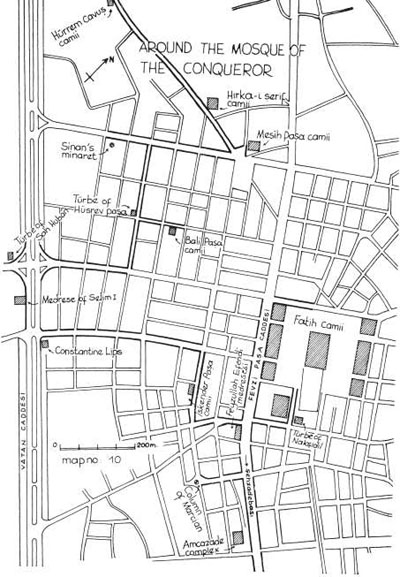
Where one stroll ends another must begin, if we are to see Istanbul in all its detail. And so we return to the south-west corner of the traffic-circle at Şehzadebaşı, to begin our next tour of the city. Once there, we will begin walking westward along the south side of Şehzadebaşı Caddesi. This will bring us into the district called Fatih, named after Fatih Camii, the Mosque of the Conqueror, around which we will be strolling.
THE AMCAZADE COMPLEX
Just to the west of the ruins of the church of St. Polyeuktos, which we examined on our last tour, we come to the fine complex of Amcazade Hüseyin Paşa. This is one of the most elaborate and picturesque of the smaller classical complexes. It was built by Hüseyin Paşa while he was Grand Vezir (1697–1702) under Mustafa II, and thus comes at the very end of the classical period. Hüseyin Paşa was a cousin (amcazade) of Fazıl Ahmet Paşa of the able and distinguished Köprülü family. The historian von Hammer says of him: “He was the fourth Köprülü endowed with the highest authority of the Empire and like his relatives he showed himself capable of supporting its weight... After his uncle Mehmet Köprülü the Cruel and his cousins Ahmet the Statist and Mustafa the Virtuous, he well-deserved the surname of the Wise. Unfortunately he remained too short a time on the stage where his high qualities had placed him, fully capable as he was of retarding if not altogether forestalling the decadence of the Empire, from which he disappeared like a meteor after having given rise to the highest hopes.”
The complex includes an octagonal dershane or lecture hall, serving also as a mosque; a medrese, a library, a large primary school over a row of shops, two little cemeteries with open türbes, a şadırvan, a sebil and a çeşme, all arranged with an almost romantic disorder. The street façade consists first of the open walls of the small graveyards, divided by the projecting curve of the sebil. All of these have fine brass grilles, those of the türbe nearest the entrance gate being quite exceptionally beautiful specimens of seventeenth-century grillework. Next comes the entrance gate with an Arabic inscription giving the date 1698. The çeşme just beyond it with its reservoir behind is a somewhat later addition, for its inscription records that it was a benefaction of the Şeyh-ül Islam Mustafa Efendi in 1739. Finally there is a row of four shops with an entrance between them leading to the two large rooms of the mektep on the upper floor. On entering the courtyard, one has on the left the first of the open türbes – the one with the exceptionally handsome grilles – and then the columned portico of the mosque: this portico runs around seven of the eight sides of the mosque and frames it in a rectangle. The mosque itself is without a minaret and its primary object was clearly to serve as a lecture hall for the medrese. It is severely simple, its dome adorned only with some rather pale stencilled designs probably later than the building itself.
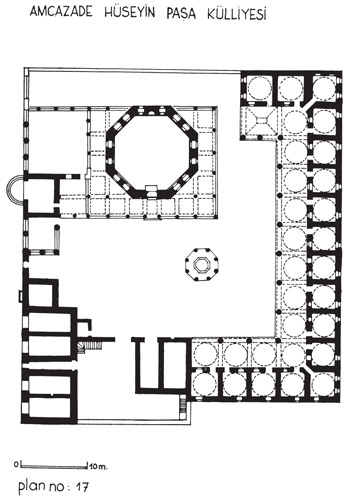
The far side of the courtyard is formed by the 17 cells of the medrese with their domed and columned portico. Occupying the main part of the right-hand side is the library building. It is in two storeys, but the lower floor serves chiefly as a water reservoir, the upper being reached by a flight of outside steps around the side and back of the building, leading to a little domed entrance porch on the first floor. The medallion inscription on the front of the library records a restoration in 1755 by Hüseyin Paşa’s daughter after the earthquake of 1894 which ruined the complex; the manuscripts it had contained were removed and are now in the Süleymaniye library. The right-hand corner of the courtyard is occupied by the shops and the mektep above them: note the amusing little dovecotes in the form of miniature mosques on the façade overlooking the entrance gate. A columned şadırvan stands in the middle of the courtyard. This charmingly irregular complex is made still more picturesque by the warm red of the brickwork alternating with buff-coloured limestone, by the many marble columns of the portico, and not least by the fine old trees – cypresses, locusts and two enormous terebinths – that grow out of the open türbes and in the courtyard. The külliye now serves as the Museum of Turkish Architectural Works and Construction Elements, including architectural and sculptural fragments, calligraphical inscriptions and old tombstones. One particularly interesting exhibit is the top of one of the minarets of Fatih Camii, toppled by the earthquake in 1894.
DÜLGERZADE CAMİİ
Opposite the Amcazade complex in a pretty little park is an ugly broken-off column, typical of First World War memorials everywhere; it commemorates Turkish aviators killed during the war and is dated 1922. On the north side of the park is the old Fatih Town Hall, built in 1913 in a style known as Ottoman Revivalism. Continuing westward along the main avenue on the same side as the Amcazade complex we pass an ancient but not very interesting little mosque called Dülgerzade Camii; it was built by one of Fatih’s officials, Şemsettin Habib Efendi, sometime before his death in 1482.
COLUMN OF MARCİAN
Beyond the mosque we turn left and a short distance down the street we see the second of the four late Roman honorific columns in the city, the Column of Marcian. This column, though known to Evliya, escaped even the penetrating eyes of Gyllius and remained unknown to the West until rediscovered in 1675 by Spon and Wheeler. It continued to be hidden away in a garden behind the houses around it until 1908, when a fire destroyed all the buildings and exposed it to view, and since then it has formed the centre of a little square. It is a monolithic column of Syenitic granite resting on a high marble pedestal; the column is surmounted by a battered Corinthian capital and a plinth with eagles at the corners on which there once must have stood a statue of the Emperor Marcian (r. 450–7). Fragments of sculpture remain on the base, including a Nike, or Winged Victory, in high relief. There is also on the base an elegaic couplet in Latin which says that the column was erected by the prefect Tatianus in honour of the Emperor Marcian. The Turks call the column Kız Taşı, or the Maiden’s Column, because of the figure of the Nike on the base. Evliya Çelebi believed the Nike to be the figure of a Byzantine princess, daughter of an apocryphal ruler named King Puzantine (a corruption of Byzantine), and he claimed that the Maiden’s Column had talismanic powers: “At the head of the Saddler’s Bazaar, on the summit of a column stretching to the skies, there is a chest of white marble in which the unlucky-starred daughter of King Puzantine lies buried; and to preserve her remains from ants and insects was this column made a talisman.”
MEDRESE OF FEYZULLAH EFENDI
We now return to the main avenue and continue walking westward on the same side. We soon come to another little külliye built at about the same time as the Amcazade complex; this one is almost as charming though not as extensive. This is the medrese founded in 1700 by the Şeyh-ül Islam Feyzullah Efendi; it now serves as the Millet Kütüphanesi, or People’s Library. The cells of the medrese surround two sides of the courtyard in which stands a şadırvan in the midst of a pretty garden. The street side of the courtyard is wholly occupied by a most elaborate and original dershane building: a flight of steps leads up to a sort of porch covered by nine domes of different patterns, the arches of which are supported on four columns. The effect of this porch has been somewhat impaired by glazing in a part of it, but its usefulness has doubtless been increased. To right and left of the porch are the large domed lecture-rooms, now used as library reading-rooms. The medrese, long disaffected and ruinous, was restored and converted into a library by Ali Emiri Efendi, a famous bibliophile who died in 1924 and left the building and his valuable collection of books and manuscripts to the people of Istanbul. The reading-rooms are almost always full of students.
COMPLEX OF FATİH SULTAN MEHMET
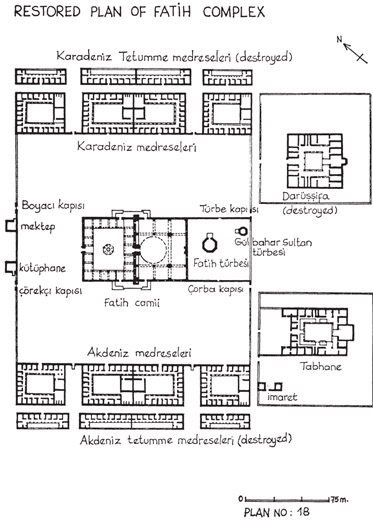
We now find ourselves opposite the enormous mosque complex of Mehmet the Conqueror. Let us continue past it along the avenue for a few hundred metres and then turn right on the first through-street, so as to approach the mosque from the western side of the great outer courtyard. The huge mosque complex built by Sultan Mehmet the Conqueror was the most extensive and elaborate in Istanbul, and indeed in the whole of the Ottoman Empire. In addition to the great mosque with its beautiful courtyard and its graveyard with türbes, the küllliye consisted of eight medreses and their annexes, a tabhane or hospice, a huge imaret, a hospital, a kervansaray a primary school, a library and a hamam. It was laid out over a vast, almost square area – about 325 metres on a side – with almost rigid symmetry, and Evliya Çelebi says of it: “When all these buildings, crowded together, are seen from a height above, they alone appear like a town full of lead-covered domes.” It occupies approximately the site of the famous Church of the Holy Apostles and its attendant buildings. This church, which was already partially in ruins at the time of the Conquest, was used as a source of building materials for the construction of Fatih’s külliye.
The complex is thought to have been built by Sinan the Elder between 1463 and 1470; the dates are given in the great inscription over the entrance portal. There is much controversy but almost no knowledge about who this architect was. He has various sobriquets: Atik, the Elder; Azatlı, the Freedman; or (by Evliya) Abdal, the Holy Idiot. The second of these names suggests that he could not have been a Turk; on the other hand, his identification with an otherwise unknown Byzantine architect named Christodoulos, which is generally accepted by western writers, rests only on the late and suspect authority of Prince Demetrius Cantemir. If he was indeed a Greek, however, he could not possibly have been a “Byzantine architect”: one cannot for a moment believe that, in the fifteenth century, there was any Byzantine architect capable of building a dome 26 metres in diameter. He must have been a Greek boy from the European provinces of the Empire taken up in a devşirme (annual levy of youths) and trained in an Ottoman school of architecture. His gravestone is extant in the garden of the little mosque he built as his own vakıf, or pious foundation, Kumrulu Mescidi (see Chapter 13). But from this we learn only that he was an architect – no mention of the Fatih complex – and, curiously enough, that he was executed in the year after it was completed, 1471. In this connection it is interesting to note the curious tale told by Evliya Çelebi in the Seyahatname, in which he says that Fatih ordered both the architect’s hands cut off, on the grounds that his mosque did not have as great a height as Haghia Sophia.
Let us now return to the mosque itself. The original mosque built by Atik Sinan was destroyed in the great earthquake of 22 May 1766. Mustafa II immediately undertook its reconstruction and the present building, on a wholly different plan, was completed in 1771. What remains of the original complex is most probably the courtyard, the main entrance portal, the mihrab, the minarets up to the first şerefe, the south wall of the graveyard and the adjoining gate; all the other buildings of the complex were badly damaged but were restored presumably in their original form. What was the original form of the mosque itself? It is of course of the greatest interest and importance to know the original plan, for this was the first large imperial building to be erected after the Conquest. It appears, then, that the mosque had a very large central dome, 26 metres in diameter; that it was supported on the east only by a semidome of the same diameter; that these were supported by two great rectangular piers on the east and by two enormous porphyry columns towards the west, the latter supporting a double arcade below the tympanum walls of the great dome arches; to north and south were side aisles each covered with three small domes. The plan is very similar, on an enormous scale, to that of Atik Ali Paşa Camii at Çemberlitaş, and even more so to that of the Selimiye at Konya, which has been shown to be a small replica of it. This plan was in certain respects a natural development of previous Ottoman buildings. Nevertheless, those who saw and described this mosque before it was destroyed, foreigners and Turks alike, including Sultan Mehmet and his architect, compared Fatih Camii to Haghia Sophia; hence it must already have shown the overpowering influence of the Great Church.
THE MOSQUE COURTYARD
It is time to take a look at what remains of this fascinating külliye. Approaching from the west, one finds that part of the west wall of the precinct has been demolished, together with the small library and mektep that once stood just outside it; trees and wooden houses have intruded, but they make a picturesque enclave in this corner. Opposite is the courtyard of the mosque itself; this, with its monumental portal, is original. In the lunettes of the six western windows are some of the most remarkable inscriptions in the city: the first Surah of the Kuran is written in white marble letters on a ground of verd antique. The effect is extremely lovely and one wonders why this fascinating technique of calligraphy should occur – so far as we know – only here. The calligrapher was Yahya Sofi, and it was his son Ali who wrote the inscriptions over the main portal of the mosque and also over the Bab-ı Hümayün at the Saray. The dignified but simple portal has rather curious engaged columns at the corners. The convex flutes or ribs of their shafts become interlaced at top and bottom to form an intertwined serpentine pattern, while the columns end in a sort of hour-glass shaped capital and base. We shall see this same treatment again in this külliye, but not elsewhere.
In the centre of this picturesque courtyard stands the şadırvan with a witch’s cap conical roof resting on eight marble columns and surrounded by tall cypress trees. In essentials it is original even to the cypresses which are constantly mentioned by travellers, though doubtless replanted from time to time. The antique marble columns of the portico have stalactite capitals of fine, bold workmanship. At either end of the mosque porch are two more exquisite lunette inscriptions, this time in faience, showing a vivid yellow combined with blue, green and white in the cuerda seca technique typical of this early period. Similar panels are to be seen in the mosque of Selim I, the türbe of the Şehzade Mehmet, and a few other early buildings. The west façade of the mosque itself belongs for the most part to the baroque reconstruction, except for the entrance portal. On the exterior it has the same engaged columns as the gate to the courtyard, and is surmounted by a stalactite canopy enclosed in a series of projecting frames which give depth and emphasis. On the sides and over the door are written in bold calligraphy the historical inscriptions. But the interior side of the portal is even more remarkable; its canopy is a finely carved scallop shell supported on a double cornice of stalactites. However, it is sadly masked by a later baroque balcony built in front of it.
THE MOSQUE
The interior need not detain us long. It is a copy of the type in which the central dome is flanked by four semidomes on the axes, invented by Sinan for the Şehzade and used again for Sultan Ahmet and Yeni Cami. Here the exterior lines are still reasonably classical and pleasing, but the interior is at once weak and heavy. The painted decoration is fussy in detail and dull in colour; the lower part of the wall is sheathed in common white tiles of such inferior make that they have become discoloured with damp! In the right-hand corner is a curious fountain of drinking water (rare inside a mosque) with an old-fashioned bronze pump and silver drinking mugs; the water is cool and delicious. The mihrab, which is from the original building, resembles in style the entrance portal, though one suspects that the gilt-framed panels in the lower part are a baroque addition. Certainly baroque but equally handsome is the mimber, an elaborate structure of polychrome marble. Tea is sometimes served to the happy few who venture into the imperial loge, the antechambers of which are being used as a school for imams. The window shutters in these rooms are fine examples of baroque intarsia work, while the small dome over the loge itself is gaily painted with trompe l’oeuil windows.
THE TÜRBES
More interesting than the mosque itself are the magnificent dependencies. In the graveyard behind the mosque are the türbes of Sultan Mehmet and his wife Gülbahar, the mother of Beyazit II. Both of these türbes were completely reconstructed after the earthquake, though on the old foundations. That of Fatih is very baroque and its interior extremely sumptuous in the Empire style. During the days of the Ottoman Empire it was the custom for new sultans to visit this türbe immediately after they were girded with the sword of Osman at Eyüp. It was thought that this pilgrimage would endow them with some of the Conqueror’s courage and vigour, but it is surely not Fatih’s fault that this visit seldom made lions of the new sultans. During the years when the Ottoman armies were victorious in battle, it was customary to deck the walls of Fatih’s türbe with captured weapons after a successful campaign. Across the centuries the türbe has been a popular shrine among the common people of the city, and something like a cult of emperor-worship grew up around the memory of the Conqueror and several other great sultans. But then in 1924, after the abolition of the Sultanate, all of the imperial türbes were ordered closed; only in recent years have a very few of them been reopened to the public because of their historical or artistic importance.
The türbe of Gülbahar is simple and classical and must resemble the original quite closely. An old and persistent legend, quite definitely apocryphal, has it that Gülbahar was a daughter of the King of France, sent by him as a bride for the Emperor Constantine Dragases and captured by the Turks when they were besieging the city. The legend goes on to say that Gülbahar, although she was the wife of Fatih and the mother of Beyazit, never embraced Islam and died a Christian. Evliya Çelebi recounts a version of this legend and has this to say of Gülbahar’s türbe: “I myself have often observed, at morning prayer, that the readers appointed to chant lessons from the Kuran all turned their backs upon the coffin of this lady, of whom it was so doubtful whether she departed in the faith of Islam. I have often seen Franks come by stealth and give a few aspers to the tomb-keeper to open her türbe for them, as its gate is always kept locked.” This story is also repeated by the Italian traveller Cornelio Magni, writing at about the same time as Evliya, who was led by the tomb-keeper to believe that Gülbahar was a Christian princess who lived and died in her faith. “The türbe,” he says, “remains always shut, even the windows. I asked the reason for this and was told: ‘The sepulcher of her whose soul lives among the shades deserves not a ray of light!’” After much entreaty and the intervention of an Emir who passed by, the tomb-keeper let him in: “I entered with veneration and awe... and silently recited a De profundis for the soul of this unfortunate Princess.”
The little library in the south corner of the graveyard beside the mosque was built by Mahmut I and dates from 1742.
THE MEDRESES
To north and south of the precinct are the eight great medreses; they are severely symmetrical and almost identical in plan. Each contains 19 cells for students and a dershane. The entrance to the dershane is from the side, and beside each entrance is a tiny garden planted with trees – an effect as rare as it is pretty. Beyond each medrese there was originally an annexe about half as large: these have quite disappeared, but seem to have consisted of porticoes around three sides of a terrace. All in all there must have been about 255 hücres, or students’ rooms, each occupied by perhaps four students. Thus the establishment must have provided for about 1,000 students – a university on a big scale. These fine buildings have recently been restored and are now again used as residences by students.
THE HOSPICE
The south-east gate of the precinct, called Çorba Kapısı, or the Soup Gate, from the proximity of the imaret, is a bit of the original structure. Notice the elaborate and most unusual designs in porphyry and verd antique set into the stonework of the canopy, as well as the “panache” at the top in verd antique. Through this gate one comes to what is perhaps the finest building of the külliye, the well restored tabhane, or hospice, for travelling dervishes. It has a very beautiful courtyard and is in general an astonishing, indeed unique, building. The 20 domes of the courtyard are supported on 16 exceptionally beautiful antique columns of verd antique and Syenitic marble, doubtless from the Church of the Holy Apostles. At the east end a large square room (which has unfortunately lost its dome) originally served as a mescit-zaviye, or room, for the dervish ceremonies. On each side of this are two spacious domed rooms opening onto two open eyvans. These are very interesting: each has two domes supported on a rectangular pillar that one would swear at first sight to be baroque. Closer examination, however, shows the same engaged ribbed columns ending in intertwined designs and an hour-glass capital and base that we found on the entrance portals of the mosque itself. The rosettes, too, and even the very eighteenth-century mouldings, can be paralleled in this and other buildings of Fatih’s time. It is thought that the two open eyvans were used for meetings and prayers in summer, the two rooms adjoining the mescit-zaviye for the same purpose in winter, and the two farther rooms in the corner as depositories for the guests’ baggage. The two rooms at the west end of the north and south sides do not communicate with the rest of the building in any way but have their own entrances from the west forecourt; they were used as kitchens and bakehouses and doubtless depended on the adjacent imaret. This leaves only ten, or possibly 12, rooms for guests; for in the middle of the south side a passage leads through a small arched entry to the area where the kervansaray and imaret stood; an adjacent staircase leads to a room with a cradle-dome above. Opposite on the north side a similar area was occupied by lavatories; but here the dome and outer wall have fallen, and a very botched repair make it difficult to see what was the original arrangement. It is altogether an extraordinary building.
THE KERVANSARAY
The great vacant lot to the south, now used as a playing field by the children of the (modern) Fatih school, was the site of the kervansaray, to the east, and the imaret, to the west. Two fragments of the latter – small domed rooms, but ruinous now – remain in the south-west corner. Evliya says it had 70 domes; this would imply that it was a third again as big as the tabhane, which has (or had) 46 domes, and one can believe it. For, when one considers that it had to supply two meals a day to 1,000 students of the medreses, to the vast corps of clergy and professors of the foundation, to the patients and staff of the hospital, to the guests of the tabhane and kervansaray, as well as to the poor of the district, it is clear that the imaret must have been enormous. The kervansaray has wholly disappeared, but it too must have been very big even if one discounts Evliya’s statement that its stables could hold 3,000 horses and mules. This whole area to the south should be excavated; it is clear that the ground has risen considerably, presumably with the rubble of the fallen buildings, and it should be possible to determine at least the extent and plan of the imaret and kervansaray. Another building of the külliye which has disappeared is the dar-üş şifa, or hospital. This was placed symmetrically with the tabhane on the north side of the graveyard; a street-name still recalls its site and bits of its wall may be seen built into modern houses.

Opposite Fatih’s tabhane is the türbe complex built in 1817–18 for Nakşidil Valide Sultan, wife of Abdül Hamit I and mother of Mahmut II. The legend goes that this lady was Aimèe Dubuc de Rivery, cousin of the Empress Josephine, captured by Algerian pirates and presented to the Sultan by the Bey of Algiers. This legend also holds that it was her influence on her son and others in the Saray which brought about the pro-French policy of the Sublime Porte in the early years of the nineteenth century, and even that she was one of the instigators of the reform movement. A romantic tale has been made of this story by Leslie Blanch in her Wilder Shores of Love; unfortunately, there seems to be little or no foundation for the legend. However this may be, Nakşidil’s türbe is a very charming one in its baroque-Empire way, forming a pleasant contrast to the austerity of the classic structures of the Fatih külliye. At the corner stands the enormous türbe, which has 14 sides; of its two rows of windows the upper ones are oval, a unique and pretty feature. The 14 faces are divided from each other by slender (too slender) columns which bear, on top of their capitals at the first cornice level, tall flame-like acanthus leaves carved almost in the round, giving a fine bravura effect – altogether a very original and entertaining building. The wall stretching along the street opposite the tabhane contains a gate and a grand sebil in the same flamboyant style as the türbe. The gate leads into an attractive courtyard from which one enters the türbe, whose interior decoration is rather elegant and restrained. Diagonally opposite at the far end of the court is another türbe, round and severely plain. In this türbe are interred Gülüstü Valide Sultan, mother of Mehmet VI Vahidettin, the last Sultan of the Ottoman Empire, together with other members of the family of Abdül Mecit. Outside, the wall along the street running north ends in a building at the next corner which was once a sibyan mektebi and is now used as a sewing school. Both wall and mektep building, constructed of brick and stone, seem to belong to an older tradition than the türbe of Nakşidil, but the recurrence here and there of the flame-like acanthus motif shows that they are part of the same complex.
Retracing our steps and passing Nakşidil’s türbe, we walk along Aslanhane Sokağı, the Street of the Lion-House, and soon find ourselves back once again on the main avenue, Fevzi Paşa Caddesi. We continue on across the avenue, taking the street which runs down the hill past the west side of the medrese of Feyzullah Efendi; from here we will stroll through the neighbourhood to the south and west of Fatih Camii.

Proceeding downhill, we take the second turning on our right and then one block along on our left we come upon an ancient mosque, Iskender Paşa Camii. It is dated 1505, but it is not certain who the founder was; he is thought to have been one of the vezirs of Beyazit II who was governor of Bosnia. It is a simple dignified building with a blind dome on pendentives resting on the walls; the three small domes of the porch are supported on ancient columns with rather worn Byzantine capitals. The şerefe of the minaret has an elaborately stalactited corbel, but the curious decoration on top of the minaret probably belongs to an eighteenth-century restoration. The mosque has many characteristics in common with Bali Paşa Camii, which we will see a little farther on along our itinerary; both are of about the same date.
MONASTERY OF CONSTANTINE LIPS
Continuing on in the same direction we come at the next turning to Halıcılar Caddesi, where we turn left and stroll downhill for a few blocks. At the corner where it runs into the wide new Vatan Caddesi is a large Byzantine church, called Fenari Isa Camii, or the Monastery of Constantine Lips. The church has been investigated and partially restored by the Byzantine Institute and what follows is a summary of the conclusions reached.
This complicated building, constructed at different dates, consists of two churches, with a double narthex and a side chapel; its original structure had been profoundly altered in Ottoman times when it was converted into a mosque. The first church on the site, the one to the north, was dedicated in 907 to the Theotokos Panachrantos, the Immaculate Mother of God, by Constantine Lips, a high functionary at the courts of Leo the Wise and Constantine Porphyrogenitus. It was a church of the four-column type (the columns were replaced by arches in the Ottoman period); but quite unusually it had five apses, the extra ones to north and south projecting beyond the rest of the building. The northern one is now demolished, the southern one incorporated into the south church. Another unusual, perhaps unique, feature is that there are four little chapels on the roof, grouped round the main dome. Some 350 years after this northern church was built, the Empress Theodora, wife of Michael VIII Palaeologus (r. 1261–82), refounded the monastery and added another church to the south, an outer narthex for both churches, and a chapel to the south of her new church; the additions were designed to serve as a mortuary for the Palaeologan family. The new church, dedicated to St. John the Baptist, was of the ambulatory type, that is its nave was divided from the aisles by a triple arcade to north, west and south, each arcade supported by two columns. (All this was removed in Ottoman times, but the bases of some of the columns still remain and one can see the narrow arches of the arcades above, embedded in the Turkish masonry.) Of its three apses, the northern one was the southern supernumerary apse of the older church. Thus there were in all seven apses, six of which remain and make the eastern façade on the building exceedingly attractive. On the interior a certain amount of good sculptured decoration survives in cornices and window frames, especially in the north church.

MEDRESE OF SELIM I
Vatan Caddesi runs along the ancient course of the Lycus River through a district called Yeni Bahçe, the New Garden. Until recently this was mostly garden land and a certain number of vegetable gardens still survive, but there is nothing much of interest along the new road except the medrese and türbe immediately to be described. Not far west of Constantine Lips, on the other side of Vatan Caddesi, a large and handsome medrese has recently been restored. This is the medrese of Selim I, the Grim, built in his memory by his son, Süleyman the Magnificent; the architect was Sinan. The 20 cells of the students occupy three sides of the courtyard, while on the fourth stands the large and handsome lecture-hall, which was at one point turned into a mosque. The original entrance, through a small domed porch, is behind the dershane and at an odd angle to it, and the wall that encloses this whole side is irregular in a way that is hard to account for. Nevertheless, the building is very attractive and once inside one does not notice its curious dissymmetry.

Just west of this medrese across a side street stands a türbe and a mektep in a walled garden. One enters the gaily planted garden by a gate in the north wall and on the left is an octagonal türbe, that of Şah Huban Kadın, a daughter of Selim I who died in 1572. This too is a work of the great Sinan. While there is nothing remarkable about the türbe, the mektep is a grand one. It is double; that is, it consists of two spacious square rooms each covered by a dome and containing an elegant ocak, or fireplace. The wooden roof and column of the porch are modern, part of the recent restoration, but they perhaps replace an equally simple original. The building now serves as an outpatient clinic for mental illnesses.

Recrossing Vatan Caddesi, we take the avenue just opposite, Akdeniz Caddesi, and walk uphill once again. We then take the fourth turning on the left into Hüsrev Paşa Sokağı and at the next corner on the left we come to a very handsome and elaborate türbe. It is by Sinan and was built for Hüsrev Paşa, a grandson of Beyazit II. Hüsrev Paşa had been one of the leading generals at the battle of Mohacz in 1526, when the fate of Hungary was decided in less than two hours. He governed Bosnia for many years with great pomp and luxury but also with severe justice. While governor of Syria he founded a mosque at Aleppo in 1536–7 which is the earliest dated building of Sinan and is still in existence. While Beylerbey of Rumelia and Fourth Vezir in 1544, he fell into disgrace because of his complicity in a plot against the Grand Vezir Süleyman Paşa. Despairing because of his fall from power, he took his own life soon afterwards by literally starving himself to death, one of the very rare incidents of suicide among the Ottomans. The türbe of Hüsrev Paşa is octagonal in form, the eight faces being separated from each other by slender columns which run up to the first cornice, elaborately carved with stalactites; the dome is set back a short distance and has another cornice of its own, also carved.

We now make a short detour on the street which runs uphill directly opposite the türbe. Just past the first intersection and on the right side of the street we see a fine mosque with a ruined porch. An inscription over the portal states that it was built in 1504 by Huma Hatun, daughter of Beyazit II, in memory of her late husband, Bali Paşa, who had died in 1495. Since this mosque appears in the Tezkere, the listing of Sinan’s works, we conclude that Sinan rebuilt Bali Paşa Camii some time later on, though whether on its old plan or a new one it is impossible to say. The plan of Bali Paşa Camii is simple and to a certain extent resembles that of Iskender Paşa, which we saw earlier on our tour. The chief difference between these two is that in Bali Paşa the dome arches to north, west and south are very deep, being almost barrel vaults; thus room is left, on the north and south, for shallow bays with galleries above. The mosque was severely injured in the earth quake of 1894 and again in the fire of 1917; it was partially restored in 1935 and further work has been done on it in recent years. But the five domes of the porch have never been rebuilt and this gives the façade a somewhat naked look.
SİNAN’S MESCİT
After leaving Bali Paşa Camii we return to Hüsrev Paşa Sokağı and continue on in the same direction. We then take the second turning on the left, on Akşemseddin Caddesi, and walk one block downhill. There, at the corner to our left, we come upon Mimar Sinan Mescidi, part of a vakıf founded by the great architect himself in 1573–4. The present mosque is brand new, except for the minaret, replacing the original mescit, which had long ago disappeared. The original mosque was rather irregular, consisting of two rectangular rooms with a wooden roof. The minaret is of a very rare type, perhaps the only one of its kind that Sinan ever built. It is octagonal and without a balcony; instead, at the top, a decorated window in each of the eight faces allows the müezzin to call to prayer. Although a very minor antiquity indeed, this lonely minaret stands as a monument to the great Sinan – may it be preserved forever from the modern tenements which encroach upon it.

Retracing our steps, we walk back uphill along Akşemseddin Caddesi for about 250 metres until we come to a square dominated on its left side by a fine classical mosque. This is Mesih Paşa Camii, built by an unknown architect in 1585. (The mosque is popularly attributed to Sinan, but without evidence.) The founder was the eunuch Mesih Mehmet Paşa, infamous for his cruelty as Governor of Egypt, who became Grand Vezir for a short time at the age of 90 in the reign of Murat III. The courtyard of the mosque is attractive but rather sombre. It consists of the usual domed porticoes under which, rather unusually, are the ablution fountains; this is because the place of the şadırvan in the centre of the courtyard has been taken by the picturesque open türbe of the founder. The mosque is preceded by a double porch, but the wooden roof of the second porch has disappeared, leaving the arcades to support nothing; the inner porch has the usual five bays. In plan the building is an octagon inscribed in a square with semidomes as squinches in the diagonals; to north and south are galleries. But the odd feature is that what in most mosques of this form are aisles under the galleries are here turned into porches. That is, where you would expect an arcade of columns, you find a wall with windows opening onto an exterior gallery which, in turn, opens to the outside by enormous arches, now glazed in. The mihrab and mimber are very fine works in marble, as are the grilles above the windows. Tiles of the best period complete the decoration of this interesting building.

If we leave by the south gate of the mosque and follow the winding road uphill, we come in a moment or two to a mosque of a very different style indeed. Hirka-i Şerif Camii, the Mosque of the Holy Mantle, was built in 1851 by Sultan Abdül Mecit to house the second of the two mantles of the Prophet which are among his chief relics in Istanbul. (The other is in its own treasury in the Saray.) The mosque is in the purest Empire style and just misses being a great success, as do most buildings in that style; all the same it is very entertaining. A monumental gateway leads to a spacious paved courtyard; the two tall minarets are extremely slender and have balconies in the form of Corinthian capitals. The façade is a little forbidding, more like a palace than a mosque, but the interior is very pleasant; it is in the form of an octagon with an outside gallery. The walls and dome, of a greenish brown, are covered with plaster mouldings of garlands and vines in buff, done with a certain bravura but also with elegance. The mihrab, mimber and kürsü, elaborately carved, are of a deep purple conglomerate marble flecked with grey, green, blue, black and yellow, and highly polished. Part of the decoration consists of elegant inscriptions by the famous calligrapher Mustafa Izzet Efendi, others by Sultan Abdül Mecit, who was himself an able calligrapher. This is a building which should not be missed by anyone who delights in the follies and oddities of architecture as long as they have a certain verve and charm.

Hirka-i Şerif Camii is built on a high terrace, partly artificial; to the south a long staircase leads down to a lower monumental gateway opening from the street below, Keçeciler Caddesi, the Avenue of the Goat Herder. If we turn right (west) and follow this street, we come after 500 metres or so to a little mosque on the left which is of no interest save that its architect was Sinan. It was built in 1560, as an inscription shows, by a certain Hürrem who was a çavuş (messenger) in the Divan. It is of the rectangular type with wooden roof and porch; restorations are recorded in 1844 and 1901. Perhaps because of these, it has lost any charm it may once have had.
Just across the lane from the garden of the mosque there is a pleasant teahouse named after Koca Mimar Sinan, the architect. One might feel inclined to rest here for awhile and have a glass or two of tea before strolling back to the main avenue.