
21

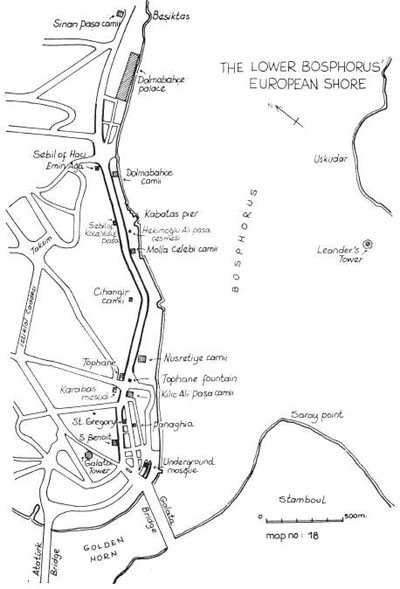
We will begin this tour where the last one ended, at the Karaköy end of the Galata Bridge. There are few monuments of great importance along this stretch; nevertheless it makes a pleasant and interesting stroll.
Before we begin, we might say a word or two about the Galata Bridge, where we have begun or ended so many of our strolls through Istanbul. The present bridge was completed in 1992, replacing an earlier bridge dating from 1910, which now rests unused between Ayvansaray and Hasköy. The central section of the bridge opens at four o’clock each morning to permit the passage of shipping to that part of the Golden Horn between the two bridges. (It is also opened occasionally at times of civic disturbance to isolate Stamboul from the rest of the city.) The first bridge at this point was built in 1845 by Bezmialem Valide Sultan, mother of Sultan Abdül Mecit; it was of wooden construction and quite pretty, as we see from the old prints.
YERALTI CAMİ
Leaving Karaköy we begin walking along the seaside road, which is always bustling with pedestrians rushing to and from the ferry station. About 200 metres along, past the ferry pier, we turn left and then left again at the next street. A short way along on our right we come to the obscure entrance to Yeraltı Cami, the Underground Mosque. This is a strange and sinister place. The mosque is housed in the low, vaulted cellar or keep of a Byzantine tower or castle which is probably to be identified with the Castle of Galata. This was the place where was fastened one end of the chain which closed the mouth of the Golden Horn in times of siege. Descending into the mosque, we find ourselves in a maze of dark, narrow passages between a forest of squat passages supporting low vaults, six rows of nine or 54 in all. Towards the rear of the mosque we find the tombs of two sainted martyrs, Abu Sufyan and Amiri Wahabi, both of whom are supposed to have died in the first Arab siege of the city in the seventh century. Their graves were revealed to a Nakşibendi dervish in a dream in 1640, whereupon Sultan Murat IV constructed a shrine on the site. Then in 1757 the whole dungeon was converted into a mosque by the Grand Vezir Köşe Mustafa Paşa.
CHURCH AND LİSE OF ST. BENOİT
Walking northward to Kemeraltı Caddesi, we see on the far side of the avenue a tall medieval tower. This is all that remains of the fifteenth-century church of St. Benoit. This church was founded by the Benedictines in 1427 and later became the chapel of the French ambassadors to the Sublime Porte, several of whom are buried there. After being occupied by the Jesuits for several centuries, it was given on the temporary dissolution of that order in 1773 to the Lazarists, to whom it still belongs. In 1804 they established a school here which is still ones of the best of the foreign lises in the city. Apart from its original tower, the present church dates partly from 1732 (the nave and south aisle) and partly from 1871 (the north aisle).
CHURCH OF ST. GREGORY
Somewhat farther along the avenue and on the opposite side of the avenue stands the Armenian church of St. Gregory the Illuminator (Surp Kirkor Lusavoriç). This was erected in 1958 after the original church nearby had been demolished when the avenue was widened. The new building is interesting as a replica of the famous church at Echmiadzin, built in the seventh century and one of the masterpieces of ancient Armenian architecture. The older church which was pulled down was an early nineteenth-century structure of no great architectural interest, but it contained some unusual tiles from the Tekfur Saray kilns; these have been transferred to the crypt of the present church.
Galata is a town of surprises and in particular shelters a large number of Christian and other sects. For instance, if you go down the alley in front of Surp Kirkor and wander about in the rather mean streets between it and the sea, you will find three churches that originally belonged to the Greek Orthodox Patriarchate but which are now the property of the so-called Turkish Orthodox Church. The latter was founded in 1924 by a dissident priest from Anatolia named Papa Eftim, who took control of the three churches in Galata and set up his own church for his parishioners, in which the mass is said in Turkish rather than Greek. Papa Eftim, who styled himself Patriarch Efthemios I, engaged in a running battle with the Greek Orthodox Patriarchate that at one point reached the League of Nations. After his death he was succeeded as patriarch by his two sons in turn, but by now the congregation is virtually non-existent, though the three churches in Galata – St. John, St. Nicholas and the Panaghia (Virgin) Kafatiani – still belong to the Turkish Orthodox Patriarchate such as it is. The Panaghia Kafatiani, the oldest of the three churches, founded in 1475 by Greeks from Kaffa in the Crimea, though the present church dates only from 1840, is the patriarchate of the Turkish Orthodox Church; it preserves a sacred icon of the Virgin Hodegitria brought from the Crimea by the original parishioners.
We now come to the district of Tophane, just outside the old walls of Galata; it takes its name from the cannon foundry which still dominates the road on the left-hand side. There was once a small but busy and picturesque port here; this has now been largely filled in, but there are still several Ottoman buildings of some interest in the immediate vicinity.

The first monument one comes to, on the right, is the mosque complex which Sinan built in 1580 for Kılıç Ali Paşa. This Ali was an Italian from Calabria called Ochiali who had become a Muslim and risen high in the Ottoman navy, being among the few officers who distinguished himself at the disastrous battle of Lepanto in 1571. As a reward for his outstanding service Selim II appointed him Kaptan Paşa, that is, Lord High Admiral, and conferred upon him the name Kılıç, the Sword. He twice captured Tunis from the Spaniards, the second time permanently. When he died in 1587, his fortune was estimated at 500,000 ducats. “Although ninety years of age,” says von Hammer, “he had not been able to renounce the pleasures of the harem, and he died in the arms of a concubine.”
To return to the mosque. Profoundly as Sinan had been impressed and inspired by Haghia Sophia, he had always avoided any kind of direct imitation of that great building. Now in his old age – he was over 90 when he designed this mosque – whether for his own amusement or on instructions from Kılıç Ali Paşa cannot be known – he deliberately planned a structure which is practically a small replica of the Great Church. It is one of his least successful buildings. One does not know quite why this is; it must have something to do with the greatly reduced proportions. But the fact is that the building seems heavy, squat and dark; it is not improved by the plethora of lamps, but this, of course, is not Sinan’s fault. His main departures from the plan of Haghia Sophia are: the provision of only two columns instead of four between each of the piers to north and south, and the suppression of the exedrae at the east and west ends; both seem to have been dictated by the reduced scale, and indeed to have retained the original disposition would clearly have made the building even heavier and darker. Nevertheless, the absence of the exedrae deprives the mosque of what in Haghia Sophia is one of its main beauties. The mihrab is in a square projecting apse, where there are some Iznik tiles of the best period. At the west there is a kind of pseudo-narthex of five cross-vaulted bays separated from the prayer area by four rectangular pillars.
The mosque is preceded by a very picturesque double porch. The inner one is of the usual type, five domed bays supported by columns with stalactited capitals; over the entrance portal is the historical inscription giving the date A.H. 988 (A.D. 1580), and above this a Kuranic text in a fascinating calligraphy and set in a curious projecting marble frame, triangular in shape and adorned with stalactites. The outer porch has a steeply sloping penthouse roof, supported by 12 columns on the west façade and three on each side, all with lozenge capitals; in the centre is a monumental portal of marble, and there are bronze grilles between the columns; the whole effect being quite charming.
The külliye of Kılıç Ali Paşa is extensive, including a türbe, a medrese and a hamam. The türbe is in the pretty graveyard behind the mosque; it is a plain but elegant octagonal building with alternately one and two windows in each façade, in two tiers. The medrese, opposite the south-east corner of the mosque, is almost square and like the mosque itself a little squat and shut in; it may well not be by Sinan since it does not appear in the Tezkeret-ül Ebniye. It is now used as a clinic. The hamam just in front of the medrese is single; unfortunately it is no longer in use. The plan is unique among the extant hamams of Sinan. The vast camekân doors lead into two separate soğukluks lying not between the camekân and the hararet, as is habitual, but on either side of the latter; each consists of three domed rooms of different sizes. From that on the right a passage leads off to the lavatories; the rooms on the opposite side were used as semi-private bathing cubicles. The hararet itself, instead of having the usual cruciform plan, is hexagonal with open bathing places in four of its six arched recesses, the other two giving access from the two soğukluks. The plan is an interesting variation on the standard, and it has been pointed out that broadly similar plans may be found in one or two of the older hamams at Bursa.
Across the street north of Kılıç Ali Paşa Camii is one of the most famous of the baroque fountains, known as Tophane Çeşmesi. Built in 1732 by Mahmut I, it has marble walls completely covered with floral designs and arabesques carved in low relief and originally painted and gilded. Its charming domed and widely overhanging roof was lacking for many years but has recently been restored. The fountain with the mosque beside it and the busy and picturesque throngs around the port used to be a favourite subject with etchers of the eighteenth and nineteenth century.
On the west side of the wide street in front of Kılıç Ali Paşa Camii, at the bottom of the hill coming down from Galatasaray, is a little mosque recently rather well-restored. It is not very interesting except it is ancient and well exemplifies the simple rectangular plan with a hipped wooden roof. It was founded by the Chief Black Eunuch Karabaş Mustafa who died, according to the Hadika, in 1530. Long a ruin, it was rebuilt in 1962; the interior is without interest.
TOPHANE
Opposite, on an eminence, is the cannon foundry from which the district takes its name, Tophane. A foundry was established here by Fatih himself and was extended and improved by Beyazit II. However, according to Evliya, Süleyman the Magnificent “pulled down the gun foundry built by his ancestors and built a new one, which no one who has not seen it is able to judge of what may be accomplished by human strength and understanding.” This he did, Evliya explains, because he was constantly at war with the Emperor of Germany: “These Germans are strong, warlike, cunning, devilish, coarse infidels whom, excelling in artillery, Sultan Süleyman endeavoured to equal by assembling gunners and artillerymen by rich presents from all countries,” and by improving the gun foundry. He goes on to give a detailed description of the methods used in casting the cannon. Süleyman’s foundry has long since disappeared and the present structure was built by Selim III in 1803, doubtless in connection with his own attempt to reform and modernize the army. It is a large rectangular building of brick and stone with eight great domes supported by three lofty piers. Beyond the foundry itself, along the height overlooking the street, a series of ruined substructures, walls and domes once formed part of the general complex, which included extensive barracks for the artillerymen. The foundry has now been restored and is open to the public as an exhibition hall. Across the street beside the Nusretiye mosque a small kiosk in the Empire style, built by Abdül Aziz, was a review pavilion where the sultan came to inspect his artillery troops.
NUSRETİYE CAMİİ
Nusretiye Camii was built between 1822 and 1826 by Mahmut II, its architect being Kirkor Balyan, the founder of that large family of Armenian architects who served the sultans throughout most of the nineteenth century and built so many of whose mosques and palaces we shall encounter along the shores of the Bosphorus. Kirkor Balyan (1764–1831) had studied in Paris and his mosque shows a curious blend of baroque and Empire motifs, highly un- Turkish, but not without a certain charm. This mosque abandons the traditional arrangement of a monumental courtyard and substitutes for it, as it were, an elaborate series of palace-like apartments in two storeys which forms the western façade of the building; such a plan had first been tried some 30 years earlier by Mehmet Tahir for the Hamidiye at Beylerbey, but it became a regular feature of all the Balyan mosques – for example, those at Dolmabahçe, Yıldız, Ortaköy and Aksaray. Notice the bulbous weight towers, the dome arches like jutting cheekbones, the over-slender minarets, so thin that they fell down soon after construction and had to be re-erected, the ornate bronze grilles here and there, or look at the interior dripping with marble and Empire garlands, and the mimber, a marvellous baroque changeling. The architect may have been perverse but he certainly had verve. The founder, Mahmut II the Reformer, called his mosque Nusretiye, Victory, because it was finished in 1826 just after his triumph over the Janissaries whom he had succeeded in liquidating.
Along the docks between Kılıç Ali Paşa Camii and Nusretiye Camii one of the warehouses has been converted into an art museum called Istanbul Modern, which opened in 2004. The collections include outstanding works of Turkish artists of the late Ottoman and early Republic eras, displayed in a very interesting and attractive setting.
Not far beyond Nusretiye Camii, on the heights above, can be seen the dome and minarets of the mosque of Cihangir, which gives its name to this upper district. Unfortunately the present building is of no interest whatever, having been built in 1890 by Abdül Hamit II. It occupies the site, however, of a mosque by Sinan which was founded by Süleyman the Magnificent in memory of his hunchback son Cihangir, who died in 1553 from sorrow, it is said, for his half-brother, the unfortunate Prince Mustafa, whom their father had just executed; Prince Cihangir was buried in the türbe of his other brother Mehmet at the Şehzade. Sinan’s mosque was burned down in 1720 and several times thereafter reconstructed and burned down, until the present rather exception ally ugly mosque was built, “bigger and better than the old ones,” as Abdül Hamit boasts in his inscription over the portal.
On the Bosphorus side of the shore highway in Fındıklı one comes to the Güzel Sanatlar Akademisi, or Fine Arts Academy, which is now part of Mimar Sinan Universitesi, the University of Sinan the Architect. The academy has an exhibition hall on the Bosphorus where art exhibits are held periodically.
MOLLA ÇELEBİ CAMİİ
At Fındıklı there is a little mosque of Sinan’s called Molla Çelebi Camii. This Molla was the Kadıasker (Chief Justice) Mehmet Efendi, a savant and poet; he built here also a hamam, but this was demolished when the street was widened. Erected in A.H. 969 (A.D. 1561–2), the building is of the hexagonal type, but here the pillars are actually engaged in the walls; between them to north and south are four small semidomes, and another covers the rectangular projecting apse in which stands the mihrab. The mosque is at the water’s edge and its position as well as its graceful lines make it very picturesque.
Between here and Dolmabahçe there are three fountains of considerable interest, all of which were moved from their original places when the street was widened and have been re-erected on their present sites. Between the mosque and the Kabataş ferry landing, beside the Bosphorus, stands the square çeşme of Hekimoğlu Ali Paşa erected in 1732; it is of marble, beautifully carved; it had lost its overhanging roof but this has now been replaced. There are çeşmes on two faces of the fountain. Nearly opposite this çeşme, across the road, is one of the most pleasing of the baroque or rococo sebils, built by Koca Yusuf Paşa, Grand Vezir to Abdül Hamit I, in 1787. It has a magnificent çeşme in the centre, flanked on each side by two grilled windows of the sebil, and a door beyond; it is elaborately carved and has incrustations of various marbles, while its long inscription forms a frieze above the windows of the sebil. It is pleasantly embowered in trees and is once more in use as a sebil, with the tables of a little café in front of it. Finally, just opposite the Dolmabahçe mosque is a little külliye with a sebil as its dominant feature. This was built in 1741 by the sipahi Hacı Mehmet Emin Ağa. Halil Ethem says rightly that it is “perhaps the most interesting eighteenth-century sebil in Istanbul.” The five-windowed sebil is flanked symmetrically on one side by a door, on the other by a çeşme; there follow three grilled windows opening into a small graveyard for the members of the sipahi’s family, his own tomb being, most unusually, in the sebil itself; beyond the graveyard there was once a small mektep which has not been restored. The whole is handsomely carved and decorated with various marbles. This poor little complex has been several times demolished and re-erected in slightly different places; it still remains incompletely restored.
We now come to Dolmabahçe, where Gümüşsuyu Caddesi passes the main football stadium in the city and joins the Bosphorus road. Just before this intersection one comes to a baroque mosque on the seaside, with a clock-tower of similar style at the far end of a terrace to the north, beyond which is Dolmabahçe Palace. Dolmabahçe Camii, begun by Bezmialem Valide Sultan, was finished in 1853 by her son Abdül Mecit. Like the neighbouring palace, it was designed by Nikoğos Balyan, a grandson of the Kirkor whom we have already met as architect of the Nusretiye. He came at a bad period and it is only with difficulty that one can admire any of his buildings. The great cartwheel-like arches of this mosque seem particularly disagreeable; but the two very slender Corinthian minarets, one at each end of the little palace-like structure that precedes the mosque, have a certain charm. The baroque clock-tower to the north of the mosque was erected by Nikoğos Balyan in 1854; it is made of cut stone and has a height of 27 metres, making it one of the most prominent landmarks on the European shore of the lower Bosphorus.
DOLMABAHÇE PALACE
We now come to Dolmabahçe Sarayı, the largest and grandest by far of the imperial palaces on the Bosphorus. The name means filled-in garden, for this was once an inlet of the Bosphorus and a harbour before it was filled in to create a royal park, a process begun by Ahmet I and completed by Osman II. A series of kiosks and seaside pavilions were later built in the park by the royal family, eventually evolving into a palace with a great Hall of the Divan for meetings of the state council. Mahmut II was the first sultan to make Dolmabahçe his principal residence, finding the palace on the Bosphorus more comfortable and agreeably situated than the crowded confines of Topkapı Sarayı. Abdül Mecit decided to build a much larger and more luxurious palace at Dolmabahçe, appointing as his chief architect Nikoğos Balyan, who worked in collaboration with his father, Karabet. The Balyans were from a distinguished Armenian family of architects who built several palaces and mosques for the sultans during the second half of the nineteenth century. The present palace of Dolmabahçe was completed in 1854, although Sultan Abdül Mecit and the royal family did not move in till 1856, finally abandoning the palace at Topkapı Sarayı that had been the imperial residence for nearly four centuries. Dolmabahçe was used as the principal imperial residence by all of the latter sultans except Abdül Hamit II, who preferred his own more sequestered palace at Yıldız. After the end of the Empire, Dolmabahçe served for a time as a state residence and was used to entertain visiting royalty and other distinguished visitors. Atatürk used it as the presidential residence when he was in Istanbul, and he died here on 10 November 1938. In recent years Dolmabahçe has been completely restored and is now open as a museum, one of the most popular attractions in the city. Tours of the palace begin at the ornate entryway to the south of the palace, passing from there through the royal gardens to the south wing of the palace.
The most impressive aspect of the palace is its seaside façade of white marble, with the edifice itself 284 metres in length along the seaside and fronting on a walled quay 600 metres long. The central part of the palace is a great imperial state hall flanked by the two main wings containing the state rooms and the royal apartments, the selamlık on one side and the harem on the other, with the apartment of the Sultan Valide in a separate wing linked to the harem through the apartment of the Crown Prince, and with an additional harem for his women and those of the other princes, and then still another residence at the north-west corner of the palace for the Kızlar Ağası, the Chief Black Eunuch. The palace complex also included rooms for those of the palace staff who lived within Dolmabahçe, as well as kitchens, an imaret to feed the staff, a pharmacy, stables, carriage houses, and barracks for the halberdiers who guarded the imperial residence. All in all, there are a total of 285 rooms, 43 large salons, six balconies, and six hamams on three storeys, with the Sultan’s private bath equipped with an alabaster bath tub.
The palace interior was the work of the French decorator Sechan, who designed the Paris Opera, and thus the decor and furniture of Dolmabahçe are strongly reminiscent of those of French palaces and mansions of the period. A number of European artists were commissioned to adorn the palace with paintings, murals and ceiling frescoes, and outstanding examples of their work, most notably works of Zonaro, Fromentin, and Aivazovkski, can be seen in situ and also in the Exhibition Hall, which has a separate entrance approached by the ornate entryway on the main road. The opulent furnishings of the palace includ 4,455 square metres of hand-woven Hereke carpets; fireplaces and chandeliers of Bohemian and Baccarat crystal, with the chandeliers numbering 36 in all, the biggest being the 4.5-tonne giant that hangs over the State Room, the largest chandelier in the world. Other furnishings include some 280 Chinese, Japanese, European and Turkish porcelains, the latter produced in the workshops of Yıldız Palace, along with 156 clocks, more than 500 silver and crystal candelabras, a dozen silver braziers, and innumerable sets of crystal and silverware. A great showpiece is the ornate stairway that leads up from the Salon of the Ambassadors, its balusters made of crystal and its upper level framed with a colonnade of monoliths of variegated marble, the grandest of seven stairways in the palace.
The palace is built on a site famous in history as that from which began the astonishing journey overland of some 70 ships of Fatih Mehmet’s fleet on 22 April 1453; up the hill to Pera they were drawn on wheeled platforms and down the valley of Kasım Paşa to the Golden Horn, thus bypassing the insuperable obstacle of the chain which barred its mouth. After Fatih’s time the area became a royal garden; Evliya says that Selim I built a kiosk here, and in Gyllius’ time it was known as the Little Valley of the Royal Garden (Vallicula Regii Horti). It was Ahmet I who began to fill in the small harbour in order to extend his gardens, and the filling-in process was continued by his son Osman II. As Evliya writes: “By order of Sultan Osman II all ships of the fleet, and all merchant ships at that time in the harbour of Constantinople, were obliged to load with stones, which were thrown into the sea before Dolmabahçe, so that a space of 400 yards was filled up with stones where the sea formed a bay, and the place was called ‘the filled-up garden,’ or Dolmabahçe.”
Evliya goes on to tell one of his astonishing stories about his unpredictable friend, Murat IV: “Sultan Murat IV happened once to be reading at Dolmabahçe the satirical work Sohami of Nefii Efendi, when the lightning struck the ground near him; being terrified he threw the book into the sea, and then gave orders to Bayram Paşa to strangle the author Nefii Efendi.”
And on that mad note we will end our tour. We might then retrace our steps to the square before Dolmabahçe; from there we can return to Taksim along the Ayazpaşa road, which winds uphill to the left of the football stadium.