
20

The historic origins of Pera and Galata are as remote in time as that of Constantinople itself.
From very early times there had been settlements and communities along the northern shores of the Golden Horn; Byzas himself is said to have erected a temple there to the hero Amphiaraus. The most important of these communities, Sykai, the Figtrees, where Galata now stands, was already in the fifth century A.D. included as the VIIIth Region, Regio Sycaena, of the city of Constantinople itself: it had churches, a forum, baths, a theatre, a harbour and a protecting wall. In 528 Justinian restored its theatre and wall and called it grandiloquently after himself Justinianae, a name which was soon forgotten. Towards the end of the same century, Tiberius II (r. 578–82) is said to have built a fortress to guard the entrance to the Golden Horn, from which a chain could be stretched to the opposite shore to close its mouth against enemy shipping; some substructures of this still exist at Yer Altı Camii near the Galata Bridge (see Chapter 21). The name, Sykai, continued in use until, in the ninth century, the name Galata began to supplant it, at first for a small district only, later for the whole region. The derivation of the name Galata is unknown, though that of the other apellation, Pera, is quite straightforward. In Greek pera means “beyond”, at first in the general sense of “on the other side of the Golden Horn”, later restricted to medieval Galata, and still later to the heights above. In the past generation these old Greek names have been supplanted by new Turkish ones; Pera is now known officially as Beyoğlu and Galata as Karaköy, but old residents of the town still refer to these quarters by their ancient names.
The town of Galata took its present form chiefly under the Genoese. After the reconquest of Constantinople from the Latins in 1261, the Byzantine emperors granted the district to the Genoese as a semi-independent colony with its own podesta or governor, appointed by the senate of Genoa. Although they were expressly forbidden to fortify the colony, they almost immediately did so and went on expanding its area and fortifications for more than 100 years. Sections of these walls with some towers and gates still exist and will be described later. After the Ottoman Conquest of 1453 the walls were partially destroyed and the district became the general European quarter of the city. Here the foreign merchants had their houses and their shops and here the ambassadors of the European powers built sumptuous embassies. For the rest, as Evliya Çelebi tells us, the inhabitants of Galata “are either sailors, merchants, or handicraftsmen, such as joiners and caulkers. They dress for the most part in the Algerine style, because a great number of them are Arabs and Moors. The Greeks keep the taverns; the Armenians are merchants and bankers; the Jews are negotiators in love matters and their youths are the worst of all the devotees of debauchery... The taverns are celebrated for the wine from Ancona, Sargossa, Mudanya, and Tenedos. When I passed through here, I saw many hundreds barefooted and bareheaded lying drunk in the streets.” Even now, there are evenings in the back streets of Beyoğlu when the scene is much the same as Evliya described it three centuries ago.
As time went on the confines of Galata became too narrow and crowded and the embassies and the richer merchants began to move out beyond the walls to the hills and vineyards above. Here the foreign powers built palatial mansions surrounded by gardens, all of them standing along the road which would later be known as the Grand Rue de Pera. Nevertheless, the region must have remained to a large extent rural till well on into the eighteenth century; in that period one often sees reference to “les vignes de Pera”. But as Pera became more and more built up, it fell a prey like the rest of the city to the endemic fires that ravage it periodically. Two especially devastating ones, in 1831 and 1871, destroyed nearly everything built before those dates. Hence the dearth of anything of much historic or architectural interest in Beyoğlu.
TAKSİM SQUARE
Taksim Square is the centre of Beyoğlu and thus the hub of the modern town. The square takes its name from the taksim, or water-distribution centre, which is housed in the handsome octagonal structure at the south-west corner of the area; this was built in 1732 by Sultan Mahmut I, and is the collection-point for the water that is brought into the city from the reservoirs in the Belgrade Forest. The statue group in the centre of the square commemorates the founding of the Turkish Republic in 1923; this was done in 1928 by the Italian sculptor Canonica. At the north-east corner of the square is the Atatürk Cultural Centre, one of the principal sites for cultural events produced during the annual International Istanbul Festival. The avenue that leaves the square from its south-east corner is Gümüşsuyu Caddesi, which leads downhill to the Bosphorus at Dolmabahçe, passing on its right side the stolid edifice of the German Embassy. (We shall continue to call these great buildings embassies, though, since the removal of the capital to Ankara they are used largely as consulates only; for they are really too grandiose to be described as consulates.)
CUMHURİYET CADDESİ AND THE MODERN CITY
The northern side of Taksim Square is bordered by the Public Gardens, on whose western side runs Cumhuriyet Caddesi, the avenue that leads to the various quarters of the modern city. The first of these is Harbiye, where a branch of the avenue passes the Military Museum, housed in the old Military School. Arrayed outside the museum are a splendid collection of ancient cannon, most of them captured by the Turks during the days when the Ottoman armies swept victoriously through southern Europe and the Middle East. Inside the museum there is an extraordinary collection of arms and other military objects from both Europe and Islam ranging in date from the early Ottoman period up to modern times, as well as other objects of considerable historic interest. At the Military Museum there are also performances of military music by the famous Mehtar Band, dressed in Ottoman costumes and playing old Turkish instruments, a very stirring spectacle.
An avenue branching off Cumhuriyet Caddesi to the right brings one to the Spor ve Sergi Sarayi (the Sport and Exhibition Palace), the Açık Hava Tiyatrosu (the Open-Air Theatre) and the Muhsin Ertuğrul Şehir Tiyatrosu (the City Theatre) which, together with the Opera House, form the centre of the city’s cultural life.
ISTİKLAL CADDESİ
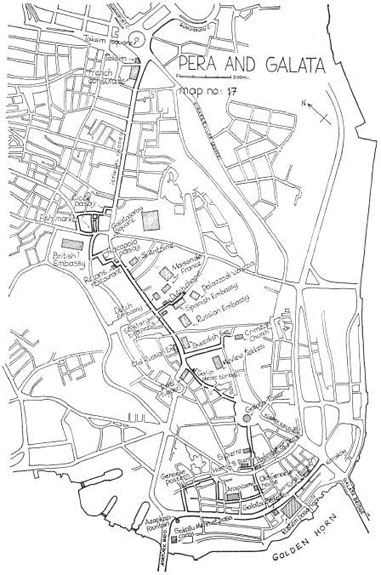
The avenue that leads off from the south-west corner of Taksim Square from the taksim itself is Istiklal Caddesi. This was formerly known as the Grand Rue de Pera, of which the Austrian historian Josef von Hammer once said: “It is as narrow as the comprehension of its inhabitants and as long as the tapeworm of their intrigues.” The avenue has now been conveted into a pedestrian mall. The old trolley line has been re-established, running the full length of the avenue between Taksim and Tünel, with a stop halfway along at Galatasaray Meydanı.
Just beyond the taksim building and on the same side of the street is the old French Consulate (consulate, not embassy, which is farther on down the avenue); it is a building with a rather quaint courtyard originally constructed by the French in 1719 as a hospital for those suffering from the plague.
The streets leading off on either side from Istiklal Caddesi between Taksim and Galatasaray are lined with restaurants, cafés, bars and night clubs, for this district is the centre of Istanbul’s night life, which has tremendously expanded in recent years, attracting celebrants from all over the world. Many of the buildings along the avenue date from the last-half-century of the Ottoman era, such as the Tokatlian Han, Cercle d’Orient, Atlas Cinema and Cité Roumelie. Halfway between Taksim and Galatasaray we see on the right the only mosque on the avenue, Ağa Camii. The first mosque on this site was founded in 1594–5 by Hüseyin Ağa, commander of the Janissary detachment at Galatasaray; this was rebuilt in 1834 and restored in 1936.
After a ten or 15 minute stroll from Taksim we come to Galatasaray Meydanı. The square takes its name from the Galatasaray Lisesi, whose ornate entrance we see on the left side of the avenue. Although the buildings of the lycée are modern (1908), Galatasaray is a venerable and distinguished institution. It was founded by Sultan Beyazit II around the end of the fifteenth century as a school for the imperial pages, anciliary to the one in Topkapı Sarayı. The school was reorganized in 1868 under Sultan Abdül Aziz as a modern lycée on the French model, with the instruction partly Turkish, partly in French. It is the oldest Turkish institution of learning in the city with a more or less continuous history; and for the past 100 years it has been the best as well as the most famous of Turkish lycées. A large proportion of the statesmen and intellectuals of Turkey have pursued their studies there and it has undoubtedly played a major role in the modernization of the country. It now has a university as well, situated on the Bosphorus near Beşiktaş.
On the opposite side of the avenue from the Lycée, a short distance before the square, we find a famous institution of quite another sort. One might easily pass it by, for it is just a little alley that leads off to the right from Istiklal Caddesi. This is the famous Çiçek Pasajı, the Passage of Flowers. The Passage goes through an edifice known as the Cité de Pera, a rococo structure erected in 1876 with a line of shops on the ground floor and luxury apartments above; notice the two splendid entrance portals, one on the main avenue and one on the side street. The Pasaj is lined with meyhanes, old-fashioned taverns where one can enjoy a tasty snack washed down with draft beer or rakı, the anise-flavoured intellect-deadenings national drink. At its inner end the Pasai opens into Şahne Şokağı, a street that leads from Istiklal Caddesi down through the Galatasaray Fish Market, one of the most colourful street-markets in the city.
Returning to Istiklal, we now turn off to the right at Galatasaray Meydanı and at the end of the first block we turn left on Meşrutiye Caddesi, passing on our right the old British Embassy. This is a handsome building in the Italian Renaissance style. It was originally designed by Sir Charles Barry, architect of the Houses of Parliament. But it was completed in 1845 by W. S. Smith along somewhat different lines. At the rear of the Embassy there is a magnificent and very English garden.
We continue along Meşrutiye Caddesi, which at the next corner turns half-left to bring us to the neighbourhood known as Tepebaşı (Top of the Hill), where we have a sweeping view out over the Golden Horn to the old city. Along the crescent-shaped avenue we pass in turn two of the city’s oldest hotels, both of them handsome neoclassical buildings of the late nineteenth century, first the Büyük Londra and then the Bristol. The Bristol Hotel has been superbly restored and is now the Pera Museum, celebrated for its collection of Orientalist paintings and other works of art. At the far end of the crescent we see on the right side of the avenue the famous Pera Palas Hotel, completed in 1893 by the French architect Alexandre Vallaury. The hotel is currently closed for renovation.
We now return to Galatasaray Meydanı and resume our stroll down the avenue. At the first corner on the right we see the Hacopulo Pasajı, a narrow alleyway that opens into a picturesque arcade surrounded by buildings of the mid-nineteenth century. Off the left side of the arcade we see the Greek church of the Presentation of the Virgin, dedicated in 1807 and rebuilt in 1855.
Returning to Istiklal, we turn right at the next corner into another little alleyway, Olivio Pasajı, which at its end brings us to the famous Rejans Lokantası. This is a Russian restaurant founded in the 1930s, famous for its borsch, chicken kievsky and lemon-flavoured vodka.
On the left side of the avenue we see a handsome Catholic church at the back of a large courtyard. This is the Franciscan church of St. Anthony of Padua, the largest Catholic church in the city. It was established on this site in 1725; the present building, a good example of Italian neo-Gothic in red brick, was designed by the architect Giulio Mongeri and completed in 1912. The impressive Art Nouveau building to the left of the church, the Mısır Apartman, or Egyptian Apartment, was built in 1910 for Abbas Halim Pasha of Egypt.
St. Anthony’s is one of the churches that was built along the old Grand Rue de Pera along with the embassies of the European powers. The embassies in this part of old Pera, on or near the Grand Rue, belong to those powers which have had legations here since the early centuries of the Ottoman Empire. Though most of these buildings are relatively modern, the embassies themselves, especially those of Venice, France, England, Holland, Sweden and Russia, are of some historical interest. They were established more or less where they are now in the course of the sixteenth, seventeenth and eighteenth centuries, generally by grants of land bestowed by the sultans, and each formed the centre of its “Nation”, as it was called, that is, of the community of resident merchants and officials of the various countries. These embassies came to play a greater and greater role in the destiny of the Ottoman Empire as its powers declined, and collectively they dominated the life of Pera until the establishment of the Turkish Republic. Near the embassies, various churches were established, more or less under their protection, and some of these survive in a modern form.
Taking the second turning on the left after St. Anthony’s, we see on the right the Maison de France; it is situated in a fine French garden with views of the Bosphorus and the Marmara. Though one of the earliest embassies to be established in Pera towards the end of the sixteenth century, the present building dates only from soon after the fire of 1831. (It was on this site that the great Turkish astronomer, Takiuddin, built his observatory in the 1570s.)
The chapel connected with the embassy, that of St. Louis of the French, is the oldest in foundation of the Latin Churches in Pera, dating from 1581; though the present structure dates only from about 1831. Among the masses celebrated there every Sunday is one in the Chaldean rite. St. Louis is the local house of worship for the Chaldean Church, an eighteenth-century offshoot of the ancient Nestorian Church which is now in union with Rome. The members of this Church in Istanbul are all from the Hakkari section in the far south-east of Turkey and are descendants of the ancient Chaldean and Assyrian peoples; parts of the mass are still sung in Aramaic, the language which Christ would have spoken.
Continuing along Istiklal Caddesi on the same side of the street we come next to the Dutch Embassy, a very pretty building looking rather like a small French chateau. The present building was designed by the Fossati brothers and completed in 1855; the lower structure, visible from the garden, goes back two centuries or more in time. The original Embassy, built in 1612, was burned twice, but parts of the substructure of the earlier buildings were preserved and incorporated into the present Embassy.
The first turning on the left beyond the Embassy brings us to the Dutch Chapel, whose entrance is a short way down along the left. Since 1857 this building has housed the Union Church of Istanbul, an English-speaking congregation from many lands. The chapel dates from the late seventeenth or early eighteenth century, although the original chapel must go back to the founding of the Dutch Embassy. The basement rooms of the chapel, now used as a Sunday school, have in the past served as a prison. The building is basically a single massive barrel vault of heavy masonry; the brickwork of the façade, newly exposed to view, is especially fine.
A frequent visitor to the original Dutch Chapel in the early years of its existence was Cyril Lucaris, six times Patriarch of Constantinople and once of Alexandria. Influenced by his conversations with theologians connected with the Dutch Chapel, Lucaris in 1629 published his Declaration of Faith, in which he proclaimed his belief in the basic principles of Calvinism. This caused a scandal in the Greek Orthodox Church which eventually led to the Patriarch being denounced to Murat IV as a Russian spy. On 25 June 1638, Lucaris was executed by the Janissaries and his body thrown into the Marmara, thus bringing to an end the remarkable career of the man whom Pope Urban had called “the son of darkness and the athlete of hell.”
A little farther down the street we pass on our right the former Spanish Embassy, now no longer functioning, with only the embassy chapel remaining in use. This chapel, dedicated to Our Lady of the Seven Sorrows, was originally founded in 1670; the present church dates from 1871.
Still farther down the street we come to the handsome Palazzo di Venezia, now the Italian Embassy. The present building dates from about 1695, though the Embassy itself was established here long before that. In the great old days this was the residence of the Venetian bailo, the ambassador of the Serene Republic of Venice and one of the most powerful of the foreign legates in the city. The Palazzo is large and imposing, its garden as typically Italian as that of the English Embassy is English. We learn from his Memoirs that Giacomo Casanova was a guest here in the summer of 1744; in his three months in the city this great lover made not a single conquest and was himself seduced by one Ismail Efendi.
Returning to Istiklal Caddesi we come next to the Franciscan church of St. Mary Draperis, down a flight of steps from the street level. The first church on this site was built in 1678 and the present structure dates from 1789. The parish itself, however, is a very ancient one, dating to the beginning of the year 1453 when the Franciscans built a church near the present site of Sirkeci Station. After the Conquest the Franciscans were forced to leave Constantinople, settling first in Galata and then later here in Pera. The Franciscans still preserve a miraculous icon of the Virgin which they claim to have taken with them from their first church in Constantinople.
Just past the church we come to the Russian Embassy; this was built in 1837 by the Fossati brothers who, a decade later, were to restore Haghia Sophia. The Fossati brothers had been for several years in Moscow as official architects to the Tsar, who sent them to Istanbul to build his new embassy; here they remained for 20 years or so as official architects to the Sultan.
Down a steep street to the left beyond the Russian Embassy and around a corner to the left we come to the Crimean Memorial Church, by far the largest and most handsome of the few Protestant churches in the city. This was built between 1858 and 1868 under the aegis of Lord Stratford de Redcliffe and was designed by C.E. Street, the architect of the London Law Courts. It is a very Streetian Gothic building with a cavernous porch, like the Law Courts themselves.
Returning once again to Istiklal Caddesi, we come next to the last of the old embassies on the avenue. This is the Embassy of Sweden, which was established here towards the end of the seventeenth century. Directly across the street from the Swedish Embassy is the Narmanlı Han, a huge old building which housed the Russian Embassy till they moved to their new quarters down the street in 1837. This building, which appears to date from the early eighteenth century, is now a congeries of shops, storerooms, offices and ateliers.
We are now at the end of Istiklal Caddesi. Just ahead, where the avenue forks to the right, is the entrance to Tünel, the underground funicular railway which in one minute and 20 seconds takes one to the bottom of the hill near the Galata Bridge. Tünel was built in 1875 and is thus one of the oldest subways in Europe and probably also the shortest; Periotes used to refer to it affectionately as “The Mouses Hole”.
GALATA MEVLEVİ TEKKE
Rather than taking Tünel, we will stroll down the steep street called Galip Dede Caddesi. Up until recent years this was a step street, like so many others in Galata, but now it has been paved in the interest of the automobile. A short way down this street on the left side we see a sebil founded in 1819 by one Halet Efendi. Just beside the sebil we come to the gateway of the Galata Mevlevi Tekke.
Entering, we find ourselves in a large and pleasant courtyard in front of the tekke with a garden on the right side and a picturesque graveyard on the other. The tekke was founded in 1491 by Şeyh Muhammed Semai Sultan Divanı, a descendant of Mevlana Celaleddin Rumi, the great divine and mystic poet who in the thirteenth century founded the religious brotherhood known as the Mevlevi, famous in the West as the “Whirling Dervishes”. The most famous şeyh of the Galata tekke was the seventeenth-century poet Galip Dede, whose ornate türbe is on the left of the path leading into the courtyard.
At the rear of the courtyard we come to the heart of the tekke, the semahane, or dancing room, a beautiful octagonal chamber that was splendidly restored in the early 1970s. The semahane and its adjacent chamber now house the Divan Edibiyatı Museum of Turkish Court Poetry, a form inspired by the mystical verses of Mevlana. The collection includes manuscripts of the works of Galip Dede and other poets, as well as examples of Ottoman calligraphy and memorabilia of the Mevlevi dervishes who lived here until the mid-1920s, when all of the dervish orders in Turkey were banned and their tekkes closed. Performances of the ethereal Mevlevi dance and the hauntingly beautiful music that accompanies it are occasionally performed in the tekke.
The graveyard beside the tekke has some very interesting old tombstones, most of them in the form of the characteristic truncated conical headdresses of the Mevlevi. One of these marks the grave of the famous Count Bonneval, known in Turkish as Kumbaracı Ahmet Paşa. Bonneval was a French officer who enrolled in the Ottoman army in the reign of Sultan Mahmut I (r. 1730–54) and was made Commandant of the Corps of Artillery. He became a Muslim, changed his name to Kumbaracı (the Bombardier) Osman Ahmet, and spent the remainder of his life in the Ottoman service, dying in Istanbul in 1747. A contemporary of Bonneval wrote of him that he was “a man of great talent for war, intelligent, eloquent with turn and grace, very proud, a lavish spender, extremely debauched and a great plunderer.”
THE GALATA TOWER
We now continue on down Galip Dede Caddesi for about 250 metres until we see on our right the huge Galata Tower. This tower was the apex of the Genoese fortifications of medieval Galata. Originally known as the Tower of Christ, it was built in 1348 in connection with the first expansion of the Genoese colony. The first fortified area, built as early as 1304, was a long narrow rectangle along the Golden Horn between where the two bridges now stand. In order to defend themselves more adequately on the side of the heights above Galata, the Genoese then added a triangular wedge with the Tower of Christ at its highest point. Later still, in 1387 and 1397, they took in successive areas to the north-west, and finally in 1446 they enclosed the eastern slope of the hill leading down to the Bosphorus. The final defence system consisted of six walled encientes, with the outer wall bordered by a moat, a short stretch of which can still be seen beside the Tower. Bits and pieces of the defence walls and towers still exist here and there around Galata, but none of them amounts to very much. The Galata Tower has been restored and there is now a modern restaurant and café on its upper levels. From the observation deck on the uppermost level one has a magnificent view out over the entire city and its surrounding waters.
In the little square beside the Tower, fixed against the remnants of the barbican, is a famous street fountain. In its present form it dates from 1732, but it was originally constructed by Bereketzade Hacı Ali Ağa, first Turkish governor of the citadel of Galata; it still bears his patronymic. It was moved to its present position in 1950 from Bereketzade’s mosque a short distance away when the latter was destroyed. Unfortunately, this charming rococo fountain has suffered badly from being painted.
Behind the tower a steep and winding street, Galata Kulesi Sokağı, leads downhill towards the Golden Horn. Not far down on the left we see the queer folly-like tower that looks so extra ordinary when viewed from the two bridges; it is merely an example of Art Nouveau and belongs to the Istanbul Hospital.
CHURCH OF SS. PETER AND PAUL
Farther down on the right is the extensive domain of the Dominician church and monastery of SS. Peter and Paul, founded in the late fifteenth century by the Genoese. Later it was taken under the protection of France and became the French parochial church in Galata. During the nineteenth century it became the parish church of the local Maltese community, several of whose tombstones are built into the courtyard wall along with an ancient Greek funerary relief. The present church dates from a rebuilding in 1841 by the Fossati brothers. At the rear of the monastery there is a fairly well preserved stretch of the medieval Genoese wall that led up from the Golden Horn to the Galata Tower, with two defence towers still standing.
At the next corner we come to a cross street, which on the left side is called Kart Çınar Sokağı. The two buildings facing one another to the left across the side street are Genoese, the one above dated 1314 and the other 1316. The latter is the former Palazzo Communale, also known as the Podestat, the official residence and headquarters of the Podesta, the Genoese governor of Galata. The Podesta retained its original appearance until the late nineteenth century, when its façade was rebuilt during the widening of the avenue below.
Turning right on the side street, which on this side is called Eski Banka Sokağı, we see on the right a huge old building known as the Han of Saint Pierre. This was built in 1771 by the Compte de Saint Priest as the “lodging-place and bank of the French Nation”, as recorded in his bequest. The French poet Andre Chènier was born in an earlier house on this site on 30 October 1762, as noted in a plaque on the façade: next to it are the arms of the Compte de Saint Priest and of the Bourbons.
We retrace our steps to Galata Kulesi Sokağı, which after a few steps brings us to Bankalar Caddesi, formerly known as Voyvoda Caddesi. The present name of the avenue comes from the several banks that were built along it in the latter half of the nineteenth century. The most famous of these is the Osmanlı Bankası, the Ottoman Bank, the huge building that dominates the south side of the avenue to our left, founded in 1856.

We now cross the avenue and continue straight ahead on Perşembe Pazar Sokağı, the Street of the Thursday Market. On the right side of the street we see two ancient stone houses, and beyond an alley we see two more of them. These were in times past referred to as Genoese houses, but they are actually Ottoman structures of the eighteenth century, one of them inscribed with the date A.H. 1148, or A.D. 1735–6. And indeed the masonry in alternate stone and brick, the pointed arches of the windows, and the general structure could not be more characteristic of Turkish building of the period. The dated building has three storeys, the upper ones projecting in zigzags held up by corbels, two zigzags in Perşembe Pazar Sokağı but four in the tiny alley to the right. This is a fine old building and one hopes that it will be preserved, for at present it and the others on this street are roughly used and are deteriorating.
ARAP CAMİİ
We take the next turning on the right and soon come to a very unusual edifice ending in a tall square tower with a pyramidal roof; this is known in Turkish as Arap Camii, the Mosque of the Arabs, one of the former Latin churches of Genoese Galata. There are many baseless legends concerning the origin and history of this church, but the evidence indicates that it was constructed by the Dominicans during the years 1323–37 and dedicated to St. Domenic. It seems to have taken the place of, or included, a chapel dedicated to St. Paul, by whose name it was also called. It seems to have been converted into a mosque in the last decade of the fifteenth century, probably for the Moors who were resettled in Galata after their expulsion from Spain, and hence the name Arap Camii. The building has been partially burned and restored several times, and in the process it was considerably widened by moving the north wall outwards several metres. Nevertheless it continues to look like a rather typical Latin church, originally Gothic, a long hall ending in three rectangular apses and with a belfry (now the minaret) at the east end. The flat wooden roof and the rather pretty wooden galleries date only from a restoration during the years 1913–19. At that time also the original floor was uncovered and large quantities of Genoese tombstones came to light; these are now in the Archaeological Museum. Fragments of a fourteenth-century fresco were recently discovered in the central apse. On the north side is a large, unkempt but not unattractive courtyard with a şadırvan.
We now return to the street by which we arrived at Arap Camii and continue on till the second turning on the right; from this we take the second turning on the left. This brings us onto Yanık Kapı Sokağı, the Street of the Burnt Gate, which takes its name from the ancient portal which we come to about 100 metres along. This is the only surviving gate of the medieval Genoese town; it once led from the fourth enceinte to the fifth. Above the archway we see a bronze tablet upon which is emblazoned the cross of St. George, symbol of Genoa the Superb, between a pair of escutcheons bearing the heraldic arms of the noble houses of Doria and De Merude.
AZAP KAPI CAMİİ
After passing through the archway we take the next left; this soon brings us out to the main highway paralleling the Golden Horn. A short distance off to the right, just beside the Atatürk Bridge, we see the handsome mosque known as Azap Kapı Camii, taking its name from the Marine Gate, or Azap Kapı, of the Tershane, or Ottoman shipyard, on the other side of the bridge highway. Founded by the Grand Vezir Sokollu Mehmet Paşa, the mosque was built in A.H. 985 (A.D. 1577–8) and its architect was Sinan. While it hardly equals Sokollu Mehmet’s slightly earlier mosque near the Hippodrome, it is nevertheless a fine and interesting building. Like the mosque of Rüstem Paşa on the other side of the Golden Horn, it is raised on a high basement in which there were once vaulted shops; the entrance, now rather squeezed by the approach to the bridge, is by staircases under the enclosed porch. The minaret is unusual both in position and structure. First of all, it is on the left or north side instead of the south, doubtless because the sea at that time came up very close to the south wall and the ground would not have been firm enough for so heavy a structure as a minaret. Furthermore, it is detached from the building and placed on a solid foundation of its own, and is connected with the mosque above porch level by a picturesque arch containing a communicating passage so that it can be entered from the porch. Internally the arrangement is an octagon inscribed in a rectangle (nearly square). The dome is supported by eight small semidomes, those in the axes slightly larger than those in the diagonals, while the eastern semidome covers a rectangular projecting apse for the mihrab, with narrow galleries surrounding three sides. The mihrab and mimber are very fine work in carved marble. It appears that the interior was once decorated with fine Iznik tiles, like that of So kollu’s other mosque, but these have disappeared and been replaced by modern Kütahya tiles. Seventy years ago the mosque was in a ruinous condition and the municipality actually proposed to demolish it to make way for the newly planned Atatürk Bridge. A public protest succeeded in saving the mosque and finally getting it restored. This was indeed fortunate, for it is certainly among the more interesting and important of Sinan’s buildings.
Just to the north of the mosque stands the famous baroque, or rococo fountain, of Azap Kapı. Built in A.H. 1145 (A.D. 1732–3) by Saliha Valide Hatun, mother of Mahmut I, it consists of a projecting sebil with three grilled windows flanked by two large and magnificent çeşmes. The façades of the çeşmes and sebil are entirely covered with floral decorations in low relief and with a little dome. For many years in almost total ruin, it has recently been fairly well restored, though unfortunately the fluted drum of the dome has been done in concrete. It is one of the most attractive of the early eighteenth-century fountains.
We now turn back and stroll in the direction of the Galata Bridge, passing a stretch of the medieval Genoese walls that was exposed when the buildings around them were demolished in the 1990s.

A little more than halfway along the avenue between the two bridges we come to an ancient and imposing building with nine domes. This is the Galata Bedesten, or covered market, built by Fatih Mehmet. A nearly square structure, its nine equal domes are supported by four great rectangular piers, and around the outside are a series of vaulted shops. Several authorities have claimed that this building is seventeenth or eighteenth century; however, both the form of the building and the masonry in brick and rubble are obviously typical products of the fifteenth century. One has only to compare it to the Old Bedesten in the Kapalı Çarşı, a construction of Fatih, to be convinced that it too is from that period.
Beside the Bedesten but entered from the next turning to the east is a handsome and unusual han. This was built by Sinan for the Grand Vezir Rüstem Paşa shortly before 1550. The date is fixed by Gyllius, who says that it was built on the foundations of the Latin church of St. Michael, which still existed when he arrived in 1544, but had been pulled down before he left to make way for the new han. It is in two storeys with a long narrow courtyard, from the centre of which rises a staircase leading to the upper floor, in an arrangement as picturesque as it is unique. The lower arcade of the courtyard has round arches, while those of the gallery above are of the ogive type. This building has been very badly treated and is in a sad state of dilapidation and squalor.
Leaving the han, we continue on towards the Galata Bridge; here we might find the streets closer to the Golden Horn somewhat more interesting than the main avenue. (Along the shore at this point there is a ferry service of small motor-boats across the Golden Horn. This is a very pleasant way to pass back and forth between Galata and Stamboul and has been in use for centuries.)
We now arrive at the great square in Karaköy, where all the streets of Galata converge chaotically towards the bridge. There is more of Galata yet to see, along the European shore of the lower Bosphorus, but perhaps we should pause here and leave the rest for our next tour. And besides, whenever one is in this area one is always tempted to relax at a café or restaurant on the lower level of the bridge. From there one can observe how the sometimes golden light of late afternoon gives even Galata a brief and spurious beauty. Then, as the sun sets behind Stamboul, silhouetting the domes and minarets of the imperial mosques on the skyline of the old city, the polluted waters of the Golden Horn do indeed look like molten gold.