
2

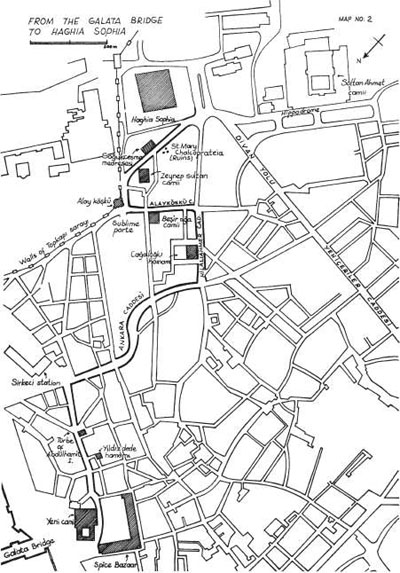
The area around the Stamboul end of the Galata Bridge, known as Eminönü, is the focal point of Istanbul’s colourful and turbulent daily life. Throughout the day and early evening a steady stream of pedestrians and traffic pours across the bridge and along the highway that parallels the right bank of the Golden Horn, while an endless succession of ferry-boats sail to and from their piers around and under the Galata Bridge, connecting the centre of the city to its maritime suburbs on the Bosphorus, the Marmara and the Princes’ Isles, as well as to stops on both shores of the Golden Horn itself.
The quarter now known as Eminönü was during the latter period of the Byzantine Empire given over to various Italian city-states, some of which had obtained trading concessions here as early as the end of the tenth century. The area to the right of the Galata Bridge, where the markets are located, was the territory of the Venetians. The region immediately to the left of the bridge was given over to the Amalfians, and beyond them were the concessions of the Pisans and the Genoese, who also had extensive concessions across the Golden Horn in Galata. These rapacious Italians were as often as not at war with one another or with the Byzantines, though at the very end they fought valiantly at the side of the Greeks in the last defence of the city. After the Conquest the concessions of these Italian cities were effectively ended in Stamboul, although the Genoese in Galata continued to have a measure of autonomy for a century or so. Today there is virtually nothing left in Eminönü to remind us of the colourful Latin period in the city’s history, other than a few medieval Venetian basements underlying some of the old hans in the market quarter around Rüstem Paşa Camii.
The area directly in front of the Galata Bridge, where Yeni Cami now stands, was in earlier centuries a Jewish quarter, wedged in between the concessions of the Venetians and the Amalfians. The Jews who resided here were members of the schismatic Karaite sect, who broke off from the main body of Orthodox Jewry in the eighth century. The Karaites seem to have established themselves on this site as early as the tenth century, at about the time when the Italians first obtained their concessions here. The Karaites outlasted the Italians though, for they retained their quarter up until the year 1660, at which time they were evicted to make room for the final construction of Yeni Cami. They were then resettled in the village of Hasköy some three kilometres up the Golden Horn and on its opposite shore, where their descendants remain to this day.
YENİ CAMİ
The whole area around the Stamboul end of the Galata Bridge is dominated by the imposing mass of Yeni Cami, the New Mosque, more correctly called the New Mosque of the Valide Sultan. The city is not showing off its great age in calling new a mosque built in the seventeenth century: it is just that the present mosque is a reconstruction of an earlier mosque of the same name. The first mosque was commissioned in 1597 by the Valide Sultan (Queen Mother) Safiye, the mother of Sultan Mehmet III. The original architect was Davut Ağa, a pupil of the great Sinan, the architect who built most of the finest mosques in the city during the golden age of Süleyman the Magnificent and his immediate successors. Davut Ağa died in 1599, however, and was replaced by Dalgıç Ahmet Çavuş, who supervised the construction up until the year 1603. But in that year Mehmet III died and his mother Safiye was unable to finish her mosque. For more than half-a-century the partially completed mosque stood on the shore of the Golden Horn, gradually falling into ruins. Then in 1660 the whole area was devastated by fire, further adding to the ruination of the mosque. Later in that year the ruined and fire-blackened mosque caught the eye of the Valide Sultan Turhan Hadice, mother of Mehmet IV, who decided to rebuild it as an act of piety. The architect Mustafa Ağa was placed in charge of the reconstruction, which was completed in 1663. On 6 November of that year the New Mosque of the Valide Sultan was consecrated in a public ceremony presided over by the Sultan and his mother. The French scholar Grelot, writing when Turhan Hadice was still alive, tells us that she was one of the “greatest and most brilliant (spirituelle) ladies who ever entered the Saray,” and that it was fitting that “she should leave to posterity a jewel of Ottoman architecture to serve as an eternal monument to her generous enterprises.”
But time has dimmed the glitter of Safiye’s jewel, and its walls and windows are blackened by the soot from the ferries which berth nearby. Then, too, Yeni Cami was built after Ottoman architecture had passed its peak, and it fails to achieve the surpassing beauty of Sinan’s masterpieces of the previous century. Nevertheless, it is still a fine and impressive structure, and its graceful silhouette is an adornment to the skyline of Stamboul.
Yeni Cami, like many of the other imperial mosques in Stamboul, represents a variation on the basic plan of the great church of Haghia Sophia. Whereas in Haghia Sophia the central dome is flanked by two semidomes along the longitudinal axis, Yeni Cami is cruciform, with semidomes along both axes and smaller domes at each of the four corners. The resultant silhouette is a graceful flowing curve from dome to semidomes to minor domes, a symmetrical cascade of clustering spheres. The north and south façades of the building have two storeys of porticoed galleries which, with the pyramidal arrangement of the domes, give a light and harmonious effect. The two minarets each have three şerefes, or balconies, with superb stalactite carving. In olden times the call to prayer was given by six müezzins, one to each şerefe, but now they have been replaced by a single loudspeaker attached to a soulless tape-recorder.
Like all of the other imperial mosques in Stamboul, Yeni Cami is preceded by a monumental courtyard, or avlu. The courtyard is bordered by a peristyle of 20 columns, forming a portico which is covered with 24 small domes. At the centre of the courtyard there is a charming octagonal şadırvan, or ablution fountain, one of the finest of its kind in the city. At the şadırvan, which means literally “free-flowing fountain”, the faithful would ordinarily perform their abdest, or ritual ablutions, before entering the mosque to pray. But in Yeni Cami the şadırvan serves merely a decorative purpose, and the ritual washings are performed at water-taps along the south wall of the mosque.
The stone dais on that side of the courtyard which borders the mosque is called the son cemaat yeri, literally the place of last assembly. Latecomers to the Friday noon service when the mosque is full often perform their prayers on this porch, usually in front of one of the two niches which are set to either side of the door. The façade of the building under the porch is decorated with tiles and faience inscriptions forming a frieze. The two central columns of the portico, which frame the entrance to the mosque, are of a most unusual and beautiful marble not seen elsewhere in the city.
The interior of Yeni Cami is somewhat disappointing, partly because the mosque is darkened by the soot which has accumulated on its windows. What is more, the tiles which decorate the interior are of a quality inferior to those in earlier mosques, the celebrated Iznik tiles of the period 1555–1620. Nevertheless, the interior furnishings of the mosque are quite elegant in detail. The most important part of the interior of Yeni Cami, as in all mosques, is the mihrab, a niche set into the centre of the wall opposite the main entrance. The purpose of the mihrab is to indicate the kıble, the direction of Mecca, towards which the faithful must face when they perform their prayers. (In Istanbul the direction of the kıble is approximately south-east, but for convenience we will refer to it as east, the general orientation of the Christian churches of the city.) In the great mosques of Istanbul the mihrab is invariably quite grand, with the niche itself made of finely carved and sculptured marble and with the adjacent wall sheathed in ceramic tiles. The mihrab in Yeni Cami is ornamented with gilded stalactites and flanked with two enormous golden candles, which are lighted on the holy nights of the Islamic year. To the right of the mihrab we see the mimber, or pulpit, which is surmounted by a tall, conical-topped canopy carried on marble columns. At the time of the noon prayer on Friday the imam, or preacher, mounts the steps of the mimber and pronounces the weekly sermon, or hutbe. To the left of the mihrab, standing against the main pier on that side, we see the kürsü, where the imam sits when he is reading the Kuran to the congregation. And to the right of the main entrance, set up against the main pier at that end, we find the müezzin mahfili, a covered marble pew. During the Friday services and other ceremonial occasions the müezzin kneels there, accompanied perhaps by a few other singers, and chants the responses to the prayers of the imam. During these formal occasions of worship, the faithful kneel in long lines and columns throughout the mosque, following the prayers attentively and responding with frequent and emphatic amens. The women, who take no part in the public prayers, are relegated to the open chambers under the gallery to the rear of the mosque.
The mosque interior is overlooked by an upper gallery on both sides and to the rear, with the two side galleries carried on slender marble columns. At the far corner of the left gallery we see the sultan’s loge, or hünkâr mahfili, which is screened off by a gilded grille so that the sultan and his party would be shielded from the public gaze when they attended services. Access to the sultan’s loge is gained from the outside by a very curious ramp behind the mosque. This ramp leads to a suite of rooms built over a great archway; from these a door leads to the hünkâr mahfili. This suite of rooms included a salon, a bedchamber and a toilet, with kitchens on the lower level, and served as a pied-à-terre for the Sultan.
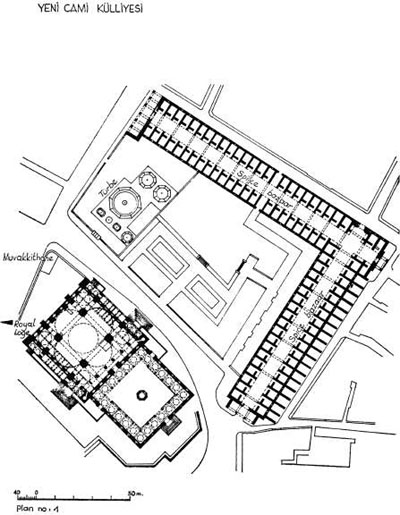
Yeni Cami, like all of the imperial mosques, was the centre of a whole complex of religious and philanthropic institutions called a külliye. The original külliye of Yeni Cami included a hospital, a primary school, a public bath, two public fountains, a mausoleum and a market, whose profits were used towards the support of the other institutions in the külliye. The hospital, the primary school and the public bath have been destroyed but the other institutions remain.
The market of Yeni Cami is the handsome L-shaped building to the south and west of the mosque. It is called the Mısır Çarşısı, or the Egyptian Market, because it was once endowed with the Cairo imposts. In English it is more commonly known as the Spice Bazaar, for in former times it was famous for the spices and medicinal herbs which were sold there. Spices and herbs are still sold there today, but the bazaar now deals in a wide variety of commodities, which makes it perhaps the most popular market in the city. In the domed rooms above the arched entrance there is a very picturesque and excellent restaurant called Pandelis, or the Mısır Lokantası, which serves both Turkish and western dishes.
The mausoleum, or türbe, of the Yeni Cami külliyesi is the handsome building at the eastern end of the garden of the Egyptian Bazaar. Here are buried the foundress of Yeni Cami, Turhan Hadice, her son, Mehmet IV, and several later sultans, Mustafa II, Ahmet III, Mahmut I, Osman III and Murat V, along with countless royal princes and princesses. The small building to the west of the türbe is a kütüphane, or library, which was built by Turhan Hadice’s grandson, Ahmet III, who ruled from 1703 till 1730. Ahmet III was known as the Tulip King, and the period of his reign came to be called the Lale Devri, the Age of Tulips, one of the most charming and delightful eras in the history of old Stamboul. It is entirely fitting that the tomb of the Tulip King should look out on a garden which is now the principal flower-market of the city.
Directly opposite the türbe, at the corner of the wall enclosing the garden of the mosque, is a tiny polygonal building with a quaintly-shaped dome. This was the muvakkithane, or the house and workroom of the müneccim, the mosque astronomer. It was the duty of the müneccim to regulate the times for the five occasions of daily prayer and to announce the exact times of sunrise and sunset during the holy month of Ramazan, beginning and ending the daily fast. It was also his duty to determine the date for the beginning of a lunar month by observing the first appearance of the sickle moon in the western sky just after sunset. The müneccim, like most astronomers of that period, also doubled as an astrologer, and the most able of them were often asked to cast the horoscopes of the Sultan and his vezirs. In more recent times the müneccim often served as the watch repairman for the people in the local neighbourhood.
At the next corner, on the same side of the street as the türbe, is the sebil of the Yeni Cami külliyesi. The sebil is an enclosed fountain which was used to distribute water free to thirsty passersby. Sebil means literally “way” or “path”, and to construct a sebil was to build a path for oneself to paradise. There are some 80 sebils still extant in Istanbul, although that belonging to Yeni Cami is one of the very few still serving something like its original purpose (bottled water is now sold there rather than given away free). These sebils are often extremely attractive, with ornate bronze grilles and sculptured marble façades. The architects who designed the pious foundations of Istanbul were quite fond of using sebils to adorn the outer wall of a külliye, particularly at a street-corner. Although most of the sebils in town no longer distribute free water, they still gratify passers-by with their beauty. For that reason they should still provide a path to paradise for their departed donors.
TOWARDS THE FIRST HILL
The next street to the right beyond the sebil is a narrow alley which leads to the hamam, or public bath of Yıldız Dede. This gentleman, whose name was Necmettin, was an astrologer (Yıldız = Star) in the court of Sultan Mehmet II and won fame by predicting the fall of Constantinople from the celestial configurations at that time. According to tradition, Yıldız Dede built his hamam on the site of an ancient synagogue, probably one belonging to the Karaite Jews. The present bath, however, appears to date only from the time of Sultan Mahmut I, about 1730. It is now known as Yıldız Hamamı, but of old it was called Çıfıt Hamamı, the Bath of the Jews.
A little farther down the main street (Hamidiye Caddesi) and on the same side we come to the türbe of Sultan Abdül Hamit I. During his reign, from 1774 till 1789, the Ottoman armies suffered a series of humiliating defeats at the hands of the Russians and the Empire began to lose its dominions in the Balkans. By that time the reputation of the once proud Ottomans had sunk so low that Catherine the Great was heard to remark to the Emperor Joseph: “What is to become of those poor devils, the Turks?” Buried alongside Abdül Hamit in this türbe is his son, the mad Sultan Mustafa IV. Mustafa, the second imperial lunatic to bear that name, was responsible for the murder of his cousin, Selim III, and nearly succeeded in bringing about the execution of his younger brother, Mahmut II. Mustafa was eventually deposed on 28 July 1808 and was himself executed three months later.
Behind the türbe there is a medrese, or theological school, also due to Abdül Hamit I. The türbe and medrese were part of a külliye built for that sultan in 1778 by the architect Tahir Ağa. The remainder of the külliye has since disappeared except for the sebil, which has been moved to a different site.
A short distance beyond the türbe, Hamidiye Caddesi intersects Ankara Caddesi, a broad avenue which runs uphill. Ankara Caddesi follows approximately the course of the defence-walls built by Septimius Severus at the end of the second century A.D., a circuit of fortifications that extended from the Golden Horn to the Sea of Marmara along the course of the present avenue, enclosing the ancient town of Byzantium. Looking to the left at the intersection we see the recently refurbished Sirkeci Station, the terminus of the famous Orient Express, which made its first run through to Istanbul in 1888. There is an antique locomotive dated 1874 on view outside the station.
We now turn right along Ankara Caddesi and follow it as it winds uphill. The district through which we are now strolling is the centre of the publishing world of Istanbul; all of the major newspapers and magazines have their presses and offices here. There are also a number of bookshops along the avenue, with one of them built over a Byzantine basement that can be seen at the back of the store. Ahead and to the left we see the building that houses the Istanbul Governor’s Office. The view down Hükümet Konağı Sokak past the governor’s office is a good perspective of the west façade of Haghia Sophia.
CAĞALOĞLU HAMAMI
About half a kilometre along, we come on our left to Hilaliahmer Caddesi. If we follow this for about 100 metres, we see on our left the entrance to one of the most famous and beautiful public baths in Istanbul. This is the Cağaloğlu Hamamı, built in 1741 by Sultan Mahmut I. In Ottoman times the revenues from this bath were used to pay for the upkeep of the library which Sultan Mahmut built in Haghia Sophia, an illustration of the interdependence of these old pious foundations. There are well over a hundred Ottoman hamams in Istanbul, which tells us something of the important part which they played in the life of the city. Since only the very wealthiest Ottoman homes were equipped with private baths, the vast majority of Stamboullus for centuries used the hamams of the city to cleanse and purify themselves. For many of the poorer people of modern Istanbul the hamam is still the only place where they can bathe.
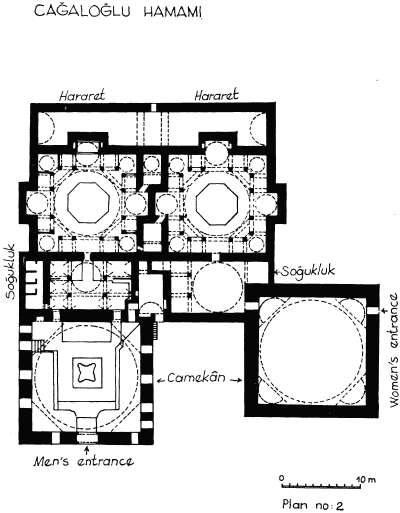
Turkish hamams are the direct descendants of the baths of ancient Rome and are built to the same general plan. Ordinarily, a hamam has three distinct sections. The first is the camekân, the Roman apoditarium, which is used as a reception and dressing room, and where one recovers and relaxes after the bath. Next comes the soğukluk, or tepidarium, a chamber of intermediate temperature which serves as an ante-room to the bath, keeping the cold air out on one side and the hot air in on the other. Finally there is the hararet, or steam-room, anciently called the calidarium. In Turkish baths the first of these areas, the camekân, is the most monumental. It is typically a vast square room covered by a dome on pendentives or conches, with an elaborate fountain in the centre; around the walls is a raised platform where the bathers undress and leave their clothes. The soğukluk is almost always a mere passageway, which usually contains the lavatories. In Cağaloğlu, as in most hamams, the most elaborate chamber is the hararet. Here there is an open cruciform area, with a central dome supported by a circlet of columns and with domed side-chambers in the arms of the cross. In the centre there is a large marble platform, the göbektaşı, or belly-stone, which is heated from the furnace room below. The patrons lie on the belly-stone to sweat and be massaged before bathing at one of the wall-fountains in the side-chambers. The light in the hararet is dim and shimmering, diffusing down through the steam from the constellation of little glass windows in the dome. Lying on the hot belly-stone, under the glittering dome, and lazily observing the mists of vapour condensing into pearls of moisture on the marble columns, one has the voluptuous feeling of being in an undersea palace, in which everyone is his own sultan.
Cağaloğlu, like many of the larger hamams in Istanbul, is a double bath, with separate establishments for men and women. In the smaller hamams there is but a single bath and the two sexes are assigned different days for their use. In the days of old Stamboul, when Muslim women were more sequestered than they are now, the hamam was the one place where they could meet and exchange news and gossip. Even in modern Istanbul the weekly visit to the hamam is often the high point of feminine social life among the lower classes. And we are told by our lady friends that the women of Stamboul still sing and dance for one another in the hararet – another old Osmanlı custom.

Leaving the Cağaloğlu Hamamı, presumably cleansed and purified, we continue on along Hilaliahmer Caddesi for another 100 metres and then turn left on Alay Köşkü Caddesi. About 100 metres along we come on our left to a small mosque with an elegant sebil at the street corner. This mosque and its külliye were built in 1745 by Beşir Ağa, Chief of the Black Eunuchs in the reign of Sultan Mahmut I. In addition to the mosque and sebil, the külliye of Beşir Ağa includes a library, a medrese and a tekke, or dervish monastery. The tekke is no longer occupied by dervishes, of course, since their various orders were banned in the early years of the Republic.
THE SUBLIME PORTE
A block beyond the mosque we come to Alemdar Caddesi, the avenue which skirts the outer wall of Topkapı Sarayı. Just to the left at the intersection we see a large ornamental gateway with a projecting roof in the rococo style. This is the famous Sublime Porte, which in former days led to the palace and offices of the Grand Vezir, where from the middle of the seventeenth century onwards most of the business of the Ottoman Empire was transacted. Hence it came to stand for the Ottoman government itself, and ambassadors were accredited to the Sublime Porte rather than to Turkey, just as to this day ambassadors to England are accredited to the Court of St. James. The present gateway, in which it is hard to discover anything of the sublime, was built about 1843 and now leads to the various buildings of the Vilayet, the government of the Province of Istanbul. The only structure of any interest within the precinct stands in a corner to the right of the gateway. This is the dershane, or lecture-hall of an ancient medrese; dated 1565, it is a pretty little building in the classical style of that period.

Opposite the Sublime Porte, in an angle of the palace wall, is a large polygonal gazebo. This is the Alay Köşkü, the Review or Parade Pavilion, from whose latticed windows the Sultan could observe the comings and goings at the palace of his Grand Vezir. One sultan, Crazy Ibrahim, was said to have used it as a vantage point from which to pick off passing pedestrians with his crossbow. The present kiosk dates only from 1819, when it was rebuilt by Sultan Mahmut II, but there had been a Review Pavilion at this point from much earlier times. From here the Sultan reviewed the great official parades which took place from time to time. The liveliest and most colourful of these was the Procession of the Guilds, a kind of peripatetic census of the trade and commerce of the city which was held every half-century or so. The last of these processions was held in the year 1769, during the reign of Sultan Mustafa II.
It might be worthwhile to pause for a few moments at this historic place to read a description of one of these processions, for it reveals to us something of what Stamboul life was like three centuries ago. This account is contained in the Seyahatname, or Book of Travels, written in the mid-seventeenth century by Evliya Çelebi, one of the great characters of old Ottoman Stamboul. Evliya, describing the Procession of the Guilds which took place in the year 1638, during the reign of Sultan Murat IV, tells us that it was an assembly “of all the guilds and professions existing within the jurisdiction of the four Mollas (Judges) of Constantinople,” and that “the procession began its march at dawn and continued till sunset... on account of which all trade and work in Constantinople was disrupted for a period of three days. During this time the riot and confusion filled the town to a degree which is not to be expressed by language, and which I, poor Evliya, only dared to describe.”
Evliya tells us that the procession was distributed into 57 sections and consisted of 1,001 guilds. Representatives of each of these guilds paraded in their characteristic costumes or uniforms, exhibiting on floats their various enterprises, trying to outdo one another in amusing or amazing the crowd. The liveliest of the displays would seem to have been that of the Captains of the White Sea (the Mediterranean), who had floats with ships mounted on them, in which, according to Evliya, “are seen the finest cabin-boys dressed in gold, doing service to their masters who make free with drinking. Music is played on all sides, the masts and oars are adorned with pearls, the sails are of rich stuffs and embroidered muslin. Arrived at the Alay Köşkü they meet five or ten ships of the Infidels with whom they engage in battle in the presence of the Emperor. Thus the show of a fight is represented with the roaring of cannons, the smoke covering the sky. At last, the Moslems becoming victors, they board the enemy ships, take booty and chase the fine Frank boys, carrying them off from the old bearded Infidels, whom they put in chains, upset the crosses of their flags, dragging them astern of their ships, crying out the universal Moslem shout, Allah!, Allah!”
Besides the respectable tradesmen, artisans and craftsmen of the city, the procession included less savoury groups such as, according to Evliya, “the corporation of thieves and footpads who might be here mentioned as a very numerous one and who have an eye to our purses. But far be they from us. These thieves pay tribute to the two chief officers of the police and get their subsistence by cheating foreigners.”
The last guild in the procession was that of the tavern keepers. Evliya tells us that there were “one thousand such places of misrule, kept by Greeks, Armenians and Jews. In the procession wine is not produced openly, but the inn-keepers pass all in disguise and clad in armour. The boys of the taverns, all shameless drunkards, and all the partisans of wine pass, singing songs, tumbling down and rising again.” The last of all to pass were the Jewish tavern keepers, “all masked and wearing the most precious dresses... bedecked with jewels, carrying in their hands crystal and porcelain cups, out of which they pour sherbet instead of wine for the spectators.”
Evliya then ends his account by stating: “Nowhere else has such a procession been seen or shall be seen. It could only be carried into effect by the imperial orders of Sultan Murat IV. Such is the crowd and population of that great capital, Constantinople, which may God guard from all celestial and earthly mischief and let her be inhabited till the end of the world.” But the last procession of the guilds passed by more than two centuries ago, and the Alay Köşkü now looks down upon a drab and colourless avenue. Nevertheless, the guilds and professions which Evliya so vividly described are still to be seen in the various quarters of the town, looking and behaving much as they did when they passed the Alay Köşkü in the reign of Murat IV.
ZEYNEP SULTAN CAMİİ
Following the Saray wall to the right of the Alay Köşkü we soon come to Soğuk Çeşme Kapısı, the Gate of the Cold Fountain, which leads to the public gardens of Topkapı Sarayı and to the Archaeological Museum. After passing the gate, we continue to follow Alemdar Caddesi, which now bends to the right, leaving the Saray walls. Just around the bend, on the right side of the avenue, we come upon a small baroque mosque, Zeynep Sultan Camii. This mosque was erected in 1769 by the Princess Zeynep, daughter of Ahmet III, and is a rather pleasant and original example of Turkish baroque. In form it is merely a small square room covered by a dome, with a square projecting apse to the east and a porch with five bays to the west. The mosque looks rather like a Byzantine church, partly from being built in courses of stone and brick, but more so because of its very Byzantine dome, for the cornice of the dome undulates to follow the extrados of the round-arched windows, a pretty arrangement generally used in Byzantine churches but hardly ever in Turkish mosques. The little sibyan mektebi at the corner just beyond the mosque is part of the foundation and appears to be still in use as a primary school. The elaborate rococo sebil outside the gate to the mosque garden does not belong to Zeynep’s foundation, but was built by Abdül Hamit I in 1778 as part of the külliye which we passed earlier. The sebil was moved here some years ago when the street past Abdül Hamit’s türbe was widened.
TOWARDS HAGHİA SOPHİA
Just beyond Zeynep Sultan Camii and on the same side of the avenue we see a short stretch of crenellated wall, almost hidden behind an auto-repair shop; this is all that remains of the apse of the once-famous church of St. Mary Chalcoprateia. This church, which is thought to date from the middle of the fifth century, was one of the most venerated in the city, since it possessed as a relic the girdle of the Blessed Virgin. After the Nika Revolt in the year 532, when the church of Haghia Sophia was destroyed, St. Mary’s served for a time as the patriarchal cathedral. It was built on the ruins of an ancient synagogue which since the time of Constantine had been the property of the Jewish copperworkers, hence the name Chalcoprateia, or the Copper Market.
The handsome though forbidding building that occupies most of the opposite side of the avenue here is the Soğuk Kuyu Medresesi. This theological school was founded in the year 1559 by Cafer Ağa, Chief White Eunuch in the reign of Süleyman the Magnificent, and was built by the great Sinan. The hillside slopes quite sharply here, so Sinan first erected a vaulted substructure to support the medrese and its courtyard. The entrance to the medrese is approached from the street running parallel to the west end of Haghia Sophia, where an alleyway leads down to the inner courtyard of the building. The student cells of the medrese are arrayed around the courtyard, with the dershane, or lecture hall, in the large domed chamber to the left as you enter. The medrese now serves as a bazaar of old Ottoman arts and crafts, as well as a restaurant serving traditional Turkish food in a picturesque setting.
Alemdar Caddesi now brings us out into the large square which occupies the summit of the First Hill. On our left we see the great edifice of Haghia Sophia, flanked by a wide esplanade shaded with chestnut and plane-trees. Straight ahead is Sultan Ahmet I Camii, the famous Blue Mosque, its cascade of domes framed by six slender minarets. In front of the Blue Mosque is the At Meydanı, the site of the ancient Hippodrome, three of whose surviving monuments stand in line in the centre of a park. This is the centre of the ancient city, and the starting-point for our next five strolls through Stamboul.