
3

“The church presents a most glorious spectacle, extraordinary to those who behold it and altogether incredible to those who are told of it. In height it rises to the very heavens and overtops the neighbouring houses like a ship anchored among them, appearing above the city which it adorns and forms a part of … It is distinguished by indescribable beauty, excelling both in size and the harmonies of its measures.” So wrote the chronicler Procopius more than 14 centuries ago, describing Haghia Sophia as it appeared during the reign of its founder Justinian I. Haghia Sophia, the Church of the Divine Wisdom, was dedicated by Justinian on 26 December 537. For more than nine centuries thereafter Haghia Sophia served as the cathedral of Constantinople and was the centre of the religious life of the Byzantine Empire. For 470 years after the Turkish Conquest it was one of the imperial mosques of Istanbul, known as Aya Sofya Camii. It continued to serve as a mosque during the early years of the Turkish Republic, until it was finally converted into a museum in 1935. Now, emptied of the congregations which once worshipped there, Christians and Muslims in turn, it may seem just a cold and barren shell, devoid of life and spirit. But for those who are aware of its long and illustrious history and are familiar with its architectural principles, Haghia Sophia remains one of the truly great buildings in the world. And it still adorns the skyline of the city as it did when Procopius wrote of it 14 centuries ago.
The present edifice of Haghia Sophia is the third of that name to stand upon this site. The first church of Haghia Sophia was dedicated on 15 February in the year A.D. 360, during the reign of Constantius, son and successor of Constantine the Great. This church was destroyed by fire on 20 June 404, during a riot by mobs protesting the exile of the Patriarch John Chrysostom by the Empress Eudoxia, wife of the Emperor Arcadius. Reconstruction of the church did not begin until the reign of Theodosius II, who succeeded his father Arcadius in the year 408. The second church of Haghia Sophia was completed in 415 and was dedicated by Theodosius on 10 October of that year. The church of Theodosius eventually suffered the same fate as its predecessor, for it was burned down during the Nika Revolt on 15 January 532.
The chronicler Procopius, commenting on the destruction of Haghia Sophia in the Nika Revolt, observed that “God allowed the mob to commit this sacrilege, knowing how great the beauty of this church would be when restored.” Procopius tells us that Justinian immediately set out to rebuild the church on an even grander scale than before. According to Procopius: “The Emperor built regardless of expense, gathering together skilled work men from every land.” Justinian appointed as head architect Anthemius of Tralles, one of the most distinguished mathematicians and physicists of the age, and as his assistant named Isidorus of Miletus, the greatest geometer of late antiquity. Isidorus had been the director of the ancient and illustrious Academy in At hens before it was closed by Justinian in the year 529. Isidorus, who was placed in charge of the building of Haghia Sophia after the death of Anthemius in the year 532, is thus a link between the worlds of ancient Greece and medieval Byzantium. Just as the Academy of Plato had been one of the outstanding institutions of classical Greek culture, so would the resurrected Haghia Sophia be the symbol of a triumphant Christianity, Byzantine-style.
The new church of Haghia Sophia was finally completed late in 537 and was formally dedicated by Justinian on 26 December of that year, St. Stephen’s Day. Hardly had the church come of age, however, when earthquakes caused the collapse of the eastern arch and semidome and the eastern part of the great dome, crushing beneath the debris the altar with its ciborium and the ambo. Undaunted, Justinian set out to rebuild his church, entrusting the restoration to Isidorus the Younger, a nephew of Isidorus of Miletus. The principal change made by Isidorus was to make the dome somewhat higher than before, thereby lessening its outward thrust. Isidorus’ solution for the dome has on the whole been a great success for it has survived, in spite of two later parti al collapses, until our own day. Restorations after those collapses, in the years 989 and 1346, have left certain irregularities in the dome; nevertheless it is essentially the same in design and substantially also in structure as that of Isidorus the Younger.
The doors of Haghia Sophia were opened once again at sunrise on Christmas Eve in the year 563, and Justinian, now an old man in the very last months of his life, led the congregation in procession to the church. Here is a poetic description of that occasion by Paul the Silentiary, one of Justinian’s court officials: “At last the holy morn had come, and the great door of the newly-built temple groaned on its opening hinges, inviting Emperor and people to enter; and when the interior was seen sorrow fled from the hearts of all, as the sun lit the glories of the temple. ‘Twas for the Emperor to lead the way for his people, and on the morrow to celebrate the birth of Christ. And when the first glow of light, rosy-armed, leapt from arch to arch, driving away the dark shadows, then all the princes and people with one voice hymned their songs of praise and prayer; and as they came to the sacred courts it seemed as if the mighty arches were set in heaven.”
Although Haghia Sophia has been restored several times during the Byzantine and Ottoman periods, the present edifice is essentially that of Justinian’s reign. The only major structural additions are the huge and unsightly buttresses which support the building to north and south. Originally erected by the Emperor Andronicus II Palaeologus in 1317, when the church seemed in imminent danger of collapse, they were restored and strengthened in Ottoman times. The four minarets at the corners of the building were placed there at various times after the Conquest: the south-east minaret by Sultan Mehmet II, the one to the north-east by Beyazit II, and the two at the western corners by Murat III, the work of the great Sinan. The last extensive restorations were commissioned by Sultan Abdül Mecit and carried out by the Swiss architects, the brothers Fossati, in the years 1847–9. As a result of this and later minor restorations and repairs, Haghia Sophia is today structurally sound, despite its great age, and looks much as it did in Justinian’s time.
THE CHURCH
The original entrance to Haghia Sophia was at its western end, where the church was fronted by a great atrium, or arcaded courtyard, now vanished. The present entrance to the precincts of Haghia Sophia brings one in through the southern side of this atrium, now a garden-courtyard filled with architectural fragments from archaeological excavations in Istanbul. From the eastern side of this atrium five doorways gave entrance to the exonarthex, or outer vestibule, and from there five more doorways led to the inner vestibule, the narthex. The central and largest door from the atrium to the exonarthex was known as the Orea Porta, or the Beautiful Gate, and was reserved for the use of the Emperor and his party. (Just to the left of this portal one can see the excavated entryway to the so-called Theodosian church, the predecessor of the present edifice, which is described in the section on the Precincts of Haghia Sophia.) In addition to the Orea Porta, the Emperor also used an entryway which led into the southern end of the narthex, where the present public exit from the edifice is located, passing through a long and narrow passageway which in Byzantium was called the Vestibule of the Warriors. Here according to the Book of Ceremonies, the manual of Byzantine court-ritual, the Emperor removed his sword and crown before entering the narthex, and here the troops of his bodyguard waited until his return.
While passing through the vestibule we should notice the gold mosaics glittering on the dark vault; these are part of the original mosaic decoration from Justinian’s church. The great dome, the semidomes, the north and south tympana and the vaults of narthex, aisles and gallery – a total area of more than four acres – were covered with gold mosaics, which, according to the Silentiary, resembled the midday sun in spring gilding the mountain heights. It is clear from his description and that of Procopius that in Justinian’s time there were no figural mosaics in the church. A great deal of the Justinianic mosaic still survives – in the vaults of the narthex and the side aisles, as well as in the 13 ribs of the dome of Isidorus which have never fallen. It consists of large areas of plain gold ground, adorned round the edges of architectural forms with bands of geometrical or floral designs in various colours. Simple crosses in outline on the crowns of vaults and the soffits of arches are constantly repeated, and the Silentiary tells us that there was a cross of this kind on the crown of the great dome. This exceedingly simple but brilliant and flashing decoration must have been very effective indeed.
Whatever figural mosaics may have been introduced into the church after Justinian’s time were certainly destroyed during the iconoclastic period, which lasted from 729 till 843. The figural mosaics which we see in Haghia Sophia today are thus from after that period, although there is far from being unanimous agreement among the experts as to the exact dates. Most of them would appear to belong to the second half of the ninth century and the course of the tenth century, although some are considerably later.
In the lunette above the doorway at the inner end of the Vestibule of the Warriors, we see one of the two mosaic panels which were rediscovered in 1933, after having been obscured for centuries by whitewash and plaster. Since that time other mosaics in the nave and gallery have been uncovered and restored, and their brilliant tesserae now brighten again the walls of Haghia Sophia, reminding us of the splendour with which it was once decorated throughout. The mosaic in the Vestibule of the Warriors is thought to date from the last quarter of the tenth century, from the reign of Basil II, the Bulgar-Slayer. It depicts the enthroned Mother of God holding in her lap the Christ-Child, as she receives two emperors in audience. On her right “Constantine the Great Emperor among the Saints” offers her a model of the city of Constantinople; while “Justinian the illustrious Emperor” on her left presents her with a model of Haghia Sophia: neither model remotely resembles its original!
We now enter the narthex, a long vestibule of nine vaulted bays. Five great doors on the left lead to the exonarthex and nine on the right give entrance to the nave. Many of these doors are splendid and interesting and most of them appear to date from the time of Justinian. The monumental central door to the nave was known anciently as the Imperial Gate. The frame of the door is covered with brass, replacing the silver with which it was sheathed in the days of Justinian, and is surmounted by a casket-like cornice in brass. According to an old Byzantine legend, the doors of the Imperial Gate were made of wood which had originally been part of Noah’s Ark and the cornice was the sarcophagus of St. Eirene.
In the lunette above the Imperial Gate we see the second of the two mosaics which were uncovered in 1933. The mosaic shows Christ seated upon a jewelled throne, his feet resting on a footstool. He raises his right hand in a gesture of blessing, and in his left he holds a book in which we may read this inscription in Greek: “Peace be with you. I am the Light of the World.” On Christ’s right an emperor prostrates himself, his hands outstretched in supplication. Above, on either side of the throne, are two roundels: the one above the emperor containing a bust of the Blessed Virgin; that on the other side, an angel carrying a staff or wand. It is thought that the imperial figure represents the Emperor Leo VI, the Wise, and the mosaic is dated to the period of his reign, 886–912. If so, it is probable that the Emperor is pleading with Christ to forgive him for what Gibbon so aptly called “the frequency of his nuptials.” For the Emperor had lost his first three wives without producing a male heir, and wished to take a fourth mate, ordinarily forbidden by the Orthodox Church. After a long and bitter dispute, the famous Scandal of the Tetragamy, Leo finally obtained permission to marry his mistress, Zoe, and legitimized his bastard son, the future Constantine VII Porphyrogenitus. Although the affair of the Tetragamy may have scandalized Byzantium, we are fortunate that it was resolved in Leo’s favour. For his son Constantine would later write the Book of Ceremonies, which recreates the pomp and splendour of the rituals and liturgies performed in Haghia Sophia in the days of Byzantium.
The Imperial Gate was reserved for the use of the Emperor and his procession, which passed through there into the nave of the church. According to the Book of Ceremonies: “The princes remove their crowns, kiss the holy Gospel carried by the archdeacon, greet the patriarch and proceed to the Imperial Gate. Bearing the candles and bowing thrice, they enter the church after a prayer is pronounced by the patriarch.”
As we walk through the Imperial Gate into the nave, we notice the deep hollows worn into the pavement on either side of the entrance. We learn from the Book of Ceremonies that in the days of Byzantium the imperial chamberlains called praepositii stood there, and we are reminded once again of the great antiquity of this place.
The first and abiding impression created by the interior of Haghia Sophia is that of a vast contained space, pierced by shafts of moted sunlight. Walking forward, we can now see the whole of the immense interior at once and appreciate its beauty and its grandeur: the fabled dome, which the ancients pictured as being suspended from heaven by a golden chain; the enormous expanse of the nave, its central area flanked by the graceful two-tiered colonnade which Procopius likened to a line of dancers in a chorus; all elements of the vast structure interrelated in perfect harmony.
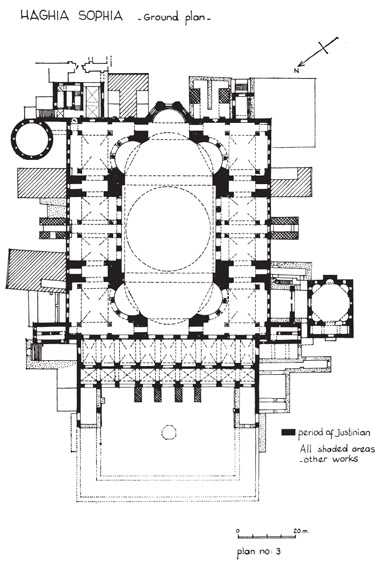
Justinian and his architects, Anthemius and Isidorus, chose to disregard the plan or the earlier churches on this site and, indeed, all earlier plans of which any trace or record has come down to us. The essential structure of their astonishingly original building can be briefly described. Four enormous and irregularly shaped piers, built of ashlar stone bound together with lead, stand in a square approximately 31 metres on a side. From these piers rise four great arches between which four pendentives make the transition from square to circle. Upon the cornice of the circle so formed rests the slightly elliptical dome, of which the east-west diameter is about 31 metres, the north-south diameter about 33 metres, the crown being 56 metres above the floor – that is, about the height of a 15-storey building. The dome has 40 ribs which radiate out from the crown, separated at the base by 40 windows, of which four towards the west were blocked up during repairs in the tenth century. To east and west, pairs of subsidiary piers support the two great semidomes, each with five windows, which give the nave its vast length, a full 80 metres. The central arches to north and south are filled with tympanum walls pierced by 12 windows, seven in the lower row, five in the upper, of which the three central ones originally formed a kind of triple arcade. All these windows have in Turkish times been considerably reduced in size, probably by the architect Sinan in the sixteenth century. Between the great piers on the north and south, four monolithic columns of verd antique support the galleries, while above six columns of the same type carry the tympana. At the eastern and western ends, to north and south, semicircular exedrae prolong the nave, with two massive monolithic columns of porphyry below and six of verd antique above, on which rest smaller semidomes. At the east, beyond the subsidiary piers, a semicircular apse projects beyond the east wall; it too is covered by a semidome or conch. Finally, four great buttresses projecting from the north and south walls opposite the central piers help to consolidate the whole fabric.
If the plan is to all intents and purposes that of a basilica, the originality consists in covering it with a dome and two semidomes. Glorious as is the dome, it is the introduction of the semidomes which constitutes the real triumph of genius. For in addition to lengthening the nave, they make it possible to appreciate from the very threshold the soaring, hovering height; they allow the dome, in short, to play its true and full part in the total effect. Contrast the relative ineffectiveness of such a dome as that of St. Peter’s, from which radiate barrel-vaults along the axes of the building. That dome, though higher and somewhat greater in diameter than Haghia Sophia’s, is almost insignificant, for it can only be seen when one is very nearly underneath it, so that one must crane back one’s neck to get a view of it at all. How very different here, where from every point of view the dome dominates the whole interior!
THE COLUMNS AND MARBLES
Much has been written about the provenance of the various columns in the church. The Anonymous of Banduri, that Baron Munchausen among Byzantine writers, is the chief source of various legends that have grown up and are still repeated about where the great columns of the nave came from: the Temple of the Sun at Heliopolis, some buildings at Rome, the Temple of Diana at Ephesus, or one of those at Baalbec, the tales differ with the tellers. But there seems to be no foundation for these stories and there is every reason to believe that most of the columns, if not all, were specially quarried for Haghia Sophia. From the Silentiary’s description, there can be little doubt that the eight monolithic verd antique columns of the nave, the 16 columns of the aisles, the 40 columns of the gallery arcade, and all the other verd antique of the building were expressly hewn for Haghia Sophia from the famous quarries in Thessaly near Molossis. But about the eight porphyry columns in the exedrae, there is a problem, for there is some evidence that the porphyry mountain at Djebel Dochan near Thebes had ceased to be quarried in the fifth century. If this is true, the eight exedra columns – which, by the way, differ very appreciably in height and diameter – must have been taken from some older building. But there is no evidence to connect them to any particular ancient building; we simply do not know where they came from.
The only other kind of marble used for columns in the church is that from the island of Proconnesus in the Marmara. It is a soft white, streaked with grey or black, and is used for the 24 aisle columns of the gallery and the eight rectangular pillars at the ends of the ground floor aisles. The floor of the church, too, the frames of doors and windows, and parts of the wall surfaces are also of this marble. It is very common to this day in Istanbul, and is used for everything from tombstones to toilets.
For the superb revetment of the piers and walls, a great variety of rare and beautiful marbles was used. Besides those already discussed, the Silentiary mentions at least eight different varieties: the deep green porphyry from Mount Taygetus near Sparta; a “fresh green” from Carystus in the island of Euboea; the rose-red Phyrygian marble from Synnada and a variegated one from Hierapolis in Asia Minor; “Iassian, with slanting veins of blood red on livid white,” probably from Lacedaemon; a marble “of crocus yellow glittering like gold,” from Simittu Colonia near Tunis; and one from the Pyrenees, “the product of the Celtic crags, like milk poured on a flesh of glittering black”; and finally the precious onyx, like alabaster honey-coloured and translucent. In order to obtain the elaborate symmetrical patterns of each panel, the thin blocks of marble were sawn in two, sometimes in four, and opened out like a book so that the natural veining of the stone was reduplicated, very much like the ink blots of a Rorschach test. And spectators, both ancient and modern, respond as patients do to the Rorschach test by finding in the veined panels likenesses of men and animals, devils and angels, giving form to the ghosts and legends which attach themselves to every stone of this ancient building.
Other types of decoration in rare marbles are also found in the church. The great square of opus Alexandrinum in the pavement towards the south-east of the nave always attracts attention. It is chiefly composed of circles of granite, red and green porphyry and verd antique. According to Antony, Bishop of Novgorod, who visited the church in 1200, the Emperor’s throne stood upon this square, surrounded by a bronze enclosure. There are some equally interesting marble panels above the imperial door: slabs of verd antique alternate with inlaid panels of various marbles. At the top is an elaborate ciborium with drawn curtains revealing a cross on an altar; lower down are other panels with ovals of porphyry, those at the bottom surrounded by pairs of stylized dolphins with foliate tails gobbling up tiny squid with waving tentacles. Finally, in the spandrels above the nave and gallery arcades is a rich and magnificent frieze of sectile work with scrolls of leaves and flowers, and birds “perched on the twigs”.
The capitals of the columns are famous and splendid. There are several different types, but all are alike in having the surface decoration of acanthus and palm foliage deeply undercut so that they produce an effect of white lace on a dark ground; it is possible that they were once gilded. The commonest of the capitals – those of the nave and gallery arcades – are generally known as the bowl type: Ionic volutes support a decorated abacus beneath which the bowl-shaped body of the capital is adorned with acanthus leaves, in the centre of which in front and back is a medallion containing a monogram. These monograms are extremely tricky to read, but when deciphered they give the names Justinian and Theodora and the titles Basileus and Augusta. The capitals of the 16 verd antique columns of the aisles are of similar type but smaller in scale. Those of the eight rectangular pillars at the ends of the aisles are closely related, only here the bowl, instead of becoming circular towards its base, remains square throughout since the column itself is square. One of these rectangular pillars, the north-west one in the north aisle, is the subject of ancient legend. Antony of Novgorod reports it thus: “One sees at the side the column of St. Gregory the Miracle-Worker, all covered with bronze plates. St. Gregory appeared near this column, and the people kiss it and rub their breasts and shoulders against it to be cured of their pains.” Centuries of credulous pilgrims have worn a hole in the metal plate and into the column itself, for the moisture contained in the cavity has always been considered specific against eye diseases and a nostrum for fertility. It is often said that the moisture in this little hole is drawn up through the column from the cisterns supposed to be under the church. But these cisterns are themselves a legend, for a recent study has shown that they do not exist.
THE MOSAICS IN THE NAVE
Little now remains of the mosaics which once adorned the nave of Haghia Sophia. The largest and most beautiful of those which have survived is contained in the conch of the apse. This mosaic depicts the Mother of God with the Christ-Child on her knees; she is dressed in flowing robes of blue with a small cross on the fold of the mantle over her head and one on each shoulder; her right hand rests on the Child’s shoulder and her left upon his knee. The Child is dressed in gold and wears sandals on his feet; his right hand is raised in blessing while his left holds a scroll. The Virgin sits on a simple bench-like throne adorned with jewels; under her are two cushions, the lower green, the upper embroidered with clubs like those on playing cards; beneath her feet is a plinth-like footstool, also bejewelled. At the bottom of the arch which frames the apse we see a colossal figure of the Archangel Gabriel; he wears a divitision, or undergarment, over which is thrown a chlamys, or cloak of white silk; his great wings, reaching nearly to his feet, are of brightly-coloured feathers, chiefly green, blue and white. In his right hand he holds a staff, in his left a crystal globe through which can be seen his thumb. Although the upper part of his left side and the top of his right wing are lost, he is nevertheless a fine and striking figure. Opposite, on the north side of the arch, can be seen only a few sad feathers of the wings of the Archangel Michael. Finally, on the face of the apse conch we read the first three and the last nine letters of an inscription in Greek, of which the whole of the middle part is now missing. The inscription was an iambic distich which once read in full: “These icons the deceivers once cast down / The pious emperors have again restored.” The apse mosaic was first unveiled by the Patriarch Photius on Easter Sunday in the year 867: a most momentous occasion, for it signified the final triumph of the Orthodox over the Iconoclasts, and celebrated the permanent restoration of sacred images to the churches of Byzantium. The two pious sovereigns referred to here are Michael III, the Sot, and his protege, Basil I, whom Michael had made co-emperor the previous May, and who would the following September murder his benefactor and usurp the throne for himself.
Three other mosaic portraits are located in niches at the base of the north tympanum wall and are visible from the nave. They portray three sainted bishops of the early church. In the first niche from the west we have St. Ignatius the Younger, in the central niche St. John Chrysostomos, and in the fifth from the west St. Ignatius Theophorus. All three figures are nearly identical except for the faces; each is clad in sacerdotal robes, the most striking item of which is the wide omophorion, or stole, with two large crosses below the shoulders and a third just below the knee; each holds in his left hand, which is concealed below his cloak, a large book with bejewelled binding; the younger St. Ignatius appears to be touching the top of the book with his right hand, while the other two have their right hands raised in blessing. The faces get older the farther east one goes: the first Ignatius, as his name suggests, is a young man but with a very ascetic face; St. John is in early middle age and his small, compressed lips hardly suggest the”Golden Mouth” from which he receives his name, Chrysostomos; St. Ignatius Theophorus is an old man with white hair and a beard. Chrysostomos and the elder Ignatius were two of the most powerful and contentious patriarchs in the history of Byzantium; each would have seen both Church and Empire wrecked rather than compromise his principles. It was said of Chrysostomos in his time that “he was merciless to sin but full of mercy for the sinner.”
The only other mosaics which are visible from the nave are the famous six-winged seraphim or cherubim in the eastern pendentives. (Those in the western pendentives are imitations in paint done by the Fossatis at the time of their restorations in 1847–9.) These have never been covered; we see them in pictures of Haghia Sophia across the centuries, hovering eerily over the nave. Evliya Çelebi believed them to be talismans, albeit moribund ones, as he tells us in his Seyahatname: “Before the birth of the Prophet these four angels used to speak, and gave notice of all the dangers which threatened the Empire and the city of Istanbul; but since his highness appeared all talismans have ceased to act.” Their faces are sometimes exposed, sometimes covered, most recently by the Fossatis’ gold-starred medallions, which are still in place. Unfortunately, these mosaics have not yet been cleaned and restored and are a bit dirty and discoloured. It is not certain whether these heavenly creatures are intended to be seraphim or cherubim; the former are said by Isaiah to have, like these, six wings: “With twain he covered his face, and with twain he covered his feet, and with twain he did fly,” while Ezekiel informs us that cherubim had only four (or eight) wings. But as Cyril Mango amusingly shows, Byzantine artists do not seem to have understood or observed the distinction between the two Orders; he suggests that perhaps we have here one of each. As to date, Mr. Mango points out that since both pendentives were largely destroyed in the collapse of 1346, the mosaics must be subsequent to that time; they doubtless belong to the period of restoration after the collapse, between 1346 and 1355. But they certainly replace, and may closely copy, older mosaics of the same subject.
THE GALLERIES
All of the remaining mosaics are in the galleries and in the rooms adjacent to them. The public entryway to the galleries is at the northern end of the narthex, where an inclined labyrinth leads us to the angle of the western and northern galleries. Before we examine the mosaics we might walk to the central or western gallery, from whence we can orient ourselves and enjoy a splendid view of the nave. Just next to the balustrade at the centre of this gallery we see the spot where the throne of the Empress was located; it is marked by a disc of green Thessalian marble set into the pavement and framed by a pair of coupled columns in green marble. Although Procopius and the Silentiary tell us that in their time the entire gallery was used as the women’s quarter, or gynaeceum, it appears that in later centuries most of the southern gallery was reserved for the use of the royal family, and, on occasion, for synods of the Orthodox Church.
Let us now return to the northern gallery, where the earliest of the visible mosaics is located. This mosaic, the last of those in the church to be uncovered and restored, is found high on the east face of the north-west pier. This panel represents the Emperor Alexander, who came to the throne in May of the year 912, succeeding his elder brother, Leo VI. “Here comes the man of thirteen months,” said Leo with his dying breath, as he saw his despised brother coming to pay his last respects. This cynical prophecy was fulfilled in June of the following year, when Alexander died of apoplexy during a drunken game of polo. This mosaic portrait must surely have been done during Alexander’s brief reign, for so incompetent and corrupt was this mad and alcoholic despot that no one would have honoured him other than in the single year when he was sole ruler. Alexander’s portrait shows him standing full length, wearing the gorgeous ceremonial costume of a Byzantine emperor: crowned with a camelaucum, a conical, helmet-shaped coronet of gold with pendant pearls; draped in a loros, a long, gold-embroidered scarf set with jewels; and shod in gem-studded crimson boots. Four medallions flanking the imperial figure bear this legend: “Lord help thy servant, the orthodox and faithful Emperor Alexander.”
On the west face of the same pier we find one of the most elaborate of the many graffiti which are carved on the walls of Haghia Sophia; it shows a medieval galleon under full sail. Anyone who has ever sat through the whole of a long Greek Orthodox service can appreciate how the artist had plenty of time to complete this sketch. Most of the other graffiti consist merely of names and dates, many of them carved on the marble balustrade. On the inner balustrade of the north gallery we find this inscription: “Place of the most noble Patrician, Lady Theodora.” A short distance farther along there is one which reads: “Timothy, Keeper of the Vessels.” What was Timothy doing in the gynaeceum, we wonder?
We now retrace our steps to view the other visible mosaics, all of which are located in the southern gallery. Before we turn into the gallery, we might pause for a moment at a closed door in the south end of the central gallery. This door leads into a large chamber directly over the Vestibule of the Warriors, and this in turn leads into a suite of rooms on either side. These rooms contain a large number of mosaics, which are thought to date from the second half of the ninth century, just after the end of the iconoclastic period. These fascinating rooms are almost certainly the large and small secreta of the Patriarchal Palace, which adjoined Haghia Sophia to the south. Unfortunately, they are not open to the public.
In the south gallery, between the western pier and buttress, there stretches a marble screen in the form of two pairs of false double doors with elaborately ornamented panels, the so-called Gates of Heaven and Hell. Between them is the actual doorway with a slab of translucent Phrygian marble above it; a sculpted wooden beam forms a kind of cornice to the whole. Neither the date nor the purpose of this screen is known. It is certainly not an original part of the church but a later addition, and it has been suggested that it may have been erected to screen off the portion of the south gallery used for Church synods.
The second in date of the imperial portraits is located at the east end of the south gallery, next to the apse; it depicts the famous Empress Zoe and her third husband, Constantine IX Monomachos. At the centre of the composition we see the enthroned figure of Christ, his right hand raised in a gesture of benediction, his left holding the book of Gospels. On Christ’s right stands the Emperor holding in his hands the offering of a money bag, and to his left is the Empress holding an inscribed scroll. Above the Emperor’s head an inscription reads: “Constantine, in Christ the Lord Autocrat, faithful Emperor of the Romans, Monomachus.” Above the head of the Empress we read: “Zoe, the most pious Augusta.” The scroll in her hand has the same legends as that over the Emperor’s head, save that the words Autocrat and Monomachus are omitted for want of space.
Now the curious thing about this mosaic is that all three heads and the two inscriptions concerning Constantine have been altered. A possible explanation for this is furnished by a review of the life and loves of the extraordinary Empress Zoe, daughter of Constantine VIII and one of the few women to rule Byzantium in her own right. A virgin till the age of 50, Zoe was then married by her father to Romanus Argyros so as to produce a male heir to the throne. Though it was too late for Zoe to produce children, she enjoyed her new life to the full, taking a spectacular series of lovers in the years that were left to her. After the death of her first husband, Romanus III (r. 1028–34), Zoe married Michael IV (r. 1034–41), and after his death she wed Constantine IX (r. 1042–55). It has been suggested that the mosaic in the gallery of Haghia Sophia was originally done between 1028 and 1034 and portrayed Zoe with her first husband, Romanus III, and that the faces were destroyed during the short and fanatically anti-Zoe reign of Michael V, the adopted son of the Empress. When Zoe ascended the throne in 1042 with her third husband, Constantine IX, she presumably had the faces restored, substituting that of Constantine for Romanus and altering the inscriptions accordingly. Zoe died in 1050, aged 72; Michael Psellus tells us that to the end, though her hand trembled and her back was bent with age, “her face had a beauty altogether fresh.” So she still appears today in her mosaic portrait in Haghia Sophia.
The third and last of the imperial portraits is just to the right of the one we have been dealing with. Here we see the Mother of God holding the infant Christ; to her right stands an emperor offering a bag of gold and to her left a red-haired empress holding a scroll. The imperial figures are identified by inscriptions as: “John, in Christ the Lord faithful Emperor, Porphyrogenitus and Autocrat of the Romans, Comnenus”, and “Eirene, the most pious Augusta.” The mosaic extends onto the narrow panel of side wall at right angles to the main composition; we see there the figure of a young prince, identified by an inscription as “Alexius, in Christ, faithful Emperor of the Romans, Porphyrogenitus.” These are the portraits of the Emperor John II Comnenus (r. 1118–43); his wife, the Empress Eirene, daughter of King Ladislaus of Hungary; and their eldest son, Prince Alexius. The main panel has been dated to 1118, the year of John’s accession, and the portrait of Alexius to 1122, when at the age of 17 he became co-emperor with his father. Young Alexius did not live to succeed John, for he died not long after his coronation; we can almost see the signs of approaching death in his pale and lined features. The Emperor was known in his time as Kalo John, or John the Good. The Byzantine historian Nicetas Choniates wrote of John that “he was the best of all the emperors from the family of the Comneni who ever sat upon the Roman throne.” Eirene was noted for her piety and for her kindness to the poor, for which she is honoured as a saint in the Orthodox Church. John and Eirene were full of good works; together they founded the monastery of the Pantocrator, the triple church of which is still one of the principal monuments on the Fourth Hill of the city.
The latest in date of the mosaics in the gallery is the magnificent Deesis, which is located in the east wall of the western buttress in the south gallery. This mosaic, one of the very greatest works of art produced in Byzantium, is thought to date from the beginning of the fourteenth century. It is a striking illustration of the cultural renaissance which took place in Constantinople after the restoration of the Byzantine Empire by Michael VIII Palaeologus in 1261. Although two-thirds of the mosaic is now lost, the features of the three figures in the portrait are still completely intact and unmarred. Here we see Christ flanked by the Virgin and St. John the Baptist; they lean towards him in suppliant attitudes, pleading, so the iconographers tell us, for the salvation of mankind. John looks towards Christ with an expression of almost agonized grief on his face, while the young and wistful Virgin casts her gaze shyly downwards. Christ, holding up his right hand in a gesture of benediction, looks off into space with a look of sadness in his eyes, appearing here as if he partook more of the nature of man than of God, whatever the medieval theologians may have decided about him. The Deesis is a work of great power and beauty, a monument to the failed renaissance of Byzantium and its vision of a humanistic Christ.
Set into the pavement just opposite to the Deesis is the tomb of the man who ruined Byzantium. Carved in Latin letters on the broken lid of a sarcophagus there, we see the illustrious name, HENRICUS DANDALO. Dandalo, Doge of Venice, was one of the leaders of the Fourth Crusade and was the one chiefly responsible for persuading the Latins to attack Constantinople in the years 1203–4. After the final capture of Constantinople on 13 April 1204, Baldwin of Flanders was crowned in Haghia Sophia as Emperor of Rumania, as the Latins called the portion of the Byzantine Empire which they had conquered. But the Latin Emperor did not reign supreme even in his capital city, for three-eighths of Constantinople, including the church of Haghia Sophia, was awarded to the Venetians and ruled by Dandalo. The old Doge now added the title of Despot to his name and thereafter styled himself “Lord of the fourth and a half of all the Roman Empire.” But proud Dandalo had little time to lord it over his fractional kingdom, for he died the following year, 16 June 1205, and was buried in the gallery of Haghia Sophia. After the Conquest, according to tradition, Dandalo’s tomb was broken open and his bones thrown to the dogs.
After the Palaeologian renaissance of the thirteenth and fourteenth centuries the fortunes of the Empire declined rapidly, and in the last decades of Byzantine rule Haghia Sophia shared in the general decay of the dying capital. Travellers to Constantinople in that period report that the church showed signs of grievous neglect and was beginning to fall into ruins. Then, towards the very end, Haghia Sophia was all but deserted by its congregation, who stayed away in protest over the Emperor’s attempted union with the Church of Rome. The people of the city began returning to their church only in the very last days before Constantinople fell to the Turks, when doctrinal differences no longer seemed important, not even to a Byzantine.
The final Christian liturgy in Haghia Sophia began shortly after sunset on Monday 28 May 1453. The Emperor Constantine XI Dragases arrived in Haghia Sophia an hour or so before midnight, and there made his peace with God before returning to his post on the city walls. The prayers continued in Haghia Sophia throughout the night, and the church filled with crowds of refugees as the sound of the Ottoman artillery grew more intense. Shortly after dawn word came that the defence walls had been breached and that the city had fallen. Then the doors of the church were barred and the congregation huddled inside, praying for a miraculous deliverance which never came. Soon afterwards the vanguard of the Turkish soldiery forced its way into Haghia Sophia, bringing to an end the last tragic hour of Byzantium.
THE CHURCH AS A MOSQUE
Sultan Mehmet the Conqueror entered the city late in the afternoon of that same day, Tuesday 29 May, and rode slowly through the streets of the city to Haghia Sophia. He dismounted at the door of the church and bent down to take a handful of earth, which he then sprinkled over his turban as an act of humility before God. Let us read Evliya Çelebi’s account of this historic occasion: “Sultan Mehmet II, on surveying more closely the church of Aya Sofya, was astonished at the solidity of its construction, the strength of its foundations, the height of its cupola, and the skill of its builder. He caused the ancient building to be cleared of its idolatrous objects and purified from the blood of the slain, and having refreshed the brains of the victorious Moslems by fumigating it with amber and lion-aloes, converted it that very hour into a mosque.”
Immediately after the Conquest, Sultan Mehmet thoroughly repaired the fabric of Haghia Sophia. Later sultans refurbished and adorned the interior of the building in various ways, so as to restore something of its ancient beauty. Evliya Çelebi describes some of these benefactions: “Sultan Murat III brought from the island of Marmara two princely basins of white marble, each of them resembling the cupola of a bath. They stand inside the mosque, full of living water, for all the congregation to perform their ablutions and quench their thirst. The same sultan caused the walls of the mosque to be cleansed and smoothed; he increased the number of lamps and built four raised stone platforms for the readers of the Kuran, and a lofty pulpit on slender columns for the müezzins. Sultan Murat IV, the Conqueror of Baghdad, raised upon four marble columns a marble throne for the preacher.”
All of these objects can still be seen in the nave of Haghia Sophia, along with the gifts of later sultans. The two lustration urns which Evliya mentions are located in the western exedrae. They are late classical or early Byzantine urns to which have been added Turkish lids. An English traveller in the seventeenth century reported that they were always kept full of water “to cool the Mohammedans overheated by their pious gesticulations.” The marble preacher’s throne is located in the middle of the northern arcade. The four marble platforms for the readers of the Kuran are the large one next to the south-east pier and the three smaller ones that are built up against the other piers. The most noteworthy of the later Ottoman additions are the very elegant library built beyond the south aisle by Sultan Mahmut I in 1739, and the imperial loge to the left of the apse, constructed by the Fossatis for Sultan Abdül Mecit in 1847–9.
Of the Fossatis’ decorations the most obtrusive and regrettable are the eight huge green levhas, or medallions, which hang from the piers at gallery level. These were done by the calligrapher Mustafa Izzet Efendi and contain in golden letters the Holy Names; that is, those of Allah, the Prophet Muhammed, and the first Caliphs and Imams. The great inscription in the dome is also by Mustafa Izzet Efendi. This replaces an earlier inscription with the same text, Surah 24:35 from the Kuran.
For a vivid picture of what Haghia Sophia was like as a mosque we turn to the Seyahatname, where Evliya Çelebi describes the building as it was in the reign of Sultan Murat IV, in the middle of the seventeenth century. From Evliya’s description we see that Haghia Sophia partook once again of the glories of the age, just as it had 11 centuries before in the reign of Justinian:
This mosque, which has no equal on earth, can only be compared to the tabernacle of the seventh heaven, and its dome to the cupola of the ninth. All of those who see it remain lost on contemplating its beauties; it is the place where heavenly inspiration descends into the minds of the devout and which gives a foretaste even here below of the Garden of Eden. Sultan Murat IV, who took great delight in this incomparable mosque, erected a wooden enclosure within it near the southern door, and when he went to prayer on Friday caused cages containing a great number of singing birds, and particularly nightingales, to be hung there, so that their sweet notes, mingled with those of the müezzins’ voices, filled the mosque with a harmony approaching to that of paradise. Every night in the month of Ramazan, the two thousand lamps lighted there and the lanterns containing wax tapers perfumed with camphor pour forth streams of light upon light; and in the centre of the dome a circle of lamps represents in letters as finely formed as those of Yakut Musta’sime, that text of the Kuran: “God is the light of the heavens and of the earth.”
And so, for nearly five centuries after the Conquest, Haghia Sophia served the faithful Muslims of the city, just as it had served devout Christians for more than nine centuries before the Fall. These words which Evliya Çelebi wrote of Haghia Sophia would have been a true description of it in either period, as church or mosque: “Aya Sofya is in itself, peculiarly the place of God. It is always full of holy men who pass the day there in fasting and the night in prayer. Seventy lectures well pleasing to God are given there daily, so that to the student it is a mine of knowledge, and it never fails to be frequented by multitudes every day.”
THE PRECINCTS OF HAGHİA SOPHİA
Something of the reverence which was accorded to Haghia Sophia in Ottoman times can be gathered from the fact that five sultans are buried in its precincts. These royal sepulchers are located in the garden just to the south of Haghia Sophia. The oldest of these structures is the türbe of the two mad sultans, Mustafa I and Ibrahim, who ruled briefly in the first half of the seventeenth century. This building, which stands at the south-west corner of Haghia Sophia, just to the right of the entrance, was formerly the Baptistry, and is part of the original structure of Justinian’s church. We learn from Evliya Çelebi that when Mustafa I died in 1623 no place had been prepared for his burial and on the suggestion of Evliya’s father it was decided to turn the Baptistry into a türbe for the dead sultan. Beside Mustafa lies his nephew, Crazy Ibrahim, who ruled from 1640 till 1648. Evliya tells us that Ibrahim’s tomb was much visited by women, “because he was much addicted to them.” But, alas, the women of Stamboul can no longer visit the tomb of Crazy Ibrahim, because the Baptistry is not open to the public.
The other imperial türbes are located in the garden beside the Baptistry; all of these are open to the public. The earliest in date is that of Sultan Selim II, which was completed in 1577. This türbe is important because it is a work of the great Ottoman architect Sinan, and also because both the exterior entrance façade and the whole of the interior are covered with superb Iznik tiles. The building is square, with an outer dome resting directly on the exterior walls; within, a circlet of columns supports an inner dome. The largest of the catafalques which we see there covers the grave of Selim II, who became sultan in 1566, after the death of his father, Süleyman the Magnificent. As Evliya Çelebi wrote of him: “He was an amiable monarch, took much delight in the conversations of poets and learned men, and indulged in wine and gaiety. He was a sweet-natured sovereign but much given to women and wine.” Selim II died in 1574 at the age of 54, after having fallen in his bath while in a drunken stupor. Beside Selim’s catafalque we see that of his favourite wife, Nurbanu. Arrayed around them are the tiny catafalques covering the graves of five of Selim’s sons, three of his daughters, and 32 children of his son and successor, Murat III. Selim’s sons were murdered on the night of 21 December 1574, assassinated according to Ottoman law, to ensure the peaceful accession of Murat, the eldest son.
Murat’s own türbe stands just beside that of his father; it was completed in 1599 by Davut Ağa, the successor to Sinan as Chief of the Imperial Architects. It is hexagonal in plan, also with a double dome, and is adorned with Iznik tiles comparable in quality to those in Selim’s türbe. The türbe contains the remains of Murat III as well as those of his favourite wife, Safiye, four of his lesser concubines, 23 of his sons and 25 of his daughters. The Sultan himself died on 16 January 1595, when he was only in his 49th year. Murat’s türbe was not finished at the time of his death and so his coffin was placed under a tent in the garden of Haghia Sophia. The following morning 19 more coffins were placed there around him, for that night all but one of his surviving sons were executed to ensure the succession of the heir, Mehmet III. This was the last application of what Evliya called the bloody code of the Ottomans; thenceforth the younger brothers of a succeeding sultan were confined in the Saray rather than murdered.
Built up against Murat’s türbe is the little building called the Türbe of the Princes, which contains only the tiny catafalques of five sons of Murat IV. These five princelings died natural deaths, succumbing to one of the many plagues which ravaged the Harem.
The latest in date of the türbes in this necropolis beside Haghia Sophia is that of Mehmet III, son and successor of Murat III. This türbe is octagonal in plan and, like the others, is covered with superb Iznik tiles. Mehmet became sultan in the year 1595 and ruled for only eight years, dying in 1603 at the age of 36. Like his father and his grandfather before him, Mehmet’s world was bounded by the walls of the Harem. Even there he was of no great distinction and sired only 11 children, barely a tenth the homeric output of his father, who is officially credited with 103 offspring. Nine of Mehmet’s children are buried with him, as is his favourite wife, Handan. Mehmet and his family hardly half fill the türbe, leaving room for 16 daughters of Murat III, all of whom died of plague in the same year, 1598.
The other Ottoman structures in the precincts of Haghia Sophia are of minor importance. The building just to the left of the entrance is a primary school built by Sultan Mahmut I in 1740. It is very typical of the little Ottoman one-room schoolhouses of that period, consisting of just a porch and a square chamber covered by a dome. To the right of the entrance there is a little domed structure built by the Fossatis in 1847–9. This was the muvakkithane, the house and workshop of the mosque astronomer, whose sundial can still be seen on the façade of Haghia Sophia to the left of the entrance. In the centre of the courtyard to the left we see the şadırvan, or ablution fountain, built by Sultan Mahmut I in about 1740. It is one of the most rococo of all mosque şadırvans, but in spite of its extravagance – or perhaps because of it – it is extremely attractive, with its widely projecting roof gaily painted in decorative motifs, its fine bronze grilles, and its marble panels carved in low relief.
Beyond the fountain, a forest of marble columns interspersed with rose bushes and other flowers forms a quaint but attractive garden, which is actually a morgue for stray columns dug up here and there around the city in the course of excavations for roads and buildings. This columnar garden leads along the west front of the building, in what was once the atrium, and brings us to the excavations which in 1935 uncovered the entryway to the Theodosian church, the predecessor of the present edifice. What remains in situ is chiefly the foundation of a monumental entrance-porch. It is essentially in the classical manner – a colonnaded porch with the traditional entablature and coffered ceiling above the columns, although at least above the central columns above the main door the entablature appears to have been arched instead of trabeated (i.e. with a horizontal lintel), as was always the case in pure classical buildings. Vast fragments of this superstructure can be examined close at hand as they lie scattered about here and there in front of the building: it is interesting to see the predominantly Hellenistic decorative motifs giving place from time to time to some distinctively Christian symbol. Through this temple-like porch one entered a great basilical church, probably with five aisles rather than the more usual three. Such a plan, with a wide central nave flanked on either side by two rows of columns forming a double aisle, was occasionally used in early times for the largest churches, as may still be seen, for example, at the Lateran and St. Paolo fuori le Mura in Rome or at St. Demetrius in Thessalonica. A similar plan was probably used for the earlier church built by Constantius. The still remaining fragments of the Theodosian church testify well enough that this too was a building of monumental proportions; it well deserved the name by which it was generally known and which it passed on to its successor; Megale Ekkiesia, the Great Church.
One might now sit and rest for awhile in the columnar garden behind Haghia Sophia, perhaps to reflect upon the past of the magnificent edifice one has just visited.