


Oedipus and the Sphinx. Fifth century BCE. (Vatican Museum)
Why should a man fear where events of chance rule, and there is clear foreknowledge of nothing? It is best to live without plan, however one might. Do not fear marriage with your mother, for many men already have lain with their mothers in dreams. But these things are nothing to the man who bears life easily.
SOPHOCLES (fifth-century BCE playwright), Oedipus Tyrannus
MODERN THEORIES OF PSYCHOLOGY
The modern study of psychology includes the investigation of human (and animal) behavior in all its forms and manifestations, although most laymen still tend to view it in the context of the psychoanalytic theories of human action and motivation developed by the early twentieth-century thinkers Sigmund Freud, Carl Jung, and their successors. The language of psychology has so permeated our contemporary vocabulary that many of these terms have lost their original, narrowly conceived, and specialized meanings. Like the terminology of all of the modern sciences and technologies, the vocabulary is based primarily on learned borrowings from Greek and Latin.
|
Greek or Latin Word |
English Meaning |
|
psyche (ψυχή) |
spirit, soul |
|
as learned borrowing, used as prefix, psycho- |
mind |
|
mens, mentis1 |
mind |
|
anima, animae |
breath |
|
animus, animi |
soul, mind, courage, passion |
|
persona |
mask |
|
sanum, sani |
healthy, sane |
Soul Study
In the earliest usage of the word psychology in English (seventeenth century), it meant the study of things concerning the soul.
Who Am I?
According to Sigmund Freud, the human psyche consists of three interactive components:
|
the id |
It. The repository of our instinctual drives that are continuously striving for expression |
|
the ego |
I. That part of the psyche that reacts to and experiences the outside world; our sense of self; consciousness, memory |
|
the superego |
Super (above) + ego. That part of the personality concerned with ethics, and shaped by the moral standard and social ideals of the community |

The god of love, Cupid, and Psyche, the mortal girl whom he saved from death (British Museum)
ANCIENT PSYCHOLOGICAL THEORY
In the classical world, many playwrights, poets, and even historians found their source material in ancient myths that vividly described the often complex psychological dynamics within the structure of the family. The Oedipus complex, as presented by Freud and based on the fifth-century BCE play Oedipus Tyrannus by Sophocles, is perhaps the most well known of such conflicts; but Greek myth provides us with many other examples of the consequences of familial passions, examples that still seem to be psychologically valid 2,500 years later.
Thus, the study of classical myth has provided an illumination of the sources of human behavior for modern students of psychology, many of whom see as a primary aim of Greek myths the exposition and resolution of the desires, needs, and conflicts that continue to drive our actions. Several characters from Greek myth, because of their extreme behavior, have given their names to a variety of psychological syndromes. Here are just a few:
narcissism: excessive admiration of one's own physical or mental qualifications. The handsome Narcissus was punished by the gods for his pride and self-absorption. Caused by Nemesis, the goddess of retribution, to fall in love with own reflection in a pool, he could not bear to tear himself away, and thus faded into nothingness. All that remained was the flower that carries his name.
Electra complex: In psychoanalytic theory, those symptoms are said to be caused by the suppressed sexual desire of a daughter for her father. Electra, daughter of King Agamemnon, conspired with her brother Orestes to murder their mother, Clytemnestra, after Clytemnestra had killed the king.
Oedipus complex: According to Freud, the desire of the child for sexual gratification with the parent of the opposite sex. The child often exhibits an intense dislike of the other parent. Oedipus, as you will recall, unwittingly (perhaps) killed his father and married his mother. But then again, as Jocasta, Oedipus's mother (and wife), says, “In dreams many a man has slept with his mother.”
|
Family Member |
Latin Word |
Greek Word |
|
mother |
mater, matris |
mater (μήτηρ) |
|
father |
pater, patris |
pater (πατήρ) |
|
brother |
frater, fratris |
adelphos (ἀδελφός) |
|
sister |
soror, sororis |
adelphe (ἀδελφή) |
|
family |
familia, familiae or |
genos (γένος) or |
|
gens, gentis |
genea (γενεά) |
|
|
son, daughter2 |
filius, filii; filia, filiae |
Be Nice to Your Mother
The Latin expression, alma mater, which means nourishing mother, was the phrase used by ancient Romans to describe their country. Today we apply the phrase to the schools we attended because their role is to foster and nourish us intellectually. When you graduate, you can say that, having been nourished by education, you are analumnus (male; plural alumni) or an alumna (female; plural alumnae). Both alma and alumnus (alumna) are derived from alo-alere = nourish.
LOVE AND MARRIAGE
In Greek myth, marriage often proves to be dangerous, indeed, even fatal: Clytemnestra killed her husband, Agamemnon, upon his return from the Trojan War, although some argued that it was with good cause. He had sacrificed their daughter Iphigeneia before setting off for Troy, and then brought back a Trojan princess, Cassandra, as part of his booty. Medea had obtained the Golden Fleece for the Greek hero Jason after he promised her marriage, but she murdered their children when Jason divorced her in order to marry another woman.
|
Marital Relationship |
Latin Word |
Greek Word |
|
marriage |
matrimonium, matrimonii |
gamos (γάμος) |
|
wife |
uxor, uxoris or |
gyne, gynaecos (γυνη´) or |
|
matrona, matronae |
gamete (γαμετή) |
|
|
husband |
maritus, mariti or |
aner, andros (ἀνήρ) or |
|
vir, viri |
gametes (γαμέτης) |
STATES OF FEELING
Love and Desire
|
Greek or Latin Word |
English Meaning |
|
amo-amare-amatum |
love |
|
cf. amicus, amici |
friend |
|
bonum, boni |
good |
|
cupido, cupidinis |
desire |
|
eros (ἔρως) |
love (noun) |
|
phileo (φιλέω) |
love (verb) |
|
verum, veri |
true |
Hatred and Disapproval
|
Greek or Latin Word |
English Meaning |
|
odium, odii |
hatred |
|
miseo (μισέω) |
hate |
|
as learned borrowing, used as |
|
|
prefix, miso- |
hating |
|
hostilis, hostilis |
enemy (adj.) |
|
cf. hostis, hostis |
enemy (n.) |
|
malum, mali |
bad |
|
fallo-fallere-falsum |
deceive |
|
pseudon (ψευ̑δον) |
lie |
|
as learned borrowing, used as |
|
|
prefix, pseudo- |
false |
Oh What a Tangled Web We Weave …
Perhaps the worst offense against the divine was hybris, an expression of insolence so delusional that it might lead one to believe that one's strength or power was equal to that of the gods. Needless to say, it was always punished. According to Greek myth, Arachne was a beautiful young girl who boasted that her spinning was finer than that of Athena. The two had a contest, and indeed, the work of the mortal girl was better. The goddess flew into a rage and began beating poor Arachne, who, in despair, hung herself. But in a final act of revenge for Arachne's hybris, Athena turned Arachne into a spider. Arachne's talent survived her transformation, however, and she continues to spin even now.
Arachne (ἀράχνη) = spider
hybris (ὕβρις) = shamelessness; in Greek myth, believing that one is the equal to the gods
I'm Okay. Are You Okay?
Of course, our emotions and behavior may seem to others to be abnormal, and one person's fear may be another's madness or uncontrollable desire.
|
Greek or Latin Word |
English Meaning |
|
mania (μανία) |
madness |
|
phobos (φόβος) |
fear |
|
insania, insaniae |
madness |
|
cf. sanum, sani |
healthy |
THE FOUR HUMORS
In antiquity and in the Middle Ages, it was commonly believed by Greek and Roman medical practitioners that the body contained four different fluids, or humors. They were yellow bile, black bile, blood, and phlegm. Doctors said that these four humors, when in proper balance, produced good health; but an excess or deficiency of any one of them could cause both physical and mental illness. Even today, derivatives of these words are not only used to describe moods and personality types, but also have become part of the modern psychiatric vocabulary.

Etruscan sarcophagus lid (Villa Giulia, Rome)
|
Latin or Greek Word |
English Meaning |
English Derivative |
Meaning |
|
chole (χολή) |
yellow bile |
choler |
anger |
|
bilis, bilis |
yellow bile |
bilious |
irritable |
|
melancholia (μελαγχολία) |
black bile |
melancholy |
deep sadness |
|
cf. melas, melanos (μέλας) |
black |
||
|
phlegma (φλέγμα) |
phlegm |
phlegmatic |
apathetic; slow |
|
sanguis, sanguinis |
blood |
sanguine |
cheerful; hopeful |
STAR WARS
There were other theories of personality and behavior in antiquity. For example, many people believed (and some still do) that the planets and other heavenly bodies affect human behavior and health, and that individuals born under the signs of particular planets share the temperaments of the gods who ruled over those planets, and who gave the planets their names.
The Planets and Their Roman Gods
|
Planet/God |
Roman Name |
Function |
|
Mercury |
Mercurius, Mercurii |
winged messenger of the gods, always on the move |
|
Venus |
Venus, Veneris |
goddess of love and sexual desire |
|
Mars |
Mars, Martis |
god of war |
|
Jupiter (Jove) |
Juppiter, Jovis |
ruler of the gods, who thus had reason to be happy |
|
Saturn |
Saturnus, Saturni |
ruler of the gloomy underworld |
|
Moon |
Luna, Lunae |
goddess whose changes in form and shape were believed to affect human behavior |
But other gods could also affect human and animal behavior. Pan, the Greek god of flocks and herds, liked to play his pipes in the countryside; the shrill high notes would cause the animals to act in peculiar ways. It was also said that he could overwhelm his enemies merely by shouting, for his cry would cause them to feel sudden, unreasonable terror, or panic.
SCIENCE AND THE HUMAN MIND
Of course, society today is obsessed with precision and scientific measurement, even in the realm of human behavior. Modern psychology has devised all sorts of means to analyze how and why we act, and has developed systems by which human intelligence is thought to be accurately measured. The Greeks and Romans were not so precise in their measurements, but we still use their vocabulary to describe levels of intellectual ability. Who knows? Perhaps the Greeks and Romans were smarter than we are.
|
Greek or Latin Word |
English Meaning |
|
intellego-intellegere-intellectum |
understand, distinguish |
|
cf. lego-legere-lectum |
choose, read |
|
idion (ἴδιον) |
one's own, private |
|
cf. idio- used as prefix in English, |
“peculiar to” |
|
idiotes (ἰδιώτης) |
private citizen |
|
imbecillum, imbecilli |
weak |
|
cf. baculum, baculi |
stick |
|
moron (μωρόν) |
foolish, stupid |
|
sophon (σοφόν) |
wise |
Don't Be Foolish
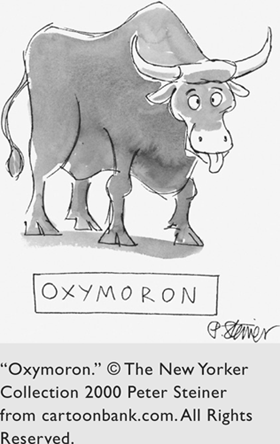
An oxymoron is a figure of speech that joins two terms that are contradictory. Here are two examples:
“Jumbo shrimp are pretty ugly.”
“He is clearly confused.”
όξύς = clever, sharp
You're an Idiot!
The word idiotes (ἰδιώτης) was applied to those who cared only for their private affairs and did not participate in public life; thus, its meaning became pejorative.

NAME ____________________________________________________________________
A. In the following questions, fill in the blank with the literal meaning of the italicized word or part of word. Make sure that your sentences are grammatically correct.
1. A magnifying glass __________objects __________.
2. The minimum wage is the __________ amount one can be paid.
3. The mayor of the city is supposed to have __________ power than other officials.
4. Someone who is demented is __________ his __________.
5. Our personalities are really just __________.
6. In a sorority, the members consider themselves to be __________.
7. If you name your dog Fido, you expect him to be __________.
8. A misogynist __________ __________.
9. Cupid was the Roman god of __________.
10. Inanimate objects do __________ have __________.
11. Genealogy is __________ __________.
12. A person with a martial disposition enjoys __________.
13. An egotist is an individual whose favorite pronoun is __________.
14. To ameliorate a situation is to make it __________.
15. When philosophers search for the eternal verities, they are looking for those ideas that are always __________.
16. An ultimatum is a __________ proposal or demand.
17. A pessimist is always sure that the __________ will happen.
18. An optimist always thinks the __________ about circumstances.
19. He made a fallacious argument because he wanted to __________ me.
20. His erratic behavior made me think that his mind was __________.
21. He was so arrogant that even his friends thought him guilty of __________.
22. He was found guilty of bigamy when he admitted that he had __________ __________.
23. His infamous behavior brought __________ to his family.
24. His odious behavior caused everyone to __________him.
25. Idiosyncratic behavior is __________ an individual.
26. A Francophile__________ all things French.
27. The pseudonymous author used a __________ __________ because he did not wish to reveal his identity.
28. Psychosis is a diseased condition of the __________.
29. I knew I had performed badly, but his pejorative comments made me feel __________.
B. Answer the following questions. If you are not sure of the answers, check your unabridged dictionary.
30. Philosophers have always discussed the summum bonum. What is it? __________ __________
31. Of what crime are you guilty if you kill your brother? __________
32. Where should your superiors be? __________
33. In the counting of votes, what is the difference between a plurality and a majority? _________________________________________________________________________
34. What is the literal meaning of matriarchy? __________ __________What is its current usage? ____________________
35. What is the difference between sanguine and sanguinary?____________________________________________________________________
36. What is the literal meaning of animus? __________What is its current usage?_______________________________________________________
37. What is the difference in meaning between amiable and amicable?_____________________________________________________________
38. What is the meaning of the Latin phrase persona non grata? ____________________
39. What do the etymologies of the words matrimony and matron tell us about the ancient Roman understanding of the purpose of marriage? ______________________________
40. Their marital bliss was shattered when he committed uxoricide. What had he done? ____________________
41. What kind of cell is a gamete? __________
42. What is the literal meaning of patrimony? __________What is its current usage? __________
43. I know it's not really true, but it seems to me that every time the moon is full, people act like__________.
44. His moronic behavior convinced me that he was a __________.
How would you characterize someone whose personality can be characterized as:
|
45. jovial |
____________________ |
|
46. saturnine |
____________________ |
|
47. mercurial |
____________________ |
What are the following fears, forms of madness, or desires?
|
48. monomania |
__________ |
56. egomania |
__________ |
|
49. megalomania |
__________ |
57. dipsomania |
__________ |
|
50. pyromania |
__________ |
58. kleptomania |
__________ |
|
51. gamophobia |
__________ |
59. agoraphobia |
__________ |
|
52. xenophobia |
__________ |
60. acrophobia |
__________ |
|
53. claustrophobia |
__________ |
61. bibliophilia |
__________ |
|
54. ailurophobia |
__________ |
62. gynophobia |
__________ |
|
55. ponophobia |
__________ |
63. triskaidekaphobia |
__________ |
C. By now, you should be able to recognize Romance language cognates of Latin words. Without consulting a dictionary, see if you can figure out the English meanings of each of the following French (F.), Spanish (S.), or Italian (I.) words.
|
64. rey (S. noun) |
__________ |
70. dire (F. verb) |
__________ |
|
65. amigo (S. noun) |
__________ |
71. odio (I. and S. noun) |
__________ |
|
66. malo (S. adjective) |
__________ |
72. con (I. and S. prep.) |
__________ |
|
67. animato (I. adjective) |
__________ |
73. padre (S. noun) |
__________ |
|
68. faire (F. verb) |
__________ |
74. verdad (S adjective) |
__________ |
|
69. fratello (I. noun) |
__________ |
Compared to What?
The comparative and superlative forms of Latin adjectives can also have English derivatives.
|
Positive |
Comparative |
Superlative |
|
bonus, boni = good |
melior = better |
optimus = best |
|
exter, exteri = outside |
exterior = outer |
extremus = outermost, |
|
magnus, magni = large |
major = larger |
maximus = largest |
|
malus, mali = bad |
pejor = worse |
pessimus = worst |
|
multus, multi = much |
plus, pluris = more |
plurimus = most |
|
parvus, parvi = small |
minor/minus = smaller |
minimus = smallest |
|
superus, superi = above |
superior = higher |
supremus or summus = |
|
ulter, ultri = beyond |
ulterior = farther |
ultimus = farthest, last |
The preceding adjectives are irregular in the formation of their comparative and superlative forms; the regular superlative ending is -issimus (-issima, -issimum). How does that ending appear in the various Romance languages?
It's My Fault
If you need to apologize, but want to show off at the same time, you can always say mea culpa.
|
culpa, culpae |
fault, blame |
No, It's Not
The legal term non compos mentis can be applied to mentally ill individuals who do not have the capacity to reason or to manage one's affairs. It is sometimes used as a defense argument for a plea that the defendant cannot be held legally responsible for his actions.
non compos mentis = not of sound mind
Footnotes
1. Mens, mentis survives in the Romance languages as an adverbial ending—e.g., dolcemente (Italian), dulcimente (Spanish), and doucement (French), all of which mean “sweetly,” are derived from the Latin phrase dulci mente (“with a sweet mind”).
2. There are no English derivatives from the Greek word for son or daughter.