

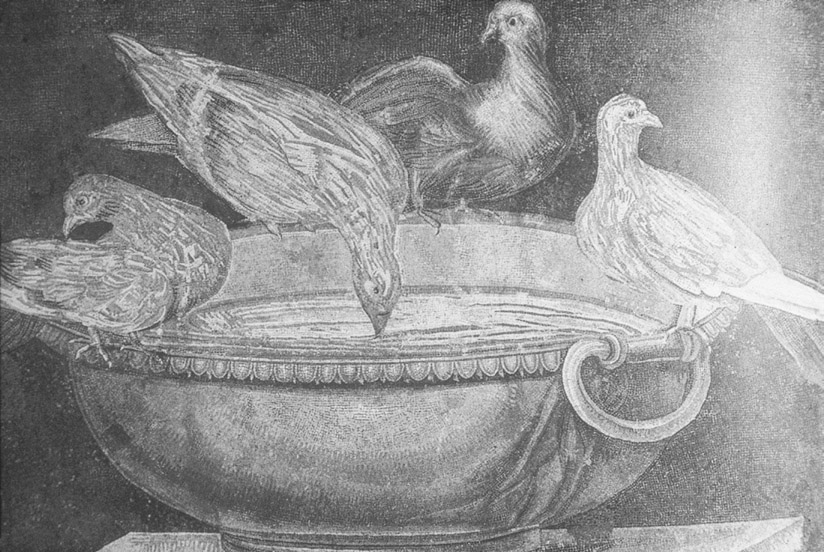
Mosaic from Hadrian's villa (Museo Capitolino, Rome)
When I reached the sanctuary, the god Asclepius bade me further to cover my head in rainy weather, wash myself without the aid of a servant, take exercise in the gymnasium, eat bread, cheese, celery and cabbage lettuce, drink lemon juice and milk, go for walks and not to omit to make sacrifice.
AELIUS ARISTIDES (second-century CE Greek orator)
ADVANCED MEDICAL TRAINING
In the preceding chapter, we surveyed all the major organs of the human body as well as the variety of ailments that might afflict them; but for those who wish to continue their medical education, what follows is an overview of the major systems, or structures to which those organs belong.1 Once again, Greek and Latin roots provide the necessary language for labeling their various components and functions. Although many of these words have come into English unchanged, some of the words included in this chapter are learned borrowings. Indeed, ancient Greek and Roman physicians sometimes had an imperfect understanding not only of human anatomy, but of the functions of various organs and systemic processes.
THE CIRCULATORY SYSTEM
The circulatory, or cardiovascular, system consists of the heart and blood vessels.
|
Greek or Latin Word |
Original Meaning |
Current English Usage |
Combining Form |
|
vena, venae |
vein |
vein |
veno- |
|
phleps, phlebos (φλέψ) |
vein |
vein |
phlebo- |
|
arteria (άρτηρία) |
windpipe |
artery |
arterio- |
|
vas, vasis |
vessel |
vessel |
vaso- |
|
corona, coronae |
crown |
coronary |
corono- |
|
lympha, lymphae |
fluid; water |
lymph |
lympho- |
The arterial system got its name from the fact that the ancient Greeks believed that the arteries carried air.
aer (ἀήρ) = air
THE RESPIRATORY SYSTEM
The respiratory system includes all those organs necessary for the taking in of oxygen and the giving off of carbon dioxide.
|
Greek or Latin Word |
Original Meaning |
Current English Usage |
Combining Form |
|
spiro-spirare-spiratum |
breathe |
breathe |
spiro- |
|
pneo (πνέω) |
breathe |
breathe |
pneo- |
|
pneumon (πνεύμων) |
lung |
lung |
pneumo- |
|
jugulum, juguli |
throat |
throat |
jugulo- |
|
pharynx (φάρυγξ) |
throat |
passageway for air and food |
pharyngo- |
|
trachea (τραχει̑α) |
rough |
windpipe |
tracheo- |
|
bronchia (βρόγχια) |
tubes |
bronchia |
bronchi- |
|
pleura (πλευ̑ρα) |
side; rib |
pleura |
pleuro- |
|
diaphragma (διάφραγμα) |
partition; midriff |
diaphragm |
phreno- |
|
or fren (φρήν) |
midriff; mind |
diaphragm, mind |
|
|
thorax (θώραξ) |
breastplate |
chest |
thoraco- |
It's Not All in Your Head
The Greeks believed that the center of emotions and the home of the mind were in the diaphragm [phren (φρήν = diaphragm]. From this notion we derive frenzy, frenetic, phrenology, and schizophrenia. What are the current meanings of these words?
THE DIGESTIVE SYSTEM
The digestive system includes all the organs necessary for taking in, breaking down, and absorbing food.
|
Greek or Latin Word |
Original Meaning |
Current English Usage |
|
digero-digerere-digestum |
separate; divide |
digest |
|
pepto (πέπτω) |
soften; cook |
digest |
|
intestinum, intestini |
internal; intestine |
intestine |
The intestine, or alimentary canal, is divided into two parts, the small and large intestines. The small intestine consists of:
|
Greek or Latin Word |
Original Meaning |
Current English Usage |
|
pylorus (πυλωρός) |
gatekeeper |
pylorus2 |
|
duodeni |
twelve |
duodenum3 |
|
jejunum, jejuni |
empty; barren |
jejunum4 |
|
ileum, ilei |
flank |
ileum |
The large intestine consists of:
|
Greek or Latin Word |
Original Meaning |
Current English Usage |
|
caecum, caeci |
blind; concealed |
cecum |
|
colon (κόλον) |
colon |
colon |
|
rectum, recti |
straight |
rectum |
There are several other organs whose secretions aid in the digestion of food:
|
Greek or Latin Word |
Original Meaning |
Current English Usage |
Combining Form |
|
cholae (χολαί) |
gall bladder |
gall bladder |
cholecysto- |
|
pancreas (πάγκρεας) |
sweetbread5 |
pancreas |
pancreato- |
There are, of course, many words in Greek and Latin that have to do with eating, some of which have become part of modern medical terminology:
|
Greek or Latin Word |
English Meaning |
Combining Form |
|
phagein (φαγει̑ν) |
eat |
-phage, phago- |
|
trophe (τροφή) |
nourishment |
-trophy |
|
nutrio-nutrire-nutritum |
nourish; support, take care of |
nutri- |
|
orexis (ὄρεξις) |
appetite |
-orexia |
|
geusis (γευ̑σις) |
taste (noun) |
-geusia |
THE REPRODUCTIVE SYSTEM
The human reproductive system consists of those organs and glands that are involved in the propagation of offspring.
|
Greek or Latin Word |
English Meaning |
|
gone (γονή) |
produce, offspring.What is the Latin cognate of this word? |
|
propago-propagare-propagatum |
extend; enlarge |
|
ovum, ovi |
egg |
|
sperma (σπέρμα) |
seed |
|
hystera (ὑστέρα) |
uterus |
|
fetus, fetūs |
offspring |
|
embryon (ἔμβρυον) |
young, fetus |
It's Not Funny …
Some ancient Greek doctors believed that many mental disturbances in women were due to the dysfunction of the uterus. Although the word has lost its association with female behavior, hysteria is still used as a medical term to define a psychological condition that produces physical symptoms. It more commonly describes states of uncontrolled emotion of sadness, fear, or joy.
THE ENDOCRINE SYSTEM
The endocrine system consists of the ductless glands that produce hormones that are discharged into the blood or lymph and that then circulate throughout the body. They include the pituitary, thyroid, parathyroid, and adrenal glands; the insulin-secreting glands of the pancreas; and the gonads. These hormones control the body's ability to metabolize a variety of substances and affect every facet of its functioning. Many of these glands take their names either from their shape or location, such as the adrenal glands, which are located adjacent to the kidneys, or the thyroid, whose shape resembles an ancient Greek oblong-shaped shield that covered the body from neck to ankles. Where are the parathyroid glands located?
|
Greek or Latin Word |
English Meaning |
|
crino (κρίνω) |
separate; secrete |
|
endon (ἔνδον) |
within |
|
glans, glandis |
acorn |
|
hormao (ὁρμάω) |
excite, stimulate |
|
pituita, pituitae |
phlegm |
|
thyreos (θυρεός) |
large shield |
|
insula, insulae |
island |
|
creas (κρέας) |
flesh, meat |
|
metabole (μεταβολή) |
change |
Ahem …
Ancient Greek physicians believed that the function of the pituitary gland was to produce phlegm, one of the four humors.

Etruscan gorgon (Villa Giulia, Rome)
MORE USEFUL BEGINNINGS AND ENDINGS
The following Greek-based prefixes and suffixes are used in modern science and medicine to describe other systems, functions, and components of the body:
|
Greek Word |
Original Meaning |
Current English Usage |
Combining Form |
|
aden (ἀδήν) |
gland |
denoting a gland |
adeno- |
|
blastos (βλαστός) |
sprout, seed |
denoting a seed or embryo |
blasto-, -blast |
|
cytos (κύτος) |
hollow; vessel |
denoting a cell |
cyto-, -cyte |
|
cystis (κύστις) |
bladder |
denoting a sac |
cysto-, -cyst |
|
histos (ἱστός) |
web |
denoting tissue |
histo- |
|
myelos (μυελός) |
marrow |
denoting bone marrow or spinal cord |
myelo- |
|
penia (πενία) |
poverty |
denoting deficiency |
-penia |
|
plasso (πλάσσω) |
mold, shape |
denoting a formation |
-plasia |
|
thrix, trichos (θρίξ) |
hair |
denoting hair |
tricho- |
The Long and the Short of It
All of the following prefixes are derived, with no change in meaning, from Greek adjectives, and are used in biology and medicine to describe a variety of physical characteristics.
|
Greek Adjective |
Meaning |
English Combining Form |
|
brachy (βραχύ) |
short |
brachy- |
|
brady (βραδύ) |
slow |
brady- |
|
lepton (λεπτόν) |
slender |
lepto- |
|
malacon (μαλακόν) |
soft |
malaco- |
|
opisthen (ὄπισθεν) |
at the back |
opistho- |
|
pachy (παχύ) |
thick |
pachy- |
|
platy (πλατύ) |
broad |
platy- |
|
scleron (σκληρόν) |
hard |
sclero- |
|
tachy (ταχύ) |
fast |
tachy- |
|
xeron (ξηρόν) |
dry |
xero- |
Use Your Head …
The Latin word for hair is capillus, capilli. From what Latin noun is this word derived?
Ring Around the Collar
As you probably know from watching all those movies about Robin Hood, the Three Musketeers, and Queen Elizabeth, the traditional way of conferring knighthood is to tap the recipient on the shoulder with the flat side of a sword, in a gesture called accolade. Because knighthood was a reward for services performed, accolade now means any award or public praise.
collum, colli = neck
Scribble, Scribble!
By the way, those illegible letters that doctors so often scrawl on prescription forms are abbreviations of Latin phrases:
|
Abbreviation |
Latin Phrase |
English Meaning |
|
ad lib. |
ad libitum |
as desired |
|
b.i.d. |
bis in diē |
twice a day |
|
b.i.d. |
bis in nocte |
twice a night |
|
h.s. |
hora somni |
at bedtime |
|
p.o. |
per os |
by mouth |
|
q.i.d. |
quater in diē |
four times a day |
|
q.v. |
quantum vis |
as much as you wish |
|
s.o.s. |
si opus est |
if necessary |
|
stat. |
statim |
immediately |

NAME _______________________________________________________________________
A. What are the following diseases, medical procedures, or biological processes?
|
1. venotomy |
____________________ |
|
2. arteriogram |
____________________ |
|
3. vasculitis |
____________________ |
|
4. phlebectomy |
____________________ |
|
5. tracheostomy |
____________________ |
|
6. pleurodynia |
____________________ |
|
7. dysgeusia |
____________________ |
|
8. tachycardia |
____________________ |
|
9. cholocystitis |
____________________ |
|
10. brachypnea |
____________________ |
|
11. anorexia |
____________________ |
|
12. trichotillomania |
____________________ |
|
13. osteomalacia |
____________________ |
|
14. adenoma |
____________________ |
|
15. myelopathy |
____________________ |
|
16. histogenesis |
____________________ |
|
17. colonoscopy |
____________________ |
|
18. pharyngoplegia |
____________________ |
|
19. pancreatalgia |
____________________ |
|
20. pneumonia |
____________________ |
B. Fill in the blank with the literal meaning of the underlined word or part of word. Make sure that the sentence is grammatically correct. If you are unsure of the meaning, check your unabridged dictionary.
21. He was so aggressive that when he “went for the jugular,” everyone around covered their __________.
22. A platypus is a mammal distinguished by its __________ __________.
23. A pachyderm is a mammal distinguished by its __________ __________.
24. A dyspeptic individual is grouchy, perhaps because he has __________ __________.
25. A sclerotic individual is one whose ideas have become __________.
26. The queen received a __________ at her coronation.
27. His inspiring speech allowed me to __________ __________ his knowledge and wisdom.
28. What is the meaning of atrophy in medical terminology? __________
29. What is its meaning in the following sentence? “Her desire for fame and fortune atrophied as her acting career blossomed.” __________
30. A pneometer is ____________________ __________.
31. Histology is the __________ __________.
32. I was insulted when my friend said I had cerebromalacia.Why? ____________________
33. A phagocyte is a __________that has the ability to __________ various substances.
34. A leptorrhine individual has a __________ __________.
35. A brachycephalic individual has a __________ __________.
36. The trademark Xerox was given to a process of __________ copying.
37. An omophagous animal__________ raw food.
38. The pylorus acts as a __________between the stomach and duodenum.
39. The lymphatic system is composed mainly of __________.
40. Myeloma is a __________that originates in the __________.
41. Peptic enzymes aid in the __________ of food.
42. I went to a trichologist when I wanted to change the color of my __________.
43. What is the etymological connection between the jejunum and jejune behavior? __________________________________________________
44. Nutrients provide __________ for the body.
45. A nocturnal creature is active during the __________.
46. If the doctor in the emergency room yells “stat!” she needs help __________.
47. Someone suffering from leukopenia has a__________ white blood cells.
48. His bald ovate-shaped head reminded me of an __________.
49. When we describe an idea as embryonic, what do we mean? ____________________
50. When we describe someone's attitude as insular, what do we mean? ____________________
C. The Latin verb digero is a compound of dis- (apart) + gero-gerere-gestum (carry, bear). What are the literal meanings and current usages of the following words?
|
Literal Meaning |
Current Usage |
|
|
51. egest |
____________________ |
____________________ |
|
52. congestion |
____________________ |
____________________ |
|
53. gestation |
____________________ |
____________________ |
|
54. gesture |
____________________ |
____________________ |
|
55. suggestive |
____________________ |
____________________ |
|
56. gesticulate |
____________________ |
____________________ |
|
57. digest (noun) |
____________________ |
____________________ |
|
58. ingest |
____________________ |
____________________ |
D. Take a deep breath …
What are the literal meanings and current usages of the following words?
|
Literal Meaning |
Current Usage |
|
|
59. respiration |
____________________ |
____________________ |
|
60. expire |
____________________ |
____________________ |
|
61. conspiracy |
____________________ |
____________________ |
|
62. transpire |
____________________ |
____________________ |
|
63. inspiration |
____________________ |
____________________ |
|
64. aspiration |
____________________ |
____________________ |
Footnotes
1.Medical and anatomical terms already given in chapter 12 are not repeated here.
2. The pylorus is the opening between the stomach and duodenum.
3. The duodenum gets its name from its size, about twelve (duodeni) finger-breadths in length.
4. The jejunum is the middle portion of the small intestine. Ancient medical theory stated that after death, it was empty.
5. Literally, “all-flesh.”