


Asclepius, the Greek god of healing and patron deity of physicians (National Museum, Athens)
Life is short, science is long; opportunity is elusive, experiment is dangerous, judgment is difficult. It is not enough for the physician to do what is necessary, but the patient and the attendants must do their part as well, and circumstances must be favorable.
APHORISMS I.1 (Hippocratic Corpus)
MODERN MEDICINE AND ANCIENT TERMINOLOGY
Perhaps no other area that affects our lives demonstrates so clearly the influence of Greek and Latin on English vocabulary as does the field of medicine. Although new diseases are defined and new technologies devised every day, medicine has created for itself an inexhaustible source for an expanding terminology by continually drawing upon Greek and Latin roots.1
THE HUMAN BODY
It is not possible to look at the constituent parts of human beings, such as blood, flesh, bones, blood-vessels and the like without considerable distaste.
ARISTOTLE, On the Parts of Animals
The human biological and medical sciences have thoroughly investigated the functions and operations of every part of the human body. They have taught us that the body is a wonderful machine that is extraordinarily efficient (most of the time). It is composed of over 200 bones, 700 muscles, and approximately five quarts of blood, and it is covered by about twenty-five square feet of skin. In addition, it possesses a remarkably intricate nervous system, as well as a multitude of organs that carry on vital functions within the machine.
|
English Word |
Latin Word |
Greek Word |
Combining Form |
|
life |
vita, vitae |
bios (βίος) |
bio- |
|
blood |
sanguis, sanguinis |
hema, hematos (αἱ̑μα) |
hema- or hemato-; -emia |
|
body |
corpus, corporis |
soma, somatos (σω̑μα) |
somato- |
|
bone |
os, ossis |
osteon (ὀστέον) |
osteo- |
|
muscle |
musculus, musculi |
mys, myos (μυ̑ς) |
myo- |
|
nerve |
nervus, nervi |
neuron (νευ̑ρον) |
neuro- |
|
skin |
cutis, cutis |
derma, dermatos (δέρμα) |
dermato- |
Shake, Rattle, and Roll
Many bones of the human body derive their names from their seeming resemblance to other objects. For example, the collar bone, or clavicle, was thought by early anatomists to resemble the shape of a key, while the shinbone was called a tibia because of its similarity in form to a flute. And if you hearing ringing in your ears, that's because the auditory ossicles are called the malleus, incus, and stapes.
|
Latin Word |
English Meaning |
|
clavus, clavi |
key > collarbone. What does the -cle ending indicate? |
|
patella, patellae |
small pan > kneecap |
|
tibia, tibiae |
flute > shinbone |
|
fibula, fibulae |
buckle, clamp > leg bone that extends from knee to ankle |
|
malleus, mallei |
hammer |
|
incus, incudis |
anvil |
|
stapes, stapis |
stirrup |
Like all machines, however, the human body is subject to occasional breakdowns (despite the classical ideal of sana mens in corpore sano). When this happens, we visit the doctor; and sometimes, we may even end up as patients in the hospital.
|
Greek or Latin Word |
English Meaning |
|
hygieia (ὑγίεια) |
health |
|
salus, salutis |
health |
|
sanum, sani |
healthy |
|
mens sana in corpore sano |
a sound mind in a sound body |
|
iatros (ἰατρός) |
doctor, physician |
|
medicus, medici |
healer |
|
doceo-docēre-doctum |
show, teach |
|
-logist |
specialist (learned borrowing), cf. -logy |
|
hospes, hospitis |
host; guest, stranger |
|
morbus, morbi |
illness |
|
patior-pati-passum |
suffer, endure |
|
cf.pascho (πάσχω) |
suffer, endure |
|
> pathos (πάθος) |
suffering, misfortune |
Is That English?
The French word jargon originally meant the chattering of birds, but now means a specialized vocabulary used by a particular group or profession that is difficult for others to understand. For example, when the doctor explains, “I'm afraid you have a rather severe bilateral probital hematoma,” what he really is saying is “Wow! What a horrific-looking black eye.”
MEDICAL SPECIALTIES
Today, of course, most doctors are specialists. There are seemingly as many specialties in medicine as there are parts of the human body, but we can get to the heart of the matter if we are willing to be patient. Let's start at the top and come face to face with what may be bothering us.
|
English Word |
Latin Word |
Greek Word |
Combining Form |
|
head |
caput, capitis |
cephale (κεφαλή) |
cephalo- |
|
brain |
cerebrum, cerebri |
encephalos (ἐγκέφάλος) |
encephalo- |
|
eye |
oculus, oculi |
ophthalmos (ὀφθαλμός) |
ophthalmo- |
|
ear |
auris, auri |
ous, otos (οὐ̑ς) |
oto- |
|
nose |
nasus, nasi |
rhis, rhinos (ῥίς) |
rhino- |
|
mouth |
os, oris |
stoma, stomatos (στóμα) |
stomato- |
|
tooth |
dens, dentis |
odous, odontos (Οδούς) |
odonto- |
|
tongue |
lingua, linguae |
glossa (γλω̑σσα) |
glosso- |
|
or glotta (γλω̑ττα) |
glotto- |
Hermon of Thasus. His blindness was cured by Asclepius. But, since afterward he did not bring the thank-offerings, the god made him blind again. When he came back and slept again in the Temple, the god made him well.
—inscription from the temple of Asclepius at Epidaurus, Greece
There are doctors who attempt to straighten us out or get us back on our feet:
|
Greek or Latin Word |
English Meaning |
|
orthon (ὀρθόν) |
straight |
|
pes, pedis |
foot |
|
pous, podos (πούς) |
foot |
|
skeletos (σκελετός) |
dried up; mummy |
|
therapeia (θεραπεία) |
service; care |
There are doctors who specialize in the diseases of particular organs:
|
English Word |
Latin Word |
Greek Word |
Combining Form |
|
belly |
abdomen, abdominis |
enteron (ἕντερον) |
entero- |
|
stomachus, stomachi |
gaster, gastros (γαστήρ) |
gastro- |
|
|
heart |
cors, cordis |
cardia (καρδία) |
cardio- |
|
kidney |
renum, reni |
nephros (νεφρός) |
nephro- |
|
liver |
hepar, hepatos (ἥπαρ) |
hepato- |
|
|
lung |
pulmo, pulmonis |
pneumon (πνεύμών) |
pneumo- |
Take a Deep Breath
South Carolina's state motto is dum spiro spero. “As long as I am breathing, I have hope.”
|
spiro-spirare-spiratum |
breathe |
|
spero-sperare-speratum |
hope |
Other doctors specialize in particular age groups or in a particular gender:
|
Latin or Greek Word |
English Meaning |
|
femina, feminae |
woman |
|
gyne, gynecos (γυνή) |
woman |
|
aner, andros (ἀνήρ) |
man |
|
anthropos (ἄνθρωπος) |
man, human being |
|
homo, hominis |
man, human being |
|
vir, viri |
man |
|
senex, senis |
old man |
|
geron, gerontos (γέρων) |
old man |
|
juvenis, juvenis |
young person |
|
puer, pueri |
child (boy) |
|
pes, pedos (παι̑ς) |
child |
Hippocratic Oath
The oath that medical students take today has its origins in Greek medicine. Called the Hippocratic Oath, it is attributed to one of the most famous of ancient Greek healers, Hippocrates.
I swear by Apollo, the healer, by Asclepius, by Hygieia and Panacea and all the divinities of healing, and call to witness all the gods and goddesses that I may keep this oath and promise to the best of my ability and judgment … that I will use my power to help the sick to the best of my ability and judgment; that I will abstain from harming or wronging anyone by it…. If, therefore, I observe this oath and do not violate it, may I prosper both in my life and my art, gaining good repute among all men for all time. If I transgress and forswear this oath, may my lot be otherwise.
|
Deity |
Function |
|
Apollo |
Greek god of light, prophecy, healing; but also the deity who brought disease |
|
Asclepius |
half-divine son of Apollo, and patron of Greek physicians. Not content with healing the sick, he attempted to bring the dead back to life. For this act, Zeus struck him down with a thunderbolt. In ancient Greece, he was honored as the patron deity of physicians. |
|
Hygieia |
The daughter of Asclepius, and worshipped as the personification of health |
|
Panacea |
“All-Healer,” said by some to be the daughter of Asclepius |
DIAGNOSIS AND TREATMENT
|
Greek or Latin Word |
English Meaning |
|
gnosis (γνω̑σις) |
knowledg |
|
cf. nosco-noscere-notum |
know |
|
bacterion (βακτήριον) |
rod, stick |
|
cf. bacillus, bacilli |
small rod |
|
frango-frangere-fractum |
break |
|
fungus, fungi |
sponge |
|
cf. sphongos (σφόγγος) |
sponge |
|
trauma, traumatos (τραυ̑μα) |
wound |
|
virus, viri |
poison |
|
-osis2 |
diseased condition of, state of |
|
-itis |
inflammation of |
|
-oma |
swelling |
|
-iasis |
diseased condition of |
|
-pathy3 |
diseased condition; treatment |
|
-plegia |
paralysis |
|
cf. plege (πληγή) |
blow |
|
-algia |
pain |
|
cf. algos (ἄλγος) |
pain |
|
-odynia |
pain |
|
cf. odyne (ὀδύνη) |
pain |
|
-rrhea |
flow or discharge |
|
cf. rheo (ῥέω) |
flow |
|
-gen |
production of |
|
cf. genos (γένος) |
birth, source |
|
-genic |
producing |
|
manus, manūs |
hand |
|
opsis (ὄψις) |
sight |
|
cf. opteuo (ὀπτεύω) |
see, look at |
|
-tomy |
cutting, incision |
|
< tomos (τομός) |
cutting |
|
-ectomy |
cutting out, removal |
|
-stomy |
making an opening |
|
< stoma (στόμα) |
mouth, opening |
Take Two Pills and Call Me in the Morning
When you go to the pharmacy to fill a prescription, be very careful. The root of the word is pharmakos (φαρμακός) = poisoner.
TO SLEEP, PERCHANCE TO DREAM
Sometimes, all it takes is a good night's sleep to make us feel better …
|
Greek or Latin Word |
English Meaning |
|
valeo-valēre |
be strong, be in good health |
|
> valesco |
What does the suffix -sco indicate? |
|
hypnos (ὕπνος) |
sleep |
|
coma (κω̑μα) |
deep sleep |
|
somnus, somni |
sleep |
|
sopor, soporis |
deep sleep |
|
Morpheus |
the son of Somnus, he was the bringer of dreams, and given the name because of the various forms he could assume. |
|
cf.morphe (μορφή) |
shape, form |

Mosaic “skull,” representing the finality of death. It was uncovered in the dining room of a house in Pompeii, Italy. (Museo Archeo-logico Nazionale, Naples)
but it doesn't cure everything, for we are mortal …
|
Greek or Latin Word |
English Meaning |
|
mors, mortis |
death |
|
< morior, mori, mortuum |
die |
|
thanatos (θάνατος) |
death |
Remember: de mortuis, nil nisi bonum: about the dead, (speak) nothing but good.
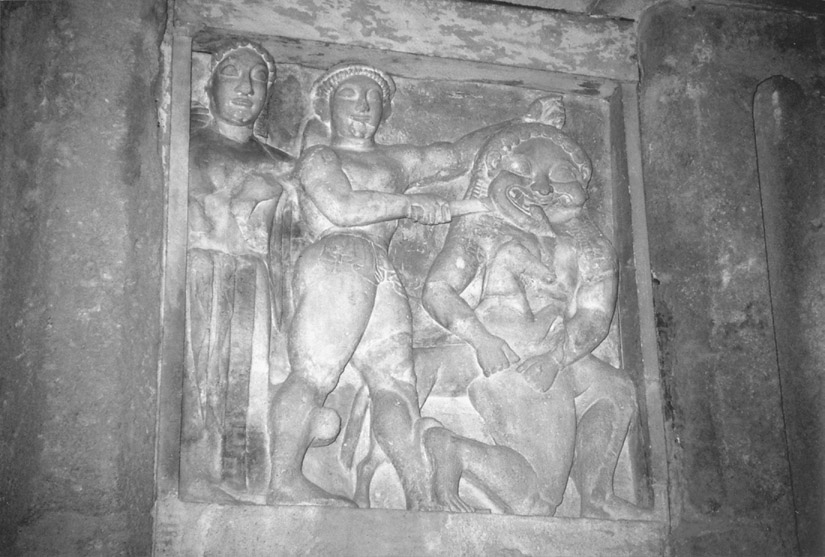
Perseus slaying the gorgon Medusa. Sixth century BCE (Selinunte, Sicily)
Dig in Your Heels …
Sometimes a word goes through so many changes of meaning that its original root is unnoticed. Recalcitrant, which now means unmanageable or stubborn, is derived from the Latin calx, calcis = heel of the foot. The verb recalcitrare originally meant to kick back one's heels, and was applied to horses.
Or Change Your Mind!
Some words are nice to know just because they sound so interesting. Tergiversate means to change one's mind or opinion, but its literal meaning is derived from
tergum, tergi (back)
verso-versare-versatum (turn)
If you don't turn your back on an idea, you may turn your mind toward it in a critical way. Thus, we have the verb animadvert, which originally meant to take notice of, but which has now come to mean to criticize, or pay attention in a negative way.
Looks Can Wound, and Words Can Hurt!
A supercilious individual is contemptuous of others and demonstrates it by raising his eyebrows, and sarcastic words can seem to tear at our skin.
|
Greek or Latin Word |
English Meaning |
|
supercilium, supercilii |
eyebrow |
|
cf. cilium, cilii |
eyelash |
|
sarx, sarcos (σάρξ) |
flesh |
|
>sarcazo (σαρκάζω) |
tear flesh |
Living Well Is the Best Revenge
Leading a healthy lifestyle is all very well and good, but perhaps the French bon vivant who is leading the Italian la dolce vita has a better time. Of course one could just shrug one's shoulders and say, “C'est la vie.” What is the Latin root of these words, and what do these expressions mean?
Ave Atque Vale!
The Roman equivalent of “have a good day” was the phrase avē atque valē. Although both imperative forms mean “be well” or “strong,” they also came to be used as a word of greeting or of good-bye. Thus, the phrase is often translated as “Hail and farewell!”
aveo-avēre = be well
Of course, not everyone was so joyful about saying goodbye. Gladiators about to enter into the arena faced the emperor and declared, “Ave, Imperator. Nos morituri te salutamus.” (“Hail, Emperor. We who are about to die salute you.”)
An Ounce of Protection
Although modern medicine emphasizes the prevention of disease through immunization, diet, and good health habits, many things can go wrong with the human body. The medical profession, however, offers a variety of approaches to diagnose, treat, and cure illness, or at least to alleviate it.
|
Greek or Latin Word |
English Meaning |
|
dieta (δίαιτα) |
way of life |
|
levis, levis |
light, easy |
|
munus, muneris |
gift, reward |
Holy Cow!
For millennia, smallpox was a dreaded disease that caused hundreds of millions of deaths in every part of the world. In 1796, the English physician Edward Jenner tested the common opinion that dairymaids who had contracted cowpox, a much milder disease, from the infected udders of cows, had immunity to smallpox. In what was a perhaps medically unethical experiment, he inoculated a small boy with cowpox; the boy recovered rather quickly, with no lasting effects. Two months later, Jenner inoculated the boy with pus from a smallpox lesion, but the child did not develop the disease.
vacca, vaccae = cow

NAME _______________________________________________________________________
A. Answer each question or fill in the blanks with the literal meaning of the underlined word or part of the word. Make sure that the sentence is grammatically correct. If you are unsure of the meaning, check your unabridged dictionary.
1. A sanguivorous animal __________ __________.
2. What is the Latin cognate of sympathy? __________
3. A corpuscle is a__________ __________.
4. An ossuary is__________ __________are kept.
5. Psychosomatic medicine examines the interaction of the __________ and__________.
6. What are the literal meanings and current usages of the following words?
|
English Word |
Literal Meaning |
Current Usage |
|
empathy |
____________________ |
____________________ |
|
sympathy |
____________________ |
____________________ |
|
apathy |
____________________ |
____________________ |
|
antipathy |
____________________ |
____________________ |
7. A subcutaneous injection is given__________ __________.
8. A corpulent individual is __________ __________.
9. The doctor said he could not detect my vital signs, but I was sure I was still __________.
10. A patient is supposed to __________ his illness.
11. If you move to a salubrious climate, you hope that it will bring you __________.
12. What are the following medical specialties?
dermatology ____________________
hematology ____________________
neurology ____________________
13. A sanitarium is __________ an individual hopes to become __________.
14. The Latin cognate of hypodermic is __________.
15. If an individual's beliefs have become ossified,they have been __________as hard as __________.
16. A misanthrope is a person who __________ __________.
17. Is it possible that the Roman poet P. Ovidius Naso had a prominent __________?
18. Binoculars enable us to see with __________ __________.
19. Someone who is cerebral uses her __________.
20. What is the distinguishing feature of the following:
|
octopus __________ |
centipede |
__________ |
|
tripod __________ |
biped |
__________ |
21. What skill does a multilingual individual possess? __________ __________What is the Greek cognate of multilingual? __________
22. Rhinoplasty is an elegant name for a __________.
23. An electroencephalogram is __________ about the activity of the __________.
24. A pulmonary function test measures the capacities of your __________.
25. A captain is the __________ of a military unit.
26. Cordial feelings arise in the __________.
27. A periodontist takes care of the area __________ __________.
28. A gastronome is __________ his __________.
29. What is the aural/oral method of learning a foreign language? ___________________________________________
30. What is the literal meaning of anemia? __________ __________ What is its current medical usage? ____________________What is its meaning in the following sentence: The stock market's performance today was anemic. ____________________
31. An androgynous creature displays characteristics of both __________ and __________.
32. A mortuary is__________ __________.
33. A traumatic experience is one that __________ you.
34. Odontalgia is an elegant word for __________ __________.
35. The nineteenth-century American poet William Cullen Bryant wrote a work entitled Thanatopsis. What was its theme? __________ __________
36. A prognosticator thinks he can __________the future __________it happens.
37. Iatrogenic illness is __________ the __________.
38. A manuscript is a document that has been __________ by __________.
39. If your teacher's lecture acts as a soporific, it may __________ you __________.
40. An agnostic says the proof of the existence of an ultimate cause of the universe is __________ able to be __________.
41. A post mortem examination is done __________ __________.
42. If you agree to an encephalectomy, your __________ will be __________.
43. A malleable metal can be __________ into a shape. What does the word mean when applied to an individual? __________
44. A valedictory address is one that __________ __________.
45. “To be in the arms of Morpheus” is an elegant way of saying that you are __________.
46. A gerontologist __________ the behavior and health of __________.
47. Senility is a disease of __________.
48. While I watched in horror, that well-behaved child suddenly morphed into a monster. What is the Greek root of this word and what is its meaning in this sentence? ________________________________________________________
49. His puerile behavior made me realize that although he was a grown man, emotionally he was still a __________.
50. My remuneration for the job was so small that I did not feel __________ for my work.
51. His virulent remarks against me made me feel as if I had been __________.
52. A somniloquist __________ while he is __________. What does a somnambulist do? ____________________
53. Although the politicians said the law would be a panacea for our problems, I knew it would not be a __________.
54. A muscle supposedly resembles a __________ __________in its movement.
55. What is the ordinary usage of the word morbid? __________ In medical terminology, what is its usage? __________
56. When my mother threatened to decapitate me if I did not clean my room, I knew she would take my__________ __________ my body.
57. What is the difference in meaning between sanguine and sanguinary? ___________________________
58. Under a system of primogeniture, the __________ __________ inherits his parents’ property.
59. In order to display valor in a difficult situation, one must be __________ in spirit.
60. What is a valetudinarian? ____________________
61. Maintain entered into English through French. Can you figure out its Latin roots? __________
62. What are the two different meanings of invalid?
________________________________________
________________________________________
63. In the following sentence, what is the meaning of the word pathos? “The pathos I felt when I heard her sing was overwhelming.” ____________________
64. What does a pathogen do? __________ __________
65. I am senescent, and now I am afraid that I am suffering from all the symptoms of __________________.
66. He was such an awful person that although he was dead, I could not say one good thing about him. What Latin adage was I ignoring? ______________________________
B. How Many Things Can You Break?
People and things can be broken in a number of ways. What are the current English meanings of the following words?
67. fragment __________
68. fractious __________
69. infraction __________
70. frail __________
71. fraction __________
72. refract __________
73. frangible __________
74. fragile __________
C. Watch Where You Throw That Thing!
Sometimes a doctor will recommend an injection of a drug in order to relieve your symptoms or even to effect a cure.
jacio-jacere-jactum throw, heal
in compound form, jecere-jectum
|
English Word |
Literal Meaning |
Current Usage |
|
75. dejected |
____________________ |
____________________ |
|
76. conjecture |
____________________ |
____________________ |
|
77. ejection |
____________________ |
____________________ |
|
78. trajectory |
____________________ |
____________________ |
|
79. abject |
____________________ |
____________________ |
|
80. interjection |
____________________ |
____________________ |
|
81. project (noun) |
____________________ |
____________________ |
|
82. project (verb) |
____________________ |
____________________ |
|
83. objective |
____________________ |
____________________ |
D. Don't Confuse Me
In order to be a successful doctor, you will need to learn all these medical diagnoses and treatments. What are the following diseases, medical conditions, and treatments?
84. pericarditis ____________________
85. neuropathy ____________________
86. myalgia ____________________
87. glossectomy ____________________
Footnotes
1. Note that most specialized medical terms are derived from Greek, rather than Latin, vocabulary. Almost all English compound forms derived from Greek that are used in medical terminology are learned borrowings.
2. The endings -osis, -itis, -oma, and -iasis were used in ancient Greek to form nouns, but they have been arbitrarily assigned these meanings in modern medical practice.
3. Learned borrowing from Greek: cf. pathos (πάθος) = suffering. In compound forms, used as a suffix = disease, condition. It is also used in names or systems of treating disease, e.g., osteopathy.