

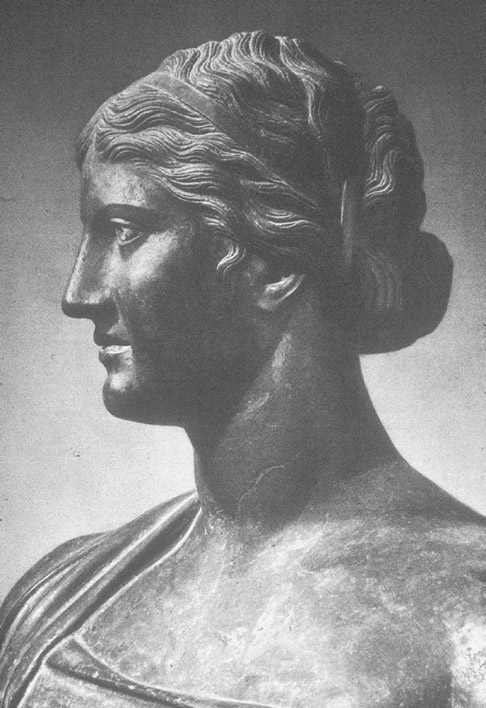
Sappho, Greek poet. Sixth century BCE (Naples Museum, Italy)
Demetrius summoned Stilpo, the philosopher, and asked him whether anyone had robbed him of anything “No one,” said Stilpo, “for I saw no one carrying away knowledge.”
PLUTARCH (first-century CE essayist), The Life of Demetrius, ch. 59
GREEK AND ROMAN EDUCATION
Although students may think that attending school is an occupation as difficult and demanding as any job, and what is more, an absolute necessity for future success, most ancient Greeks and Romans viewed education and learning beyond the basic skills as a luxury available only to those who had money, and therefore the leisure, to devote themselves to study and the pursuit of knowledge.
|
Greek or Latin Word |
English Meaning |
|
educo-educare-educatum |
train, rear; educate |
|
cf. duco-ducere |
|
|
pedia (παιδεία) |
education; culture |
|
encyclios pedia (ἐγκύκλιος) |
“encircling” education; general knowledge |
|
pedagogos (παιδαγωγός) |
The slave who accompanied a child to school. The Romans applied the term paedagogus more generally to one who taught young children. What are the roots of this word? |
|
schole (σχολή) |
leisure |
|
ludus, ludi |
sport, diversion, joke; school |
|
cf. ludo-ludere-lusum |
play; joke, mock |
|
studeo-studēre |
be eager for, be diligent |
There were various forms of rudimentary instruction in classical Athens: reading and writing, poetry and music, and athletics—all for a fee. Although they never mandated universal compulsory education, many Greek cities gradually began to supervise education with the help of wealthy benefactors who provided endowments and paid teachers’ salaries. Pedagogy was grounded in memorization and recitation, and discipline was strict.
|
Greek or Latin Word |
English Meaning |
|
rudis, rudis |
rough; unskilled |
|
> erudio-erudire-eruditum |
polish; educate |
|
tueor-tuēri-tuitum |
look after, guard |
|
cf. tutor, tutoris |
guardian, protector |
|
disco-discere |
learn |
|
> discipulus or discipula |
pupil |
|
and disciplina |
instruction, learning |
|
didacton (διδακτόν) |
taught |
|
docēo-docēre-doctum |
show, teach |
|
memoria, memoriae |
memory |
Higher Education
Once the fundamentals had been mastered, it was possible to continue one's education in a variety of subjects. Participation in public life demanded an ability to speak and argue well, and sophistae, men who claimed to teach not only the skills of persuasive rhetoric and oratory but also a practical wisdom, often commanded large fees. Education thus came to be seen as a pragmatic means of producing good citizens and promoting cultural traditions. Not everyone approved of the sophists’ teaching methods or their goals. Plato's denunciation of this kind of instruction, in which “the weaker argument is made to seem the stronger,” gave the term “sophist” the pejorative meaning it has today.
At Plato's school, the Academy, and at the Lyceum of Aristotle, advanced instruction was given in philosophy, mathematics, and science. The curriculum of the liberal arts, the product of the faculty of these institutions as well as the sophists, became the foundation of higher learning in Europe, and forms the basis of education in the modern college and university. Of course, it wasn't always just seminars and lectures and a lot of hard work; campus life clearly held some pleasures, most notably symposia.
|
Greek or Latin Word |
English Meaning |
|
oro-orare-oratum |
speak; pray |
|
sophon (σοφόν) |
wise, clever |
|
> sophistes (σοφιστής) |
expert, teacher |
|
pragma, pragmatos (πρα̑γμα) |
matter, affair |
|
cf. praxis (πρα̑ξις) |
business, transaction |
|
curro-currere-cursum |
run |
|
> curriculum, curriculi |
running, race; racecourse |
|
semen, seminis |
seed; origin |
|
> seminarium, seminarii |
garden, nursery |
|
for-fari-fatum |
speak |
|
facultas, facultatis |
skill, ability.What is the Latin root of this word? |
|
campus, campi |
plain, field |
|
symposion (συμπόσιον) |
drinking party |
It's All Academic …
The school founded by Plato was called the Academy. Today, the adjective academic is commonly used to mean scholarly or learned, but without practical application.
But Not Too Academic
In ancient Greece, the symposium was a gathering of men who were entertained by poets and musicians, as well as with wine. At the one described by Plato in his dialogue, The Symposium, the participants, including Socrates, try to define the meaning of eros.
What Were You Saying?
There are of course, many kinds of speeches; some may be flattering:
|
Greek Word |
English Meaning |
|
encomion (ἐγκώμιον) |
a speech ofpraise |
|
eulogia (εὐλογία) |
fine language |
|
panegyrikon (πανηγυρικόν) |
festive; flattering |
|
But not all speech, of course, is complimentary. When Philip of Macedon, the father of Alexander the Great, tried to rally the Greek cities to his cause, the Athenian orator Demosthenes delivered a series of stinging attacks against him. These diatribes were so harsh that the term philippic is now applied to any violent and bitter speech against an individual. |
|
|
diatribe (διατριβή) |
a way of spending time; learned discussion; criticism. Its modern usage is pejorative: a harsh and abusive verbal attack. |
From Greek into Latin
Some Greek and Latin nouns retain their original plural endings in English. Greek words that were adopted by the Romans often have Latin endings in English, e.g.,
|
Greek symposion > |
Latin symposium (sing.); symposia (plur.) |
|
Greek encomion > |
Latin encomium (sing.); encomia (plur.) |
|
Latin colloquium (sing.); colloquia (plur.) |
The Liberal Arts
In the medieval universities of Europe, the liberal arts were divided into two classes of study: the quadrivium and the trivium.The quadrivium consisted of arithmetic, astronomy, geometry, and music; the trivium comprised grammar, rhetoric, and dialectic. What Latin words are at the root of these courses of study?
The Key to Success
The culture of ancient Greece was held in such high regard that when the first American fraternity was founded in 1776, it took its name, Phi Beta Kappa, from the initial letters of the Greek phrase, φιλοσοφία βίου κυβερνήτης: Philosophy is the Guide of Life. It's a useful thought.
BOOKS AND LIBRARIES
The first organized research library was said to have been established by Aristotle at the Lyceum, but certainly the largest and most famous library in antiquity was founded in the third century BCE at Alexandria in Egypt. It is claimed by contemporary sources that it contained 700,000 volumes. Associated with the library was the museum, an institute for advanced research under the aegis of the government, where scholars cataloged and edited much of the canon of ancient Greek literature.
The production of books was a difficult and laborious task, since each text had to be copied by hand, and errors were inevitable. Most volumes were written on rolls of papyrus, although parchment, made from treated animal skins, was also used. The codex, forerunner of the modern book, with bound pages, was not in common use until the second century CE. Now, of course, with the use of computers and the electronic transmission, storage, and retrieval of information, some people believe that printed books may go the way of the feather pen and inkwell.
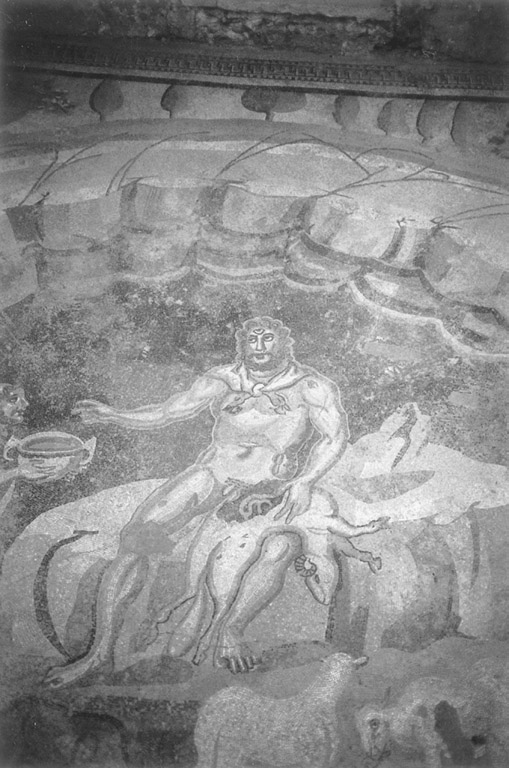
Mosaic of a Cyclops. Fourth century CE (Piazza Amerina, Sicily)
|
Greek or Latin Word |
English Meaning |
|
biblion (βιβλίον) |
book |
|
> bibliothece (βιβλιοθήκη) |
library |
|
liber, libri |
book |
|
> librarium, librarii |
library |
|
aegis (αἰγίς) |
shield, protection |
|
volumen, voluminis |
roll, book |
|
cf. volvo-volvere |
turn, roll |
|
papyros (πάπυρος) |
Egyptian papyrus plant, from whose fiber paper was made |
|
codex, codicis |
block of wood; tablet, book |
|
canon (κανών) |
rule; standard |
Going Around in Circles
Research, the foundation of all good scholarship, is derived from the Latin verb circo-cir- care = to go around.
Stop, Thief!
The root of the word plagiarism reveals just how serious a crime it is.
plagio-plagiare-plagiatum = steal, kidnap
Talking May Be Hazardous to Your Mental Health
We have already seen that there are a great many Latin verbs that mean “to speak.” Some of them produce derivative nouns and adjectives that go beyond plain talking. Which words that have to do with speech can you find in the following sentence? “After taking elocution lessons, what fatal pronouncement did the loquacious oracle vocalize when it predicted your future?”
Get to the Point
Although many students find it hard to believe, punctuation is important for understanding the meaning of a sentence. Ancient Greek and Latin texts not only had no punctuation, but no spaces between words. These marks were invented by the librarians in Alexandria in the third century BCE, but it was not until the ninth century CE that they were used with any regularity. So consider yourself lucky; otherwise, you might get the wrong idea from the following sentence: “As we sat down to eat my father made a speech.”
|
Greek or Latin Word |
English Meaning |
|
sententia, sententiae |
opinion |
|
cf. sentio-sentire = feel |
|
|
pungo-pungere-punctum |
pierce, prick; sting, bite |
|
periodos (περίοδος) |
going around, circuit |
|
comma (κόμμα) |
that which is cut off |
|
colon (κω̑λον) |
member; part of a clause |
|
hyphen (ὑφέν) |
in one; as a single word |
|
apostrophe (ἀποστροφή) |
turning back or away from |
|
parenthesis (παρένθεσις) |
insertion; injection |

NAME _______________________________________________________________________
A. Answer the following questions, or fill in the blank with the literal meaning of the italicized word or part of a word. Make sure that the sentence is grammatically correct. If you are unsure of the meaning, check your unabridged dictionary.
1. Our illusions help us __________with reality.
2. A good educator should __________ __________ knowledge from her students who are, of course, __________to learn.
3. A scholar needs __________ to do research, or else he will __________in confusion.
4. What are two different current usages of rude?
____________________
____________________
5. An autodidact is __________ __________.
6. His disciples wanted to __________ what he had to say.
7. The first question a pragmatist asks is, “What can I __________?”
8. What is a rhetorica/ question? ____________________ Can you give an example? ___________________________________________________________
9. He was employing so many deceptive and even false arguments that everyone accused him of ____________________.
10. The speaker delivered an encomium to the mayor because he wished to __________ her.
11. His eyes __________ over the newspaper as he gave the headlines a cursory glance.
12. When the criminal confessed, he __________ what he had done.
13. What are two different usages of facu/ty?
____________________
____________________
14. If scholars got at the root of symposium, they would do more __________ than talking when they met.
15. Freud was a seminal figure in modern psychology because his work was the __________ for future work in the field.
16. Illegible writing __________ __________ __________.
17. When Roman law was codified, it was __________ into a __________.
18. What are the Spanish and French words for library?
____________________
____________________
19. Noncanonical works are those that lie outside the __________ of what is acceptable.
20. His sentences were so convoluted that they were all __________ __________.
21. A fabulous party is worth __________ about.
22. We all wish we had a tutelary spirit who would __________ us from harm.
23. He had only a rudimentary education, so he was _____________ in reading.
24. Her encyclopedic memory contained all kinds of __________.
25. His behavior was so ludicrous that we thought he was__________.
26. What are two different usages of oratory?
____________________
____________________
27. The project was done under the aegis of the mayor's office. What does aegis mean in this context? __________
28. What is the current usage of the word voluminous? ____________________ Can you figure out how it got this meaning? ______________________________
29. What are two different usages of tuition?
____________________
____________________
How are these usages related? ________________________________________
30. It was difficult to __________ __________ of him, even after his death; but the minister delivered a moving eulogy.
31. A plagiarist is__________ __________ someone else's ideas or words.
32. What is the difference in meaning between famous and infamous?___________________________________
33. Even as I stood up to speak, I still couldn't make up my mind: should I flatter the mayor with a __________ or harshly attack him in a __________?
34. The words punctuation and punctual have the same Latin root but very different meanings. Do an etymological “search” to see how each word evolved into its present meaning.
punctuation ____________________________________________________________
punctual ____________________________________________________________
B. Playing Around
Construct sentences using the following words. Your sentences need to indicate that you know the meaning of the word.
|
35. collusion |
________________________________________ |
|
36. delusion |
________________________________________ |
|
37. prelude |
________________________________________ |
|
38. interlude |
________________________________________ |
|
39. allusion |
________________________________________ |
C. Here are some more words, some of them quite elegant, that come into English unchanged from either Greek or Latin. Use your unabridged dictionary to find the original meanings and current usages of the following words:
|
English Word |
Greek or Latin Meaning |
Current Usage |
|
40. opprobrium |
____________________ |
____________________ |
|
41. veto |
____________________ |
____________________ |
|
42. eureka |
____________________ |
____________________ |
|
43. kudos |
____________________ |
____________________ |
|
44. memento |
____________________ |
____________________ |
|
45. scintilla |
____________________ |
____________________ |
|
46. lacuna |
____________________ |
____________________ |
|
47. enigma |
____________________ |
____________________ |
|
48. stigma |
____________________ |
____________________ |
|
49. item |
____________________ |
____________________ |
|
50. verbatim |
____________________ |
____________________ |
|
51. hiatus |
____________________ |
____________________ |
|
52. interim |
____________________ |
____________________ |