

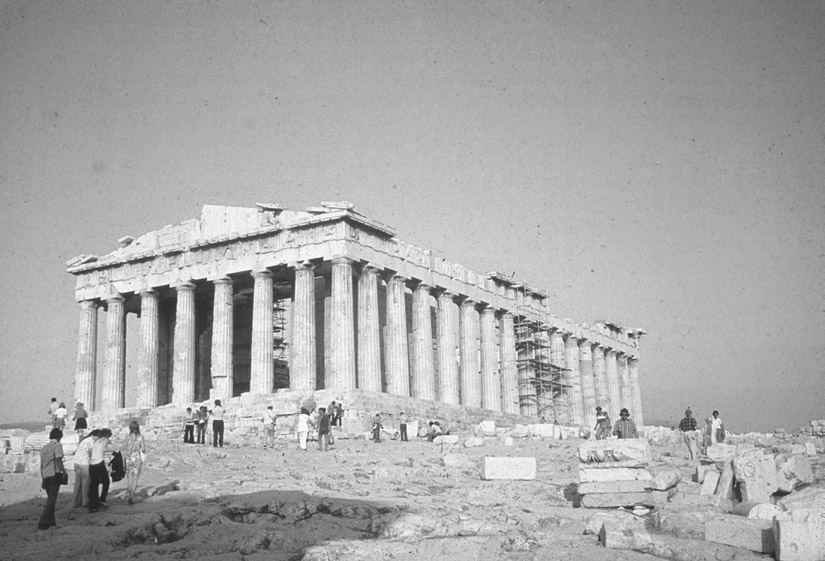
Parthenon of Athens, the temple dedicated to Athena, protecting goddess of the city of Athens
We Athenians cultivate a taste for the beautiful with moderation and we love knowledge without softness.
PERICLES Funeral Oration (430 BCE)
EUROPE AND THE CLASSICAL HERITAGE
Western European culture has seen itself as the intellectual heir, in both form and content, of the artistic traditions of Greece and Rome. Although a great variety of non-European cultural forces have also influenced the development of European thought, many of the European traditions of creative expression, from the plastic and decorative arts to architecture and literature, can trace their ancestry back to the monumental legacy of the civilizations of the classical world.
THE FINE ARTS
The Greek exploration of spiritual and intellectual expression through the plastic arts established the forms and styles that were to become the reference points for all subsequent activity in these creative fields in classical antiquity. It was an influence that survived the end of the classical world. The European fascination with the human form, especially as expressed in sculpture, as well as the ideals of harmony and proportion that also provide the basis of classical architecture, perhaps have their origins in the Greek search for rationality, order, and measure in the visible world.
|
Greek or Latin Word |
English Meaning |
|
creo-creare-creatum |
bring forth, make |
|
> cresco-crescere-cretum |
arise, become visible |
|
decus, decoris |
ornament, splendor, honor; dignity |
|
> decorus, -a, -um |
suitable, proper |
|
mnema (μνɳ̑μα) |
monument, remembrance |
|
ratio, rationis |
plan, thought; order |
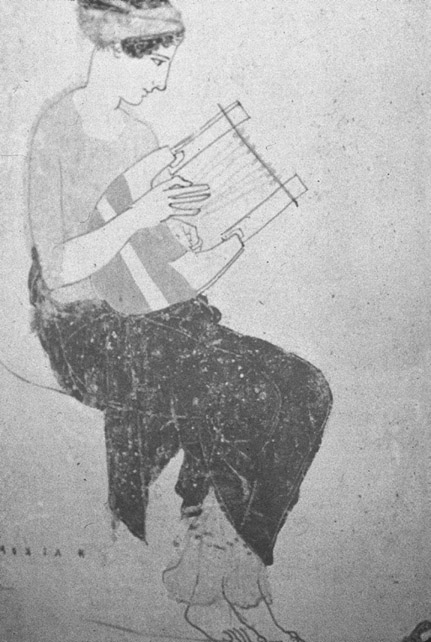
Cithara player. Fifth-century BCE vase painting (Antikensammlungen, Munich)
Studying the Classics
The term classical is usually applied to Greek art of the fifth and fourth centuries BCE. More generally, it is used to describe the civilization of Greek and Roman antiquity, and has come to represent a particular artistic or architectural style modeled on Greek and Roman prototypes.
classis = type, class
> classicus = belonging to a class > belonging to the highest class
Pots and Pans
Greek pottery was valued both for its utility and its beauty. Often, elaborately decorated with scenes or figures from Greek myth, these products—ranging from storage jars to drinking cups—found their way all around the Mediterranean world.
ceramia (κεραμεία) = pottery
CITY PLANNING
The Romans, whose aesthetic tastes were in part influenced by Greek models, were innovators as well, especially in the realm of both public and private architecture and city planning.
|
Greek or Latin Word |
English Meaning |
|
urbs, urbis |
city, town |
|
rus, ruris |
countryside |
|
porta, portae |
city gate |
|
agora (ἀγορά) |
marketplace; place of assembly |
|
forum, fori |
outside space; marketplace; place of assembly |
|
circus, circi |
circle |
|
aedes, aedis |
room |
|
> aedificium, aedificii |
building. What Latin verb can you see in this word? |
|
domus, domi |
house |
|
camera, camerae |
vault; private room |
|
cella, cellae |
small room |
|
fenestra, fenestrae |
window |
|
murus, muri |
wall |
|
cubiculum, cubiculi |
bedroom |
|
cf. cubo-cubare-cubitum1 |
lie down |
|
Palatium, Palatii |
one of the seven hills of Rome, on which the Emperor Augustus built his residence |
Going Places
In order to unite the various provinces of an empire that extended from Britain to Mesopotamia, from the Danube to North Africa, Rome built a remarkable system of roads whose remains can be seen even today. The Emperor Augustus erected the “Golden Milestone” in the Roman Forum, and all distances within the empire were measured from this point, and it was from here that all the major roads within the empire diverged. Thus we have the expression, “all roads lead to Rome.” What does this phrase now mean?
|
Latin or Greek Word |
English Meaning |
|
via, viae |
street, road, way |
|
iter, itineris |
road, route; journey |
LITERATURE
The ancient Greeks created enduring models for many of the genres of later European literature. Poetry in all its forms, as well as tragedy, comedy, and historiography, all can trace their roots to the classical literary traditions.
|
Greek or Latin Word |
English Meaning |
|
augeo-augēre-auctum |
enlarge; increase |
|
> auctor, auctoris |
one who increases; originator |
|
drama (δρα̑μα) |
doing |
|
historia (ἱστορία) |
inquiry |
|
hymnos (ὕμνος) |
song in praise of a deity |
|
littera, litterae |
letter; literature (in plur.) |
|
paean (παιάν) |
song of thanksgiving to Apollo, god of healing |
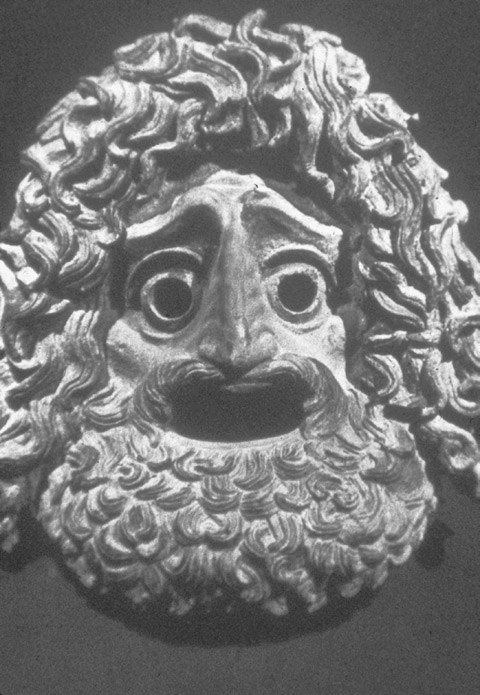
Mask of a tragic actor
THEATER
Although its exact origins are a matter of debate, it is clear that Greek theater had its beginnings in religious ritual: tragedies and comedies were performed in honor of Dionysus, the god of wine and fertility, who promised his worshippers release from the constraints of ordinary life. Attending the festival of Dionysus, at which the plays were performed, was a religious, civic, and perhaps psychological, obligation. The Greek philosopher Aristotle, in his definition of the function of tragedy, said that it was the representation (mimesis) of an action that, by means of arousing “pity and fear” in the individual, attempted to purge him of these emotions.
The production of the tragedies, which for the most part drew their themes and plots from Greek myth, was part of a competition subsidized by the wealthiest citizens, who paid the costs, including the training of the dramatic chorus, as a civic obligation. The judges, chosen by lot in order to prevent bribery, seem to have based their awards on audience applause.
In its most developed form, the cast consisted of three actors (female roles were played by men) and the members of the chorus. Originally, the author also acted in the production of his work; eventually the state provided the leading actor. The playwright Sophocles (496–406 BCE), author of Oedipus and Antigone, is said to have been a skilled musician and graceful dancer as well, who performed in several of his own dramas.
Not all Greek theater was serious and solemn. Comedy, with its sometimes fantastic plots, took pleasure in being raucous and often lewd, and in poking fun at popular religious beliefs and social relationships, as well as at prominent Athenian citizens, politicians, artists, and intellectuals.
|
Greek or Latin Word |
English Meaning |
|
comos (κω̑μος) |
revel; merry-making |
|
> comoedia (κωμῳδία) |
revel-song; comedy |
|
catharsis (κάθαρσις) |
cleansing; purification |
|
choreuo (χορεύω) |
dance in a circle |
|
character (χαρακτήρ) |
mark, stamp; special type |
|
clamo-clamare-calamatum |
shout, call out |
|
criticon (κριτικΟν) |
able to judge |
|
> hypocrites (ὑποκριτής) |
actor |
|
cf. crisis (κρίσις) |
decision; trial; dispute |
|
histrio, histrionis |
actor |
|
mimesis (μίμησις) |
representation; imitation |
|
orchestra (ὀρχήστρα) |
place where the chorus danced |
|
plaudo-plaudere-plausum in compounds, -plodo, -plodere, -plosum |
clap, strike |
|
protagonists (πρωταγονιστής) |
leading actor |
|
scene (σκηνή) |
tent; stage wall; stage backdrop |
|
theaomai (θεάομαι) |
look at, see |
|
> theatron (θέατρον) |
theater |
|
tragoedia (τραγῳδία) |
literally, goat-song; tragedy |
The Muses
Traditionally, every artist claimed that he was inspired by the Muses, the divine daughters of Zeus and the goddess Mnemosyne (Memory). The nine sisters each had a particular sphere of creative activity over which she presided.
musike (μουσική) art, letters; accomplishment
|
Goddess |
Artistic or Intellectual Realm |
|
Calliope |
Epic poetry |
|
Clio |
History |
|
Erato |
Lyric poetry |
|
Euterpe |
Flute playing |
|
Melpomene |
Tragedy |
|
Polyhymnia |
Sacred song |
|
Terpsichore |
Dance |
|
Thalia |
Comedy |
|
Urania |
Astronomy |
MUSIC
Much of musical terminology and many musical instruments—woodwinds, strings, and percussion—have classical roots.
|
Greek or Latin Word |
English Meaning |
|
musice (μουσική) |
belonging to the Muses |
|
sono-sonare-sonitum |
sound |
|
melodia (μελῳδία) |
song |
|
canto-cantare-cantatum |
sing |
|
organon (ὄργανον) |
instrument |
|
stringo-stringere-strictum |
draw tight, bind; cut off |
|
percutio-percutere-percussum |
strike |
|
cornu, cornūs |
horn |
|
cymbalon (κύμβαλον) |
cymbal |
|
tympanon (τύμπανον) |
drum |
|
cithara (κιθάρα) |
lyre, lute |
|
tuba, tubae |
trumpet |
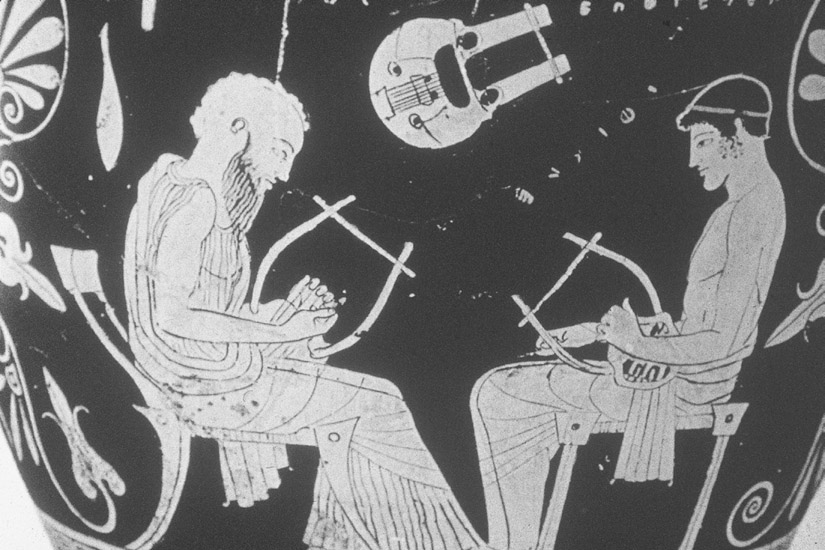
Linus, music teacher of the Greek hero Heracles. The Greek hero was said to have killed Linus after he criticized his student's playing. (Staatliches Museum, Schwerin, Germany)
Practice, Practice, Practice
If you play an instrument, you are familiar with the terms that are used to describe the various tempi, or rates of speed in a musical composition. Almost all of these terms are Italian, since in the seventeenth century, Italian composers were the first to use a system of notation to indicate the speed at which a piece was to be played. Italian is, of course, a direct descendant of Latin.
|
Italian Term |
Musical Meaning |
Latin Root |
|
allegro |
quickly |
alacer, alacris = quick, brisk |
|
vivace cf. vivo-vivere = live |
lively (faster than allegro) |
vivax, vivacis = brisk, lively |
|
presto |
very quickly |
praesto (adv.) = available, ready |
|
forte |
loudly |
fortis, fortis = strong, brave |
|
piano |
softly |
planus, plani = even, level |
Tempi is the plural form of the Italian noun tempo. What is its Latin root?
Let's Hear It for the Maestro
The shout of encore, meaning more, or again, is derived from the Latin phrase in hanc horam (at this time; still, yet). What is the derivation of maestro?
From A to Z
The first note on the musical scale in the medieval period was designated by the Greek letter gamma, while the final note was called ut. Thus, the word gamut, a contraction of gamma and ut, was used to denote the entire scale of tones. Today, the word is used to mean the entire range of any area, as in the phrase, “his emotions ran the gamut from grief to rage.”
ATHLETICS, COMPETITION, AND EXCELLENCE
Theater was not the only form of entertainment available to the Greeks and Romans, and the competitive spirit extended into the realm of physical activity. Wrestling, jumping, discus and javelin throwing, and racing were all part of public contests sponsored by the state or by wealthy citizens. Heracles, the mythical Greek hero known for his remarkable strength, was credited with founding the Olympic games; and although they were dedicated to Zeus, the contests in the stadium provided an area for the demonstration of human excellence. The entrants competed on behalf of their cities, and victors often received the same kind of public prestige (and rewards) as modern athletes.
Floor mosaic, depicting a gladiatorial contest, from a second century CE Roman villa in Nennig, Germany
Sometimes, the original purpose of the contest seems to have been lost. Roman gladiatorial combat, for example, probably had begun as part of funeral ritual, but by the time of the emperors, sponsorship of these violent spectacles had become merely a means for politicians to win popular support and to keep the populace happy.
|
Greek or Latin Word |
English Meaning |
|
agon (ἀγών) |
contest, struggle |
|
arena, arenae |
sand; arena, place for contests |
|
athlos (ἀ̑θλος) |
contest |
|
discos (δίσκος) |
plate, disc |
|
dromos (δρόμος) |
running |
|
gladius, gladii |
sword |
|
gymnazo (γυμνάζω) |
exercise naked, train |
|
peto-petere-petitum |
seek, ask; strive for |
|
prestigiae, prestigiarum |
delusion, deception. Check your dictionary to see how the word took on a positive meaning |
|
pugno-pugnare-pugnatum |
fight |
|
stadion (στάδιον) |
race course |
|
sthenos (σθένος) |
strength |
|
testor-testari-testatum |
show, prove; witness |
Leisure, the Freedom from Activity, Is Legal
The etymology of the word leisure is the Latin licet = it is permitted.
Setting a Record
According to Greek tradition, when the Athenians defeated the Persians at the Battle of Marathon in 490 BCE, the runner Pheidippides raced the twenty-six miles back to Athens to announce the good news. Marathon now denotes any long race, while the ending -thon has been used to coin many new words, all having the sense of endurance, such as telethon or walkathon.
Approval Ratings
When a fighter fell in the arena, Roman spectators often expressed their feelings. Traditionally, the gesture of thumbs up indicated that the gladiator should be spared by his opponent; thumbs down meant that the victor should show no mercy. The Roman satirist Juvenal declared that the citizens of Rome had become so decadent that they cared only for panem et circenses, “bread and circuses,” that is, free food and public entertainment, provided by ambitious politicians eager to buy votes.
|
Latin Word |
English Meaning |
|
ambitio, ambitionis |
going around; canvassing for votes; desire for office |
|
cado-cadere-casum |
fall |
|
in compounds, -cido, -cidere-cisum |
|
|
panis, panis |
bread |
|
votum, voti |
vow, oath |
Some New Beginnings
You have already learned (p. 50) that -sco indicates what is called an inceptive verb, meaning that the action has just begun, or is continuing. Here are a few more verbs that belong in this category:
|
Latin Inceptive Form |
English Meaning |
|
effervesco-effervescere |
begin to boil, foam, bubble |
|
adolesco-adolescere-adultum |
grow up |
|
coalesco-coalescere-coalitum |
grow together, become one |
|
obsolesco-obsolescere-obsoletum |
wear out, decay; go out of use |
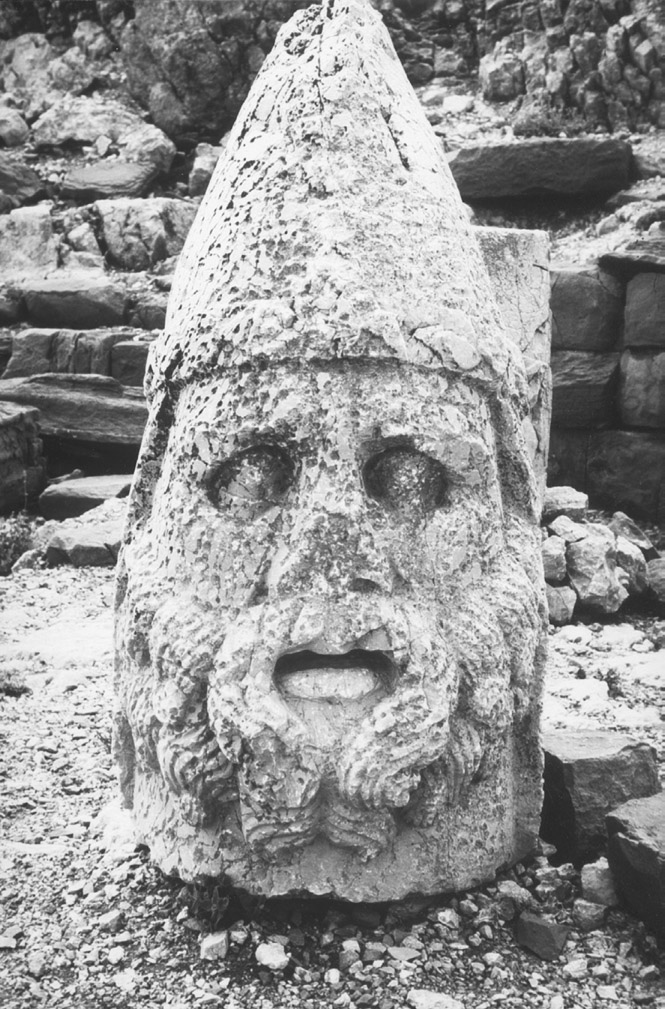
Monumental head from the tomb of Antiochus, first-century BCE ruler of Commagene, on Mt. Taurus in Turkey

NAME _______________________________________________________
Answer each question or fill in the blank with the literal meaning of the italicized word. Make sure that the sentence is grammatically correct. If you are unsure of the meaning, check your unabridged dictionary.
A. Fine Arts and City Planning
1. A domesticated animal should live in your ___________.
2. By looking at the itinerary, I knew which___________ he had taken.
3. What is the difference in meaning between urban and urbane?
____________________
____________________
4. Their indecorous behavior was _______________ at all ___________ for the occasion.
5. What is the shape of London's Piccadilly Circus? ________________
6. I don't know why my boss was so angry when she found me napping in my cubicle; after all, it was designed for ________________.
7. When he threatened to defenestrate me, I moved away ____________the_______________ .
8. As I saw the portals close, I knew I'd never get beyond those______________ .
9. I went to see the murals he had painted, but they had torn down the________________.
10. What activity took place in the Roman Forum that gives the word its current usage?______________
11. The house had a rustic charm that can only be found in the ______________.
12. The legislative branch of the U.S. government is bicameral. That means that it has______________.
13. Although she gave her rationale for acting this way, I still don't understand her___________ .
14. If it is incumbent upon you to do a task, the responsibility ________________you. What is another current usage of this word?_______________
15. What Latin word is the etymological connection between increase and crescent?___________What is the current usage of each word?
a._________________
b._________________
16. A mnemonic device helps you____________something.
17. I was pleased to get a pay increment, because that meant my salary would __________.
18. When my mother reiterated her instructions for the tenth time, I told her she was going__________over the same___________ again and again.
19. The restrictions placed on the speakers imposed by the chairman___________further debate.
20. Their collaboration was a failure, because they were unable to____________ __________________ .
21. I found him in a recumbent position. What was he doing?_____________
22. The words edifice and edification have the same root but very different meanings. Check your dictionary to see if you can figure out the history of both words.
B. Literature, Theater, Music
23. It was clear he had won plaudits for his performance: everyone was___________ him.
24. Everyone's character has its own particular_______________.
25. The choreographer __________ __________ for a performance.
26. When I heard the clamor in the street, I looked to see who was __________.
27. He took a second job to augment his wages because needed to __________ his income.
28. We had reached a crisis, and it was time to make a__________.
29. Paying his debts was a cathartic experience, because it __________ him of guilt.
30. I knew he was a hypocrite, only __________ that he was sorry.
31. When the witness attested to the evidence he __________ __________ its truth.
32. Cliometrics is that branch of the study of __________ that attempts to __________ economic or social facts.
33. If orchestra had kept its original meaning, what would happen there?__________
34. Critics are supposed to be able to __________ works of art.
35. I suffered a concussion when I was__________ __________ on the head.
36. A cantata is a musical composition that is meant to be __________.
37. What is a cornucopia? ____________________. Construct a sentence using the word.
______________________________________________________________________
38. I took drastic measures because it was clearly necessary to_______________ something.
39. If I agonize over a decision, I am ______________ to decide what to do.
40. I started to scream in pain, but my mother said, “Stop the histrionics; I know you're only__________.”
41. As the pantomime watched me, he __________ __________ my actions.
42. A sonogram is__________ produced by __________ waves.
43. She had terpsichorean aspirations, but unfortunately, she couldn't__________.
44. She wasn't very imaginative: her original thoughts ran the __________ from A to B.
45. When I asked him to clarify his idea, he tried to ______________it__________.
46. The ear's tympanic membrane acts as a____________ .
47. She __________ __________ an exclamation of disgust.
48. In the sentence, “he took what I said literally,” what is the present meaning of literally? ___________
49. What kind of entertainment should be shown at a theater named the Thalia? ____________
50. Although the teacher said, “Finish your homework with alacrity,” I did not do it _____________.
51. She showed great fortitude under stress; I would not have been so __________.
52. After the accident, he suffered from amnesia, and had __________ __________ of what had happened.
53. What is the etymology of viaduct? __________ __________ What is it? ___________
C. Athletics and Contests
54. An invincible enemy is __________ __________ __________.
55. A votive offering is one made in fulfillment of a__________.
56. One's last will and testament is a document that has been__________.
57. A remark that impugns your reputation __________ __________ it.
58. If you suffer from myasthenia, what is the matter? __________ __________ __________
59. A gymnasium is a ____________ people ____________.
60. He was casual in his approach to life. He took things as they___________.
61. What is a palindrome? ____________________ Use your unabridged dictionary to find the meaning. What are the roots of this word? ___________________________
62. A pugnacious individual is always _________________ a desire for____________.
63. Calisthenics are a means of increasing bodily_____________.
64. A petition is a means of_____________ for something.
65. The chief weapon of a gladiator was his __________.
66. His political ambitions were fueled by a __________.
67. The original meaning of the word arena was ground covered with __________. What are two current English usages of this word?
____________________
____________________
68. She entered the pentathlon, although she wasn't sure she could finish all ___________.
69. Syndrome is a medical term for a group of complaints that __________ __________.
70. His effervescent personality _____________ to remind me of a_____________ champagne.
71. Physically, he was an adult, but it was clear to everyone that he had never __________.
72. Although we tried to form a coalition, our ideas never seemed to __________.
73. That technology is rapidly becoming obsolescent, and will soon __________.
Footnotes
1. In compounds, cubo often takes the form -cumbo, cumbere, -cubitum.