

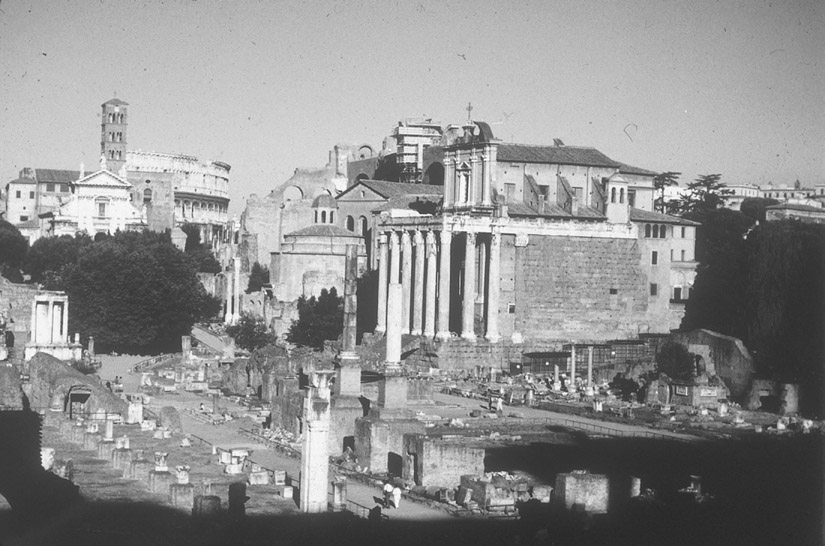
Roman Forum
Latin is a dead language,
As you can plainly see.
It killed off all the Romans,
And now it's killing me.
Popular rhyme among students of Latin
INFLECTED LANGUAGES
Before we can begin to study the Greek and Latin roots of English vocabulary, we must first understand something of the way in which these languages “work.” In modern English, the function of any word in a sentence or a phrase is determined by its position. For example:
The dog bites the man.
has a very different meaning from
The man bites the dog.
whereas
The the man dog bites and
Bites man the dog the
have no meaning at all.
Both Latin and Greek, however, are inflected languages. That means that the functions of words within a particular sentence are determined not by word order, as in English, but by various endings that are placed on each word.
In Latin, canis = dog
vir = man
mordeo = I bite
If we want to say “The dog bites the man, ” we can write:
Canis virum mordet, or
Canis mordet virum, or
Mordet virum canis, or
Virum canis mordet.
No matter how we arrange the words, the meaning of the sentence is always the same, because the ending (inflection) of each word determines its function in the sentence. If we want to change the meaning of the sentence, we have to change the endings of the words.
If we want to say, “The man bites the dog,” we can write:
Canem vir mordet, or
Canem mordet vir, or
Mordet vir canem, etc.
What has changed in these different Latin sentences? Can you explain why these changes have occurred?
Inflection
All Indo-European languages (including English) were originally highly inflected, although English has lost most of the distinctive endings. We can see the persistence of inflection in English, however, in such changes in form as I, my, me; he, his, him; goose, geese; sing, sang, sung; teach, teaches, taught. What grammatical change does each of these different forms indicate?
LATIN NOUNS AND ADJECTIVES
The changes in the endings of nouns and adjectives are determined by declension. Each change of form that occurs is called a case. There are six cases in Latin, each one expressing a possible function of a noun, pronoun, or adjective in a sentence, as in the example of femina (woman):
femina = woman
|
Case |
Sing. Form |
Function |
Example |
Plural Form |
|
Nominative |
femina |
subject |
The woman carries a book.1 |
feminae |
|
Genitive |
feminae |
possessive |
I carry the woman's book. |
feminarum |
|
Dative |
feminae |
ind. object |
I give a book to the woman. |
feminis |
|
Accusative |
feminam |
direct object |
I see the woman. |
feminas |
|
Ablative |
feminā |
means/agent |
It was done by the woman. |
feminis |
|
Vocative |
femina |
direct address |
Woman, look at this! |
feminae |
There are five declensions (that is, five different sets of endings) in Latin; every noun and adjective belongs to one of these five declensions. Each declension is identified by the ending found in the genitive (possessive) case.
1. The first declension is identified by -ae in the genitive case:
femina, feminae = woman, of the woman
porta, portae = door, of the door
nauta, nautae = sailor, of the sailor
2. The second declension is identified by -i in the genitive case:
vir, viri = man, of the man
amicus, amici = friend, of the friend
bellum, belli = war, of the war
3. The third declension is identified by -is in the genitive case:
rex, regis = king
mens, mentis = mind
urbs, urbis = city
4. The fourth declension is identified by -ūs in the genitive case:
manus, manūs = hand, of the hand
cornu, cornūs = horn, of the horn
5. The fifth declension is identified by -ei in the genitive case:
fides, fidei = faith, of the faith
dies, diei = day, of the day

Marcus Aurelius, last of the “good” Roman emperors (161–180 CE). While on campaign, he composed a work of philosophy, The Meditations, that was grounded in Stoic teachings. (Vatican Museum)
There are very few nouns and no adjectives that belong to the fourth and fifth declensions.
FINDING THE STEM OF A LATIN NOUN OR ADJECTIVE
The reason why it is so important to understand how declensions work is that almost all English derivatives from Latin nouns and adjectives are formed from the stem of the word. The stem of a noun or adjective is the genitive case minus the case ending.
|
Genitive Case |
Stem |
|
feminae |
femin- |
|
nautae |
naut- |
|
portae |
port- |
|
viri |
vir- |
|
belli |
bell- |
|
regis |
reg- |
|
mentis |
ment- |
|
urbis |
urb- |
|
manus, manūs |
man- |
|
fidei |
fid- |
LATIN VERBS
Just as nouns and adjectives are inflected, so are verbs. The inflection of verbs is called conjugation. The changes in verb endings indicate person (first, second, or third person), tense (time of action), voice (active or passive2), and mood (indicative, subjunctive, or imperative3).
Almost every Latin verb has four stems (called principal parts), each of which has a different function, and from which are formed all the possible tenses, and voices. For example,
amo-amare-amavi-amatum = love
amo = I love (first person singular, present tense, active voice)
amamus = we love (first person plural, present tense, active voice)
amavi = I have loved (first person singular, perfect tense, active voice)
amabitur = She (or he or it) will be loved (third person singular, future tense, passive voice)
amata eras = you (fem.) had been loved (second person singular, pluperfect tense, passive voice)
amatē = love! (imperative)
amare = to love (infinitive)
CONJUGATIONS
There are four conjugations, each of which is distinguished by the vowel that appears in the infinitive form:
1. The first conjugation is distinguished by a in the infinitive form:
amo-amare-amavi-amatum = love
porto-portare-portavi-portatum = carry
2. The second conjugation is distinguished by ē (long) in the infinitive form:
moneo-monēre-monui-monitum = warn
teneo-tenēre-tenui-tentum = hold
3. The third conjugation is distinguished by ě (short) in the infinitive form:
duco-ducere-duxi-ductum = lead
facio-facere-feci-factum = make
4. The fourth conjugation is distinguished by i in the infinitive form:
audio-audire-audivi-auditum = hear
venio-venire-veni-ventum = come
FINDING THE STEM OF A LATIN VERB
Almost all English derivatives from Latin verbs are formed either from the present infinitive stem (which is the infinitive minus the -re ending) or from the perfect passive stem (the fourth principal part minus the -um ending.4) Very often, when a suffix is added to the present stem of a verb (see next chapter), the distinguishing vowel of the conjugation is also dropped before the suffix is added.
|
Present Infinitive |
Present Stem |
Perfect Passive5 |
Perfect Stem |
|
portare (to carry) |
porta- |
portatum |
portat- |
|
monēre (to warn) |
monē- |
monitum |
monit- |
|
tenēre (to hold) |
tenē- |
tentum |
tent- |
|
ducere (to lead) |
duce- |
ductum |
duct- |
|
agere (to do) |
age- |
actum |
act- |
|
facere (to make) |
face- |
factum |
fact- |
|
venire (to come) |
veni- |
ventum |
vent- |
|
audire (to hear) |
audi- |
auditum |
audit- |
Deponent Verbs
There is a class of Latin verbs called deponent—verbs that are conjugated with the passive endings only, but that have active meanings. The conjugation to which each deponent verb belongs is identified in the infinitive form already noted. The mark of the passive infinitive is a final -i.
1. The first conjugation deponent verb is distinguished by an a in the infinitive form:
arbitror-arbitrari-arbitratum = think
hortor-hortari-hortatum = urge
2. The second conjugation deponent verb is distinguished by an ē in the infinitive form:
fateor-fatēri-fassum = speak
mereor-merēri-meritum = deserve
3. The third conjugation deponent verb loses the ēr in the infinitive and retains only the final i as the indication of the infinitive:
sequor-sequi-secutum = follow
revertor-reverti-reversum = return
4. The fourth conjugation deponent verb is distinguished by an i in the infinitive form:
experior-experiri-expertum = try
Examples
|
Present Infinitive |
Present Stem |
Perfect Participle |
Perfect Stem |
|
arbitrari (to think) |
arbitra- |
arbitratum |
arbitrat- |
|
hortari (to urge) |
horta- |
hortatum |
hortat- |
|
fatēri (to speak) |
fatē- |
fassum |
fass- |
|
merēri (to deserve) |
merē- |
meritum |
merit- |
|
sequi (to follow) |
seque-6 |
secutum |
secut- |
|
reverti (to return) |
reverte- |
reversum |
revers- |
|
experiri (to try, attempt) |
experi- |
expertum |
expert- |
As we shall see, there are many English words that are derived from these verbs.
SOME VERY USEFUL LATIN VERBS
|
Principal Parts |
English Meaning |
Present Stem |
Perfect Stem |
|
ago-agere-actum |
do, drive |
age- |
act- |
|
audio-audire-auditum |
hear |
audi- |
audit |
|
capio-capere-captum7 |
take |
cape- (-cipe-)- |
capt- (cept-) |
|
cedo-cedere-cessum |
go, yield |
cede- |
cess- |
|
dico-dicere-dictum |
say, speak |
dice- |
dict- |
|
do-dare-datum |
give |
da- |
dat- |
|
duco-ducere-ductum |
lead |
duce- |
duct- |
|
facio-facere-factum |
make |
face-(-fice-) |
fact- (-fect-) |
|
fero-ferre-latum |
bear, carry |
fer- |
lat- |
|
loquor-loqui-locutum |
speak |
loque- |
locut- |
|
mitto-mittere-missum |
send |
mitte- |
miss- |
|
moveo-movēre-motum |
move |
movē- |
mot- |
|
pono-ponere-positum |
put, place |
pone- |
posit- |
|
scribo-scribere-scriptum |
write |
scribe- |
script- |
|
sto-stare-statum |
stand |
sta- |
stat- |
|
teneo-tenēre-tentum |
hold |
tenē- (-tinē-) |
tent- |
|
venio-venire-ventum |
come |
veni- |
vent- |
|
verto-vertere-versum |
turn |
verte- |
vers |
|
video-vidēre-visum |
see |
vidē- |
vis |
|
voco-vocare-vocatum |
call |
voca- |
vocat- |
Be Grateful for Small Things
To the great relief of Latin students everywhere, adverbs, prepositions, and conjunctions are not declined.
Double Meanings
Sometimes, two words will have the same Latin root, but end up appearing in words that have totally different meanings. For example,
egregious and gregarious both derive from grex, gregis = flock
salary and saline both derive from sal, salis = salt
money and admonish both derive from moneo-monēre-monitum = warn.
Check your unabridged English dictionary for current meanings of these words and how these meanings developed.
Doublets
When two different English words derive from the same root and have related meanings but different English spellings, they are called doublets. Doublets most often occur when a Latin root comes into English in two different ways: directly from Latin and through an intermediary language, such as French, as well. For example,
amiable and amicable both derive from amicus, amici = friend
card and chart both derive from charta, chartae = paper
poison and potion both derive from potio, potionis = drink
royal and regal both derive from rex, regis = king
traitor and tradition both derive from trado-tradere-traditum = hand over
Check your dictionary to see if you can find a word that is a doublet of fragile.
Un Faux Ami, or What Did I Say?
A word can be spelled the same in two different languages but have no etymological connection. For example, the French word coin means corner, while the German word kind means child. The French call these seemingly related words faux amis, or false friends.?

NAME _______________________________________________________________________
A. Find the stem of each of the following Latin nouns or adjectives and list an English derivative and its current usage. Use your unabridged English dictionary to find the derivative and its definition. Remember: the genitive case (minus the ending) gives each noun or adjective its stem.
Examples
|
Latin Word |
Meaning |
Stem |
English Derivative |
Current Usage |
|
liber, liberi |
free |
liber- |
liberal |
favorable to progress |
|
audax, audacis |
bold |
audac- |
audacity |
boldness, daring |
|
Latin Word |
Meaning |
Stem |
English Derivative |
Current Usage |
|
1. aqua, aquae |
water |
__________ |
__________ |
__________ |
|
2. liber, libri |
book |
__________ |
__________ |
__________ |
|
3. corpus, corporis |
body |
__________ |
__________ |
__________ |
|
4. nox, noctis |
night |
__________ |
__________ |
__________ |
|
5. mors, mortis |
death |
__________ |
__________ |
__________ |
|
6. bellum, belli |
war |
__________ |
__________ |
__________ |
|
7. canis, canis |
dog |
__________ |
__________ |
__________ |
|
8. lex, legis |
law |
__________ |
__________ |
__________ |
|
9. pes, pedis |
foot |
__________ |
__________ |
__________ |
|
10. vulnus, vulneris |
wound |
__________ |
__________ |
__________ |
|
11. fama, famae |
rumor, report |
__________ |
__________ |
__________ |
|
12. lux, lucis |
light |
__________ |
__________ |
__________ |
|
13. os, oris |
mouth |
__________ |
__________ |
__________ |
|
14. os, ossis |
bone |
__________ |
__________ |
__________ |
|
15. gravis, gravis |
heavy |
__________ |
__________ |
__________ |
|
16. vita, vitae |
life |
__________ |
__________ |
__________ |
|
17. tempus, temporis |
time |
__________ |
__________ |
__________ |
|
18. rus, ruris |
countryside |
__________ |
__________ |
__________ |
B. In exercises 19–31, find the present or perfect stem, and an English derivative and its current usage for each of the following Latin verbs:
|
rego-regere-rectum = rule |
dormio-dormire-dormitum = sleep |
|
rapio-rapere-raptum = seize |
relinquo-relinquere-relictum = leave |
|
fallo-fallere-falsum = deceive |
miror-mirari-miratum = wonder at |
|
sentio-sentire-sensum = feel |
nascor-nasci-natum = be born |
|
mando-mandare-mandatum = order |
pendo-pendere-pensum = hang |
|
voco-vocare-vocatum = call |
plaudo-plaudere-plausum = clap |
Examples
|
Latin Verb |
Present Stem |
Eng. Derivative |
Current Usage |
|
doceo-docēre-doctum (teach) |
docē- |
docile |
easily trained or managed |
|
tango-tangere-tactum (touch) |
tange- |
tangible |
able to be touched; real |
|
Latin Verb |
Present Stem |
Eng. Derivative |
Current Usage |
|
doceo |
doct- |
doctor |
a learned person |
|
tango |
tact- |
tactile |
pertaining to touch |
|
Latin Verb |
Present Stem |
Eng. Derivative |
Current Usage |
|
19. rego |
_________ |
_______________ |
__________________________ |
|
20. relinquo |
_________ |
_______________ |
__________________________ |
|
21. sentio |
_________ |
_______________ |
__________________________ |
|
22. pendo |
_________ |
_______________ |
__________________________ |
|
23. nascor |
_________ |
_______________ |
__________________________ |
|
24. mando |
_________ |
_______________ |
__________________________ |
|
25. fallo |
_________ |
_______________ |
__________________________ |
|
Latin Verb |
Present Stem |
Eng. Derivative |
Current Usage |
|
26. sentio |
_________ |
_______________ |
__________________________ |
|
27. dormio |
_________ |
_______________ |
__________________________ |
|
28. nascor |
_________ |
_______________ |
__________________________ |
|
29. fallo |
_________ |
_______________ |
__________________________ |
|
30. voco |
_________ |
_______________ |
__________________________ |
|
31. plaudo |
_________ |
_______________ |
__________________________ |
C. The following Latin words (32–49) are used in English without any change in form or ending. Find the original Latin meaning of each word by looking in an unabridged English dictionary. Which of these words have changed in meaning, even when they have remained the same in form?
|
Latin Word |
Latin Meaning |
Current English Usage |
|
32. miser |
_________________ |
_________________________ |
|
33. bonus |
_________________ |
_________________________ |
|
34. pauper |
_________________ |
_________________________ |
|
35. minister |
_________________ |
_________________________ |
|
36. album |
_________________ |
_________________________ |
|
37. arbiter |
_________________ |
_________________________ |
|
38. rumor |
_________________ |
_________________________ |
|
39. crux |
_________________ |
_________________________ |
|
40. via |
_________________ |
_________________________ |
|
41. explicit |
_________________ |
_________________________ |
|
42. major |
_________________ |
_________________________ |
|
43. gratis |
_________________ |
_________________________ |
|
44. onus |
_________________ |
_________________________ |
|
45. rancor |
_________________ |
_________________________ |
|
46. squalor |
_________________ |
_________________________ |
|
47. novella |
_________________ |
_________________________ |
|
48. ulterior |
_________________ |
_________________________ |
|
49. valor |
_________________ |
_________________________ |
D. In exercises 50–70, fill in the blank with the word that best defines the italicized word or part of a word in the sentence. Make sure that your sentences are grammatically correct.
Example
An audition allows an actor to be heard.
50. An agent is someone who __________things for you.
51. A captive is one who has been__________.
52. A pedestrian goes by __________.
53. Data are information that is __________.
54. At a convention, delegates __________together.
55. A factory is a place where goods are __________.
56. The inscription was __________on the wall of the house.
57. Status is an indication of one's social__________.
58. Transportation is a means of __________across.
59. A deposit is money __________ down on an item to be purchased.
60. “Please remit payment” is a polite way of saying “__________ us back the money.”
61. Elocution lessons teach you how to __________ out.
62. A conductor __________ the orchestra.
63. When he told me he had reverted to smoking, I knew he had __________back to his bad habits.
64. Sequential numbers __________ one another in order.
65. I got a merit increase in my paycheck that I __________ because of my hard work.
66. He exhorted the students to work harder, but his __________ had no effect.
Sometimes a Latin verb form will become a noun in English. In the following sentences, what is the literal meaning of the italicized word, and what is its current English meaning?
67. The recipe called for six eggs, but I had only five. ____________
68. His speech contained one non sequitur after another, and I became more and more confused. ____________
69. His book had the imprimatur of the leading scholars in the field. ____________
70. The doctor admitted that he had given me only a placebo, but even so, I felt much better. ____________
E. In Exercises 71–78, fill in the blank in each sentence with one of the words listed below that best completes the meaning of the sentence.
|
mordant |
portals |
gratis |
arbiter |
|
morbid |
nausea |
amorous |
sequence |
71. He said he loved me, but I rejected his __________ advances.
72. His __________ remark made me feel as if he wanted to bite me.
73. We couldn't reach an agreement, and so the court appointed an __________ to make the decision.
74. I wanted to be a sailor, but I suffered from __________.
75 Before I had reached the __________ of the building, the guard opened the door.
76. His __________ jokes convinced me that he had a sick sense of humor.
77. He said he was presenting the outline of the course in __________, so I could follow what he was saying.
78. I knew there would be a price to pay, even though my friend said the tickets were __________.
Footnotes
1. There is no indefinite (a, an) or definite (the) article in Latin.
2. The use of the active voice indicates that the subject of the sentence is doing the action (the wolf ate the boy). The passive voice indicates that the subject of the sentence is receiving the action (the boy was eaten by the wolf).
3. Mood is the way of expressing the action of a verb as a fact (indicative), as a command (imperative), or as a possibility that may or may not occur (subjunctive). The subjunctive in both Latin and Greek has many uses.
4. For this reason, the third principal part of the verb will not be given in subsequent vocabulary.
5. The perfect passive form is really a verbal adjective (called a participle) as well as a verb. Since all nouns and adjective have gender (masculine, feminine, neuter), every participle has a masculine, feminine, and neuter form, depending on the gender of the noun it is describing. The form previously given (-um) is the neuter form. We shall see in the following chapters the consequences of this dual function of the participle.
6. The present stem of third conjugation deponent verbs replaces the distinguishing final e that it lost when forming the infinitive.
7. In compounds of capio, facio, and teneo, the a or e of the present stem becomes an i. For example,
recipio-recipere-receptum = take back
conficio-conficere-confectum = make together, accomplish
retineo-retinēre-retentum = hold back, restrain