

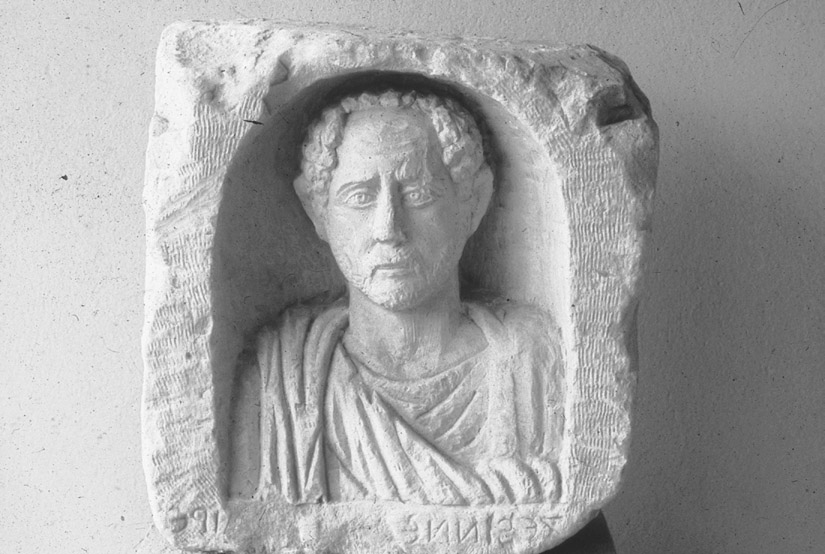
Portrait of a man, third century CE (Adana Museum, Turkey)
I trade with both the living and the dead, for the enrichment of our native tongue. We have enough in England to supply our necessity, but if we will have things of magnificence and splendor, we must get them by commerce.
JOHN DRYDEN (English poet, 1631–1700),
dedication of his translation of Vergil's Aeneid
FORMING NEW WORDS
Just as we form adjectives and nouns in English from other English nouns and verbs (e.g., woman, womanly; farm, farmer; move, movement, movable), so too did Latin and Greek. Each ending (suffix) that we add to the stem of a noun or adjective tells us something about the quality or nature of the word.
I. ADJECTIVE-FORMING SUFFIXES USED WITH LATIN NOUN STEMS
|
Latin Ending |
Meaning |
English Derivative Form |
|
-alis, -ialis |
having the characteristic of, belonging to |
-al, -ial |
|
-anus, -ianus |
having the characteristic of, belonging to |
-an, -ian |
|
-aris, -arius |
having the characteristic of, belonging to |
-ar, -ary |
|
-ilis |
having the characteristic of, belonging to |
-il, -ile |
|
-inus |
having the characteristic of, belonging to |
-ine |
|
-osus |
full of, abounding in |
-ose, -ous |
|
-lentus |
full of, abounding in |
-lent |
Examples
|
Latin noun |
English meaning |
Latin stem |
Latin adjective |
English derivative |
|
princeps, principis |
chief |
princip- |
principalis |
principal |
|
margo, marginis |
edge, boundary |
margin- |
marginalis |
marginal |
|
socius, socii |
ally, companion |
soci- |
socialis |
social |
|
vox, vocis |
voice |
voc- |
vocalis |
vocal |
|
urbs, urbis |
city |
urb- |
urbanus |
urban, urbane |
|
mare, maris |
sea |
mar- |
marinus |
marine |
|
familia, familiae |
family |
famili- |
familiaris |
familiar |
|
vir, viri |
man |
vir- |
virilis |
virile |
|
servus, servi |
slave |
serv- |
servilis |
servile |
|
copia, copiae |
abundance |
copi- |
copiosus |
copious |
|
virus, viri |
poison |
vir- |
virulentus |
virulent |
Because Latin nouns and adjectives have gender, the Romans commonly used the masculine, feminine, or neuter form of the adjective as a noun. For example:
magnus (masculine) = large, but also, the large man
magna (feminine) = large, but also, the large woman
magnum (neuter) = large, but also, the large thing
II. NOUN-FORMING SUFFIXES USED WITH LATIN NOUNS AND ADJECTIVES
Sometimes we wish to express the abstract quality of a particular noun or adjective, and we do so by forming a new noun (e.g., man, manly, manliness; state, statehood; handsome, handsomeness; kind, kindly, kindliness).
|
Latin Ending |
English Meaning |
English Derivative Form |
|
-atus |
office, group engaged in |
-ate |
|
-itas, -ietas |
quality of |
-ity, -iety |
|
-itudo |
abstract state or quality |
-itude |
|
-itia |
abstract state or quality |
-ice |
|
-monium, -monia |
abstract state or quality |
-mony |
|
-ia, -ium |
abstract state or quality |
-y |
|
-arium |
place where |
-arium |
|
-ista |
one who believes in |
-ist1 |
|
-ismus |
an abstract belief in |
-ism |
Examples
|
Latin Noun or Adjective |
English Meaning |
Stem |
Latin Derivative |
English Derivative |
|
princeps, principis |
chief |
princip- |
principatus |
principate |
|
brevis, brevis |
short |
brev- |
brevitas |
brevity |
|
socius, socii |
friend, ally |
soci- |
societas |
society |
|
varium, varii |
different |
vari- |
varietas |
variety |
|
virilis, virilis |
manly |
viril- |
virilitas |
virility |
|
magnus, magni |
large |
magn- |
magnitudo |
magnitude |
|
gratum, grati |
pleasing |
grat- |
gratitudo |
gratitude |
|
pater, patris |
father |
patr- |
patrimonium |
patrimony |
|
custos, custodis |
guard |
custod- |
custodia |
custody |
|
sol, solis |
sun |
sol- |
solarium |
solarium |
|
servus, servi |
slave |
serv- |
servitudo and servitia |
servitude service |
III. DIMINUTIVE-FORMING SUFFIXES WITH LATIN NOUNS
We may indicate the smallness or familiarity of an object or person by the addition of a suffix (e.g., drop, droplet).
|
Latin Ending |
English Derivative Form |
|
-culus |
-cule |
|
-ellus |
-el |
|
-illus |
-il |
|
-olus |
-ole |
|
-uleus, -ulus |
-ule |
Examples
|
Latin Noun |
English Meaning |
Latin Diminutive Form |
English Derivative |
|
corpus |
body |
corpusculus |
corpuscle |
|
mus |
mouse |
musculus |
muscle |
|
moles |
mass |
moleculus |
molecule |
|
novum |
new |
novellus |
novel |
|
saccus |
bag |
sacellus |
satchel |
|
pupus |
boy |
pupillus |
pupil (student) |
|
pupa |
girl |
pupilla |
pupil (part of the eye) |
|
gladius |
sword |
gladiolus |
gladiolus |
|
area |
ground |
areola |
areole |
|
nux |
nut |
nuculeus |
nucleus |
|
modus |
measure |
modulus |
module |
IV. NOUNS AND ADJECTIVES FORMED FROM LATIN VERBS
We may also make a noun or adjective from a verb by the addition of a suffix; the newly formed noun or adjective retains the quality of action in the verb (e.g., the verb make > the noun maker; the verb like > the adjective likeable). In Latin, nouns and adjectives may be formed from either the present or perfect passive stem of the verb. Remember that the present stem will often lose its final vowel, especially if it is joined to a suffix that begins with a vowel.
A. Nouns and Adjectives Formed from the Present Stem of Latin Verbs
|
Latin Noun Ending |
English Meaning |
English Derivative Form |
|
-mentum |
state of, quality of |
-ment |
|
-bulus, -bulum |
means of, place of, result of |
-ble |
|
-men |
means of, place of, result of |
-men |
|
-or |
means of, place of, result of |
-or |
|
-culus, culum |
means of, place of, result of |
-cle |
|
Latin Adjectival Ending |
English Meaning |
English Derivative Form |
|
-bilis, -ilis |
capable of being |
-ble, -ile |
|
-ax, acis |
inclined to |
-acious |
|
-uus; -ulus |
inclined to |
-uous; -ulous |
|
-idus |
inclined to |
-id |
|
-ns, -ntis (singular) |
indicates present participle |
-nt2 |
|
-ntes or -ntia (plural) |
indicates present participle |
-nce or -ncy |
Examples
|
Latin Verb |
English Meaning |
Present Stem |
Latin Noun or Adjective |
English Derivative |
|
sto-stare |
stand |
sta- |
stabulum |
stable (noun) |
|
doceo-docēre |
teach |
docē- |
docilis |
docile |
|
specio-specere |
look at |
spece- |
specimen |
specimen |
|
rigeo-rigēre |
stiffen |
rigē- |
rigor |
rigor |
|
vivo-vivere |
live |
vive- |
vividus |
vivid |
|
veho-vehere |
carry, ride |
vehe- |
vehiculum |
vehicle |
|
audeo-audēre |
dare |
audē- |
audax, audacis |
audacious |
|
credo-credere |
believe |
crede- |
credulus |
credulous |
(www.cartoonstock.com)
|
Latin Verb |
English Meaning |
Present Stem |
Latin Noun or Adjective |
English Derivative |
|
tango-tangere |
touch |
tange- |
tangens, -entis |
tangent |
|
vaco-vacare |
be empty |
vaca- |
vacuus |
vacuous |
|
tolero-tolerare |
bear |
tolera- |
tolerans, -antis |
tolerant |
|
ago-agere |
do, drive |
age- |
agens, -entis |
agent |
|
rego-regere |
rule |
rege- |
regens, -entis |
regent |
|
audio-audire |
hear |
audi- |
audientes |
audience |
B. Noun- and Adjective-Forming Suffixes with the Perfect Passive Stem of Latin Verbs3
|
Latin Ending |
English Meaning |
English Derivative Form |
|
-or |
he who |
-or |
|
-rix |
she who |
-rix |
|
-ura |
act of, result of |
-ure |
|
-orius; -orium |
that which is used for |
-ory; -orium |
|
-ivus |
given to |
-ive |
|
-io, -ionis |
state of, result of, process of |
-ion |
|
-ilis |
capable of being |
-ile |
Examples
|
Latin Verb |
Perfect Stem |
Latin Noun or Adjective |
English Derivative |
|
ago-agere-actum |
act- |
actor |
actor |
|
activus |
active |
||
|
actio, actionis |
action |
||
|
doceo-docēre-doctum |
doct- |
doctor |
doctor |
|
sto-stare-statum |
stat- |
statura |
stature |
|
statio, stationis |
station |
||
|
facio-facere-factum |
fact- |
factorium |
factory |
|
factio, factionis |
faction |
||
|
capio-capere-captum |
capt- |
captor |
captor |
|
captura |
capture |
||
|
captivus |
captive |
||
|
audio-audire-auditum |
audit- |
auditorium |
auditorium |
|
auditio, auditionis |
audition |
||
|
auditor |
auditor |
||
|
mitto-mittere-missum |
miss- |
missio, missionis |
mission |
|
missilis |
missile |
||
|
tango-tangere-tactum |
tact- |
tactilis |
tactile |
|
video-vidēre-visum |
vis- |
visibilis |
visible |
|
visio, visionis |
vision |
||
|
voco-vocare-vocatum |
vocat- |
vocatio, vocationis |
vocation |
Can You Spell That?
Although knowing the Latin root of an English word often can help you figure out its spelling, unfortunately it doesn't always work. For example, the person who holds a piece of property should be a tenent, since its Latin root is teneo-tenēre. What is the correct English spelling of this word? Check your dictionary to find out the reason why.
V. VERBAL SUFFIXES
A. The Romans added the verbs ago, facio, and capio to adjectives and nouns to form new verbs, adjectives, and nouns. The newly formed verbs then had the meaning of to do, make, or take a certain state.
|
Latin Verb |
English Meaning |
Latin Compound Verb Form |
English Derivative Form |
|
ago |
do, drive |
-igo |
-igate; -igation |
|
facio |
make, do |
-ficio |
-fy; -fic; -ficate |
|
capio |
take |
-cipio |
-cipate; -cipation |
Examples
|
Latin Adjective or Noun |
English Meaning |
Compound Latin Verb |
English Derivative |
|
castus, casti |
pure |
castigo (make pure) |
castigate |
|
navis, navis |
ship |
navigo (drive a ship) |
navigation |
|
pax, pacis |
peace |
pacifico4 (make peaceful) |
pacify; pacific |
|
pars, partis |
part |
participo (take part) |
participate |
B. By adding the suffix -sco to a verb stem, noun, or adjective, Latin indicates the process of beginning or continuing.
Examples
|
Latin Root |
English Meaning |
Latin Compound Form |
English Derivative |
|
candeo-candere |
shine |
candesco = begin to shine |
candescent |
|
candescence |
|||
|
seneo-senere |
be old |
senesco = grow old |
senescent |
|
senescence |
|||
|
quies, quietis |
rest |
quiesco = become quiet |
quiescent |
|
quiescence |
VI. VERBAL LEARNED BORROWINGS5
There are many learned borrowings in English that are derived from Latin verb stems:
|
Latin Verb |
English Meaning |
English Derivative Form |
English Meaning |
|
caedo-caedere-caesum |
kill |
-cide |
killer, killed |
|
facio-facere-factum |
make |
-fact |
made |
|
fero-ferre-latum |
carry, bear |
-fer |
carrier |
|
voro-vorare-voratum |
eat |
-vore |
eater |
Examples
|
Latin Noun |
English Meaning |
English Derivative Form |
English Noun |
English Adjective |
|
frater, fratris |
brother |
-cide |
fratricide |
fratricidal |
|
ars, artis |
skill |
-fact |
artifact |
artificial |
|
conus, coni |
cone |
-fer |
conifer |
coniferous |
|
caro, carnis |
flesh |
-vore |
carnivore |
carnivorous |
What Do You Call That Word?
All the terms used to describe the parts of speech in English are derived from Latin roots.
noun = a word referring to a person, place, thing, state, or quality (nomen, nominis = name).
verb = a word that expresses, action, existence, or occurrence (verbum, verbi = word).
adjective = a word that modifies, or qualifies, a noun (adjicio-adjicere-adjectum = add to).
adverb = a word that modifies or qualifies a verb or adjective.
preposition = a word placed before a noun to form a phrase that modifies another noun, adjective, or verb (praepono-proponere-praepositum = place before).
conjunction = a connector between words, phrases, clauses, or sentences (conjun- go-conjungere-conjunctum = join together).
Gender Differences
Gender is a grammatical category that is used to classify nouns, pronouns, and adjectives (and in some languages, verbs). In the Romance languages, the gender of nouns can be determined by their articles (the). These articles are derived from the masculine and feminine forms of the Latin demonstrative adjective ille, illa = that
|
Latin |
Spanish |
French |
Italian |
|
ille = that (man) |
el |
le |
il |
|
illa = that (woman) |
la |
la |
la |
What Does That Mean?
Sometimes an English word will retain its singular and plural Latin endings when it comes into English. For example, the Latin verb ago-agere produces agenda, which literally means “the things that are to be done,” while erro-errare-erratum (wander, go astray) gives us erratum (singular) and errata (plural). How are these words used in English?
Anglo-Saxon Suffixes
Not all English suffixes are Greek or Latin in origin. Old English (Anglo-Saxon) has left its mark on the formation of modern English vocabulary as well.
|
Old English Suffix |
English Meaning |
Example |
|
-ard |
possessor of |
dullard |
|
-er, -ster |
agent |
doer, gangster |
|
-less |
without |
toothless |
|
-ful |
full of |
truthful |
|
-some |
full of |
quarrelsome, toothsome |
|
-ish |
somewhat |
foolish |
|
-ness |
quality of, state of |
happiness, largeness |
|
-dom |
state of being, domain of |
kingdom, martyrdom |
|
-hood |
state, condition, character |
motherhood, neighborhood |
|
-ship |
state, condition, character |
kingship, kinship |

NAME _______________________________________________________
A. What English adjectives are derived from the following Latin nouns? What is the current meaning of each adjective? Use the endings in section I of this chapter. If necessary, consult an unabridged English dictionary.
Examples
|
Latin Noun |
English Meaning |
English Adjective |
Current Usage |
|
vulgus, vulgi |
crowd |
vulgar |
crude, unrefined |
|
> vulgaris |
|||
|
puer, pueri |
boy |
puerile |
immature, childish |
|
> puerilis |
|
Latin Noun |
English Meaning |
English Adjective |
Current Usage |
|
1. tempus, temporis |
time |
________________ |
________________ |
|
2. mundus, mundi |
world |
________________ |
________________ |
|
3. populus, populi |
people |
________________ |
________________ |
|
4. corpus, corporis |
body |
________________ |
________________ |
|
5. miles, militis |
soldier |
________________ |
________________ |
|
6. fabula, fabulae |
story |
________________ |
________________ |
|
7. lex, legis |
law |
________________ |
________________ |
|
8. nomen, nominis |
name |
________________ |
________________ |
|
9. ops, opis |
wealth, power |
________________ |
________________ |
|
10. verbum, verbi |
word |
________________ |
________________ |
|
11. stella, stellae |
star |
________________ |
________________ |
B. Which English nouns are derived from the following Latin adjectives? What is the current meaning of each noun? Use the endings in Section II. If necessary, consult an unabridged English dictionary.
Examples
|
Latin Adjective |
English Meaning |
English Noun |
Current Usage |
|
avarum, avari |
greedy |
avarice |
greed |
|
fortis, fortis |
brave, strong |
fortitude |
moral strength, bravery |
|
Latin Adjective |
English Meaning |
English Noun |
Current Usage |
|
12. clarum, clari |
clear |
________________ |
________________ |
|
13. malum, mali |
bad |
________________ |
________________ |
|
14. brevis, brevis |
short |
________________ |
________________ |
|
15. novum, novi |
new |
________________ |
________________ |
|
16. acer, acris |
harp |
________________ |
________________ |
|
17. varium, varii |
different |
________________ |
________________ |
|
18. memor, memoris |
mindful |
________________ |
________________ |
|
19. sanctum, sancti |
holy |
________________ |
________________ |
|
20. gravis, gravis |
heavy |
________________ |
________________ |
C. The following words have been made up, but they have been given Latin adjectival or noun endings. Identify each as either a noun or an adjective, and give the meaning of the suffix.
|
Noun or Adjective? |
Meaning of Suffix |
|
|
21. spragid |
________________ |
________________ |
|
22. fulmatorium |
________________ |
________________ |
|
23. granatary |
________________ |
________________ |
|
24. crellacious |
________________ |
________________ |
|
25. dractator |
________________ |
________________ |
|
26. stracticial |
________________ |
________________ |
|
27. grenulent |
________________ |
________________ |
|
28. lorbimony |
________________ |
________________ |
|
29. traminiety |
________________ |
________________ |
|
30. spranabile |
________________ |
________________ |
|
31. muvacture |
________________ |
________________ |
|
32. revulist |
________________ |
________________ |
|
33. quacticule |
________________ |
________________ |
|
34. scrimitude |
________________ |
________________ |
D. What English nouns and adjectives are derived from the present stems (second principal part) of the following Latin verbs? What is the current usage of each noun or adjective? Use the endings in Section IV, part A. If necessary, consult an unabridged English dictionary.
Examples
|
Latin Verb |
English Meaning |
Present Stem |
Eng. Noun or Adj. |
Current Usage |
|
vivo-vivere-victum |
live |
vivē- |
vivid |
intense, full of life |
|
valeo-valēre6 |
be strong |
valē- |
valor |
boldness, courage |
|
Latin Verb |
Meaning |
Pres. Stem |
Eng. Noun or Adj. |
Current Usage |
|
35. curro-currere-cursum |
run |
____________ |
____________ |
____________ |
|
36. experior-experiri-expertum |
try |
____________ |
____________ |
____________ |
|
37. recipio-recipere-receptum |
take back |
____________ |
____________ |
____________ |
|
38. miror-mirari-miratum |
wonder at |
____________ |
____________ |
____________ |
|
39. stupeo-stupēre |
be stunned |
____________ |
____________ |
____________ |
|
40. sedeo-sedēre-sessum |
sit |
____________ |
____________ |
____________ |
|
41. fallo-fallere-falsum |
deceive |
____________ |
____________ |
____________ |
|
42. clamo-clamare-clamatum |
shout |
____________ |
____________ |
____________ |
|
43. solvo-solvere-solutum |
loosen |
____________ |
____________ |
____________ |
|
44. patior-pati-passum |
suffer |
____________ |
____________ |
____________ |
E. Which English nouns and adjectives are derived from the perfect stems of the following Latin verbs? What is the current usage of each noun or adjective? Use the endings in Section IV, part B. If necessary, consult your dictionary.
Examples
|
Latin Verb |
English Meaning |
Perf. Stem |
Eng. Noun or Adj. |
Current Usage |
|
tolero-tolerare-toleratum |
bear, endure |
tolerat- |
toleration |
endurance |
|
jungo-jungere-junctum |
join |
junct- |
juncture |
act of joining |
|
Latin Verb |
English Meaning |
Perf. Stem |
Eng. Noun or Adj. |
Current Usage |
|
45. nascor-nasci-natum |
be born |
____________ |
____________ |
____________ |
|
46. lego-legere-lectum |
read, choose |
____________ |
____________ |
____________ |
|
47. curro-currere-cursum |
run |
____________ |
____________ |
____________ |
|
48. morior-mori-mortuum |
die |
____________ |
____________ |
____________ |
|
49. sedeo-sedēre-sessum |
sit |
____________ |
____________ |
____________ |
|
50. fallo-fallere-falsum |
deceive |
____________ |
____________ |
____________ |
|
51. patior-pati-passum |
suffer, bear |
____________ |
____________ |
____________ |
|
52. sentio-sentire-sensum |
feel |
____________ |
____________ |
____________ |
|
53. solvo-solvere-solutum |
loosen |
____________ |
____________ |
____________ |
|
54. muto-mutare-mutatum |
change |
____________ |
____________ |
____________ |
|
55. frango-frangere-fractum |
break |
____________ |
____________ |
____________ |
F. Fill in the blank with the literal meaning7 of the italicized word or part of the word. Make sure that your answers are grammatically correct.
56. All his arguments were fallacious, but everyone was ____________ by them.
57. His sanctimonious words revealed that he thought he was ____________ than everyone else.
58. They tried to revivify the patient, but it became clear that he was no longer ____________.
59. The mutability of our circumstances shows that our lives are subject to ____________.
60. It is said that “brevity is the soul of wit,” but some speakers never learn to keep their comments ____________.
61. If you have a sedentary job, you will spend a lot of time ____________.
62. The clamor in the street grew as the crowd ____________ their demands.
63. She gave the document a cursory glance as her eye ____________ down the page.
64. I asked him to verbalize his thoughts, but he couldn't find the ____________.
65. The Maritime Provinces of Canada are situated by the ____________
66. In Roman gladiatorial combat, the chief weapon of the fighters was the ____________.
67. His voracious appetite drove him to ____________ everything in the refrigerator.
68. I was told he had a mortal illness, but I hoped he would not ____________.
69. Identify the functions of the italicized words (nouns, adjectives, verbs?) in the following sentence: The spragid glomularity of the stractibulous bananitude oblifected me.
G. Fill in the blank with a word of the opposite meaning chosen from the list below. Check your dictionary if you are not sure of the meaning.
|
scarce |
silent |
freedom |
concrete |
rebellious |
|
peaceful |
poor |
secretive |
separation |
otherworldly |
|
70. juncture |
__________ |
|
71. copious |
__________ |
|
72. mundane |
__________ |
|
73. turbulent |
__________ |
|
74. vocal |
__________ |
|
75. docile |
__________ |
|
76. intangible |
__________ |
|
77. opulent |
__________ |
|
78. candid |
__________ |
|
79. servitude |
__________ |
Footnotes
1. These Latin endings are actually derived from Greek suffixes and are most often used to form learned borrowings (see note 5 below) in English.
2. A participle is a verb form used as an adjective; the present active participle is formed most often in English by adding the suffix -ing to the basic form of the verb—e.g., the running man, the smiling woman, the driving rain. Because Latin participles are adjectives, they can be declined and have number. All present participles belong to the third declension.
3. The fourth principal part of the verb, from which the perfect passive stem is derived, is also a participle, but passive in meaning, and refers to some event that happened in the past. It is most often expressed in English by the suffixes -ed and -en: e.g., scrambled eggs (eggs that have been scrambled), broken leg (a leg that has been broken), or amarried man (a man who has been married). Although the stem has a passive meaning, it can take on an active meaning when a suffix is added (see examples above).
4. Note that in compounds formed from a noun or adjective together with -ficio or -cipio, the final -i of the verb stem often disappears.
5. A learned borrowing is a word based on a Greek or Latin root, but given a meaning that it did not have in Latin or Ancient Greek—e.g., telephone, which is formed from the ancient Greek words tele- (from a distance) and phone (sound). The Greeks of the fifth century BCE obviously did not have telephones, but because of the high esteem in which classical learning was held, the ancient Greek language was used to name this nineteenth-century invention.
6. Some verbs do not have a perfect passive system.
7. In this, and in all following exercises, a blank represents the literal definition of the italicized word or part of the word. In the context of these exercises, the literal meaning of a word or part of a word is the original meaning of the Greek or Latin root.