
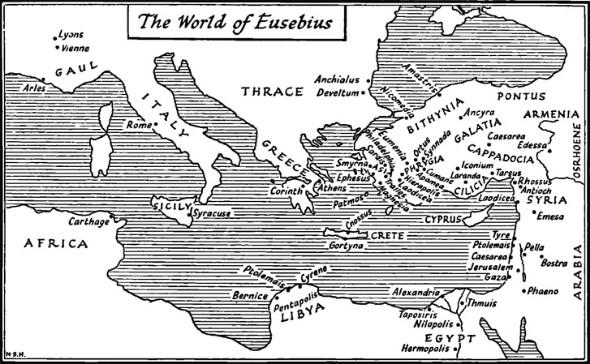
The following ‘Who’s Who’ has entries for all the people who appear in the pages of The History of the Church (with the exception of a very few people mentioned in quotations from Josephus and of no importance to Eusebius’ story). It also contains articles on a few other matters – e.g., Easter, the Septuagint, groups such as the ‘Seventy’ (disciples), the Apostles, the gnostics, the docetists – which also require comment. Each article includes a list of the places in The History of the Church (by Book and chapter: IX. 2 = Book 9, chapter 2) where they are mentioned, as well as brief comment, which often supplements and sometimes corrects what Eusebius tells us. Dates are given when it is possible to be specific: in the case of the bishops of the great sees of Rome, Alexandria, Antioch and Jerusalem (Aelia), except for Rome, (where there is confirmation independent of Eusebius) dates are not given, and the reader is recommended to consult Appendix A. Almost all geographical places mentioned by Eusebius can be found on the map opposite. Other information can be found in the appendices.
ABGAR (I. 13; II. 1). King (toparch) of Edessa in Osrhoene. The legend of the correspondence between Jesus and Abgar is fabulous, though Abgar V Uchama (‘the Black’) was king in Edessa during Jesus’ ministry in Palestine. The legend perhaps reflects the favour to Christians in Edessa shown by Abgar IX the Great (179–214). The parallel version of the legend in the fifth-century Doctrine of Addai (Addai = Thaddaeus (q.v.) in The History of the Church) relates that Abgar not only received a letter from Jesus, but also acquired a portrait of him: of this Eusebius knows nothing. J. B. Segal, Edessa, ‘The Blessed City’ (Oxford, 1970), pp. 62–81.
ABRAHAM (1. 2, 4). Jewish patriarch (Gen. xii–xxv).
ACHAEUS (VII. 15). Legatus of Syria and Palestine c. 260/1.
ACHILLAS (VII. 32). Presbyter of Alexandria under Theonas, the head of the Catechetical School. He succeeded Peter as bishop of Alexandria.
ADAUCTUS (VIII. 11). Roman official martyred under Diocletian. ADOPTIONISTS. Heretics who believed that Jesus was a mere man whom God had adopted as his son (’mere man’ = psilos anthropos in Greek; hence adoptionism is sometimes called ‘psilanthropism’).
AELIAN (VII. 30). Member of the synod that condemned Paul of Samosata.
AEMILIAN (VII. 11). Lucius Mussius Aemilianus, Deputy-Prefect of Egypt in 257 and later Prefect. After the capture of Valerian he conspired unsuccessfully against Gallienus, and was besieged in Alexandria.
AFRICANUS (1. 6, 7; VI. 31). Sextus Julius Africanus, probably born in Jerusalem, he later settled at Emmaus. On its behalf he went on an embassy to the Emperor Elagabalus, which led to its restoration as Nicopolis. He was friendly with the royal house of Edessa, and had connexions with Heraclas and Origen in Alexandria. Under the Emperor Alexander Severus he was involved in the building of a public library in the Pantheon at Rome. A lay Christian writer, he compiled a Chronography (Dictionary of Dates), according to which the world was to last for 6,000 years, the birth of Christ having occurred in 5500, and a major work (in twenty-four books) called Cesti (’embroidered girdles’, a fanciful name for a miscellany, like Stromateis – ‘carpet bags’): of these only fragments survive. Two letters survive, one to Origen on the authenticity of the story of Susanna (interpolated in the Greek Septuagint version of Daniel), in which he produces cogent reasons for its having been composed in Greek (to which Origen replies unconvincingly), and another to Aristides, which seeks to reconcile the divergent genealogies of Christ in the gospels of Matthew and Luke. Both letters manifest an astute critical intelligence. His reconciliation of Matthew’s and Luke’s genealogies was widely accepted: the same method is found (with some amplification) in the eighth-century compendium of Byzantine theology, John Damascene’s On the Orthodox Faith, 87.
AGABUS (II. 3, 8; V. 17). The Christian prophet from Judaea, mentioned in Acts xi. 28, xxi. 10.
AGAPIUS (VII. 32). Bishop of Caesarea after Theotecnus, late third century; probably succeeded by Eusebius.
AGATHOBULI (VII. 32). The two Agathobuli are said by Anatolius to have been the teachers of Aristobulus the Great.
AGATHONICE (VI. 15). Martyr, the account of whose martyrdom survives: see Carpus.
AGRIPPA I (II. 4, 9, 10, 19). Herod Agrippa I, grandson of Herod the Great, he reigned 37–44. He was the Herod of Acts who had James the apostle beheaded, and died consumed by worms, the account of which is given by Luke in Acts xii and by Josephus (which Eusebius reproduces).
AGRIPPA II (II. 19, 23; III. 10). Son of Agrippa I, reigned 50-c. 93, he was the ‘king Agrippa’ before whom Paul the apostle appeared (Acts xxv. 13ff.)
AGRIPPA CASTOR (IV. 7). Earliest recorded Christian writer against heresy, he wrote against the Gnostic Basilides: of him we know no more than Eusebius tells us.
AGRIPPINUS (IV. 20; V. 9). Bishop of Alexandria.
ALBINUS (II. 23). Procurator of Judaea 62–4.
ALCE (IV. 15). Apparently a prominent Christian of Smyrna, conceivably the same lady greeted by Ignatius of Antioch forty years earlier (Ignatius’ Smyrneans, 13; Polycarp, 8). Her brother and nephew were pagans, but not apparently hostile to Polycarp.
ALCIBIADES (V. 3). Christian converted from Encratism in prison.
ALCIBIADES (V. 3). Montanist leader not mentioned elsewhere; it may be that the name Miltiades was intended, and ‘Alcibiades’ is a slip of the pen, caused by the mention of Alcibiades a few lines earlier.
ALEXANDER (II. 5). Brother of Philo (q.v.). He held the post of alabarch, i.e. (probably) superintendent of customs on the Arabian side of the Nile.
ALEXANDER (IV. 1; V. 6). Bishop of Rome 105–15.
ALEXANDER (V. 1). Martyred in the persecution at Lyons and Vienne.
ALEXANDER (V. 16). One of the martyrs from Eumenia in Phrygia, martyred at Apamea.
ALEXANDER (V. 18). Montanist self-styled martyr, presented by Apollonius (Eusebius’ source) as a fraud.
ALEXANDER (VI. 8, 11, 14, 19, 20, 27, 39, 46). A friend of the two philosopher-theologians who taught at Alexandria, Pantaenus and Clement, he became a friend and supporter of Origen. He was twice a confessor, being imprisoned during persecution for several years at the beginning of the third century, and finally dying in prison during the Decian persecution. Already bishop of an unknown see in Cappadocia, c. 212 he visited Jerusalem and was chosen as coadjutor to the bishop Narcissus, whom he succeeded on his death. His is the first recorded example both of the appointment of a coadjutor and of the translation of a bishop from one see to another (the latter practice forbidden, ineffectually, by the Council of Nicaea). He established a library at Jerusalem, which Eusebius used in compiling The History of the Church. He defended Origen against the accusations of his bishop, Demetrius, and together with Theoctistus, bishop of Caesarea, ordained him to the priesthood. He wrote several letters, from which Eusebius quotes some passages.
ALEXANDER (VI. 21, 24, 26, 28). Marcus Aurelius Severus Alexander, Emperor 222–235, probably thought by Eusebius (implausibly) to have been a Christian (cf. VII. 10).
ALEXANDER (VI. 41). Martyred at Alexandria in the Decian persecution.
ALEXANDER (VII. 11). Martyred in Caesarea in the reign of Valerian.
ALOGI. The name given by Epiphanius to heretics who opposed Montanism and rejected the Fourth Gospel and the Revelation, ascribing them to the heretic Cerinthus. They flourished in Asia Minor towards the end of the second century. Their name (from a = not and logos = reason or word) means ‘irrational’ and was probably also meant to suggest opponents of reason (in theology) and of the Logos or Word of God (this name figures prominently in the Johannine Literature). Gaius of Rome may have been associated with them.
AMBROSE (VI. 18, 23, 28). A rich and cultured man of noble birth, whom Origen reclaimed from heresy c. 211. He became Origen’s patron and encouraged him in his writing and research, making it possible for Origen to devote himself to the study of the Scriptures at the school he set up in Caesarca (231), where Ambrose joined Origen. He was apparently ordained deacon, and suffered as a confessor at Caesarea c. 235, which prompted Origen’s Exhortation to Martyrdom. He died c. 250.
AMMIA (V. 17). Christian prophetess mentioned by Miltiades.
AMMON (VII. 41). Soldier martyr at Alexandria in the Decian persecution.
AMMON (VIII. 26). Bishop of Bernice in Pentapolis, to whom Dionysius of Alexandria wrote several letters against Sabellius.
AMMONARION (VI. 41). Martyred at Alexandria in the Decian persecution.
AMMONIUS (VIII. 13). Presbyter of Alexandria, martyred in the Great Persecution.
AMMONIUS SACCAS (VI. 19). Alexandrian philosopher, the teacher of Longinus and Plotinus, as well as Origen. Brought up a Christian, according to Porphyry, he became a pagan. Died c. 243.
ANATOLIUS (VII. 32). An Alexandrian philosopher of considerable learning who established a school of Aristotelian philosophy at Alexandria. He played a notable role during a siege of the Greek quarter (the Brucheum) of Alexandria, probably during the revolt of the Prefect Aemilian (262). Soon afterwards he was consecrated bishop by Theotecnus, bishop of Caesarea, presumably as coadjutor, but in 268, on his way to the synod at Antioch which condemned Paul of Samosata, was made bishop of Laodicea. Eusebius quotes a long passage from his treatise on the date of Easter (q.v.), which introduced a nineteen-year cycle for calculating the date: this cycle is essentially that still used. He also wrote a ten-part work, Elements of Arithmetic; the fragments that remain, however, are probably not authentic. Died c. 282.
ANDREW (III. 1, 25, 39). The apostle. Eusebius says that he went to Scythia. The tradition that he preached in Achaia, and was martyred at Patras, is late and unreliable, and even more so the tradition that he was crucified on a ‘St Andrew’s cross’ (in the form of an X). Eusebius also mentions the spurious Acts of St. Andrew, which he asserts is heretical. For the Acts, see James, pp. 337–63, and Hennecke and Schneemelcher, II, pp. 390–425.
ANENCLETUS (III. 13, 15, 21; V. 6). Bishop of Rome, also called (not in Eusebius) Anacletus and Cletus (conventional dates: 76–88).
ANICETUS (IV. 11, 14, 19, 22; V. 6, 24). Bishop of Rome 155–66.
ANNAS (I. 9f). (Called, correctly, Ananus by Josephus.) Jewish high priest A.D. 6/7–15, when he was deposed by the Prefect, Valerius Gratus, and later succeeded by his son-in-law, Caiaphas. Luke (and Acts) and John speak of Annas and Caiaphas as high priests, perhaps reflecting the conviction of some Jews that Annas could not be deposed. Eusebius is very confused, and tries to make out that Annas was high priest at the beginning of Jesus’ ministry, Caiaphas at the end, Jesus’ ministry having lasted almost four years (something Eusebius seeks to establish elsewhere: see III. 24). This involves a curious interpretation of the passage he quotes from Josephus: there may have been barely four years between the deposition of Annas and the appointment of Caiaphas, but Caiaphas seems to have been high priest for almost twenty years.
ANNIANUS (II. 24; III. 14, 21). First bishop of Alexandria after the evangelist Mark, though Eusebius studiously avoids the term ‘bishop’.
ANONYMOUS (V. 16f.). Eusebius does not give the name of one of his main sources for Montanism, though he quotes from him extensively. He is consequently referred to as the ‘Anonymous’. We know nothing about him, though from the way he refers to Zoticus as ‘our fellow-presbyter’ (V. 16.5; cf. 1 Peter v. 1) and his authoritative tone, it has been argued that he must have been a bishop.
ANTEROS (VI. 29). Bishop of Rome 22 November 235–3 January 236.
ANTHIMUS (VIII. 6, 13). Bishop of Nicomedia, martyred in 303 at the beginning of the Great Persecution.
ANTINOUS (IV. 8). Favourite page of the Emperor Hadrian, who was drowned in the Nile 130 or 131. He was deified by Hadrian, who founded Antinoopolis in the Thebais in his honour. His deification is mentioned often by the second-century apologists as an example of the origin of the pagan gods: a theory often called Euhemerism (after Euhemerus, a Sicilian writer, c. 315 B.C.).
ANTIPAS (I. 9–11; II. 4). Herod Antipas (called Herod by Eusebius), son of Herod the Great, tetrarch of Galilee and Peraea 4 B.C.–A.D. 39, who married Herodias, his brother’s wife, thus incurring the wrath of John the Baptist, whose execution he ordered (see Mark vi. 14–29). He is the ‘Herod’ of the Crucifixion (Luke xxiii. 6–12).
ANTIPATEH (I. 6f.). Father of Herod the Great.
ANTONINUS PIUS (II. 13; IV. 10–12, 14, 18). Titus Aurelius Fulvus Boionius Antoninus Pius, Emperor 10 July 138–7 March 161. Eusebius is very confused about the Antonines, so it is sometimes unclear which Emperor he has in mind: he evidently regarded Antoninus Pius as friendly towards the Christian Church (see Marcus Aurelius).
ANULINUS (X. 5–7). Proconsul of Africa after Constantine’s conversion (if not before), who had to deal with the early stages of the Donatist controversy.
APELLES (V. 13). Disciple of Marcion, who broke away from his master’s teaching, rejecting his dualism and his Docetism, but retaining his hostility to the Old Testament. Apart from Eusebius, our main source is Tertullian, who refers to him in his On the Prescription of Heretics and devoted to him a treatise (now lost). The discussion between Rhodo and Apelles, which we know of from Eusebius, was called by the great Church historian A. von Harnack ‘the most important religious discussion in Church history’. He wrote a long book, Syllogisms, devoted to proving the worthlessness of the Old Testament, fragments of which are preserved in Ambrose’s treatise On Paradise.
APION (V. 27). A contemporary of Irenaeus who wrote a treatise (now lost), The Six Days of Creation.
APOLINARIUS (IV, 21, 26, 27; V. 5, 16, 19). Claudius Apolinarius, bishop of Hierapolis and Christian writer. We know no more than Eusebius tells us. As he wrote an apology to Marcus Aurelius (alone), he must have flourished 170–80. He seems to have been a prominent opponent of Montanism. He is also one of Eusebius’ sources for the story of the Thundering Legion (q.v.).
APOLLONIA (VI. 41). Martyred at Alexandria in the Decian persecution.
APOLLONIADES (V. 28). Probably disciple of Theodotus (the cobbler or the banker q.v.), adoptionist heretic.
APOLLONIUS (V. 18). Anti-Montanist writer, perhaps writing as late as 200. He is said (on no very reliable authority) to have been bishop of Ephesus. According to Jerome, his attack on Montanism provoked a response from Tertullian (now lost).
APOLLONIUS (V. 21). A senator (according to Jerome) martyred in Rome under Commodus. The Acts of his martyrdom survive in a late and unreliable version, which makes Apollonius an Alexandrian and the magistrate Perennius proconsul of Asia. See Musurillo, pp. 90–105.
APOLLOPHANES (VI. 19). Antiochene Stoic (third century B.C.).
APOLOGISTS. The name given to those Christian writers (mainly of the second century) who wrote Defences (Apologies) of Christianity, often addressed to the Emperor. They were pleas that Christians did not deserve to be persecuted, and answered the suspicions often raised against Christians: suspicions of atheism (denial of the existence of the gods) and immorality (especially ‘Oedipean incest and Thyestean banquets’ – Oedipus made love to his mother, Thyestes had a meal of his children). The first charge was met by the explanation that Christians were monotheists, the second by the explanation that it was a misunderstanding of the Christian Eucharist and the fraternal love of the Christian community. Eusebius once suggests that the charge of immorality is justly levelled against the Gnostic sects with whom pagans confuse Christians (IV. 7). The charge of Thyestean feasts and Oedipean incest is mentioned as having been made against Christians in the letter about the persecution at Lyons and Vienne (V. 1. 14). The apologists drew on Greek (mostly Platonic) philosophy in their attempts to explain Christianity to the pagan world.
APOSTLES. Name given to the most important leaders in the first-generation Church. Luke (in Acts) attempts to limit the number of apostles to the twelve disciples of Jesus, Matthias being chosen to fill the place vacated by Judas Iscariot; Paul seems unaware of the twelve apostles (though he knows of the Twelve: see 1 Cor. xv. 5–7) but fiercely defends his own right to the title of apostle (see the beginning of all his epistles). The Didache (see below) seems to envisage the apostles as itinerant missionaries, as opposed to the settled ministry of bishops and deacons. Eusebius makes what he can of this evidence (and seems not to have any more): apostles belonged to the first generation of the Church; the name refers primarily to the Twelve, but by extension to a ‘large number’, including Paul (I. 12). Eusebius mentions the Didache (the ‘Teachings of the Apostles’) as a spurious work, not to be included in the canon (q.v.). This work, probably very ancient, was rediscovered in the last century, and is a kind of primitive Church Order: see Early Christian Writings, pp. 187–99.
AQUILA (V. 8; VI. 16). Biblical translator. A native of Sinope in Pontus, he lived under the Emperor Hadrian. He was a proselyte to Judaism, and produced an extremely literal translation of the Hebrew Bible into Greek, intended to replace the Septuagint which the Christians had adopted. Only a few fragments survive, but Origen and Jerome admitted its fidelity to the Hebrew original. It occupied the third column of Origen’s Hexapla.
AQUILA (VI. 3, 5). Subatianus Aquila, Prefect of Egypt 203–10.
AQUILA (VII. 11). Alexandrian presbyter (probably) mentioned in one of Dionysius of Alexandria’s letters.
ARABIANUS (V. 27). An essay of his mentioned. Otherwise unknown.
ARCHELAUS (I. 6, 8). Son of Herod the Great; ethnarch of Judaea, Idumaea and Samaria 4 B.C.–A.D. 6.
ARISTARCHUS (II. 22). Fellow-prisoner of Paul (Col. iv. 10).
ARISTEAS (V. 8). The letter of Aristeas is a pseudepigraphical letter, written in Greek, supposedly by Aristeas, an official at the court of Ptolemy Philadelphus (285–247 B.C.), giving a miraculous account of translation of the Septuagint (q.v.). Charlesworth, II, pp. 7–34.
ARISTIDES (I. 7: VI. 31). Recipient of letter from Africanus on the genealogy of Christ.
ARISTIDES (IV. 3). A Christian apologist from Athens who wrote the earliest extant Apology. For centuries it was believed lost. Towards the end of the last century part of an Armenian translation was discovered, then a complete Syriac version: this led J. A. Robinson to detect the original Greek version behind an episode in the Greek novel ascribed to John Damascene, Barlaam and josaphat. Eusebius ascribes the Apology to the reign of Hadrian, but there are strong reasons for thinking that it was addressed to Antoninus Pius, early in his reign. The Apology of Aristides, ed. and trans. J. Rendel Harris (Texts and Studies, I/1; 2nd edn, 1893; repr. 1967).
ARISTION (III. 39). Mentioned alongside John the presbyter by Papias. An Armenian manuscript of the Gospels, dated 986, discovered by F. C. Conybeare in 1891, attributes Mark xvi. 9–20 (the ‘longer ending’) to the ‘elder Aristion’. This may refer to Papias’ Aristion, and may be correct.
ARISTO OF PELLA (IV. 6). The learned John of Scythopolis (sixth century) tells us (in a passage preserved in the scholia on The Mystical Theology of Dionysius the Areopagite attributed to Maximus the Confessor) that Aristo of Pella was the author of the Dialogue between Jason (a Christian) and Papiscus (a Jew). It was known to Celsus (whose mockeries of it Origen attacked: Contra Celsum IV. 52) and it quotes a verse from the version of Aquila. It must have been written therefore between 140 and c. 180; these dates fit with what Eusebius tells us, that Aristo wrote an account of the destruction of the Temple under Hadrian.
ARISTOBULUS (VI. 13; VII. 32). Great Jewish philosopher who lived in the time of Ptolemy VI Philometor (i.e., about 180–145 B.C.) in Alexandria. Anatolius is certainly wrong in regarding him as one of the seventy translators of the Septuagint (VII. 32). Schürer, III, pp. 579–87.
ARISTOTLE (V. 28). Greek philosopher, 384–322 B.C.
ARMENIA (IX. 8). Eusebius mentions that the Armenians had become Christians by 312, but he seems to know no more. The ‘apostle of Armenia’ was Gregory the Illuminator, of royal descent, who had been brought up a Christian while an exile in Cappadocia. On his return to Armenia, he succeeded in converting the king, Tiridates (c. 238–314), to the Christian faith. He himself was consecrated bishop (Catholicos) by the metropolitan of Caesarea in Cappadocia c. 290 and lived to c. 328.
ARTEMON (V. 28; VII. 30). Artemon (who seems to be identical with Artemas) was an adoptionist (q.v.). He was named by the synod of Antioch (268), which condemned Paul of Samosata, as the father of the heresy, and seems to have been alive at the time. In V. 28, Eusebius quotes from a work Theodoret tells us was called the Little Labyrinth (q.v.), as if it were directed against Artemon. The passages quoted, however, do not mention Artemon, but rather concern the two Theodoti (the cobbler and the banker, q.v.), Asclepiodotus and Natalius, and describe events in Rome during the time of pope Victor (189–99) and pope Zephyrinus (199–217): probably too early for one who was alive and influential in the region of Antioch in 268.
ASCLEPIADES (VI, 11, 21). Bishop of Antioch.
ASCLEPIODOTUS (V. 28). Also called Asclepiades, unless that is someone else. An adoptionist attacked by name in the Little Labyrinth (q.v.). He belonged to the Rome of pope Zephyrinus (199–217), and is accused of heavy-handed emendation of the Scriptures as well as adoptionism.
ASTERIUS URBANUS (V. 16). Montanist, probably the compiler of Maximilla’s oracles.
ASTYRIUS (VII. 16, 17). Senator of Caesarea, prominent opponent of paganism, who buried the body of the soldier–martyr Marinus.
ATER (VI. 41). An Egyptian (i.e., a Copt, not a Greek), martyred at Alexandria during the Decian persecution.
ATHENODORE (VI. 30; VII. 14, 28). Brother of Gregory Thaumaturgus. Like him, he studied rhetoric as a pagan, became a Christian, studied under Origen at Caesarea, and returned to Pontus, where he became a bishop. As a bishop, he participated in the synod of Antioch (268) which condemned Paul of Samosata.
ATTALUS (V. 1, 3). A Christian from Pergamum, martyred in the persecution at Lyons and Vienne, by being thrown to the wild beasts. V. 3 records a vision he had in a dream.
ATTICUS (III. 32). Provincial Governor in Judaea, who had been a Consul: perhaps Sextus Attius Suburanus, who was Consul in 104.
ATTICUS (VI. 19). Bishop of Synnada in Phrygia.
AUGUSTUS (I. 5f., 9). Gaius Julius Caesar Octavianus (Augustus from 27 B.C.), great-nephew of Julius Ceasar; Emperor 23 B.C–A.D. 14. (Eusebius dates his reign from 44 B.C., the year of Julius Caesar’s death.)
AURELIAN (VII. 28, 30). Lucius Domitius Aurelianus, Emperor 270–5. The Christians of Antioch appealed to him to remove Paul of Samosata after their failure to acquire possession of the church in Antioch. According to Eusebius, he contemplated a renewed persecution of Christians, but died before he could put it into effect.
AURELIUS QUIRINIUS (V. 19). A bishop-signatory to a (synodical?) letter by Serapion of Antioch. He signs himself ‘martyr’: i.e., witness or confessor.
AVILIUS (III. 14. 21). Second bishop of Alexandria, though Eusebius avoids the term ‘bishop’.
AVIRCIUS MARCELLUS (V. 16). Recipient of the anonymous treatise against Montanism. A Greek epitaph, discovered in 1883 by W. M. Ramsey, now in the Vatican Museum, mentions the travels of an Abercius Marcellus, bishop of Hieropolis in Phrygia Salutaris, to Rome and Nisibis, and bears witness in allusive symbolic language to the universal celebration of the Eucharist. The text of this epitaph is incorporated in an early fifth-century life of St Abercius, which makes much of his miraculous powers. There seems little doubt that this Abercius is Eusebius’ Avircius, and it seems that the anti-Montanist leader was not only well travelled during his lifetime, but after his death was held in such esteem that two centuries later he was still venerated as a notable miracle-worker.
BABYLAS (VI. 29, 34, 39). Bishop of Antioch, who died a confessor in prison during the Decian persecution. According to Chrysostom, it was Babylas who insisted that the Emperor Philip, wishing to take part in the Easter Vigil, make open confession of Christianity and consent to be enrolled with the penitents (the story related in VI. 34): though the story itself is hardly credible.
BACCHYLIDES (IV. 23). A Christian of Corinth, very likely the same as Bacchyllus (see next entry).
BACCHYLLUS (V. 22, 23). Bishop of Corinth at the end of the second century, who, together with Polycrates of Ephesus and Theophilus of Caesarea, took a leading part in the Quartodeciman controversy (q.v.).
BARCABBAS and BARCOPH (IV. 23). Prophets of the Gnostic Basilides (Barcoph’s name is spelled Parchor by Clement of Alexandria).
BAR COCHBA (IV. 6, 8). The leader of the Jewish rebellion in Palestine in A.D. 132. He was hailed as messiah by Rabbi Akiba, but his revolt was ultimately unsuccessful. The name ‘Bar Cochba’ means ‘Son of a star’ and has messianic connotations (cf. Num. xxiv. 17). It only occurs in Christian sources: Jewish sources call him Simon Bar Kosiba (’Son of a lie’), repudiating any such claims.
BARDAISAN (IV. 30). A Syriac writer, born in Edessa in 154 of pagan parents, he became a Christian and wrote polemics against Marcionism; later he fell out with the bishop of Edessa and was excommunicated. He fled to Armenia c. 216 and died 222. Eusebius regards him as one who had been a Valentinian Gnostic, but had renounced heresy and become a more or less orthodox defender of Christianity. Other Christians (notably, Hippolytus) regarded him as a leader of oriental Gnosticism. Porphyry knew him as a learned champion of Christianity with a special interest in other religions. He certainly seems to have denied the doctrine of the resurrection of the body. His followers maintained their existence as a sect for some centuries. Ephrem (fourth-century Syriac writer) regarded Bardaisan as one who opened the door to Mani and his doctrine.
BARNABAS (I. 12; II. 3, 12; III. 25; VI. 14). Companion of Paul the apostle on his first missionary journey (Acts xiii–xiv). Eusebius says that he was one of the Seventy (q.v.). He also mentions the Epistle of Barnabas, which he regards as spurious. Although it does not claim to be written by Paul’s companion, it was regarded as his as early as Clement of Alexandria. For the epistle, see Early Christian Writings, pp. 155–84.
BARSABAS (I. 12; III. 39). Joseph Barsabas, who was unsuccessful in the lottery to choose the successor as apostle for Judas (Acts i. 15–26). Eusebius says he was one of the Seventy (q.v.),
BARTHOLOMEW (V. 10). One of the apostles, who, according to Pantaenus, had preached in ‘India’ (a vague term referring to any country east of Ethiopia) and founded a Christian community there. BASILICUS (V. 13). Follower of Marcion.
BASILIDES (IV. 7, 22). Gnostic theologian who taught at Alexandria in the second quarter of the second century. Accounts of his teaching – strikingly divergent – are preserved by Irenaeus and Hippolytus. He seems, unlike most Gnostics, to have had genuine philosophical interests. Foerster, I, pp. 59–83.
BASILIDES (VI. 5). Soldier, sympathetic to Christianity, who was involved in the martyrdom of Potamiaena and later martyred himself. He was a pupil of Origen’s in the Catechetical School.
BENJAMIN (IV. 5). Sixth bishop of Jerusalem.
BERYLLUS (VI. 20, 33). Bishop of the Arabians in Bostra. Eusebius is enthusiastic about his literary work, but tells us nothing of it. He fell into some form of adoptionism, from which he was rescued by Origen.
BESAS (VI. 41). Soldier martyred at Alexandria after showing sympathy for Christians.
BIBLIS (V. 1). Martyred in the persecution at Lyons and Vienne. She first apostasized, but then, under torture to make a confession damning to the Christians, rallied and accepted martyrdom. Her rejection of the charge of cannibalism seems to suggest that Christians abstained from animal blood, as required by the apostolic decree of Acts xv. 19f.
BLANDINA (V. 1). Slave-girl martyred in the persecution at Lyons and Vienne.
BLASTUS (V. 15, 20). Roman schismatic presbyter, against whom Irenaeus wrote. Another source says that he was a Quartodeciman.
BOLANUS (VII. 30). Member of the synod that condemned Paul of Samosata.
‘BYSTANDERS’ (VI. 42; VII. 9). The highest order of penitents, allowed to be present throughout the Eucharistic liturgy, but not allowed to receive communion (Latin: consistentes). The penitential discipline of the early Church required those Christians guilty of grave sin and wishing to be restored to full membership of the Church as communicants to undergo a (usually long) period of exclusion from the liturgy, until they were deemed ready to receive communion again.
CAECILIAN (X. 5, 6, 7). Bishop of Carthage 311-c. 345. His consecration as bishop by Felix, bishop of Aptunga, who was accused (probably falsely) of being a traditor, led to the Donatist schism, which afflicted the North African Church for many years. The Donatists held that as Felix was a traditor, i.e., one who had handed over Scriptures and/or sacred vessels during the persecution, he could no longer validly consecrate.
CAIAPHAS (I. 10). Jewish High Priest c. 18–37, and therefore the high priest involved in the Crucifixion. Son-in-law of Annas (q.v.).
CALIGULA (II. 4–8). Gaius Julius Caesar Germanicus, Emperor 37–41 (called Gaius by Eusebius).
CALLISTIO (V. 13). Addressee of Rhodo’s account of his disputation with Apelles.
CALLISTUS (VI. 21). A former slave who was bishop of Rome 217-c. 222. He was attacked by Hippolytus for both Sabellianism and laxity in admitting to communion those guilty of adultery and fornication. It is not clear what the truth is behind Hippolytus’ charges. Eusebius seems to know nothing about it.
CANDIDUS (V. 27). A contemporary of Irenaeus who wrote a treatise (now lost), The Six Days of Creation.
CANON (III. 25). Eusebius lists the ‘writings of the New Testament’ in three categories: (i) those which are acknowledged by all: the four Gospels, the Acts of the Apostles, the Epistles of Paul (at III. 3 he specifies that there are 14, though he recognizes that the Roman Church denies that Hebrews is by Paul: at III. 38 he mentions the notion that Paul wrote the Epistle to the Hebrews in Hebrew and that the Greek version is a translation, either by Luke or, which Eusebius finds more convincing, by Clement of Rome), I John, I Peter, to which he adds, with doubts, the Revelation of John; (ii) those which are disputed: five of the Catholic Epistles – James, Jude, II Peter, and II and III John; (iii) the spurious books: the Acts of Paul, the Shepherd of Hermas, the Revelation of Peter, the Epistle of Barnabas, the Teachings of the Apostles (the Didache), and the Revelation of John (if it does not belong in class i). Eusebius also mentions as a possible candidate for class iii the Gospel of the Hebrews. Additionally, he lists works that are simply heretical, falsely ascribed to the apostles: the gospels of Peter, Thomas, Matthias, and the acts of Andrew, John, ‘and other apostles’. This gives a vivid picture of the fluid nature of the New Testament canon at the beginning of the fourth century. Indeed the canon of the New Testament developed only gradually: it begins to take shape towards the end of the second century (spurred on as a response to Marcion’s truncated canon), and becomes relatively settled only in the course of the fourth century. See H von Campenhausen, The Formation of the Christian Bible, trans. J. A. Baker (London, 1972).
CAPITO (V. 12). Tenth Gentile bishop of jerusalem.
CARACALLA (VI. 8, 16, 21). Marcus Aurelius Antoninus, nicknamed Caracalla, elder son of Septimius Severus; Emperor 212–17 (called Antoninus by Eusebius).
CARICUS (V. 19. VI. 12). Correspondent of Serapion of Antioch.
CARINUS (VII. 30). Marcus Aurelius Carinus, elder son of Carus, he became Augustus on his death, and was killed, having been defeated in battle by Diocletian, in 285.
CARPOCRATES (IV. 7, 22). Gnostic. Eusebius says that Carpocrates was ‘father of another heresy known as that of the Gnostics’; Irenaeus, whom he claims in support, says simply that the Carpocratians called themselves Gnostics.
CARPUS (IV. 15). Eusebius remarks that the accounts of the martyrdom of Carpus, Papylus and Agathonice survive. They were discovered late last century: see Musurillo, pp. 22–37.
CARUS (VII. 30). Marcus Aurelius Carus. Rebelled against Probus and became Emperor in 282. He invaded Persia and captured Ctesiphon but was killed in Persia.
CASSIAN (V. 12). Second Gentile bishop of Jerusalem.
CASSIAN (VI. 13). Julius Cassian, a second-century writer whose views were Encratite and Docetic. Eusebius refers to his Chronography. He is usually mentioned (as here) in tandem with Tatian. We know more about him from Clement who quotes from several works of his.
CASSIUS (V. 25). Bishop of Tyre, late second century.
CELADION (IV. 11, 19). Bishop of Alexandria (though not called bishop).
CELERINUS (VI. 43). A layman, one of the Confessors (q.v.); he seems to have been a Carthaginian.
CELSUS (VI. 19). Bishop of Iconium.
CELSUS (VI. 36). Author of the first-known pagan polemic against Christianity, called the True Doctrine. Eusebius calls him an Epicurean, but he was almost certainly a Platonist. His attack, which belongs to the late second century and was probably directed against Justin Martyr, produced a massive response from Origen in the middle of the third century. His fundamental charge against Christians was one of sedition, coupled with that of innovation upon and corruption of ancient tradition. See Origen: Contra Celsum, translated with introduction and notes by H. Chadwick (Cambridge, 1953).
CEPHAS (I. 12). Eusebius, following Clement of Alexandria, maintains that the Cephas of Gal. ii. 11 was not the apostle Peter (although he obviously was) but another Cephas, one of the Seventy (q.v.).
CERDO (III. 21; IV. 1). Bishop of Alexandria (and called such at IV. 1).
CERDO (IV. 10f.). Heretic who, according to Irenaeus, taught in Rome in the time of pope Hyginus: he opposed the God of the Old Testament to the Father of Jesus Christ, was docctic and rejected the resurrection of the body. Irenaeus presents him as the precursor of Marcion.
CERINTHUS (III. 28; IV. 14; VIII. 25). Eusebius presents Cerinthus simply as a chiliast, indeed one who presented the coming kingdom of Christ on earth as a time of sensuous indulgence. (Dionysius mentions that some ascribed the Revelation of John to Cerinthus.) Irenaeus, however, saw Cerinthus as a Gnostic and an Ebionite, a heretic peculiarly opposed to Johannine Christianity, against whom John wrote his Gospel. According to Epiphanius, the Alogi (q.v.) ascribed both the Gospel and the Revelation to Cerinthus.
CHAEREMON (VI. 19). Stoic philosopher from Alexandria (first century A.D.).
CHAEREMON (VI. 42). Bishop of Nilopolis who fled during the Decian persecution.
CHAEREMON (VII. 11). Deacon, companion of Dionysius of Alexandria.
CHILIASM. The belief that at the second coming Christ will reign on earth for a thousand years (also called millenarianism). Most orthodox (non-Gnostic) Christians in the second century seem to have upheld it (cf. Rev. xx). It was anathema to Eusebius, and it is possibly because of his staunch chiliasm that Papias is regarded by Eusebius as being so simple-minded.
CHRESTUS (X. 5). Bishop of Syracuse, ordered by Constantine to attend the synod of Aries (314).
CHRYSOPHORA (IV. 23). Recipient of letter from Dionysius of Alexandria.
CLARUS (V. 25). Bishop of Ptolemais, late second century.
CLAUDIUS (II. 8, 11, 19). Tiberius Claudius Nero Germanicus, Emperor 41–54.
CLAUDIUS (VII. 28). Marcus Aurelius Claudius (Gothicus), Emperor 268–70, later claimed by Constantine as his ancestor.
CLEMENT OF ALEXANDRIA (I. 12; II. 1, 9, 15; III. 23, 29f, 34; IV, 26; V. 11, 28; VI. 6, 11, 13). Early Christian philosopher-theologian who taught in Alexandria at the end of the second century. His work, much of which survives, presents Christianity under an elegant guise, drawing on classical philosophy and literature as well as the Scriptures. He left Alexandria as a result of the persecution there (202), and we hear nothing of him again unless Eusebius’ report (VI. 11) is to be trusted, which has him c. 211 carrying a letter for his friend Alexander from Cappadocia to Antioch (from the letter he appears to have been ordained presbyter). Eusebius quotes a good deal from his writings. E. P. Osborn, The Philosophy of Clement of Alexandria (Cambridge, 1957).
CLEMENT OF ROME (III. 4, 15, l6, 21, 38f; IV. 22f.; V. 6; VI. 25). Third bishop of Rome, whom Eusebius (following Origen) identifies with the Clement of Phil. iv. 3. Eusebius mentions and quotes from the letter he ‘wrote in the name of the Roman Church’ to the church of Corinth, and reports that from the beginning it was read in Christian Churches. He knows of the so-called Second Epistle, but is reserved about its attribution to Clement. The Clementine Homilies he regards as spurious. Eusebius is quite favourably disposed to the idea that the Epistle to the Hebrews was composed by Paul in Hebrew and translated into Greek by Clement. For the I Clement, see Early Christian Writings, pp. 19–51.
CLEOBIUS (IV. 22). Otherwise unknown heretic.
CLEOPATRA (I. 5). Last of the Ptolemaic rulers of Egypt, reigned 51–30 B.C.
CLOPAS (III. 11; IV. 22). The disciple mentioned in the Gospels (Luke xxiv. 18, John xix. 25). According to Hegesippus he was the brother of Joseph, the foster-father of Jesus; his son, Symeon, succeeded James the Just as bishop of Jerusalem.
COLON (VI. 46). Bishop of Hermopolis, who received a letter from Dionysius of Alexandria on the subject of repentance, of which a fragment survives.
COMMODUS (IV. 26; V. 9, 21f., 26; VI. 6). Lucius Aelius Aurelius Commodus, elder son of Marcus Aurelius; sole Emperor 180–92 (when he changed his name to Marcus Aurelius Commodus Antoninus).
CONFESSORS. Those Christians who suffered during persecution without actually being killed: in this sense it is to be distinguished from the term ‘martyr’ (cf. V. 2.3), though sometimes the term ‘martyr’ is used more generally to cover the term confessor. In a more specific sense, the ‘Confessors’ refers to a group well-known from Cyprian’s correspondence. They comprised two presbyters, Moses and Maximus, two deacons, Nicostratus and Rufinus, and four laymen, Celcrinus, Sidonius, Urban and Macarius. All were imprisoned at Rome during the Decian persecution. Celerinus, apparently the first Confessor during the persecution at Rome, was examined by Decius himself, released and returned to Carthage. The rest were imprisoned after the martyrdom of Fabian. Moses, certainly, and Rufinus, probably, died in prison; the rest were released and for a time supported Novatian. They all, however, returned to the allegiance of pope Cornelius.
CONSTANTINE THE GREAT (VIII. 13, 17; IX. 9, 11; X. 5–9). Flavius Valerius Constantinus, born at Naïssus c. 285, he was proclaimed Augustus at York in 306, and became a Christian (in some sense) as a result of his victory over Maxentius at the Milvian Bridge outside Rome in 312, a victory that made him sole Emperor of the West. From then on he supported the Christian Church with gifts, legal exemptions for its clergy, etc. Eusebius tells us relatively little about Constantine in The History of the Church: his account of the battle of the Milvian Bridge is very low-key. His Life of Constantine (still unfinished when he died in 339) has a much more elaborate account, supposedly based on the Emperor’s own memories.
CONSTANTIUS CHLORUS (VIII. 13, appendix). Flavius Valerius Constantius, father of Constantine the Great. He became Western Caesar in 293, and senior Augustus after Diocletian’s abdication in 305. Although not a Christian himself, he was lenient to Christians during the Great Persecution.
COPONIUS (I. 5). First Prefect of Judaea, A.D. 6–9.
CORACION (VII. 24). Leader of the chiliasts in the Fayûm, who were convinced of their error by their bishop, Dionysius of Alexandria.
CORNELIUS (IV. 20). Bishop of Antioch.
CORNELIUS (VI. 39, 43, 46; VII. 2). Bishop of Rome 251–3. Elected pope April 251, when, owing to the Decian persecution and the martyrdom of Fabian, the sec had been vacant for fourteen months. He found himself opposed by the Novatianists, but was supported by synods in both Rome and Carthage. He was banished to Centumcellae (Cività Vecchia) by the Emperor Gallus, June 253, and died there.
CORNUTUS (VI. 19). Lucius Annaeus Cornutus, teacher of rhetoric and philosophy in Rome (first century, A.D.).
CRESCENS (III. 4). Associate of Paul the apostle.
CRESCENS (IV. 16). The philosopher who opposed Justin Martyr. He is described as a ‘Cynic’, the name given to a school of philosophy that despised conventions; it also means ‘dog’.
CRISPUS (X. 9). The eldest son of Constantine. He was put to death by Constantine in 326, apparently on a charge of treason, and consequently there is no mention of him in the corresponding passage of the Life of Constantine, or in the Syriac version of The History of the Church.
CRONION (VI. 41). Martyred at Alexandria during Decian persecution; commemorated by the Church under his nickname, Eunus (’Goodfellow’).
CRONIUS (VI. 19). Pythagorean philosopher, second century.
CULCIANUS (IX. 11). According to Eusebius, a friend of Maximin Daia, appointed by him Prefect of Egypt and executed after his downfall. But there was a Clodius Culcianus whom we know from papyri to have been Prefect of Egypt in February 303 (too early to have been appointed by Maximin) and still there in May 306. It was he who condemned Phileas and Philoromus to death, apparently in February 307. For the Acts of Phileas, see Musurillo, pp. 328–53.
CYPRIAN (VI. 43; VII. 3). The great bishop of Carthage, c. 248–58. Eusebius seems not to have known very much about him, apart from his support for Cornelius over the Novatianist schism and his views on the rebaptism of heretics (which Eusebius regarded as an innovation). Many of his works survive, and an extensive correspondence.
CYRIL (VII. 32). Bishop of Antioch, a ‘contemporary’ of Eusebius. He was bishop when the Great Persecution broke out and was banished to Pannonia, where after three years, according to the Passion of the Quatuor Coronati (the Quattro Coronati, or the ‘four crowned ones’, to whom an ancient basilica on the Celian Hill in Rome is dedicated), he died of grief on hearing of the deaths of these four Pannonian martyrs.
DAMAS (III. 36). Bishop of Magnesia on the Maeander, mentioned by Ignatius.
DECIUS (VI. 39–41; VII. 1, 11, 22; VIII. 4). Gaius Messius Quintus Decius, Emperor 249–51. He instigated the first fully imperial persecution of the Christians. Eusebius says it was because of hatred of Philip, whom he overthrew and whom Eusebius says was a Christian. Rather the persecution was the inevitable consequence of his attempt to remedy the ailing condition of the Empire by requiring everyone to sacrifice to the traditional gods (the extant libelli – certificates of having sacrificed – make it clear that everyone was required to sacrifice, including pagans who could be under no suspicion of being Christians: see A New Eusebius, no. 200, pp. 228f.). Many Christians sacrificed, or otherwise acquired libelli, thereby provoking a crisis in the Church as it sought to deal with such mass apostasy.
DEMETRIAN (VI. 46; VII. 5, 14, 27, 30). Bishop of Antioch.
DEMETRIUS (V. 22; VI. 2f., 8, 14, 19, 26, 29). Bishop of Alexandria 189–231/2. He appointed Origen head of the Catechetical School in Alexandria c. 203 (and may have founded the school then). Later he fell out with Origen and in 231 at a synod banished him from Alexandria. Eusebius represents the quarrel between the two as concerned with disciplinary matters (Origen’s preaching although a layman, and then his being ordained priest irregularly at Caesarea); it is possible the quarrel involved theological matters.
DEMETRIUS (VI. 13). Hellenistic Jew quoted by Clement of Alexandria, who compiled a brief chronological history of Israel c. 220–204 B.C. Schürer, III, pp. 513–17.
DEMETRIUS (VII. 11). Presbyter of Alexandria during Decian persecution.
DEMETRIUS (VII. 13). One of the bishops (presumably in Egypt) addressed in Gallienus’ toleration edict.
DESPOSYNI (I. 7; III. 11, 9, 32). Name given to the relatives of Jesus (= ‘belonging to the Lord’). Eusebius regards them as step-relations, relations of Joseph, Jesus’ foster-father. James ‘the Lord’s brother’ (q.v.), according to Eusebius Joseph’s son, was the most famous of the desposyni: he became first bishop of Jerusalem, and was succeeded by Symeon (q.v.), another desposynus.
DIOCLETIAN (VIII 30; VIII. 2, 5, 13, appendix; IX. 9a, 10). Gaius Aurelius Valerius Diocletianus, Emperor 284–305. In 293 he reorganized the Empire by establishing his famous ‘tetrarchy’, with himself as Augustus in the East, Galerius being his Caesar, and his old comrade, Maximian, as Augustus in the West, Constantius Chlorus being his Caesar. In 303 he began a persecution of the Christians, the so-called ‘Great Persecution’, possibly at the instigation of Galerius. There were four edicts: the first ordered the closing of churches, the handing over of the Scriptures, and deprived the better classes who were Christians of their civil rights; the second ordered the imprisonment of the clergy; the third decreed torture and death for the clergy; and the fourth (in 304) required all to sacrifice to the gods. These edicts were unevenly enforced: much less strictly in the West than the East. After various vicissitudes the persecution came to a temporary halt with the edict of Galerius (311), but flared up again in the East and only came to an end with the so-called ‘edict of Milan’ (313) after Constantine’s victory over Maxentius and conversion to Christianity. Meanwhile Diocletian and Maximian abdicated as Augusti in 305. Diocletian died probably in 311 (rather than the traditional later dates of 313 or even 316).
DIONYSIA (VI. 41). Christian mother martyred at Alexandria during the Decian persecution.
DIONYSIUS (II. 25; III. 4; IV. 21, 23). Bishop of Corinth, an important late second-century figure.
DIONYSIUS (III. 4; IV. 23). Paul’s Athenian convert (Acts xvii. 34), who, according to Dionysius of Corinth, became the first bishop of Athens. At the end of the fifth or beginning of the sixth century, some works composed by a Syrian monk (Celestial Hierarchy, Ecclesiastical Hierarchy, Divine Names, Mystical Theology, and nine letters) were attributed to him: they were destined to be very influential. Later tradition also made him first bishop of Paris, and patron of France.
DIONYSIUS (VII. 5, 7–9, 13(?), 27, 30). Bishop of Rome, 260–68. Little is known about him apart from his correspondence with his namesake of Alexandria. (Eusebius mistakenly dates his reign 266–75.)
DIONYSIUS OF ALEXANDRIA (III. 28; VI. 29, 35, 40-46; VII. 0, If., 4–7, 9–11, 13(?), 20–8, 30, 32). Bishop of Alexandria 247-c. 264. We know little for certain about him before he became bishop. Eusebius says he was head of the Catechetical School after Heraclas (from c. 233), and a pupil of Origen’s. But his own exceptional rhetorical and philosophical culture, together with what seems a reference to a distinguished civil career (see VI. 11, 18), perhaps suggests that he was a late convert to Christianity who received his intellectual formation as a pagan. Eusebius devotes almost as much attention to him as to Origen, and it is perhaps his devotion to Origen that leads him to represent Dionysius as Origen’s disciple. As bishop he had to deal with the Decian persecution (during which he fled) and the mass apostasy it occasioned: he was indulgent towards repentant apostates. In 251 he immediately supported Cornelius in Rome against the anti-pope, Novatian. Later he supported pope Stephen against Cyprian over the question of the rebaptism of heretics. We also learn from him about civil war and plague in Alexandria, apparently after the persecution under Valerian in which he was banished from Alexandria. An episode Eusebius does not tell us about concerns the correspondence with his namesake of Rome about the doctrine of the Trinity, in which Dionysius of Rome accused him of tritheism. He was invited c. 264 to a synod in Antioch to deal with the problem of Paul of Samosata, but could not go because of ill-health and must have died about that time. He opposed chiliastic interpretations of the Revelation, which he argued was not by the apostle, but by another John, perhaps John the presbyter (q.v.).
DIOSCURUS (VI. 41; VII. 11). A boy who was tortured during the Decian persecution.
DIUS (VI. 10). Said to have been appointed bishop of Jerusalem in succession to Narcissus during his absence (temporary, according to Eusebius’ account).
DIUS (VIII. 13). Alexandrian presbyter, martyred in the Great Persecution.
DOCETISTS (VI. 12). Heretics who denied that Christ had a real humanity (so he only seemed – Greek: dokein– to be human). A common heresy in the early centuries, especially amongst Gnostics.
DOLICHIAN (V. 12). Twelfth Gentile bishop of Jerusalem.
DOMITIAN (III. 13–20, 32). Titus Flavius Domitianus, son of the Emperor Vespasian; Emperor 81–96. Towards the end of his reign, he became more and more ruthless, until it degenerated into a Terror (93–6). It is very likely that Christians suffered along with everyone else, less clear that there was a specific persecution of Christians as Eusebius alleges.
DOMITILLA (III. 18). Niece of Domitian and husband of Flavius Clemens (not his niece, as Eusebius claims). They were charged with atheism (probably Judaism, or sympathy with Judaism): Flavius Clemens was executed, Domitilla exiled to Pandateria. Eusebius treats her as a Christian martyr, and the existence of the (Christian) Cemetery of Domitilla in Rome was for long held to support this. But the cemetery itself proves no more than that from about 150 onwards, the Christians constructed a cemetery on land that had belonged to Domitilla fifty years before.
DOMITIUS AND DIDYMUS (VII. 11, 20). Recipients of a letter from Dionysius of Alexandria. It refers to events belonging to the Decian persecution, though Eusebius misplaces it and has it referring to the persecution under Valerian.
DOMNINA (VIII. 12). Martyred at Antioch during the Great Persecution. We learn her name from St John Chrysostom: her two daughters were called Bernice and Prosdoce.
DOMNUS (VI. 12). Christian of Antioch who lapsed into Judaism because of persecution, and to whom Serapion wrote.
DOMNUS (VII. 14). Bishop of Caesarea, 257/8.
DOMNUS (VII. 30, 32). Bishop of Antioch, son of Demetrian, elected to succeed Paul of Samosata (Demetrian’s successor).
DONATISTS. A schismatic body in the North African Church that rejected the consecration of Caecilian as bishop of Carthage, on the grounds that he had been consecrated by one who had been a traditor during the Great Persecution. They elected Majorinus as bishop of Carthage, who was soon succeeded by Donatus, from whom they are called. They were particularly strong in Numidia. Eusebius never mentions them by the narre Donatists, but knows of them, alludes to them (V. 2), and preserves important documents relating to the beginning of the Donatist schism (X. 5.15–7.2). W. H. C. Frend, The Donatist Church (Oxford, 1952).
DOROTHEA (VIII. 14). Exiled at Alexandria after refusing the advances of the Emperor Maximin (we learn her name from Rufinus’ Latin translation of The History of the Church).
DOROTHEUS (VII. 32). Learned presbyter of Antioch, about whom we know nothing more than Eusebius tells us; late third century.
DOROTHEUS (VIII. 6). Member of the imperial household, martyred in the Great Persecution.
DOSITHEUS (IV. 22). A Samaritan, the founder, apparently, of a messianic sect, about whom we know virtually nothing; second century.
EASTER. The yearly festival of the Resurrection of Christ, along with Sunday, the weekly anniversary of the Resurrection, the oldest festival of the Christian Church. The Greek name(pascha) is the same word as that used for the Jewish Passover. It is to be noticed that there was no commemoration of the Passion of Christ apart from Easter: the Passion and Resurrection of Christ were observed as a single liturgical event.
The celebration of Easter has given rise to several controversies. The first was over the question whether Easter was the Christian Passover, to be celebrated a the same time as the Jews celebrated Passover, or whether, as the feast of the Resurrection, it must always be celebrated on a Sunday. Those who celebrated Easter on the Jewish Passover were called Quartodecimans (q.v.). Quartodecimanism was, though only by implication, condemned at the Council of Nicaea (325), where the immediate issue about Easter seems to have been a conflict between different ways of calculating the date of the Paschal full moon. According to Jewish methods (followed by the church of Antioch), the Paschal full moon could occur either before or after the Vernal Equinox (which had simply to fall in the month Nisan); according to Christian methods (followed at both Alexandria and Rome, though otherwise these methods were not identical), Easter (and therefore the Paschal full moon) had to fall after the Vernal Equinox. The Council of Nicaea seems to have forbidden Christians to celebrate Easter ‘with the Jews’, i.e., to follow their methods of calculation, but does not seem to have further specified how to calculate the date of Easter.
Eusebius is interested in methods of calculating the date of Easter. It was inconvenient simply to wait until the full moon after the Vernal Equinox and then celebrate Easter on the following Sunday: it allowed no time for preparation. So various schemes were devised. Eusebius tells us of Hippolytus’ sixteen-year (really, double eight-year) cycle (VI. 22), Dionysius of Alexandria’s eight-year cycle (VII. 20), and Anatolius’ nineteen-year cycle, which is the one still in use.
EBIONITE (III. 27; V. 8; VI. 17). The word is derived from a Hebrew word meaning ‘the poor’: this may indicate that the original Ebionites were materially poor, or that they thought of themselves as the ‘poor ones’ who depend utterly on the grace of God (cf. the figure of the poor in the Psalms, e.g., Ps. xl. 17, and the first Beatitude, Matt. v. 3, Luke, vi. 20). The derivations Euscbius gives (both derived from Origen) – that they have a poor or mean idea of Christ in thinking him merely a man, or display poverty of intelligence in rejecting the pre-existence of the Reason (or Word) of God – are both derogatory. They seem to have been Jewish Christians, who respected Christ, but could not conceive of his relationship to God as anything other than that of a man inspired by God (like one of the prophets). Eusebius is scornful of Jewish Christianity, and knows little about it anyway: it seems to have been much more important in the early centuries of Christianity than appears from The History of the Church.
ELAGABALUS (VI. 21). Varius Avitus Bassianus, Emperor 218–22 (he took the name Elagabalus, the name of the sun-god of Emesa, whose hereditary priest he was, when he became Emperor).
ELEUTHERUS (IV. 11, 22; V. 0, 3, 4, 6, 22). Bishop of Rome c. 174–89, during the beginning of the Montanist crisis.
ELKASAITES. Called by Eusebius Helkasaites (q.v.).
ELPISTUS (IV. 23). Corinthian Christian in the time of Dionysius of Corinth.
ENCRATITES (IV. 28f.). From the Greek enkrateia, ‘self-control’. Encratites were ascetics, who abstained from wine and meat, and frequently from marriage as well. Many early Christians manifest Encratite tendencies, especially in the Syrian Church. Those who rejected Encratism accused them of calling in question the doctrine of creation (as those who were Gnostics certainly did). Eusebius suggests that Tatian was the founder of Encratism, but the tendency seems too widespread for that to be plausible.
EPHRES (IV. 5). Thirteenth bishop of Jerusalem.
EPIMACHUS (VI. 41). Martyred at Alexandria in the Decian persecution. He is commemorated with Alexander on 12 December, which suggests that the ‘long imprisonment’ may have lasted from February to December.
EROS (IV. 20). Bishop of Antioch.
ESSENES (IV. 22). One of the seven Jewish sects listed by Hegesip-pus; also one of the four sects mentioned by Josephus (Ant. xviii. 1, 2, 6). They were an ascetic group and formed themselves into religious communities: the community at Qumran was probably Essene, and Eusebius’ Therapeutae (not Christians, as he thought) are very like Essenes. Schürer, II, pp. 555–74, 583–90.
EUELPIUS (VI. 19). A layman who preached in Laranda at the invitation of the bishop, Neon.
EUETHIUS (VIII. 5). The name, probably, of the man who tore down Diocletian’s Edict of Persecution and thus suffered martyrdom. Eusebius does not give his name, but according to the Syriac martyrology a Euethius suffered martyrdom at Nicomedia on 24 February, the day the edict was published. Tradition identified him with St George (of England).
EUMENES (IV. 5, 11). Bishop of Alexandria (not called bishop).
EUPHRANOR (VII. 26). Recipient of a letter from Dionysius of Alexandria on temptation.
EUPOLEMUS (VI. 13). Hellenistic Jew quoted by Clement of Alexandria, who wrote a colourful account of the history of the Jews, embellished with midrashic tales (second half of second century B.C.). Schürer, III, pp. 517–21.
EUPORUS (VII. 26). Recipient of letter from Dionysius of Alexandria.
EUSEBIUS (VII. 11, 32). Deacon who had visited the confessors in Alexandria during the Decian persecution, and shared the sufferings of Dionysius under Valerian. Bishop of Laodicea in Syria, prob. c. 264–9.
EUSEBIUS (X. 4). The Church Historian himself, modestly styled as ‘one of the moderately capable’. Bishop of Caesarea, c. 313–39.
EUTYCHIAN (VII. 32). Bishop of Rome, 4 January 274/3 January 275–7 December 282/3: therefore, nine years (not ten months, as Eusebius has it).
EUTYCHIUS (VII. 30). Member of the synod that condemned Paul of Samosata.
EVARESTUS (III. 34; IV. 1; V. 6). Bishop of Rome, c. 100–c. 109.
EVODIUS (III. 22). First bishop of Antioch.
EZRA (V. 8). Jewish priest (fourth/fifth century B.C.) who played a major role in the restoration of Judaism in Jerusalem after the return from Exile. Jewish tradition attributed to him the miraculous recreation of the Jewish Scriptures (see 2 Esdras xiv), a story alluded to by Irenacus.
FABIAN (VI. 29, 36, 39). Bishop of Rome 10 January 236–20 January 250, when he suffered martyrdom in the Decian persecution. An election of a successor was impossible until Decius had left Rome on his expedition against the Goths: Cornelius was elected after a vacancy in the see of fourteen months.
FABIUS (VI. 39, 41, 43f., 46; VII. 14). Bishop of Antioch, who was inclined to support Novatian after the Decian Persecution, and to whom Dionysius, Cornelius and Cyprian wrote to prevent him.
FADUS (II. 11). Cuspius Fadus, Procurator of Judaea, 44–746.
FAUSTINUS (VII. 11). Alexandrian presbyter (probably) mentioned in Dionysius’ letter to Domitius and Didymus.
FAUSTUS (VI. 40; VII. 11; VIII. 13). A deacon who shared Dionysius’ sufferings in Alexandria under Decius and Valerian, and later in the Great Persecution suffered martyrdom as a presbyter. (It is possible that there are two Fausti involved.)
FELIX (II. 19–20). Procurator of Judaea c. 52–?60 (cf. Acts xxiii–xxiv).
FELIX (VII. 30, 32). Bishop of Rome 269–273/4 (Eusebius mistakenly implies 275–80).
FESTUS (II. 22). Procurator ofjudaea ?60–62 (cf. Acts xxiv. 27–xxv. 27).
FIRMILIAN (VI. 27, 46; VII. 5, 14, 28, 30). Bishop of Caesarea in Cappadocia, c. 230–268. An influential churchman and an admirer of Origen, whom he visited at Caesarea and who spent several years with him in Cappadocia. He attended the synod at Iconium c. 230, which concerned itself with the Montanist schism, and took part in the Novatianist controversy at Antioch in 252. He supported Cyprian of Carthage against Stephen of Rome over the question of the rebaptism of heretics (his only extant writing is a letter to Cyprian). He was president of the first synod of Antioch called to examine the question of Paul of Samosata, and died at Tarsus on his way to the final synod in 268.
FLAVIUS (VII. 20). Recipient of one of Dionysius of Alexandria’s festal letters.
FLAVIUS CLEMENS (III. 18). Husband – not uncle – of Domitilla (q.v.).
FLORINUS (V. 15, 20). Roman presbyter who became a heretic, and later embraced Valentinianism. Irenaeus wrote a letter and a treatise, The Ogdoad, against him.
FLORUS (II. 26). Procurator of Judaea, 64–6.
FRONTINUS (V. 18). Aemilius Frontinus, Proconsul at Ephesus, who tried the Montanist ‘martyr’, Alexander. Otherwise unknown.
GAIUS (II. 4–8). See Caligula.
GAIUS (II. 25; III. 28, 31; VI. 20). A churchman of Rome of the early third century for whose learning Eusebius had the greatest admiration. He composed a Dialogue against the Montanist Proclus during the time of pope Zephyrinus. In this he attacks Cerinthus for his chiliastic beliefs (for Cerinthus the coming kingdom of Christ would be a time of riotous sensual indulgence). It is possible that Eusebius’ enthusiasm for anti-chiliasm has got the better of him. Elsewhere it appears that Gaius was a heretic whom Hip-polytus opposed, and that his anti-chiliasm was but part of his total rejection of the Johannine corpus (both Revelation and the Gospel), which he ascribed to Cerinthus (the passage quoted at III. 28.2 is probably meant to imply that Cerinthus was the author of Revelation, though Eusebius clearly did not so understand it). All this makes Gaius look like one of the Alogi (q.v.), and would fit with the hypothesis that he wrote the Little Labyrinth (q.v.), a hypothesis that is, however, unproven.
GAIUS (V. 12). The name of the sixth and the eighth Gentile bishops of Jerusalem.
GAIUS (V. 16). Martyr from Eumenia in Phrygia who suffered at Apamea.
GAIUS (VI. 40; VII. 11). Christian who shared Dionysius’ sufferings during the Decian Persecution.
GAIUS (VII. 32). Bishop of Rome, 16/17 December 282/3–22 April 295/6, one of Eusebius’ ‘contemporaries’.
GALEN (V. 28). The famous physician, A.D. 129–?199.
GALERIUS (VIII. 5, 16f., appendix). Gaius Galerius Valerius Maxi-mianus, chosen by Diocletian as Caesar of the East in 293, he became Augustus of the East on Diocletian’s abdication in 305. He is thought to have been behind the Great Persecution. Falling ill in 311 he relented and issued an edict of partial toleration (VIII. 17), and died a gruesome death shortly afterwards, which Eusebius describes with grim delight, relishing the parallels with the fates of other tyrants: Herod the Great (The Jewish War, p. 117), Herod Agrippa I (Acts xii. 20–3 and Josephus, Antiquities, XIX. 8) and Antiochus I (2 Maccabees ix. 5–29).
GALILEANS (IV. 22). One of the seven sects of the Jews listed in Hegesippus, probably the same as the fourth of Josephus’ Jewish ‘philosophies’, the more recent sect founded by Judas the Galilean or Gaulonite.
GALLIENUS (VII. 10, 11, 13, 22, 23, 28). Publius Cornelius Eg-natius Gallienus, son of Valerian, appointed Augustus with him in 253. After the capture of his father by the Persians (260), Gallienus faced various revolts, including that of Aemilian in Alexandria. He established himself in the East, but had tacitly to accept the rule of Postumus in the West. He quickly put an end to his father’s persecution of the Christians, and issued an edict of toleration that recognized the Church’s right to places of worship (rescript summarizing edict: VII. 13). He was murdered 20 March 268.
GALLUS (VII. 1, 10). Gaius Vibius Trebonianus Gallus, succeeded Decius after his death, Emperor 251–3. Towards the end of his reign he banished pope Cornelius in Centumcellae, but it is not clear that there was a renewal of persecution in his reign.
GERMANICUS (IV. 15). Martyred in Smyrna shortly before Polycarp.
GERMANION (VI. 10). One of the bishops appointed to succeed Narcissus, during his absence from Jerusalem.
GERMANUS (VI. 40; VII. 11). Bishop who accused Dionysius of Alexandria of cowardice for fleeing in the Decian persecution, to whom Dionysius wrote a long response.
GNOSTICS A name given to dualist heretics prominent in the second century. Their beliefs vary widely, but almost all agreed that the creator of the world was not the true God whom Jesus had revealed. Eusebius seems to regard Carpocrates as the founder of Gnosticism (IV. 7): more commonly it was Simon Magus (q.v.) who was so regarded.
GORDIAN (VI. 29, 34). Antonius Gordianus, Emperor 238–44. Eusebius passes over the complicated events of 238. In that year Marcus Antonius Gordianus, then aged seventy-nine, was invited by some nobles to become Emperor in succession to Maximin. He made his son, Gordian II, his colleague. In the struggle against those loyal to Maximin, Gordian II was killed, and Gordian I committed suicide after a reign of twenty-two days. Balbinus and Pupienus Maximus were appointed Emperors, Gordian III (the Gordian Eusebius mentions) being Caesar. After Maximin’s murder, Balbinus and Pupienus were also murdered, and the boy Gordian (he was thirteen) became sole Emperor. Power was first in the hands of his mother, Maccia Faustina, daughter of Gordian I, then passed to the Praetorian Prefect Timesitheus, and eventually into the hands of Philip the Arab, who had Gordian murdered and succeeded him in 244.
GORDIUS (VI. 10). One of the bishops appointed to succeed Narcissus, bishop of Jerusalem, during his absence.
GORGONIUS (VIII. 6). Member of imperial household martyred under Diocletian.
GORTHAEUS (IV. 22). Heresiarch, of whom nothing is known.
GRATUS (V. 16). Proconsul of Syria during the early stages of Montanist crisis, otherwise unknown.
GREGORY (VI. 30; VII. 14, 28). Gregory Thaumaturgus (’miracle-worker’, though Eusebius does not use this name), also called Theodore. He and his brother, Athenodore, were born of pagan parents in Neocaesarea in Pontus, and studied rhetoric, before going to Caesarea where they were converted to Christianity by Origen and became his pupils. After studying with Origen, they went back to Pontus, Gregory becoming bishop of Neocaesarea, and converted the pagan population. When Gregory left Origen, he composed a fine panegyric on Origen, which contains a splendid account of Origen as a teacher. In 253–4 he witnessed the Goths devastating Pontus, something he describes in his ‘Canonical Letter’. He also took part in the first synod of Antioch (264/5) called to deal with Paul of Samosata. He died c. 270. See Lane Fox, pp. 517–42.
HADRIAN (IV. 3–10; V. 5, 11). Publius Aelius Hadrianus, Emperor 117–38. His rebuilding of Jerusalem as Colonia Aelia Capitolina with a shrine to Jupiter Capitolinus on the site of the Temple provoked the Jewish revolt of 132–5. After the suppression of the revolt, Jews were banned from Aelia Capitolina (therefore from this date the succession of Gentile bishops of Jerusalem begins), and Judaea became Syria Palaestina, under a Consular Legate with two legions.
HEBREWS, Epistle to (III. 3, 38; VI. 13f., 20, 25, 41). Eusebius includes this among the epistles of Paul the apostle, but is well aware that there was dispute about this attribution, especially at Rome (Gaius is mentioned as denying its Pauline authorship). Eusebius also knows of a compromise position: that Paul wrote an epistle to the Hebrews in Hebrew, and that the epistle we have is a translation of it into Greek, either by Luke the Evangelist or (as Eusebius thinks more likely) by Clement of Rome (III, 38). It is now generally accepted that the Epistle is not by Paul.
HEBREWS, Gospel of the (III. 25, 27, 39; IV. 22). A gospel that found especial favour with Jewish Christians (i.e., Jews who had become Christians). Eusebius includes it among the ‘disputed’ books of the New Testament (probably among the spurious ones), but does not regard it as heretical (cf. III. 25). This Gospel of the Hebrews is the Jewish-Christian gospel most often mentioned by the Fathers (others being the Gospel of the Nazarenes, which was written in Aramaic or Syriac, to which Eusebius refers as known to Hegesippus – IV. 22 – and the Gospel of the Ebionites, which seems to have been definitely heretical). A few fragments remain: it seems to have no special relationship to the Canonical Gospels, and gave some prominence to the appearance of the Risen Lord to James ‘the Lord’s brother’. Eusebius knows a fragment about a woman ‘falsely accused before the Lord of many sins’: this could be the passage that appears in our Bibles as John vii. 53–viii. 11, which is omitted by most manuscripts or included after Luke xxi. See James, pp. 1–10 and Hennecke and Schneemelcher, I, pp. 117–65.
HEGESIPPUS (II. 23; III. 11f., 16, 19f., 32; IV. 7, 8, 11, 21f.). A converted Jew (a ‘Jewish Christian’), probably a native of Palestine, who wrote his ‘Memoirs’ in five books, a work directed against the Gnostics. Though they now survive only in fragments (mainly preserved by Eusebius), the work is said to have existed entire in some libraries until the sixteenth or seventeenth century. He is one of Eusebius’ principal sources for the early history of Jerusalem. Eusebius places him in the first half of the second century.
HELEN (11. 12). Mother of Izates, king of Adiabene (beyond the Tigris, near ancient Nineveh). She and her whole family had converted to judaism in the first century A.D.
HELENUS (VI. 46; VII. 5, 28, 30). Bishop of Tarsus, who apparently convened a synod at Antioch to gather support for Novatian (who had won the support of fabius, bishop of Antioch) (VI. 46). He attended the synods of Antioch that condemned Paul of Samosata, at the latter of which he presided instead of the recently deceased Firmilian.
HELIODORUS (VII. 5). Bishop of Laodicea in Syria.
HELKESAITES (VI. 38). A Jewish–Christian sect which arose early in the second century in the Jordan valley and which took its name from their sacred writing, the Book of Elkesai, in which Elkesai wrote down the revelation he had received from an angel of enormous stature, who was the Son of God, and who had been accompanied by a female of similar dimensions, who was the Holy Spirit. They rejected the authority of Paul the apostle, in common with many Jewish–Christian sects, and laid great emphasis on the forgiveness of sins in baptism. We know more about them from Hippolytus and Epiphanius (who call them Elkesaites) than from Eusebius, who is mistaken both as to their date (not as late as c. 140) and as to their duration. Far from being short-lived, there seems evidence of them as late as the tenth century. They seem, too, to have provided the background in which Mani was nurtured.
HEMEROBAPTISTS (IV. 22). One of the seven Jewish sects mentioned by Hegesippus, who practised daily ablutions. From other (Christian) sources, it seems that their beliefs were similar to those of the Pharisees, except that they denied the doctrine of the resurrection of the body.
HEHACLAS (VI. 3, 15, 19, 26, 29, 31, 35; VII. 7, 9). An older man than Origen, who had attended the classes of Ammonius Saccas for five years before Origen began to do so. Converted by Origen, he was closely associated with him in the Catechetical School, and succeeded Origen as head when he left Alexandria c. 231. He soon succeeded Demetrius as bishop of Alexandria (c. 232) and remained bishop until 247. According to Africanus (VI. 31), he had a great intellectual reputation, and was probably less in the shadow of Origen than Eusebius seems to imply. (Called ‘pope’ at VII. 7: a common and early title for the bishop of Alexandria.)
HERACLIDES (VI. 4). Pupil of Origen’s at the Catechetical School, martyred while still a catechumen.
HERACLIDES (X. 6). Procurator (chief financial officer) of Africa under Anulinus.
HERACLITUS (V. 27). Christian writer who composed a work on the Pauline epistles, otherwise unknown.
HERAIS (VI. 4). A woman, a pupil of Origen’s, who was martyred (’received the baptism of fire’, and so was still a catechumen).
HEHMAMMON (VII. 1, 10, 22). Recipient of letter from Dionysius of Alexandria.
HERMAS (III. 3; V. 8). Author of The Shepherd, an early Christian work of visions and moral exhortation (usually reckoned as one of the ‘Apostolic Fathers’) that was accorded nearly canonical status in some circles of the early Church (it appears after the books of the New Testament in the fourth-century Codex Sinaiticus (now in the British Library), and is quoted as Scripture by Irenaeus, as Eusebius reports: V. 8). The Muratorian Canon (and the Liberian Catalogue) identifies him as a brother of Pius, bishop of Rome c. 140–55, and says he wrote during his reign. Hermas himself refers to Clement as his contemporary, which would suggest a late first-century date. There is no consensus as to which date is correct. See Lane Fox, pp. 381–90.
HERMO (VII. 32). Last of the bishops of Jerusalem ‘up to the persecution of my time’.
HERMOPHILUS (V. 28). Otherwise unknown, presumably disciple of Theodotus (q.v.), the cobbler or the banker.
HERO (III. 36; IV. 20). Bishop of Antioch in succession to Ignatius.
HERO (VI. 4). Pupil of Origen’s, martyred just after his baptism.
HERO (VI. 41). An Egyptian (i.e., a Copt) martyred during the Decian persecution at Alexandria.
HEROD (I 6, 8f.). ‘The Great’. Appointed king of the Jews by the Romans in 40 B.C. and reigned 37–4 B.C. It was during his reign that Christ was born.
HEROD (IV. 15). Chief of police who took Polycarp to the arena in Smyrna to be martyred. (It is possible that his name is an embellishment, to bring out the parallel between Polycarp’s martyrdom and Christ’s crucifixion; or it may have been recorded for that reason.)
HERODIAS (I. 11; II. 4). Daughter of Aristobulus IV, one of Herod’s sons, who married first another of his sons, Herod, and then Herod’s brother, Antipas. The marriage of Antipas and Herodias provoked the condemnation of John the Baptist, and Herodias’ resentment eventually secured John’s death.
HESYCHIUS (VIII. 13). An Egyptian bishop, imprisoned with Phileas during the Great Persecution, and martyred.
HIERAX (VII. 21, 30). An Egyptian bishop, recipient of letter from Dionysius of Alexandria and member of the final Antiochene synod (268) that condemned Paul of Samosata.
HIPPOCRATES (X. 4). The great Greek physician, quoted (not by name) in Eusebius’ festal oration addressed to Paulinus of Tyre.
HIPPOLYTUS (VI. 20, 22). Great Roman theologian and writer, and probably the first anti-pope. We know very little about him, and Eusebius seems to know even less. A man of enormous learning, he wrote extensively against the Gnostics and particularly opposed Sabellianism. He was also a rigorist in the matter of the Church’s penitential discipline. Both these seem to have led to his sustained opposition to the popes of his day, and during the reign of Callistus he seems to have become anti-pope (hence (?) Eusebius’ ignorance of his see). During the reign of the Emperor Maximin, both he and the pope (Pontian) were exiled to Sardinia, where they were apparently reconciled. In 1551 the torso of a statue was discovered at Rome, the base of which is inscribed with an Easter table and a list of works, much like what we know Hippolytus to have written (not much like Eusebius’ admittedly incomplete list). It was taken to be a statue of Hippolytus, and thus restored (it now stands in the entrance-hall of the Vatican Library). It seems, however, to be the statue of a female figure (perhaps representing the Church, and commemorating the achievement of one of her theologians?). Apart from his Scriptural commentaries, his most important work (known to Eusebius) is his Refutation of all Heresies, most of which was discovered in a manuscript on Mount Athos in the last century. The important Apostolic Tradition (in the list on the statue) with its account of the Church’s liturgy at the beginning of the third century has also survived (though not in its original form).
HIPPOLYTUS (VI. 46). Bearer of Dionysius of Alexandria’s letter to the Romans.
HOSIUS (X. 6). (So in Greek sources, meaning ‘pious’: properly Ossius) Bishop of Cordova from c. 296, from early in the fourth century he appears as Constantine’s ecclesiastical adviser. He was sent by Constantine to investigate the Arian controversy and played an important role at the Council of Nicaea. He lived to a great age, and suffered considerably during the later stages of the Arian controversy.
HYGINUS (IV. 10f.; V. 6, 24). Bishop of Rome 136–40.
HYMENAEUS (VII. 14, 28, 30, 32). Bishop of Jerusalem, one of Eusebius’ ‘contemporaries’. Participated in the synods at Antioch that dealt with the problem of Paul of Samosata.
IGNATIUS (III. 22, 36, 38f; V. 8). Bishop of Antioch who was arrested there and sent under guard to Rome, where he was martyred in the reign of the Emperor Trajan. During the journey he wrote letters to various churches in Asia Minor and to the church at Rome, encouraging the Christians in their faith and combating those Jewish Christians who seemed to him to be restricting the meaning and practice of the Christian Gospel, and others (maybe the same) who could not accept the reality of Christ’s Incarnation and his sufferings, and inclined to docetism. He speaks with great enthusiasm of his coming martyrdom. See Early Christian Writings, pp. 53–112.
INGENUUS (VI. 41). Soldier, martyred at Alexandria in the Decian persecution.
IRENAEUS (II. 13; III. 18, 23, 26, 28, 36, 39; IV. 7, 10, 11, 18, 2lf., 25, 29; V. 4, 7f., 20, 23, 26, 28; VI. 13). The greatest theologian of the second century, he was bishop of Lyons in succession to Pothinus who died in the persecution at Lyons and Vienne in 177, the account of which Eusebius preserves (V. 1). Two of this works have survived: Against Heresies, which survives complete in a Latin translation, and the Demonstration of the Apostolic Preaching, which survives in an Armenian version discovered in the last century. In addition, Eusebius mentions several letters, a treatise called the Ogdoad, a brief apologetic treatise and a collection of homilies. His Demonstration is an exposition of the Church’s Rule of Faith (or Rule of Truth), the creed-like summary of the Christian faith that Irenaeus (in common with other second- and third-century writers) refers to several times. Against Heresies is a lengthy attack on Gnosticism, especially Valentinianism in its various forms. Against their speculations, dualistic opposition of the Old and New Testaments, and appeal to a secret apostolic tradition, he lays emphasis on a faith available to all, even the simplest, the identity of the God of the Old Testament and the Father preached by Jesus, and the unity of the two Testaments, and the public, and demonstrable, nature of the Church’s tradition, to which the succession lists of the principal sees of the Christian Church (especially that of Rome) bear witness. A native of Asia Minor, he was fond of recalling his acquaintance with Polycarp, bishop of Smyrna, himself a disciple of John, the Beloved Disciple, and during the Quartodeciman controversy Irenaeus mediated between Rome and the Quartodecimans of Asia Minor. By tradition he died a martyr, but this tradition has no confirmation.
ISCHYRION (VI. 42). Martyred at Alexandria in Decian persecution.
ISIDORE (VI. 41). An Egyptian (i.e., a Copt) martyred at Alexandria in the Decian persecution.
JAMES (I. 12; II. 1, 23; III. 5, 11; IV, 5, 22; VII. 19). ‘The Lord’s Brother’, also ‘the Righteous’ or ‘the Just’. Eusebius, along with most early tradition, regards James as a son of Joseph, Jesus’ foster-father, and therefore really a step-brother (from Jerome onwards, the Western tradition thought of him as a cousin of Jesus). The Risen Lord appeared to him (1 Cor. xv. 7), and this may have convinced his doubting brother (cf. John vii. 5). He became a leader of the Church in Jerusalem, while remaining devoutly Jewish. According to Hegesippus, he was a Nazirite and wore the linen clothes of a priest (and according to Epiphanius, in a passage from Hegesippus omitted by Eusebius, he wore the petalon, the sacerdotal plate, or perhaps mitre, as did John, the Beloved Disciple: see III. 31). He entered the Sanctuary of the Temple (reserved for priests), and spent much time there in prayer. He was martyred in 62, of which martyrdom Eusebius preserves two accounts: one from Hegesippus, and a much briefer one from Josephus. Eusebius records that the Epistle of James is ascribed to him, but records, too, that some doubt it. He was the first bishop of Jerusalem or, as Eusebius puts it, the first to be elected to the ‘episcopal throne’ of Jerusalem. He regularly refers to the ‘episcopal throne’ of Jerusalem (and of nowhere else), and tells us that it still existed in his day (VII. 19).
JAMES THE APOSTLE (II. 9; III. 5, 39; V. 11). ‘The Great’, the brother of John, the first of the apostles to be martyred (Acts xii. 2).
JESUS (III. 8). A Jew (son of Ananias) who, according to the account of Josephus that Eusebius cites, was handed over to the Roman authorities by the Jewish authorities in Jerusalem for his preaching of doom: a fate oddly similar to that of Jesus Christ. He was released, and went on proclaiming woe to Jerusalem, until he was finally killed by a stone from a siege-engine in the early stages of the siege of Jerusalem (66).
JESUS CHRIST (I. 13; VII. 18). The ever-present subject of Eusebius’s narrative. Two events are more specific. There is the story of His correspondence with king Abgar of Edessa (q.v.). There is also the account of a statue of Jesus, erected in gratitude by the woman cured of haemorrhaging (Mark v. 25–34) in Caesarea Philippi, who was herself commemorated in another statue facing it. Eusebius says that he himself had seen it, and does not seem at all censorious, though he describes it as a ‘Gentile custom’. This is all the more odd in that, later, when Constantine’s sister, Constantina, requested of Eusebius a portrait of Jesus, he replied very negatively, underlining the theological impossibility of any such depiction of Christ.
JOHN THE APOSTLE (III. I, 18, 20, 23–5, 28f., 31, 39; IV. 14, l8, 24; V. 8, 11, 18, 20, 24; VI. 14, 25; VII. 10, 24f.) The ‘beloved disciple’, to whom are traditionally ascribed the fourth Gospel, the Epistles of John and the Revelation. Eusebius admits to doubts about his authorship of 2 and 3 John and of Revelation. The Passion Narrative in the fourth Gospel seems to suggest that John was known to the high priest (John xviii. 15), even though John was a Galilean fisherman, the son of Zebedee. Polycrates tells us that he wore the petaion (like James the Lord’s brother, q.v.), which perhaps suggests that he belonged to one of the priestly families. Eusebius tells us that John was exiled to Patmos during the reign of Domitian, and returned to Ephesus after his death (in 96). On Patmos he received the revelations recorded in the book of Revelation. He died in the reign of Trajan (98–117) and was buried at Ephesus. John’s Gospel was, according to Eusebius, the last of the canonical Gospels to be written and had the special aim of proclaiming Christ’s divinity. Eusebius notices the discrepancy between John’s Gospel and the others over the length of Christ’s ministry, and explains it (unconvincingly) by saying that the synoptic Gospels record only the last year of the ministry, from the imprisonment of John the Baptist, while John covers the events of Jesus’ ministry that preceded it (III. 24; cf. I. 10). Eusebius also knows of the Acts of John, which he regards as heretical: a good deal of it survives, and it is Gnostic (see James, pp. 228–70 and Hennecke and Schneemelcher, II, pp. 188–259).
JOHN THE BAPTIST (II. 9; III. 24). The Jewish prophet of repentance, put to death by Antipas, regarded by Christians as the forerunner of Christ.
JOHN ‘THE PRESBYTER’ (III. 39; cf. VII. 25). The writer of 2 and 3 John calls himself ‘the presbyter’ (though he does not give his name), and in a famous passage of Papias there is mention of ‘the presbyter John’, a disciple of the Lord, whom Eusebius takes to be distinct from John the apostle, so that there were two prominent Christians called John in Asia in the first century, both buried in Ephesus (the tradition of the two tombs of John in Ephesus is referred to twice). Eusebius is inclined to attribute the Revelation to John the presbyter, if it is felt that it cannot be attributed to the evangelist (as Dionysius of Alexandria argued with great force: VII. 25). It has to be said that it is not at all clear from the passage quoted from Papias that he is referring to two Johns. Nevertheless, John the presbyter had proved a tantalizing figure; some modern scholars have wanted to attribute the whole of the Johannine corpus to him, and indeed have seen in John the presbyter an important, though shadowy, figure in the beginnings of the Church in Asia Minor (see, e.g., B. H. Streeter, The Primitive Church (London, 1929), pp. 89–97).
JOHN (IV. 5). Seventh bishop of Jerusalem.
JOSEPH (I. 7, 8; II. 1; III. 11). The husband of Mary, the Mother of Jesus, and therefore foster-father of Jesus. According to Eusebius, it is his sons by a former wife who are known as the ‘brothers of the Lord’, Mary having remained a virgin and having had no children other than Jesus.
JOSEPH (IV. 5). Fourteenth Jewish bishop of Jerusalem.
JOSEPHUS (I. 5f., 8–11; II. 4–6, 10, 20f., 23, 26; III. 5f, 8, 9f.; VI, 13; VII. 32). The great Jewish historian, who lived c. 37–c. 100. Joseph, son of Matthias, as he is properly called, a priest from Jerusalem, was born in Palestine. He became a Pharisee, took part in the Jewish War, and was taken prisoner by Vespasian, whose favour he won by prophesying that he would become Emperor. When that prophecy was fulfilled in 69, Josephus was set free and took the name ‘Flavius’. His first work, the Jewish War, was an account of that uprising and its suppression by the Romans. His other great work was the Antiquities of the Jews. He wrote a response to criticisms of his Antiquities, usually called Against Apion. Eusebius knows and mentions all these (III. 9), and regards the Life, from which he quotes, as an appendix to the Antiquities. However, he ascribes to him incorrectly the book known as 4 Maccabees (for which see Charlesworth, II, pp. 531–64). In listing Josephus’ works, Eusebius quotes a passage in which Josephus summarizes the Hebrew canon of Scripture – twenty-two books, divided into the familiar Law, Prophets (including the history books) and the Writings (comprising, it seems, Psalms, Proverbs, Ecclesiastes, and the Song of Songs) – a passage that many modern scholars find curiously anachronistic (cf. Origen’s list: VI. 25). The passage quoted also insists on the inviolability of the text of Scripture in a way that is similarly held to be anachronistic.
Josephus is Eusebius’ main source for the history of the first century A.D. Eusebius is also fond of showing how Josephus supports the history presupposed by the writings of the New Testament. These citations raise various problems. At I. 11. 7f., Eusebius quotes Antiquities, XVIII. 3. 3, a passage that refers to Christ as ‘a very gifted man – if indeed it is right to call him a man’. All the manuscripts we have of the Antiquities agree with Eusebius’ reading here: but it is hard not to think that it has been subject to some Christian interpolation. (A similar problem arises with passages in the Jewish War found only in the Slavonic version: see the Penguin Classics edition, pp. 47of.) At II. 23. 20, Eusebius quotes a passage from Josephus about the fall of Jerusalem being a punishment to the Jews for the stoning of James the Righteous (and including a reference to ‘Jesus known as Christ’). This passage is nowhere found in the manuscripts of Josephus known to us, though Origen (Contra Celsum I. 47) quotes the same passage as from Josephus. Again, it is difficult not to think it a Christian embellishment. Another problem raised by Eusebius’ citations of Josephus has to do with his very desire to show how they support the biblical record (in this context, principally Luke’s Acts of the Apostles). Luke’s account of the death of Agrippa I (called by him, quite correctly, Herod) has an angel smiting the king (see Acts xii. 21–3). Eusebius’ citation from Josephus also has an angel, but Josephus’ text in the manuscripts has an owl, which is described as a messenger (angelos) of death. Here Luke’s version (to which Eusebius assimilates his quotation from the much fuller Josephus) may be the more authentic, and Josephus the one who has embellished the account. A more crucial example is Eusebius’ citing Josephus’ account of Theudas’ rebellion in support of Luke’s account of Gamaliel’s speech (Acts v. 35–9), which also mentions an impostor named Theudas. But Josephus places the rebellion of Theudas in the procuratorship of Fadus, and Fadus became procurator in 44, more than a decade later than the date of Gamaliel’s speech in Acts, so Gamaliel can hardly be referring to Josephus’ Theudas.
JOSHUA (I. 2). Moses’ successor as leader of the people of Israel (in Greek: Jesus).
JUDAS (I. 5). ‘The Gaulonite or Galilean’, who led a Jewish revolt c. A.D. 6, which is referred to by both Luke and Josephus. (Eusebius seems unaware that such a date, which is meant to be the date of the registration referred to in Luke’s Infancy Narrative as taking place at the time of Christ’s birth, poses problems for his chronology.)
JUDAS (I. 12; II. 1; V. 16). ‘Iscariot’, the disciple who betrayed Jesus. Eusebius shows no interest in Judas: in particular he does not preserve what Papias had to say about Judas’ death (fragment 3).
JUDAS (IV. 5). Fifteenth and last Jewish bishop of Jerusalem; he must therefore have been bishop at the time of Bar Cochba’s revolt.
JUDAS (V. 17). Christian prophet (cf. Acts xv. 32).
JUDE (III. 19f, 32; VI. 14). The brother of Jesus, presumably his step-brother (see James the Lord’s brother). Supposed author of the Epistle of Jude. According to Hegesippus, his grandsons were brought before the Emperor Domitian, because they belonged to the royal line of David, but were dismissed as constituting no threat to his authority. Eusebius says that having been released they became leaders in the Church, both because they had borne witness (as martyrs or confessors) and because they were the Lord’s kin (see Desposyni.)
JUDE (VI. 7). The Christian author of what would seem to be some kind of apocalypse, early third century.
JULIAN (V. 9, 22; VI. 2). Bishop of Alexandria.
JULIAN (V. 11). Name of the fifth and ninth Gentile bishops of Jerusalem.
JULIAN (V. 16). Bishop of Apamea, opponent of Montanism.
JULIAN (VI. 41). Martyred at Alexandria in the Decian persecution.
JULIANA (VI. 17). A woman from whom Origen received the notes (or commentary) on the Gospel of Matthew by Symmachus, the translator of the Hebrew Bible. According in Palladius (in the Lausiac History, 64), this Juliana was a Christian virgin in Caesarea in Cappadocia, with whom Origen stayed after he left Alexandria (c. 235). He says that he himself saw the volume of notes by Symmachus, and says that it was inscribed in Origen’s own hand to the effect that he had found the book with Juliana who had herself received it from Symmachus.
JUSTIN MARTYR (II. 13; III. 26; IV. 8f., 11, 16–18, 29; V. 8, 28). The greatest of the second-century apologists. He had studied as a philosopher before he became a Christian, and as a Christian continued to wear the robe of a philosopher (IV. 11), and thus taught Christianity as the true philosophy. Of his works only the first and second Apologies and the Dialogue with Trypho the Jew survive: Eusebius knew of other works. His Apologies are defences of the Christian faith against persecution, and the suspicions that seemed to justify such persecution; his Dialogue with Trypho is a long, and rather stylized, discussion of the interpretation of Scripture, in which Justin justifies the Christian ‘prophetic’ interpretation of the Scriptures against the arguments of Trypho. His other works were directed against heretics, notably Marcion and the Gnostics, and seem to have included some philosophical treatises. He was deeply influenced by the Platonic philosophy of his day, in which he saw many parallels to Christianity. He was martyred sometime between 162 and 168: the account of his martyrdom survives (see Musurillo, pp. 42–61). H. Chadwick, ‘Justin Martyr’s Defence of Christianity’ in Bulletin of the John Rylands Library 47 (1965), pp. 275–97, reprinted in his History and Thought of the Early Church (London, 1982).
JUSTUS (III. 35; IV. 5). Name of third and eleventh bishops of jerusalem.
JUSTUS (IV. 4). Bishop of Alexandria (not called bishop).
LAETUS (VI. 2). Quintus Maecius Laetus, Prefect of Egypt 200–203.
LATRONIAN (X. 5). ‘Corrector’ (i.e., governor) of Sicily under Constantine. Chrestus, bishop of Syracuse, is referred to him for transport for himself and his entourage to Arles.
LEONIDES (VI. 1). The ‘father of Origen’, as Eusebius says he is usually called; martyred at the beginning of the third century.
LEVI (IV. 5). Twelfth Jewish bishop of Jerusalem.
LICINIUS (VIII. 13, 17; IX. 9–11; X. 5, 8f.). Valerius Licinianus, born of peasant stock in (new) Dacia, he became a comrade of Galerius, and in 308 was made Augustus of the West to succeed Severus, who had been killed by Maxentius. In 312 he married Constantine’s sister, Constantina, and after Constantine’s victory over Maxentius, himself defeated Maximin (313). He began to fall out with Constantine, fought and lost an indecisive war (316), and c. 320 renewed the persecution of the Christians in the region under his control (the East). Constantine attacked and defeated him in 324, and sent him into retirement in Thessalonica, where he had him put to death. The treatment of Licinius in The History of the Church reveals evidence of different stages in its composition. In Book IX he appears as Constantine’s friend and ally. When the end of Book X was added, which gives an account of the victory over Licinius, references to him in Book IX are touched up with mention of his ‘coming madness’ (IX. 9. 1, 12), and in some MSS references to him are deleted (notably, the closing sentence of book IX).
LINUS (III. 2, 4; III. 13, 21; V. 6). First bishop of Rome (conventional dates: 64–76).
LITTLE LABYRINTH (V. 28). The name given by Theodoret to the treatise, from which Eusebius quotes, directed against adoptionism. Eusebius says it concerns Artemon and his heresy, but the passages he quotes refer only to Theodotus the Cobbler and his disciples. The Little Labyrinth attacks what it regards as a highly rationalistic form of Christianity, which owes more to Euclid, Aristotle and Galen than to the Scriptures, and is much given to heavy-handed textual emendation of the Scriptures. Theodoret ascribed the Little Labyrinth to Origen, which is certainly wrong; Photius, the learned ninth-century Patriarch of Constantinople, seems to ascribe it to Gaius (q.v.). Gaius seems to have shared the views of the Alogi (q.v.) mentioned by Epiphanius (who denied that John had written the fourth Gospel or Revelation, and ascribed them to Cerinthus); the anti-rationalist sentiments of the author of the Little Labyrinth might well have been shared by the Alogi. The favoured opinion is, however, that its author was Hippolytus, a noted hunter of heretics, especially in Rome, about the same time as the heretics mentioned in the Little Labyrinth (though it seems to show more respect for pope Zephyrinus than Hippolytus did).
LONGINUS (VI. 19). Cassius Longinus (c. 213–73), rhetorician and philosopher; pupil of Ammonius Saccas and teacher of Porphyry in Athens. Later he became adviser to the rulers of Palmyra, Odenathus and Zenobia, and was executed after their downfall.
LUCIAN (VII. 9). The subject of a letter on baptism sent by Dionysius of Alexandria to his namesake of Rome. Lawlor wonders whether this Lucian could be the presbyter who caused Cyprian to write a letter to Quintus on the rebaptism of heretics (Ep. 71).
LUCIAN (VIII. 13; IX. 6). Lucian of Antioch, born in Samosata, who studied in Edessa under one Macarius, and finally settled in Antioch where he became a renowned teacher. He was ordained presbyter, possibly by Paul of Samosata. He was a considerable biblical scholar and revised the text of the Greek Bible. He was also noted for his great sanctity. His pupils played a major role in the Arian controversy in support of their fellow-pupil, Arius. Alexander, bishop of Alexandria, accused Lucian of having followed Paul of Samosata in his heretical opinions and of having been ‘out of communion with three bishops for many years’. It is difficult to know what credence to give to this accusation. Lucian died a martyr’s death in 313, having earlier been imprisoned at Nicomedia at the beginning of the Great Persecution in 303.
LUCIUS (IV. 12, 14; V. 5). Lucius Aurelius Verus, adopted son of Antoninus Pius (whose other adopted son was Marcus Aurelius). On Pius’ death in 161, Verus (as he is properly called) was made Augustus alongside Marcus Aurelius (q.v.), and remained co-Emperor until his death in 169. (Eusebius usually calls him Lucius; at V. 5, however, he seems to call him Marcus Aurelius Caesar: the Antoninus must be Marcus Aurelius).
LUCIUS (IV. 17). ‘Voluntary’ martyr, whose death is recorded by Justin.
LUCIUS (VII. 2). Bishop of Rome, 26 June 253–5 March 254.
LUCIUS (VII. 11, 30). Presbyter of Alexandria who went underground during the Decian persecution, and attended the synod that condemned Paul of Samosata.
LUCUAS (IV. 2). Leader of revolt of Jews in Cyrene in the reign of Trajan.
LUKE (II. 22; III.4, 24, 31, 38; V. 8; VI. 14, 25). Companion of Paul the apostle and author of the gospel that bears his name and the Acts of the Apostles. Eusebius lays great stress on his reliability.
LUPUS (IV. 2). Marcus Rutilius Lupus, Prefect of Egypt 113–17.
LUSIUS (IV. 2). Lusius Quietus, a Moorish general who distinguished himself in the Parthian war.
LYSANIAS (I. 9). Tetrarch of Abila (Luke iii. 1: Abilene), at some period before A.D. 37.
MACAR (VI. 41). Martyred at Alexandria in the Decian persecution.
MACRIAN (VII. 10, 23). Fulvius Macrianus, staff officer of Valerian’s, who, according to Dionysius (who is exceptionally vitriolic about him), incited Valerian to persecute the Christians and then after Valerian’s capture by the Persians, sought to make his sons, Macrian and Quietus, Emperors. They quickly perished in battle and Gallienus became Emperor.
MACRINUS (VI. 21). Praetorian Prefect under Caracalla, who contrived his assassination and succeeded him in 217. In little more than a year his luck had turned, and he was defeated and put to death by Bassianus, who succeeded him as Elagabalus.
MALCHION (VII. 29, 30). Head of school of rhetoric at Antioch and presbyter. He was chosen to interrogate Paul of Samosata at the synod of Antioch (fragments of his dialogue with Paul survive), and, according to Jerome, himself composed the synodical letter (much of it preserved in VII. 30) that condemned him.
MALCHUS (VII. 12). Martyred at Caesarea under Valerian.
MAMAEA (VI. 21). Julia Avita Mamaea, mother of the Emperor (Severus) Alexander. Having heard of Origen’s fame, she sent for him and had an interview with him at Antioch (probably 231–3, not 218 as often supposed, when she was not yet the Emperor’s mother).
MANI (VII. 31). Eusebius has a short and vitriolic section on Mani (216–276/277), the founder of the religion called after him, Manichaeism, which was a threat to the Church for many centuries. It was a kind of extremely dualistic Gnosticism, preached by Mani in Persia from 240 onwards. He was exiled to India, and finally condemned to a long and horrible death at Ctesiphon. It was a powerfully missionary faith. Eusebius tells us little about it, though his few statements of fact are not altogether false. See S. N. C. Lieu, Manichaeism (Manchester, 1985).
MARCELLA (VI. 5). Martyred with her daughter, Potamiaena, at beginning of the third century in Alexandria.
MARCELLINUS (VII. 32). Last bishop of Rome whose reign Eusebius notes, and said by him to have been martyred in the Great Persecution. It seems, however, that he lapsed, handing over Scriptures and offering incense to the gods.
MARCELLUS (VII. 11). A Christian from Rome who was with Dionysius when he appeared before the prefect in the Valerian persecution.
MARCIAN (VI. 12). Apparently the leader of the Docetists at Rhossus; otherwise unknown.
MARCION (IV. 10f., 14f., 18, 22–5, 29f.; V.8, 13, 16; VII. 12). A native of Sinope in Pontus and a wealthy shipowner, and said by Hippolytus to have been the son of a bishop who excommunicated him for immorality, he was the founder of the sect that formed the most effective challenge to Christianity in the early centuries. He began to form his sect in Rome from the 140s. The essence of his teaching was a sharp sense of the newness of the Christian Gospel and its contrast with Judaism, a contrast so great that he rejected the Old Testament, regarding the God of the Old Testament, the creator God, as altogether different from the God proclaimed by Jesus Christ. He held that only Paul had understood the radical nature of Jesus’ teaching, and accepted as Christian Scriptures only Paul’s Epistles and the Gospel of Luke (both of which he claimed had been interpolated by Christians who had not grasped the radical break implied by the Christian gospel). His sect was well organized with recognized clergy, and high (indeed severe) moral standards: they boasted of martyrs (’an immense number of Christian martyrs’: cf. V. 16), two of whom Eusebius records in The History of the Church (Metrodorus: IV. 15, and an unnamed woman; VII. 12. He mentions another martyr, a bishop, Asclepius, in Martyrs of Palestine). Eusebius tells us nothing about Marcion’s teaching, only that he took further the error of his teacher, Cerdo, but he reveals how serious a challenge it was felt to be in the number of writers he mentions attacking Marcion: Justin, Dionysius of Corinth, Irenaeus, Theophilus of Antioch, Philip of Gortyna, Modestus, Rhodo, Bardaisan (he is ignorant of the most extensive attack on Marcion to have survived: Tertullian’s Against Marcion). The most important book on Marcion is A. von Harnack, Marcion. Das Evangelium vom fremden Gott (Leipzig, 1921; 2nd edn, 1924).
MARCIUS TURBO (IV. 2). Prefect of Egypt January–August 117.
MARCUS (IV. 11). Gnostic heretic (his followers were called Marcosians) who flourished in the Rhône Valley in the middle of the second century. Irenaeus is our sole source for them: they seem to have believed in a trinity consisting of the Father, the Mother (Truth) and the One who descended on Jesus.
MARCUS AURELIUS (IV. 12–14, 18; V. 0, 2, 5, 9). Born Marcus Annius Verus, he was nicknamed Verissimus by Hadrian, who decreed that he should succeed Antoninus Pius as Emperor, from whom, on his adoption, he acquired the name Antoninus. Marcus Aurelius Antoninus became Emperor at Pius’ death and ruled 161–180. He made Lucius Verus co-Emperor, who like Aurelius had also been adopted by Antoninus Pius at Hadrian’s instruction. Aurelius’ son, Commodus, was appointed his successor. As well as being an effective Emperor, he was a philosopher whose Meditations (in the original Greek called ‘To himself) have been cherished throughout the centuries as a ‘breviary for contemplatives’ (E. R. Dodds).
Eusebius, however, is deeply confused by the names of the Antonine Emperors: he calls Aurelius by his full name only once (‘Marcus Aurelius Verus (also Antoninus)’: IV. 14) and on one occasion Aurelius is confused with Lucius Verus (V. 5). Eusebius commonly calls him ‘Antoninus’ and so invites confusion with Antoninus Pius, Aurelius’ predecessor as Emperor. This confusion is central to an understanding of the rescript at IV. 13. Eusebius’ text ascribes it to Marcus Aurelius, whilst simultaneously claiming that its author is ‘the same emperor’ as the author of the rescript immediately preceding at IV. 12: this rescript is written by Antoninus Pius. Moreover, Eusebius seems to wish to give the impression that Antoninus Pius was a ‘good’ Emperor who did not persecute Christians and Marcus Aurelius was a ‘bad’ one who did. This simplistic contrast is unsustainable if the rescript at IV. 13, which includes a defence of Christians against persecution (’if anyone persists in starting legal proceedings against one of these people simply because he is one of them, the accused shall be acquitted of the charge’), were written by Aurelius. Elsewhere, Eusebius allots to the reign of Aurelius the martyrdoms of Poly carp (very likely wrongly), Metrodorus, Pionius (certainly wrongly), Ptolemy and Lucius (probably wrongly), Justin, the martyrs of Lyons and Viennc and many others. If the rescript is authentic (and although there are doubters it has notable defenders, e.g., Harnack), then it appears that Eusebius has confused the identity of the imperial author in line with his preconceptions about the ‘good’ and ‘bad’ reigns of two Emperors who, although neither was particularly personally sympathetic to Christians, did not pursue any imperial persecution.
MARINUS (VII. 5). Bishop of Tyre. He was not successor to Alexander: the parenthesis should come after the mention of Mazabanes.
MARINUS (VIL 15). Soldier in the legio X Fretensis, martyred at Caesarea (note that Theotecnus, the bishop of Caesarea, presents him with a simple choice between the Gospel and the sword).
MARINUS (X. 5). Bishop of Aries, ordered by Constantine to investigate the Donatist complaints against Caecilian, bishop of Carthage. He presided at the Council of Aries (314).
MARK (II. 15f., 24; III. 24, 39; V. 8; VI. 14, 25). The traditions Eusebius knows present Mark as a disciple of Peter the apostle, who wrote his Gospel from what he had heard from Peter’s teaching. It was the second to be written (Matthew’s being the first), and was composed during the lifetime of the apostle (though Irenaeus, cited V. 8, thinks it was after his death), presumably at Rome (cf. VI. 14). Papias remarks that Mark did not put down the events in order. (In contrast modern scholarship regards Mark’s as the first to have been written, in the late 60s.) Eusebius also records the tradition that Mark brought Christianity to Egypt and estabished and governed the Church in Alexandria. (He is not called bishop, but apart from Cerdo few of the early leaders of the Church in Alexandria are.)
MARK (IV. 6; V. 12). First Gentile bishop of Jerusalem.
MARK (IV. 11). Bishop of Alexandria (not called bishop).
MARK (X. 5). Addressed, along with pope Miltiades, in one of Constantine’s letters. Conceivably he was pope Sylvester’s successor in 336.
MARTYRS. The name (meaning ‘witness’) is the name given to those who have died rather than abjure their Christian faith; sometimes it is used more loosely of those who have suffered, but have not been killed (though more often these were distinguished as ‘confessors’). Martyrdom, because it was a signally close following of the way of Christ Himself, was quickly seen as the ideal goal of the Christian life (the word Eusebius habitually uses to describe the martyr’s death means to ‘fulfil’, ‘accomplish’, ‘perfect’, ‘finish’, ‘consecrate’: the Penguin Classics translation usually uses ‘fulfil’): the martyr was one who had been filled with Christ’s Spirit, his words were prophetic, his intercession powerful. The Acts of the Martyrs – sometimes records of the trial, sometimes accounts written from one church to another telling of another ‘fulfilment’ – were treasured by the churches (and soon embellished), and read at the celebrations of the Eucharist in honour of the martyrs at the places where they were buried (their remains were treasured as relics, and soon shrines were built to house them) on the anniversary of the martyrdom (his, or her, ‘heavenly birthday’: see IV. 15.40–4). The martyrs thus became archetypal saints. For martyrs and martyrdom, see Lane Fox, pp. 419–92. For the Acts of the Martyrs, see H. Musurillo, The Acts of the Christian Martyrs.
MARY (I. 7; II. 1; III. 27; V. 8). Mary, the mother of Jesus.
MARY (III. 6). A woman from Bathezor, who was driven to infanticide and cannibalism during the siege of Jerusalem.
MARY (III. 32). Wife of Clopas, whose son was Symeon, second bishop of Jerusalem. Eusebius identifies her with the woman who stood with Mary, the mother of Jesus, and the other women at the foot of the cross (John xix. 25).
MASBOTHEANS (IV. 22). Listed by Hegesippus as both a (Christian) heresy and as one of the seven Jewish sects. The Apostolic Constitutions also mentions them, saying that they deny providence and the immortality of the soul. Otherwise unknown.
MATERNUS (X. 5). Bishop of Cologne, ordered by Constantine to investigate Donatist complaints against Caecilian, bishop of Carthage.
MATTHEW (III. 24, 39; V. 8, 10; VI. 17, 25). The apostle, thought by Eusebius to have written the first Gospel, in Hebrew or Aramaic, the Greek version being a translation. Eusebius says that the Gospel of Matthew was taken to India by Bartholomew, who preached the Gospel there. (Modern scholars have largely abandoned the idea that the Gospel of Matthew which we have had a Semitic original, and it is generally held that Matthew’s Gospel is dependent on Mark’s, rather than being the first.)
MATTHIAS (I. 12; II. 1; III. 25, 29). The disciple, originally one of the Seventy, who was elected to succeed Judas Iscariot as an apostle. Eusebius mentions a gospel of Matthias as one of the heretical scriptures (III. 25). Clement preserves several sayings of the apostle, one of which Eusebius gives us (III. 29). But the gospel is lost, and it is not clear from where Clement derived his traditions of Matthias (see Hennecke and Schneemelcher, I, pp. 308–13).
MATTHIAS (IV. 5). Eighth Jewish bishop of Jerusalem.
MATURUS (V. 1). Recently baptized Christian, martyred in the persecution at Lyons and Vienne.
MAXENTIUS (VIII. 14; IX. 9; X. 8). Marcus Aurelius Valerius Maxentius, son of Maximian, he was passed over when Diocletian and Maximian abdicated in 305. When Constantius died in 306 and Constantine was declared Emperor at York by the army, he was declared Emperor by the Praetorian Guard and the city of Rome. He called his father from retirement to help him, and for some years established himself. Initially, he was favourable to the Christians under him, but later, according to Eusebius, he initiated a reign of terror (it is not clear how true this is). In 312 Constantine invaded Italy and Maxentius was destroyed at the battle of the Milvian Bridge.
MAXIMIAN (VIII. 13, appendix; IX. 9a, 10). A soldier, born of peasant parents, who became Diocletian’s Caesar in 285. With the inauguration of the tetrarchy, he became Augustus of the West. In his regions (Rome and North Africa) the Great Persecution was enforced with some severity from 303–5. In 305, he abdicated together with Diocletian. The next year, when his son Maxentius was declared Emperor in Rome, he came out of retirement to support him, initially with some success. He then won over Constantine, who married his daughter, Fausta. In 307 after the failure of Galerius to seize Rome, he tried to depose his son, but failed and fled to Gaul, and was again forced to abdicate (308). He was involved in a revolt against Constantine, was captured and committed suicide (310). He was the subject of a damnatio memoriae (311), from grief at which, it is alleged, Diocletian died; though it was later ignored and Maximian regarded as an ancestor of the Constantinian dynasty.
MAXIMILLA (V. 14, 16, 18). One of the two original Montanist prophetesses.
MAXIMIN (IV. 24; V. 19). Bishop of Antioch.
MAXIMIN (VI. 28f). Gaius Julius Verus Maxirninus, Emperor 235–8.
MAXIMIN (VIII,. 13f.; IX. if, 4, 6–11; X. 8). Gaius Galerius Valerius Maxirninus (also called Daia or Daza), who became Caesar to his father, Galerius, when Galerius became Augustus of the East on the abdication of Diocletian and Maximian (305). He governed Syria, Egypt and south of Asia Minor. He was an enthusiastic persecutor of Christians (Eusebius regularly refers to him as the ‘tyrant’), and renewed persecution after the death of Galerius in 311 (Galerius had issued an edict of toleration in 311: oddly Maximin’s name is not included in the edict as Eusebius gives it: VIII. 17). He resented Licinius’ elevation to Augustus in 310 (he refused the title of ‘son of Augustus’), and allied himself with Maxentius. He was defeated by Licinius, and died, a fugitive, in 313 after he had issued an edict of toleration and turned on the pagan priests he had supported previously to such little effect (cf. IX. 10). Eusebius portrays his death as the typical death of a tyrant (cf. his account of the death of Galerius: IX. 16); Lactantius says that he died slowly from poison he had given himself.
MAXIMUS (V. 12). Fourth Gentile bishop of Jerusalem.
MAXIMUS (V. 27). Author of two brief works mentioned by Eusebius, apparently a contemporary of Irenaeus. In his Preparation of the Gospel Eusebius quotes a long passage from On matter. This passage appears in the Philocalia, as if Origen were the author, in a work by ‘Adamantius’ (thought to be by Origen from the fourth century), and in On Free Will by Methodius, a contemporary of Eusebius. The solution of the enigma thus posed is not at all clear.
MAXIMUS (VI. 43). One of the Confessors (q.v.).
MAXIMUS (VII. 11, 28, 30, 32). Presbyter of Alexandria who succeeded Dionysius as bishop.
MAXIMUS (VII. 28, 30) Bishop of Bostra, who attended the synod that condemned Paul of Samosata.
MAZABANES (VI. 39; VII. 5, 14). Bishop of Jerusalem, who succeeded Alexander.
MELETIUS (VII. 32). Metropolitan of Pontus, early fourth century.
MELITO (IV. 13, 21, 26; V. 24, 28; VI. 13). A notable second-century Christian who was bishop of Sardis. He apparently made a pilgrimage to the Holy Land and was interested in Jewish traditions (he gives a list of the books of the Old Testament, which corresponds with the Hebrew rather than the Greek canon, though the order is not Jewish). Polycrates, Irenaeus and the Little Labyrinth all refer to him as a pillar of orthodoxy. He was apparently a celibate. He also supported the Quartodecimans in the Quartodeciman controversy (q.v.). Eusebius lists many of his works, and quotes a few passages, but they are all lost save for a few fragments. In 1940, however, a work was published which survives in papyri, which claims to be Melito’s On the Passover (or Easter Festival). It is a homily, rather than a treatise, and it seems unlikely that it is the work Eusebius refers to. It may, nevertheless, be by Melito of Sardis. Although there is nothing unmistakably Quartodeciman about it (and references to the Easter Festivalrather suggest that the work Eusebius knew was), it is clearly a product of Jewish Christianity, where the Quartodecimans would have been at home. See Melito of Sardis: On Pascha and Fragments, ed. and tr. by S. G. Hall (Oxford Early Christian Texts, 1979).
MENANDER (III. 26; IV. 7, 22). Gnostic heretic, claimed by Eusebius, as by other Fathers, to be successor to Simon Magus, and like him a Samaritan. He seems to have claimed that he himself was the Saviour, come to redeem mankind from invisible aeons (the supernatural angelic powers, who govern and often created the world, that play a prominent role in Gnosticism).
MERCURIA (VI. 41). An old lady martyred at Alexandria in the Decian persecution.
MERUZANES (VI. 46). Bishop of Armenia (Armenia Minor? 250–64 would seem too early for a bishop in Armenia, q.v.). Recipient of letter on repentance from Dionysius of Alexandria.
METRAS (VI. 41). An old man martyred at Alexandria in the Decian persecution.
METRODORUS (IV. 15). Marcionite presbyter, martyred together with Pionius (q.v.).
MILTIADES (V. 16). Leader of the Montanists in Pentapolis: the ‘Anonymous’ says that the sect was named after him (i.e., ‘Milti-adians’ rather than ‘Montanists’).
MILTIADES (V. 17, 28). A man widely known as a supporter of orthodoxy: though an Asian, both Tertullian the African and Hippolytus the Roman knew of him. In addition to the works Eusebius mentions, he evidently wrote a treatise against Montanism (known to the ‘Anonymous’) and one against Valentinianism (known to Tertullian). (At V. 17 he seems to be called ‘Alcibiades’: cf. what is probably the reverse slip at V. 3.)
MILTIADES (X. 5). Bishop of Rome, 310/11–314. Only mentioned in a document cited in The History of the Church, and not formally included.
MINUCIUS FUNDANUS (IV. 8f, 26). Consul suffect in 107, Proconsul of Asia, c. 124–5, to whom Hadrian addressed his rescript on the treatment of Christians.
MODERATUS (VI. 19). Late first-century Pythagorean philosopher.
MODESTUS (IV. 21, 25). Early Christian writer, whose work against Marcion wins Eusebius’ especial praise. Nothing of his survives.
MONTANUS (IV. 27; V. 3, 14–18). Founder of heretical movement in Phrygia in the latter half of the second century (called, therefore, Cataphrygians, or the Phrygian heresy, as well as Montanists). They called themselves the ‘New Prophecy’ and claimed that God spoke to his Church through ecstatic prophets (and prophetesses), whose authority was to be heeded rather than that of the bishops. Montanus, a recent convert, was the first such prophet (he called himself the Paraclete: cf. John xiv. 16, 26, etc.), and Maximilla and Priscilla (or Prisca) notable prophetesses. They claimed many martyrs for their sect, though their opponents dispute this (martyrs seem to have been rare in late second-century Phrygia), and looked for the imminent coming of Christ at Pepuza in Phrygia (renamed Jerusalem by Montanus). The movement was opposed by many bishops in Asia Minor. It spread to Rome where it encountered further opposition, and to North Africa where it won the allegiance of Tertullian. Eusebius is our only source for evidence about the sect in Phrygia: he mentions works against Montanism by Apolinarius and Serapion of Antioch, but relies mainly on two sources, one by an author whose name he does not give (called, therefore, the ‘Anonymous’) and the other by Apollonius. Montanism as Tertullian knew it was orthodox in doctrine and ascetic in practice: with a severe penitential discipline and a ban of second marriages, it laid great emphasis on fasting and eagerly looked forward to martyrdom. It is not clear that Phrygian Montanism was quite like this. It is claimed that Phrygian Montanism was Sabellian (q.v.): Maximilla’s utterance, ‘I am word and spirit and power’ (V. 16. 17), certainly sounds Sabellian. Tertullian, however, was an avowed opponent of Sabellianism, and linked Sabellianism with the rejection of the New Prophecy (cf. Against Praxeas, 1). Opinions vary, too, as to the real nature of Montanism: whether it was the resurgence of a dying tradition of Christian prophecy in the face of a growing institutionalization of the Church, or (as seems more likely) an early instance of the apocalyptic movements that have emerged from time to time in Christian history. Sec Lane Fox, pp. 404–10.
MOSES (I. 2f.; VII. 32). The ancient leader of the people of Israel. MOSES (VI. 43). One of the Confessors (q.v.).
MUSAEUS (VII. 32). Mentioned by Anatolius: presumably (from context) a learned Jewish writer, but quite unknown.
MUSANUS (IV. 21, 28). Unknown Christian writer aginst Encratism.
NARCISSUS (V. 12, 22f., 25; VI. 8–11). Fifteenth Gentile bishop of Jerusalem (and, Eusebius adds, the thirtieth from the apostles in unbroken succession). He seems to be the first bishop of Jerusalem about whom Eusebius knows anything since James and Symeon. The episcopal list he cites at V. 12 (like the one he cites at IV. 5) seems to be derived from Hegesippus (he has missed out two names in V. 12: from the Chronicle it appears that after Capito there should be a second Maximus, and Antoninus): they have not excited much scholarly confidence. Narcissus was clearly an important figure in the second century. Together with Theophilus, bishop of Caesarea, he called a synod in Palestine to discuss the Quartodeciman problem: this fact suggests that, even at this early date, Jerusalem and Caesarea were acquiring a certain metropolitan status amongst the churches of Palestine (later confirmed at the Council of Nicaea: see canon 7). He had a reputation as a wonderworker. At some stage he seems to have been absent from Jerusalem and a succession of bishops appointed in his stead, but he then returned and took over the government of his see again. He lived to a great age (he was 116 years old at some time between 212 and 216): in his later years (c. 212) Alexander was appointed to be bishop together with him, and to succeed him (what is called a co-adjutor bishop).
NATALIUS (V. 28). Mentioned in the Little Labyrinth as a disciple of the adoptionists, Asclepiodotus and Theodore the banker, whom they persuaded to be their bishop. If he really was a bishop, he would have a claim to be the first known ‘anti-pope’.
NEMESION (VI. 41). Martyred, after being arrested on a false charge, in Alexandria during the Decian persecution. Like Christ, he died between two criminals.
NEON (VI. 19). Bishop of Laranda.
NEPOS (VII. 24). An Egyptian bishop, noted for his piety and the hymns he had composed, who embraced chiliasm and expounded it in a treatise that Dionysius went to the trouble of refuting.
NERO (II. 20, 22, 24–6; III. 1, 5, 32; IV. 26). Nero Claudius Caesar, Emperor 54–68. In 64 a fire half-destroyed Rome and rumours circulated that Nero had instigated it and recited his own poems over the burning city. Nero tried to make the Christians scapegoats for the fire (see Tacitus, Annals XV. 44. 2–8; Suetonius, Life of Nero XVI. 2). It was in the Neronian persecution that the apostles Peter and Paul died.
NERVA (III. 20f.). Marcus Cocceius Nerva, Emperor 96–8.
NICETES (IV. 15). Father of Herod, the chief of police, who met Polycarp after his arrest, and persuaded the Governor not to let the Christians have his dead body. His sister, Alee, was a Christian.
NICOLAUS (III. 29). Of the sect of Nicolaitans; we know no more than can be inferred from Rev. ii. 6, 15. It is quite uncertain whether they had any connexion with the Nicolaus of Acts vi. 5, though Eusebius is not alone among the Fathers in asserting this. Eusebius says the sect was short-lived: there is no trace of it after 200.
NICOMACHUS (VI. 19). An arithmetician and Neopythagorean from Gerasa (between A.D. 50 and 150).
NICOMAS (VII. 28, 30). Bishop of Iconium who attended the synod that condemned Paul of Samosata.
NILUS (VIII. 13). Egyptian bishop, martyred in the Great Persecution.
NOVATIAN (VI. 43, 45f; VII. 4. 7f). A learned Roman presbyter, the author of various works, the most important being On the Trinity. He seems to have been the spokesman for (some of) the Roman presbyters, and was disappointed in the election of a pope after the Decian persecution, when Cornelius was preferred. Against Cornelius, he took a rigorist line over the treatment of those who had lapsed in the persecution. He became an anti-pope (probably against his will), and according to Socrates the Church historian he suffered martyrdom in the Valerian persecution. He gained support for his rigorist position (e.g., from Fabius, bishop of Antioch), and the sect of Novatianists survived for several centuries. (Eusebius always calls him Novatus – except when quoting Dionysius’ letter to Novatian, who gets his name right – but he is not to be confused with Novatus, who led the opposition to Cyprian in North Africa. Subsequent Greek writers follow Eusebius’ practice.)
NOVATUS. Eusebius’ name for Novatian (q.v.): the North African Novatus is not mentioned by Eusebius.
NUMENIUS (VI. 19). Leading Neopythagorean, native of Apamea (second century).
NUMERIAN (VII. 30). Marcus Aurelius Numerianus, younger son of Carus, he was appointed Caesar in 282 and succeeded his father as Emperor after his death in 283. The following year he died in mysterious circumstances and was succeeded by Diocletian, who killed Aper, the Praetorian Prefect and Numerian’s father-in-law, suggesting that he was Numerian’s murderer.
ONESIMUS (III. 36). ‘Pastor’ of the Church in Ephesus. He was there when Ignatius wrote to the Ephesians, and Ignatius certainly calls him a bishop (see, Eph. 1).
ONESIMUS (IV. 26). The person to whom Melito addressed his Extracts.
ORIGEN (III. 1; VI. 1–39, 46; VII. 1). The great theologian, ascetic and biblical scholar of the third century. Book VI of The History of the Church is more or less a biography of Origen, based on the Apology for Origen, on which Eusebius collaborated with his revered master, Pamphilus. Origen, who studied under the philosopher Ammonius Saccas in Alexandria, was one of the most learned of early Christian theologians. When still very young he was put in charge of the Catechetical School at Alexandria (a place for teaching catechumens about the Christian faith) by the bishop, Demetrius. Later he confined his attentions to more advanced teaching and handed over the elementary teaching to Heraclas. He eventually fell out with his bishop, Demetrius, and left Alexandria. He set up a School (or an academy) in Caesarea with the help of his wealthy patron, Ambrose. Eusebius represents the quarrel with Demetrius as being a matter of discipline (Origen had preached in the presence of bishops, though only a layman, and had been ordained by other bishops, though as a eunuch he could not be ordained): it is possible that already there was anxiety about Origen’s orthodoxy. (The story about his self-emasculation is not above suspicion: Eusebius seems to be relying on hearsay.) Origen’s output was phenomenal, but much of it has been lost, as from the sixth century onwards he has been regarded as a heretic (he was condemned at the fifth Ecumenical Council in 553). Several of his works had been translated into Latin (by Jerome, who later turned against Origen, and by Rufinus), and many more of these have survived. The Origenist controversy, an almost endemic feature of desert monasticism from the late fourth century onwards, which led to his condemnation, was certainly inspired by Origen’s ideas but developed them with a confidence that went beyond Origen’s intentions (the real master-mind of ‘Origenism’ was Evagrius, a great philosopher of the monastic life, who died in the Egyptian desert in 399). During the persecution of Decius, Origen was imprisoned and cruelly tortured; he died of his sufferings a few years later. See H. Crouzel S.J., Origen (Eng. tr. Edinburgh, 1989).
PACHYMIUS (VIII. 13). Egyptian bishop martyred in the Great Persecution.
PALMAS (IV. 23; V. 23). Bishop of Amastris, who called a synod (apparently as metropolitan of Pontus) to discuss the Quartodeciman problem.
PAMPHILUS (VII. 32; VIII. 13). Eusebius’ friend and mentor, whose name Eusebius took (he called himself Eusebius Pamphili). Born c. 250 in Berytus (Beirut) of noble parents, he was well educated and embarked on a secular career. But as a still young man, he gave away all his wealth and devoted himself to theology and the study of the Scriptures, living in poverty. He studied at Alexandria under Pierius (known as ‘Origen the Younger’), and there conceived his great reverence for Origen. He then went to Caesarea, revived Origen’s academy, and replenished the library. There he became a presbyter, and there he met Eusebius, who became one of his pupils. Pamphilus and his pupils were devoted to the memory of Origen and collected his works in the library at Caesarea. They also worked on the text of the Greek Bible. In 308 Pamphilus was arrested, tortured and committed to prison. In prison, with the help of Eusebius, he composed the first five books of his Apology for Origen, a defence of Origen against accusations of his unorthodoxy that were already current. He was martyred on 16 February 310 (the account of his martyrdom is found in the Martyrs of Palestine, 11), and after his death Eusebius wrote the last book of the Apology. The Apology seems to have formed the basis for Book VI of The History of the Church: the original Greek is lost, but Book I survives in Rufinus’ translation. Eusebius also wrote a Life of Pamphilus, which is lost.
PANTAENUS (V. 10f.; VI. 6, 13f., 19). Born in Sicily, he was a convert from paganism to Christianity. According to Eusebius, he undertook a missionary journey to India. From c. 180, he settled in Alexandria and taught there (as first head of the Catechetical School, Eusebius says, but more probably as a private teacher, like Justin in Rome). His pupils included Clement and Alexander of Jerusalem. He died probably before the end of the second century.
PAPIAS (II. 15; III. 36, 39). Bishop of Hierapolis at the beginning of the second century, author of a work in five books, The Sayings of the Lord Explained, of which only fragments survive, preserved mainly by Irenaeus and Eusebius. Eusebius has a very low opinion of Papias’ intelligence, perhaps because he so deplores Papias’ chiliasm.
PAPIRIUS (V. 24). Eminent Quartodeciman mentioned by Poly-cratcs; apparently Polycarp’s successor as bishop of Smyrna.
PAPYLUS (IV. 15). Martyr, the account of whose martyrdom survives: see Musurillo, pp. 22–37.
PATRICIUS (X. 6). Vicar of the diocese of Africa, c. 313.
PAUL (II. 1, 3, 12, 21–3, 25; III. 1–4, 23f., 30f.; IV. 1, 29; V. 6, 8, 11; VI. 14, 25, 41; VII. 18). The converted Pharisee who became an apostle, and preached the Gospel throughout most of the Mediterranean world. According to Eusebius, he was martyred at Rome under Nero. Eusebius accepts all fourteen epistles as genuine, but knows about doubts as to the authenticity of the Epistle to the Hebrews (q.v.). He also knows of the so-called Acts of Paul, which he regards as inauthentic, though not heretical; fragments of this work survive (see James, pp. 270–99, and Hennecke and Schneemelcher, II, pp. 322–90). Eusebius regards Luke’s Gospel as in some sense ‘Paul’s’, and mentions the idea that when Paul referred to ‘my gospel’ he meant the Gospel according to Luke (III. 4. 7). Eusebius also refers to the existence of a portrait in colour of Paul, seemingly without any scepticism (VII. 18).
PAUL (VI. 2). A heretic, an Antiochene by birth, patronized by the lady with whom Origen stayed as a young man.
PAUL (VI. 40; VII. 11). Companion of Dionysius of Alexandria during the Decian persecution.
PAUL (VII. 27–30). Paul, bishop of Antioch, a native of Samosata, condemned for heresy at two synods of Antioch, in 264 and 268/9, but only deposed after the congregation of the church in Antioch had appealed to the (pagan) Roman Emperor. Eusebius tells us little directly about his heresy, but from the long synodical letter he quotes (VII. 30 and elsewhere) it would appear that he was an adoptionist, who believed that Jesus was a man inspired by God, a man ‘from below’ and not in any serious sense the Word of God made flesh.
PAUL (VII. 30). Member of the synod of Antioch that condemned Paul of Samosata.
PAULINUS (VI. 19). Lay Christian allowed to preach in his presence by Celsus, bishop of Iconium.
PAULINUS (X. 1, 4). Bishop of Tyre from at least 313; later, after Eustathius’ deposition in 326, he was bishop of Antioch for six months. Eusebius had great admiration for him, and dedicated to him not only Book X of The History of the Church, but also his Onomasticon (a gazetteer of biblical sites). He was one of the Eastern bishops mentioned by Arius in his letter to Eusebius of Nicomedia as having been anathematized (by Alexander of Alexandria?) for denying the eternity of the Son of God, but seems (from a letter addressed to him by Eusebius of Nicomedia) to have been somewhat lukewarm in his support for Arius. He is praised quite extravagantly in Eusebius’ oration for the rededication of the church in Tyre, which forms the bulk of Book X.
PELEUS (VIII. 13). Egyptian bishop martyred in the Great Persecution.
PERENNIUS (V. 21). Tigidius (?) Perennis (so correctly), Praetorian Prefect at Rome 183–5.
PEHTINAX (V. 26). Proclaimed Emperor by the Praetorian Guard on 1 January 193, following the assassination of Commodus. He reigned scarcely three months, before being overthrown and killed.
PETER (I. 12; II. 1, 3, 9, 13–15, 17, 25; III. 1–4, 30f., 39; IV. 1; V. 6, 8, 11, 28; VI. 12, 14, 25; VII. 18). The leader among the disciples of Jesus, and the principal apostle, who died a martyr in Rome under Nero (upside-down, according to a tradition of which Eusebius is the first witness). According to Eusebius (who seems to deduce this from 1 Peter i. 1), Peter preached to the Jews of the Dispersion (or the Diaspora) in Asia Minor. Eusebius accepts i Peter as authentic, but regards 2 Peter as not by the apostle. He knows, and regards as spurious, various other works ascribed to the apostle: a gospel (which he regards as heretical), an Acts of Peter, the Preaching of Peter, and the Revelation of Peter. In VI. 12, he records that Serapion of Antioch composed a work exposing the so-called Gospel of Peter (for which see Hennecke and Schnecmelcher, I, pp. 179–87); fragments of the Acts of Peter survive (see ibid., II, pp. 259–322 and James, 300–36); the Preaching of Peter (to be distinguished from the Preachings of Peter) was known to Clement of Alexandria, who quotes from it and regards it as authentic, it seems to have been transitional between early Christian missionary preaching and second-century apologetic (see Hennecke and Schneemelcher, II, pp. 94–102); the Revelation of Peter was also known to Clement, who seems to have regarded it as canonical (cf. VI. 14), it, too, survives in fragments (see ibid., II, pp. 663–83 and James, 505–24). Eusebius also records that a portrait in colour of Peter was known to exist, and that he had seen it (VII. 18).
PETER (VI. 40; VII. 11). Companion of Dionysius of Alexandria during the Decian persecution.
PETER (VII. 32; VIII. 13; IX. 6). The last bishop of Alexandria recorded by Eusebius, martyred in the Great Persecution (24 November, 312). Several fragments of his writings survive, which reveal him as an opponent of Origenist ideas.
PETER (VIII. 6). Servant of the Imperial household, tortured to death at the beginning of the Great Persecution.
PEUCETIUS (IX. 11). An otherwise unknown consul and friend of Maximin Daia, executed after his death.
PHARISEES (IV. 22). One of the seven sects of the Jews mentioned by Hegesippus, and one of the four ‘philosophies’ mentioned by Josephus (Antiquities xviii. 1. 3). They were zealous upholders of the Law, or Torah, and resisted attempts to dissolve the identity of Judaism in some overall Hellenism. They are represented in the Gospels as opponents of Jesus; this probably reflects the experience of the Church late in the first century, when the Pharisees took the lead in defining Judaism – against, among other things, the newly emerging Christian movement. Sec Schürcr, II, pp. 381–403.
PHILEAS (VIII. 9f., 13). Bishop of Thmuis, martyred in the Great Persecution (306). Accounts of his martyrdom survive: a Latin account which includes the martyrdom of Philoromus, and a Greek account, preserved in the virtually contemporary Bodmer papyrus, which tells of Phileas alone (see Musurillo, pp. 328–53).
PHILEMON (VII. 5, 7). Roman presbyter, to whom Dionysius of Alexandria wrote about the controversy over rebaptism of heretics.
PHILETUS (VI. 21, 23). Bishop of Antioch.
PHILIP (II. 1; III. 30f., 39; V. 17, 24). Eusebius (or his sources) confuse Philip, one of the twelve apostles, and Philip, one of the seven deacons whose appointment is recorded in Acts vi, who was also called an Evangelist (cf. Acts xxi. 8). Philip the evangelist had four daughters: according to Gaius and the ‘Anonymous’, they were prophetesses; according to Clement of Alexandria some married; according to Polycratcs two remained virgins. Philip is mentioned by Polycrates as a Quartodeciman, and said by him to be buried at Hierapolis.
PHILIP (I. 9). Son of Herod the Great, tetrarch of the northern part of his kingdom, from 4 B.C. to A.D. 34.
PHILIP (IV. 5). Ninth Jewish bishop of Jerusalem.
PHILIP (IV. 15). Philip the Asiarch, mentioned in the account of the martyrdom of Polycarp. The full text calls him (in an appendix) ‘Philip of Tralles, high-priest’. A Caius Iulius Philippus of Tralles is attested as an Asiarch (the exact status of which is unknown) for September 149.
PHILIP (IV. 21, 23). Bishop of Gortyna in Crete, a writer whose works are lost (late second century).
PHILIP (VI. 34–6, 39). Julius Verus Philippus, Emperor 244–9 (’the Arab’). Succeeded Timesitheus as Praetorian Prefect, and connived at Gordian’s assassination, whom he then succeeded as Emperor. The end of the 240s saw pretenders arise in the Balkans and the East, and Decius, having been appointed to the Danubian command was acclaimed Emperor by the troops. In an ensuing civil war (which Dionysius of Alexandria seems to refer to, though the main theatre of the civil war was a long way from Alexandria; VI. 41. 7), Philip was killed and Decius succeeded him. Eusebius says that Philip was a Christian (VI. 34: see under Babylas); but this is certainly false.
PHILO (II. 4–6, 17f.; VI. 13; VII. 32). The great Jewish philosopher and exegete (c. 20 B.C.– A.D. 50). He belonged to a wealthy Jewish family in Alexandria, and in 39 he took part in an embassy to Rome to plead the rights of the Jews before the Emperor Caligula (described in his Embassy to Gaius, which survives: Eusebius evidently knew a much longer work in 5 books, cf. II. 5). He wrote very prolifically mainly in the form of commentary on passages from Genesis and Exodus: Eusebius is aware of more than has survived (cf. II. 18). In his works he essayed a massive synthesis of Jewish Scriptures and Hellenistic philosophy, which was very attractive to Christian theologians, especially in Alexandria (Clement, Origen and Anatolius). Later theologians such as Ambrose, fourth-century bishop of Milan, and Gregory, fourth-century bishop of Nyssa, were deeply indebted to him. Many of his works have been preserved, but by Christians rather than Jews, and indeed his thought has more affinity with second- and third-century Christian thought, than with Rabbinic theology. Nonetheless, Eusebius is wrong in taking Philo’s account of the Therapeutae (q.v.) to be an account of early Christian monasticism. See Schürer, III, pp. 809–89.
PHILOROMUS (VIII. 9). Roman tribune martyred together with Philcas (q.v.).
PHILUMENE (V. 13). A prophetess who spoke in ecstasy (a ‘clairvoyante’?), with whom Apelles associated, and from whose prophecies he claimed his authority.
PIERIUS (VII. 32). Presbyter and teacher in Alexandria. The fifth-century Philip of Side (followed by Photius) says that he was head of the Catechetical School in Alexandria, but Eusebius’ silence on the matter renders it doubtful. Pamphilus studied with him, and probably picked up from him his enthusiasm for Origen (Jerome called Pierius ‘Origen the Younger’). He suffered as a confessor in the Great Persecution, and afterwards retired to Rome, where he died. He was a prolific writer, but only fragments survive.
PILATE (I. 9; II. 2, 6f.; V. 7; IX. 5). Pontius Pilatus, Prefect of Judaea 26–36, when he was removed from his office by Lucius Vitellius, Governor of Syria, for misgovernment. It was during his prefecture that Jesus was crucified. According to Eusebius, he eventually committed suicide, a tradition that may well be correct. Eusebius mentions a work called the Memoranda of Pilate, saying that they were a forgery of recent date: very likely they were part of the anti-Christian propaganda put about by Maximin Daia in the Great Persecution c. 311. The extant Acts of Pilate are conceivably a Christian response to such propaganda (see Hennecke and Schneemelcher, I, pp. 444–84). The Acts of Pilate provide further evidence for the Resurrection of Christ, building on the tradition (referred to by Eusebius: cf. II. 2) that Pilate knew of the Resurrection and of the claims that Christ was divine, and reported them to the Emperor Tiberius. Tertullian even regarded Pilate as ‘in his heart a Christian’ (pro sua conscientia Christianus: Defence, 21. 24) in his report of this tradition; in the Coptic Church, Pilate was eventually venerated as a saint.
PINNAS (VII 13). One of the bishops addressed in Gallienus’ edict of toleration.
PINYTUS (IV. 21, 23). Bishop of Cnossus in Crete, mentioned by Eusebius as a writer. Nothing of his survives.
PIONIUS (IV. 15). Martyred at Smyrna on the anniversary of the martyrdom of Polycarp, actually a century later than Eusebius says. The Acts of his martyrdom survive: see Musurillo, pp. 136–67. See also Lane Fox, pp. 460–92.
PIUS (IV. 11; V. 6, 24). Bishop of Rome 140–55.
PLATO (II. 4; IV. 8). The great Greek philosopher, c. 429–347 B.C.
PLINY (III. 33). Gaius Plinius Caecilius Secundus, c. 61-c. 112 (’Pliny the Younger’). In c. no he was sent by the Emperor Trajan as legatus Augusti to reorganize the disorderly province of Bithynia-Pontus. Among his problems there was what to do with Christians, about which he wrote to Trajan, who replied. The letters survive; Eusebius knows of them only from Tertullian’s Defence (or Apology), which he knew in a Greek translation.
PLUTARCH (VI. 3f.). The brother of Heraclas, converted by Origen. He was martyred at the beginning of the third century.
POLYBIUS (III. 36). Bishop (according to Ignatius) of Tralles (Eusebius’ language is less definite).
POLYCARP (III. 28, 36, 39; IV. 14f; V. 5, 20, 24). Bishop of Smyrna, a disciple of John the apostle and evangelist. Polycarp, who had deeply impressed the young Irenaeus, was venerated as a living witness to the apostolic age throughout the first half of the second century. He lived to a great age, claiming to have served Christ for eighty-six years at his trial (which probably means that he was baptized in infancy). He was martyred probably 155–6 (or even 157–9), but not during the reign of Marcus Aurelius, where Eusebius places it. The account of his martyrdom (which takes the form of an encyclical letter from the church of Smyrna) survives: Eusebius summarizes the first part and quotes the rest. See Musurillo, pp. 2–21. See also Early Christian Writings, pp. 115–35.
POLYCRATES (III. 31; V. 22, 24). Bishop of Ephesus c. 190, a Quartodeciman, whose letter to pope Victor is quoted in long excerpts by Eusebius.
POMPEY (I. 6). Gnaeus Pompeius, 106–48 B.C. One of the ‘Triumvirate’, mentioned only (in a summary of Josephus) for his violation of the Temple sanctuary (63 B.C.).
PONTIAN (VI. 23, 29). Bishop of Rome 22 August 230–29 October 235. He as banished by the Emperor Maximin to Sardinia in 235, with Hippolytus, where they both died, reconciled with each other.
PONTICUS (V. 1) A fifteen-year-old boy martyred in the persecution at Lyons and Vienne.
PONTIUS (V. 19; VI. 12). Correspondent of Serapion of Antioch.
PORPHYRY (VI. 19). Neoplatonist philosopher, pupil and biographer of Plotinus, 232/3-c. 305. Porphyry was an opponent of Christianity, and composed a work in fifteen books Against the Christians. This work, which was ordered to be burnt in 448, only survives in fragments cited by others. Not only were his Preparation of the Gospel and Demonstration of the Gospel directed against it, Eusebius also wrote a refutation of Porphyry which is, alas, lost. Porphyry’s work also attracted works written in refutation of it from Apollinaris of Laodicea and the Arian Church historian, Philostorgius. Eusebius quotes a passage from the third book of Against the Christians which concerns Origen. It reveals Porphyry’s exasperated admiration for the Christian scholar.
POTAMIABNA (VI. 5). Christian virgin martyred at the beginning of the third century. Another account of her martyrdom is found in Palladius’ Lausiac History (chap. 3): the story there (said to have been told by Antony the Great to Isidore, who told it to Palladius) places her martyrdom under the Emperor Maximian. The name of the Prefect concerned, Aquila, confirms Eusebius’ date.
POTHINUS (V. 1, 5). Bishop of Lyons, who perished in the persecution at Lyons and Vienne in 177.
POTITUS (V. 13). An otherwise unknown disciple of Marcion.
PRIMUS (IV. 1, 4). Bishop of Alexandria.
PRIMUS (IV. 22). Bishop of Corinth in the middle of the second century.
PRISCILLA (V. 14, 18f.). One of the two original Montanist prophetesses (also known as Prisca).
PRISCUS (VII 12). Martyred at Caesarea under Valerian.
PRISCUS (VII. 32). Presbyter of Alexander under Theonas.
PROBUS (VII. 30). Marcus Aurelius Probus, Emperor 276–82. After his murder in 275, Aurelian was succeeded by Marcus Claudius Tacitus who was in turn murdered c. June 276. His Praetorian Prefect, Marcus Annius Florianus (Florian) proclaimed himself Emperor and was recognized except in Syria and Egypt, which set up Probus. Probus outmanoeuvred him at Tarsus, where he was killed by his own troops in the autumn 276, and Probus became sole Emperor. Although successful in his attempts to consolidate the frontiers of the Empire, he made himself unpopular with the army. The troops in Raetia proclaimed Carus Emperor in 282; Probus was deserted and killed by his own troops. (Eusebius skips Tacitus and Florian in his account of the Emperors.)
PROCLUS (II. 25; III. 31; VI. 20). A leader of the Montanists, against whom Gaius wrote his Dialogue.
PROCLUS (VII. 30). Member of the synod that condemned Paul of Samosata.
PROTOCTETUS (VI. 28). Presbyter of Caesarea (otherwise unknown), to whom (along with Ambrose) Origen dedicated his Exhortation to Martyrdom.
PROTOGENES (VII. 30). Member of synod that condemned Paul of Samosata.
PTOLEMY (IV. 17). Christian catechist martyred in Rome. The account of his martyrdom is given in Justin’s Apology, which Eusebius quotes. Very likely he was a friend of Justin’s.
PTOLEMY (V. 8; VII. 32). Ptolemy I Soter, friend and biographer of Alexander the Great, king of Egypt, 304–282 B.C. Irenaeus (quoted V. 8) places the translation of the Septuagint in his reign, probably owing to a misunderstanding of the Letter of Aristeas, which places the translation in the reign of his son, Ptolemy II Philadelphus.
PTOLEMY (VI. 41). A soldier martyred in Alexandria in the Decian persecution.
PTOLEMY PHILADELPHUS (VII. 32). Ptolemy II Philadelphus, second of the Macedonian kings of Egypt. It was during his reign, according to the Letter of Aristeas, that the Septuagint was translated. Made joint-ruler with his father in 285 B.C., he succeeded to the throne 283/2, and died 246. He built the Pharos, the Museum, the Library and many other edifices and institutions of Alexandria.
PUBLIUS (IV. 23). Bishop of Athens, who, according to Dionysius of Corinth, died a martyr’s death. Dionysius may also imply that he was the successor of Paul’s convert, Dionysius the Areopagite.
PUBLIUS (V. 12). Third Gentile bishop of Jerusalem.
PUBLIUS (V. 19). Aelius Publius Julius, bishop of Develtum in Thrace, one of the signatories of Serapion of Antioch’s (synodical?) letter to Caricus and Pontius which condemned Montanism.
PYTHAGORAS (II. 4; IV. 7; VI. 19). Ancient philosopher (sixth/fifth century B.C.) from Samos who migrated to Southern Italy c. 531. He believed that mathematical (or numerical) laws determined nature, and believed also in metempsychosis (transmigration of souls).
QUADRATUS (III. 37; IV. 3, 23; V. 17). Eusebius mentions a Quadratus in three different contexts. First, there is Quadratus the evangelist and Christian prophet: he is mentioned as last of a succession of prophets and compared to Philip’s daughters, and perhaps came from Asia Minor (III. 37; V. 17). Secondly, there is Quadratus the first Christian apologist, who addressed his apology to the Emperor Hadrian (perhaps when Hadrian was in Asia Minor in 123/4 or 129). A third Quadratus is mentioned by Dionysius of Corinth as the third bishop of Athens. Jerome identified the apologist and the bishop, and it is chronologically possible for the bishop, apologist and evangelist/prophet to be the same, though such identification is by no means certain. It would be odd for the bishop of Athens to have come from Asia Minor, and Jerome’s identification may be no more than a guess.
QUARTODECIMANS (V. 23–5). The early Christians seem to have followed two distinct traditions about the celebration of Easter (q.v.): some celebrated Easter at the same time as the Jews celebrated Passover, i.e., on the day of the full moon in the first month of the year, viz., 14 Nisan [the first (lunar) month of the Jewish Year was the month in which the Vernal Equinox fell]; other Christians always celebrated Easter, the feast of the Resurrection of Christ, on a Sunday, the Sunday following the Passover full moon. Those who stuck to 14 Nisan, whatever day of the week it was, were called Quartodecimans (from the Latin for fourteen). The Christians of Asia Minor were mainly Quartodecimans, while the tradition that restricted Easter to a Sunday was followed at Rome. The controversy that Eusebius records (from an anti-Quartodeciman point of view) seems to have begun with the Church of Rome attempting to achieve uniformity of practice amongst Christians. Under Anicetus (whom Polycarp visited not long before his death), the Romans and the Asians agreed to differ. Later, under Victor, the bishop of Rome tried to impose the Roman practice by excommunicating the Quartodecimans. Gradually the anti-Quartodeciman practice became virtually universal (it was, though only implicitly, endorsed at the Council of Nicaca in 325), though, according to Epiphanius, there were still groups of Quartodecimans in the latter half of the fourth century.
QUINTA (VI. 41). Martyred at Alexandria in Decian persecution.
QUINTUS (IV. 15). A Phrygian who offered himself too eagerly for martyrdom at Smyrna, and then took fright and lapsed. The mention that he was from Phrygia may be significant: it may be meant to imply that he was a Montanist, and express official disapproval of their enthusiasm for ‘voluntary martyrdom’. (The Martyrdom takes the form of a letter to the church in Philomelium, in Phrygia.)
QUIRINIUS (I. 5). Publius Sulpicius Quirinius, Governor of Syria, A.D. 6–21. One of his first tasks was to supervise the assessment of Judaea when that territory was annexed after the death of Archelaus. This ‘registration’ Eusebius, following Luke (ii. 2), identifies with the registration at the time of Jesus’ birth. But that took place during the reign of Herod the Great, who died 4 B.C. The other dating of the birth of Our Lord given by Eusebius in I. 5 (‘forty-second year of Augustus’ reign, and the twenty-eighth after the subjugation of Egypt and the deaths of Antony and Cleopatra’) yields 3 B.C.: too late for the birth of Jesus, and too early for the registration under Quirinius.
RECHAB (II. 23). In the account of the martyrdom of James the ‘Lord’s brother’ that Eusebius reproduces from Hegesippus, it is said that ‘one of the descendants of Rechab the son of Rachabim’ tried to stop the stoning. ‘Rachabim’ is simply transliterated from the Hebrew in the Septuagint of Jer. xxxv. 2 as if it were a proper name: it is a plural, meaning ‘Rechabites’. So here it means ‘one of the Rechabites’, a foreign tribe who had intermarried with the Levites and so acquired priestly status. However, Epiphanius, when he quotes this passage from Hegesippus, puts the speech here attributed to one of the Rechabites into the mouth of Symeon (q.v.), the cousin of James (On Heresies, 78.14).
RETICIUS (X. 5). Bishop of Autun, ordered by Constantine to investigate Donatist complaints against Caecilian of Carthage together with Militiades.
RHODO (V. 13). A pupil of Tatian, who attacked the heresy of Marcion, and engaged in a dialogue with Apelles. He also wrote a commentary, The Six Days of Creation.
RUFUS (IV. 6). Quintus Tineius Rufus, governor of Judaea at the time of the Bar Cochba (q.v.) revolt (132–5).
SABELLIANS (VII. 6, 26). The name given to those Christians who thought that the unity of God entailed that ‘Father’, ‘Son’ and ‘Holy Spirit’ were simply the names for successive modes or operations of God. They are also called ‘modalist Monarchians’ and ‘Patripassians’ (those who say that the Father suffered). Sabellians were named after Sabellius, about whom we know very little, except that he was condemned at Rome c. 220 by Callistus. Dionysius of Alexandria (q.v.) was troubled by Sabellians (thus called) in Pentapolis. What Eusebius does not record is that these Sabellians appealed to Rome against Dionysius, and that a synod in Rome having considered the matter wrote to Dionysius asking him to explain what seemed to them heretical expressions in his own teaching. Dionysius replied to the pope, his namesake, Dionysius of Rome. The controversy caused embarrassment among the supporters of the Council of Nicaea in the next century, as the Arians were able to cite Dionysius’ reluctance to use the word homoousios of the relationship of the Son to the Father. Consequently a good deal of the correspondence between the two Dionysii has been preserved in discussions of the episode in the next century. See C. L. Feltoe, The Letters and Other Remains of Dionysius of Alexandria (Cambridge Patristic Texts, 1904), pp. 165–98; A New Eusebius, nos. 235f. (pp. 268–71).
SABINUS (VI. 40; VII. II). Aurelius Appius Sabinus, Prefect of Egypt, 249–50.
SABINUS (IX. 1, 9a). Praetorian Prefect (of Maximin Daia) 311–12.
SADDUCEES (IV. 22). One of the seven Jewish sects mentioned by Hegesippus, one of the four Jewish ‘philosophies’ mentioned by Josephus (Antiquities, XVIII. 1. 4). They were the priestly aristocracy, and did not survive the destruction of the Temple in A.D. 70.
SAGARIS (IV. 26; V. 24). Bishop and martyr, buried at Laodicea. (At IV. 26 it is unclear what is meant by ‘at the time Sagaris died a martyr’s death’: it could mean that Sagaris died under Servillius (sic) Paulus (q.v.), or that an argument arose in Laodicea about the date of Easter at the time of year when Sagaris died, which probably means he died at Easter. The latter interpretation is more likely.)
SAMARITANS (IV. 22). One of the seven Jewish sects mentioned by Hegesippus. According to Jewish tradition, the descendants of those who were resettled in the northern kingdom of Israel by the Assyrians after they had conquered it in 721 B.C. (cf. 2 Kings XVII, xviii. 9–12). In fact they must have been the result of intermarriage between the Jews who were left behind and the Gentile settlers. At some stage they became a religious sect with a temple on Mt Gerizim; they accepted as Scripture the Pentateuch (the Torah) alone.
SANCTUS (V. 1). The deacon from Vienne, martyred in the persecution at Lyons and Vienne. (The fact that he is designated as from Vienne may imply that the persecution took place in Lyons.)
SATURNINUS (IV. 7, 22, 29). Gnostic heretic, a disciple, with Basilides, of Menander. He taught that an unknown Father made the angelic realm; while seven angels made man and the world, which was feeble without a spark of life from above. His understanding of Christ was Docetic, and his practice extremely ascetic; he condemned marriage and procreation. Not implausibly, then, Irenaeus traced the origins of Encratism back to him. (Eusebius calls him ‘Satorninos’ and his followers ‘Satornilians’: Latinized in the translation as ‘Saturninus’ and ‘Saturnilians’. Greek sources usually have ‘Satornilos’, Latin sources ‘Saturninus’, possibly deliberately associating him with the dark god, Saturn.)
SEJANUS (II. 5). Lucius Aelius Seianus, Praetorian Prefect under the Emperor Tiberius, executed for suspected treason in A.D. 31. Noted (especially from Philo) for his hostility to the Jews.
SENECA (IV. 5). Tenth Jewish bishop of Jerusalem.
SEPTUAGINT. The name given to the earliest Greek translation of the Hebrew Bible, which became the version of the Old Testament used by Greek-speaking Christians. Its name derives from the legend, preserved in the Letter of Aristeas (q.v.), according to which it was translated at the command of Ptolemy II Philadelphus (q.v.) by seventy-two Jewish scholars in seventy-two days (septua-ginta is the Latin for seventy). The legend is right in suggesting an Alexandrian origin for the Septuagint, but it is probably to be dated later, perhaps 200–150 B.C.
SERAPION (V. 19, 22; VI. 11 f.). Bishop of Antioch from 199. Evidently an important theologian of the early third century, we know little about him apart from what Eusebius tells us. He was an opponent of Montanism, and exposed the ‘Gospel of Peter’ as Docetic.
SERAPION (VI. 41). Martyred at Alexandria in the Decian persecution.
SERAPION (VI. 44). An old man who lapsed in the Decian persecution at Alexandria, but was given communion on his death-bed (by his grandson).
SERENNIUS GRANIANUS (IV. 8f.). Quintus Licinius Silvanus Granianus, Consul suffect in 106, Proconsul of Asia in c. 123–4, who wrote to Hadrian to ask about the treatment of Christians. Hadrian’s reply went to his successor, Minucius Fundanus. (Eusebius gets his name wrong: it is not Serennius but Silvanus.)
SERENUS (VI. 4). The name of two of Origen’s pupils at the Catechetical School who were martyred at the beginning of the third century.
SERVILLIUS PAULUS (IV. 26). According to Rufinus, his name was Sergius Paulus. If so, he was probably Lucius Sergius Paulus, who was Consul for the second time in 168. He could have been proconsul of Asia 166/7.
SEVENTY (I. 10, 12f.; II. 1). The seventy disciples, distinct from the twelve who became apostles, whom Jesus sent out in pairs (Luke x. I). According to Eusebius, there was no list, but he gives the names of several: Barnabas, Sosthenes, Cephas(?), Matthias, Barsabas, Thaddaeus.
SEVERA (VI. 36). Wife of the Emperor Philip, to whom Origen is said to have addressed a letter.
SEVERUS (IV. 29). The name of an otherwise unknown Encratite, whose followers were called ‘Severians’.
SEVERUS (V. 26; VI. 1, 6–8). Lucius Septimius Severus, Emperor 193–211. There were persecutions of Christians in several places throughout the Empire at the end of the second and beginning of the third century. Eusebius dwells most on the persecution in Alexandria (VI. 1–5). But Alexander was imprisoned in Cappadocia (cf. VI. 11. 5); there was additional persecution at Antioch (cf. VI. 11. 4: Bishop Asclepiades martyred; VI. 12. 1: Domnus converted to Judaism because of persecution), Rome (according to Hippolytus), Corinth possibly (cf. Palladius, Lausiac History 65: as the story comes from Hippolytus, it may belong to this period), and Carthage, where Perpetua, Felicity and their companions were martyred (the dramatic account of their sufferings survives, though Eusebius seems not to have known of it: see Musurillo, pp. 106–31). Eusebius sees this as evidence of a Severian persecution, instigated by the Empéror (cf. VI. 1), and has been followed in this by many. But it is most unlikely that there was such an ‘imperial’ persecution at this stage: it is unclear what led to such an apparently widespread persecution.
SEXTUS (V. 27). Otherwise unknown author of a treatise on the Resurrection (contemporary of Irenaeus).
SICARII (II. 20f.). Jewish terrorists who sought to overthrow Roman rule. In the Jewish War they defended Masada to the bitter end.
SIDONIUS (VI. 43). One of the Confessors (q.v.).
SILAS (V. 17). Early Christian prophet (cf. Acts xv. 32), who accompanied Paul the apostle on his ‘second’ missionary journey (Acts xv. 40–xviii. 5).
SILVANUS (VIII. 13; IX. 6). Bishop of Emesa, martyred in the Great Persecution under Maximin (312).
SILVANUS (VIII. 13). Bishop of Gaza, martyred in the Great Persecution.
SIMON MAGUS (II. I, 13f; III. 26; IV. 7, 22). Simon Magus (‘the magician’) was the Samaritan who was converted by Philip’s teaching, and then disastrously confronted Peter the apostle over his desire to possess the spiritual powers the apostles had (Acts viii. 9–24). He was regarded by the Fathers as the father of all heresy: the great heresiologists of the second and third century (Irenaeus, Hippolytus) trace all heresy (principally Gnosticism) back to him. Part of the reason for this is doubtless the desire to see the fount of all heresy decisively defeated at the beginning by the principal apostle. Justin tells us, in a passage reproduced by Eusebius (II. 13. 3f.), that he worked his magic in Rome and was commemorated by a statue there. The base of the statue was discovered in 1574, but the inscription reads SEMONI SANCO DEO etc. Semo Sancus was a Sabine deity; Justin or his informant had evidently misread the inscription. Simon seems to have regarded himself as a saviour-figure: he led about with him a woman he had saved from prostitution, whom he called Helen and regarded as Ennoia (= ‘thought’), the first emanation, whose downfall led to the existence of the world. There seems to have existed a sect of Simonians at the end of the second century.
SOCRATES (IV. 16). The great Greek philosopher, who died 399 B.C. (The ‘precept’ which Eusebius strangely omits is: ‘A man is not to be reverenced more than the truth’.)
SOCRATES (VII. 32). Bishop of Laodicea, succeeded by Eusebius c. 264.
SOPHRONIA (VIII. 14). A martyr (Eusebius gives no name, but Rufinus calls her Sophronia), who died by her own hand rather than yield to the advances of the Emperor Maxentius.
SOSTHENES (I. 12). One of the Seventy, associated with Paul the apostle in his greeting to the Corinthians (cf. i Corinthians i. 1).
SOTAS (V. 19). A Christian (? bishop) from Anchialus (on the Black Sea coast, in Thrace), an opponent of Montanism.
SOTER (IV. 19, 22f., 30; V. 0, 6, 24). Bishop of Rome 166–74.
STEPHEN (II. 1; III. 5, 29). One of the seven deacons appointed by the apostles (Acts vi. 1–6), the first Christian martyr (cf. Acts vi. 8–viii. 3). By chance his name in Greek means ‘crown’: Eusebius, and many following him (especially those who have composed texts for the liturgy on his feast day), have not been able to resist the pun between his name and the ‘crown of martyrdom’.
STEPHEN (VII. 2f., 5). Bishop of Rome 12 March 254–2 August 257. He was engaged in controversy with Cyprian over the question of the rebaptism of heretics, and also over his right, as bishop of Rome, to intervene in the affairs of other dioceses. He seems to have been the first pope to base the papal claims on his status as the successor of Peter the apostle, to whom the Lord had given the power of the keys (cf. Matt. xvi. 17–19).
STEPHEN (VII. 32). Bishop of Laodicea, ‘the last before the persecution’. He lapsed in the Great Persecution.
SYMEON (III. 11, 22, 32, 35; IV. 5, 22). Bishop of Jerusalem after James ‘the Lord’s brother’. His father, Clopas, was Joseph’s brother, so he was called a cousin of Jesus. He suffered martyrdom at the age of 120 at a date which would seem to be c. 106/7.
SYMMACHUS (V. 12). Seventh Gentile bishop of Jerusalem.
SYMMACHUS (VI. 16f.). The translator of the Hebrew Bible into Greek, whose version occupied the fourth column of Origen’s Hexapla. Eusebius states (probably rightly) that he was an Ebionite, but Epiphanius says he was a Samaritan who became a Jewish proselyte. He seems to have lived towards the end of the second century. It seems, too, that he wrote a collection of hostile notes on Matthew’s Gospel, which he gave to a Christian virgin Juliana, who later passed them on to Origen.
SYNEROS (V. 13). An otherwise unknown follower of Marcion, who deviated from his master’s teaching in postulating three ultimate principles.
TATIAN (IV. 16, 29; V. 13, 28; VI. 13). A native of ‘Assyria’ (i.e., east of the Euphrates, Adiabene) and born of pagan parents, he received a Hellenistic education, and at Rome became a Christian and a disciple of Justin Martyr. Like him he was one of the apologists, and his Apology (addressed ‘to the Greeks’ generally) has survived. Later, probably 172, he returned to the East. His greatest work, the Diatessaron, was a harmony of the four Gospels (dia tessaron = through or from four). He composed it, perhaps while still in Rome, in Syriac and it was widely used in the Syriac-speaking churches for centuries. Curiously there is no trace of his name in the Syriac tradition, and it has been conjectured that the tradition about their ‘apostle’ Addai preserved the memory of him (see Thaddaeus). The Little Labyrinth includes his name in a list of orthodox theologians, but Irenaeus (and following him, Eusebius) say that he lapsed from orthodoxy and founded Encratism. Part of his heresy, apparently, was to deny the salvation of Adam. Early Syriac Christianity was strongly ascetic, so Tatian would have found himself at home there. See Tatian: Oratio ad Graecos and Fragments, ed. and trans, by Molly Whittaker (Oxford Early Christian Texts, 1982).
TELESPHORUS (IV. 5, 10; V. 6, 24). Bishop of Rome 125–36, the first to suffer martyrdom (so Eusebius understands Irenaeus. It is possible that Irenaeus simply meant that he was a confessor).
TELESPHORUS (VII. 26). One of Dionysius of Alexandria’s correspondents.
TERTULLIAN (II. 2, 25; III. 20, 33; V. 5). The first great Latin theologian. As is the case with much in the West, Eusebius knows very little about him. He identifies him, probably wrongly, with the Roman jurist, and of his many writings (most of which have survived) he knows only his Apology. So he knows nothing of Tertullian’s attack on the laxity of the penitential discipline in the Church of his day, nor of his vigorous defence of orthodox Christian teaching against Gnosticism, Marcionism, Sabellianism, nor of his growing sympathy with Montanism, and his ultimate abrogation of the Catholic Church in favour of that sect. Tertullian seems to have been born c. 160 and brought up in Carthage a pagan. He became a Christian c. 197, and wrote most of his works in the next twenty-five years. He must have died in the mid-220s.
THADDAEUS (I. 12f.; II. 1). One of the Seventy, after Jesus’ death, sent by the apostle Thomas to preach the Gospel in Edessa. Thaddaeus is named as one of the twelve apostles in the lists in Matthew and Mark (cf. Matt. x. 2–4; Mark iii. 16–19) and he is called an apostle in the account of Thaddaeus’ mission (I. 13. 11). In the other lists of apostles in the New Testament (Luke vi. 13–16; Acts i. 13), the name of ‘Judas the son of James’ seems to be substituted for ‘Thaddaeus’. A further confusion of identity occurs in the account of Thaddaeus’ mission, in which the apostle Thomas is also called Judas – ‘Judas known as Thomas’ (I. 13. 11), and Thomas simply means ‘twin’. In the Syriac tradition Thomas is generally known as Judas Thomas (the Gnostic Acts of Judas Thomasgo back to a Syriac original, which must be one of the earliest pieces of Christian Syriac literature: there Judas Thomas is the twin brother of Jesus). According to Syriac tradition, Christianity was brought to Edessa by Addai the apostle, identified with the Thaddaeus of the Gospels (’Addai’ could also be derived from ‘Judas’). It is quite unclear what lies behind all these traditions. The question seems further confused when it is noticed that Mani’s two disciples were called Addai and Thomas. The great Syriac scholar Burkitt conjectured that behind the tradition of Addai lurked the memory of Tatian, who preached Christianity in Adiabene at the end of the second century. The summary of Christian belief about Jesus that Thaddaeus gives to king Abgar contains one point of interest: the assertion that Jesus ‘descended into Hades’. This forms part of the Apostles’ Creed, and it is a late addition there. It seems to have found its way into western Creeds (but not eastern ones) from Syriac-speaking Christianity, where it is widely attested. See J. N. D. Kelly, Early Christian Creeds (London, 3rd edn, 1972), pp. 378–83.
THEBUTHIS (IV. 22). Disappointed in not being chosen to succeed James, the ‘Lord’s brother’, as bishop of Jerusalem, he is said by Hegesippus to have introduced heresy into the Church, thereby corrupting her ‘virginity’.
THELYMIDRES (VI. 46; VII. 5). Bishop of Laodicea, correspondent of Dionysius over the problem of repentance (of the lapsed).
THEMISO (V. 16, 18). Montanist, who prevented orthodox bishops from intervening over manifestations of the spirit; accused of being a phoney confessor by Apollonius.
THEOCTISTUS (VI. 8, 19, 27, 46; VII. 5, 14). Bishop of Caesarea, and an important churchman in the first part of the third century. He was a friend of Alexander and a supporter of Origen: the two Palestinian bishops ordained him priest. (He seems to have been bishop for a long time: c. 215–257/9.)
THEODORE (VI. 19). Layman allowed to preach in his presence by Atticus, bishop of Synnada.
THEODORE (VII 30). Member of the synod that condemned Paul of Samosata.
THEODORE (VIII. 13). Egyptian bishop, martyred in the Great Persecution.
THEODOTION (V. 8; VI. 16). Late second-century Jewish proselyte from Ephesus, who produced a translation into Greek of the Hebrew Bible (probably revising earlier Greek versions, including the Septuagint), which occupied the sixth, and last, column of Origen’s Hexapla.
THEODOTUS (V. 3, 16). Montanist, he seems to have been a kind of treasurer for the sect.
THEODOTUS (V. 28). The cobbler (or shoemaker). Founder of an adoptionist (or ‘dynamic monarchian’) sect in Rome; attacked in the Little Labyrinth. According to Hippolytus, he was a native of Byzantium.
THEODOTUS (V. 28). The banker. A disciple of Theodotus the cobbler, also attacked in the Little Labyrinth. According to Hippolytus, he founded the sect of the ‘Melchizedekians’, who held that Melchizedek was greater than Christ.
THEODOTUS (VII. 32). Appointed bishop of Laodicea after Stephen’s apostasy. He was a close friend of Eusebius who dedicated to him his Preparation of the Gospel and his Demonstration of the Gospel. According to Arius he was condemned, with Eusebius and several others, by Alexander for denying the eternity of the Son of God, but he acquiesced in the condemnation of Arius at the council of Nicaea. He had a long episcopate: he was present at the council of Seleucia in 359.
THEONAS (VII. 32). Bishop of Alexandria.
THEOPHILUS (IV. 20, 24). Bishop of Antioch. One of the apologists. Of the works that Eusebius mentions only his apology (To Autolycus) survives. His lost work, Against Hermogenes, was probably used by Tertullian in his treatise of the same name: Hermogenes rejected the idea that God created the world out of nothing. For his apology, see Theophilus of Antioch: Ad Autolycum, text and trans, by R. M. Grant (Oxford Early Christian Texts, 1970).
THEOPHILUS (V. 22f., 25). Bishop of Caesarea (c. 190) who, together with Narcissus of Jerusalem, presided over a synod in Palestine to settle the Quartodeciman controversy.
THEOPHILUS (VI. 41). An old man martyred at Alexandria in the Decian persecution.
THEOPHILUS (VII. 32). Member of the synod that condemned Paul of Samosata.
THEOPHRASTUS (V. 28). Pupil and successor of Aristotle (c. 370–288/7 B.C.).
THEOTECNUS (VII 14f, 28, 30, 32). One of Eusebius’ ‘contemporaries’, a pupil of Origen’s, bishop of Caesarea from c. 260 until about the end of the century. He consecrated Anatolius as his coadjutor, who became bishop of Laodicea nevertheless. He was a member of the synod that condemned Paul of Samosata.
THEOTECNUS (IX. 2–4, 11). Curator (‘city sheriff’) of Antioch during Maximin Daia’s renewed persecution (winter, 311/12), of which he was a zealous agent. For his zeal he became Governor (probably of Coele Syria), but was executed by Licinius after Maximin’s downfall.
THERAPEUTAE (II. 7). The Therapeutae (and Therapeutrides) were a Jewish community in Alexandria described by Philo in his On the Contemplative Life. They seem somewhat similar to the Essenes. Eusebius is quite wrong in thinking of them as a Christian community, foreshadowing the monastic movement of his day (about which he is otherwise silent). Two things are striking about Eusebius’ account. First, he regards such an ascetic, celibate life not as at all separate from normal Christian practice but a development of it. Second, he describes it as the ‘philosophic life’, seeing such ascetics as true philosophers: something found again in his account of Origen and his pupils (cf. VI. 3). Such an identification of the monastic and the philosophical was already traditional by the time of Eusebius, and remained so (especially in the Greek Church).
THEUDAS (II. 11). False prophet. Eusebius records Josephus’ account of him, and identifies him with the Theudas referred to by Gamaliel (Acts v. 34–9), which is historically impossible (see Josephus). But Luke says that Theudas’ revolt happened before Judas’ rebellion (c. A.D. 6), so he may have intended to refer to another, otherwise unknown Theudas.
THOMAS (I. 13; II. 1; III. 1, 25, 39). One of the twelve apostles. According to Eusebius, he preached the Gospel to the Parthians; according to a tradition preserved among the Syrians (in, e.g., the Gnostic Acts of Thomas) he took Christianity to India, a tradition defended to this day by the Syrian Christians of Malabar (who call themselves the ‘Christians of St Thomas’). Eusebius knows of a spurious, and heretical, Gospel of Thomas. A copy of this gospel has been discovered amongst the Gnostic library of Nag Hammadi (II. 2; see The Nag Hammadi Library, ed. J. M. Robinson, Leiden, 1984, pp. 117–30). It seems to have been known to Mani. See Hennecke and Schneemelcher, I, pp. 278–307. (For Thomas’ involvement in the Abgar legend, see Thaddaeus.)
THRASEAS (V. 18, 24). Bishop and martyr from Eumenia, buried in Smyrna, counted by Polycrates among the Quartodecimans.
THUNDERING LEGION (V. 5). During the Danubian campaigns of the Emperor Marcus Aurelius (172), a sudden thunderstorm saved the Roman Army from drought and defeat. Christians (Tertullian and, according to Eusebius, Apolinaris also) attributed this to the prayers of the Christian members of Legio XII Fulminata. The miracle is also referred to by pagan writers, e.g. Dio Cassius, though without reference to Christian prayers. By Eusebius’ time, the legend has developed to the point where the enemy is hit by a thunderbolt. The name of the legion (Fulminata – ‘thunderstruck’: not quite what the story requires anyway) goes back to the time of Augustus, and can have had no connection originally with the event Eusebius describes.
TIBERIUS (I. 9; II. 2, 4, 6). Tiberius Julius Caesar Augustus, Emperor A.D. 14–37.
TIMAEUS (VII. 32). Bishop of Antioch.
TIMOTHY (III. 2, 4). One of Paul the apostle’s fellow-workers (to whom the first two ‘Pastoral’ epistles are addressed); according to tradition, bishop of Ephesus.
TIMOTHY (VI. 40; VII. 26). One of Dionysius of Alexandria’s ‘boys’ (either children or pupils or servants); Dionysius’ treatise On Nature was addressed to him.
TITUS (III. 4). One of Paul the apostle’s fellow-workers (to whom the last ‘Pastoral’ epistle is addressed); according to tradition, bishop of Crete.
TITUS (III. 5, 10, 13). Titus Flavius Vespasianus, elder son of Vespasian. He played an active part in the Jewish War, and in August 70 captured Jerusalem. He succeeded his father in 79 and died two years later.
TOBIAS (I. 13). The Edessene with whom Thaddaeus stayed, according to the Abgar legend.
TOBIAS (IV. 5). Fifth Jewish bishop of Jerusalem.
TRAJAN (III. 20f., 23, 31, 33; IV. 1, 3; V. 5). Marcus Ulpius Traianus, Emperor 98–117. It was to Trajan that Pliny wrote about the treatment of Christians: Trajan’s rescript, with its advice that Christians were not to be sought out, was preserved by Christians. The end of his life saw revolts of Jews throughout the East, echoes of which reach the pages of The History of the Church.
TRYPHO (IV. 18). Justin’s interlocutor in his Dialogue against the Jews, said by Eusebius to be a renowned Hebrew, but otherwise unknown. He may even be entirely fictitious.
TYRANNION (VIII. 13). Bishop of Tyre, martyred in Antioch in the Great Persecution.
TYRANNUS (VII. 32). Bishop of Antioch, appointed in 303 after his predecessor, Cyril, had been arrested and banished to Pannonia at the beginning of the Great Persecution.
URBAN (VI. 21, 23). Bishop of Rome 222–30.
URBAN (VI. 43). One of the Confessors (q.v.).
URBICIUS (IV. 17). Quintus Lollius Urbicius, who fought with Hadrian in the Jewish War, was later legatus in Britain, and ended his life as Praefectus Urbi (City Prefect in Rome) c. 160.
URSUS (X. 6). Rationalis Africae (finance minister for Africa), who was instructed by Constantine in spring 313 to make payments to Caecilian, Catholic bishop of Carthage. He was later vicarias (in the West) c. 314–15.
VALENS (V. 12). Eleventh Gentile bishop of Jerusalem.
VALENTINUS (IV. 10f, 14, 22, 29f.; V. 20; VI. 18). Gnostic heretic who taught in Rome c. 136–c. 165. Probably the most influential of the Gnostics, he taught belief in an elaborately structured pleroma (= fulness) of pairs of aeons (invisible heavenly beings), consisting initially of an ogdoad (a set of eight: Irenaeus composed a lost treatise with this title, cf. V. 20), which spawned yet more pairs. The existence of the visible world is a result of the fall of Sophia (= Wisdom), the last of the aeons. The redeemer, Jesus, saves men from the world by giving them saving knowledge (or gnosis). This gnosis is available only to the spiritual (pneumatikoi); ‘natural’ (psychikoi = soul-ly) men can attain some kind of salvation through faith and good works (by ‘natural’ men, Valentinus seems to mean ordinary members of the Church), while the rest of mankind, the hylikoi (hyle = matter), have no chance of redemption. Valentinus had many pupils, whose teaching represented variants of his own. His own teaching seems to have developed, as the Gospel of Truth (discovered at Nag Hammadi: I. 3; The Nag Hammadi Library, ed. J. M. Robinson, Leiden, 1984, pp. 37–49) seems much less elaborate than Patristic reports. See W. Foerster, Gnosis, I, Oxford, 1972, pp. 121–243.
VALERIAN (VII. 10–13; VIII. 4). Publius Licinius Valerianus, Emperor 253–60. His reign, with his son Gallienus, was much disturbed by raids from Goths and Persians. In 257 he issued edicts of persecution against the Christians, initially attacking the clergy and the corporate life of the Church, and then proceeding to actual persecution. In 260, in an expedition against the Persians, he was captured at Edessa; his subsequent fate is unknown.
VALERIUS GRATUS (I. 9). Prefect of Judaea A.D. 15–26.
VERONICA (VII. 18). Or Bernice. The name of the woman healed of a haemorrhage who, according to Eusebius, erected a bronze statue of Jesus and herself at Caesarea Philippi in her house. (Eusebius does not give her name: that is found in Macarius Magnes’ account of the statue, which in other respects contradicts Eusebius – it is at Edessa, for instance.) The same name is given to the woman (also identified with the woman cured of a haemorrhage) who according to the Acts of Pilate healed the Emperor Tiberius with a miraculous portrait of Christ. This seems to be the origin of the Veronica known in the West, who offered her head-cloth to Christ to wipe the blood and sweat from his face on his way to Calvary: she received it back imprinted with the features of his face.
VESPASIAN (II. 23; III. 5, 7f.; V. 5). Titus Flavius Vespasianus, Emperor 69–79. In 67 he was appointed by Nero to suppress the Jewish rebellion.
VETTIUS EPAGATHUS (V. 1). Young man of rank who objected to the treatment of the Christians during the persecution at Lyons and Vienne. He was arrested and himself suffered martyrdom.
VETURIUS (VIII. 4). Military commander (in the East?) from 297. He initiated the persecution in the army that heralded the Great Persecution. (Eusebius disdains giving his name: it is found in Jerome’s translation of the Chronicle.)
VICTOR (III. 31; V. 22–4, 28). Bishop of Rome 189–99. He attempted to solve the Quartodeciman problem by imposing Roman practice (Easter always on a Sunday), and excommunicating the Quartodecimans.
XYSTUSI (IV. 4f.; V. 6, 24). Bishop of Rome 115–25 (Also called Sixtus.)
XYSTUS 11 (VII. 5, 9, 14, 27). Bishop of Rome 20 August 257–6 August 258 (eleven months, not eleven years, as Eusebius has it). Unknown to Eusebius, he suffered martyrdom in the Valerian persecution, so that he was no longer alive (let alone pope) when referred to at VII. 14. (Also called Sixtus).
ZABDAS (VII. 32). Bishop of Jerusalem c. 298–300.
ZACCHAEUS (IV. 5). Fourth Jewish bishop of Jerusalem.
ZACHARIAS (V. 1). Father of John the Baptist, with whom Vettius Epagathus is compared.
ZEBENNUS (VI. 23, 29). Bishop of Antioch.
ZENOBIUS (VIII. 13). Presbyter of Sidon, martyred at Antioch during the Great Persecution.
ZEPHYRINUS (V. 28; VI. 14, 20f.). Bishop of Rome 199–217.
ZEUS (VI. 41). Soldier martyred at Alexandria in Decian persecution.
ZOTICUS (V. 16, 18). The ‘Anonymous’ (q.v.) mentions two people of this name, both opponents of Montanism. Zoticus of Otrus is his ‘fellow-presbyter’; Zoticus of Cumane seems to be bishop of that place (conjectured to be near Apamea, perhaps Conana?). This second Zoticus is also mentioned by Apollonius.