
The battle is a bloody, even a faecal, pool of brown ink on a small scrap of paper that has miraculously survived the centuries and found its way into the Accademia Gallery in Venice. Using a sharp metal nib, squiggling and scratching at the paper to create tangled ambiguity and gory suggestiveness, Leonardo da Vinci has visualised a hellish mêlée, a frantic, murderous congestion of men and horses. Yet it is all quite precise—horribly precise. The ground is a dense network of lines that darken the scene, among which we glimpse a horse knotted into itself and a man twisted on the ground, desperately dragging his broken, naked body away from a rearing horse that’s about to bring its hooves down and crush him. Above these tortured figures mounted warriors charge, the huge, round flanks of their horses shining out of the slaughter as if glistening with sweat, the men bent over the horses’ great necks holding on for dear life as they plunge long, sharp lances at their enemies. The lances are decorated with fluttering banners; one flag streams free of the slaughter, another is tangled up with the horses as, at the heart of the struggle, a rider raises a club high above his head in a gesture of savage command.
This is the most developed of three battle sketches in the Accademia. On the same sheet, nude infantrymen swing clubs and sticks in rapid sketches of different poses they might adopt in battle. On another, still-smaller scrap of paper, the infantrymen approach another desolate knot of warriors: look closer and this is exactly the same battle scene as on the first sheet, with the same horses and banners and the central figure of the warrior raising his weapon—but in this drawing there are more footsoldiers, one rushing between the horses and trying to spear a knight, others fleeing a horse-borne attacker. Nearby is the arch of a stone bridge, with a struggle on it enigmatically delineated by a few smoky wisps of ink—the cloud of marks becomes solid and matted, like smeared flesh in a butcher’s shop, when you risk a second look.
A third sheet reveals still more bodies fallen beneath horses, with knights cruelly plunging their lances down into naked men on the ground below them, as if they were hunters slaughtering a pig that dogs had run to ground. A fallen horse raises its skull-like head to the sky in a scream of pain—for all the world like a detail from the painting Picasso would create more than four hundred years later to protest the bombing of Guernica during the Spanish Civil War. At the same time Leonardo’s briefly sketched horse recalls horses painted on cave walls in France thirty thousand years ago. His drawings are timeless in their savagery. It’s a strange word to use of a Renaissance artist, but their power is primitive. Around the horses on this final sheet, infantrymen are massacring one another so chaotically that it is impossible to tell who’s fighting whom: this anarchy of slaughter is even more disturbing in a scene below in which clouds of dust are raised by the last exhausted killers on a battlefield strewn with the dead and dying.
These three small sheets cut from a notebook show Leonardo dreaming up the tremendous painting with which he planned to awe the Great Council of the Florentine Republic. The subject he was given was a famous victory, intended to put courage in the hearts of the assembled citizens.
Nothing in the history of Florence was prouder than the tale of the Battle of Anghiari. On 29 June 1440 a Florentine army faced the forces of powerful Milan across the valley of the Tiber on the border between Tuscany and Umbria. The brilliantcondottiereNiccolò Piccinino was poised to lead the Milanese into Tuscany, to menace the very liberty of Florence. That morning the Florentines, camped in front of the hill town of Anghiari, watched a cloud of dust moving towards them from Borgo San Sepolcro on the far side of the plain: instead of charging towards Piccinino’s advance they waited, and Leonardo Bruni, who was then chancellor of the Republic, believed the sweat and exhaustion of Piccinino’s army were factors in its defeat. Still it was a close-run thing. Hundreds of mounted knights clashed across a bridge over a small tributary of the Tiber close to Anghiari; each side in turn held the bridge and was driven back, while squadrons of infantry swarmed over the stream in flanking moves. At last Piccinino’s ranks broke, the survivors desperately fleeing, leaving behind arms, armour, and their standards—an emotional loss in that age of chivalry. Piccinino survived, shamed by his flight. The war with Milan was not over, but Florentines remembered it as the day their liberty was saved.
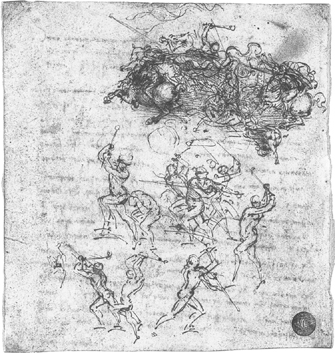
Leonardo da Vinci, sketches for The Battle of Anghiari (autumn 1503–4). The warrior with his arm raised, the round-rumped horses, and fluttering standard in the upper part of this tiny sketch all made it into the full-scale design for The Battle of Anghiari. (illustration credit 6.1)
From tiny sketches great battles grow. Leonardo’s scribbled compositions in Venice are just pocket-sized squares of paper, the figures on them no more than an inch tall at the most, the drawings essays, attempts, trials. You might almost call them doodles. But his immense mural is taking shape here, in these quick designs; and what’s more, its power is already formidable—even at this scale, the violence unleashed by his imagination is frightening. Leonardo is probably the greatest draughtsman in history. This is the reason he is able so magically to move from art to science, from fantasy to practical—or apparently practical—inventions. Drawing is the thread that weaves his disparate interests into one beautiful braid. Because he can create a living image in a few pen strokes and can elaborate a detailed, shaded, finished drawing without ever turning it into something dry, his mind generates a mind-boggling universe of fascinating form. These three sketches in which he works out the composition of The Battle of Anghiari are among his most impressive works because—in themselves, in their tiny compass—they contain enough horror, fear, tension, and energy to sustain a work a thousand times bigger. They are truly the seeds of the finished painting—it will be far bigger but it will replicate their DNA, will grow from their pungent essence.
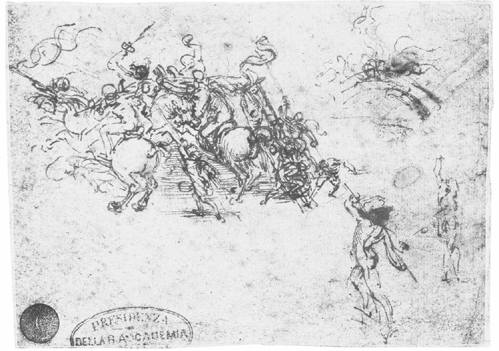
Leonardo da Vinci, sketches for The Battle of Anghiari (autumn 1503–4). The bridge across which the historical Battle of Anghiari was fought can be seen in this sketch. (illustration credit 6.2)
The Battle of Anghiari lives in these little fragments of paper: an epic history of killing is held within them. In a sense they are not drawings “for” anything—not designs for another, more important work, but living and complete masterpieces in themselves. Leonardo was fascinated by the process of creativity, and wanted to make this process visible to others. He let people see his designs, and in those designs he touches on deep emotional and psychological forces that make it absurd to call them “preparatory.”
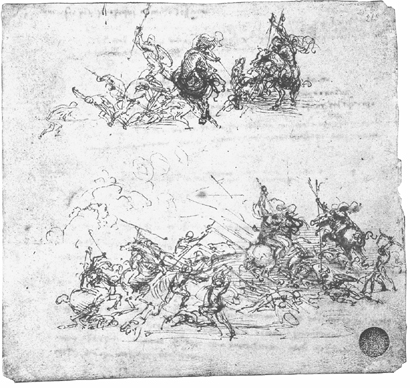
Leonardo da Vinci, sketches for The Battle of Anghiari (autumn 1503–4). Compressed brutality distorts bone and flesh at the heart of this at first glance so fragile drawing. (illustration credit 6.3)
Even the weakest of the Venetian drawings for The Battle of Anghiari—the sheet that does not have flowing banners or a man raising his sword arm high at the centre of a dense struggle, but instead tries out more diffuse compositions—lures the imagination into a place of horror. Dead and dying bodies carpet the battlefield: pen lines that at first seem innocent start to resemble lakes of blood, or a morass of pulped organic matter. Horses’ heads seem to jolt free of their vertebrae. Warriors merge into their mounts as if they were becoming centaurs—half man, half horse. None of these perceptions are fixed, none are unambiguous—none are final. Something new appears with each glance. The drawing’s only constant is its strength.
There are the battles in the history books and the battles we dream of. In this world, Leonardo’s world, people saw soldiers in the sky and spectral armies in broad daylight. In 1494, on the eve of the French invasion of Italy, armoured knights massed in the clouds above Arezzo—where Anghiari is—to the thunderous sound of drums and trumpets. Many people saw them. In July 1504 witnesses reported seeing a squadron of knights in a meadow near Bologna; one witness walked over to see what the soldiers wanted and the people watching saw him brutally cut down: then he came back, saying he’d found no one in the meadow. An army came out of a wood and fought a terrible battle: many died and carts carried the corpses away. Again, when people approached there was no trace of an army, no sign a battle had taken place.
As we have seen, the Battle of Anghiari had taken place more than sixty years before Leonardo received his commission to paint it. His imagination rose to the occasion, but what transfixed him, what makes the drawings in the Accademia so viscerally shocking, was not in the past. War was real and immediate to Leonardo da Vinci. He knew it at first hand and it troubled his dreams. In his notes on painting he describes a method of generating visual images which he recommends while admitting it might seem “trivial and laughable”: “This is that when you look at any wall marked with various stains or with variegated stones … you may be able to see the likenesses of different landscapes, enriched with mountains, rivers, rocks, trees, plains, wide valleys and hills of several types, or again you may be able to see all kinds of battles …”
When Leonardo received his great commission, Florence’s war with Pisa was nine years old, a sad affair of siege and attrition. Sometimes nothing would happen for weeks; then a group of peasants sent out to burn Pisa’s crops would be caught and savagely slaughtered. Part of the delay and discontinuity arose from the seasonal nature of war in Renaissance Italy. Armies campaigned only in the spring and summer when the ground was best for horses. At the end of summer hostilities broke off until the next year.
Florence knew it was the dominant power in Tuscany when it finally conquered Pisa after a cruel siege in 1406. Losing the city again in 1494 was a devastating blow to patriotic pride—if we can speak of patriotism when the state in question is not a nation but a city, its countryside, and subject towns. An Italian word for this intense local feeling is campanilismo, loyalty to your own cathedral bell tower. Florentine pride expressed itself in devotion to its famous Dome—a character in Machiavelli’s play La Mandragola is loath to let the Dome out of his sight. This is a joke on parochialism, but there could be no bigger joke, it might seem to us, than a republic that fought year after year, wasting blood and money, causing misery and suffering, just to conquer a neighbouring city thirty or so miles away. This is of course to misunderstand all wars, all polities. The war that Florence was still fighting, as Leonardo returned to the city in 1503, to reconquer Pisa was a microcosm of the ambitions of larger states. Anyway, who is to call Florence small? It was the most cultured and sophisticated city in the Europe of its day, and its intellectuals, steeped in the works of Thucydides and Livy, could write the history of their micro-empire as grandly as the story of Rome itself. The great Florentine humanist Leonardo Bruni, who was chancellor of the Republic at the time of the Battle of Anghiari, wrote a history of Florence in three volumes in Latin modelled on the classical historians. He wrote of skirmishes between a few mercenaries outside Italian villages as seriously and poetically as if he were narrating the campaigns of Alexander.
If you want grandeur, consider Dante, who—after he was exiled from Florence in the feuds of Guelfs and Ghibellines—dedicated his remaining years to writing the greatest literary work of medieval Christendom. The Divine Comedy is a journey through the entire cosmos, from the pit of Hell (Inferno) up Mount Purgatory (Purgatorio) to the ethereal space of Heaven itself (Paradiso). Yet at the same time it is a passionate imaginary journey through Tuscany, a series of encounters with the shades of Florentines and their neighbours. The universe is infinite yet local. The most horrific story in the Inferno ends with an invective against Pisa. As they walk on the frozen lake of Cocytus, the pilgrim Dante and his guide, Virgil, see a damned soul chewing at another sinner’s head. He explains that in life he was Count Ugolino, and the flesh he mauls for all eternity is that of Archbishop Roger, who had him and his sons sealed in a dungeon with no food at the bottom of a tower in Pisa. Seeing the pain on his face, his children begged him to eat them; as they starved to death, he went blind with hunger until in the end he was fumbling among their corpses, calling out to them desperately. Finally, “Hunger overpowered grief.”
The story of Ugolino has proved to be a timeless and universal image of suffering—and of the passion for vengeance. Far from ending in a plea for universal mercy and tolerance, Dante, a medieval Florentine to his bones, calls for the extermination of a city that can permit such crimes:
Ah! Pisa, shame of the peoples
of the beautiful land where sì sounds out,
because your neighbours are slow to punish you
let Capraia and Gorgona move!
Let them block the Arno
and let it flood and let every person in you drown.
The hatreds of Tuscans were big enough to fill a region a hundred times larger. Capraia and Gorgona are islands off the shore of Tuscany; so deep was his loathing for Pisa that one of Europe’s supreme poets lavished his imagination on a local apocalypse intended just for the Pisans.
If only something as fast and final could have ended the current war. Contemplate the wretched events of one summer. In May 1503 Gianpaolo Baglioni, the mercenary captain hired by Florence, paraded with forty mounted knights on Piazza della Signoria before riding to Pisa. Footsoldiers were mustered and the poor were hired as despoilers, to go into the Pisan countryside and destroy crops. Later in the month, sixty of these agricultural vandals were crushed in an accident—or perhaps it was a Pisan trap. With their crops ruined and French troops arriving to help Florence, it looked bad for Pisa. In June Florentine soldiers seized the fortress of La Verrucola, considered strategically valuable. A Pisan counterattack was repulsed—but then Florence had to take troops from its western front to hold down another Tuscan city, Arezzo, where it was rumoured the feared warrior-prince Cesare Borgia might shortly turn up. And that was pretty much it for the campaigning season that year. Perhaps 1504 would prove more conclusive.
Small armies, punitive raids, attacks on crops—it was a war fought half-heartedly, its cruelties chaotic. During that summer of 1503, before the end of the campaigning season, and just a few months prior to getting his commission to paint in the Great Council Hall, Leonardo was advising on a ruthless stratagem that just might bring the Pisan conflict to a conclusion.
Leonardo was at Cascina, a little town beside the Arno. Its bed was broad and dry, pockmarked with stones around which olive-green water eddied in the summer heat. Pisa was just a few hours’ ride downstream. He looked across the river at the lovely mountains hanging in the blue sky, and drew the vista in a few spontaneous strokes of chalk. He had grown up in these hills and he loved them. On one of the topographical sketches he made in Madrid Codex II, the notebook he carried with him on that horseback journey, he was even able to mark his birthplace, Vinci.
The British landscape painter John Constable said his art had been formed by the scenes of his boyhood. Leonardo’s boyhood scenes had helped to make him a poet of landscape. His very earliest dated drawing, today in the Uffizi Gallery in Florence, is also the earliest dated study of a landscape in Western art: done on 5 August 1473, it depicts a view from the hills around Vinci, looking down on the Arno plain towards Pisa and the empty brightness of the Mediterranean Sea. At least that view is Leonardo’s starting point—what he actually creates in this ink drawing is a fantasia of rocks and rounded slopes, vast craggy overhangs, sheer precipices, and organic nodules of earth, an idyll in which you can feel the warmth of the summer air. Exactly thirty years later—one of the maps in his notebook is dated 22 July 1503, three months before he received his commission to paint the great battle scene—he found himself back in the countryside where he’d grown up, once more sketching that summer landscape with its river heading for the sea beneath hills crested with towers and towns. But this was no innocent nostalgic holiday.
He was riding along the river sketching views of its environs, marking the positions of towns, not as preparation for a painting—although you can’t help wondering if the journey through the Arno valley fed into the watery, rocky vista behind the Mona Lisa—but as a mapmaker and engineer. The roughly sketched map dated 22 July 1503 shows the course of the river from Pisa eastward, including Cascina and the fortress La Verrucola. More maps in the same notebook, polished and coloured, show the river, its tributaries, and canal routes in refined detail. He is making a careful study of this river, of what might be done with it. On the 22 July map he has written, “Levelling of the Arno.”
Not even Leonardo da Vinci claimed to have the technology to shift Capraia and Gorgona and block the river to drown all Pisans. Dante’s apocalyptic vision was, however, informed by the real menace of the Arno. A fast river rising from mountain torrents, it regularly burst its banks. Even in modern times flooding has devastated Florence—works of art damaged in the floods of 1966 were still being restored in the twenty-first century. If the river could do such harm without warning, on its own, what if it were harnessed? Might not some revised version of Dante’s scenario help win the Pisan war?
A plan was concocted in 1503 to divert the Arno away from Pisa, depriving it of its life-giving connection with the sea. Piero Soderini and Niccolò Machiavelli were its most enthusiastic proponents; Machiavelli thought it a brilliant stratagem that might break the wretched deadlock. In 1502, he and Leonardo were both at the court of the notorious Cesare Borgia. Chances are it was here that these two provocative thinkers met; if so, it may have been his acquaintance with the Second Chancellor that led to Leonardo’s involvement in the plan.
The Pisan war demanded some kind of bold action. Machiavelli, a specialist in boldness, advocated changing the course of the river. Did he get the idea from conversations with Leonardo? It’s a seductive possibility, yet Leonardo doesn’t ever seem to have been the chief engineer on the project, which surely he might have been if the idea was his. Machiavelli had good cause to know he was a skilled engineer as well as an artist—for Borgia employed him as such, and Machiavelli revered Borgia. It is known that they were both with Borgia at Imola in central Italy in 1502, although no correspondence or notebook entry proves they even spoke to one another there. Why, if they were friends (as many would love to believe), would Machiavelli not have given Leonardo responsibility for the project? On such awkward questions any simplistic belief that Leonardo and Machiavelli collaborated to divert the river founders. The relationship between Leonardo and reality is never as straightforward as that. But his notes make it hard to resist the conclusion that he played an important part in dreaming up the scheme. Madrid Codex II explicitly mentions “levelling” the Arno, as we have seen. The notebook reveals him considering options, moving meditatively through the landscape, studying the river, proposing the best places to dig a diversion.
Leonardo’s drawings of river beds done in 1503 and 1504 are never only technical solutions to an immediate problem. Practice may be the soldiery, but theory is the captain. In a series of sketches in the Codex Arundel he appears to be very specifically trying to work out how to change the course of a river using rocks: “It is possible to change the flow of a small river with a big stone.” His drawings of boulders piled onto a river bed and changing the flow of water might look like studies for the Arno diversion. Yet they are scientific experiments. In a proposed book on water he planned to have a section about “obstacles.” It’s the simplest experiment you can do in a shallow river—place rocks in it and see what the little dam does to its flow: a game a child might play, that Leonardo himself might have played when he was growing up near the Arno. The bed of the river in summer is broad, and there are rocky shoals. Clambering on these, picking up rocks and testing how obstructions made waves and ripples and weirs around themselves, was Leonardo’s idea of science. It was a beautiful idea of science.
He made a rough map showing the river’s approach to Pisa, marking Cascina and other towns and forts, at the front of Madrid Codex II. As he travelled along the Arno he drew views and made quick maps of the towns and the river’s course. And he drew two hypothetical diversions. He had a grand idea for a shipping canal that would divert the river from just west of Florence in a great geometric curve through northern Tuscany, giving the Republic a navigable route to the sea. On one of the maps in Madrid Codex II and a sheet in the Royal Collection he carefully charts this canal. By contrast his ideas for the Pisa diversion are marked much more abruptly on these two maps in rapid, rough strokes showing how channels could be dug from the river between Cascina and Pisa towards the Stagno, a large pool to the south. This is in fact broadly the plan that would be finally attempted by hydraulic engineers working for the Florentine Republic in the autumn of 1504.
Which suggests that Leonardo’s mapping of the Arno in July 1503 did indeed play a significant part in planning the madcap scheme to win a war with water. His theory would be put into practice by others the following year. But there is more. In that summer of 1503 he made another map in Madrid Codex II that concentrates exclusively on the Arno and its canals in the vicinity of Pisa. This map is specifically concerned with what interested the Florentine army—the waterways around the enemy city. It is finished and coloured, and Leonardo has written place names in conventional left-to-right script, rather than using the right-to-left mirror script with which he kept many of his notes secret. It is intended to be shown to others; it is part of a discussion. On it he has sketched a new canal that could be dug from just west of Cascina to connect the Arno with the Stagno. What could the purpose of such a canal be, if not to divert the river?
This map shows how badly Pisa’s life could be disrupted by a diversion, describing the network of canals and pools around the city, all of which would be damaged if the Arno changed its course. On his rough sketch map on folio 1 verso of the Madrid notebook, the one that’s dated 22 July 1503, he also focuses on the Pisa region—this is where he is “levelling” the Arno. The place names that keep reappearing in the topographical sketches in Madrid Codex II are of fortresses and towns close to Pisa where he was looking in detail at the lie of the land and the flow of the river: Caprona, Verrucola, Dolorosa, Cascina. In other drawings, the river looks like a bloody cluster of arteries, its bed mapped in soft red chalk. A map in the Royal Library at Windsor is a great shadowy organic veil, the river like a serpent sloughing its skin.
These drawings are at once real and dreamlike—if Florence truly did rely on them as advice, it was allowing itself to be lured into a twilight zone between the possible and the impossible, history and utopia. The plan to divert the Arno was a Faustian fantasy of limitless power over nature—no true marriage of science and politics, instead a dangerous liaison.
The rich and evocative portrait Madrid Codex II paints of a summer mapping the Arno lends enormous weight to the idea that Leonardo did indeed give Florence crucial advice about diverting the river. It fleshes out the record in the Archivio di Stato that in July 1503 the Florentine Republic paid him “to level the Arno near Pisa,” and even contains tantalising clues to conversations between him and Machiavelli. His topographic drawings in this notebook are at once practical mapmaking research and beautiful landscapes. He stood at Cascina, drawing what his note calls the “veduta,” the view. Cascina is a low-lying town, and his drawing looks up from this spot towards nearby hills. In the dedication of The Prince, as if remembering Leonardo that summer, Machiavelli reaches for an artistic image: it may seem presumptuous for a lowly man like him to offer a ruler advice, but “it is as if one who wants to draw countrysides puts himself down on the plain to consider the nature of mountains and high places and, to consider the low places, will put himself on the mountains …” There were not many artists in early sixteenth-century Italy who went drawing in the countryside—Leonardo was ahead of his time in his enjoyment of landscape for its own sake.
On 24 July 1503 one Francisco Ghuiducci wrote a report from the Florentine military camp near Pisa—“ex castris”—informing the Palazzo della Signoria about a visit by Leonardo da Vinci and other wise heads. They looked at drawings and plans and, “with many discussions and doubts,” approved the work “whether the Arno was turned here, or remained in a canal …” Ghuiducci signs his letter “from the field against Pisa”—it is a dispatch from the front line. That is where Leonardo was, close to the walls of the enemy city behind which children were going hungry and old people and paupers dying off, in the misery of siege.
There are more ways than one to fight a war. Leonardo was clearly involved in planning the Arno stratagem in the summer of 1503. The Florentine Republic did not, however, put the venture in his charge when it was finally attempted more than a year later. Instead it commissioned him, in October 1503, within months of his Arno journey, to decorate the Great Council Hall. His patriotic battle scene would inspire the assembled citizens to vote taxes to pay for the Arno diversion and any other stratagems that Soderini and his military expert Machiavelli judged necessary. What is crucial to understand is that when Leonardo started to design his battle picture that autumn, war was not an abstraction for him. It was urgent and immediate. He had been in the countryside where Florence was fighting Pisa, had mapped the river close to where peasants were ruining crops and being ambushed. He knew the reality of warfare—a reality that even before this he had described with dreamlike precision in a note on how to paint a battle: “Make first the smoke of the artillery, mixed in the air with dust thrown up by the movements of horses and combatants … And if you make anyone who has fallen, mark the place where he has slipped and been dragged through the dust and bloody mud, and in the half-liquefied earth show the impression of the footprints of men and horses who have passed, make also a horse trailing his dead master, and show the mark of the dragged body in the dust and mud …” Leonardo’s scientific attempt to analyse smoke and describe the effects of gunfire from the point of view of a painter gives way to a horrible scene. He dwells on the morass of battle, the mashing of everything into a landscape of pulped flesh. It’s the same nightmare battle we see in the three compositional drawings for The Battle of Anghiari in Venice: the world become a bloodstain.