
Michelangelo’s earliest surviving lines of verse can be found on drawings connected with the Great Council Hall competition. One is especially enigmatic: “dolce stanza nell’ inferno”—a sweet room in hell. It is sharply inscribed in ink on a small, square sheet of paper, above a sketch of a bloody battle scene. In the battle, mounted knights charge one another with lances, men on the ground fall or struggle against the horses, and at the heart of the chaos a horseman raises his sword or club above his head, preparing to bring it down savagely on one of the riders’ arms as he struggles with a lance.
The scene is strangely familiar to anyone who has been looking at Leonardo da Vinci’s designs for The Battle of Anghiari.
Michelangelo’s commission for the Great Council Hall directly confronted the never-ending war with Pisa. In 1364 too the Florentine Republic had been at war with the nearby rival city. In his History of Florence—the book that was Michelangelo’s source—the Humanist Leonardo Bruni tells how, late in that summer campaigning season, a Florentine army was camped at Cascina:

Michelangelo, A Battle Scene and other studies, 1504. The struggle in this drawing is very like Leonardo da Vinci’s horse battle. (illustration credit 7.1)
The summer heat was immense, and many of the soldiers were weaponless or lying in their tents or bathing in the nearby river. At this time there was no care or anxiety about the enemy. Then unexpectedly the enemy rushed the fortifications, hoping with its first impetus to overcome the camp and subdue unarmed men caught at leisure … When the Florentines had thronged together from everywhere … they were not content to merely defend the fortifications, but bursting forth fell upon the enemy, compelling him to take flight.
The enemy that day was led by Sir John Hawkwood, the English mercenary who later worked for Florence and got his equestrian portrait posthumously painted in the cathedral. He was not a foe to take lightly. The Florentines nonetheless won the battle.
This is one version of the story. The chronicler Villani tells it differently: according to him, the army were not surprised by Hawkwood but tested by one of their own captains, who gave a false alarm to save them from their torpor.
Michelangelo’s first designs for his battle scene do not rise to the possibilities of this story. They are derivative. He had evidently seen Leonardo’s explosive sketches—and they had impressed him, almost too much.

Michelangelo, architectural sketches and poetry, 1504. Michelangelo seems to have started to compose poetry at the time of his rivalry with the notebook-filling Leonardo. (illustration credit 7.2)
Michelangelo had never been near a battlefield. His drawings of rampaging horsemen and frenetic close combat seem—brilliantly—cerebral; studies of weight, movement, but with very little heart. It’s not him, this theme. He won’t win the competition by aping Leonardo. It seems fitting that a poem—his first—on the reverse of his little square battle scene expresses anxiety about the fragility of reputation:
After living happily for many years, in one
oh-so-brief hour you lament and suffer;
or someone who fame or ancient lineage
illuminates, is darkened in a moment.
There is no moving thing under the sun
death does not conquer or fortune change.
One question this and related drawings—including a still more manifestly Leonardesque battle in the Ashmolean Museum, Oxford—invite is how he knew his rival’s work so closely. Either he or a spy must have visited the amazing workshop Leonardo da Vinci created for himself in a Florentine monastery.
On 24 October 1503 Leonardo picked up the keys to the Sala del Papa and other rooms off the Great Cloister of the Dominican monastery and church of Santa Maria Novella. This was where he was to live at the expense of the state while he worked on his cartoon for the Hall in the Palace. It was here that, a year later, he would store the clothes listed in his inventory as being “in a chest at the monastery.” And it was from here that he had to walk every time he needed to visit the Palazzo della Signoria, to collect his monthly pay, ask for funds for paper or wood and carpenters to build the machinery he said he needed, or explain why the entire project was proceeding more slowly than his employers would have liked. The marble façade of Santa Maria Novella overlooked a broad piazza in the north-western part of the city close to the gardens and palace of the wealthy Rucellai family. The Rucellai in the fifteenth century had favoured the gifted architect and polymath Leon Battista Alberti, a true Renaissance man who had anticipated Leonardo in his intellectual appetite—writing books on painting, politics, and family life as well as designing imaginative reinterpretations of ancient Roman buildings. In the 1450s Giovanni Rucellai, who was at that time with Cosimo de’ Medici one of the two richest men in Europe, commissioned Alberti to design his house: its use of flat pilasters evenly spaced reproduces a particularly graceful antique effect yet makes it slightly surreal. At nearby Santa Maria Novella, the same architect created—with Rucellai’s money—a great vertical plinth of green and white marble with scrolls on its curved upper storey like engravings lifted out of the frontispiece of a book. This façade is the most classical of any church in Florence; it promises an interior like that of a Roman temple or perhaps a library.
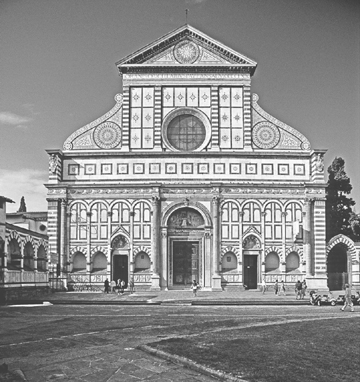
Façade of Santa Maria Novella, Florence, architect Leon Battista Alberti, probably begun about 1458. With his writings on architecture, painting, politics, and morality Alberti, like Leonardo, was a Renaissance man. (illustration credit 7.3)
This is a deception. Alberti’s modern façade was added on to a medieval church with a tall, simple Gothic nave, a great barn of a place that originated in the struggles between orthodoxy and heresy that had gripped thirteenth-century Europe. It was built by the Dominican preaching order, founded by St. Dominic to combat the Cathars and other religious subversives. Dominic was a giant of Catholic orthodoxy and Santa Maria Novella the outpost of the Papal Curia—the Pope’s court—in medieval Florence. When the Pope visited the city in days gone by, he had stayed here. On the west side of the church stood a complex of monastic cells, big meeting and dining halls, and comfortable guest chambers built around two square cloistered courtyards. The Sala del Papa and its connecting rooms where Leonardo was now to be based were—as the name implies—built for the Pope’s use, but by 1503 there were far more salubrious residences where Florence could put up important guests. The Sala del Papa had been allowed to decay. The first thing Leonardo did when he saw it was to ask for carpenters to mend the leaky roof. The repairs started before Christmas 1503 and were still going on in January, so the rooms allotted to Leonardo must have been in a shoddy state.
At least it was peaceful. The monastic atmosphere of the cloisters with their square gardens and shady walks provided space in which to think. Leonardo loved places like this; it was reminiscent of Santa Maria delle Grazie, where he’d spent so much time slowly painting The Last Supper. His workplace was situated off the Great Cloister. The nearby Green Cloister was decorated with green-tinted paintings by Paolo Uccello, including his powerful Deluge, with doomed sinners still fighting one another viciously as they cling to bits of flotsam beneath the floating fortress of Noah’s Ark. As for the church itself, it was a veritable museum of Florentine painting, with chapels and side altars decorated by painters including Masaccio, Ghirlandaio, and Filippino Lippi (who had only recently, in 1502, completed his paintings in its magnificent Strozzi Chapel).
What would Leonardo’s new studio have looked like? It’s a fair guess it would have held a lot of books and papers. As workmen repaired the roof of the Gothic Sala del Papa, it wasn’t just painting materials that Leonardo was preparing to install there.
The massive leather volume lies on a table in the Royal Library in Windsor Castle. Its huge folio cover is worn and reddened. When you open it up there is nothing—this is an empty book, an eviscerated tome. The drawings and written notes it once held have in modern times been carefully removed and each precisely catalogued sheet sealed in plastic to preserve the fragile blue and pink papers.
When we speak of “Leonardo da Vinci’s notebooks,” we are referring to actual, physical objects of fragile antiquity. This particular great album was assembled in Milan in the sixteenth century, found its way to Spain, and ended up by the end of the seventeenth century (by a mysterious route) in the British Royal Collection. It contained a raw collection of Leonardo’s notes assembled after his death from papers he left to his pupil and friend the Milanese nobleman Francesco Melzi; another vast collection assembled in the same way is the Codex Atlanticus in the Ambrosiana Library in Milan. Often “Leonardo’s notebooks” means these posthumous collections of diverse sheets and fragments. But sometimes “notebook” means a notebook that Leonardo used as such and that survives as it looked when he owned it—from the novel-sized Manuscript B in the Institut de France in Paris to the pocket-sized Codex Forster II in London’s Victoria and Albert Museum.
Leonardo’s notebooks contain everything from lists of books and clothes, instructions to young painters, drafts of letters, and household accounts to drawings of grotesque faces, maps of Italy, and science fiction stories. They are the direct, unedited transcription of one person’s thoughts: the mind of Leonardo da Vinci moves in his notebooks from one interest to another, one level of reality to another—the most refined philosophical questions appear side by side with the most prosaic matters. Many of his sheets contain a diversity of themes and speculations, and when a written note appears beside a drawing it does not necessarily mean the two are directly connected. A diatribe against cannibals might be next to a drawing of the human heart. Leonardo’s words and images together—the words in a reversed script to be read with the aid of a mirror—constitute a unique form of art, as well as an intellectual marvel. When Vasari wrote his Lives he reported on the astonishing notes he had seen in the house of Leonardo’s heir Melzi: “And he cherishes them and looks after them like relics, along with the portrait of the happily remembered Leonardo, and to those who read these writings, it appears impossible, that that divine spirit reasoned so well of art, and of the muscles, and the nerves, and the veins; and with such diligence of all things.”
The wonder that Leonardo’s notes inspire has not diminished in five hundred years. From being pure enigma, however, they have been gradually transcribed, translated, and published. The first attempt to put them in order was by Melzi himself, who collated the master’s writings about art into a manuscript, Treatise on Painting, printed in French in 1651 and in English in the Napoleonic age. The trouble with such attempts to edit Leonardo’s notes into a coherent “book,” however, is that even though he did plan to write books, he never did in fact, and to remove the mess and chaos of his notebook pages is also to remove the dizzying energy and mystery of his mind’s convolutions. In 1883 Jean-Paul Richter transcribed and edited the first modern edition of Leonardo’s writings,The Literary Works of Leonardo da Vinci, which gets far closer to the sprawling diversity of Leonardo’s thought. Since then, his notebooks have been quarried not so much for artistic advice as for marvellous inventions and science. Here too there’s a danger of rationalising away their magic, for Leonardo got no closer to complete scientific theories than he did to finished works of art. It is the process, the journey, that fascinated him as both artist and scientist, and the pleasure of following his mind is that of exploring a meandering river’s unexpected course.
Leonardo was a self-taught intellectual who took a big book collection with him wherever he went. The same notebook that contains the inventory of the clothing he put into storage when he left Florence in the autumn of 1504 also lists the books he left behind.They ranged from a volume about palmistry to tomes on architecture by Alberti and Leonardo’s friend Francesco di Giorgio Martini of Siena; works of natural science, including Ptolemy’s Cosmography, a work by the Arab astronomer Albumasar, and Pliny’sNatural History; and mathematical works, including basic arithmetic primers as well as Euclid. As with mathematics, so with literature; Leonardo’s curiosity was never held back by snobbery or pretension. Just as he collected school-level arithmetic books to help him with his calculations, he owned basic grammars and comic verse, including Sebastian Brant’s Ship of Fools, yet also possessed three volumes of Livy’s History of Rome.
Many of these books had been in Leonardo’s collection for years and are recorded on an earlier inventory; others were new. Who knows, perhaps he found some of the saints’ lives that are fairly numerous in this inventory lying around the monastery and quietly added them to his hoard. All his books were for use rather than ostentation. His own copy of one of the items listed in this inventory survives: the manuscript of Francesco di Giorgio Martini’s treatise on architecture in the Laurentian Library in Florence still has the annotations that Leonardo made in it. They show how, when he read, he made notes, singled out useful ideas and images. In fact he often transcribed what he read into his own manuscripts. The 1504 inventory shows he still had his copy of Valturio’s compendium of miltary inventions De re militari with him in Florence; in his notebooks from his time in Milan in the 1480s he’d copied out many of this book’s descriptions of ancient war machines and drawn his own improved versions of them. Reading was not a leisure activity for Leonardo—it was part of the process of creative thought.
That shows in the maverick diversity of his reading materials. Fifteenth-century Florence had been the site of an intellectual revolution. “Humanism,” as later historians named it, was a movement to revive and properly translate the works of ancient Greek and Roman authors, and was at the heart of the Renaissance as a cultural movement. Yet Humanism was by definition led by an élite that wrote in Latin. Leonardo da Vinci did not belong to that élite. He did not have a university education. As an adult he taught himself some Latin—his primers are there in the inventory—but most of his reading was in Italian. And he did not in any way regulate it according to the hierarchies a Humanist might; classic literature had to share shelf space with trash. There are some key Florentine Humanist works in his 1504 list: Ficino’s interpretation of Plato and the Hermetic tradition, On the Immortality of the Soul; Matteo Palmieri’s On the Civil Life; and Alberti’s writings. There are translations of the classics too—including Ovid’sMetamorphoses, the great source of ancient mythology in which Renaissance artists found stories like the fall of Icarus, the loves of Jupiter, and the battle of the Lapiths and Centaurs.
But the classics rub up against a wild diversity of themes and authors. Leonardo is as happy with a book on palmistry—De Chiromantia—as with the Philosophy of Albertus Magnus, as fascinated by Aesop’s Fables—of which he stored three editions, one in prose, one in verse, and one in French—as he is keen to study medical works such as Guidone on surgery and Montagnana on urine. He reads to learn about the world, and that means books about herbs and hydraulics, the works of Aristotle, and a strange attack on women called The Mangle. Books by his friends Francesco di Giorgio and Luca Pacioli bear witness that, far from brooding in solitude, he was a social person whose ideas were freely shared with others—as were his books. He lists a couple in his inventory that were on loan to others; notes scattered through his papers reveal him constantly borrowing and lending books. He always seemed to be looking for books by Archimedes, yet this reverence for an antique author does not make him a classically fixated Humanist. On the contrary, in one of his notes on Archimedes’ war machines he plucks this scientist from ancient Greece and dumps him in medieval Spain: “I have found in the Histories of the Spaniards that in their wars with the English was Archimedes of Syracuse who at that time resided in the company of Ecliderides, King of the Cirodastri …” This sounds like something Leonardo might have read in a chivalric romance. Similarly, in the notebook that contains his book inventory, on a map of the Pisa region he mentions (in the summer of 1503) the “castles of Cascina” in an apparent reference to a popular romance called Amadis of Gaul. In some ways Leonardo’s reading of poetry and history was not that different from the trashy literacy of Don Quixote.
Books were raw material for the notebooks he kept filling in such profusion. In the chest in 1504 he stored some of his own codices: a book of war machines with a skull on its cover and one of designs for the armature of the bronze horse. Other notebooks would have gone with him on his travels—including, obviously, Madrid Codex II. In these years he also was adding to the Codex Arundel and producing notes that ended up in the Codex Atlanticus in Milan and in the Royal Library, Windsor. In other words, when he lived at the monastery in Florence he was producing notes and drawings with giddy creativity. His varied collection of books helped stimulate a heightened fluency of thinking that might take him in one of a multitude of directions at any moment.
If you look at his notes from around the year 1504 you get some inkling of the vast range of his interests at the time he took on the commission for the Great Council Hall. He was thinking about canals, water music, waves, mythology, artillery, fortifications, the wind, and, above all, pure mathematics. Any one of these topics might engross him for hours, for a day, while he worked on his notes in the rooms off the Great Cloister at Santa Maria Novella. To call these topics “distractions” is inaccurate, because the life his notebooks reveal is one long distraction.
Even setting up his workshop provided days of fun. In February 1504 a labourer was paid for making a doorway to give Leonardo direct access to the Sala del Papa, where he was drawing his cartoon, from his camera, his living chamber. Surely this camera was also a study. Renaissance artists were fascinated by the image of the intellectual at work in a well-appointed study. Their paintings breathe a romance of books and paper. Fathers of the Church are portrayed at work in monastic spaces—that is, in settings that are idealised versions of the Florentine cloister where Leonardo based himself from October 1503 onwards. In Antonello da Messina’s painting Saint Jerome in His Study, the scholar works in a fabulously well-designed wooden cubicle inside a monastery. He has everything he needs: a lectern for reading, a comfortable circular chair, convenient shelves on which his books are propped open to the right page so he can consult them with minimum fuss, even a couple of potted plants. The Gothic cloister is airy around and above his open study, so he gets both privacy and space.
In reality, Leonardo’s rooms at Santa Maria Novella centred on a semi-derelict old hall whose roof urgently needed to be mended—but he would certainly have striven to make his cloistered environment as comfortable as St. Jerome’s. In his writings on the painter’s beautiful life—he pictures himself working in fine clothes, gently touching a picture with the lightest of brushes, while musicians play for him or poetry is read out to him—Leonardo devises a living-machine as fine-tuned as Jerome’s: “a chest, where it is possible to raise and lower the work, so the work moves up and down and not the master; and every evening you can let down the work and shut it up on top, so that in the evening it may function as a chest which when closed makes a bench.” This is his personal device for making work easier, an artist’s version of the ergonomic furnishings that appear in Renaissance images of studies. One type of Florentine chair was even named after the prophet Savonarola, who was said to have invented it for use in his study at the convent of San Marco: woodcuts in his books portray him working with a lectern as cleverly designed as the one painted by Antonello. Leonardo, of course, was not a scholar: he was an artist who worked with ideas, and what he needed was to be able to draw efficiently. His chest on which the work could be lowered up and down was geared to his lifestyle.
Leonardo lived up to the image of the Renaissance man, the universal mind, portrayed in paintings like Antonello’s. One of the greatest of these images is Botticelli’s St. Augustine in His Study, done on a wall in the Church of Ognissanti in Florence in about 1480. Tellingly, it dates from the moment when Leonardo was starting to reveal himself as a thinker as well as an artist. Botticelli was his contemporary and rival, and in his vision of St. Augustine’s study he portrays a life of the mind as free-ranging as the one Leonardo was embarking upon as he designed his Adoration of the Magi. In Botticelli’s painting, the Father of the Church is no narrow theologian. Behind his workstation with its intricate lectern that doubles as a chest of drawers (a nearly identical one appears in a woodcut of Savonarola’s study), Augustine has an astronomical globe and a clock, books in fine bindings—and, intriguingly, an opened codex covered with handwriting and geometrical drawings.
It looks teasingly similar to some of Leonardo’s notebooks. At the very least this shows the idea of intellectual life to which Leonardo aspired: a world of mathematical speculation and mysterious “secrets” in great handwritten volumes. At a pinch, who knows—it could even be an allusion to his own first attempts at making notes (though no notebooks survive from his early years in Florence). Not only did he know Botticelli; this painting was commissioned by the Vespucci family for their local church, and Leonardo was friends with the Vespucci, including of course Agostino, who in the 1500s worked in the government Palace. “Il Vespuccio wishes to give me a book on geometry,” Leonardo reminded himself in a note.
Leonardo may have had books like St. Augustine’s, but he was no saint. He did not live a life of ethereal asceticism. The rooms at Santa Maria Novella would not have been filled just with books but with all sorts of stuff—including his beautiful velvet and satin garments. He was constantly collecting and then giving away or selling odd things, to use in experiments or for art or just for pleasure. Stray notes give glimpses of a chaotic material life:
Tapestry
compasses
Tommaso’s book
Giovanni Benci’s book
box in the Dogana
to cut the cloth
the sword-belt
to resole the little boots
a light hat
the canes from the ruined houses
the debt for the tablecloth
swimming bag
book of white paper for drawing
charcoals.
Notes by other hands—probably his assistant Salaì’s—among his sheets from about 1504 include shopping lists for meat, bread, wine, to feed not just Leonardo (who may already have been a vegetarian at this point, as he certainly was later) but his team. He had assistants and students with him at Santa Maria Novella. Salaì was the leader, always around except when he was off getting expensive clothes made. Leonardo also had a servant, Tommaso. In August 1504 “Jacopo the German” joined them, and in April 1505 a seventeen-year-old called Lorenzo. In between his deep thoughts Leonardo had to take care of his working family: “The morning of St. Peter’s Day on the 29th day of June 1504 I took out 10 ducats, of which I gave one to my household servant Tommaso to spend.” “On Monday morning one to Salaì …” And Salaì writes:
The morning of Santo Zenobio on the 29th day of May 1504, I had from Leonardo Vinci 15 gold ducats, and commenced to spend them.
|
to Mona Margarita |
S 62 d 4 |
|
to repair the ring |
S 19 d 8 |
|
clothes |
S 13 |
|
good beef |
S 4 |
|
eggs |
S 6 |
|
owed at the bank |
S 7 |
|
velvet |
S 12 |
|
wine |
S 6 d 4 |
|
meat |
S 4 |
|
mulberries |
S 2 d 4 |
|
mushrooms |
S 3 d 4 |
|
salad |
S 1 |
|
fruit |
S 1 d 4 |
|
candles |
S 3 |
The food wouldn’t only have been for Leonardo and his associates. The gregarious artist would surely have had other people over to eat with him. The still life he painted of a meal laid out on metal plates on a neat blue-trimmed white cloth in The Last Suppersuggests the kind of simple but good fare you’d have enjoyed at Leonardo’s table.
Leonardo’s life was not the background to his work, nor was science a diversion from art. His notebooks reveal no such distinctions. There was no hierarchy in his mind between designs for commissioned paintings and free-ranging speculations on whatever happened to interest him. This is at the heart of the story of the Great Council Hall competition. The simple fact is that Leonardo had many other things on his mind as well as the battle painting for the Republic. As far as Florence was concerned, his job in 1504 was to make a painting for the People. In his own mind, the painting was only one of several areas of activity, one winding road among infinite regions of thought.
I think he liked Santa Maria Novella. He liked it so much that he arranged to work there instead of in the Great Council Hall. For he chose to work in Florence in a way that differed from and yet also tried to re-create his previous experience of this kind of painting, when he had undertaken The Last Supper.
He had worked slowly and subtly while painting his Milanese mural, rejecting the traditional, tried and tested technique for painting on plaster, buon fresco—which means painting into wet plaster so the colours harden into the very surface and can endure as long as it does—because it has to be painted in rapid bursts before sections of plaster dry. Each section is called a “day”: the technique defines the pace. Leonardo instead painted on the dry wall, slowly, delicately. The disastrous fate of The Last Supper is owing to the meditative way in which he lingered over this thoughtful work in its monastic setting.
The point is, the quiet of a monastic setting gave Leonardo time and space to think. The Great Council Hall, on the other hand, was a busy, secular, sometimes very crowded room at the political heart of Florence. It was not possible to work in privacy or calm there. In all our attempts to understand the story of the competition between Leonardo and Michelangelo, this simple fact is easy to lose sight of. For an artist who insisted on a contemplative style of life and thought, working in the Great Council Hall was an unpleasant prospect. He was better off prolonging his time at Santa Maria Novella. There, he could work peacefully.
There was a way to legitimise the decision. Leonardo transferred the slow and meditative process that had created The Last Supper to the drawing of a cartoon. He had already impressed Florence with the one he had exhibited at the Annunziata. Now, he set out to draw a full-scale cartoon for The Battle of Anghiari. The contract of May 1504 reveals that he was still working on this preliminary design and planned to complete it before he even started to transfer or copy it onto the wall. His drawings had aroused wonder in Florence at the start of the sixteenth century. Now he was contemplating a truly gargantuan drawing, and before he even started work in the Palace, his battle picture could be admired in the monastery.
Yet even the execution of the cartoon was not straightforward. Before beginning it, he needed to do some research.
When Leonardo carefully stashed his books at the monastery, he put with them a series of drawings he had done in 1503–4 from his base at Santa Maria Novella. His inventory lists “a book of horses, sketched for the cartoon” (“un libro di cavalli, schizati pel cartone”)—an entire notebook full of studies of horses that he considered essential to designing his painting of a battle. After all the years in Milan observing horses in the duke’s stables and mapping their proportions in order to design his bronze colossus, he still felt the need to make fresh studies before he could draw the full-scale cartoon for his mural.
Leonardo obviously cared for horses and loved to look at them as well as after them—the 1504 inventory includes a book of horse medicine—but he also found in the horse a majestic natural metaphor. All the forces of nature could be encapsulated in its elegant yet potent form. A horse can look gentle and dangerous, expressive and remote, tame and wild. In all his scientific work Leonardo remained loyal to the medieval idea of microcosm and macrocosm. In this traditional view of the cosmos, everything is a token of everything else: the same elements that compose a human being compose a tree, and unexpected analogies can be discerned by the knowledgeable mind in things apparently quite different. In his most spectacular demonstration of this essential phenomenon, Leonardo reveals (in a drawing done in the early 1490s) how the layers of fatty tissue and bone in a bisected human head exactly match the layers of an onion. The drawing depicts a halved onion next to a diagram of a head in profile, and his note explains that just as you can see the inner rinds of an onion laid bare when you halve it, so the bisection of a human head reveals the outer hair and muscles, then the pericranium, the cranium, the pia and dura mater, the rete mirabile, and the bone.
Brilliant as this anatomical observation is, it is also a statement of a pre-modern, and by later scientific standards mystical, conception of nature. Leonardo expressed his belief in microcosm and macrocosm theoretically: “Man has been called by the ancients a little world, and certainly the name is well given, for if a man is made of earth, water, air and fire, so is this body of the earth; if man has in him bones that hold up his flesh, so the rocks hold up the earth; if man has in him a lake of blood, where the lungs increase and decrease in breathing, the body of the earth has its ocean which similarly rises and falls …”
When he compared a bisected head with an onion, Leonardo was becoming increasingly fascinated with the human microcosm. His account of the layers of flesh and bone beneath the scalp follows on from a series of drawings of the human skull that he made in 1489: these are his first great anatomical studies, the beginning of what would become his most outstanding contribution to science. Drawn with a fantastic, steady strength, and so sensitive to anatomical realities that they include details not observed by medically trained anatomists until centuries afterwards, these drawings date from the time when Leonardo was renewing his concentration on the bronze horse. It is not a coincidence. As he clarified his sense of human anatomy he also became increasingly confident in his vision of the horse; instead of a rearing steed bearing a warrior, he advanced his idea, and built his model, for a majestic, colossal animal standing riderless, like a scientific model.
If humanity was a “little world,” the horse was something more: both a microcosm and, in its strength and power, an image of the macrocosm. The horse was big enough to bridge the gap between flesh and the abstract elements: it was the living personification of air, fire, earth, and water. When the Florentine Republic commissioned Leonardo to paint a battle scene in the Great Council Hall, it unwittingly offered him an opportunity to return to a favourite theme. War was fought by men on horses, and no battle scene could be contemplated without the spectacle of rearing, galloping, charging, and falling steeds. They teem in the battle scenes carved on Roman military sarcophagi preserved in Pisa’s Campo Santo. The Florentine sculptor Bertoldo di Giovanni in about 1473 distilled the essence of these ancient battles in a bronze archetype of conflict: his battle includes waves of horses ploughing down barbarians. Leonardo saw a licence to make a brand-new scientific study of a creature that embodied his fascination with the natural world.

Leonardo da Vinci, the layers of the brain and scalp compared with the layers of an onion, early 1490s. Leonardo illuminates the cosmology of microcosm and macrocosm by showing how a head is like an onion. (illustration credit 7.4)
He embarked on a study of horses from life, scrutinising them now not for their proportion and grace when they stood still, but for their display of energy and movement. His sketches “for the cartoon” went far beyond essential preparatory work. They constituted an entirely new project, an analysis of motion in horses that anticipated, by several centuries, the photographic motion studies of Eadweard Muybridge and the Impressionist racing pictures of Degas. The “book of horses sketched for the cartoon” has long since been dismembered. Pages survive in the Royal Library at Windsor, however, that were undoubtedly made in preparation for The Battle of Anghiari and almost certainly come from the very notebook mentioned in the inventory. They are among the greatest evocations of movement in the entire history of art. They don’t anticipate merely Muybridge and Impressionism, but Futurism into the bargain. Movement, something that had obsessed Leonardo ever since he had tried to catch the blur of a cat’s squirming limbs in an early drawing, is here clarified as a theme with blood-red intensity.
Drawn in red chalk, very fast, from life, a horse is going wild, shaking its body with frenzied abandon as Leonardo dares himself to capture its changing form. Its rear legs, firmly planted on the earth, and its muscular rump possess a densely shaded solidity: this very solid, sculptural sense of mass gives the animal, which after all is just a flat chalk sketch a couple of inches tall, compelling reality. It is not simply that Leonardo finished this part of the drawing and then was forced to sketch the rest more quickly when the horse started to rear and rave. Rather, centuries in advance of the disjunctive multiple glances of Cubism, he drew the horse from two viewpoints, as if it were two creatures in one: while its rear half is impressively fixed and detailed, its front legs, head, and neck—everything forward of its ribcage—shake and shudder. It has three front legs clawing at the air, as Leonardo uses a deliberately grotesque device to record motion. Its neck, bent achingly back, starts as detailed study and becomes a tangle of brutal lines and curves tracing its panicky movements. Its head, with a dark, round eye, is a whirl of curves and glimpsed nostrils, as fluid as a cloud of electrons. In this drawing Leonardo goes beyond the fictions most art settles for: he recognises the mobility of nature, the fluency of life, and—this is what makes the drawing so profound—the limits of eye and brain in assimilating the true complexity of reality. It is almost as if the horse were a composite monster, a half-human centaur: in that doubleness, Leonardo reveals two ways of seeing anything, as matter and as energy. All this in a sketch of a horse.
Leonardo challenged himself to see and record things that are impossible for the naked eye to see and record—or are they? His drawings from the book of horses convey the power of speed not just suggestively but through his sincere attempt to record it: he was, manifestly, looking at actual horses and trying to capture their fleeting passage. In one amazing small sketch in Windsor, on a torn sheet that surely must have come from the book of drawings that he left in the monastery, he is visibly trying to delineate a horse and rider as they whiz past him: and he does it magically, by abandoning detail and drawing a quick caricature of the animal’s long head thrust forward like a torpedo, perfectly horizontal and streamlined, its mane seeming to pull back in a great arch of effort, the rider just a ghost on its back, its two front legs off the ground. Doubtless in embarking on his intense study of the horse in motion in 1503–4, Leonardo was going beyond what any other artist might consider necessary preparation for a painting. Once again, as Freud might say, the “investigator” in him was preempting the painter. But no one who looks at these sketches can believe he was wasting his time.

Michelangelo, A Male Nude, 1504–5. The ready and waiting energy of David bursts into motion in drawings for The Battle of Cascina. (illustration credit 7.5)
Michelangelo was daunted by all this. He not only imitated the frenzy of Leonardo’s battle composition but even tried to draw horses in the stable; an ink study of one in the Ashmolean Museum reveals him for once in his life flailing. It looks flat, un-anatomical, and rigid, even without Leonardo’s stupendous horses for comparison. But Michelangelo was learning fast. Soon he would liberate himself from the weight of emulation, discover what a battle might mean to him in his heart—and fight passion with passion.