
The young men hang around talking, some of them sitting on the stone wall, others leaning against it nonchalantly. One of them playfully pulls away his companion’s colourful robe so he will be as naked as everyone else. Tousle-haired and louchely muscular, the youths have nothing on at all apart from the decorative draperies slung over their arms like towels. That hint of bathers by the pool is not an anachronism. In about 1506 Michelangelo included this gang of five nude men disporting themselves in the background to his heroic circular picture The Holy Family. While a powerfully masculine Mary raises Christ aloft towards the bright, wise dome of his father’s, Joseph’s, head, and an infant John the Baptist in wild-animal fur looks up from behind a grey parapet, these relaxed nudes have no obvious reason to be chatting in the middle distance. They function almost as a signature of the artist, who was at that moment the revolutionary prophet of the nude. But naturally, interpreters interpret. Perhaps they represent the pagan era that Christ’s coming brought to an end.
Perhaps. But sometimes, even in a painting by Michelangelo, quotidian experience intrudes. These nudes look as if they are at the baths. The communal bathhouse was an important part of Renaissance life and had an obvious connection with the art of the nude. That connection was certainly not lost on Leonardo da Vinci. “Go every Saturday to the baths where you will see naked men [nudi],” he reminds himself. He doesn’t specify that his reasons are artistic. A woodcut by Albrecht Dürer portrays a public bath in a German city in the late 1490s: six undressed men stand and sit under a wooden canopy in the open air. Two lean against a stone wall reminiscent of the architecture in Michelangelo’s painting, and indeed the entire scene is like a down-to-earth pendant to his group of nudes in his painting of the Holy Family often called, after the collector who commissioned it, the Doni Tondo. Dürer jokes on the relationship between this very real bathing scene and the ideal art of antiquity: a fat bather drinks from a huge German beer stein but also resembles Silenus, the foolish companion of Bacchus in classical myth, while two men play musical instruments like shepherds in Arcadia. Their fulsomely incised bodies exist between the real and the ideal, the naked and the nude. Dürer puts them in tiny thongs that unconvincingly hide their shame, but one of them just happens to stand behind a suggestive water tap.
Going to the baths was an important social ritual, a chance to speak with the powerful on terms of intimacy. Bertoldo di Giovanni, who supervised the artists at Lorenzo de’ Medici’s sculpture garden, got a chance both to see nudes and to talk to his employer when he accompanied Il Magnifico to the baths. Bathing establishments could be as elaborate in Renaissance Italy as in ancient Rome or the spas of the eighteenth century: in the Studiolo of Francesco de’ Medici in Florence is Girolamo Machietti’s painting of the baths at Pozzuoli, where numerous ailing men enjoy the naturally heated water of the volcanic Flegrean Fields near Naples. Uniformed servants bring towels; the spa has a grand colonnaded loggia. In Machiavelli’s play La Mandragola the hero plots to meet the woman he’s in love with at a spa, where anything might happen.
Only the super-rich, on the other hand, could afford a private bathroom. Raphael designed a luxurious one for Cardinal Bibbiena in Rome, and one for his own house. These were rare sybarites. For most people going to the baths meant stripping naked in front of other men or women. In Florence, you didn’t even need to visit the bathhouse to see men undress. In the panoramic fifteenth-century view of the city called the “Chain Map,” youths are fishing in the Arno in their trunks.
Naked bodies are naked bodies, then and now. The word “nude” has taken on pretensions over the centuries. Eighteenth-century connoisseurs sought to distinguish the nude in art from pornography, to stress its lofty intent. But in early sixteenth-century Italynudosimply meant “naked.” When Michelangelo depicted a gathering of undressed youths apparently at the baths, he was daring people to point out this banal similarity. The fact that apparently no one did is proof of the extraordinary triumph of his vision in Florence in 1504: the triumph of the nude.
“Chon ornamento decente”: Leonardo’s suggestion that before going on public exhibition Michelangelo’s statue of David should be made modest was like pointing out that the emperor had no clothes. Michelangelo’s statue stands alert and energetic, a work of tremendous and manifest importance: it communicates its seriousness so absolutely that to see its nudity as in any way carnal seems blasphemous. Leonardo’s words are not prudish—they are lewd. For in pointing out the need for ornamento decente he was reducing David to the one thing Michelangelo’s art never seems to be: mere fleshy depiction. He was caricaturing the statue in words just as he caricatured it in his notebook drawing, where the statue becomes much more meaty and earthly: its heroic transcendence of the ordinary is refused. To display such a thing without covering its membrum virile was surely scandalous.
Michelangelo was getting away with something: breaking the rules of his society and being celebrated for his transgression. His outrage was a mirror of Leonardo’s own, for which the older man had been persecuted.
The question of male nudity gets us to the most intimate layer of their relationship: close to the heart of the onion. Leonardo and Michelangelo had something intimate in common: both had a strong sexual preference for men. In modern language, they were gay—but of course there was no such terminology in their world. Without modern terms for homosexuality, is it an anachronism even to speak of such an experience? The history of private life is a history of images and words. Emotions, the most fleeting of human realities, can be known only through their cultural forms. This makes the sexualities of Leonardo and Michelangelo rather more interesting than if we simply said they were homosexual. It’s much more singular than that. They themselves spoke openly about, and visually explored, desire, and the very different ways in which they did so reveal self-definition at the heart of their hatred.
Michelangelo wanted to defeat Leonardo. At Santa Maria Novella the older man was painstakingly making an immense drawing. Michelangelo too prepared to make a cartoon. In October and through to Christmas, records of payments show that workmen were helping to paste together a gigantic sheet of paper for the young artist to draw on.
Taking on Leonardo in drawing was the most foolhardy thing Michelangelo had ever done. Drawing was the essence of Leonardo in the same way that sculpture was the essence of Michelangelo. If Michelangelo found himself when he picked up a chisel in Lorenzo de’ Medici’s garden, it was in his very first drawings—a landscape of the Arno, a head of a warrior, a child with a cat—that Leonardo revealed his uniqueness. No other fifteenth-century artist drew with his abandon and diversity; no one else so passionately put drawing at the very heart of his enterprise. Unifying all his interests, infinitely adaptable—a drawing can be anything from a tiny sketch to a vast finished cartoon, can be done in the workshop or in the street—it was Leonardo’s true medium. And he revolutionised its techniques, pioneering a kind of free-form scribble to generate ideas and, beginning in the 1490s, to use beautiful, tender red chalk to create supple, living shades, adding a new weapon to his graphic repertoire.
Michelangelo’s early drawings are crisp, bold, cross-hatched designs, but nothing to compare with the incredible graphic output Leonardo preserved in his notebooks. It was by looking at the older artist’s red chalk horses and rivers that Michelangelo, in 1504, suddenly discovered this sensual, evocative medium. He still made ink and silverpoint drawings, whose power increased enormously as he quickly absorbed Leonardo’s revolutionary lessons that drawing is an art in itself, and that the experience of making one can be as intense as the carving of stone. But he also made big, expansive sketches in chalk, in which he worked with tremendous freedom and strength, all of a sudden a great, a stupendous, draughtsman. Whatever he learned from Leonardo’s technique—and he learned a lot, very quickly, from his rival in 1504—it was not mere method that took Michelangelo in a few months to the same heights in drawing he’d already reached as a sculptor. It was the clarity with which he recognised himself: the courage with which he decided to concentrate on the most personal subject matter at his command. It was the season of the nude. His giant David stood now at the heart of Florence, and if you ignored the ridiculous metal underpants, it was a defiant statement of the beauty and perfection of the human form—which for Michelangelo meant the body of a man. In preparing to draw his cartoon for the Great Council Hall he relentlessly took this as his theme: he threw himself passionately into drawing the male nude. Even the dignity ofDavid was to be outdone by the mountainous backs and twisting muscles he put on paper.

Michelangelo, A Seated Nude, 1504–5. There is a vivid sense of the live model and even the bathhouse as Michelangelo contemplates this young man. (illustration credit 8.1)
In sculpture, the nude male form was traditional. Even though it had been eclipsed in the Middle Ages, its revival was inevitable as soon as artists set out to rival the marble statues of antiquity. Michelangelo’s Bacchus acknowledges the strangeness of this revival, the eeriness of digging up dead naked gods. In painting and engraving too, fifteenth-century artists emulated the nudes of ancient Greek and Roman sculpture. A youth with a physique like a statue’s is tortured with crossbows in the Pollaiuolo brothers’ painting of St. Sebastian; in Botticelli’s Venus and Mars the sleeping war god exhibits a classical nude form. But there is always in these works the excuse of revival, the mask or alibi of classicism. A great exception is Donatello’s bronze David, so dangerously erotic in its invitation to look. Michelangelo had already, by 1504, brought the Renaissance rediscovery of the classical nude to unprecedented heights of authenticity. His art is his alone, and so are his nudes: quotations of classical statuary are beside the point. Every body sculpted by him becomes part of his meditation on the agony of the soul’s strange physical imprisonment. Every pose in his art is reimagined. To say his encounter with nakedness was personal is a drab understatement.

Michelangelo, figure for The Battle of Cascina, 1504–5. This nude adopts a pose right out of the baths, as if drying himself. (illustration credit 8.2)
To passionately draw the nude is, however, something else again. A drawing is an intimate study and an emotional experiment—at least that is what Michelangelo learned it could be, from Leonardo. His drawings for The Battle of Cascina depart from technical design or studies of classical statuary. He is looking at young men naked, drawing their bodies in the poses he asks them to assume. Anyone who hadn’t registered before that young Michelangelo was utterly besotted with the bodies of men was certainly going to notice now.
The bathhouse is never far away from these drawings. One youth drawn in brown ink and black chalk raises his right arm and reaches with the left towards that underarm as if drying himself; he is nude, facing the artist with casual elegance as he turns as if to speak to a fellow bather. He is not at the baths; there is no cloth or brush in his hand; it is a pose Michelangelo has required of him. But there is an unnervingly intimate sense that it is a pose he’s seen, and wants the model to recreate—a pose he finds desirable.
Another model is sitting down, twisting around to look behind him. Again it seems this could be a pose Michelangelo has seen in an instant at the baths and got this nude to hold, so he could draw it in colossal detail: here ink is used sublimely, each dimple and bulge of the superb flesh seen with an eye like steel. The youth is proud and beautiful, and he looks away from Michelangelo: the way the drawing is heightened with lead white makes his skin almost shine in its perfection. In Bacchus the young Michelangelo imagines ecstasy; in the Pietà, death; with David he faces the world; in his drawings of nude bathers in 1504 he confesses desire.
Some people gamble, others set sail for new continents. The compulsion to take risks is a mysterious part of what makes us human. Michelangelo, as he approached the age of thirty, was in thrall to risk. It made him feel alive. It makes us feel alive when we look at his art. We may not see his sculptures or his paintings or his drawings as in any way dangerous, only as marvellous; but the reason they feel so vital and real to the beholder has everything to do with daring. They are not anchored by any certainties at all, Michelangelo’s works; they break free from the moorings of convention, artistic, spiritual, moral, and risk everything—risk death, of one kind or another—in their pursuit of new experience. He lives in his art because he lived through his art.
In 1504 he was risking a new explicitness about the sexuality of his art even though there was no need to. In addition to the established model of the antique nude, there were other models, too. It was in Christian images that nudity first returned to medieval art. In the Baptistery of Pisa, in the thirteenth century, Nicola Pisano sculpted Daniel as a nude. Michelangelo’s sense of the body is Christian as well as classical. In 1504, as he was experimenting with the red chalk he’d seen Leonardo use, he went back to one of his oldest Florentine haunts, the Brancacci Chapel. Here, in the early fifteenth century, the austerely gifted young Masaccio had painted a cycle of religious histories that both Michelangelo and Leonardo revered. As a teenager Michelangelo had spent so much time drawing here that he was seen as acting as if he owned the place. A rival sculptor, Pietro Torrigiani, got so fed up with Michelangelo’s brooding presence that he punched him in the face, smashing his nose. In 1504, Michelangelo went back to the chapel in the Santo Spirito quarter and made a red chalk drawing of Masaccio’s great, bleak depiction of Adam and Eve. As Adam walks cast out from Paradise, his face in his hands, his genitalia, not yet covered with shame, are robustly and somehow tragically portrayed. Michelangelo had precedent on his side, had the reverence for antiquity on his side, even had God on his side. But in 1504 he deliberately risked all that. He unmasked the longing in his passion for the male nude.
Leonardo had his own enigmatic relationship with male beauty. In the Sala del Papa, he was surrounded by sensuality: his clothes, all those pinks and purples, satins and velvets; his hair, and Salaì’s. His accounts list many expenditures on Salaì, including a haircut: according to Vasari, Leonardo especially adored his assistant’s hair. But the clothes, too, kept coming as he bought Salaì shirts and shoes, jerkins, caps, and hose, constantly replenishing the youth’s wardrobe, constantly trying to keep track of the money he gave him. In one list of what Salaì spent appear these two items:
|
to Paolo for a … |
20 soldi |
|
to a fortune teller |
11 soldi |
Salaì was then in his twenties, only a few years younger than Michelangelo. Leonardo was fifty-two. The friendship of a younger and older man was a traditional template of same-sex relationships going back to classical Athens, although Salaì had joined Leonardo’s household when he was just ten. In an enigmatic note, Leonardo remarks that when he made a Christ Child he was imprisoned. “Now, if I do him as an adult you will do worse to me.”
When he was in his twenties, in Florence in the 1470s, Leonardo had felt the chill of communal disdain. In April 1476 the twenty-four-year-old was one of several men accused of committing sodomy with a teenaged apprentice goldsmith named Jacopo Saltarelli. That June the charge was brought again. Possibly the reason it went no further was that his co-accused included young men of wealthy and influential families. Sex between men was not considered a rarity in Renaissance Florence—it was seen as widespread. The Office of the Night was set up specifically to combat practices contemporaries believed to be especially prevalent in the city. In Germany a nickname for a homosexual was Florenzer. A higher proportion of men in Florence than elsewhere never married.
So Leonardo was not necessarily that unusual—but perhaps he was unguarded, or unlucky, because it seems he was injured by these accusations and other reports. He was, as it were, expelled from the Garden. Long before Michelangelo studied in Lorenzo the Magnificent’s garden, it was thrown open to the young Leonardo, claims the early-sixteenth-century manuscript biography of him by the Anonimo. He worked there with Lorenzo’s encouragement, much as Michelangelo was to do. But any Medici nurturing of Leonardo faded away, and he decided to leave Florence—under a cloud? In 1479, Lorenzo the Magnificent was sent a man who had fled Florence after accusations of sodomy. He got as far as Bologna, whose rulers sent him back after imprisoning him for six months, to answer to Lorenzo for his lifestyle. His name was Paolo de Leonardo—he was apparently an assistant of the young painter.
Leonardo, it seems, was already surrounded by an alternative household as a young artist in Florence: he may have been influenced in this by his own teacher Verrocchio. Later it seems to have simply been accepted that this was how he lived. He was put up in monasteries, visited courts like that of Isabella d’Este in Mantua, and everywhere he was accompanied by the beautiful youths led by Salaì. This was his family.
In his art, nothing is that down to earth. He is capable of obscene and overt sexual jokes. In a late drawing closely related to his sensual painting of John the Baptist in the Louvre, he portrays a long-haired youth pointing up to heaven while sporting an enormous erection. So much for ornamento decente—Leonardo’s comment at the 1504 meeting was a political, not a sincere, remark. It may also be worth mentioning that he made a detailed anatomical study of the anal sphincter. Yet Leonardo shows no preference for portraying men in his art. He responds as intensely to beauty in women as in men—more subversively, he merges the two. He delights in angels, beings of indeterminate gender, like the gorgeous one in the second Virgin of the Rocks. He positively wants his figures to be clothed, because clothing creates ambiguity. It is a paradox: Leonardo veils his sexuality, indeed veils the body, in his art while he seems not to have disguised the way he lived. Michelangelo thrusts forward his love for the male body while denying to his last breath the apparent meaning of it.
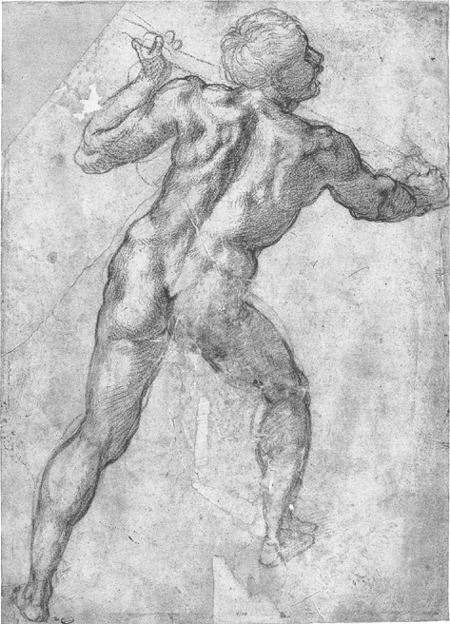
Michelangelo, figure for The Battle of Cascina, 1504–5. The valleys and crevices of shade make this body resemble a landscape. (illustration credit 8.3)
In his biography of Michelangelo, Condivi, relaying the artist’s own views, says:
He has … loved the beauty of the body, as one who knows it well, and with the kind of love, that among certain carnal men, who do not know how to understand the love of beauty unless it is lascivious and ignoble, it has been taken as a reason to think and speak ill of him: as if Alcibiades, a most attractive young man, had not been loved by Socrates most chastely, from whose side, when he rested with him, it was said that he got up just as if he had lain beside his father.
This is how Michelangelo defended himself against gossip. He invoked Plato’s Symposium, a dialogue about love in which the philosopher Socrates and his pupil, the charismatic politician Alcibiades, speak. And this is not an isolated quotation. His love poetry, especially from the 1530s on, is shaped by the Neoplatonic ideal of chaste love that had been popularised by Marsilio Ficino. He wrote a series of tremulous poems to Tommaso Cavalieri, to whom he also sent powerful drawings, including one of the homoerotic myth of the rape of Ganymede. In verse he simultaneously insists on the physical beauty of his love object and transfigures that beauty into something spiritual:
Well, alas! How will it be heard,
the chaste desire [la casta voglia] that
burns the interior of my heart
by those who in others always see themselves?
Michelangelo’s poetry is not alone in the sixteenth century in exploiting the language of Neoplatonic love to paint desire as something utterly ethereal even as it is utterly bound to the human face and body. It is, to be frank, a cliché of the age—but his version of it has special intensity and conviction. His poems have a massive, even clumsy, rock-like force that transcends the brittleness of convention (just as his Bacchus transcends classical quotation). Through this language of love he finds a way to experience love—for he sincerely pursued Cavalieri and later formed an equally chaste relationship with a woman poet, Vittoria Colonna. Neither relationship was unreal—or real.
His poems to Cavalieri are risky, provocative. He starts sending them and giving them to the young nobleman when there is at first uncertainty, even refusal, on Cavalieri’s part. This is not a courtly game: the sense of an old man perhaps making a fool of himself is very real. Michelangelo was in his fifties when he met the twenty-three-year-old Cavalieri in 1532. The poems gradually persuade Cavalieri to accept the artist’s admiration and build a monumental passionate myth that connects the two men; but it is only a myth: there is no evidence to question Michelangelo’s claim that he was celibate, that his love was chaste. And yet, it is love. It does focus relentlessly on physical desire, even as it insists that this desire is angelic. It’s as if the poetry as such is the consummation that turns body to spirit. One of Michelangelo’s favourite poetic images is the fire that consumes him—an image of heat that dissolves, of the physical becoming pure energy. Desire becomes art, and its very intensity turns base matter to pure form.
In 1504, when he was still a young man, Michelangelo was not yet the powerful writer he would become. But his drawings of the nude as he planned The Battle of Cascina are his first great transfiguration of the erotic into a loving art. Their sexuality is touchingly, blatantly real. When he draws a man’s back and runs his eye down every muscular furrow, caressing the bones under the skin with black chalk, it is unequivocally desire that binds him to this object. But the very keenness of the regard somehow transfigures this blatant eroticism. There is extreme emotion in these drawings: to put it in terms both more universal and more accurate to Michelangelo’s art than the rhetoric of Neoplatonism, they are drawings in which desire turns to love. He starts out desiring the men he observes, but as each great density of shade carves each back into a mountain landscape, the feeling changes: it matures. It is love of which these drawings speak. They are moving homages to the beautiful young nudes he sees. Their faces are invisible, and yet you find yourself seeing them as individuals and wondering what their fate will be. Time is included in Michelangelo’s vision of them: death is included. There is a tragic power to these drawings. He portrays young men in their full strength and beauty and yet shades them with intimations of ruin. Lust becomes love becomes compassion: pietà.
Leonardo, seeing the David, saw through it. This nude was obscene; it needed decent ornament. But he was struck, he was startled. On a creamy-white sheet of paper next to a monumental drawing of a rearing horse that he’d sketched for his battle cartoon, he scribbled two very fast, frenetic chalk blurs of physicality, then used a pen to reveal definite compositions within these “stains”: he even drew in rectangular frames in brown ink, to show what this would look like as a painting. They are ideas for a nude, but Leonardo’s nude is anti-Michelangelesque by definition: she is a woman. While Michelangelo disgorged his passion for male beauty, Leonardo experimented with ideas for a nude painting of Leda. In ancient mythology the god Jupiter transformed himself into a swan to make love to this beautiful nymph: their offspring, two sets of human twins, hatched out of swan’s eggs. In Leonardo’s drawings he lavishes the imagination Michelangelo was bringing to his bathers on a woman who kneels on her right knee, her thigh an ample curve of flesh shaded warmly within the inked lines, and reaches around to her left towards a vaguely defined child: but under these forms in the two drawings, one smaller and one larger, you can see alternate poses, phantom curves and twists as Leonardo intensely improvises. The nude, in these drawings, has become a daring game of the artist’s imagination: What poses can a body assume? What contortions can be incorporated into the ideal of beauty? Human beauty becomes a plaything.

Leonardo da Vinci, sketches for Leda and horse studies, circa 1504. Leonardo here sketches his revolutionary female nude beside a centaur-like drawing for a knight in The Battle of Anghiari. (illustration credit 8.4)
There is a direct parallel with Michelangelo’s drawings of naked men twisting, stretching, contorting. Both artists are competing to invent the most spectacular physical performances. This competition had its roots in the works that confirmed Leonardo’s fame in Florence at the start of the sixteenth century.
Michelangelo was doing something unprecedented in his personal odyssey of nude contortions—wasn’t he?
In reality, he was desperately competing with Leonardo. When the older artist returned from his long self-imposed exile at the start of the sixteenth century, he amazed the Florentines with drawings that spectacularly contorted the human figure in strange yet beautiful compositions. Citizens flocked to see his cartoon of the Virgin and St. Anne at the Annunziata as if it were a festival: in the version that survives, there is a majestic, complex game being played with human bodies, a dream of some infinitely ingenious classical sculpture. As Mary sits on the lap of her mother, resting on Anne’s broad right thigh while Anne’s leg is raised higher, Mary is brought so close to her that they almost resemble a mythic two-headed being, their shoulders sloping at the same angle to form a smooth semicircular curve, the face of Anne turned nocturnally down towards Mary’s bright orb, as if they were the moon and the sun. Their bodies are clothed, their knees pressing against the draperies, but there is nudity here too: Christ in Mary’s arms is lovingly admired by the young St. John, whose face is a fleshy sphere under his soft curls and who is naked except for a loincloth.
Leonardo must surely have discovered its unique constellation of bodies in some exercise of improvised doodling like the one for his Leda—the beholder might suspect, and surviving sketches reveal precisely, such a process. They illuminate how Leonardo spewed out a great whirl of chalk, released this eccentric form, and then precisely drew in the lines of the limbs and heads in ink over the almost random chalk blot. Out of weirdness he discovered harmony; that’s the game: to reveal pattern in chaos.
Leonardo’s new kind of composition—phantasmic, wilful, at once impossible and natural, grotesque and beautiful—took classical models apart and put them together again with a new power. It may be that his Virgin and St. Anne and John the Baptist was influenced by seeing ancient robed and seated statues at Hadrian’s Villa near Rome, yet it more closely resembles the robed goddesses on the Parthenon, not to be widely known until the nineteenth century. In reality, Leonardo did not rely on any one classical model but created his own new and heightened idea of sculptural majesty. The group obsessed every young artist who saw it—including Michelangelo. Versions and interpretations of it—maybe he had more than one cartoon on show at Santa Maria Novella—are a major genre of early-sixteenth-century Florentine art. In a round marble relief known as the Taddei Tondo, Michelangelo takes the theme of Mary with the infant Christ and St. John from Leonardo’s group and invents a composition that is the antithesis of Leonardo, while paying—accidental?—homage to his rival by giving much of the unfinished work a Leonardesque softness, an equivalent in stone of the older master’s painterly haze.
Out of this haze comes a harshness. Leonardo portrayed an intimate friendship between Christ and St. John. In Michelangelo’s tondo, Christ is virtually leaping out of his mother’s arms to fly away from John: in place of closeness there is revulsion. This infant Christ is the most finished part of the work, his little body precisely hewn, right down to the small baby’s penis. Michelangelo insists on Christ’s full humanity as he tries to escape his terrible destiny. At the same time he offers a dynamic, explosive contrast to Leonardo’s massive, organic whole—and displays an ingenious physical possibility all his own, of a Christ who does not stay in Mary’s arms but who becomes a kind of flying putto, soaring out of the pictorial group into three-dimensional reality. Sculpture, claims this work, trumps painting.
In the painted tondo he created for Agnolo Doni, designing a richly carved wooden frame for it, Michelangelo defies Leonardo’s cartoon of the Virgin and St. Anne even more unequivocally. Leonardo had created a doubly maternal group—Christ’s mother and grandmother, intertwined—but in this circular painting Michelangelo does the opposite. His Holy Family is dominated by Joseph, a choice radically at odds not just with Leonardo but with the Florentine culture to which the Annunziata cartoon strongly appealed. For Leonardo knew what he was doing, exhibiting a beautiful image of Mary and her mother at the Annunziata, which was famous all over Italy for its precious relic, the miraculous painting of the Annunciation kept there in a tabernacle designed by Michelozzo. Like other medieval Italian cities, Florence adored the Virgin—the city was full of icons of her, and she was prayed to almost as a mother goddess. Leonardo jokes about this in his Prophecies:
Of Christians.
Many who hold the faith of the son only
raise temples in the name of the mother.
Michelangelo is driven in his tondo to attack Florentine popular culture in order to attack Leonardo. It’s reminiscent, oddly, of the First Herald Francesco’s criticisms of Donatello’s Judith—it is not good for the woman to kill the man, and it is not good, implies the Doni Tondo, to depict a Holy Family dominated by women. In Michelangelo’s painting Joseph gets his due: a good old man, strong and sensitive, he towers over his young wife (clearly modelled on a boy), who is doing the correct thing and presenting Christ to him. And the arrangement of human forms is spectacular: Mary kneels, twisting around to raise up Christ, her arms arcing in space. Not only does Michelangelo strive to create a more exciting physical complication than the one Leonardo imagined in his St. Anne studies; in the kneeling Mary, he sets out to improve on the kneeling Leda whose form Leonardo had invented as his riposte to Michelangelo’s nudes.
Yet there is more to these reconfigurations of Leonardo than a cool comparison of styles. Michelangelo finds fault not only with his rival’s art but with his life. There is something very personal in his vision of the Holy Family. Michelangelo loved his father.Ludovico was a good Christian man, old-fashioned in his ways, his son told Condivi, and in Michelangelo’s letters his efforts to be loyal and solicitous to a man who actually seems to have been tetchy and dependent are moving. Not only did Michelangelo respect and help his father, but he did his best for his brothers, especially his beloved Buonarroto, whose death caused him terrible grief. The family home was in the Santa Croce quarter, east of Piazza della Signoria, a working-class district where Michelangelo was later to increase the family’s property: today the Casa Buonarroti museum is there. Michelangelo worked on his cartoon for the Great Council Hall in a room at the Hospital of the Dyers in this quarter, near the family home. At this time of his life there is no record of him indulging in flights of Platonic love or expressing his admiration for male beauty in any other realm but his art: it may well be significant that his pursuit of Tommaso Cavalieri and other men became an overt part of his life only after his father died. In 1504 he was a good son and brother who chose to work on his cartoon in his own family’s quarter. On the other side of Florence there was Leonardo with his strange famiglia centred on a relationship with a handsome young criminal type, Salaì, who, in between visits to the barber and the fortune teller, functioned as something between Leonardo’s adopted son and his lover.
With his coiffed hair and his pink tights and his extravagant wardrobe, his equally finely got-up servants and followers, Leonardo simply repelled Michelangelo. There is real rage towards the older man’s blurring of male and female beauty, his strange sensuality and “family,” in the younger artist’s responses to the Annunziata cartoon. His Doni Tondo utterly rejects the alternative Holy Family depicted in Leonardo’s vision. Not only does a firmly masculine family replace a feminised one: the infant John the Baptist is portrayed by Michelangelo at a respectful distance from the Family, separated from them by a grey stone wall. This is a pointed contrast with the intimate, indeed sensual, way the young Baptist approaches Christ in Leonardo’s cartoon in London. Michelangelo makes the same point even more insistently in his marble tondo: Christ flees the young John as if disgusted by him.
In 1504, as they plot their rival cartoons for the Great Council Hall, these two titanic minds are systematically competing in every aspect of their designs. Consider Michelangelo’s drawing of a seated nude turning away from the beholder, twisting his entire body and neck while maintaining elegance. This might seem utterly remote from Leonardo’s works. But one of the works to be seen in Leonardo’s rooms at Santa Maria Novella was his portrait of Lisa del Giocondo—a seated figure who turns around in her chair, twisting her body with such apparently effortless elegance that the convolution of the pose goes unnoticed. Not by Michelangelo. The Mona Lisa is a hidden enemy with which his gyrating nudes compete. Her circular motion even as she sits still becomes, in his drawings of mighty male figures turning their heads, twisting their backs, a vortex of power. And this, in turn, provokes Leonardo’s most brilliant riposte to the strident energy of all those nudes.
Daunted as he was by David, in the end Leonardo didn’t find his rival’s obsession with the male body that enviable. In his notes on painting he denounces an art that appears to be Michelangelo’s: “O anatomical painter, in your desire for your nudes to display all their emotions, guard against your extreme awareness of the bones, chords and muscles making you a wooden painter …” This is a direct criticism of the kinds of nudes Michelangelo was drawing. In fact it is an insightful analysis of their meaning: Michelangelo set out to “display all their emotions” not in their faces but through their bodies. In a great drawing of a man’s back he reveals pathos and passion inscribed in the very flesh in exactly the way Leonardo suggests. But this muscular emotion is “wooden,” says Leonardo, and in the Mona Lisa he offers his brilliant reply to the anatomical grandeurs of Michelangelo’s nudes.
When Michelangelo insulted him in the street, Leonardo couldn’t think of an answer; when it came to art, he was more eloquent. The earliest imitation of the Mona Lisa, painted by Raphael in about 1506, transposing her features onto those of Maddalena Strozzi Doni, notably lacks the most famous thing of all about her: Maddalena does not smile. This doesn’t prove that Leonardo had yet to make his painting smile, but a scientific investigation of the painting by the Louvre revealed an unsmiling image below the one we see. It’s conspicuous that Raphael should have left out the feature that most struck later observers and was assiduously copied or inventively reimagined by so many later artists. The Mona Lisa’s smile in fact seems connected with the anatomical drawings Leonardo did after 1506, in which among other things he dissects “the muscles called lips.” If so, her face is his considered riposte, in the aftermath of his competition with Michelangelo, to the young man’s “wooden” anatomical nudes. All those surging backs and stretching limbs, those contorted poses, that strident heroic display of feeling in the human body—and really, the only muscles you need to display emotion are your lips. Without stirring from her chair, Lisa del Giocondo banishes Michelangelo’s men with a mocking smile.