
Introduction
Americans are patriotic people: a 2008 poll showed 72 percent believe the USA is “the best nation in the world.” But it turns out that “patriotic” and “historically knowledgeable” can be two different things: in recent surveys, almost half of Americans didn’t know that the Constitution gives Congress the right to declare war, while one-quarter of high school students said Columbus set sail after 1750 and a third couldn’t say in which century the American Revolution occurred.
Why is that, when there are so many amazing, fascinating, weird, unbelievable but still true facts and stories? Probably because some history books—and some history teachers—just aren’t putting the “fun story” into “fundamental history.” The truth is, learning about American history doesn’t have to be a death-march through dusty dates, dreary details, and dead dudes in wigs. America is an amazing place, and it’s all in the history, baby. How did rum and tobacco save the colonies? When did geopolitics hinge on a large rodent? Who made the first potato chip? What was the worst accident during a U.S. nuclear test? Who invented rock-and-roll? Did the CIA really support Osama bin Laden? Does internet dating really work?
You’ll find all the answers in this book—plus plenty of other weird, intriguing, and downright incredible facts omitted by the average high school history course. Of course, there’s absolutely no way a single volume can cover all the stuff you’re supposed to know about American history, but we promise this book contains most of the stuff you really ought to know … along with crazy trivia and terribly ironic quotes perfect for breaking the ice at cocktail parties, wedding receptions, blind dates, armed standoffs, and other awkward situations.

THE STATE OF THE UNION 
“Begin at the beginning” is tricky advice when you’re talking about American history. Do you start with the arrival of the first human beings? The first native civilizations? The first European contact? The first permanent European settlement? But we’ll give it a shot.
The first human inhabitants of North America arrived during the last Ice Age, when hunter-gatherers from northern Asia followed tasty wooly mammoths across a land bridge connecting Siberia to Alaska. Several waves of nomads may have crossed from Asia to North America between 23,000 BCE and 9000 BCE, at which point the Ice Age ended, the polar ice caps melted, and sea levels rose about 400 feet, submerging the land bridge and isolating the nomads in North America.
Over thousands of years their descendants migrated south, crossing 10,000 miles of incredibly varied terrain to reach the southern tip of South America no later than 8000 BCE. Spreading out across tundra, forests, grasslands, swamps, deserts, and jungles, they gradually formed separate linguistic and cultural groups. By one count, there are still about 2,000 native languages spoken in the Western Hemisphere, the vast majority–about 1,450–in South America.
Around 4000 BCE, one Mesoamerican group, the Olmecs of southeastern Mexico, invented agriculture by domesticating maize (corn), leading to the first Native American civilization. The Olmecs are considered the “mother culture” of the civilizations that followed, including the Maya and Aztecs. The domestication of maize and another staple crop, the potato, triggered the formation of complex societies in the Andean region of South America, including the Nazca, Moche, Chimu, and Inca.
But native societies in what became the United States never attained the same level of complexity. Although some groups had large populations that supported craftsmen, royalty, and priests, they never developed systems of writing, so much of their history remains mysterious. Sources like oral histories, linguistics, and archaeology generally only go back about 3,000 years, leaving the period from 7000 to 1000 BCE pretty darn enigmatic. The arrival of Europeans added assault to mystery, with new diseases and brutality decimating the native population of the future United States, which dropped from an estimated 5–10 million in 1492 to 250,000 in 1900. This tidal wave of death wiped out whole cultures and languages, so long story short: we know a lot more about the relatively short period of European settlement in the New World than we do about the much longer native history that preceded it. Acknowledging this bias, we’re mostly going to begin with the parts of the past we know more about—meaning Europe an settlement to the present—because a book filled with “gosh, we dunno” probably wouldn’t sell too many copies.
 WHAT HAPPENED WHEN
|
23,000 BCE–9000 BCE |
Asian nomads cross the land bridge connecting eastern Siberia to Alaska. |
|
|
100 CE |
Teotihuacan in Central Mexico has a population of 150,000+. |
|
|
700 |
Mayan city of Tikal has a population of 100,000+. |
|
|
900 |
Mayan civilization mysteriously disappears. |
|
|
1002/3 |
Vikings led by Leif Ericson discover Vinland (Newfoundland). |
|
|
1150 |
Chaco Canyon culture sites are abandoned. |
|
|
1427 |
Aztec Empire is founded in Mexico. |
|
|
1438 |
Inca Empire is founded in Peru. |
|
|
October 12, 1492 |
Columbus makes landfall in the Bahamas. |
|
|
1499 |
Amerigo Vespucci explores coast of South America. |
|
|
1519 |
Aztec Empire is destroyed by Hernán Cortés. |
|
|
1533 |
Inca Empire is destroyed by Francisco Pizarro. |
|
|
August 28, 1565 |
St. Augustine, Florida, is founded by Spanish settlers. |
|
|
1585 |
English colonists settle on Roanoke Island, Virginia. |
|
|
1590 |
Roanoke colony is mysteriously abandoned. |
|
|
May 14, 1607 |
English colonists found Jamestown, Virginia. |
|
|
July 3, 1608 |
French colonists found Quebec. |
|
|
December 18, 1620 |
Puritan Separatists (Pilgrims) found Plymouth, Massachusetts. |
|
|
1625 |
Dutch colonists found New Amsterdam. |
|
|
September 17, 1630 |
Puritans found Boston, Massachusetts. |
|
|
1634 |
English colonists (including persecuted Catholics) settle Maryland. |
|
|
1641–1666 |
Beaver Wars pit Iroquois against rival tribes, with European support. |
|
|
May 18, 1642 |
French colonists found Montreal. |
|
|
June 6, 1676 |
Nathaniel Bacon leads rebellion against royal governor in Virginia. |
|
|
March 4, 1681 |
Royal charter granted to William Penn for Quaker colony in Pennsylvania. |
 LIES YOUR TEACHER TOLD YOU
LIE: Columbus was the first to discover America.
THE TRUTH: Columbus gets his own holiday for his so-called accomplishment, but there’s no doubt he was late to the discovery game. The Vikings discovered America about 500 years before he got there, and it’s likely that the Polynesians found it even earlier!
The seafaring Polynesians reached Fiji by 1300 BCE, Tahiti by 300 CE, and Hawaii by 400. Given their remarkable feats of navigation, it seems likely they reached the Americas as early as 500. In South America, they appear to have brought chickens to Peru.
BREAST ASSURED
While the Vikings weren’t in the New World for long, they did pick up some good stories. One saga tells of a Viking hunting party in Newfoundland surrounded by native warriors. The Viking men were inclined to withdraw, but Freydis, the pregnant half sister of Leif Ericsson, would have none of this cowardice. She charged the field, revealed her ample bosom, and slapped one of her breasts with the flat side of a sword–because that’s how Viking ladies do it. The startled natives retreated without a fight. Can you blame them?
The Viking case is as solid as a battle axe: Leif Ericsson, the adventurer who sailed from Greenland to Newfoundland in 1002 or 1003, made several trips and reported his adventures in “Vinland” in detail. The sheer numerical superiority of the local Native Americans eventually persuaded the Vikings to pack it in. They abandoned Vinland around 1015, and the American adventure became a thing of legend. No one is certain of the dates because, well, the Vikings were illiterate (or preliterate, if you want to be nice about it), but Leif’s adventures were incorporated into oral histories that were passed down until they were finally transcribed in the twelfth or thirteenth centuries.
CONSTRUCTION SEASON
The Aztecs, Mayans, and Incas tend to get all the credit for building awesomely gigantic monuments. But it wasn’t all teepees and totem poles up North: there was plenty of major construction afoot.
In the Midwest, a succession of “mound-builder” tribes or tribal confederations lived in clusters of villages along the main tributaries of the Mississippi River. They are best known for, yes, building earthen mounds, beginning around the tenth century CE, including Monk’s Mound, a 100-foot-tall flattened pyramid covering almost 14 acres, in modern-day Cahokia, Illinois. Most likely, the tribes used these mounds like the ancient Mesopotamians and Central Americans did, as platforms to bring the priestly elite closer to the gods. Around the same time, the “Fort Ancient” culture in the Midwest was busy raising enormous structures in the shapes of animals. The largest of these, the Serpent Mound in Adams County, Ohio, is three feet tall, six feet wide, and more than 1,300 feet long. The last mound-building society disappeared in the sixteenth century–possibly destroyed by nomadic Plains tribes, newly mobile with the acquisition of horses from Spaniards.
In the Southwest, the Anasazi of modern-day New Mexico built multi-story stone structures (some as tall as four stories) that are still standing–and they didn’t even use mortar or cement! At its height in the tenth and eleventh centuries, the Chaco Canyon proto-city probably had a population of 4,000–5,000 people, while the surrounding network of villages may have housed 25,000–50,000 people. Two hundred and fifty miles of roads, some of them paved with cobblestones, connected Chaco and the surrounding villages. No one knows why Chaco Canyon was abandoned around 1150, but there is evidence prolonged drought caused a famine. There may also have been violent upheaval; the oral histories of Navajo pueblo-dwellers recall Chaco as a place where “people got power over other people,” suggesting exploitation and social unrest.
LIE: Columbus realized he’d discovered a new land.
THE TRUTH: You’ve probably heard that Columbus discovered America by mistake. That’s fair. After all, Renaissance Europeans believed that creation had been fully revealed, so they weren’t exactly expecting to find two giant continents hidden on the other side of the planet. Plus, Columbus had drastically miscalculated the circumference of the earth at 19,000 miles instead of 24,900 miles–he based his projections on the work of Pierre d’Ailly, a Catholic cardinal who used Roman miles (4,840 feet) instead of nautical ones (6,080 feet). Units, people!
 In 1592, exactly 100 years after Columbus “discovered” the New World, the English Parliament passed a law setting the “statute mile” at its current length of 5,280 feet.
Thus when the Niña, Pinta, and Santa Maria made landfall in the Bahamas on October 12, 1492, Columbus naturally assumed he had hit Asia. Sure, he saw no sign of the silk and pepper he was looking for, but he did find some people to call “Indians,” with a small (but still worth it) amount of gold to steal. In 1493 his patrons, Ferdinand and Isabella of Spain, sent Columbus back across the ocean. He was given a sweet new title, Admiral of the Ocean Sea, and instructed to rob the place–wherever it was–blind. The admiral was then to serve as governor of whatever was left.
This is where an understandable mistake turns into bullheaded stupidity. On the four return expeditions from 1493 to 1502, it gradually dawned on everyone but Columbus that the land they were exploring wasn’t the East Indies. This suspicion was supported by a whole bunch of evidence, including the testimony of natives who insisted, again and again, that they’d never heard of China, Japan, India, silk, pepper, elephants, or any of that nonsense.
Amerigo Vespucci, dispatched in 1499 by the king of Portugal as quality control, wrote in his first report that “these regions … may rightly be called a new world,” and was later honored by having his name stamped on the place. But Columbus scoffed at his colleague. He dismissed the locals as “bestial men who believe the whole world is an island,” and forced his crew, under threat of corporal punishment, to sign an affidavit declaring they’d discovered Asia. Obstinate till the very end, Columbus died in 1506, still believing he was right.
CHAINS YOU CAN BELIEVE IN
Geography wasn’t the only subject Columbus failed at: he was also a terrible governor. In fact, he was so bad that Ferdinand and Isabella called him back to Spain in chains in 1503 to answer charges of corruption and brutality. In 1546, the Dominican monk Bartolomé de las Casas wrote:
On the island of Hispaniola, of the above three million souls that we once saw, today there be no more than two hundred of those native peoples remaining … The Spaniards have shown not the slightest consideration for these people, treating them (and I speak from first-hand experience, having been there from the outset) not as brute animals–indeed, I prayed to God that they might treat them as well as animals–so much as piles of dung in the middle of the road.
The monarchs found Columbus not guilty (raping and pillaging had kind of been the whole point), but ordered him into retirement.
LIE: The Puritans came to America to establish religious freedom.
THE TRUTH: The Puritans came to America to escape other people’s religious freedom. The story starts in 1593, when radical Protestant “Separatists” emigrated from England to Holland, where they could live in peace, without being hung or jailed for religious nonconformity. That led to a new problem for the Puritans: the easygoing Dutch allowed people to practice all sorts of crazy religions, including Judaism, Catholicism, and eventually even atheism–the horror! Meanwhile, the Protestant Dutch didn’t observe the Sabbath with the same zeal as the Puritans and also permitted drinking, gambling, music, dancing, and “mixed company” in social settings–all big Puritan no-no’s.
Worried that their children were being “Dutchified,” the Separatists hopped the Mayflower out of Holland on September 16, 1620. Remembered as “the Pilgrims,” they headed for northern Virginia but wound up in what is now Massachusetts, where they founded Plymouth, the first Puritan colony in the New World. The first years were fairly disastrous, with half the colonists dying in the first winter of 1620–1621–but it was still better than living near dancing, drinking gamblers. Separatists were so eager to get away from Holland and England that two more boatloads arrived in 1623 and 1627, offsetting the attrition.
Inspired by the “success” at Plymouth, about 20,000 non-Separatist Puritans left England for Boston, the first settlement of the royally chartered Massachusetts Bay Colony, beginning in 1628. But the fledgling theocracy of the non-Separatists proved just as intolerant as that of the Separatists. When the free-thinking Roger Williams suggested detaching church from state–a step that would technically allow the practice of other religions–he was banished. Williams went on to found Rhode Island in 1635, while fellow rebel Thomas Hooker led his more relaxed followers out of uber-strict Boston to Connecticut in 1636. Shortly thereafter, the Puritan elders exiled Anne Hutchinson for criticizing their authority, much as Puritans had criticized the Catholic and Anglican clergy. It seems that Puritans, in addition to disapproving of laughing, smiling, dancing, and touching, did not have a sense of irony. Good times.
But the bigger point is that traveling across the ocean in search of isolation didn’t solve any of their problems. Like religious ideologues everywhere, the Puritans of Massachusetts were surprised when new immigrants and their own children didn’t share the same enthusiasm for the doctrine. In 1691, King Charles II accelerated the breakdown of Puritan society when he changed the colony’s royal charter so that property ownership, not membership in a Puritan church, became the basis of men’s voting rights. He also amended the charter to include protection of religious dissenters. Looking back, the old-fashioned Puritans might have regretted the move overseas.
BONUS LIE: “THE THIRTEEN COLONIES”
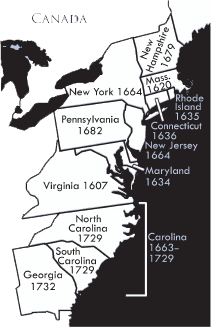
Like the rest of us, you probably bought the ol’ Thirteen Colonies story, but it’s not an accurate depiction of colonial America for most of its history. In 1606 King James I chartered just two companies to settle North America, the Virginia Company of London and the Plymouth Company. As settlements were founded, each new city was recognized as its own colony: for example, Connecticut actually contained 500 distinct “colonies” (or “plantations”) before they were merged into a single colony in 1661. Sometimes colonies were mashed together into mega-colonies, like the short-lived, super-unpopular Dominion of New England, which incorporated Massachusetts, Rhode Island, Connecticut, New Hampshire, and Maine from 1686 to 1691, plus New York and New Jersey from 1688 to 1691 for good measure. Colonies also split, like Massachusetts, which spawned New Hampshire in 1679. And some colonies weren’t really colonies at all: while it’s often listed as one of the Thirteen Colonies that rebelled in 1775, Delaware wasn’t technically a colony or a province. Designated “the Lower Counties on the Delaware,” it had its own assembly but fell under the authority of the governor of Pennsylvania until it declared itself an independent state in August 1776. So technically, there were just 12 colonies in 1775 and 13 states in 1776.
WHERE MY GODS AT 
Good Witch Hunting
Was it mass hysteria, backlash against loosened social restrictions, or dark sorcery that fueled the Salem Witch Trials? Let’s start with a little background. The infamous witch trials actually took place not in Salem Town, but in Salem Village, a small farming colony outside Salem Town. The place was “the sticks,” as they say, with a population of about 90 adult male landowners (and their families), compared to Salem Town’s 330 adult men. In keeping with the age-old divide between country and city folk, the conservative farmers from Salem Village viewed the big city as a den of sin and vice, while the cosmopolitan merchants of Salem Town looked down on their country cousins as ignorant hicks. Meanwhile, the increasing population of Salem Town put pressure on the farmers, as town streets pressed outward, and land grew increasingly scarce.
Salem Village sent a request to Britain for permission to incorporate as a town, but it was returned with the rejecting message “The King Unwilling.” In 1757 the determined residents ignored His Majesty, calling the new town Danvers, and added the king’s three-word message to the bottom of the town seal.
Unsettled by economic pressure and the feeling that society was evolving beyond their control, the farmers of Salem Village were all too ready to believe accusations of witchcraft, still widely feared in Europe. And of course, accusations of witchcraft are always a convenient way to dispose of women who are viewed as too smart, too independent, too strange, or too annoying. Many of the victims of the Salem Village witch trials matched this description, with a suspiciously high number of single women, some of them widows, who were highly visible for doing business in Salem Town. Plus, there was an added incentive: the rules for hunting witches gave the accuser part of a convicted witch’s property.
The hysteria began when a group of teenage girls, led by the pastor’s daughter, accused 156 people from 24 towns and villages of witchcraft. The girls claimed that these “witches” were casting spells and inflicting demonic possession on them. They were apparently inspired by the pastor’s black female slave, Tituba, whom he’d brought to Massachusetts from the West Indies, and who frightened the girls with tales of voodoo.
When the deputy constable of Salem Town, John Willard, suggested the girls were making the stories up to get at personal enemies, they accused him of witchcraft too; he was one of 19 found guilty of bizarre charges and executed. Another of the 19 was George Burroughs–a Harvard graduate who hadn’t lived in Salem for almost a decade, but who was brought back from Maine, tried, and executed after saying the Lord’s Prayer correctly … because his accuser said the Devil spoke the correct version for him. Obviously.
Oddly enough, the few people who actually were practicing “witchcraft"–Tituba, another slave from the West Indies named Candy, and Dorcas Hoar, a white woman who dabbled in the occult–were all set free after a brief time in jail.
 OTHER PEOPLE’S STUFF
Location, Location, Location
After purchasing the entire island of Manhattan from uncomprehending natives for the legendary $24 worth of cheap trade goods, the Dutch couldn’t get too upset when the English robbed them of the island in turn. The first Dutch settlers arrived on Governor’s Island (just south of Manhattan Island) in 1624. They named it Noten Eylandt, or the “Island of Nuts.” The following year, Fort Amsterdam was constructed on the southern tip of Manhattan Island, the purchase of which was finalized in 1626. By 1655 there were about 2,000 people living there–only half of them Dutch–making the city something of a metropolis. (Back in 1640, Boston was the biggest city, with 1,200 inhabitants.)
Manhattan Island was named for an Algonquin tribe known as the Manhattans, who “sold” it to the Dutch colonial governor, Peter Minuit, in 1626 for “trinkets” said to be worth $24. Some historians believe that the items were mistakenly given to a group of Canarsie natives who lived not in Manhattan, but what is now Brooklyn.
Dutch religious tolerance made New Amsterdam a haven for Spanish and Portuguese Jews fleeing oppression (which is basically redundant), Huguenots (French Protestants), and even Catholics (well, sort of). As far as trade, the spot was perfect for a number of reasons, including its proximity to the Hudson River, a highway for native trappers bringing beaver pelts from the interior. The trade route was protected by another Dutch colony, Orange (later Albany), about 200 miles upriver. At the same time, Manhattan itself was easily defended from native attack by the Hudson and East rivers, and later a defensive wall built just outside town (Wall Street).
Unfortunately for the Dutch, all of these advantages also attracted the attention of the British, who seized New Amsterdam in 1664 during the Second Anglo-Dutch War. The Dutch reclaimed it, but in 1673, the Brits seized it again in the Third Anglo-Dutch War. The Brits were smart enough to continue policies of religious tolerance and boosting commerce, and business went on pretty much as before–the only real change was that the British and Dutch elite began to intermarry, forming a new Anglo-Dutch governing caste called the Knickerbockers. (And oh yeah, under British law women could no longer own property. Sorry ladies).
It’s All About the Beavers
The British and the French have never liked each other–ever–and their period of cohabitation in the New World was certainly no exception. The two imperial powers had totally different outlooks and delighted in annoying each other. The one thing they could agree on, however, was beavers–specifically, how awesome their fur was when they weren’t wearing it anymore.
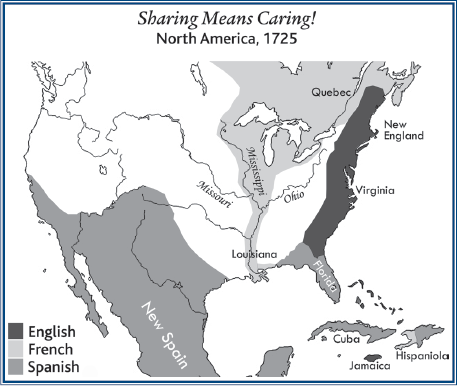
In fact, English, Dutch, and French colonial policy was largely shaped by competition for control of the international beaver market. To secure beaver access, each nation allied itself with different native tribes, whom they courted with gifts of money, alcohol, and firearms. The French got things started in 1609 by aligning themselves with the Huron and Algonquin, two fierce groups living in central Ontario and New England, respectively. The Algonquin and Huron had long battled the nearby Mohawks, and the French were happy to take advantage of existing hostilities and join the fight. The Mohawks, themselves a fairly fierce group of people living in what is now eastern New York State, had friends of their own. Together with the Seneca, the Cayuga, the Oneida, and the Onondaga, the Mohawks formed the Iroquois League–a defensive alliance that may date back to the twelfth century.
While the Iroquois League could field a formidable army, it suddenly found itself at a disadvantage against the Huron and Algonquin, who were now being armed with muskets by the French. That’s where the English jumped into the fray, soon joined by the Dutch, who found a profit in running guns to the Iroquois in the 1640s. Now the Iroquois turned the tables, driving the Hurons from their homeland with a series of fierce attacks from 1645 to 1652.
MORE THAN JUST A PRETTY PELT
Europeans were big fans of beavers long before North America was settled. In fact, they had hunted European beavers to the brink of extinction by the sixteenth century–partly for their soft, glossy fur and partly for castoreum, a rather nasty secretion from the beaver’s nether regions that doubles as a painkiller. (Certain Native American tribes still use beaver testicles in lieu of aspirin; how humans discovered this use for beaver bits is anyone’s guess.)
Just as they had in Europe, the English, Dutch, and French set about killing every beaver they (or native trappers) could lay their hands on. In 1624 the Dutch colony of New Amsterdam shipped 400 beaver pelts to Europe. Two years later, the figure topped 7,000, and by 1671, it had climbed to about 80,000. Measuring dead beavers by the ton, the French recorded 45 tons of pelts delivered by native trappers in 1685, 75 tons in 1687, and 400 tons in 1689–by which time they’d managed to flood the European market. In fact, the last shipment ended up rotting on the docks in Montreal.
With this kind of treatment, it’s not surprising that the total number of North American beavers dropped from perhaps 60 million before European contact to about 100,000 at the beginning of the twentieth century. Since then, prudent wildlife management policies have returned the population to about 10 million across the United States. But Americans are still trapping the poor little delightfully soft critters–about 15,000 in Ohio alone from 2000 to 2005.
This wasn’t the end of the “Beaver Wars.” The Hurons split into two groups, with one heading east into Quebec, and the other moving southwest into the Ohio River Valley–prime beaver-hunting ground, which was already attracting the interest of the English and French. The Huron’s continued hatred of the English and their Iroquois allies gave a leg up to the French, who gained control over most of the American Midwest. Meanwhile, the Iroquois tightened their grasp on the northeastern beaver trade by wiping out two smaller native confederations–the Erie Nation in Ohio in 1657 and the Susquehannock Nation in Pennsylvania in the 1670s. (It seems the Europeans weren’t the only ones practicing genocidal policies in the New World.) The pelt-driven warfare continued into the eighteenth century, as the French found new native allies and the Iroquois found themselves increasingly at odds with Dutch and English settlers.
The Susquehannock people were also known as the Conestoga. In the mid-eighteenth century, craftsmen in the Pennsylvania town of Conestoga developed a large-wheeled covered wagon by that name. Pioneers traveling west commonly used these Conestoga wagons, and the cigars smoked by the drivers became known by the nickname “stogie.”
King Philip’s War
Unsurprisingly, as European settlers encroached more and more on native land, tensions between natives and colonists frequently boiled over into open hostilities. One of the most destructive conflicts was King Philip’s War, from 1675 to 1676. The war pitted white colonists in New England (along with their native allies from the Mohegan and Pequot tribes) against a coalition of native tribes led by the Wampanoag, whose chief, Metacom, was known to English colonists as “King Philip.”
Half a century before the war, Metacom’s father, Massasoit, had helped the first English settlers establish Plymouth, Massachusetts, in 1620, by providing emergency food aid that helped them survive the winter (the origin of the Thanksgiving celebration, when colonists and natives feasted together in 1621). More white settlers showed up over the following decades, establishing dozens of new towns across what are now Massachusetts, Rhode Island, Connecticut, and Maine, pushing native tribes off their land.
After the death of Massasoit in 1661, Metacom’s older brother Wamsutta became chief of the Wampanoag but died in suspicious circumstances during a diplomatic visit to Plymouth colony. Coming to power in 1662, Metacom had obvious reasons to distrust white colonists. In December 1674, a Christian native missionary, John Sassomon, told the governor of Plymouth colony that the chief was organizing a native alliance against the white settlers. Sassomon was murdered by Metacom’s henchmen as punishment for disloyalty. The enraged Puritans hanged three natives for Sassomon’s murder in June 1675–which in turn enraged the natives. With everyone good and enraged, fighting broke out between Plymouth settlers and the local Pokanoket tribe and spread quickly to involve whites and natives all over New England.
In proportional terms, King Philip’s War turned out to be one of the most destructive conflicts in American history, claiming the lives of about 800 colonists and 3,000 natives. The colonists finally won by sheer brutality, foreshadowing hundreds of years of native losses; in another sign of things to come, both sides employed tactics that would today be described as “ethnic cleansing,” focusing on wiping out enemy villages. While male colonists were usually killed, women and children were sometimes kidnapped and held for ransom, as recounted in the “Narrative of the Captivity and Restoration of Mrs. Mary Rowlandson.” Rowlandson, a young female colonist with a newborn child, described an attack on February 10, 1675:
the bullets flying thick, one went through my side, and the same (as would seem) through the bowels and hand of my dear child in my arms … the Indians laid hold of us, pulling me one way, and the children another, and said, “Come go along with us"; I told them they would kill me: they answered, if I were willing to go along with them, they would not hurt me.
Triangular Trade
How to Screw Three Continents at Once!
By the time they arrived in America, the English were masters at screwing their subjects (see: Ireland). The settling of North America gave England a vast new canvas to work on, and the only thing that changed in the seventeenth century was the scale of the extortion. In its perfected form, the scheme became known as the Triangular Trade, because it linked three areas: Europe, the Americas, and Africa. As the trade evolved, the shape eventually became more of a squished baseball diamond, but if you keep your eye on the ball, you’ll notice the American colonists got screwed every time.
The organizing principle of the British Empire was mercantilism, a philosophy that called for enriching the home country by accumulating stocks of precious metals. The rules of the game: First, the home country always had to export more than it imported, so it could stockpile gold and silver at the expense of its trading partners. Second, the government had to encourage and develop manufacturing in the homeland, since manufacturers could charge more for exported finished goods than they paid for imported raw materials. Third, foreign competitors were to be locked out of the market if they threatened domestic industries.
With these basic ground rules in place, the Brits were able to bilk their American colonists coming and going. In the early seventeenth century, agents for the Virginia Company could buy tobacco at 3 shillings per pound in Virginia and sell it for 8 shillings per pound in London, a 165 percent markup. British merchants could buy codfish from New England fishermen for about 12 shillings a quintal (which weighed about 110 pounds) and then sell it in Spain for 36 shillings a quintal, a markup of 200 percent. Beaver pelts purchased from native trappers for 12 shillings a pelt were sold in London for about 45 shillings, for a 205 percent markup.
Meanwhile, American colonies weren’t allowed to sell their cotton, tobacco, timber, fish, grain, or beaver pelts to anyone besides British merchants–even if foreign buyers offered better prices. Mercantile policy also discouraged the development of colonial industries like clothing manufacturing, because they might compete with British businesses. The colonies were supposed to export raw materials to Britain at low prices and import manufactured goods at artificially high prices–and that was all.
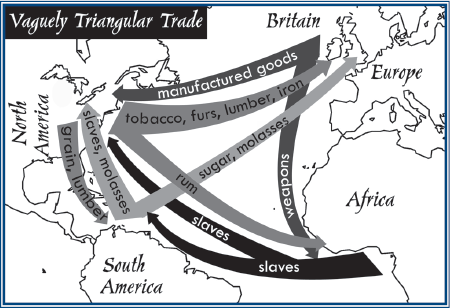
Imports were no better. One of the best examples is the slave trade, which supplied indispensable labor for agriculture beginning in 1617. In addition to obviously victimizing the slaves themselves, the slave traders of the Royal Africa Company–who enjoyed a monopoly–gouged their customers. In 1690, male slaves were bought for an ounce of gold from the chiefs of coastal tribes in West Africa and then auctioned in the American colonies for an average of 20–25 pounds, a markup of 300 percent to 400 percent.
And for an extra dollop of irony, sometimes the overpriced imports were based on the colonists’ own low-cost exports. Hats were manufactured in Britain using beaver pelts from the North American colonies, with hatters buying the pelts on the cheap and then selling the hats back to American colonists for more than double the price. By the mid-eighteenth century, American colonists were paying three to four times what British subjects in the homeland paid for items of clothing. But rest assured–the British government was screwing the regular people of Britain too, by forcing them to pay hugely inflated prices for goods they could get cheaper elsewhere, especially popular colonial commodities like sugar, tobacco, and rum.
TRENDSPOTTING 
Being Broke
One of the rawest of raw deals in history was indentured servitude, a cruel scam in which entrepreneurs offered to pay the costs of passage to America (about 10–15 pounds) for ambitious but broke young men and women seeking a better life. Roughly 75 percent of the early colonists arrived in America this way. Other indentured servants were convicts sentenced to hard labor or victims of large-scale kidnapping schemes. (One professional kidnapper claimed to have sent 800 people to America.) In exchange for passage, they had to work as field hands or domestic servants for a specified length of time, after which they would be free to claim a plot of land and go into business for themselves … supposedly.
But like a well-written mobile phone contract, the problems were all in the fine print and hidden fees. Once the indentured servants arrived in America, their masters were obligated to provide only the bare minimum in food, lodging, and clothing. Not coincidentally, the masters also ran a profitable sideline selling provisions on credit, which forced the laborers to borrow money just to eat, thus keeping them in debt and indentured. Life was hard for everyone in the early colonial period, but it was especially hard for these folk. Over half the young men and women who came to America as indentured servants died before they earned their freedom.
Two young men who worked as indentured servants would go on to become presidents of the United States: Millard Fillmore and Andrew Johnson.
The use of indentured servitude declined with the rise of slavery, which it strongly resembled: indentured servants could be bought and sold, were forbidden to marry, and could be hung for running away before their term was over. The key difference, of course, was that their period of indenture was (technically) supposed to end at some point.
While not quite indentured servants, the colonists who settled Georgia were pretty close. In fact, Georgia was founded as a debtors’ colony for indigent men from England–a good 20,000 of whom were freed from debtors’ prison by James Oglethorpe, the colony’s founder, just before he obtained the colonial charter in 1732. It worked out for the crown because the new colony (the last of the 13 to be chartered) provided a buffer for the rich royal domain of South Carolina against the fierce Creek native tribes in Florida and Alabama. The state’s charter, signed by George II, is a little long-winded but refreshingly honest about its motives:
[M]any of our poor subjects are, through misfortunes and want of employment, reduced to great necessity, insomuch as by their labor they are not able to provide a maintenance for themselves and families; and if they had means to defray their charges of passage, and other expences, incident to new settlements, they would be glad to settle in any of our provinces in America where by cultivating the lands, at present waste and desolate, they might not only gain a comfortable subsistence for themselves and families, but also strengthen our colonies and increase the trade, navigation and wealth of these our realms.
Being a Slave
People of all races have been captured, bought, and sold in virtually every part of the world for most of human history. Slavery was practiced enthusiastically in Europe by the Greeks and Romans, and in the medieval period, the Vikings, Venetians, Genoese, and Mongols trafficked in slaves from Britain, Central Europe, and the Slavic tribes of the Balkans and Ukraine–in fact, the word “slave” comes from “Slav.” But the European supply of slaves began drying up when the Catholic Church banned the enslavement of Christians in the tenth century, and by the fifteenth century, Europeans were looking for a new source of slaves. They didn’t have to look very far.
Like various other groups, Africans had been kidnapped and sold as slaves in Europe and the Middle East ever since the Classical period. However, it wasn’t until the mid-fifteenth century that the Portuguese hit on the idea of buying slaves on the west coast of Africa. A half-century later, the European discovery of the New World opened up a huge new market.
Modern African slavery was qualitatively different from the earlier versions. In the “good ol’ days,” the institution of slavery had a certain twisted fairness, as anyone of any race was liable to be enslaved: prisoners of battle, civilians on the losing side of a war, someone out for a walk. Slaves were also recognized as human beings–even if they weren’t always treated that way. In Roman times, well-educated slaves could become trusted business advisors or personal tutors to the children of nobility. In contrast, by the 1400s, Europeans were only allowed to enslave “heathen” Africans, who were considered subhuman and treated like animals. They were transported from Africa to America in horrific conditions, jammed aboard slave ships in holds that didn’t allow them to stand up straight, receiving only the bare minimum of food and water. In the seventeenth century, it wasn’t uncommon for ships to lose a quarter of their human cargo to disease and starvation during the course of the Atlantic crossing.
The distinction between white men and African slaves was codified in British colonial law beginning in the late seventeenth century. To keep slaves ignorant and docile, white masters were forbidden to teach them to read or write. To prevent rebellion, slaves were forbidden to gather in groups or speak to each other in their native language, sometimes on penalty of death; likewise, runaway slaves could be hung or severely beaten. Children born to slaves were also slaves themselves, making the servitude heritable and giving masters an incentive to promote breeding (even though slave marriages weren’t recognized–slave families could be broken up, with spouses and children sold to different masters in faraway places).
The Fugitive Slave Act of 1793, signed into law by President George Washington, not only gave owners the right to capture their own escaped slaves from any American state or territory, but also established that children born to an escaped slave were also property of
But there were still some ethical dilemmas to be solved. By the eighteenth century, most African slaves had been converted to Christianity, and European theologians decided that Africans did in fact possess immortal souls. But slave owners laid these issues to rest with some questionable theological reasoning: the souls of Africans might be equal in spiritual value to those of Europeans, they conceded, but they were paired with a “primitive” spirit that demanded “guidance” from superior Europeans to achieve salvation. The preposterous logic insisted that slavery was good for slaves.
Slaves are no more at Liberty after they are Baptized, than they were before … The liberty of Christianity is entirely spiritual.
–Bishop William Fleetwood
 MADE IN AMERICA
Rum Punch
Rum wasn’t invented in America, but it proved so popular in the colonies that it should qualify as an all-American drink.
Upon all the new settlements the Spaniards make, the first thing they do is build a church, the first thing ye Dutch do upon a new colony is to build them a fort, but the first thing ye English do … is to set up a tavern or drinking house.
–Captain Thomas Walduck, 1708
It wasn’t the flavor; by all accounts, the batches produced in the seventeenth century (called “kill-devil” by British colonists on Barbados) were incredibly nasty and dangerous. That’s not surprising, considering that the liquor was invented as a way to get rid of an industrial byproduct–molasses, a thick, sticky brown goo that had to be drained from sugar crystals during the refining process. At first no one knew what to do with the stuff, but sometime in the first half of the seventeenth century, someone realized that molasses contains enough sugar to allow fermentation; with a little tinkering, you could turn it into booze.
But not delicious booze: one early imbiber called it a “fiery spirit,” another “a hot, hellish, and terrible liquor.” If this sounds unappealing, consider that distillers might throw a dead animal or animal dung into the “wash” to speed up fermentation. They also used lead pipes in the construction of their stills, sometimes resulting in lead poisoning among heavy imbibers–which was mostly everyone. In Barbados each colonist drank an average 10 gallons of rum per year, while North American colonists averaged 3 gallons per year. That this foul liquor could quickly become the most popular drink in the American colonies is evidence, above all, of the miserable conditions prevailing there, especially among poor colonists who came as indentured servants. Despite the occasional case of blindness or death, rum got you drunk enough to forget your miseries, at least temporarily–and when you woke up the next morning, you could start forgetting all over again.
Of course this was incredibly bad for your health. In 1639, a visitor to Barbados recounted men getting so drunk they passed out on the ground, where they were eaten alive by land crabs, and in 1707, a visitor to Jamaica estimated that rum killed over 1,000 colonists a year on that island alone (out of a total population of 7,000 white colonists). Colonial legislatures tried to control the sale and consumption of rum, with laws passed in Bermuda (1653), Connecticut (1654), Massachusetts (1657), and even Barbados itself (1668)–but with human misery trumping the law, rum continued making great if somewhat unsteady strides.
Etymologists are uncertain about the exact origin of the word “rum,” but most believe that it is a shortened form of the English word “rumbullion,” meaning a fracas or uproar (and possibly related to “rumpus”).
Distilleries were established on Staten Island in 1664 and in Boston in 1667, fed by molasses imported from the Caribbean plantations; these drastically lowered the price and increased the level of intoxication to new highs (or lows, depending on your point of view). In fact, rum played an integral part in the development of the American colonies, as businessmen in New England invested their rum profits in new industries like textile manufacturing. Meanwhile, on the frontier, fur merchants used rum (and other hard alcohol) to buy furs from native trappers, despite–or maybe because of–its catastrophic impact on Native American society.
Before the invention of rum, early colonists on Barbados experimented with other uses for molasses. One of the more innocuous suggestions called for mixing molasses with eggshells and horsehair to make mortar (as in cement). Somewhat more alarming were the practices of injecting molasses into the urethra as a cure for syphilis in both men and women and using it in enemas to combat intestinal complaints.
Sticks and Stones
Contemporary sports like football and mixed martial arts might seem brutal, but they can’t hold a candle to early Native American competitions. Take lacrosse. The sport originally combined religious devotion and combat training, and it served as a substitute for actual warfare among the Native American tribes of eastern North America. In fact, its original name in the Mohawk language means “little brother of war.”
In many ways this is an apt description. Instead of the usual 10 players per team, opposing sides could number in the hundreds. Goals were separated by anywhere from 500 yards to several miles (compared to the 110 x 60 yard field of modern lacrosse), and there were no sideline boundaries, meaning players could range as far as they wished. A match could last all day, following a night of ritual chanting, dancing and prayers; afterward there might be another celebratory feast with more of the same.
The game was also dangerous. Injuries were inflicted before the matches began, with medicine men using ritual blades to make shallow cuts on the bodies of players–adorning them with their own blood as well as special paint made from ash and natural pigments. Then, during game play, hundreds of warriors would crowd around the ball, trying to scoop it up with sticks resembling large wooden spoons or paddles; these also served as weapons during the fierce struggle for possession of the ball, leading to stab wounds and broken limbs (and death, if the limb happened to be someone’s head).
As a non-violent (well, less-violent) substitute for war, lacrosse helped settle disputes between tribes that might otherwise boil over into real armed conflict. This included property disputes: every player had to make a wager before the game started, a wager as small as a piece of jewelry or as big as a family. Through wagers, a lacrosse match could be used to settle the disputed possession of a woman or some other piece of property.
Nonetheless, like so many other native customs, lacrosse was roundly condemned by early European observers, beginning with French missionaries who saw a version of the game played by the Hurons in the 1630s. But the sport was so dynamic and entertaining that white settlers eventually adopted their own version. One slightly less judgmental missionary, Jean de Brebeuf, is credited with coining the European name for the sport, noting that the stick used to carry the ball resembled the ceremonial “crosier,” a staff of office carried by high-ranking Catholic officials. In 1867 the rules of modern lacrosse were standardized by a Canadian dentist, W. George DeBeers, who probably enjoyed steady business as a result.
Lighting Up
It may not be our most admirable innovation, but tobacco is an all-American weed. In fact, without it, the permanent settlement of Virginia and indeed America itself might never have happened.
Virginia was colonized by poor men drawn from the dregs of England’s southern ports. Desperate to leave their stations, they founded Jamestown in 1607 as the first permanent English settlement in America. By 1610, cold, starvation, and raids by the neighboring Powhatan tribe had carried off all but 65 of the 500 original settlers. Even after more settlers arrived the next year, Jamestown was still hanging by a thread. Most of the reinforcements were dead, with more colonists falling to native attacks. Lord De La Warr himself fell ill and returned to England. What could possibly save the colony?
Enter tobacco. The American weed gave the squalid little collection of shacks an economic reason to exist. The first Virginia tobacco was actually a hybrid of a local strain, cultivated casually by the neighboring native tribes, and a strain from Spanish Guyana (located just north of Brazil). The local strain was hardy enough to survive outside of the tropics, but it was too harsh, while the Guyanese variety was smoother. The hybrid version grew well in the southern “Tidewater” coastal region and the “Piedmont” (foothills) that separated the Tidewater from the Appalachian Mountains farther inland.
Like molasses, tobacco was a favorite ingredient in suppositories or enemas prescribed by seventeenth-century physicians for a wide range of maladies. (And no, this is not why the discarded tips of cigars and cigarettes are called “butts.”)
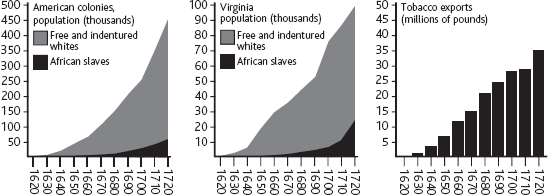
The highly addictive crop quickly became very marketable. From 2,500 pounds in 1616, Virginia’s tobacco exports soared to 17,500 tons in 1720–a 1.4 million percent increase! Tobacco exports constituted over 80 percent of the total value of all colonial exports in the seventeenth century. The first law passed in the American colonies–approved by the Virginia legislature in 1619– set the minimum price for tobacco (three shillings). In the seventeenth and eighteenth centuries, tobacco served as a substitute for money, called “country money” or “country pay,” and shop owners and small-time farmers cultivated small patches of tobacco just to have some petty cash.
I Grow, You Grow, We All Grow Tobacco!
(though not always voluntarily)
JUST LIKE IN THE MOVIES
Like the Puritan settlers of New England, the first English colonists in Virginia probably would have been wiped out completely were it not for charitable natives. The starving inhabitants of Jamestown were particularly indebted to Pocahontas, the daughter of chief Powhatan, who was the “emperor” of a tribal confederation covering eastern Virginia. According to one colonist, John Smith, Pocahontas saved him from execution by her father’s men and later brought provisions to the colonists, which allowed them to survive harsh winters in 1607–1608. To repay her kindness, in 1613 two colonists kidnapped Pocahontas and demanded the release of several English prisoners held by Powhatan (along with a ransom). Embittered by her father’s failure to ransom her promptly, Pocahontas converted to Christianity and married a colonist named John Rolfe in 1614. In 1616 Pocahontas and Rolfe visited England, where she was treated as royalty and introduced to King James I. English hopes for converting the Virginia tribes died with Pocahontas, who succumbed to disease shortly after leaving England to return to the New World in 1617. Today many of Virginia’s (and America’s) oldest families proudly claim descent from Pocahontas through her son, Thomas Rolfe.
After Sir Walter Raleigh brought the first batch of tobacco to Europe’s virgin lungs in the late sixteenth century, most people in England consumed tobacco in the form of snuff–powdered tobacco sometimes mixed with dried flowers or spices. Users could also place chewing tobacco against their gums or smoke it in long, slender clay pipes based on designs borrowed from Native Americans. There were numerous attempts to control and even eliminate tobacco use in England, beginning with James I, who issued a “counterblaste” against the “noxious weed” in the form of a pamphlet detailing its health drawbacks. In Turkey tobacco use could bring the death penalty in the 1630s, and in Russia the first offense brought deportation to Siberia; the second, execution. But none of these had much effect: tobacco was so habit-forming that users would risk death just to get their fix.
In 1624 Pope Urban VIII threatened to excommunicate snuff users–not because snuff was habit-forming, but because the act of
While they had barely scratched out a living before discovering tobacco, the first Virginia colonists became incredibly wealthy, and their success attracted thousands of imitators. Predictably, trouble followed.
PROFILES IN SCOURGES 
Nathaniel Bacon (c. 1647–1676)
Over the seventeenth century, the success of Virginia’s tobacco planters attracted increasing numbers of poor but ambitious young Englishmen. Enticed to the New World by the promise of endless free land, these new colonists were surprised to find that all the good land had already been claimed. The new recruits soon pressured Governor William Berkeley to push farther west and displace various native tribes, most notably the formidable Susquehannocks. But Berkeley knew the Susquehannocks would not be happy about this. So to avoid violence, he tried to contain English settlement within the current colonial borders.
This proved futile. Defying Berkeley, the unhappy colonists formed unofficial militias and attacked Susquehannock villages along the border, massacring native men, women, and children. The Susquehannock retaliated by doing the same to white settlements. The enraged colonists now demanded firm action from Berkeley, who, under orders from the king not to antagonize the natives, had to refuse. It was at this point that Nathaniel Bacon stepped forward for his brief, and not entirely honorable, moment in the spotlight of history.
William Berkeley served as Virginia’s governor for a total of 27 years–far longer than any person since.
A charismatic rabble-rouser, Bacon began respectably enough. Appointed to the Virginia colony’s council by Berkeley, Bacon became bitter when the governor refused to allow him to attack the main Susquehannock villages. Accusing Berkeley of corruption, in 1676 Bacon organized his own personal 500-man militia–a motley collection of former and escaped indentured servants, freedmen, and runaway slaves. They began attacking neighboring natives–but not the Susquehannock (they weren’t picky). Instead they turned on two other nearby tribes, who had previously enjoyed peaceful relations with the English.
Berkeley arrested Bacon and jailed him, but his followers sprang him from prison almost immediately. Surrounded and outgunned, the governor was forced to agree to Bacon’s demand of new elections for the colonial assembly, elections that swept Bacon and his followers into power. Bacon turned out to be a violent nut with a real reform agenda–one that included genocidal policies. During the brief period he ruled Jamestown, the assembly granted freed indentured servants the right to vote, wrote a Declaration of the People of Virginia, and prepared to mount expeditions to wipe out the nearby native tribes once and for all. Before Bacon’s rebels could really accomplish anything, however, troops loyal to the governor attacked Jamestown, forcing Bacon’s army out. A few months later, the rebels returned and–perhaps at Bacon’s order–burned Jamestown to the ground.
That old fool has put to death more people in that nude [empty] country than I did here for the murder of my father.
–Charles II of England, on Nathaniel Bacon
After a promising start, Bacon’s rebellion rapidly lost steam. The coup de grâce came with Bacon’s death from dysentery, apparently the result of an epic infestation of body lice–basically, he died from a really bad case of crabs.
Blackbeard (c. 1680–1718)
Who was the man behind the beard? No one is sure of his real name–either Edward Teach, Edward Thatch, or Edward Drummond–but one thing’s for sure: the man was a big fan of violence and theft. Blackbeard’s father was a privateer–in essence, an officially licensed pirate–who raided Spanish shipping on behalf of the British government in the closing years of the seventeenth century. Young Edward took up the same calling, following his father’s bloody, drunken footsteps through the West Indies and the Spanish Main (the north coast of South America).
When the war with Spain ended, Blackbeard was out of a job, as all privateering licenses were revoked by King George I, who now wanted peace with Spain. But like many privateers, Blackbeard simply ignored the change in British foreign policy, which had only been an excuse to steal things in the first place. He could get along just as easily without a license–actually life would be even easier, since the list of potential targets now included British ships and settlements.
LADIES IN RAIDING
Two of the most successful pirates during this era were women–Anne Bonny and Mary Read, who joined the crew of John “Calico Jack” Rackham. When they were finally captured in 1720, Bonny and Read put up a better fight than Rackham, who was plastered. As he was marched to the gallows, Bonny supposedly bid Rackham adieu with the comforting words: “I am sorry to see you here Jack, but if you had fought like a man, you need not be hanged like a dog.” Read later died in prison, but Bonny–who avoided execution because she was pregnant–was ransomed by her father and died an old woman with eight children.
Even among heavyweights like Bartholomew “Black Bart” Roberts, Henry Morgan, and Ned Low, Blackbeard stood out for his daring and extraordinary capacity for cruelty. With his flagship, Queen Anne’s Revenge, he captured two other ships and formed a pirate fleet crewed by several hundred that terrorized the Atlantic and Caribbean for two bloody years, 1716–718. For the climax, in May 1718 Blackbeard laid siege to the port of Charleston. There, he captured ten ships and a group of leading citizens, whom he held for ransom. This audacious attack on one of the largest cities in colonial America served little purpose beyond putting Blackbeard firmly on the British most-wanted list. But then Blackbeard was never known for being rational.
Calico Jack Rackham designed one of the very first “Jolly Roger” flags, depicting a white skull above two crossed cutlass swords on a black background.
What Blackbeard lacked in sanity, he made up for in creativity. Before going into combat, he would braid slow-burning cannon fuses or pieces of hemp into his enormous beard and tricorne hat, creating a wreath of smoke and sparks to look like “a Fury from Hell,” if not “the Devil” himself. On one occasion, when business was slow and his crew was getting restless, he supposedly shot two of them in the legs so they “would remember who he was.” On another slow day, figuring they were all going to hell anyway, Blackbeard proposed turning the ship into an imitation inferno with pots of burning sulfur belowdecks to see who could stand their impending fate the longest (surprise: it was him). Over his prolific career, he supposedly accumulated 14 wives, scattered around various Caribbean islands and the Carolinas, forcing the last to prostitute herself to his officers.
This general craziness helped terrify enemy crews into submission (after all, that’s how he treated his friends), but it failed to protect him from the government. Blackbeard had allegedly struck secret deals with the governor of North Carolina, Charles Eden, and high-ranking officials in New York, who allowed him to plunder far and wide in return for a cut of the loot–but when Blackbeard became too big a liability, they sold him out. Eden granted Blackbeard a royal pardon, knowing it would lull the pirate chief into letting his guard down–then the governor of Virginia, Alexander Spotswood, sent two ships to attack him. Blackbeard destroyed one, but the commander of the other sneakily hid his crew belowdecks to lure Blackbeard on to the offensive. After a fierce battle, Blackbeard’s throat was slit by a British sailor; the body was beheaded, and the head was posted on a stake by the Virginia shore as a warning to other pirates. By some accounts, in the final battle, Blackbeard was shot or stabbed 25 times before actually dying.
BY THE NUMBERS 
|
13 |
size, in acres, of the Monk’s Mound in Cahokia, Illinois |
|
100 |
height, in feet, of Monk’s Mound |
|
197 |
height, in feet, of the Great Pyramid in the Aztec capital, Tenochtitlan |
|
80,400 |
number of human sacrifices supposedly made by the Aztecs to consecrate the Great Pyramid in 1487 |
|
4,700 |
population of English colonies in America, 1630 |
|
250,000 |
population of English colonies in America, 1690 |
|
7,289 |
number of English colonists sent to Virginia, 1607–1624 |
|
1,249 |
number of these still alive in 1624 |
|
30,000 |
male colonists in Maryland, 1704 |
|
7,000 |
female colonists in Maryland, 1704 |
|
85 percent |
proportion of Maryland colonists who were indentured servants |
|
16 |
average age of marriage in Maryland, 1704 |
|
150 |
cost, in pounds of tobacco, of a “mail order” wife in Virginia in 1621 |
|
40 |
average life expectancy of white colonists in the seventeenth century |
|
2,000 |
population of African slaves in North America, 1650 |
|
28,000 |
population of African slaves in North America, 1700 |
|
21.3 percent |
average mortality rate among captive Africans on British slave ships, 1619–1700 |
|
29.8 percent |
average mortality rate among captive Africans on Spanish slave ships, 1599–1700 |
|
10 percent |
average mortality rate among white colonists crossing the Atlantic, seventeenth century |
|
50 percent |
proportion of white indentured servants who died before achieving freedom |
|
20 |
average age of white indentured servants |
|
10–15 |
average cost, in pounds, of a white indentured servant in the second half of the seventeenth century |
|
15,000 |
total number of people engaged in piracy off the coast of North America, c. 1700 |