

THE STATE OF THE UNION 
It’s likely that up to 78 percent of American readers have heard of the “American Revolution"–something related to Washington’s wooden teeth, tea brewed incorrectly in Boston Harbor, Paul Revere watching lamps in a distant steeple, bad people getting tarred and feathered, and Benedict Arnold doing something naughty.
While the Revolution may seem mundane–of course we had to declare independence! Taxation is bad!–on closer examination, it’s pretty weird. For one thing, colonists still considered themselves Englishmen: all their complaints were based on customs and precedents established in the home country. There were also deep personal and economic connections between American revolutionaries and the evil British oppressors (who were basically indistinguishable from the colonists they were sent to govern). Indeed, about three in ten colonists remained loyal to King George III up through the end of the Revolution. But somehow, out of this strange brew of confused loyalties and competing ideologies, a new national identity arose. In other words, in their struggle to regain traditional British freedoms, the American colonists discovered–or decided–that they were, well, American.
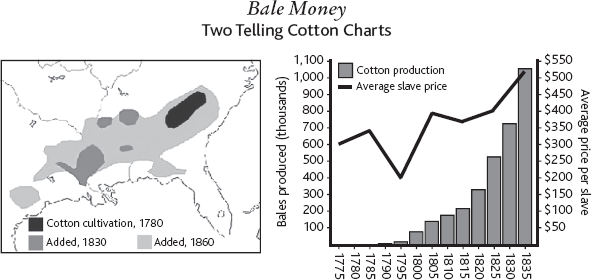
Of course, that just included the white ones: in their fight for freedom and liberty, the colonists had no intention of extending this justice to the growing number of African (and African-American) slaves toiling on Southern plantations. The big increase in the slave population was thanks to a little invention known as the cotton gin, which made cotton production far more profitable, soon displacing tobacco as the main Southern cash crop. The rise of cotton led to continuing close economic ties between the United States and Britain well after the American Revolution, as British textile mills came to rely more and more on American cotton.
Not that everything was smooth sailing for the United States and its former colonial master: British stubbornness and American pride led to renewed conflict in the War of 1812, which is famous for its indecisive outcome. Although the United States lost almost every important battle during the war, it somehow came out ahead, securing its claim to the Northwest Territory (now the Midwest) and New Orleans, which opened the whole Mississippi basin to American settlers.
 WHAT HAPPENED WHEN
|
1733 |
Molasses Act institutes tax on molasses but isn’t strictly enforced. |
|
1754–1763 |
French and Indian War (aka The Seven Years’ War). |
|
1763 |
Sugar Act enforces tax on molasses more strictly, leading to colonial protest. |
|
1764 |
Currency Act forbids colonies to issue paper money; British taxes must be paid in gold or silver. |
|
1765 |
Stamp Act levies tax on all official documents; Bostonians riot. |
|
1767 |
Townshend Acts take control of judicial system and tighten customs enforcement, leading to more protests. |
|
1773 |
Tea Act leads to widespread protests, Boston Tea Party on December 16. |
|
1774 |
Parliament closes the port of Boston and tries to take direct control of Massachusetts. |
|
September–October 1774 |
First Continental Congress agrees to a total boycott of British goods. |
|
April 1–19, 1775 |
Paul Revere’s ride; Battles of Lexington and Concord. |
|
May 10, 1775 |
Ethan Allen and Benedict Arnold capture Fort Ticonderoga. |
|
June 15, 1775 |
George Washington is unanimously elected commander in chief by Continental Congress. |
|
July 1776 |
Revolutionary leaders issue the Declaration of Independence. |
|
December 1776 |
Benjamin Franklin goes to France as the rebel ambassador. |
|
June 1777 |
Marquis de Lafayette arrives in South Carolina. |
|
September 1777 |
British defeat rebels at Brandywine Creek on September 11 and capture Philadelphia on September 26. |
|
February 6, 1778 |
France declares war on Britain, joining war as an American ally. |
|
September–October 1781 |
Main British army under Cornwallis surrenders at Yorktown. |
|
March 1783 |
Unpaid Continental Army officers and soldiers in Newburgh, New York, plot a military coup. |
|
September 3, 1783 |
The United States and Britain sign the Treaty of Paris. |
|
August 1786–February 1787 |
Thousands of indebted Massachusetts farmers rise up in “Shays’ Rebellion.” |
|
May–September 1787 |
Constitutional Convention meets in Philadelphia to draw up a new plan for national government. |
|
April 30, 1803 |
Thomas Jefferson purchases the Louisiana Territory from France. |
|
August 14, 1807 |
Robert Fulton launches the world’s first successful steam-powered boat service. |
|
January 1, 1808 |
Congress ends the slave trade with Africa; internal slave trade continues. |
 LIES YOUR TEACHER TOLD YOU
LIE: The colonists rebelled against the brutal tyranny of King George III.
THE TRUTH: Unfazed by his occasional bouts of madness (talking to trees, etc.), the colonists actually hoped for a time that King George III might become an ally in their real struggle–against the British Parliament.
The problem with Parliament was that its rank-and-file members were inconsistent, greedy, and shortsighted. Having run up an enormous debt financing the French and Indian War, they squeezed the American colonies for cash and simply couldn’t admit that things were starting to get revolutionary. They refused to hear American grievances and actively sabotaged negotiations hosted by their few reasonable colleagues. Finally, when the situation became violent, they overreacted and brought the hammer down on the American colonies–a move practically guaranteed to lead to partition.
 Most depictions of King George III make him appear elderly, mostly due to the obligatory white wig worn by distinguished men of the era. But when the American Revolution broke out in 1775, the monarch was only 36 years of age. General George Washington was 43.
In 1700 colonists were already unhappy with mercantilist policies that enriched British merchants and manufacturers at the colonies’ expense. But they tolerated these policies because, for an appropriate bribe, corrupt officials would gladly turn a blind eye to smuggling. This system worked through the end of the seventeenth century, but in the early eighteenth century, the cash-strapped British Parliament began levying taxes on whatever it could think of–beginning with a tax on molasses, passed in 1733. (This was especially loathed because it made rum more expensive, and you just don’t mess with booze.) Above all, the new taxes angered American colonists because they were given no say in how the British Parliament decided that money should be raised or spent. This violated the 1689 British Bill of Rights, which said no subject of the English crown should be taxed without representation in the official legislature. But Parliament went ahead and granted itself the power to levy new colonial taxes–a power that members were thrilled to abuse.
The Molasses Act was followed by the French and Indian War (1754–1763), in which the British teamed up with the Iroquois to kick the French out of the New World once and for all. This proved to be more difficult and expensive than anyone expected, and Parliament “asked” (told) the colonies to make financial contributions for their own defense. True, the British had been urged into war by the colonists, including Benjamin Franklin, but Parliament was drinking too much of its own rum-flavored Kool-Aid. In addition to the expense, the war highlighted the colonists’ biggest complaint: Parliament refused to let the colonists settle in the newly acquired territories for fear of alienating native allies.
Forcing colonists to bankroll the defense of a place they were banned from inhabiting was probably not the brightest idea. Then Britain’s Parliament escalated the aggravation by cracking down on smuggling and collecting customs revenues to the penny. This new, tighter administration succeeded in raising customs revenues from about 2,000 pounds a year in 1760 to 30,000 pounds by 1768. It also succeeded in provoking rebellion. The colonists became especially angry about British use of writs of assistance–open-ended search warrants that gave inspectors the right to go anywhere while investigating smuggling and customs evasion. Outraged, many colonial lawyers, including John Adams, asserted that writs of assistance were illegal under the 1689 Bill of Rights.
Parliament also dreamed up some new taxes to pay off the huge debt after the French and Indian War ended in 1763. Arriving during an economic depression, the Sugar Act of 1764 (the first new tax since the Molasses Act) enraged rich and poor colonists alike, sparking episodes of violence across the colonies. In protest, Samuel Adams led Massachusetts merchants in the first boycott of British goods. Boycotts continued to be a favorite tactic of the patriots as 1765 brought the Revenue Act, which continued the tax on molasses, and the Stamp Act, which required a duty be paid on all official documents, from attorney’s licenses and land grants all the way down to newspapers and lowly playing cards (and dice, for good measure).
In response to growing disorder, in 1765 Parliament passed the Quartering Act, which required ordinary Americans to open their property to house thousands of British troops. These were the famous Redcoats–rowdy, poorly educated teenage boys and young men drawn from the British lower classes, who liked to drink, carouse, and “blow kisses to the local lasses.” Farmers, merchants, and landlords feared for their property–and their daughters. When, perhaps unsurprisingly, colonists in New York declined the offer to play hosts, Parliament hit back by trying to suspend New York’s colonial legislature and governor for almost four years, until the New Yorkers finally caved in 1771.
Many people do not hesitate in supposing that most of the young ladies who were in the city with the enemy, and wear the present fashionable dresses, have purchased them at the expense of their virtue.
–A wealthy merchant in Philadelphia, 1778
It turned out that randy, substance-abusing British youths weren’t the precise instruments of policy needed to resolve colonial grievances, but Parliament seemed to be looking for a fight. In 1768 the Townshend Acts, a power grab intended to grant Britain control of the colonial judicial system, sparked violent protests in Boston (long notorious as the most rebellious colonial city, and, not coincidentally, also the drunkest). In response, the Brits piled more Redcoats into the city, which led to more clashes and the killing of an 11-year-old boy, Christopher Seider, on February 22, 1770. About two weeks later, on March 5, an angry mob of 400 Bostonians confronted a dozen Redcoats guarding the Boston customs house, first pelting them with gravel-filled snowballs before escalating to stones and empty bottles. The Redcoats lost their cool and opened fire, hitting 11 men. Six of these died in what has come to be known as the “Boston Massacre.”
But what was happening with old King George III while all this was going on? During this period the king was still mostly sane and enjoyed a reputation as a kind-hearted ruler. More to the point, George III had the power to call and dismiss Parliament and appoint the prime minister who led it. So it wasn’t all that crazy for the American colonists to hope George might step in and convince Parliament to act reasonably.
Erected in Bowling Green Park in Manhattan in 1770, a two-ton equestrian statue of George III was a frequent target of vandalism, none greater than the one that occurred on the date the Declaration of Independence was read aloud in New York City for the first time. On July 9, 1776, a band of patriots brought down the statue with ropes. About half the pieces were taken to the Connecticut home of General Oliver Wolcott, where they were melted down to form exactly 42,088 bullets.
And on a number of occasions, he actually did, beginning in 1766, when he helped his former prime minister, William Pitt, persuade Parliament to repeal the hated Stamp Act. Grateful colonists erected statues of George III and Pitt in New York City. In fact, every unpopular colonial tax on the books was eventually repealed at the king’s request, or at least with his consent, except for one: the Tea Act of 1773.
The Tea Act–intended to shore up the failing East India Company by allowing it to dump thousands of tons of tea at discount prices–stirred fears that cheap British tea would wipe out both local merchants and smugglers trafficking in competing brands. In retaliation, colonial leaders, merchants, and smugglers organized a massive tea boycott. In New York and Philadelphia, ship captains were persuaded to sail back to England, while in Charleston the tea rotted on the docks. Boston, as usual, opted for a more violent solution: the Boston Tea Party, in which 50 colonists–not very convincingly disguised as tea-hating Mohawk Indians about 300 miles from home–dumped all the tea in Boston Harbor.
At this point, George III went from nice to nasty. It was one thing to protest taxes on paper, but destruction of property was a villainous crime. More importantly, George III wanted to keep his right to arbitrary taxation. In fact, that was the whole point of the Tea Act: George III said Parliament had to hang on to at least “one tax to keep up the right.” His fury only grew when the people of Boston refused to pay for the ruined tea. In 1774 the king supported the passing of what the colonists called the “Intolerable Acts,” which closed the port of Boston, seized control of the colonial government of Massachusetts, and once again forced Americans to quarter Redcoats in their barns and warehouses. So the colonies convened the First Continental Congress, where they agreed to a total boycott of British goods. It was on.
Most historians believe that King George III suffered from a hereditary disease called porphyria, which causes psychiatric symptoms such as depression and delirium.
Thus fatherly King George III became George the Tyrant, whose recent goodwill was quickly forgotten. According to the Declaration of Independence,
The history of the present King of Great Britain is a history of repeated injuries and usurpations, all having in direct object the establishment of an absolute Tyranny over these States … In every stage of these Oppressions We have Petitioned for Redress in the most humble terms: Our repeated Petitions have been answered only by repeated injury. A Prince, whose character is thus marked by every act which may define a Tyrant, is unfit to be the ruler of a free people.
BONUS LIE: INDEPENDENCE DAZE
Everyone knows July 4, 1776, was Independence Day–the day the rebellious colonies declared their independence from Britain. But it’s not: independence was declared a few times, and the best candidate is actually July 2. Obviously it’s too late to change the holiday now, but for the record, here’s how it went down.
Wednesday, June 12–Thursday, June 27: With a British invasion of New York looming, the rebel Continental Congress in Philadelphia asks Thomas Jefferson to draw up a rough draft of the Declaration of Independence, followed by a second draft for review.
Friday, June 28: The second draft is read to Congress, followed by informal discussions.
Monday, July 1: Formal discussions of the second draft begin.
Tuesday, July 2: As the British invasion fleet approaches New York, Congress votes to declare independence from Britain.
Thursday, July 4: After more discussions, Congress approves the revised Declaration of Independence, which is printed by John Dunlap of Philadelphia.
Saturday, July 6: The Declaration is published in the Pennsylvania Evening Post.
LIE: George Washington was one of history’s great military minds.
THE TRUTH: There’s no question George Washington was a brilliant leader, whose intelligence and moral qualities were key to the success of the Revolutionary War and the newly founded United States. However, he was not a particularly good general–and he said as much himself.
History makes it clear that Washington was physically brave, even daring. In 1752, on the death of his father, the 21-year-old Washington inherited the post of district adjutant in the royal government of Virginia. Because he was familiar with the Ohio Territory from surveying expeditions, in 1753 he was chosen to travel 200 miles to the French Fort of Le Boeuf (near modern-day Pittsburgh, Pennsylvania) to deliver a blunt message: get out. The sassy French not only refused but built another fort, Fort Duquesne, at the head of the Ohio River, igniting the French and Indian War.
Growing up, George Washington celebrated his birthdate as February 11, 1733. When all British colonies adopted the Gregorian calendar in 1752, and the “New Year” was moved from March to January, his birthdate was recalculated as February 22, 1732.
In April 1754, Washington returned to the area with a ragtag force of 186 colonial militiamen, some frontiersmen, and a few native warriors allied with the Brits. Following an ill-advised advance on Fort Duquesne, Washington retreated to a makeshift wooden palisade dubbed “Fort Necessity,” which 700 French soldiers and native allies soon encircled. After some bloody but inconclusive fighting, it started to rain heavily, and Washington’s troops couldn’t keep their gunpowder dry. Luckily, the French were happy to let the Virginians return home, where Washington was pleasantly surprised to receive a note of thanks from the House of Burgesses for his brave leadership.
It got worse in 1755, when Washington joined a second British expedition, led by General Edward Braddock, for a second try at Fort Duquesne. The motley British force of about 2,100 was ambushed by a force of French guerrilla fighters and their native allies as soon as it crossed the Monongahela River. In the Battle of Monongahela on July 9, 1755, Braddock was killed, along with 500 of his troops, but Washington managed a fighting retreat that allowed most of the rest to escape. Once again, Washington made the best of a bad situation–but it still ended in running away.
LADIES LOVE GEORGE WASHINGTON
Washington wasn’t always the old, white-haired patriarchal Founding Father that we know and love. At six feet three inches, the young Washington had the ladies of pre-Revolutionary Virginia swooning. On closer introduction, they were enchanted by his magnetic gray-blue eyes and auburn ponytail. And he was ripped: modern experts who reconstructed Washington’s appearance using techniques from forensic anthropology say he had a quarterback’s physique, weighing 220 pounds with wide shoulders, a narrow waist, and muscular legs. Legs were a particularly important feature in colonial America, where styles favored breeches and knee stockings so women could admire men’s calves. In 1759, at the age of 27, Washington’s masculine wiles snared Martha Custis–the young, beautiful, and spectacularly wealthy widow of a Virginia planter.
Six feet high and proportionably (sp) made; if anything rather slender than thick for a person of that height with pretty long arms and thighs.
–George Washington’s description of himself to a London tailor, 1763
Having played a key role in starting it, Washington sat out the rest of the French and Indian War. Two years into war, in 1756, he was assigned the tedious duty of maintaining “security” in the borderlands, and by 1758 he’d given up hope of a military career, focusing on his coming wedding to Martha Custis, a wealthy widow. So when Washington was appointed commander of the revolutionary forces in 1775, 17 years removed from active duty, he frankly advised the Second Continental Congress that he wasn’t a very skilled or experienced military commander.
Then why did the rebels choose Washington, a man whose main contribution to military history thus far was successfully running away? Simple: he was the only prominent revolutionary with any military experience at all. Benjamin Franklin was many things–printer, inventor, diplomat, all-around genius–but he was not a soldier; John Adams was a lifelong bookworm and professional lawyer; Thomas Jefferson was also a lawyer when he wasn’t busy being fabulously wealthy (or totally broke) and smart; and James Madison was a frail, philosophical gentleman who dabbled in law and politics.
I beg it may be remembered by every gentleman in this room, that I this day declare, with the utmost sincerity, I do not think myself equal to the command I am honoured with.
–George Washington, 1775
As commander by default, Washington went on to score important victories during the Revolutionary War, including Trenton, Princeton, and Monmouth. But there were at least as many defeats and “strategic withdrawals,” including the Battles of Long Island, White Plains, Brandywine Creek, and Germantown. It’s true he improved over time, in part by listening to good advice. In fact, the plan for the final victory that ended the Revolutionary War–the siege of Yorktown–was suggested to Washington by General Comte de Rochambeau of France.
Despite his mistakes and errors in judgment, of course, all anyone really remembers is Washington’s eventual success. And his greatest military skills weren’t strategic or tactical anyway. His real triumph was organizational: forming an army from scratch, procuring funds and supplies from a well-intentioned but totally unreliable Congress, and coordinating with his subordinate commanders–all through handwritten correspondence delivered by couriers on horseback.
 QUICK’N'EASY AMERICAN REVOLUTION
The American Revolution saw the underdog colonists win an unlikely victory over the powerful British Empire–mostly because they just cared more.
Things started off well for the rebelling colonists: on April 19, 1775 Redcoats marched from Boston to Concord, Massachussetts, but Paul Revere rode ahead to warn the rebels, who gathered at the Lexington town green and defeated the Brits. On May 10, 1775 Benedict Arnold’s Connecticut militia and Ethan Allen’s Green Mountain Boys from Vermont stormed Fort Ticonderoga, then shipped their freshly captured cannons to George Washington for the siege of Boston. The cannons blocked the Royal Navy from supplying the Redcoats, who finally withdrew from Boston on March 17, 1776.
But the wheels were already coming off. In June 1775 the rebels mounted an ill-advised invasion of Canada, only to discover the Canadians wanted no part of the Revolution: the siege of Quebec ended in disastrous defeat on December 31, 1775. Meanwhile, after abandoning Boston, Admiral William Howe regrouped in Halifax, Nova Scotia, and returned to seize New York with 32,000 Redcoats on August 27–30, 1776. Howe then defeated Washington at the Battle of Brooklyn and again at White Plains, New York on October 28. Retreating south, Washington scored two small victories at Trenton and Princeton, New Jersey–but the Brits still had the upper hand.
Hoping to divide and conquer, the Brits then tried to split the colonies along the Hudson River Valley and the Delaware River Valley, but only the latter succeeded: Admiral Howe sailed around the Chesapeake for a surprise attack on Philadelphia and defeated the rebels at Brandywine Creek on September 11, 1777. On October 4, 1777 Washington’s push to retake the city was defeated at Germantown, and his desperate troops were forced to spend the winter at Valley Forge, Pennsylvania, without food or shelter. But they got a boost when Horatio Gates and Arnold stopped the British invasion of the Hudson Valley at Saratoga, New York, September 19–October 3, 1777.
The tide began to turn. In February 1778 Benjamin Franklin negotiated an alliance with France, and suddenly the Brits faced a blockade by the French Navy. Fearing they might be cut off up North, and hoping to consolidate loyalist support down South, the Brits withdrew from Philadelphia and took Charleston, South Carolina on May 12, 1780. The British general Lord Cornwallis scored a major victory over Southern rebels under Gates at Camden, South Carolina, on August 16, 1780, but then divided his army, leading to a rebel victory at Cowpens, South Carolina, on January 17, 1781. Alarmed, Cornwallis chased Nathanael Greene’s forces across North Carolina and Virginia and defeated them at Guilford Court House, March 15, 1781.
Believing he’d secured the Southern colonies (nope) Cornwallis headed north to rest his tired troops and get supplies by sea at Yorktown, Virginia. On the advice of the French general Rochambeau, Washington scrapped a planned attack on New York City and instead rushed south to cut the Brits off on the Yorktown peninsula. The French Admiral de Grasse blockaded them by sea and 8,800 starving Redcoats were forced to surrender on October 19, 1781. The Brits called it quits soon after.
LIE: The American Revolution pitted the Americans against the British.
THE TRUTH: Loyalties during the American Revolution weren’t as cut and dried as you might think. One British faction, the Whigs, were extremely sympathetic to the American patriots, and at least one-third of American colonists actually opposed the Revolution, remaining loyal to George III and Parliament.
In Britain, 1689's Bill of Rights had limited the king’s power to tax his subjects. But the Whigs, a group of aristocrats and commoners opposed to royal power, also believed the king should no longer have the right to appoint the prime minister, and that he should be appointed by Parliament instead. Unsurprisingly, the king disagreed, reasserting the crown’s right to appoint the prime minister in 1760. This angered the Whigs, who feared George III was trying to establish tyranny in Britain, and it made them natural allies of the American rebels (even while the latter were asking George for help against Parliament–it was complicated).
On the other side of the pond, the American colonists were hardly united in their opposition to British rule. According to John Adams, about one-third of the colonists were fervent supporters of the Revolutionary cause, one-third remained loyal to Britain, and one-third were neutral. So who made up the one-third of colonists that remained loyal to George III, and why were they so committed? In geographic terms, loyalists were spread throughout rural New York and New Jersey, as well as the southern colonies. Most stayed loyal for personal and professional reasons, including people with close family ties or financial connections to Britain. This could mean anyone from farmers to merchants to Anglican clergy. But being a loyalist was a risky proposition: those who admitted being pro-Britain on rebel turf had their property confiscated and ran the risk of being “tarred and feathered” (usually a fatal procedure). Or they’d just get the crap kicked out of them. Many loyalists fled the countryside for big cities held by the Brits, including New York, Philadelphia, Charleston, and Savannah, which was fine until the Brits called it quits in 1783.
America has chosen to be, in many respects to many purposes, a nation.
–U.S. Chief Justice John Marshall, 1821
Once the British left town, it became clear that not all of the loyalists were that loyal. Most swallowed their pride and stayed put, accepting their citizenship in the newfangled “United States” with quiet skepticism. Still, 62,000 hard-core loyalists (roughly one of every 40 colonists) left the new nation, with 46,000 heading to Canada (where New Brunswick was created as a home for 14,000 loyalist refugees), 9,000 fleeing for the Caribbean and Bahamas, and 7,000 heading home to Britain. Later, expatriate loyalists helped keep Canada loyal to Britain despite American meddling.
I never use the word “Nation” in speaking of the United States; I always use the word “Union” or “Confederacy.”
–former Vice President John C. Calhoun, 1849
So when exactly did Americans become, well, American? The Brits were probably the first to suggest that colonists were somehow fundamentally different–and not in a good way. Popular British opinion held that colonists had “degenerated to such a degree” that one Briton was equal to 20 colonists, and that they were “almost a different species from the English of Britain.” With their pride wounded, colonists responded that they were indeed different from the British–but only because they were actually better. Benjamin Franklin asserted that American colonists were “much purer, much less corrupt” than the English who remained behind. However, he concluded with a plea to the British public to stop treating the colonists as “foreigners,” indicating there was still some bond between the two nations.
Ultimately, it took British oppression and brutality during the Revolutionary War to sever the connection. It was the Brits’ heavy-handed policies that not only alienated their colonies but united them around common grievances–the theme of Benjamin Franklin’s famous “Join or Die!” cartoon from 1754. The fact that it was a conscious choice actually strengthened the new national identity, forever linking “American-ness” with the ideals of freedom and liberty.
Ben Franklin’s “Join or Die!” graphic reflected a common superstition at the time, claiming that a severed snake could come back to life if its sections were joined prior to sundown.
Still, after the Revolution most people thought of themselves as citizens of their home state first and as “Americans” only second, while the states basically behaved as separate sovereign nations. The lack of effective central government made it pretty hard to do anything. The resulting crises eventually prompted the revolutionary leaders to write a new constitution–although nobody was quite sure what this plan for national government would look like.
LIE: The Founding Fathers always wanted the United States to be a democracy.
THE TRUTH: Some of the Founding Fathers were big fans of democracy–but only some of them.
During the Revolutionary War, the states had (mostly) cooperated under the Articles of Confederation–an extra-loose, open-ended set of agreements that weren’t even ratified until 1781, when the war was almost over. The Articles of Confederation had some major problems: most importantly, they didn’t give the federal government the right to raise taxes. This made sense during an anti-tax uprising, but it also meant that the government would be perpetually broke.
It wasn’t long before the resulting shortfall led to even more revolutionary fighting after the Revolution. In 1786 an ex-farmhand and Revolutionary veteran named Daniel Shays led a “debtors’ rebellion” of poor, bankrupt farmers in western Massachusetts. Many Revolutionary veterans, including Shays and his rebels, had been given bonds for future payment or land grants in the western territories that never materialized. The veterans argued that if state governments were allowed to tax them and throw them in jail for defaulting on debts, they at least deserved to be paid by the federal government for their service during the war. “Shays’ Rebellion” concluded with four dead and lots of arrests.
I have been greatly abused, have been obliged to do more than my part in the war; been loaded with class rates, town rates, province rates, Continental rates and all rates … been pulled and hauled by sheriffs, constables and collectors, and had my cattle sold for less than they were worth … The great men are going to get all we have and I think it is time for us to rise and put a stop to it, and have no more courts, nor sheriffs, nor collectors nor lawyers.
–A Massachusetts farmer and “Shays-ite,” 1786
While everyone pretty much agreed on the need for a new national government, Shays’ Rebellion put the spotlight on growing disagreement among the Revolutionary leaders about how much power “regular folks” should have. In the context of eighteenth-century political thought, it boiled down to a simple question: should white men who didn’t own property be given the right to vote?
If the Founding Fathers looked to Britain, the answer was definitely “no.” The right to vote for representatives to the British House of Commons extended only to landowning male British subjects, who were about 10 percent of the male population in 1750. If you were one of the “great, unwashed masses,” you kept your mouth shut at the risk of getting beaten with a golden-handled cane. By comparison, America was far more democratic. About 75 percent of the male population of Rhode Island and Connecticut were eligible to vote because they owned land or livestock worth 40 pounds or more, equal to roughly $70,000 in 2008. But rules varied. Around the time of the Revolution, just 40 percent of New York’s male citizens could vote for its governor.
During the Revolution, the swelling crowds of property-less (male) city dwellers agitated for the vote at the state level, usually with success–but the national electoral system was still up in the air. More than a decade after the Declaration of Independence, the Founding Fathers still weren’t sure whether democracy was the way to go. At the Constitutional Convention in 1787, James Madison, Alexander Hamilton, and Gouverneur Morris expressed concern that poor people, given the right to vote, would simply become pawns of rich men who would pay them to vote a particular way. Even Thomas Paine–otherwise one of the most “democratic” Founding Fathers–argued servants shouldn’t be allowed to vote, since they would just vote for whomever their masters chose. Other skeptics feared “democratic despotism"– that is, a rich dictator seizing power by promising to redistribute property to his poor followers.
New claims will arise; women will demand the vote; lads from 12 to 21 will think their rights not enough attended to; and every man who has not a farthing, will demand an equal voice with any other.
–John Adams, warning against expanding suffrage, 1776
But as dangerous as democracy seemed, the alternative was far worse. Aggrieved by the government’s failure to pay them for their military service, Revolutionary War veterans had already flirted with another round of revolution during the Newburgh Conspiracy of 1783, and denying them the right to vote might push them over the edge. So the Founding Fathers, encouraged by pro-democracy leaders like Thomas Jefferson, decided to bite the bullet and embrace universal (white male) suffrage, at least for elections to the lower house of Congress, the House of Representatives. There were still plenty of checks on popular sovereignty: the president was chosen by electors from an Electoral College, who were themselves elected by popular vote, and senators were chosen by state legislatures until 1913, when the Seventeenth Amendment to the Constitution provided for election by popular vote.
Give the votes to the people who have no property, and they will sell them to the rich.
–Gouverneur Morris, 1787
This didn’t mean the new nation was out of the woods as far as uprisings were concerned. After Alexander Hamilton persuaded Congress to form the National Bank and assume the states’ war debts in 1791, Congress raised a tax on whiskey to pay the debt–but as already demonstrated, you don’t mess with America’s booze. Poor farmers who made their living off whiskey in rural western regions refused to pay the tax, sparking the Whiskey Rebellion of 1794. Washington (now the country’s first president) led an army 13,000 strong to restore order, and the rebellion subsided after a few months. But it was a stark reminder that America continued to face deep economic divisions.
$YMBOL MINDED
How did the word “dollar” come to be represented by “$"–a symbol with no apparent connection to any of the letters in dollar?
After the Revolution, the Founding Fathers were determined to dump the vestiges of British rule, including currency based on pounds, shillings, and pence. Instead of inventing a whole new system, however, they sensibly modeled their currency on that of another European power, Spain–partly because no one could confuse it with Britain’s, and partly because gold and silver from Spanish colonies in South America and Mexico played a big role in international finance. The main denomination was intended to correspond in value to the Spanish real de a ocho, or piece of eight–the standard Spanish coin at this time. To mix things up a bit, the Founding Fathers called their version, with the same monetary value, a dollar, an old North European monetary unit from the German word Taler, a short form of Joachimstaler–a coin minted in the Joachimstal valley of Bohemia in the sixteenth century.
So where’d the $ sign come from? Well, nobody’s sure, but there are a couple of possible explanations. One theory holds that it’s a contorted version of the Spanish shorthand ps, standing for pesos. Another theory says it’s an 8 with a slash through it, referring to the Spanish piece of eight. Our favorite explanation: it’s an abstract interpretation of an artistic detail on the Spanish real de a ocho, showing a banner wrapped around a pillar.
 PROFILES IN SCOURGES
Benedict Arnold (1741–1801)
His name instantly summons images of betrayal by candlelight. But what exactly did Benedict Arnold do?
Before switching sides, Arnold was one of the best rebel officers. Representing Connecticut, in 1775 Arnold was co-commander with Ethan Allen of the expedition that captured Fort Ticonderoga, an important early rebel victory. In 1777, although outnumbered and outgunned, Arnold put up a fierce fight for Lake Champlain and then inflicted an impressive amount of damage before withdrawing at the Battle of Ridgefield, Connecticut. And during the climactic Battle of Saratoga, Arnold took two for the team: he was shot in the leg by a British bullet and was then crushed under his falling horse.
Yes, Arnold had all the makings of an American hero. But during the next five months, as he lay bedridden in excruciating pain, Arnold grew bitter. His grievances dated back to 1775, when his accomplishment at Ticonderoga was lost in a political battle between Connecticut, Massachusetts, and Congress over who would take credit for the victory (history favors Ethan Allen). Arnold then accepted two difficult commands refused by other officers, mounting a heroic resistance in both battles–but his accomplishments were ignored because these were technically defeats. In February 1777, following machinations by his political enemies, the Continental Congress passed over Arnold to promote a junior officer to major general. Although Arnold eventually received his promotion, Congress refused to restore the order of seniority–meaning Arnold was technically still subordinate to junior officers promoted over him.
To add insult to injury, Arnold now faced a smear campaign of rumor and innuendo by his political enemies in the Continental Congress. Actually, there was a good deal of truth in the whispered allegations. As military governor of Philadelphia, Arnold had made a series of insider business deals that would allow him to profit from supplying provisions to the rebel armies. When local merchants and politicians protested his corrupt dealings, Arnold demanded a court martial to clear himself of the charges. The court martial in December 1779 cleared him of all but two minor charges–but these two convictions still drew a rather nasty reprimand from Washington. Not long afterward, the accountants of Congress calculated that, after the expenses for his northern campaigns were tallied up, Arnold owed Congress 1,000 pounds (another snub from Ticonderoga).
Broke and upset, Arnold became involved in the loyalist underground through his marriage in April 1779 to 18-year-old Peggy Shippen, the daughter of a prominent loyalist judge. Over the next year, Arnold made contact with British spies in New York City, sometimes using Shippen’s circle of pro-loyalist female friends to carry their secret correspondence. Arnold told the British about the locations of rebel troops and supplies. Eventually he agreed to a plan in which he would take command of the rebel fort at West Point on the Hudson River and then turn it over to the Brits. His fee for this service was to be 10,000 pounds–although he got greedy and upped the price to 20,000 pounds.
After taking command of West Point in August 1780, Arnold did everything in his power to weaken the fort’s defenses, dispersing his troops and transferring supplies out of the fort. (His aides figured he was selling them on the black market.) But the whole plan was undone by Arnold’s insistence on a personal meeting with his handler, British spymaster John Andre. After their meeting, rebel sentries searched Andre and found plans Arnold had sketched of the fort’s weaknesses. Arnold fled aboard a British ship, Andre was hung, and Washington raced north to secure West Point.
But this was only the beginning of Arnold’s career as a traitor. Recognizing his cunning and bravery, the Brits gave Arnold a series of substantial military commands, including a force of 1,600 Redcoats and loyalist irregulars that Arnold led on a devastating series of raids across Virginia and a fierce assault on the rebel port of New London, Connecticut, which he burned to the ground. Still, Arnold’s new British superiors soon became wary of his alarming casualty rates. No one argued when Arnold left for London to give the prime minister his personal views on the war.
In the halls of power, however, Arnold found himself totally locked out of important decisions by the British officer elite. So from 1785 to 1792, Arnold busied himself losing money in a series of bad business deals in Britain and the Virgin Islands. He also had a number of alarming run-ins, including dueling with a member of Parliament and being burned in effigy by townsfolk in St. John. After organizing the British militias on various Caribbean islands, Arnold was rewarded for his service to the British government with land in Ontario, Canada. He died there in 1801, at the age of 60.
 TRENDSPOTTING
Laying Out the Unwelcome Mat
Up until the end of the seventeenth century, most immigrants coming to the American colonies were either English or African: aside from the Dutch in New York and the Swedes in Delaware, there just weren’t too many ethnicities around. This began to change in the early eighteenth century, when various non-English Europeans started to appear in large numbers. The two biggest groups were the Scots-Irish and the Germans; Anglo-Saxon Americans didn’t exactly rush to set out the welcome mat for either.
The term “Scots-Irish” refers to a group–or actually a group of groups–with a rather complicated lineage. Unfortunately, like many shorthand terms, it is confusing and wrong, but it stuck.
After Queen Elizabeth conquered northern Ireland in the savage “Nine Years’ War” (1594–1603), her successor, King James I, decided to stamp out Irish Catholic resistance by flooding the area around Ulster with English-speaking Protestants. The only problem with this plan was that no Englishmen would risk being skinned alive by Irish rebels. So James (who was also king of Scotland) invited troublesome Presbyterian Scots to move from England’s border with Scotland to northern Ireland. The strategy was surprisingly effective: the English border calmed down, and the badass lowland Scots (descendants of Vikings) helped crush the Irish rebels. The Scots were eventually joined by Huguenot (French Protestant) refugees, enterprising Welshmen, and German Mennonites fleeing persecution in the Palatinate, all of whom would later (to their great puzzlement) be lumped together as Scots-Irish.
Although they were doing England’s dirty work, as Presbyterians, the “Ulster Scots” were “the wrong kind of Protestants.” English economic and religious discrimination breathed new life into long-standing grievances about the mistreatment of their ancestors. After English lords began confiscating their land without payment (also called stealing), from 1717 to 1775, about 200,000 dispossessed Scots-Irish fled to America, where they found that all of the best land along the coast had already been claimed by (surprise) the English. The first wave of Scots-Irish immigrants headed inland, divvying up the land in the foothills of the Appalachians, where the soil actually turned out to be pretty good. Later, waves of Scots-Irish moved farther inland until they reached the wild Appalachian Mountains, then fanned out along the “Great Wagon Road,” eking out a living on small farms from western Pennsylvania to northern Georgia.
It would be hard to exaggerate just how much the Scots-Irish hated the English. They arrived in the colonies ready to rise up against British rule, and they formed the shock troops of the Revolution. Many of Boston’s inhabitants were young, unemployed Scots-Irish men–a group with nothing to lose–while poor Scots-Irish frontiersmen in Appalachia, accustomed to self-sufficiency, were perfectly equipped to turn the countryside into a bloody morass of guerrilla warfare.
They swarm like the Goths and Vandals of old & will over-spread our Continent Soon.
–James Byrd II, on Scots-Irish immigrants, 1736
Because they came from Ireland, the Protestant immigrants were simply called “Irish” until the first half of the nineteenth century, when large numbers of Irish Catholic immigrants began to arrive in the United States for the first time. At this point, the proud Protestants began using the term Scots-Irish to distinguish themselves from the destitute Irish Catholics, whom their ancestors had helped oppress back in the old country not so long before. Meanwhile Anglo-Saxon American colonists disdained both groups–but at least everyone could still agree on hating the English!
The other main immigrant group was even more foreign, and thus even more disliked: German-speaking settlers from what are now Germany, Switzerland, and the Netherlands. These simple peasant farmers settled overwhelmingly in rural Pennsylvania, where they mostly tried to stay out of everyone’s way. Once again inaccuracy reigned, as the new German settlers who began showing up around 1710 were all lumped together as “Pennsylvania Dutch"–a corruption of the closely related word Deutsch. The German immigrants came from all kinds of religious and geographic backgrounds, and most assimilated into the mainstream colonial culture; however, two groups of Swiss German Anabaptists–the Mennonites and Amish–preserved their cultural traditions by living in separate communities that embrace simplicity and reject technological conveniences.
Those who come hither are generally of the most ignorant Stupid Sort of their own Nation … Why should Pennsylvania, founded by the English, become a Colony of Aliens, who will shortly be so numerous as to Germanize us instead of our Anglifying them?
–Benjamin Franklin, on German immigrants, 1753
Ode to a Grecian Turn
During the Revolution, patriotic Americans started looking back to the liberty-loving Greeks as Classical role models. But identifying with these enlightened heroes of the past wasn’t just an abstract mental exercise: it also sparked trends in architecture and clothing.
Examples of neo-Classical architecture are easy enough to find: just go to Washington, D.C., or visit any local government building from before 1900, and you’ll see all the basic elements. The first big surge of neo-Classical architecture came with the so-called Federal Style (1780–1830), based on Roman architecture and simplified versions of Classical motifs used in Britain. This led to an offshoot called the Palladian style. The White House, Monticello, and the rotunda at the University of Virginia are all done in the Palladian style, partially because Thomas Jefferson was such a big fan of the look. (To be accurate, the Palladian style was actually a re-revival of an earlier, sixteenth century Venetian revival of Classical architecture.)
In the U.S. Capitol building, one must ascend 365 steps to get from the basement to the top of the rotunda.
Beginning in the early nineteenth century, architecture influenced by ancient Athens became popular. The Federal Style soon gave way to the “Greek Revival,” and famous buildings from this period include the U.S. Capitol, the Supreme Court, and the Bank of Pennsylvania. Eventually, the Greek Revival spread to more ordinary buildings and even private homes, and it remained the dominant architectural style in the United States through the first half of the nineteenth century.
Interestingly, the Classical look invaded American fashion too–especially when it came to women’s clothing. Beginning around 1790, the simple, flowing neo-Classical lines replaced the elaborate gowns that had dominated the Revolutionary period. Ironically, the new style replacing the old “French look” was also plucked from fashion-forward France.
We have imported the worst of French corruptions, the want of female delicacy. The fair and the innocent have borrowed from the lewd the arts of seduction.
–A Bostonian, on neo-Classical clothing
At first the new line of clothing was considered too lewd for society. The best dresses were made of thin, sheer materials like silk, taffeta, and chiffon. And because there were fewer layers of fabric to shield women’s bodies from wandering eyes, a prudish public frowned upon the clothes. But public opinion soon changed. After all, young women weren’t going to let male stares and female disapproval dissuade them from showing off the new fashions!
These daring women complemented their silk dresses with jewelry inspired by Roman and Greek ornamentation, hairstyles based on Roman matrons', and accessories like silk kerchiefs printed with Egyptian patterns. One of the most visible adherents of the new style was Dolley Madison, wife of James Madison (who also served as First Lady in ceremonial functions for Thomas Jefferson, a widower). As the most-watched hostess in the country for 16 years, Dolley dazzled her guests with colorful, low-cut dresses, giving the costumes an ultra-chic Oriental twist with turbans decorated with ostrich feathers and jewelry.
 WHERE MY GODS AT
Got Jesus?
One of the most significant long-term trends in American history is religious revivalism, which has produced several enormous surges in Christian evangelism. The first big Christian revival, or “Great Awakening,” swept the American colonies in the first half of the eighteenth century, from around 1743 to 1755.
The causes of the First Great Awakening may have included a latent feeling of guilt that the colonies had strayed from the Puritan principles of their forefathers as they gained prosperity. With the spiritual stew already simmering, all America needed was a little more ecclesiastical kindling; this was provided by a young Anglican minister from England named George Whitefield, who toured the colonies in 1739–1740.
While the Anglican Church today may be perceived as, well, somewhat stodgy and boring, Whitefield was anything but: his electrifying sermons so moved his audiences that some critics deemed them sensational and even unseemly. Whitefield’s warnings of eternal damnation and furious attacks on contemporary immorality struck fear and shame into his listeners, resulting in countless conversions on the spot. If this sounds familiar, that’s because the First Great Awakening established the pattern for American evangelical Christian movements down to the present day.
After Whitefield’s brief, stunning tour of the colonies, the cause was taken up by great American preachers like Jonathan Edwards, who together with Whitefield inspired a new generation of preachers. Methodist and Baptist preachers traveled the South, converting whites, freed blacks, and slaves, while across the country new churches were built to house growing congregations.
There is nothing that keeps wicked men, at any one moment, out of hell, but the mere pleasure of God.
–Jonathan Edwards, 1741
OTHER PEOPLE’S STUFF 
The Louisiana Wholesale Clearance
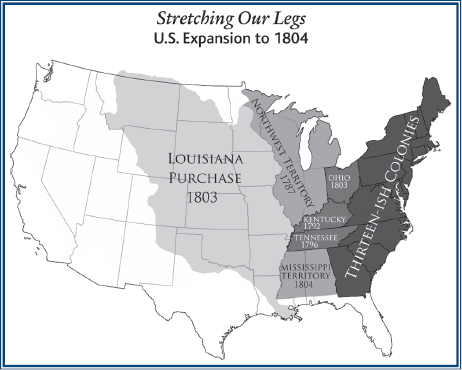
The biggest expansion of U.S. territory in history was an incredible deal–which, incredibly, almost didn’t happen.
In 1803 Napoleon Bonaparte came into possession of a large chunk of real estate in the New World through some typical Corsican wheeling and dealing. This was actually business as usual for the American Midwest, which had changed hands a number of times in the previous half-century. After the French and Indian War, Britain had taken France’s tree- and beaver-filled northern colonies in Canada but given the southern colonies to Spain–a weak, declining empire that could be counted on not to do anything rashly ambitious with them.
But the Spaniards were secretly determined to get something out of all that empty land. Fast forward to 1800, when King Charles IV signed the secret Treaty of Ildefonso, ceding the territory to France in exchange for a promise to help the Spanish king’s son-in-law take the throne of a European principality. Napoleon was excited, envisioning a new French empire in the New World, with grain from the American Midwest feeding slaves in lucrative French sugar plantations in the Caribbean.
But it was not to be: Napoleon’s plans were derailed by a revolt of slaves and free blacks in the French colony of Saint-Domingue (modern-day Haiti), followed by the resumption of war with Britain in 1803, bringing the Royal Navy between France and its American possessions–just as France was about to get its paws on the Louisiana Territory. Disappointed but realistic, Napoleon decided to cash out and sell the whole thing to whoever wanted it (except for Britain–definitely not Britain).
The United States was the most logical buyer, and the deal should have been a foregone conclusion: the young republic stood to double its territory for the low, low price of $15 million (actually $11.25 million plus forgiving $3.75 million in French debt)–which works out to about $0.03 per acre. And as a bonus, they’d get New Orleans, which controlled access to the Mississippi River.
Amazingly, the deal faced substantial opposition in Congress, with the Federalists asserting, bizarrely and incorrectly, that the whole area was a useless desert. Thankfully, reason prevailed, in part because everyone was afraid that the territory might end up in British hands–not an implausible fear, as the Brits had nearby bases in Canada and Jamaica and attacked New Orleans (unsuccessfully) in 1814.
This accession of territory affirms forever the power of the United States, and I have given England a maritime rival who sooner or later will humble her pride.
–Napoleon Bonaparte, 1804
Realizing no one really knew what the heck he’d bought, in 1804 Jefferson dispatched two explorers–Meriwether Lewis and William Clark–to map the huge territory and assess its resources and potential. Congress, always cheap, complained about the excessive cost for the 33-person mission–$2,500–but ultimately agreed. Over two epic years, Lewis and Clark traveled over 8,000 miles, encountering three dozen native tribes and documenting over 100 new species of animal and 176 new species of plant. They were helped enormously by a French trapper, Toussaint Charbonneau, and his young native wife, Sacajawea, who acted as guides and translators for most of the expedition.
America’s War of Dumb Luck
On the heels of one its finest moments, the newly minted United States proceeded to the distinctly less glorious War of 1812.
The American cause was fair enough: after the Revolution, the Brits reneged on their promise to evacuate forts in the “Northwest Territory"–covering Ohio, Indiana, Michigan, and Illinois. The Brits also had the obnoxious habit of stopping American ships on the high seas and kidnapping sailors, who were forced to serve with British crews. (The Brits claimed they were just reclaiming deserters from the Royal Navy.)
Having a just cause is a great start, but it doesn’t substitute for an army, navy, or strategy. Even though the last American invasion of Canada during the Revolutionary War had been soundly defeated, the Americans decided to try again. They would liberate Canada from British rule, whether Canada liked it or not–and in fact, Canada did not like it, putting up a fierce resistance. Meanwhile the invading “militias” barely deserved the name; instead, they were angry mobs of frontiersmen scraped together with no real chain of command.
The War of 1812 was poorly named, since little action occurred that year. Most of the fighting took place in 1813, a peace treaty was signed in 1814, and the deciding battle was fought in 1815 (before news of peace had arrived).
After cleaning the American clocks up north, Britain took the fight to the United States, which was virtually defenseless. (The tiny U.S. Navy was vastly outnumbered by the Brits.) But it wasn’t their aim to reconquer the United States; they just wanted to break heads. In August 1814 they burned Washington, D.C. They failed, however, to take Baltimore during an all-night bombardment in September (during which Francis Scott Key wrote the “Star-Spangled Banner”). The Royal Navy also enforced a strict blockade of American ports, inflicting serious damage on the U.S. economy. But the blockade was enormously expensive to maintain. Finally, in December 1814, with neither side making any progress toward its goals (whatever those may have been), America and Britain decided to call the whole thing off.
So how exactly did America manage to come out ahead? The Brits renounced their claims to the Northwest Territory, clearing the way for the first big surge of Western settlement. And there was a bonus: not knowing that a peace treaty had been signed in Paris three weeks before, the British attacked New Orleans in December 1814 but were roundly defeated by Andrew Jackson. So the Americans did score a victory in the end–after the war was over.
PIRATES OF THE … MEDITERRANEAN?
Not all of America’s early wars were characterized by disastrous stupidity, and some were breathtakingly ambitious. For instance, if you menaced American merchants or damaged their property, the plucky little United States would send Marines to the other side of the world to complain, violently, in person.
Thomas Jefferson set the precedent in 1803 by sending a small force of Marines (possibly all the Marines there were) to the Mediterranean, where American ships were being harassed by the Barbary Pirates, based out of Tripoli. Technically vassals of the Ottoman Empire, by the early nineteenth century, these pirates barely paid lip service to the sultan in faraway Constantinople and preyed on the ships of any country that didn’t pay them exorbitant “tolls.”
Europeans were used to these fees as a cost of doing business, and Congress was prepared to foot bills of up to $30,000 a year–a considerable amount, considering that the total U.S. government revenues of the time were about $10 million. But Jefferson vehemently disagreed, pointing out that pirates are, well, not very trustworthy. And he was right: by the time Jefferson took office, the pasha of Tripoli alone was demanding $225,000 a year for “protection.”
Seeing a chance to boost American prestige and fight pirates to boot, Jefferson dispatched naval squadrons to the Mediterranean beginning in May 1801. By August 1803 seven American ships–the better part of the U.S. Navy–were patrolling the North African coast with 800 men aboard. The duty was time-consuming and dangerous–not to mention way more expensive than just paying off the pirates.
Finally, in early 1805, General William Eaton and First Lieutenant Presley O’Bannon, the Marine commander, decided they’d had enough. To put an end to the menace, they convinced the pasha of Tripoli’s brother–then in exile in Alexandria–to seize the throne. From March to May 1805, ten Marines, reinforced by a few hundred Arab mercenaries, marched across 500 miles of the Sahara Desert to mount a successful surprise attack on the Tripolitanian town of Derna.
Seeing a serious threat to his throne, the pasha of Tripoli moved to make peace with the United States, and the two sides signed the Treaty of Tripoli. The pasha rescinded his demands for tribute (except for one last ransom of $60,000 for the crew of the USS Philadelphia). Meanwhile, his brother’s claim to the throne was conveniently forgotten.
MADE IN AMERICA 
A Ridiculously Long and Incomplete List of Things Ben Franklin Invented
We all remember Ben Franklin as a pretty bright guy who discovered some pretty important stuff. The real question is, what didn’t this polymath genius invent?
1742: Observing the wasteful use of firewood in inefficient colonial fireplaces, he designed the Franklin Stove, which used its iron body to diffuse a much larger proportion of the heat. The stove enabled poor families to save money and be warmer in the winter.
1749: Noticing that lightning was attracted to metal and tall objects, Franklin hit on the idea of attaching vertical metal rods to the tops of tall buildings to attract the lightning, thus sparing the roof a direct hit.
1752: To prove that lightning was static electricity, Franklin carried out his famous kite experiment with the help of his young son William (nobody ever said he was a responsible parent). He conducted an electrical charge from a key along a wire into a primitive battery. Franklin and son were lucky to survive; in following years, a number of scientists who tried to replicate Franklin’s experiment were killed by lightning.
Franklin’s kite was made of a thin silk handkerchief stretched across a handcrafted cedar crosspiece.
1752: To allow his brother to urinate while suffering from kidney stones, Franklin invented the first flexible urinary catheter used in North America.
1763: Franklin, who had been appointed postmaster of Philadelphia in 1737, came up with the odometer. The complicated device composed of three interlocking gears was attached to the wheel of postal carriages in order to figure out the distances traveled by postal officers.
1770: He named and described the “Gulf Stream"–the giant Atlantic current circulating between the Gulf of Mexico and the west coast of Ireland–and correctly identified it as the reason the voyage from Britain to America took longer along certain routes. British admirals ignored his findings and then came up with the same answer several decades later.
1784: Troubled by being both near- and far-sighted at the age of 78, Franklin improved spectacles by inventing the “bifocal.”
1786: To reach merchandise on high shelves, he invented a pole with a claw at one end operated by handles at the other–a device still used at corner bodegas everywhere.
1787: Although he never actually built them, during one of his eight Atlantic crossings, Franklin came up with a design for watertight bulkheads that would help limit flooding below deck if a ship’s hull was breached.
Along the way, he also helped develop America’s first fire department and first library, as well as the concept of daylight savings time. But perhaps the most remarkable thing about Ben Franklin the inventor was his refusal to patent any of his ideas, so that the widest possible number of people could benefit from them.
As we enjoy great Advantages from the Inventions of others we should be glad of an Opportunity to serve others by any Invention of ours, and this we should do freely and generously.
–Benjamin Franklin’s autobiography, published 1790
The Touch, the Feel of Cotton Gins
Benjamin Franklin wasn’t the only American on the scene inventing useful things. In 1793, Eli Whitney came up with the cotton gin, a brilliant invention that–unfortunately–led to a resurgence of slavery in the United States. Like Ben Franklin, Whitney never profited from his invention, though it wasn’t from lack of trying.
The cotton gin was a great labor-saving device, vastly speeding up the process for removing seeds from cotton (which used to be done by hand). But it was a mixed blessing: by freeing slaves from seed-picking duty, the cotton gin made them available for more fieldwork, so plantation owners could cultivate more land. This lowered the price of cotton, making woven textiles available to the masses, which increased demand. The machine fed a cycle in which plantation owners began buying even more slaves to grow and harvest the vital cash crop, which gave them money to buy more land and slaves, etc.
Another of Eli Whitney’s contributions to society was his effort to streamline firearm production. He developed an early system of interchangeable parts that could be used to create multiple types of weapons, a tactic that later helped several industries (notably automobiles) develop quickly.
The big increases in the number of slaves and territory controlled by slave owners fueled fears in the North, where sentiment was already turning against slavery–foreshadowing the Civil War. All thanks to one machine!
As for Eli Whitney himself, he never got to enjoy the fruits of his epoch-making invention, thanks to his greediness. Instead of licensing the design (so other people could build their own cotton gins while paying him royalties), Whitney tried to keep a monopoly on the technology. He hoped to charge farmers and plantation owners exorbitant prices–up to 40 percent of the finished processed cotton. This caused so much resentment that competing knockoff cotton gins soon began springing up around the countryside. Whitney tried to stop these patent infringements, but at the time, patent laws were still evolving, as was the judicial system. Nonetheless, Whitney kept up the struggle until the lawsuits finally bankrupted him in 1797.
Bale Money
Two Telling Cotton Charts
Full Steamboats Ahead
After James Watt patented the steam engine in 1765–1776, engineers and tech geeks everywhere set their minds to finding new ways to use steam power, including locomotives on rails and steam-powered vessels. A number of inventors built boats powered by steam engines, including Claude de Jouffroy, who demonstrated a paddle steamer in Paris in 1783; James Rumsey, a Virginian who launched a steamboat on the Potomac near Shepherdstown in 1786; John Fitch of Connecticut, who demonstrated his steamboat to members of Congress in 1787; and John Stevens, a New Yorker who built a propeller-driven steamboat in 1802. But none of the inventors were able to translate their designs into a viable business.
Enter Robert Fulton. In 1803 his first steamboat sank like a rock in the Seine River in Paris, France, but his second design for a steam-powered paddle-wheel boat performed perfectly. Returning to New York, Fulton built a new boat–the Clermont–with a stronger hull and areas for passengers and cargo. In 1807, Fulton and his wealthy soon-to-be uncle-in-law, Robert Livingston, launched the world’s first steam-powered passenger service between New York and Albany. With a paddle wheel propelling it at four to five miles per hour, the 142-foot-long Clermont took just two and a half days to make the 300-mile round trip, compared to four days for sailing ships.
At first glance it might seem like Fulton won undeserved fame, reaching the prize after other men had cleared the way. But Fulton’s achievement was real. Making steamboats commercially viable required cutting down on coal consumption and increasing the number of passengers who could be accommodated safely. To attract customers, Fulton also glammed up the experience: the price of the ticket for the overnight journey from New York to Albany included comfy beds and two meals.
In the years after Fulton launched his steamboat line, steam-powered vessels filled the rivers and coasts of the United States, making long-distance travel cheaper, helping open the vast plains of the American Midwest to settlers, enabling industrial development, and fueling the literary antics of Tom Sawyer and Huckleberry Finn.
BY THE NUMBERS 
|
250,000 |
European population of the American colonies in 1700 |
|
2.5 million |
European population of the American colonies in 1775 |
|
1/20 |
ratio of colonial population to British population, 1700 |
|
1/3 |
ratio of colonial population to British population, 1775 |
|
2,000 |
British customs revenues from the American colonies, in pounds, 1760 |
|
30,000 |
British customs revenues, in pounds, in 1770 |
|
45 |
tons of tea dumped in Boston Harbor by American patriots, 1773 |
|
17,000 |
strength of the Continental Army commanded by Washington, at its peak |
|
6,000 |
strength of French forces sent to help the rebels under Lafayette and Rochambeau |
|
32,000 |
total strength of British forces in America, at their peak |
|
50,000 |
total strength of Britain’s standing armies around the world, 1775 |
|
1,500 |
number of native warriors provided to the British by their Iroquois allies |
|
180,000 |
pounds of cotton produced in the Southern states in 1793 |
|
93 million |
pounds of cotton produced in the Southern states in 1810 |
|
240,000 |
slave population of the 13 colonies, 1750 |
|
1,300,000 |
slave population of the Southern states, 1810 |
|
50,000 |
number of African slaves imported to Charleston, South Carolina, from 1804 to 1808 |
|
$240 |
cost of a slave imported from Africa, 1775 |
|
$390 |
cost of a slave imported from Africa, 1807 |
|
85 percent |
proportion of slaves who were native-born in 1810 |
|
828,000 |
area, in square miles, of Louisiana Purchase in 1803 |
|
$15 million |
cost, in dollars, of the Louisiana Purchase |
|
$0.03 |
cost per acre, in dollars, of the Louisiana Purchase |
|
14 |
number of American states formed from the Louisiana Purchase |
|
23 percent |
their proportion of the current area of the United States |
|
2/3 |
proportion of landless Virginian men who moved west to claim land in the 1790s |