
Before we look at capturing images with high frame rate cameras, it is necessary to point out that both sensor size and pixel size affect the resolution and field of view (FOV) because, as you will see, the smaller sensor of a high frame rate camera produces a vastly different image than a DSLR when using the same telescope! The difference may sound counter-intuitive as both cameras use the same telescope, but it is all to do with the sensor size and associated FOV. As we have seen, the DSLR can almost fit the full disc of the moon in its FOV, but the high frame rate camera will only show a handful of craters.
Consider the difference between sensors in the different cameras.
The Canon 6D sensor information:
The physical size of the CMOS sensor 35.8 x 23.9 mm which has a diagonal of 43.04 mm (1.69”) and a surface area of 855.62 mm²
Pixels: Total pixels 20.6M, the pixel size of 6.54um, pixel dimensions 5472x3648
The ZWO ASI224MC camera sensor information:
Physical size: 4.8mm x 3.6mm IMX224 CMOS sensor which has a diagonal of 6.09mm
Pixels: Total pixels 1.2M, pixel size 3.75um, pixel dimensions 1304x976
You can see the Canon 6D DSLR sensor and pixel size are significantly larger than the ASI224MC astronomy camera. How does each camera compare against each other for resolution?
It is possible to calculate the resolution, but we need to look at both the telescope resolution in combination with the camera resolution to determine the effectiveness of the imaging system.
Telescope resolution
The theoretical limit of the telescope can be calculated using the Dawes limit calculation:
|
Dawes limit |
= 116/D |
D = Diameter of the telescope lens |
|
= 116/180 |
||
|
= 0.64 arcseconds |
The standard baseline for telescope resolution is called the Dawes limit which was formulated by English astronomer William R. Dawes who calculated the resolving power of a telescope by splitting binary stars. The calculation is based on point sources of light with the atmospheric distortion factored into the calculation. This standard is not completely accurate for bright objects such as the Moon and planets using modern equipment. As you will see, a system which includes a high frame rate camera can resolve smaller details than this calculation specifies.
Camera resolution
Resolution = (pixel size/Focal length of telescope) x 206.265
The examples use the Skymax Pro180 (2700mm focal length) with each camera
Canon 6D resolution = (6.54/2700) x 206.265 = 0.49 arcseconds per pixel
ZWOASI224MC resolution = (3.75/2700) x 206.265 = 0.29 arcseconds per pixel
According to the Dawes limit, the Skymax Pro180 telescope has a resolution of 0.64 arcseconds but the high frame rate camera resolution is 0.29 arcseconds per pixel. Therefore, theoretically, the full resolution of the camera cannot be realised. However, this is not strictly true, and you can resolve finer detail because the Dawes number has this large sensitivity included in the figure for seeing conditions. As already mentioned, the high frame rate cameras can cut through the atmospheric distortion by capturing ‘lucky’ breaks in seeing and this ‘seeing’ aspect can be improved. Therefore, high frame rate camera systems have greater resolving power than static imaging, and they should be able to achieve a better resolving power than the Dawes limit.
For example:
One arcsecond on the Moon is equal to 1.87km. The proposed resolution of the scope using the Dawes equation is 0.64 arcseconds which equals 1.2km. The smallest lunar feature I have managed to resolve is the alpine valley rille 0.6km wide. This is 0.32 arcseconds and on the very edge of the camera resolution, in this case the linear nature of the rille may have helped to define it and therefore this target may not be a true reflection of the resolving power. You can view the image of Alpine Valley in the lunar features section. A more realistic way to measure the resolution would be to identify non-linear structures. The smallest circular craters I have imaged are approximately 1km diameter, a slight improvement on the Dawes limit. DSLR images do not have the advantages of high frame rate cameras and the seeing conditions hinder the resolution. The DSLR is therefore more in line with the Dawes limit for the telescope, even though the camera has a better resolution than the telescope.
Another aspect of the relationship between camera and telescope resolution to be aware of is the Nyquist sampling theorem. The theorem states that the sampling frequency must be a minimum of twice the resolving frequency for two objects to be identified as distinct and separate. In real terms this means there must be at least two pixels spanning the resolution of the telescope. For example, if the telescope can resolve 1arcsecond, the camera pixel should cover 0.5arcsecond of the sky.
Field of view (FOV)
When you have worked out the resolution, calculate the field of view to visualise the size of the object or area of the lunar surface which your system can see. Online resources can be used to calculate this and there are many online tools available for this purpose. All you need to know is your equipment model, sensor and optical train dimensions:
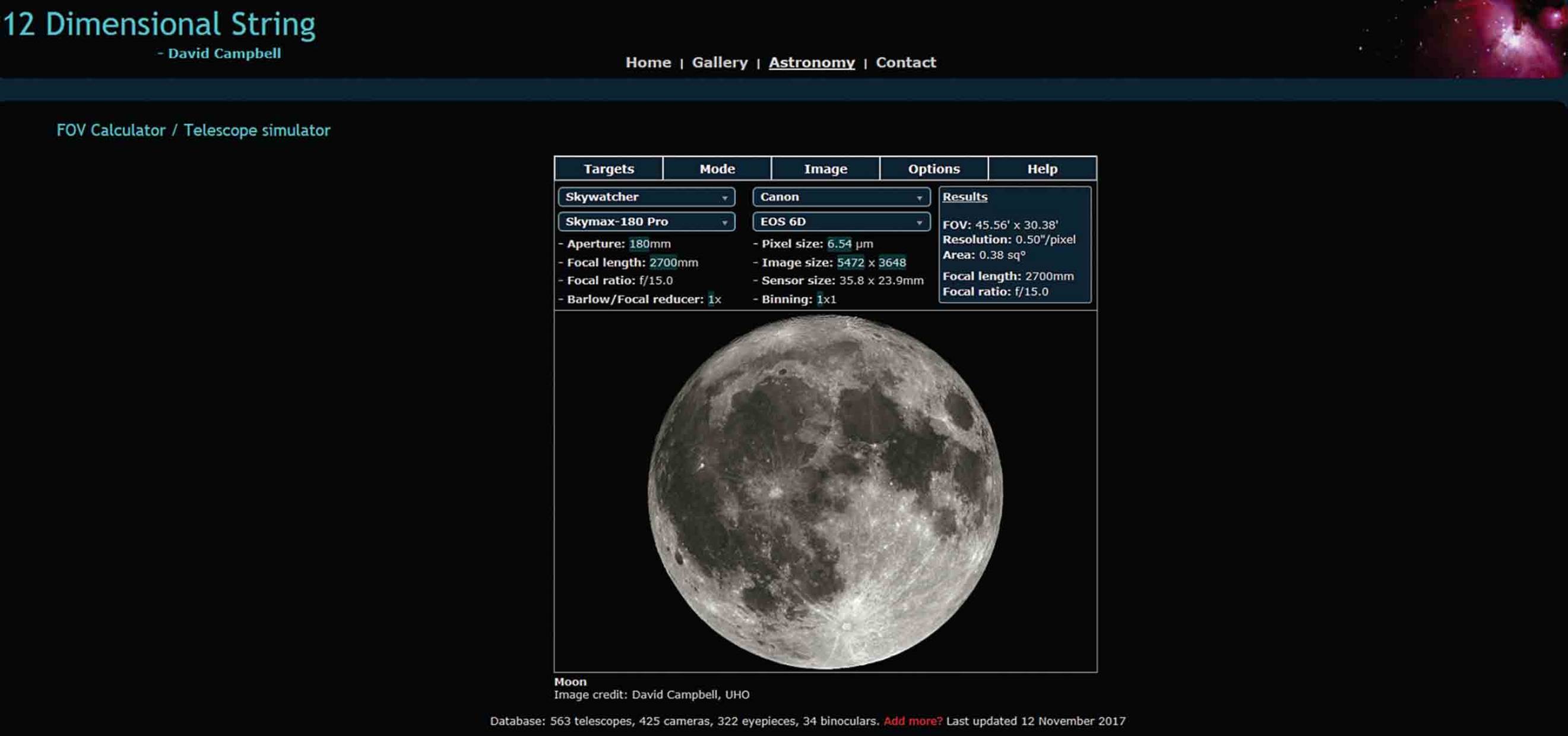
The field of view from the Canon 6D with the Skymax Pro180.
https://astronomy.tools/calculators/field_of_view/
http://www.12dstring.me.uk/fovcalc.php
These software resources will show you the FOV which you can expect by adding the equipment information. I find the most user-friendly option is 12 Dimensional String; this software has all the camera sensor sizes pre-set and you simply need to find your equipment from the drop down boxes, pick the Moon as your target and the software does the rest. The FOV for your system will show on the screen.
You can see how very different the two images are just by changing the camera!

The field of view from the ZWOASI224MC with the Skymax Pro180.