
10
…Death has no repose
Warmer and deeper than the Orient sand
Which hides the beauty and bright faith of those
Who make the Golden Journey to Samarkand.
From ‘The Golden Journey to Samarkand’, James Elroy Flecker, 1913
The Ili Valley begins in China’s far north-west corner and snakes into Kazakhstan. To go north of the valley, you climb past vineyards and cotton fields, pyramidal mounds with black tombstones slotted into their tops like slices of bread in a toaster, copper hills, haystacks, apple groves, lines of silver beech and occasional roadside fruit-sellers sitting at tables a few hundred feet from their farmhouses. Coal trucks climb the hill past shepherds guiding their flocks. As you leave the valley, the rim of clouds to the north gives way to blue-black mountains crested with snow. The fields below them are dirty green and dim yellow. Near the town of Huocheng you come to a walled garden. You walk along an apple orchard, down a path that passes a handful of sheep and a pair of cows. At the end you find a double door flanked by two taller trees.
The mausoleum stands twenty feet further on. It is almost a cube and its tall, pointed arch draws the eye. Tracing the arch’s edge is a band of white writing on a turquoise background. Either side of the arch, lines of relief carving meet a bar above it to form a rectangle. In the panels above the arch’s haunches, white medallions and midnight blue crosses form studded diagonal lines. Further out from the arch, to right and left, flower motifs forge vertical columns either side of a broader teal-green band with white writing set like musical notes along it.
Inside the arch, in the tympanum, a maze of lines and squares surrounds a small, oblong metal grill like a crossword puzzle. The whole face is crowned by the hump of a plain white dome that juts perhaps six feet above the façade. The first ten feet of wall above the ground have lost their colour so that only their stone form remains. Behind the building and to the right, the Heavenly Mountains are blue-black in the mid-distance, but turn to white as you follow them towards their peaks.
The mausoleum is the first sign, heading west towards China’s border, of a foreign vernacular belonging to a foreign faith – the herald of a civilization that once dominated Central Asia and that focused much of its skill and attention on the paper page. The identity of the man for whom it was built – Tughlug, a fourteenth-century convert to Islam who ruled ‘Moghulistan’ in north-west China – is far less important than what the building represents. For the clues to the culture he had adopted lay written out on his mausoleum in Naskh, a tenth-century Arabic script. And the writing in the columns either side are in Thuluth, a cursive, eleventh-century script with curved, oblique lines in which a third of each letter slopes away as if a landslide has just begun beneath it.
This epitaph in stone is one of hundreds flecked across Muslim Central Asia. It was built in 1363 and is among the oldest Islamic mausoleums in the region. It stands as one of the eastern gateways into a new culture but also as one of the earliest signs of that new culture emerging. Seven years after its construction, a ruler called Timur would found an empire across Central Asia and beyond. In the West, he has been immortalized as Tamburlaine in Christopher Marlowe’s play, and as Tamurlane in Edgar Allan Poe’s epic poem.
Timur conquered and subdued Central Asia in the fourteenth century, from north-west China to the Caucasus, eastern Turkey, Mesopotamia, and as far south-east as the Indus River. He claimed to be a descendant of Genghis Khan and he wanted to rebuild the Mongol empire. But Timur’s heritage was Persian, and his gift was to fuse his Mongol ambitions with Persian refinement. Across Central Asia, he erected mosques, madrasas and mausoleums. They were the expression, in brick and tile and stone, of his vision for a united empire. He often profited by fostering terror, once piling 90,000 severed heads into a pyramid outside Baghdad. But he was just as adept at turning art to his imperial ambitions.
Timurid buildings are Islamic but they make their own statement. Dotted across the sands, grasslands and baked earth of Central Asia, they form a bridge, a theological statement in stone. Their pale yellow bases fuse with the ground below, while their bulbous azure domes are welded to the sky above them. The sky was the muse of the Turks and ‘turquoise’ was their colour. These buildings echo their earlier belief in a sky-god, or conceivably point to the Zoroastrian god Ahura Mazda, identified with the sky itself. For Timur, the buildings were multicultural monuments. But they were more than that too; not only did they unite Turkish and Persian, they linked the new Timurid polity to the heavens themselves.
The largest Timurid dome in Central Asia forms a hood over the shrine of Ahmad Yasavi in south-east Kazakhstan. It spans 59 feet and measures some 90 feet from base to crest. A vast iwan, the three-walled space so common in monumental Islamic architecture, faces east from the shrine and either side of it, towers twist to form bevelled edges as they rise from an octagonal base. Two smaller iwans sit in the recess of the larger one and Kufic script is visible through the windows of the smallest. The script is white, with a blue outline, and it is written onto a sandy background with malachite decoration. Birds fly from brick to brick, making a din in the eerie forecourt.
Inside is Timur’s 2-ton bronze cauldron, big enough for several people to sit in. It bears a script interwoven with decorative leaves. A very different script, white and rigid and tall, fills the band of sandy tiles below it. Set above the bowl is a vast stalactite (or muqarnas) corbel vault, with smaller vaults flanking it in two iwans off to the side. In the rear iwan, where aquamarine tiling reaches five feet above the floor flanked by a floral border and corner pillars in mosaic faience,55the doors still stand. Above, the weave of floral patterns finally gives way to calligraphy.
The dome and main iwan hold the skyline at the old city of Turkistan, sentinels of Timur’s new world order. Across the region, Timur’s grand iwans tower like spiritual portals and their obelisks and columns shoot the sky. Few would leave such monumental legacies in Persia and none would do so in Khurasan or Transoxiana. Timur left them across all three.
The edifices are decorated throughout with verses from the Koran. Bands of writing dance like arabesques across the tiled faces of Timur’s great monuments. On the Green Mosque at Balkh in northern Afghanistan, corkscrew pillars and a ribbed dome frame an inner pishtaq (the gateway to the iwan) marked with a broad band of Kufic script that forms the outline of a square. Lines flow outwards from the band to delineate geometrical shapes, as if the art has sprouted from the writing itself. On the outside of the drum, the supportive ring of stone that carries the dome above it, two layers of white script stand against an aquamarine background. One is curved and soft, like playful scribbling; the other is brittle as bones. In the Samarkand madrasa of the fifteenth-century Timurid ruler Ulugh Beg, Kufic texts in gold or blue form hoods over arches or bands across pishtaqs, inside recesses and along the columns that flank doorways. Some 130 miles west, wide bands of writing fill the whole width of the iwan’s three inner walls at Bukhara’s Kalan mosque (the current one built a century after Timur’s death). Still more writing dominates the rear iwan too.
Timur’s own tomb, the Gur-Emir at Samarkand, seems baroque in its lattice of gold, silver and blue, with complex muqarnas vaulting. On the outside of the dome’s supporting drum, Kufic calligraphy in tiles wraps itself all the way round, almost overlapping with the arabesques and geometrical shapes that spread like wallpaper over the two pillars beside it. It is an appropriate resting place for a man who used writing as the vernacular of the architecture he sponsored.
But it is Samarkand’s Bibi Khanum mosque, built for 10,000 worshippers, which spells out the link from these buildings to the paper page most clearly. For, while all these monuments celebrated Koranic writing, taking the words of the page and integrating them into their architectural forms, it was at Bibi Khanum that the page itself was used on a monumental scale. Timur commissioned a Koran for the building that, when open, measured four square yards and sat on an enormous stone lectern. Each page was just over seven feet by five feet. The whole Koran needed 1,600 sides or 29,000 square feet of paper, equivalent to two-thirds of an acre. Here was paper as a symbol of power, a physical text to act as the centre point of Timur’s largest mosque.56 It was not the only time he used writing on paper in this way – on one occasion Timur had a sheet of paper fifty feet long produced as a sign of his authority. Like his library, it no longer exists. His buildings, on the other hand, tell us all we need to know.
The calligraphy that criss-crosses the monuments of Central Asia is the clue to the next step in paper’s journey. Today it is the buildings that draw us back through the centuries to the flowering of a region already in thrall to the written word. Their celebration of the Koran took many forms: interwoven with floral motifs, boxed into strict geometrical patterns or standing alone as a building’s guardian verse over the main entrance. Yet this delight in the written word had begun on paper, not tile – on the pages of books rather than the walls of mosques and madrasas. Indeed, under Timur these written sentences spilled from the paper page onto the monuments of his empire, peppering the physical landscape with the very words of the Koran. It was a move calculated to attach religious legitimacy to the political power of the day, but it also points to just how much Islam had become a religion of the written word, an identity largely delivered to it on the paper page.
—
An Arabic saying has it that culture comes from the Persians – and it would spread across the Caliphate on paper. As the armies of Islam crossed the Levant and the Fertile Crescent from the Arabian Peninsula, their interest in the arts began to grow. They encountered cultures soaked in artistry and craftsmanship and began to learn from them. The Persians played a leading role.
Ibn Khaldun, the great fourteenth-century philosopher and historian from Tunis in North Africa, wrote that the founders of Arabic grammar were Persians. So too, he wrote, were the scholars of the hadith, or sayings of the Prophet. The great jurists, theologians and most of the Koranic commentators were Persians too. The intellectual sciences were owned by the Persians. Among Muslims in the earliest centuries of Islam, it was the Persians who preserved and ordered their knowledge most carefully. (Today’s Iran is still quite rare among Islamic countries for celebrating its ancient, pre-Islamic history.) Ibn Khaldun even quoted the Prophet Muhammad as saying that, if learning were fixed in the highest heavens, the Persians would rise to it.
Persian peoples have inhabited Iran, Afghanistan and other parts of Central Asia for more than two millennia and the ‘first’ Persian empire, the Achaemenid empire founded in the sixth century BC, was the most powerful and magnificent kingdom of its day, spanning a region that included parts of Asia, Africa and Europe. Thus, when the Abbasid armies conquered Persia, they simply put on its robes of state. Iranians were spread across Asia, from Mesopotamia to Transoxiana, and they peopled the new Islamic bureaucracy, filling all corners of government. As the bureaucracy’s clout subsided, imams and authors came to the fore. The offices of state were Abbasid but the theories that underpinned them – theories of governance and of administration – were thoroughbred Persian. In great part these theories emphasized the role of the literary and religious classes in administrative life, and the work of these classes was done on the page.
Yet Islam did not simply adopt a Persian identity. Instead, Abbasids and Persians cross-fertilized ideas to create a more universal religion. Arabic remained the language of Islam but it was Persians who became its scholars. The Sassanid Persian empire ended with the Muslim conquests but its royal art was funnelled into an Islamic mould. Royal images, motifs and symbols were far enough removed from religion (and so far enough removed from heresy) to become a bank of icons for Islam too.
The early caliphs were not interested in foreign conversions. In the sixth century Caliph Umar tried to limit conversions to the Arabs. Converts meant more soldiers to divide booty between, more pensions to pay and less poll tax revenue. In Central Asia, it was especially difficult for locals to convert. On one occasion, the promise of a tax break was repealed after too many locals converted. A rebellion ensued. The first Islamic Caliphate, which ended in 750, was undone by its failure to translate Islam out of Arab culture. Its successors, on the other hand, sought converts as much as wealth; as they planted nomadic, Arab Islam in the rich soil of Iranian cultures, a new form of Islam began to take root and grow.
Iranians took Bedouin poetry from the Arabs and refashioned it to suit their own tastes, spawning new forms. The new poetry was in Arabic but its appeal was far broader. Meanwhile, many Iranians devoted themselves to studying Islam and Arabic. One mid-ninth-century Iranian religious scholar would read from the Koran, and then explain it in Arabic to the Arabs on his right and in Persian to the Persians on his left.
Iranians, already fond of learning and writing, studied in madrasas and soon became the Caliphate’s best scribes. It was two Iranians, Ibn al-Muqaffa and Abd al-Hamid, who became the pioneers of Arabic literary prose. Iranians lived in Arab communities just as Arabs lived in communities of Iranians. The empire was turning bilingual but its focus was the one script, Arabic, and its glue was the one religion. In order for such a bookish religion to reach its potential, paper was essential and, by the fifteenth century, Iranian papermakers could make papers of virtually any useful size, strength or texture.
The Arabs had spread Islam under the banner of holy war and conquest, but Persians ensured it was able to acclimatize abroad. Yet a closer look at the great Iranian scholars, commentators, scientists, inventors and calligraphers of the early Muslim empire throws up a surprise. These men did not come from western Persia or Mesopotamia, where Islam first encountered the fading Persian empire, but from further afield – from eastern Persia, Khurasan, and the lands south of the Oxus River, as far south as northern Afghanistan. (Khurasan covered parts of today’s Afghanistan, Iran, Turkmenistan, Uzbekistan and Tajikistan.) To the west of Persia, including Mesopotamia, most Muslims were Shi’ite whereas further east Sunni Islam, the predominant form, held sway.
The cities of Bukhara and Nishapur produced the two greatest collectors of the hadith, al-Bukhari and al-Hajjaj. Across Khurasan, scholars studied apace to learn pure Arabic and soon became famous for the Koranic style of spoken Arabic. Indeed, the tenth-century geographer al-Muqadassi said it was the Khurasanis who spoke the purest Arabic because they studied it so assiduously. The first Arabic dictionary was recorded as being written in Khurasan in the eighth century. Khurasan and Transoxiana also supplied many of the silks, furs, textiles and silver objects sold in the markets of Baghdad. Zoroastrians fled to its cities from central Persia, while its growing wealth and sophistication attracted Arab settlers too, and supported a new age of scholarship and invention.
New Persian was first saddled for use in these lands too. This fresh language adopted many Arabic words, a growth supported by the writings of Arab and Persian poets. But it crystallized for the first time in the east, where the population was more mixed. Khurasan became the factory of Islamic civilization as nowhere else could, taking on Arabic as the script of science and learning with ease, but turning Persian into the spoken language of the Caliphate’s east. Iranians had not been so united since the fall of the Achaemenid empire in the fourth century BC.
This young Persian, Muslim culture suckled on other parent cultures too. Chinese painting and Manichaean texts aided the emergence of Persian miniatures. Painting schools sprouted in Herat, Shiraz and Tabriz. This new Islamic powerhouse helped to forge a more ecumenical religion, one that could convert as many people by persuasion as by force, threats or the offer of tax breaks. It spawned new warriors at the end of the ninth century too, warriors determined to expand the frontiers of Islam still further. Yet even among them, education had made their vision of Islam multicultural: a fusion of Arabic, Hellenistic and Iranian learning.
The madrasa, or Islamic school, was born in Khurasan and Transoxiana. The Koran, theology and jurisprudence all became elements of religious education under the Abbasid Caliphate (founded in 750 to replace the Umayyad Caliphate; the Battle of Talas was an early Abbasid victory). In Central Asia, Muslim jurists grew in stature; even today, they perform a vetting service that sits awkwardly with the more democratic institutions of Iran. The madrasa would gain increased independence from the mosque from around the tenth century. Soon, professional reciters were employed in towns throughout the region so that the Koran could be heard – as late as the nineteenth century, the Tajik city of Khojand alone had seventy reciters.
In the tenth century Muhammad ibn Ishaq wrote that Khurasan paper was made from linen. Already, it could compete with the best Chinese papers available. But paper’s new patron was Islam, and the faith raised calligraphy to the region’s highest art form. Persians used both parchment and papyrus, the former common for letters and bureaucracy. In Egypt, the Sassanid Persians had even written on the hides of cows, sheep and buffaloes. For royal letters, they sometimes used scented silk, closing them with a seal and then placing them in multicoloured damask envelopes. A hoard of eighth-century letters was found near Mount Mug in Tajikistan by Soviet scholars in 1933. Most were written in Sogdian and were on wood, silk or skin. A few were on Chinese paper and parchment. Soon, however, Samarkand was profiting from its own paper industry.
Around the turn of the eleventh century the Baghdadi bibliophile Ibn al-Nadim recorded that the Chinese wrote onto a paper made from ‘a kind of herbage’. He went on to say that this material provided a large income for Samarkand itself. He, too, argued that the Arab papermakers had initially acquired their craft from the Chinese captives in the city. The claims appeared in al-Nadim’s great work, the Fihrist, a kind of compendium of all books which existed in the Arabic language. Such a work could hardly fail to mention the surface that had fuelled book culture so effectively. Islam reduced the Babel of scripts used across Central Asia to one above all, Arabic, and it focused attention onto one book too, the Koran. With that focus, bookmen emerged across the region and the ancillary skills of papermaking, bookbinding, illumination and calligraphy became as God’s own arts.
—
Sheep graze among the walls and ditches of the old hill city of Marakanda, founded twenty-seven centuries ago and conquered by Alexander the Great. After the Muslim conquests, Arabs and Turks migrated to live there in numbers, and its wealth spawned artists. Seen from the ruins of Marakanda towards dusk, the city of Samarkand below you radiates a warm light. Grand iwans and minarets spike the cityscape. These are from the time of Timur, after the Mongols had destroyed the old city. Around it the countryside is rich, carpeted in the green that only centuries of irrigation can provide. Marakanda was always a city of gardens flanked by fields. But papermaking needs water too, and this supply, coupled with the prolific local flax and hemp, granted Marakanda a papermaking boom. Together with Herat, it became the production centre for converting Central Asia to Islam – on the page.
Its new product spread quickly. Persia was using Khurasan paper in the eighth century. In Central Asia, papermaking soon became the first step in a far longer process – to build Korans whose physical beauty reflected their identity as the words of God. Rules and standards for dimensions, illustrations, font sizes and styles, margin decorations, chapter headings and miniatures all developed as part of a vision of a harmonious and carefully composed page. The execution of this vision depended on an army of calligraphers, decorative artists, papermakers, miniaturists and bookbinders. By the fifteenth century, Iranian papermakers were making dozens of different types of paper, varying in size, thickness, colour and quality. From the thirteenth to the sixteenth century, these papers were the best to be produced in Islamic lands.
Central Asia had found a force capable of unifying it. Buddhism preferred printing to displays of calligraphy and Manichaeism was in slow decline. Foisting Arabic onto the region as the only language of scripture placed a new emphasis on the bones of the letters themselves. The very strokes of a brush or pen spoke as clearly as the sounds they represented.
Spacing, proportionality and visual balance became the goals of the calligrapher. But he could work with strokes that were thick or thin or that varied in width, with different spacings between letters and words and with a range of overlapping and intertwining formats. Some styles were sharp and cubic while others were fluid and curvilinear, a line of ballerinas caught on the page. It was not simply that the blank page was a vehicle for the written language. Instead, the script itself was like a blank page for the artist-calligrapher too, affording him huge scope for variation in form and mood. At times, beauty trumped legibility.
Naskh, a cursive script, was standardized in the tenth century and travelled east, finally arriving on the buildings Timur erected. (It is also the preferred script for printing in Arabic.) In the twelfth century, calligraphers often used two different cursive scripts, one for the text of the Koran and the other for a commentary. A volley of commentaries written across Persia adopted this double-writing; in Nishapur, the author al-Surabadi used it to pen fabulous stories about Adam, Noah and Solomon. Islam allowed Central Asia to adopt Arabic not only as a script but also as a potter’s clay, receptive to the region’s artistry.
Often books were signed twice, once by the calligrapher and then by the illuminator – such was the perceived importance of their respective roles. Illuminators embellished the first and last folios of a book. They designed the layout of the text and its borders. They penned a large medallion at the centre of the first folio as a billboard for the owner’s name. And they drew a scalloped headpiece across the page-wide frontispiece of the second folio, to carry the book’s title and thebismillah, the refrain which opens every chapter of the Koran but the ninth. Often the second folio showed a royal hunt or a maze of geometrical shapes. These frontispieces were the portals into the written word. Islam did not simply put text on paper: it constructed its books with an architect’s eye.
Further into the books, a gold and blue frame might envelop the text while headpieces carried chapter titles, and margins were filled with patterns, plants, animals, birds, appliqué work or incrustation. Many of the techniques had come from China, notably dyeing, marbling, tinting and gold sprinkling. (European travellers took Persian marbling techniques back to Europe in the seventeenth century.) Often a gold spray was spattered across the margin too, or a blue, yellow, red or orange tinting. Framed by these margins, the words of the Prophet were laid out across the page, actors delivering their lines on a painted stage.
But there was no sense of perspective on the medieval Muslim page and no chiaroscuro either. Thus, when landscape paintings began to appear on Central Asia’s pages, they pillaged Chinese styles. The Mongols arrived in the 1220s under Genghis Khan and Chinese brushwork crossed Asia as a result of their westward progress. In Persia, the cities of Shiraz and Tabriz became centres for miniature painting; further west, so too did Baghdad. By the 1420s there were forty master calligraphers in Herat alone and many more manuscript and miniature masters too.
The Mongols would split their empire four ways. Central Asia was handed to Chagatai, Genghis Khan’s second son, and in the early fourteenth century the calligraphers, illuminators and bookbinders of the lands he ruled began to create Korans of a new order. One Koran given to the Khan measured 28 by 20 inches, yet each page carried just five lines, in alternating black and gold.
In what is now north-west Afghanistan, the Herat school of miniatures used soft, light tones as background for the bold, glittering clothes of characters in their pictures. Over time, pictures grew more detailed, a warren of exactness without focus across each tableau. Moreover, large sums were spent on books produced in Herat, and even on the paper. One elaborate fifteenth-century copy of the Shahnama, an epic eleventh-century poem on the history of the Persian kings, cost 42,450 dinars,57 an enormous sum, and was worked on by calligraphers, illuminators, margin-makers and painters; 12,000 dinars of the total were spent on the Chinese paper.
Then, in the late fourteenth century, Timur began to reel scribes and artists back to where the region’s papermaking had begun, his new capital at Samarkand. A fresh, fluid and curvilinear script called nastaliq was invented and became the vehicle for Persian poetry. In Samarkand, paintings took on a spare format, less crowded with tangential detail. Meanwhile, in Herat, calligraphers began to exaggerate the turns and flicks of Arabic letters, thickening them or cutting their reed pens at an oblique angle. (Fountain pens were invented in Egypt in the tenth century but were not popular in Persia or Central Asia.) They even used découpage, cutting letters from paper to stick on another sheet as text.
This obsession with paper, scripts, bookmaking and book decoration helped Islam to win the region for the new faith. There were forced conversions, tax and job incentives too, but it took years to evangelize the countryside and to turn Islam from an Arab import into a world religion. The scholars of eastern Persia and Khurasan, however, embedded Islam locally, and their calligraphy, papermaking, illumination and bookbinding were the nuts and bolts of the change, since they beautified the books of Islam with local colour and decoration. Thanks to their work, Koranic texts and commentaries became not only more widespread but also the focus for high culture in the region, objets d’art that adorned the new faith and won admirers through their physical beauty as well as their written content.
Yet the evidence of the Timurid love for the written word, and for the beautified word, survives today largely on stone, not paper. In fact, buildings were the books that forged an imperial landscape in Timurid Central Asia, introducing all sorts of novelties, including the squinch (the Persian corner hood that allowed the transfer of weight from a dome to a square base). The old city of Samarkand stands today as Timur’s showpiece, an array of ribbed domes, geometrical designs, arabesques, minarets, verses and patterns written in brick and tile, iwans, portals, mihrabs (the recesses that face Mecca), stalactite vaulting, courtyards, pishtaq fronts, silver inlay, relief carving, lapis lazuli, gold and the letters of Islamic calligraphy, Arabic in tile and stone. Many of these features had been designed on paper first – in other cases, they were really just the overflow of decorations already in use on the page. Such influences would continue to be felt further afield, after Timur’s grandson Babur founded the Mughal dynasty, its great buildings, dotted across Rajasthan, built on the traditions established in Central Asia. Yet it is the city of Herat which claimed the finest expression of the Koran in stone, brick and tile.
—
Herat spreads in tree-lined streets from the Friday Mosque to the fields. In the streets that flank the mosque, shops sell fabrics, gravestones, carpets, burqas, clothes and rifles. Stalls along the pavement sell shoes, shampoo and fruit smoothies. The Mausoleum of Gohar Shad, Persia’s great female patron of the arts, sits in a dry and mournful garden at the edge of the city. The dome has lost its colour but still shows signs of its antique glory: double-octagon squinches carry the dome’s weight to a square base. Five of the nine minarets remain, slanted and crumbling. (The other four fell as Afghans prepared to fight against the Persians and Russians in 1885, helped by a lone British general acting against orders.)
It was Gohar Shad who moved the Timurid capital from Samarkand to Herat in 1405 and gave the Persian language new sway. Today Herat remains a city caught between Persia and Central Asia; for a century and a half its largely Persian citizens have been under Afghan rule. This rich confusion is played out not only in the faces and facial hair of its residents but in the building at its centre, too, the Friday Mosque.
Its courtyard is paved with long, white flagstones. These, together with the arches, add serenity to offset the detail of the panelling on pishtaqs and iwans. Inside the courtyard, the iwan sits only twice as high as the arcades that flank it, three archways wide on either side. Plain marble base panels stand five feet tall, while archway panels and pillars form a mosaic of patterns: leaves and branches, geometrical shapes and medallions, like a pointillist painting using only blues, greens and occasional yellows. A band of texts five feet tall spans each arcade, its letters running rhythmically across them like the electrified forms of a Jackson Pollock, with white writing on a background of blues. More writing fills the pillars and spans the main iwan and soft yellow Kufic script dances on the western iwan overhead. Everywhere art and calligraphy intertwine across a monument whose decorations support and embellish one another. The result is one of the most heavenly buildings on earth.
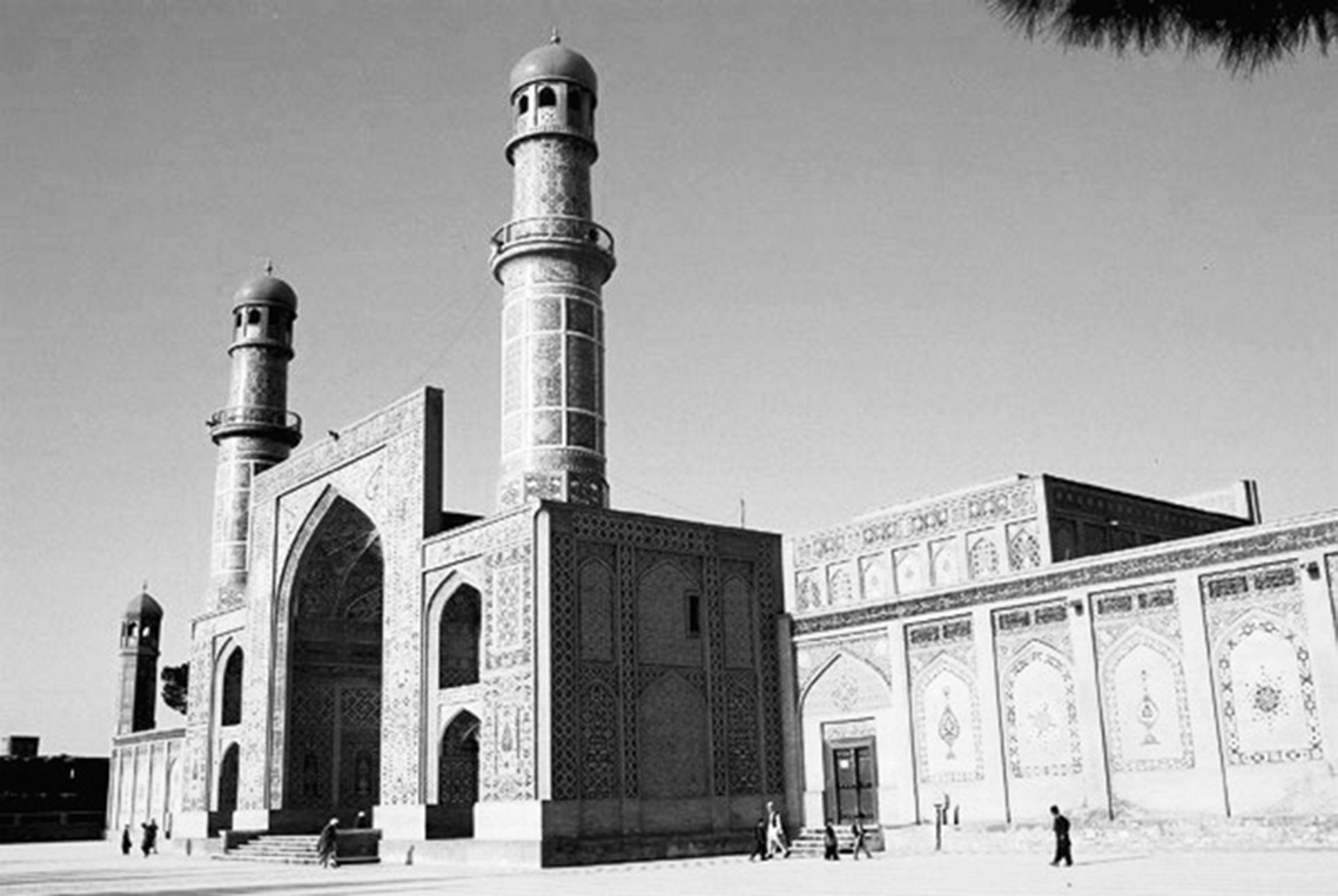
Credit 10.1
13 The Friday Mosque, Herat. It was here that Timur’s monumentalism was most successfully subdued by a Persian aesthetic. The form is contained and simple, enabling the building to hover rather than soar, and for the eye to be drawn to the elegant archways and to the unending foliated patterns of the upper panels. Disciplines of the paper page were crucial for the erection and decoration of such buildings, among them geometry.
The Friday Mosque shimmers turquoise in the midday heat, graceful and intricately patterned. But the rows of calligraphy painted across its panels are a reminder that the building forms part of a broader civilization spanning Eurasia, a civilization founded on a single book. In the story of paper, these monuments act as the most arresting relic of an age it might otherwise be hard to access or visualize. The mosques and madrasas of Central Asia are not so much the next step in the paper trail, as they were largely built centuries after the initial transfer of papermaking to the region. Instead, they are perhaps the finest flowering of paper’s second great partner civilization – a museum of exhibits which point back to an age when paper revolutionized the region. Paper provided the surface not only for the Koranic verses that now decorate walls and arches, but also for the drawings and mathematics which made such buildings possible, and for the planning of those geometrical patterns and arabesques which help to make them among the finest monuments in the world.
In Timurid Central Asia, writing, geometry and art all spilled over from the page onto the monuments that still stand to this day. Paper, cheaper than all predecessors and far more versatile, allowed calligraphers and artists to experiment more freely, and to focus not merely on the message of a book but also on its form, decoration and image. Most of these experiments are now lost to time and decay, but the decision to transfer their results to the empire’s finest buildings means that their legacy remains strikingly visible. These monuments are crucial evidence that the progress of paper from western China to the Mediterranean is essentially an Islamic tale. It is therefore not possible to trace that progress without first turning back in time to the one book that brought it all about, to the man who was its author and to the scholars and rulers who finalized its contents.
—
It began life as an unwritten recitation performed in a proudly oral culture. And yet the Koran gave birth to a civilization that spanned Eurasia, one which placed books, and therefore paper, at its very heart, propelling literacy down the social scale, advancing arts and sciences to unparalleled levels and setting in place a vast paper bureaucracy as its tool of government. No single book had ever spurred the advancement of a highly bookish culture on a continental scale. Yet this had come from an author who felt uneasy about setting his teachings down in writing in the first place.
In hindsight, Islam’s partnership with paper can appear almost inevitable. Paper allowed the Koran to travel the world and to embed itself in cities as distant as Cordoba in Spain and Delhi in India. Any faith might win new lands through conquest in the short term. But to last down the centuries, some sort of unchanging authority was needed and the Koran provided just that. It is perhaps not hard to see how instrumental paper has been in the success of Islam and of its book of revelation, the Koran.
Yet that is to look at it with our own, book-wearied eyes. Sixth-century Arabia, where Muhammad was born, had no great attachment to books. It was predominantly an oral culture, one which revelled in recited poetry as well as in a life of wandering. It is no great surprise that Muhammad himself – who may have been illiterate – felt uneasy about the use of writing. Had that coolness towards written texts persisted, paper’s journey would have looked very different; it would certainly have taken far longer to make its mark beyond the lands of Greater China.
In China, writing had been a pillar of the civilization for several centuries before the arrival of paper. Thus, once the Chinese literati had accepted a lower-brow writing surface than the silk and bamboo they were used to, paper’s status was secure. But an Arabian religion was a far less obvious partner for paper’s global progress. It is easy, looking back, to miss just how unlikely it all was.