
11
He entrusted knowledge to a piece of paper, thus squandering it. Woe to the man who entrusts knowledge to mere paper.
Ibn Abd al-Bar, tenth century
It all began, or so we are told, when Zaid ibn Thabit’s master ordered him to scratch out a few consonants onto the shoulder blade of a camel.
Zaid’s master, after all, was probably illiterate. Their home was a merchant town in an oasis that lay on the trade route from Yemen to Palestine and Mesopotamia. By the time of Zaid, who lived in the seventh century, the camel had emerged as Western Asia’s most popular beast of burden. Zaid’s people, the Arabs, owned the camels and increasingly controlled the trade flows. But his master, Muhammad Ibn Abdullah, had lost interest in pursuing trade as a career. As he observed oasis life and the rise of a new breed of merchants, he watched them discard their old social values, and he objected to the injustices and selfishness that ensued.
Muhammad was born around 570 and, as he grew older, he became convinced that God would not forget the peoples of Arabia. His own tribe, the Quraysh, was responsible for upkeep of the Ka’aba, the cuboid granite home of the ‘Black Stone’ in Mecca to which devotees made pilgrimages once a year from all around the peninsula. The Ka’aba was meant to be where heaven and earth intersected and where the original house of worship had been built by Abraham. The ‘Black Stone’, which today sits in one corner of the Ka’aba, is reckoned to survive from early antiquity. The Ka’aba had certainly existed as a place of pilgrimage for centuries before Muhammad was born, the ‘Black Stone’ all that now remains of its oldest elements, and had played home to many idols. By Muhammad’s time, however, it was treated as a sanctuary for the one supreme God. And yet this affiliation was not enough to satisfy Muhammad, who knew Jewish communities and probably met wandering Christian monks and preachers too. These groups had their own prophet; so did the Persians in the person of Zoroaster. Why not the Arabs?
Like his contemporaries, Muhammad visited the Ka’aba, but he also liked to withdraw to the cave of Hira, close to Mecca, to meditate and to escape the city. One such visit was to upend his life, his tribe and, ultimately, the whole Arabian Peninsula. For in the cave Muhammad heard a voice.
‘Recite!’
‘What shall I recite?’ he replied.
‘Recite: in the name of your Lord who created, created man from a blood-clot. Recite: And your Lord is most generous, who taught man by the pen, taught man what he knew not.’
Muhammad was terrified and hurried back to his wife, Khadijah.
Khadijah had first hired Muhammad, fifteen years her junior, as an agent to travel with her trade caravans. She was so impressed by the returns he managed and by his reputation that she decided to marry him. When he returned from the cave to his wife’s side, Muhammad was not sure whether the voice had truly come from God. But Khadijah consoled him, reminding him that he was a good kinsman, generous to guests, supportive of the weak and kind to the destitute. The message must be God’s, she assured Muhammad. Khadijah is remembered as the first Muslim.
Thus began Muhammad’s revelations, which continued throughout his life. Three years after his first cave revelation he began to preach his new message and to draw a following. According to Islamic tradition, some of his revelations would be written down quickly, on the bones of camels, sheep and asses, on potsherds and white stones and leather, on date palm leaves, parchment, papyrus and wooden boards. Islamic historians have traditionally depicted Muhammad as illiterate, adding to the miraculous nature of Koranic revelation. Muhammad certainly began to employ scribes, but the Koran mostly began its life as a growing body of sermons for his Meccan followers to live by and recite. In this era, many Arabs still distrusted writing: their poets were lovers and masters of the spoken word. Indeed, when they gathered at sites across the peninsula each year to make religious observance, poetry recitation competitions were held. Traditional sources place Muhammad at these events, but not as a participant.
Even today, most Muslims encounter the Koran first and foremost as a recitation rather than a paginated script. Life’s most important moments are marked by Koranic readings and the written Koran is more a musical score to be performed than a book to be silently read in private. It is recitation that allows the voice of the Prophet to reappear. Muhammad was slow to accept the writing down of his personal sayings, but his Koran became the one of seventh century’s largest anthologies of prose-poems, and a book that drew on several physical experiences and sensations at once: sight, touch, speaking and hearing.
Muhammad’s revelations spawned an empire of writing which stretched from Central Asia to Spain. Before the West began to print books, the Koran was exceptional in its geographical reach and the size of its audience; in modern times every home and every Muslim would own a copy. It would also launch a dozen related scholarly disciplines, such as lexicography and grammar. The Koran’s destiny was the paper page and, in time, paper would become the administrative currency of the Islamic empire, an empire as large as any that had gone before it. It had come from mercantile Arabs, who raised up the Koran as the lodestone of a new civilization, forging a community around it.
The Koran’s impact on the story of paper is therefore exceptional. It was born as a recitation in a largely illiterate community of urban and nomadic Arabs, who had previously preferred the oral performance of poetry to the written page. Yet it was these Arabs who took that recitation to the page, who raised up the Koran as the lodestone of a new civilization, forging a community around it and, in so doing, raised the paper book to a new status. Books were placed at the centre of Arab and Islamic culture and life. Its rulers and civil servants brought that book culture into all the lands under Islamic rule, which reached as far as the borders of China to the east and the Maghrib to the west, later spreading north into Europe. A culture of reading (and of written bureaucracy, as imperial governance took shape) was therefore introduced to peoples thousands of miles apart and, from the ninth century, it took place on paper. This movement, oceanic in its scale, began with the written Koran.
Credit 11.1
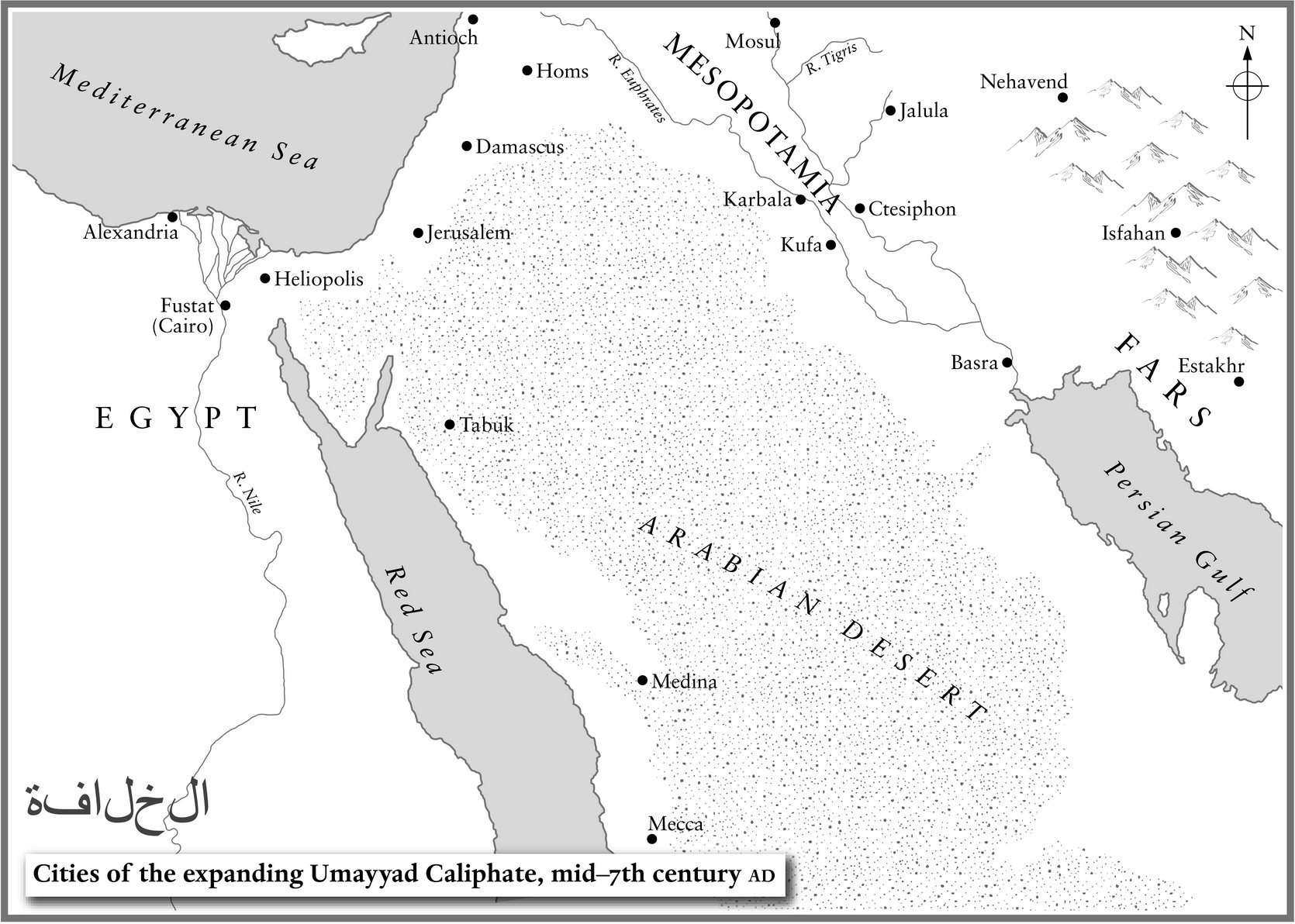
14 Cities of the expanding Umayyad Caliphate, mid-to-late-seventh century AD.
Muhammad moved to Medina (then called Yathrib) in 622 and succeeded in uniting his immigrant fellow tribesmen with their host community to form a single community of the faithful. All the while he continued to pass on his revelations, which Koran 3:103 described as ‘the rope of God’. In their view, Muhammad was no more than a mouthpiece, receiving God’s words directly from the angel Gabriel.
This is a crucial point for understanding why Muhammad’s new teaching became paper’s great ally. In the story of paper, one of the greatest surprises is how a religion of a fractured, tribal society, many if not most of its members functionally illiterate, came to rest entirely on a single book and the study of that single book. The process that places literacy at the heart of a community’s way of life for the first time is rarely simple. But it is harder still to navigate that process when literacy and illiteracy sit side by side, when religious influences are both external and internal, and when a community has its own language but is also familiar with non-local dialects.
Prior to the Koran, there were only the beginnings of significant Arab writings to draw on, but there are plenty of echoes and parallels of non-Arab cultures to be found in the Koran. Some scholars have seen strains of the Jewish Exodus story in the Islamic hijra, the migration of Muhammad and his followers to Medina, and Islam’s declaration of faith, ‘There is no God but God’, resembles the Samaritans’ earlier liturgical refrain ‘There is no God but the one’.58 The Koran’s claim that Jesus never physically died on the cross due to a last-minute substitution echoes the teachings of Docetism, an early Christian heresy. Some of the Koran’s stories also appear in the earlier Jewish Midrash and in Jewish Apocrypha. The Koran similarly appears to draw heavily on stories from Genesis, the gospels and Christian Apocrypha. Sidney H. Griffith, a leading historian of the period, has presented evidence that the Bible, originally penned in Hebrew, Aramaic and Greek, was not translated into Arabic before the rise of Islam.59 There is a much stronger case for religious influence from Syriac and many of the Koran’s verses, the more controversial Syriac philologist Christoph Luxenburg60 had argued, closely mirror fifth- and sixth-century Syriac Christian hymns. This should come as no surprise, however: scriptures are typically part of a religious conversation across beliefs and cultures. The Koran itself even makes passing reference to other religious works, such as the Hebrew Scriptures: ‘to David we gave the Psalms…’ (4:163). The Koran assumes its audience is familiar with the Jewish and Christian scriptures. Gabriel, an angel in the Jewish scriptures, is never identified as an angel in the Koran, but is clearly still understood to be one.
Thus any religious text is in some sense responsive. But concepts of the Koran being influenced by pre-Islamic human agency, even in the form of scriptures, have traditionally been unwelcome within Islamic scholarship. The idea of the Koran having any kind of decisive human or literary context is problematic to the traditional view of the Koran, which takes the book as a standalone revelation from God. This has fettered the study of the Koran’s origins.
Nevertheless, in the 1930s two Western scholars, Arthur Jeffery, an Australian, and Gotthelf Bergsträsser, a German, decided to write a critical history of the Koran, both to chronicle the text’s creation and to amass all references to its variant readings from across the whole of Arabic literature. They travelled to see the oldest Koranic manuscripts and gathered perhaps 15,000 photographs of early Korans and of early references to variant readings. But Bergsträsser, a professor of Semitic Studies and an eager opponent of the Nazis, died on a mountaintop in 1933 in strange circumstances. (One Egyptian academic openly blamed the Nazis for Bergsträsser’s death.)
Another scholar, Otto Pretzl, continued the project with Jeffery, and much of the work was finished when he died in an airplane crash outside Sebastopol in 1941. After the war, in 1946, Jeffery explained to a crowd in a Jerusalem lecture theatre that the whole photo-archive in Munich had been destroyed by bomb action and fire. He concluded that a truly critical edition was unlikely within a generation. Jeffery died in 1959. In the 1970s Dr Anton Spitaler, a professor of Semitic Philology at Munich University, confirmed that the collection had been destroyed. (Indeed, it was probably Spitaler who had informed Jeffrey of the archive’s demise.)
There, it seemed, the story must end, until fresh scholars could access all those materials once again, with all the funding and political will that such access would require. In the 1980s, after Spitaler had retired, it emerged that the 450 rolls of film had in fact survived and that Spitaler had passed them on to a former student. It is these photos that are now under scrutiny at Corpus Coranicum, an eighteen-year research project at the Berlin-Brandenburg Academy of Sciences. The project is cataloguing photographs of the oldest Korans from around the world as a public research archive, but a key element in the project is focused on intertextuality: the relationship between the Koran and other texts that may have influenced it. Michael Marx, who runs the project on a day-to-day basis, views it as an attempt to begin to map the Koran in its earliest days. ‘We are hoping to rein in that untamed beast, Koranic scholarship,’ Marx told me. ‘We want to show the textual history of the Koran, just as has been done with the Bible, with Shakespeare and with Goethe.’
There are plenty of clues that the Koran had a dynamic relationship with other faiths, cultures and texts. There were already pilgrimages to Mecca before Islam, just as there was, according to Islamic tradition, a Christian icon in the Ka’aba, long since Islam’s holiest site.
The Koran accepted some elements of pre-existing faiths but self-consciously rejected others. Thus, sometimes it agrees with Jewish and Christian scriptures, but at other times it integrates elements from Genesis and the gospels not to rehash old arguments but to set itself up in opposition to them. In one story from the Infancy Gospel of Thomas, a second-century apocryphal gospel, Jesus is described as making birds from mud and giving them life, after which they fly away, a story which suggests his divinity even in childhood (a claim some devotees denied). Yet the Koran, which rejects the divinity of Jesus, chooses to use that same story, adding simply that Jesus is only able to give life to the birds because God grants him that power in that particular moment – the lesson had been deliberately reversed.
Elsewhere, the Koran takes a well-known theological formula and turns its meaning on its head, reinterpreting the Syriac Christian version. It affirms, for example, that ‘God is one, eternal, has not procreated nor was he born…’ (112:1–3), but this teaching is also the basis on which it discounts the divinity of Jesus and, further, the possibility of God choosing to become a man. Moreover, in terms of its literary form, the Koran is not the heir of either the Tanakh or the gospels and letters of the Christian New Testament – it is a very different form. For all it shares with Christianity, the Koran is not a mere recalibration of Christian theology. Michael Marx believes the historical freshness of Islam can sometimes be lost in comparisons. ‘Islam is not apocryphal gospel number 99,’ explained Marx. ‘It is something new. There is a prophet who has a different idea and, against the backdrop of church history and all these late antique cults, he starts installing a new theology.’
There was much in that backdrop to respond to – not only the thriving Syriac Christian communities of eastern Turkey, Syria, Mesopotamia and Arabia, but also the large Jewish communities in Arabia. There were pagan cults, Manichaean communities and still others. Yemen itself was nominally Jewish, and surviving inscriptions make clear that the Yemenite rulers accepted monotheism, though they often leave out details associated with Jewish religious practice. It was in this context that Arab rulers, aware of Syriac Christianity and its many writings, began to channel their own religious identity, which lacked some of the defining characteristics of Christianity and Judaism, such as a well-worked doctrine of God or an accepted set of scriptures. In such a setting, it is perhaps easy to imagine Christians and Jews asking Muhammad’s new followers why they have no scriptures of their own.
The Koran’s relationships with pre-existing texts, then, are enormously important to the rise of paper, since they help to answer the question of how such an avowedly oral culture could have become one of paper’s greatest allies, spurring paper’s spread across Asia and North Africa into Europe. But these influences remain difficult to pin down. Indeed, the beginnings of the Koran are more disputed among historians and Koranic scholars than agreed on. It is not even clear that the Koran is rooted purely in the tradition of oral recitation, as Islamic tradition has asserted. The words ‘quran’ (recitation or liturgy) and ‘kitab’ (book) both appear regularly through the 114 suras of the Koran, suggesting some level of acceptance of both forms. Certain words point to the importance of written sources in the compilation of the Koran too. ‘Furqan’ is used in the Koran to mean both ‘salvation’ and ‘commandment’, giving the word two derivations: ‘purqana’ is Syriac/Aramaic for salvation, ‘puqdana’ is Syriac for commandment. Yet while these two words sound very different, they look very similar. Conflation into the single word ‘furqan’ therefore suggests the use of physical texts in the process of transmission.61
Muslim dating begins with the hijra of 622, when Muhammad and his followers left Mecca for Medina, and there is no Arabic term for ‘pre-hijra’, no equivalent of ‘BC’, and therefore no nod towards older sources. As for form, early copies of the Koran were not scrolls, like the Jewish scriptures; they were codices, the book form already used by Christians. But their script, running from right to left, distinguished them from Christian scriptures, and soon they developed their codices to be more horizontal, further marking out their uniqueness.
—
The Koran’s official compilation is better documented. Islamic tradition places the death of Muhammad in 632 (although at least one source places it later). By this time, the west and south of the Arabian peninsula recognized Muhammad as God’s Prophet and ruler. But the death of the Prophet brought a new challenge. He could no longer pass on or confirm the revelations he had received and there was no library of his teachings. That same year, Islamic tradition narrates that hundreds of the great Koranic reciters were killed at the Battle of Yamama, along with thousands of eastern Arabians, who had been living among the palm orchards of their desert oases.
The death of so many reciters vexed Abu Bakr, Muhammad’s successor as caliph, since there was a real danger that Muhammad’s revelations might actually end up forgotten or only half-remembered. So Abu Bakr ordered a gathering of the verses of the Koran, a collation of the words of God, whether they were on parchment, on bones, on date palm leaves or in the memories of the people. Although they were to be checked against oral tradition, this was nonetheless a textual project.
It was Muhammad’s son-in-law Uthman, who was elected caliph in 644, who is remembered as the father of the physical Koran. Medieval Muslim sources sometimes call Uthman the editor, sometimes the collector, sometimes simply the copyists’ boss and sometimes the binder of the Koran. Uthman, was, above all, the canonizer.
It is fortunate he was a good diplomat too, for an argument soon broke out in the city of Homs in Syria between Syrian and Iraqi Muslims over their different versions of the Koran. (Different major cities in the Caliphate housed slightly different versions of the Koran within their own walls; each mushaf, or codex, was based on the reading of one the Prophet’s own companions. Written differences between them were often only in such areas as phraseology and sentence structure.) One of Uthman’s generals accused both parties of squabbling like their ancestral non-believers, left for Medina and, ignoring tribal protocols, went straight to see Uthman. He told the caliph that the different versions of the Koran needed to be reduced to one or else Muslims would get caught in an argument as untidy as the one between the Jews and the Christians.
Islamic tradition recounts that Uthman appointed Zaid ibn Thabit, that self-same scribe who had sat with Muhammad etching consonants onto a camel’s shoulder blade, as editor-in-chief for his new project, a single and standardized Koran. Zaid was helped by three further editors and by those of the Prophet’s Companions who had survived. (All ‘Companions’ had a personal link to Muhammad and were therefore believed to hold exceptional authority.) Zaid was the best copyist and he was aided by a linguistically proficient Companion, who dictated all the texts Uthman had gathered. This was the moment that written text truly began to compete with the oral tradition in Arab-Muslim culture, not least because the project relied on the assumption that the page (at this stage still parchment) was the best available guardian of accuracy.
Uthman was thorough, ordering drafts of verses from the regional garrisons as well as from the private libraries of followers in Mecca and Medina. He stipulated conditions for submissions to be accepted: they must have first been written in the Prophet’s presence, there must be at least two witnesses to the Prophet’s recitation and, where there was disagreement over the wording within the editorial committee, the dialect of the Quraysh, Muhammad’s own clan, should be preferred. The tradition also affirms that this editorial committee ensured that Uthman’s text would be definitive, that all submissions would be heard, that doubts over phraseology would be answered only by those who heard theayas(verses) directly from the Prophet and that the caliph himself would supervise the work.
Uthman’s legacy was therefore to create a unifying text to hold the empire together, a book that acted as the religious authority in Muhammad’s stead. By the early 650s, the tradition recounts, Uthman had gathered the 77,000-plus words of the Koran, and scribes spent four months then copying out the Uthmanic prototype. The parent book was kept by Uthman in Medina, but four copies (their parchment format now fairly well standardized across the empire) were supposedly sent in the four directions of the compass, or, according to Islamic tradition, to Damascus, Basra and Kufa (the fourth city would have been Mecca), with one copy kept at Medina. Uthman then ordered all other copies of the Koran to be burnt.
Parchment formed the pages of Korans across the empire. It was flexible and durable, making it an apt partner for the words of God, since flexibility and durability both encouraged regular reading. When the parchment pages of a Koran were of the same size, it was called a mushaf; hundreds of mushafs survive today. The Koran itself makes indirect reference to two writing surfaces: parchment and papyrus. Papyrus, unlike parchment, was an import: only after the Arab conquest of Egypt, in 640, did the Arabs begin to use papyrus too. The oldest surviving Arabic text on papyrus dates to 642. The great fourteenth-century Muslim social historian Ibn Khaldun wrote that, in Islam’s early days, parchments had been used for scholarly works, letters of government, bills of credit and other official notes, since people lived in luxury. Yet as a culture of books grew, he wrote, there had simply not been enough parchment available.
By the early ninth century, paper was increasingly playing a major role in the Caliphate. Korans had remained on parchment, perhaps because other writings needed to be portable whereas Korans simply needed to last. Paper, however, combined portability with durability. Moreover, a parchment Koran might need around 300 sheepskins, making it an expensive product. Paper was much more affordable. The earliest complete Arabic paper manuscripts are from the turn of the ninth century. It was an apt moment for paper to make itself felt, as the Caliphate was on the brink of a literary outpouring, one which might otherwise have been stunted by the price of its surfaces. The high status of the Koran may be one reason that it was slower than other Arabic books to make the switch from parchment, the expensive surface of wisdom and revelation for centuries; paper was often viewed as pedestrian by comparison. But in the tenth century even Korans switched to paper.
The earliest paper Korans used a script called nakshi. The script’s shape led to the re-adoption of the vertical codex; previous Arabic scripts had been better suited to horizontal codices. The exception to the Koran’s tenth-century adoption of paper was in the Maghrib, where parchment continued to carry the words of the Koran until the fourteenth century.
—
The Koran’s role in the story of paper is unique. It was the cornerstone of a new empire and civilization that spanned much of Eurasia, one which would allow paper to sound the death knell of parchment and papyrus across the Caliphate. Yet the Koran became as much a recited monologue as a written book, and the memory and gestures associated with recitation were as crucial to its identity as were pen and ink. Its calligraphy can be viewed as a written recitation just as its recitation can be viewed as acoustic calligraphy. In part, this comes from its own roots. But, as the Caliphate spread, the Koranic message needed to be delivered to distant lands without being changed in the process. The result was a work that falls between two media. Even today, that tension continues, and silent reading is still considered second best to recitation.
In the first centuries of Islam, an instructor would teach or recite the Koran orally and the students would then try to retain it by memory. They would not read the teacher’s notes, and when he died those notes would sometimes be burnt. Islamic tradition avers that written transmission was far from trusted and that the favoured medium for the Koran was not the page but the human voice. And yet, even if its transmission process did favour the oral record, it was the Koran, first a work to be heard and recited, then a work which remained wedded to parchment decades after other texts had switched to paper, which would form the cornerstone of a paper civilization.
The Koran cannot simply be set alongside the Christian and Hebrew scriptures as just one of the major monotheistic texts that aided paper’s Asian fortunes prior to the Renaissance. Instead, the Koran has a much more significant, and unusual, place in paper’s story. Both the Hebrew and Christian scriptures had spent centuries on papyrus, parchment or vellum before the arrival of paper in Western Asia. But, as we shall see, Islam, after committing itself to the page, made the switch to paper far more quickly. Moreover, it was not Christianity that conquered so much of Asia in the paper age – it was Islam. This meant that paper would have as its ally the highest text of a civilization that ruled over half of Eurasia, a civilization that would seek not just conquests for the Caliphate but, in time, converts for its book-centred religion, too. Christianity would undergo its own conversion to paper, but that conversion would come centuries later and attach itself not just to a cultural transformation but also to a major – and internal – theological shift. In the meantime, parchment and vellum would suit Rome and Constantinople well.
If the Koran enjoyed a unique power in propelling paper’s conquest of Asia prior to the Renaissance, it was thanks not only to its role as the primary text of the Islamic Caliphate, which at its height under the Abbasid dynasty (750–1258) had a population of close to 20 million. The theology of the Koran was crucial too, whereas the Tanakh and Bible are not traditionally viewed by Jews and Christians as having always existed. The Koran, on the other hand, came to be viewed by most Islamic theologians as eternal and uncreated in its own right. In the early days of Islam, the nature of the Koran was the great subject that Islamic theologians debated, much as the nature of Jesus had been the great subject for debate among Christian theologians in the early Church. God’s primary word to humanity in Christianity had been the person of Jesus, God-made-man, whereas for Muslims God’s word to humanity is the Koran itself. In Islamic civilization, following decades of controversy, it gradually became orthodoxy that the Koran itself was the eternal word of God.
Thus Muslim theologians came to believe that the Koran was as uncreated as God himself, a teaching that began its life in controversy (an important element in disagreements between the Mu’tazilites and Ash’arites) but which was gradually accepted over the course of the ninth century. The result of this doctrine was that the book’s provenance could not be questioned. This created a paradox, for as the words of the Koran spilled onto the doors, walls, chests, carpets, buildings, bindings and furniture of the Muslim empire, a raft of sciences took shape: physical, linguistic, philosophical and theological, as the next chapter relates. And yet for all these subjects of study and criticism, the Koran itself could not be fully set in its historical amd intertextual context. The response of one legal school to any questioning of God’s word became bila kayfa – ‘without how’.
This doctrine of the Koran is also why, after thirteen centuries, there is no critical edition of it that cites its source manuscripts and analyses that manuscript history. The 1924 Egyptian edition so widely used today is based not on a text-critical reading but a canonical reading – community acceptance through Islamic history, not antiquity, was therefore paramount. There are around 4,000 pages of Koranic text surviving from the first two centuries of Islam, which in the earlyhijazi script is the equivalent (in terms of quantity) of around seven Korans. Yet attempts to return to the earliest texts and so to relay the Koran’s early manuscript history have foundered. In recent decades, the scale and logistics of the project have presented a particular challenge. Yet there is clearly hunger among many scholars (Islamic and non-Islamic) for a critical edition that comes as close as possible to the exact phrasing and sounds of the original – or at least earliest – Koran. One Koranic scholar has described it as ‘the most cherished dream of everyone who works with the Qur’an’.62
The Koran’s unimpeachable authority gave to paper an unparalleled role, since it no longer simply carried the words of God – instead, it carried the uncreated words of God. Not simply eternal truths, but an eternal book. Once established as a binding for society, such a doctrine is not easy to challenge or even to chip away at. In the story of paper, it is a doctrine that has helped one of history’s greatest civilizations to persist and to place the written word at its heart, with global consequences.
That status has made it difficult to subject the original compilation of the Koran to widespread academic scrutiny, even when miracle finds of documents do occur, as in 1972 when a hoard of manuscripts, including some 12,000 Koran fragments, was found by builders in the roof of an old mosque in Yemen. The manuscripts, Koranic texts dating from the seventh and eighth centuries, were then studied by two scholars of Islamic history and art, Gerd Puin and Hans-Caspar von Bothmer, who found in the documents minor textual variations in the rasm (vocalization) never before recorded. Puin concluded that there had been changes in the oral tradition of reading the Koran, but that although the meanings of the words borrowed from Aramaic (which had been used in the early recitations of the Koran) differed from their Arabic definitions they had mostly been exchanged for their Arabic connotations by the Muslim grammarians, philologists and exegetes who interpreted these texts later. That view remains controversial among Koranic scholars, but the Yemeni authorities withdrew the documents owing to the controversy that comments about them was sparking in the Islamic world. The manuscripts are in San’a and are carefully preserved, with photographic access restricted. But both Puin and von Bothmer believed they constitute the earliest manuscripts of the Koran; indeed, von Bothmer concludes that a complete standard text of the Koran existed in the first Islamic century.
—
These discoveries are not merely important for the Koran but also for the spread of paper. They begin to answer how it was possible for a largely oral culture from Arabia to spread a book-based religion across half of Asia. They begin to answer whether the Koran really was its own invention, or whether it took the influence of more bookish cultures to bring it about. Arguments over the Koran’s nature, as an oral recitation or a written book, as a created revelation or an eternal book, helped to foster debates that found their way to the page, since the page could transport those debates right across the empire. Even the problem of agreeing on a standardized text, and all the challenges around the Koran’s compilation, gave rise to a culture of written scholarship and the study of language, as the next chapter recounts. All these factors had a role to play in making Muhammad’s new religious community a way of life founded on a single book.
No copy of this book was yet on paper. By the fourth century, parchment and vellum were increasingly competing with papyrus across Western Asia, and with that came the replacement of the scroll with the codex. Until then, Egyptian papyrus had dominated writing surfaces, but papyrus disintegrates more quickly and is unsuited to folding into a codex. Thus parchment and vellum became the surface of Islam’s holy books in its early years, after the first scraps on the bark of date palms, on animal skin or, sometimes, on papyrus or bone. Papyrus was usually preferred for legal and commercial documents and tended to be kept in scrolls, whereas the codex was more portable and manageable. Moreover, Coptic and Syriac Christians were already using it for their own holy book, which began as a collection of parchment sheets between two boards.
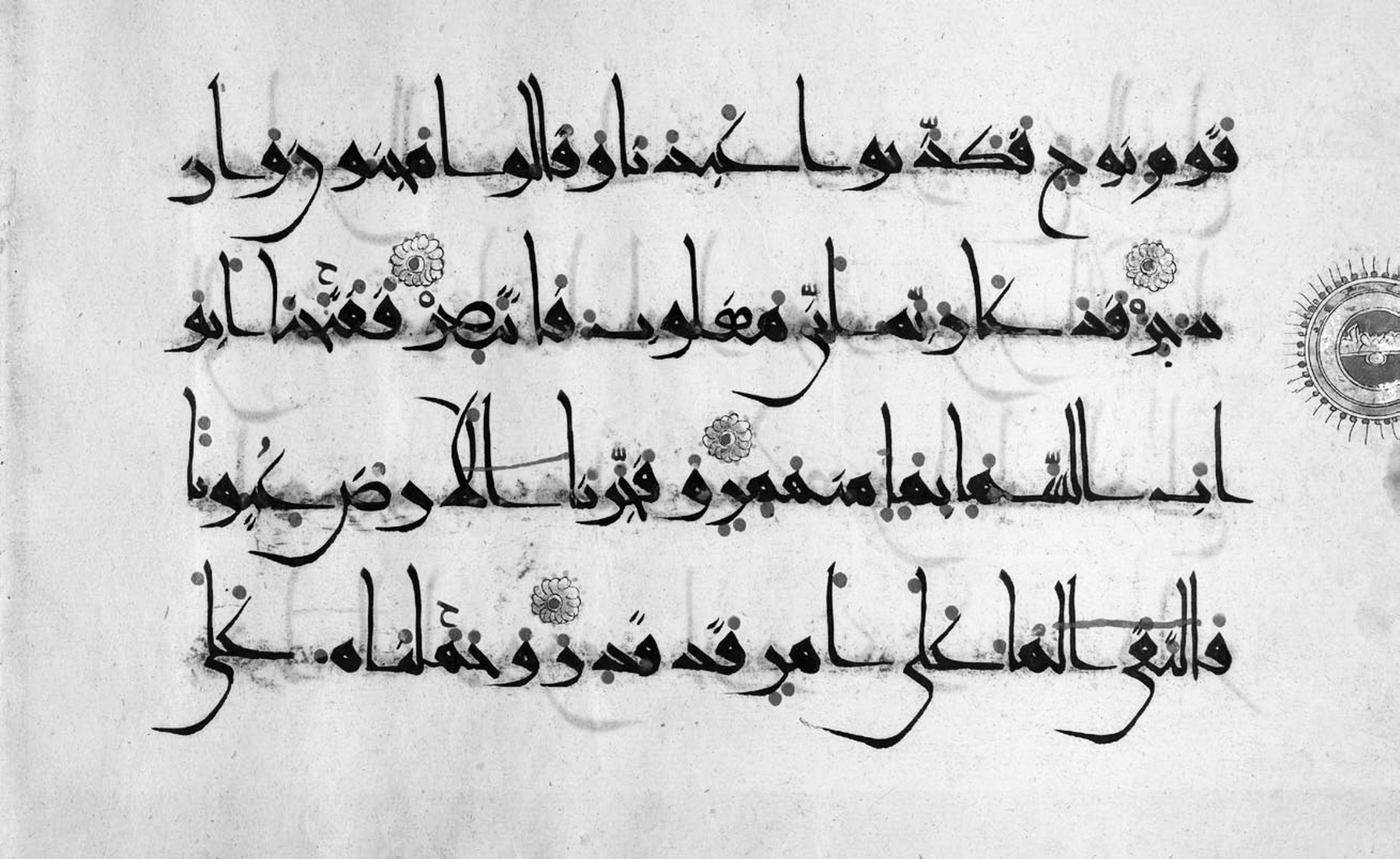
To make a codex, each double folio was folded into two leaves, which were assembled in gatherings, then sewn together and bound as quires into a book or codex. In Muslim books, the text is in a single-column block, like rows of worshippers in a mosque, whereas in traditional European bibles, each page carried two columns, like pews either side of a cathedral nave. Paper only took over Korans very gradually but, by the tenth century, the shift had taken place everywhere in the Muslim world except North Africa.
Korans were often split into thirty parts, one for reading each day of the month, and in the eighth century a system of diagonal strokes was introduced to the Arabic script to avoid confusion between letters. But the Uthmanic Koran could not be fundamentally altered. Scribes therefore used red or yellow inks for any additions, so as to distinguish them from the black-inked letters of God.
Credit 11.2
15 An early paper Koran. This non-illustrated manuscript dates to AD 993 (AH 383), was produced in Isfahan, Iran, and measures 9 by 13 inches. The text is written using black ink, the circular diacritical marks (indicating vowels) are in red, and gold is used for the decorative medallions. The script is a more angular version of Kufic than parchment Korans generally carried. It also points to new influences affecting the look of Islam’s holy book – not the Arabian desert or the Eastern Mediterranean but the eastern lands of the Caliphate. (Copyright © Metropolitan Museum of Art/Art Resource/Photo SCALA, Florence, 2013.)
The history of the Koranic manuscripts is the history of the Arabic script. The script was derived in part from Syriac as well as Nabatean scripts: before Islam, Arabic script appears in only a handful of inscriptions. But from the seventh century it began to displace its competitors and became widespread enough to develop regional forms. Nevertheless, the bureaucratic elite worked hard to ensure linguistic unity as the glue of empire, and their Korans reflected this ambition.
Soon scribes sat at the centre of Islamic civilization. They would receive a diploma after several years’ training under a master scribe. The master would teach them how to trim reeds for poems, how to prepare inks from iron and gall or gum and how to illuminate their texts. Often the calligrapher and illuminator was the same person. At the least, the two formed a partnership in which they co-designed a page’s layout. Al-Baihaqi, a tenth-century hadith expert from Khurasan, reported that those unable to write would turn up at the mosque, clutching sheets of parchment, in the hope that people would write for them. The hadith even say that, when the ink of the scholars comes to be weighed on the Day of Judgment, it will outweigh the blood of the martyrs.
Opening a Koran was like entering a sacred building. It began with a ‘carpet page’, often decorated with hexagrams and interlocking arabesques of text. After the conquest of Egypt in the 640s, books were carefully bound and often, thanks to Moroccan influence, tooled with gold. Inside, the handwriting unveiled the character of its scribe; the best handwriting was a signature of spirituality. On the pages themselves, gold was primary, but blues, reds, greens and yellows extended the decorations. Suns and trees were dotted across them: a tree representing the Koran stretched from earth to heaven, decorated with the blue and gold of the heavens and its lights.
In Egypt in the early fourteenth century, the first Mamluk dynasty Koran had ornate colophons for each volume.63 The colophon for the seventh volume sat on a cloud motif against a pink foliate background, flanked with gold filigree on a blue setting. The patron, calligrapher and illuminator are all mentioned. Each volume is announced with a grand double frontispiece or carpet page. Its letters are entirely in gold. The book had become the glory of Islamic culture.
The illustrative and calligraphic beauty achieved in the Korans of the early and middle periods of Islamic history is mesmerizing. For Muslims, the Koran was God’s book eternal, the word made parchment. When Caliph Uthman, the Koran’s publisher-in-chief, was assassinated, blood from the sword wounds in his neck and head was said to have stained the pages of his first Koran, which he still held in his hands. But this sometimes fragmentary, sometimes inscrutable text, as important for its rhymes and cadences as for its content, for its role as a sacred object as for its status as a teacher, outgrew parchment soon enough. And, as it spawned the sciences of Islam’s most productive era, it launched Asia’s western half into the paper age.