
2
The pages are still blank, but there is a miraculous feeling of the words being there, written in invisible ink and clamouring to become visible.
Vladimir Nabokov, The Art of Literature and Commonsense
Writing was the making of paper. Looking back across two millennia, the early history of paper, before it became the vehicle of the written word, appears like the prelude to a far bigger story. Chinese hemp paper wrappers survive from the late second century BC, vestiges of paper’s pre-writing age, while a county map found at Fangmatan, some 200 miles west of the ancient Chinese capital of Chang’an (now called Xi’an), dates from the early second century BC, pointing to a new role. Examples of writing on paper date back to the late first century BC, but they are exceptionally rare and usually little more than scraps.
Marco Polo recorded that the Chinese had used paper for kites (their Chinese name meant ‘paper birds’), military signalling, window panes and decorations before there was any concerted attempt to employ it as the surface of the written word. Without writing, paper would still have enjoyed a fruitful, if unspectacular career but, as we look back at the stuttering beginnings of paper’s employment, we are like Nabokov at his desk: faced with a blank page but confident that words hidden on its surface are about to become visible. Thus the birth of writing is part of paper’s prehistory, the background to the one role it has played which was transformative for the world. And writing is one of our strangest and most ingenious inventions because it preserves what are most fleeting: words.
Words, after all, are how we package our ideas and experiences for each other. As tools of communication they are, of course, flawed; human speech, wrote Gustave Flaubert, ‘is like a cracked tin kettle on which we hammer out tunes to make bears dance when we long to move the stars’.5 And yet those blunt tools remain the most versatile we have; words are still the currency of communication. They salvage our thoughts and experiences from history to live a little longer.
Yet the greatest weakness of words is not their imprecision but their mortality. Often words disappear as quickly as the breath that first carried them. The life of some words can be counted in decades while others are passed on down the generations. But even then they are shovelled into new forms as they pass from man to woman, woman to man. Unchecked, the process of oral history is a game of Chinese whispers writ large.
Yet 5,000 years ago, ingeniously, all that began to change, as words took physical form, sometimes scratched and sometimes carved. Suddenly, they might live on for years, decades and centuries, even if nobody could remember them.
—
Writing began in Sumer, a kingdom in Mesopotamia (now southern Iraq) that was something like the factory prototype of settled civilizations – it was the site of the first known extensive use of the wheel, irrigation, the plough and the arch. Eight thousand years ago the ‘black-headed people’, as the Sumerians called themselves, either ceased their wanderings or simply moved south (their origins remain disputed) and built cities, among them Uruk where, in the fourth millennium BC, markings began to preserve speech.
A line drawing of a bison and hunter carved on a wall might tell a story; such images survive from more than 30,000 years ago. But as Sumer’s population grew, its rulers needed to keep records of property ownership, trade transactions and temple accounts. The complexity of Sumerian society therefore led to the creation of signs and then, from those signs, to images, images that represented not just objects but the sounds of the names of those objects too. Gradually adjectives, verbs and conjunctions were added and Sumer drew itself a germinal script. This phonetic genesis, turning copycat images into abstract sound signs, is called the rebus principle. It allows, say, a drawing of an eye to represent the sound ‘i’ in general, irrespective of meaning; this essential link first took place no later than the thirty-fourth century BC, perhaps in Uruk, principal city of Sumer. The argument over how to define ‘writing’ remains unresolved, some viewing signs as ‘writing’ while others insist those signs are only writing once they represent sounds (or phonemes) of some sort. Few would dispute, however, that the switch to a phonetic form was a groundbreaking innovation in the history of communication.6
Yet the invention of writing did not mean writing could spread rapidly. Sumerian scribes had to write on clay tablets with a stylus, the writing utensil with which they could carve out wedge-shapes in the clay; ‘cuneiform’, the name of their script, simply means ‘wedge-shaped’. Thus the Sumerian script looks like a set of golf tees set at right angles to each other, even though it had developed from images of everyday objects and shapes, such as the image for a head.
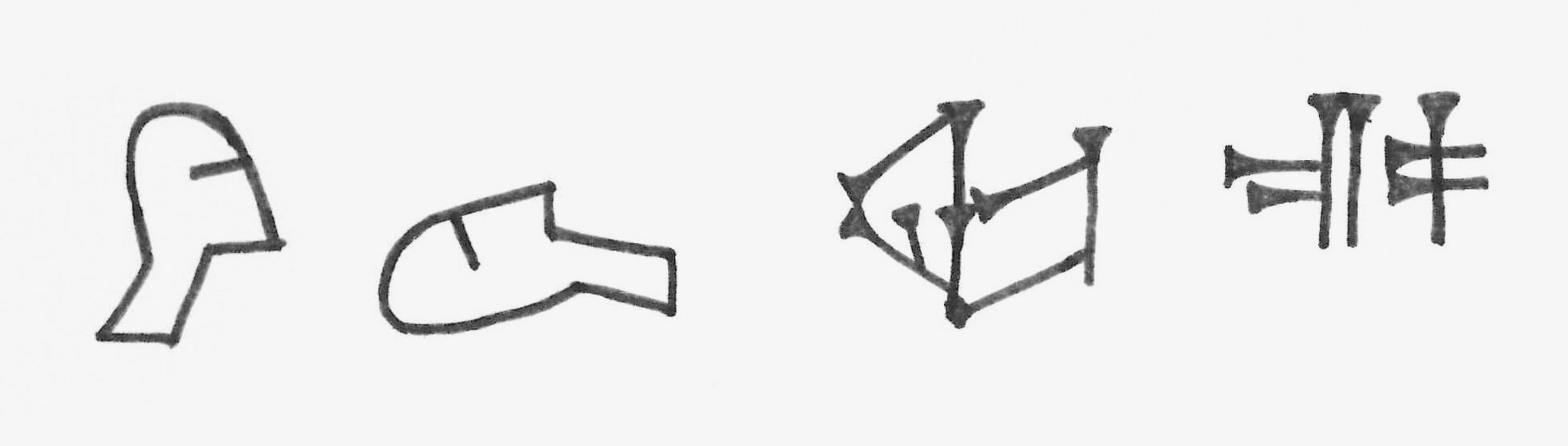
Credit 2.1
2 Impression of the development of the Sumerian sign ‘sag’ (head) into cuneiform, from the start of the third to the early second millennium BC.
Tablets were heavy and usually rectangular, though they were sometimes barrel-shaped or even a prism with six or eight sides, each side carrying text. Some tablets were smaller than a credit card, usually those used as receipts for, say, the purchase of a few sheep, a field or a tax payment; these at least were portable. One twenty-first-century BC clay business receipt for the delivery of a lamb (now in the British Museum) measures a little over 1 inch by 1½ inches and weighs around an ounce.
Poems or stories needed far larger tablets; those that recorded significant historical events or political texts were often half-an-inch thick and might measure 12 inches by 18 inches – almost twice as long as an A4 sheet of paper. As a writing surface, clay was at least fairly durable; once the clay had dried, the text was set. But clay tablets did not circulate well, due to their size, weight and fragility. Tiny receipts were manageable but few beyond the court and a few of the elite could afford to own significant texts.
If Sumer could not fully exploit its invention, it was an electrifying technology all the same. Writing changed how we govern, communicate, tell stories, remember important facts, ensure reliability, make ourselves job-worthy, express ourselves and find common ground with different groups in society. For the first cultures to use texts, the invention or discovery of writing was so magical that it needed a divine explanation, as much as the seasons, agriculture, fertility and the sun needed a divine explanation. Plenty were given to explain the miracle, from Scandinavia to Egypt to China.
In Norse mythology (the Germanic Norse script comprised ‘runes’) the ability to write was earned by Odin, king of the gods, who hung on a tree for days on end by way of payment. W. H. Auden’s translation of the myth tracks Odin’s journey towards paginated knowledge.
I took up runes;
from that tree I fell.
The Kabbalah, handbook of Jewish mystics, views writing as no less touched by divinity. It tells how God chose three consonants (Y, H, W) to form his name, Yahweh, before forging the universe itself from a recipe of twenty-two letters that he later impressed onto the tongue of Abraham. In ancient Egypt it was Thoth, the god of writing, who carried each pharaoh from his death to heaven. In Thoth’s House of Life, as the empire’s largest library was known, scribes composed and copied texts with a pen or scalpel which they called ‘the claw that fastens on the tongue’.
Egypt had adopted writing by the late 3200s BC, presumably borrowing the principle from the Sumerians, given their relative proximity. Yet, instead of merely copying the Sumerian wedge-shapes, Egyptians used coloured birds and suns too, a series of erect, thick-rimmed images we call hieroglyphs. The most vivid are filled with blocks of blue, red and yellow. Their columns read like vertical cartoon strips, a series of stick men, knives, ibises, gods, ripples, eyes, ducks, houses, reeds and mountains. Their man-animal hybrids make these tales in stone less picture-book cartoon than danse macabre; many were drawn on coffins and the walls of burial chambers. This was a script that covered stone tombs, walls and pyramids, but in the late third millennium BC, it also began to appear on papyrus, that precious reed of which Egypt had all but a monopoly.
The sticky pith of the papyrus leaf was cut into thin strips and a lattice made out of them, ready to be pressed into sheets and then struck repeatedly with a mallet, creating a smooth surface texture ready for writing. Papyrus was the writing material of the Mediterranean for centuries, and thus the writing surface of the classical world – used for its philosophy, mythology, drama and poetry. As the medium for this new civilization, it was also the deliverer of the beginning of the western literary canon. Indeed, the Greek word for the plant’s inner sap, bubloi, gave birth to the word biblos, meaning ‘writings on papyrus’. This is the root of our word ‘Bible’, reflecting the material on which Christian New Testament texts first appeared. Although Papal Bulls appeared on papyrus as late as 1057, papyrus writings largely disappeared from view in the early centuries of the Christian era.
Yet papyrus is not merely part of writing’s West Asian and European heritage; it remains, often inappropriately, bound up with its identity to this day. The word ‘paper’ is itself a misnomer, deriving from the word ‘papyrus’ even though paper is made through maceration (the breaking up and soaking of fibres in water) rather than simply through matting and pounding, the techniques used to prepare papyrus as a writing surface. In Europe, it was long assumed that paper was a Greek or an Arab invention; either way, it was supposed, the secret of papermaking must then have been passed eastwards to China. The words ‘paper’ and ‘papyrus’ have often been used interchangeably, as though their meanings were identical.
This confusion over paper’s origins, geography and chronology continues. Even the 2008 English Standard Version (ESV) of the Bible translates one of the final sentences of the apostle John’s second letter as ‘Though I have much to write to you, I would rather not use paper and ink.’ All major English translations use the same final three words, from the King James Version of 1611 to the New American Bible of 2011. Yet John, writing in what is now Turkey, would not have been able to use paper for some seven centuries. The ESV gives a more accurate picture of ancient reading culture in Paul’s second letter to Timothy, when Paul asks Timothy to ‘bring the cloak…the books and above all the parchments’ (2 Tim. 4:13). Parchments, made from animal hides and in use from the third century BC in western Turkey, were difficult to produce and therefore more expensive, and so writings on them were usually more valuable in content; perhaps in this case they were Hebrew Scriptures, whereas ‘the books’ Paul refers to were doubtless on papyrus, which was also used for such pap as notes and receipts. As late as AD 390, St Augustine apologized for writing a letter on papyrus instead of on parchment.
By comparison with the clay tablets produced in Sumer 5,000 years ago, papyrus was infinitely cheaper and easier to produce, and far more portable. It became the writing and reading surface of both ancient Greece and ancient Rome. In ancient Greece, it enabled the growth of writing, which was used in banking, in commerce, in citizenship documents, in list-making and, at the higher end of society, in philosophy, poetry and politics too. By the fifth century BC, anorchestra, or semi-circular recess, in Athens’s marketplace – the agora – was allocated to booksellers. As democracy expanded in the city from the fifth to fourth centuries BC, literacy became increasingly indispensable for those in government. The Athenian practice of ostracism, by which an individual could be expelled from the city-state and which required eligible citizens to cast a written vote, has allowed modern historians to arrive at a basic literacy rate of 5–10 per cent for Attica in the fifth-to-fourth centuries BC. However, this refers only to a very basic, functional literacy, far removed from the more wide-ranging ability that ‘literacy’ usually implies today. The Hellenization of Alexander the Great’s empire also raised educational provision (and, with it, literacy levels) and installed libraries in various cities around the Eastern Mediterranean, most famously at Alexandria in Egypt.
In ancient Rome books were used not merely in education and high society but in the military and other spheres of ordinary life. Where the Greeks had exported knowledge, the Romans imported it, amassing books from conquered territories to fill libraries at home. As collections grew and copying and translation projects gained momentum, so textual criticism developed too. Bookshops were concentrated in a particular area of Rome, and literary culture aided social mobility as the city became the centre of the Mediterranean book trade. By the end of the first century AD, it was possible to buy codices in Rome as well as scrolls and to select from Greek and Roman titles, old and new.
Yet it was paper, not the papyrus scroll, which would achieve the greater victory for the written word. Although literacy was growing in ancient Greece and Rome, it was too limited for popular reading to flourish, especially as papyrus, though not prohibitively expensive, was not cheap either. Greek texts generally lacked spaces between words – a key exception was in lists – which acted almost as a veto on silent reading and contemporary references make clear the practice was exceptional. In Greece, only the elite could do more than draw up a few lists.
Rome itself undoubtedly had a significant book trade, but evidence for similar book trades in other Roman cities is limited. Claims of textual inaccuracy were widespread and Cicero himself cited limitations on access to books, while many poets besides were sceptical of the value of committing their works to a physical form, despite the publicity it might bring. Whether Augustan Rome was primarily an oral or a book-based culture remains a contentious question. But the ability to read much more than signs, lists or adverts was confined to a small and powerful section of the population; the use of written ballots suggest basic literacy of up to 10 per cent in the Roman empire from the second to fifth centuries AD.7
Moreover, in both the Greek city-states and in the Roman empire, publication of a new work began with a public recitation and, if a work was reckoned suitable for the public, it might continue to be delivered out loud – only more private works would be read in silence. Papyrus scrolls also limited the practicability of longer texts, since it took so long to roll forward or back to a different section of the text – usually texts were no longer than 30–35 feet, although that would only allow for two or three of the twenty-four books of The Iliad. In both Greece and Rome, even the concept of a widespread population able to read independently (with all the choice that implied) was foreign. Thus, while both cultures placed spaces between non-vocalic words and both cultures would sometimes insert vowels into their writings too, neither culture introduced both together, which would have aided private, silent reading enormously. (In the central Middle Ages, however, word spacing was introduced, permitting easy silent reading, which in turn enabled less fluent readers to read without pressure – and so gradually come to understand more difficult texts.8)
In short, the physical texts of the Greco-Roman world remained closely bound up with recitation, oratory and public entertainment on the one hand while, on the other, their format – the papyrus scroll – hampered easy reference, portability and the reading of longer texts. Papyrus was fragile and thus impossible to fold or bind, and text would appear on only one side of the material. It was also laborious to make it smooth for writing. Storage was not simple either, since papyrus is especially sensitive to moisture and the papyrus plant, although not limited to Egypt, grew most abundantly in the Nile Delta and along its banks.
Papyrus did help to deliver a cultural outpouring in both Greece and Rome. What it could not do, however, was provide a culture of books in which reading and writing were inexpensive, longer books manageable and storage straightforward. Nor could it overturn oral culture. Its place in the history of literacy was assured, but it would be far superseded.
—
During the second millennium BC, writing caught on among the Elamites in Iran, the Harappans in the Indus Valley (now Pakistan) and the inhabitants of the North China Plain. While the Elamites and Harappans wrote onto clay tablets or stone monuments, writings in second-millennium BC China were on turtle shells – and probably on bamboo and wood strips as well, although it is the shells that have survived. These scratched images usually marked major events such as a royal birth, a battle or a drought; even an untrained eye can sometimes recognize a baby, a tree or a house. Although hardy and not too cumbersome, turtle shells cannot accommodate much text. Besides, they were seemingly used not to pass information to a wider or more distant audience but simply for their supposed magical properties.
As new scripts appeared, they were borrowed and adapted by different cultures. It was probably slaves who borrowed from the Egyptians to forge the beginnings of a Canaanite script in Syria by the start of the second millennium BC. From Canaanite came Phoenician, sometimes called the first alphabet since it employed a different sign for each consonant (although none for most vowels), and from Phoenician came Aramaic, Hebrew and still others, until Western Asia was a patchwork quilt of alphabets. As the Phoenicians plied the Mediterranean in their trading ships, new alphabets appeared on islands such as Sicily and Cyprus, as well as in Greece.
Following the conquests of Alexander the Great in the fourth century BC, Greek culture engulfed the Eastern Mediterranean. Its writings spread too, and the Greek alphabet became a settlement for stories, ideas and poetry far from its ancestral home. From Greek, the Etruscan script formed a bridge to the Latin alphabet, its written shapes the book masters of the distant future, following the spread of a Latinized Christianity across Europe.
Thus writing appeared in waves, spreading from its Chinese and Mesopotamian roots across Asia and Europe, the descendants of the Sumerian and Chinese scripts becoming the lodestones of new identities and literary canons across the continents. Just as Chinese spawned new Korean, Japanese and Vietnamese scripts, so Greek and Latin brought fresh alphabets to Europe, among them the Gothic alphabet, in use in Bulgaria from the fourth century AD before it was transported across large swathes of Europe.
Finally, on the Arabian Peninsula, close to the birthplace of writing, a new script, descended from Aramaic, appeared in the fifth century, and was quickly carried in all directions: east to Persia and the edge of China, south to the ports of Oman and Yemen, west to Egypt and the Maghrib, and north to Turkey and Armenia. It overran all it encountered, the most powerful script yet, its letters swooping across the multicultural pages of these lands like the rhythmical tails, dots and rests of a music score. It had every spur it could hope for – political, economic, cultural and religious – for this was no less than the bright-eyed adolescence of the Arabic script.
Yet, while it had been written out on bones, bark, stone and parchment, Arabic had lacked the surface that could fully deliver on its ambitions.
—
As this Babel of scripts spread quickly around the world, so cultures of writing were emerging that would deliver to paper its global future. Nevertheless, paper was born into one particular culture: China. Until the second half of the twentieth century, Europeans generally assumed that all scripts could be traced to one ancestor; just as they believed the roots of all world civilizations lay in Mesopotamia, so they assumed that all scripts, even ancient Chinese, must find their roots there too. The problem with this theory of a single global mother script, an ur-script, was the geographical gap that lay between the scripts of the ancient Middle East on the one hand, notably Sumerian, Akkadian and Egyptian hieroglyphics, and the script of ancient East Asia, namely, Chinese. Some scholars came up with theories to plug the gap, lured by the romance of the pursuit. After all, if the beginning of writing is not the beginning of human history, it is at least the frontispiece of humanity’s autobiography.
In fact, writing had at least three ancient and independent beginnings: Sumerian, Chinese and, by the third century BC, Central American. Even the Egyptians, the Harappans and the Elamites might have coined their scripts from scratch, although the case is far from clear-cut. As we have seen, the Sumerians probably first set stylus to tablet to cope with the complexities created by forsaking nomadism: to manage an agricultural surplus, protect land ownership rights and keep on top of tax receipts, for example. In China, on the other hand, writing became viewed as a way of ordering the world at a much grander level – if not a second Chinese creation to match the birth of the earth itself, then at least a means of restoring primal harmony, part of a quest to return to a golden age. The ingredients of this written power were the practice of magic and the study of history; through the correct reading of history, it was possible to discern the means of political and social harmony.
Even the earliest pages of China’s prehistory emphasize the Chinese obsession with writing. By the second century BC, the legend of the Yellow Emperor, supposed founder of the Han Chinese state in the third millennium BC, had been set to writing. According to the story – and there are several versions – the emperor’s court historian Cangjie, a man with four eyes, was hunting one day when he noticed the network of connected veins on a turtle. Impressed, he began to study the natural world and to coin a system of symbols for natural phenomena. These, the ancestors of phonetic characters, were known as ‘oracle bone script’. Other versions of the legend refer to other animals, but the turtle legend is especially striking in light of recent discoveries.
In 2003, American and Chinese archaeologists were digging up 349 graves in Jiahu, a prehistoric site in central China, when they discovered a group of turtle shells and animal bones. Eleven different images had been scratched onto the shells and bones 8,500 years before and some resembled Chinese characters, especially images of an eye and of the sun. Nine of the eleven images were on the plastron and carapace, the outer and inner parts of the turtle shell. In one grave, archaeologists found a decapitated corpse (the head was never found) and eight turtle shells. The characters were not phonetic; in other words, the markings were not complete writing. The rudiments of a Chinese script may have developed on other surfaces too, but turtle shells and animal bones are the earliest Chinese writing surfaces to survive.
—
True writing in China was born several centuries later. Moreover, plenty of examples were uncovered in the nineteenth century. Yet instead of being passed on to museums or research institutes, they were used as medicine. This revelation emerged thanks to a medicine purchase made by a Beijing philologist, Wang Yirong, in 1899. Inside the parcel Wang had bought were bone fragments that were meant to be ground up as ‘dragon bones’, a salve for cuts and bruises. (Turtle shell fragments were also ground up and used to treat malaria.) Wang noticed scratched images on the fragments. More importantly, he found that he could read some of them. Wang and a fellow researcher, Liu E, used their knowledge of ancient Chinese bronze inscriptions to decipher the scratches. Although Wang himself committed suicide in 1900, after an international force had occupied Beijing, his colleague Liu continued to buy up all the shell and bone fragments he could find in the medicine shops of Beijing, and in 1903 he published Tieyun Cang Gui (literally ‘Iron Cloud Tibet Turtles’), a book of 1,058 rubbings of shell and bone inscriptions he had collected. Liu and Wang’s discoveries pointed to how the Chinese script may have been born, namely, through the practice of divination.
The second-millennium BC Book of Changes, one of China’s oldest texts, is a divination manual. It explains the eight trigrams – symbols that stand for heaven, earth, fire, water, air, thunder, mountain and lake. Apparently random routines (like blindly grasping a handful of yarrow sticks from a larger bunch) would point the practitioner to a particular number. He would then look up the number in the divination manual to read the linked trigram; the trigram would indicate what course of action he should take. Confucius, living in the sixth century BC, read his bamboo Book of Changes so assiduously that the binding fell apart three times.
Wisdom-seekers could also tell the future by boring small hollows on the back of a turtle shell and inserting hot brands into them; each hollow would send a single crack out across the surface, which the diviners would interpret. In some shells that were discovered at a site at Anyang dating to 1200 BC (the same site that Wang’s own quarry was traced to), the question, the divined answer and the outcome had all been written down.
Three weeks and a day later, on jiayin [day 51 of the ritual cycle], the child appeared. Unlucky. It was a girl.
The questions were formulaic but the answers were often expressive; the Anyang dig had yielded true writing. The written lexicon at Anyang included 3,000 characters, and one fragment even mentions a scribe. After all, when writing appeared in China, signs had already been used for several thousand years. No language is perfectly phonetic; English, for example, has a small arsenal of signs, such as £, %, &, and 0 to 9. But truly phonetic writing can represent the sounds of a language as well as the ideas, and the Shang dynasty scratches at Anyang do just that.
Anyang shows the Shang honouring ancestors, reading the future and placating the gods. But the Anyang inscriptions are also an inventory of human desires, of their fulfilment and their denial. True writing in China came of age here, in characters like line-drawings, their forms dictated by the brittle surface on which they were etched. And almost nothing has proved to be as enduringly Chinese as its characters. Other markers of Chinese identity and culture – Confucius and the classics, the imperial system, polygamy, the system of palace eunuchs, Buddhism, and even the authority of parents and teachers – were all either outlawed or attacked in China over the course of the twentieth century. Characters, on the other hand, although partially simplified under Mao Zedong, have proved to be the cement of Chinese civilization, providing a link between the ages, even into communist times; indeed, in 2010 there was an exhibition of Mao’s own calligraphy in his home province of Hunan in southern China. It is hard to conceive of China remaining itself without its script.
Writing in China was the arbiter of both the future and the past, the tool of both diviners and historians. While other ancient cultures used writing, China revered it, turning it into an agent of magic, an interpreter of history and a proof of authority. A new age of writing emerged in China as a result, setting it at the heart of the culture. Three millennia ago, there was nowhere on earth writing had risen to such heights.