
3
Writing is the great work in the management of the state; it is an accomplishment that does not expire. A life span ends after its allotted span; and with the death of the body, honour and glory pass away too. Life and body are limited by time, unlike Writing, which is eternal. Therefore the writers gave over their bodies to ink and brush, and materialized their thoughts in tablets and collections. Without the praise of historians or the patronage of the powerful, their names and their reputations survived for posterity.
Cao Pi, Essay on Writing, third century AD
Writing could almost be classed an inevitability. Sumer, China and Mesoamerica all developed writing unaided, giving the practice, as we have seen, at least three birthplaces. Writing’s early uses spanned such different practices as fortune-telling in China and accounting in Sumer. This breadth of subjects, from magic to measurements, the future to the past, reflects the universality of writing. Its birth needed a sufficiently complex and powerful civilization in which the spoken word was no longer enough.
Paper, on the other hand, was a child of chance. By the middle of the eleventh century BC, when China’s Shang dynasty was overthrown in battle, writings in China had begun to expand beyond magic. As a result, their surfaces would become more important; bones, shells and stones were still used, but only bamboo would prove equal to the demands of the age. Centuries later, it was a bamboo-writing culture into which paper would be born. The invention of paper cannot be attributed merely to necessity as the invention of writing surely must be. The Chinese might have kept writing on bamboo for another millennium, had paper not appeared. Yet once it did, paper’s superiority as the courier of words became plain.
However, convenience alone could not propel paper to become writing’s leading partner. Bamboo was inseparable in China from the high and ancient wisdom it carried on its surface; long before the emergence of paper, Confucius himself had written on bamboo. It was a treasured surface for words, lending respectability to the content. In its earliest days as a writing surface, paper was seen as far inferior in quality to bamboo, despite its practical advantages; yet it was bamboo bibliophilia which would create a world of writing for paper to fuel. Political turmoil, beginning in the eighth century BC, would spark a search not simply for military might or signs in the sky, but for fresh ideas about the cosmos, government, social relations and the basis for peace. This war of words was played out on bamboo.
Three dynasties in particular turned writing into the currency of power and governance in China: the Zhou (1046–256 BC), the Qin (221–207 BC) and the Han (206 BC–AD 220). The later rise of paper only makes sense in light of the culture of writing that had first emerged, on bamboo. In Red Dust, his travelogue on post-Mao China, the author Ma Jian wrote that China’s roots went too deep and that he was dirty from all the digging. That is the danger of heading far back into China’s prehistory, but paper’s story cannot be told without a little digging.
—
In the ancient Shang dynasty, during the late second millennium BC, writings in what is now China appeared not only on turtle shells, cattle scapulae and other animal bones, but also on the surface of expensive bronze tripods, used in religious rituals to make offerings to the gods. With its capital at Anyang on the North China Plain, the full extent of Shang control is difficult to gauge, but its influence was felt as far as today’s Beijing region, hundreds of miles to the north-east. The Shang dynasty used writing for symbolic as well as magical power.

Credit 3.1
3 The Western Zhou dynasty (1046–771 BC) comprised an alliance of many states under the official aegis of the Zhou, with its capital at Haojing. Only some of these appear in the map above, several of them the geographical outliers. It is from this period that the earliest extant reference to Zhongguo (‘central kingdom’) survives. Today the word is simply translated as ‘China’; it may originally refer to the position of the Zhou on the plains, or even to the Zhou’s sense of civilizational supremacy. Through its centre flows the Yellow River, known both as the cradle of Chinese civilization and as one of the most destructive rivers in human history.
The Zhou dynasty, however, would be far more important for the spread of writing in China, thanks in part to a much greater geographical reach. Beginning in the eleventh century BC, it ruled from the dynastic capital at Haojing near the Yellow River over an empire with a clear political hierarchy and a strong military. The Zhou would last twice as long as its predecessor, the Shang; as well as ruling a larger territory, the dynasty would also introduce far more advanced forms of government and bureaucracy, laying the foundation for the imperial system. The Zhou was the primus inter pares of a confederation of states which it allowed relative independence in return for assurances of loyalty and regular tribute. Each state operated as a royal fiefdom of its own and treaties between them were formalized by attaching bamboo strips of writing to an animal, which was later buried. The Zhou managed to oversee this network of states by expanding the bureaucracy to forge the beginnings of Chinese imperial governance. It filled the bureaucracy with scholar-mandarins, men conversant not only with governance and diplomacy but with history and poetry too. Zhou poetry celebrated martial virtues and ceremony, reflecting a way of life centred on political order and ritual. Its poems embraced the agricultural seasons as well as the mythological founding fathers of the Han people. The Zhou introduced iron, bronze smelting and irrigation to increase harvests, and the dynasty kept back a ninth of all arable produce in reserve. Peace came with a surfeit of weapons and crops.
The Zhou rulers were atavistic, pickling their history in bamboo archives and on the surface of ornamental bronzes in order to confirm and perpetuate their political legitimacy. Some 6,000 inscribed bronzes survive from the Zhou dynasty attesting to the enormous influence bronze writings have exterted on Chinese textual culture. The best of these bronzes were used for ancestral sacrifices and would have heroic deeds recorded on them. The writing was much better ordered than on many of the divination bones and set out in columns, with the first column sitting on the right (although some of the bone-writings used columns too). Some inscriptions related dynastic or mythological strories at considerable length, others acted as legal documents, while more than seventy Zhou bronzes that survive are inscribed with poetry. A few bronzes use ornamental scripts, notably ‘bird script’. Bronze may have been the first surface on which Chinese scribes employed artistic writing styles.
Daily business at court required much larger quantities of writing, however. In the eleventh century BC, a Zhou scribe would write out the king’s will and testament and copies of state documents were filed in the archives. The early Zhou had a Grand Recorder, an Assistant Recorder, a Recorder of the Interior and a Recorder in Attendance on the Sovereign. Writing was the royal preservative. This written unity would knit together its polyglot empire, as the Zhou rolled out a more standardized script. That script became the glue of Chinese civilization, the tool of mandarin-scholars across the North China Plain.
Although writing remained largely an activity for the elite, under the Western Zhou (1046–771 BC) the elite found new uses for it, such as the ancient form of ‘letters of appointment’ sometimes referred to on Zhou bronzes, or mention of the king handing a document to a document-maker. The use of both bureaucratic and ritual writings points to an increasingly text-savvy elite. Indeed, there even seems to have been written administration practised at local level: trade transactions, legal cases, military administration and land concessions all involved basic written records.9 The Chinese word for ‘book’, tushu, literally means ‘map document’; it emerged in the Zhou dynasty.
The glacial decline of the Zhou dynasty took half a millennium, beginning with the enforced move of the capital city, after a siege, in 771 BC. Its position as patron of the peace then slowly crumbled. As the possibility of dynastic extinction became increasingly tangible, Zhou rulers made plans to save their libraries as well as their lives. In 517 BC the king’s son was forced to flee the capital with a retinue of his staff. Yet such was the importance of owning the history books that the fugitives carried the Zhou archives with them. Just as Zhou ascendancy had embedded reading and writing at the centre of Chinese civilization during the Western Zhou period, so now the chaos of dynastic decline during the Eastern Zhou period (771–256 BC) sparked an age of inquiry that raised the role of authors far higher than the Zhou rulers had intended.
—
Books under the Zhou looked very unlike the books we buy today; instead of broad pages their books comprised narrow bamboo strips, and where we use a sheaf bound on one side they used a roll-out mat joined by strings. Nevertheless, they were still books, since they bound pages together to form a continuous whole. Bamboo was cheaper, more versatile and easier to write on than the alternatives of the day (notably bones, bronze or stone). Moreover, bones and bronzes had specific and limited uses. Bamboo, on the other hand, would prove to be an apt partner for a more bookish age. It lasted as a writing surface from the eleventh century BC to the fourth century AD, capturing on its surface a millennium-and-a-half of Chinese civilization.
Two figures from this period dominate the view, from any angle. Centuries later it is easier to admire their impact and stature than it is to examine the details of their lives and personalities, which are scant and muddied by mythology. We can only get so close to Laozi (‘Old Master’) and Confucius (‘Master Kong’); indeed, there is debate over whether the Laozi of legend ever existed. According to Sima Qian, the great second-century BC father of Chinese historians, Laozi was an expert in history at the royal archives of the Zhou in the sixth century. When he met Confucius, Laozi told him to discard his airs and master his lust, while Confucius told his followers that Laozi was an enigma, like a dragon miraculously surfing the clouds to heaven.
Yet for all their mystery, these two figures were the trailblazers of a new kind of knowledge. Neither sought revolution; indeed, Confucius spent many years trying to find an existing ruler who would adopt his social and political philosophy. Yet both men wrote out their ideas without the usual political patronage and outside the institutions which had traditionally controlled the historical record. History writing in the kingdoms of ancient China had been owned by its rulers, and the recorders of history had worked as court scribes, propaganda secretaries for the ruling houses since the early Zhou dynasty. But Laozi and Confucius, however unwittingly, loosened the bindings that tied writers to their ruler, signalling new power for the author. This new power would help to forge the educated Chinese man of the future, too.
A Chinese proverb, which has since passed into cliché, described a Chinese gentleman as a Confucian in public and a Daoist in private. (It was sometimes added that he was a Buddhist on his deathbed.) It is a saying that betrays where China was heading, namely, towards becoming an empire of writing and of books, particularly the writings of Daoism, Confucianism and, later, Buddhism. Writing-based government bureaucracy was already well established in China, but Laozi and Confucius stand at the beginning of a new Chinese age of the book.
According to the official imperial histories, Laozi first wrote his thoughts down some two and a half millennia ago, on a broad hill west of Xi’an. It is now home to the memorial temple of Youguan which lies, low-slung, across its brow. Within view stand the Qinling Mountains. Bamboo forests and peach trees pepper the nearby hills and fields of maize lie scattered across the valley below. These mountains were the favoured hideaway for troubled courtiers, hermits, poets and wanderers through much of Chinese history.
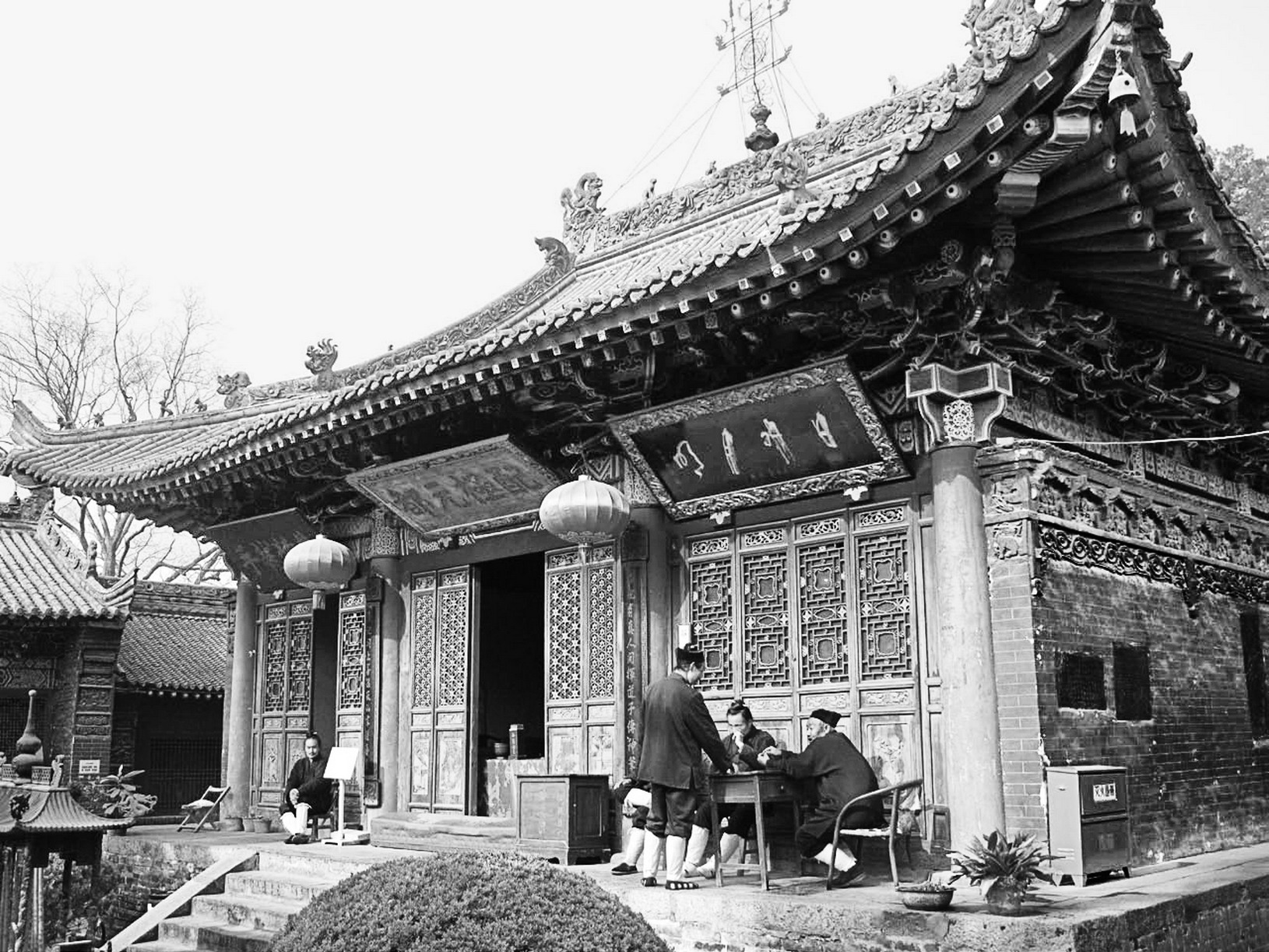
Credit 3.2
4 Daoist monks at Youguan Temple in the foothills of the Qinling Mountains in 2009. The site of the temple is traditionally believed to be the site where Laozi wrote down his Five Thousand Words, the Dao De Jing. In 2009 the oldest monk at the monastery, seventy years old if he was a day, lived in privileged seclusion close to the summit of a nearby hill.
Living in the sixth century BC, Laozi was more pessimistic than most of his peers about the Zhou dynasty’s prospects. As the state looked to liturgies and ritual rubrics to restore the dynasty’s halcyon years, Laozi lamented that merely imposing rules and restrictions on men was proof that the world had lost its sap of goodness. Finally, wrote the historian Sima Qian, Laozi harnessed his ox and journeyed across China, leaving the capital for the mountains, fifty miles south-west of the city. Here he came to the Western Gate which led out of China, out of settled civilization and beyond which he might find the great paradise in the West, which may simply be a euphemism for heaven itself. To leave the kingdom, after all, was to forsake life. The gatekeeper recognized him at once and cut him a deal: if Laozi would write down his wisdom, the gatekeeper would open the door for him. The result was Laozi’s 5,000-word work, the Scripture of the Way and Virtue, or Dao De Jing in Chinese.
When the way was lost virtue remained
When virtue was lost benevolence remained
When benevolence was lost righteousness remained
When righteousness was lost there were the rites.
The rites are the wearing thin of loyalty and trust, and the beginning of chaos.
Laozi’s Way and Virtue forms a collection of aphorisms and proverbs whose aim is to unite the disciple with the natural order of the world, not through knowledge alone but through intuition and experience. They enable a disciple to discover harmony with nature and to harness it to his or her own needs. After the Bible, the Dao De Jing has had more translations worldwide than any other book, despite the endless debates over its author’s identity and its true vintage.10The dao (or tao) of Daoism means ‘the way’ and Laozi believed he had uncovered it, although his descriptions of how to find it are often as cryptic as they are illuminating. Daoism has operated as China’s antidote to urban life for centuries, offering an escape from the strictures and patterns of court life. Yet that same ritual Laozi wished to escape was very dear to the followers of Confucius, and only Confucius rivals Laozi in his influence on imperial Chinese thought and writing.
Confucius was six foot tall, probably divorced and often contrarian. He had a humanist’s faith in human nature and a moralist’s disappointment with the rulers of his day. He bore the hallmarks of a social conservative in his love for loyalty, the ancients, propriety, public humility and an inflexible social structure. He preached a utopia in which each man knew his place and stayed there, a utopia plucked from the borderlands of myth and history. It was for such reasons as these that in 1966, as the Cultural Revolution attacks on anything old-fashioned gathered steam, students dug him up to prove him (and his ideas) dead.
But his politics was no mere throwback. Confucius believed governors should be chosen for their virtue and ability, not their lineage, and that the point of good government was the people’s welfare. He taught that a ruler who was not righteous and humane would forfeit the Mandate of Heaven – his divine right to rule – because the ruler existed for the sake of the people he ruled.
As Minister for Crime in the state of Lu, Confucius introduced softer punishments for minor crimes, abolishing the practice of cutting off a person’s nose for petty theft. But in 498 BC he left his home and his job, ostensibly in pique at the king’s failure to observe ritual. He wandered around eastern China for fourteen years with a group of disciples. He was outraged at the moral decline of the Zhou, and believed only a supreme emperor could restore ethics to the kingdoms; morality and political unity were natural bedfellows. Yet he saw only destruction on the horizon.
Confucius is traditionally credited with The Analects, one of classical China’s Four Books, and The Spring and Autumn Annals, one of its Five Classics. Of all the nine titles, The Spring and Autumn Annals was considered the supreme work, because it alone was reckoned to be able to war with evil, outline the way of heaven and rectify right and wrong. The book was the founding work of his belief system, the ur-text of Confucianism. The era itself would come to be named after this one work.
For all their influence, the annals are rice writing; they lack colour and texture. Without descriptive narrative, they chronicle a 242-year procession of state visits, floods, temple rituals, marriages, military victories, city wall construction projects, regicides, even plagues of locusts. Their bald prose uses just 16,771 characters to cycle through two-and-a-half centuries. The shortest entry, for the year 715 BC, is one word:
Pests
Later scholars, however, found the Annals so gnomic and ingenious that arguments over interpretations spiralled into colloquies until five commentaries dominated. One such commentary was eleven times the length of the Annals itself. But all the commentaries agreed that the Spring and Autumn Annals was an inventory of the failures of the Zhou dynasty. On their overall diagnosis of the dynasty, therefore, Confucius and Laozi were in agreement. An archaeological find made in northern China in 1993 suggests they may have agreed on much else besides.
Dubbed ‘China’s Dead Sea Scrolls’ by one of the researchers working on the project, the 13,000 characters set down on 804 bamboo strips included a jumbled Dao De Jing and several Confucian works. They point not only to a rich culture of religion and writing, but also to overlaps between Confucianism and Daoism, perhaps even to some kind of conversation between the two. The writings dated to the fourth century BC, but the conversation would continue. Confucius and Laozi’s heirs would brush out new ideas on politics, philosophy, relationships and religion, turning bamboo strips into the leading forum for debating ideas across the empire.
A great shift now took place: instead of literate subjects simply looking to the state to fashion history, a new authority emerged, one based on texts and on the interpretation of those texts. Historians would no longer simply be state servants; instead, their clout and independence began to grow together. Confucius had, one of his greatest heirs wrote, signalled reformation by writing his Spring and Autumn Annals without a patron, and so challenged the right of the state to control history. By the 320s BC, Confucius’s ideas were being discussed in a scholars’ academy in Linzi, one of the state capitals, as mandarins and exegetes argued over whether humanity’s self-reflective, self-critical faculty proved its goodness or whether morality was in fact counter to human nature. In the process, both the cosmos and the state itself were put under the microscope.
As political breakdown in China continued, so the old ethical debates, which had sought to always work from first principles, were replaced with the study of political realities, signalling the ascendancy of a newly pragmatic and empirical approach to politics. (A comparable shift would take place through the 1910s and 1920s, as the founders of the Chinese Communist Party in Shanghai abandoned the high ideals of anarchism for an activist’s communism.) The Linzi academy itself disappeared in the mid-third century BC, a victim of shifting political priorities, but it had helped to raise the written word to the status of an authority in its own right, the page becoming a battlefield for ideas and a place to argue over the direction of politics in the future, usually through the process of interpreting the classics.
The written apotheosis of these debates came with the publication, in the mid-third century, of an encyclopaedia under the chancellor of the state of Qin in central China. The official histories recount that the chancellor invited 3,000 scholars to his home to help with the project. He was reported to have ‘exhausted all the writing strips, brushes and ink’ to pen a syncretistic work that argued the empire existed for the benefit of the ruled, not the ruler. Its ideas encoded China’s ‘Hundred Schools’ period, which lasted from the fifth to the third century BC. The period’s very name bears testament to the in-numerable new philosophies it bred, all brushed out on bamboo.
—
Just twenty years after the chancellor’s death, however, all his work was undone. In 221 BC the state he had served conquered its neighbouring states and beyond, uniting China into a true empire and insisting on the doctrine of Legalism. (Legalism argued for a law-based system of governance but lacked any ideal of public service.) Now a vandal power, this Legalist force despised Confucius, believed the state existed for its ruler, not for the ruled and set about the greatest project of centralization yet, standardizing China’s characters, weights and measures and bureaucracy. Its name was the Qin dynasty.
The Qin’s new chancellor, Li Si, has gone down in history as the greatest vandal of all. According to the historian Sima Qian, Li advised the first emperor to burn all the books in the imperial bureau and to tattoo any hoarders, the result in part of a Legalist philosophy that valued hierarchy and order over learning, particularly Confucian learning. (Criminals and bandits had been regular recipients of tattoos since the Zhou dynasty.) Anyone who discussed the old Confucian classics the Book of Documents or the Book of Odes should suffer execution and his corpse should be put on show by way of warning. Anyone who used the past to criticize the present should be killed with his family. A year later, Sima Qian recounted, the emperor buried 460 scholars alive. Yet for all its success in centralizing the empire’s governance, the Qin failed to turn China away from its books; indeed, some of the dynasty’s more bookish opponents grew legendary.
Fu Sheng was a scholar of the Confucian classics and the words of the Book of Documents were his staple. As the campaign to burn the books and kill the scholars took hold, Fu blinded himself, feigned madness and probably fled from home. When the old learning was revived under the Qin’s successor dynasty, the Han, Emperor Wen sent a scribe to visit the aged scholar. As Fu dictated the Book of Documents from memory, the scribe transcribed the old text in a modern idiom. When Fu’s dialect was impenetrable, local people were asked to interpret it. Such were the accusing stories that emerged after the fall of the Qin.
In fact, the dynasty had preserved many of the classics, usually for the official palace professors. To handle the enormity of its empire, the Qin rationalized, unified and nationalized the scripts of China into an armoury of characters that could be deployed throughout the land. Written texts proliferated. Moreover, the state was divided into thirty-one counties and in each a magistrate would send written accounts back to the capital. A centralized bureaucracy had been born, stretching hundreds of miles in all compass directions, and ruling over a population of 40 million. Its currency was writing.
Although the Qin encouraged bamboo scholarship of a kind, it was only under very tight control. Nevertheless, literacy appears to have trickled down the social scale with soldiers able to read (and perhaps write) lists. Two letters dating to the third century BC were written on wooden boards by a Qin soldier fighting in a southern campaign; he asks for cash and for his mother to bring some clothes to the front line for him, and he asks after his mother’s health and his wife’s loyal service to her father-in-law. These letters suggest literacy at quite low social levels, as well as some kind of postal system that was available to soldiers, if not also to civilians. There is even evidence for some literacy among women – certainly among the elite, generally for women who were heads of households and possibly further down the social scale too. The History of the Han Dynasty, which is among imperial China’s best-loved official histories, was written by Ban Gu and his sister, Ban Zhao.11

Credit 3.3
5 Text as cultural patriarch: the blind scholar Fu Sheng dictates the Book of Documents from memory to Fu Nu, his scholar-daughter, who then translates his dialect into mandarin for the kneeling scribe. (Nothing here is more fanciful than the scribe’s use of paper, centuries before it became the surface of the classics.) The composition probably dates to the late fifteenth century, some 1,700 years after the dictation was believed to have taken place. Du Jin, its Ming dynasty painter, here employs a trademark formalism well suited to a scene that speaks so eloquently of one of the highest priorities of classical Chinese civilization: retention of the classics. (© 2014, Image copyright The Metropolitan Museum of Art/Art Resource/Scala, Florence)
Yet the dynasty would not last. After the death of its first emperor, the Qin quickly fell, the victim of popular revolt. The entire dynasty endured for just fifteen years. Importantly for the future of books and paper, the ensuing Han dynasty, founded by a rebel peasant, absorbed the horror stories of Qin misrule, preserving Qin history as a warning of the consequences of bad governance while Han scholars sifted through that history at their desks. The new dynasty took on the Qin bureaucracy, the Qin empire and many of the Qin laws, but appointed itself, the Han, as true author of the empire. As it did so, an armful of old books became the guiding stars of Chinese education, governance and philosophy. The Han founder, Liu Bang, displayed little initial enthusiasm for the empire’s resurgent bookishness. An early conversation with one of his advisers, Lu Jia, and recorded in the History of the Han, made clear Liu’s feelings.
Liu Bang: I took the empire on horseback. Why should I bother with the Book of Odes and Book of Documents?
Lu Jia: You took it on horseback, but you cannot rule it from horseback.
In fact, Liu would prove to be an excellent ruler and a good student: a meritocrat, a peasant in spirit and a Confucian in practice. He protected some of his weaker subjects, such as farmers, from exploitation and cut the volley of Qin laws down to three clear basic principles. He also introduced the beginnings of an empire-wide civil service recruitment system, one which chose state bureaucrats based on merit, not background or connections.
Liu’s successors moulded his Confucianism into a new form of statecraft, gathering the classics together until books (most of them on bamboo, some on wood, a select few on silk) were said to be ‘piled up like hills’. An Imperial Library was founded and summaries of all its books were commissioned. Classification systems were soon needed to create dozens of sub-divisions: 16 works by the Yin-Yang school alone (a school which emphasized the supreme power of elemental forces of nature) were held by the library, 249 chapters or facsimiles in all. The library held 70 different works on the 6 classics – 2,690 chapters. Two-thirds of the 667 titles listed on the Han library catalogue have since disappeared, but several Han titles dug up in recent years are not even mentioned on the list. Bibliographies and new classifications appeared too: the six classics, the various philosophers, poetry and rhyming prose, military studies, science and occultism, and medicine. One such bibliography listed 600 titles comprising more than 13,000 volumes. (Once fully edited, texts would even be transferred onto silk – an exceptionally expensive product – for the Imperial Library.) Beyond the palace and government, wealthy men bought and collected books for their own libraries.
As reading spread, talented but socially inferior civil service candidates began to work their way up towards the court. (Officialdom expanded too, reaching 130,285 members by 5 BC, most of whom would have been functionally literate. Perhaps twice as many officials again were employed at local level.) Thus, in 140 BC, when Emperor Wu personally examined more than a hundred recommended young scholars, many of them were from poor families. Before a candidate appeared, the emperor was handed a few bamboo slips with policy questions brushed onto them. One of the poorer candidates to appear that year was Dong Zhongshu, who came from the riverine flatlands south of what is now Beijing. Dong’s answers, coupled with his essay arguing for a Confucian state, won him a senior role.
It was Dong’s advice which led to the founding, in 136 BC, of a Commission for the Recovery of Classical Texts and, twelve years later, a Grand Academy. The latter began with 100 students but, by AD 140 that number had grown to 30,000. Throughout this period, colloquy after colloquy was held to decide which of the classics deserved a dedicated ‘chair’ (an official position which gave special prominence to the associated text). Writing, studying and collecting books became a state preoccupation; even in Dong’s day the Spring and Autumn Annals had five main schools, each armed with a commentary of its own. But this culture of the bamboo text was also a logistical headache. In AD 25, porters needed more than 2,000 carts to transport the imperial book collections, and thousands of bamboo works were lost on the journey.
Dong himself believed texts were a spiritual matter. He argued the future was divined not with turtle shells, bones or yarrow plants, but with the right reading of the past. The Qin disgusted him. Asked whether Qin governance just needed renovating, Dong replied that you could not carve a piece of rotten wood or trowel a wall of dried dung. Instead, Dong wanted the classics cut to five texts and, in the mid-130s BC, he got his wish. From this point until AD 1, wrote one of the Han historians, it was not uncommon for a scholarly study of a single classic to run to a million words.
Some, however, viewed this outpouring of written opinion as prolix. In the first century AD, the great philosopher Wang Chong began life in the Chinese capital in such poverty that he had to memorize the classics by reading them at the bookstalls. Later in life, he complained that scholars merely pursued their studies in ‘old ruts’. A commentary on the first sentence of the Book of Documents, one of the Confucian classics, was 20,000 characters long. The Book of Changesand Book of Documents both attracted commentaries of 300,000 characters each. (By the eighteenth century, commentaries on the classics were a hundred times longer than the classics themselves and stretched to 50,000 scrolls.) Yet even in first-century AD China, this over-writing had its high-profile critics, among them the renowned official historian Ban Gu, who lamented the nit-picking extremes to which writers had gone in their commentaries:
But they only deceived themselves. That is the tragedy of scholarship.
Ten miles north of Xi’an a hewn mound rises a hundred feet above some of the world’s oldest farmland. From its flat summit, which spans some 260 feet, you look down over vineyards, apple orchards and pine farms. Elderly men fly kites on the crest, surrounded by treetops and mist. Below the mound, a staggered series of platforms leads south to a driveway flanked by trees. There are two sheep tethered to one of the trees. This sheer and obscure mound is the last vestige of Weiyang Palace, where scholars gathered to debate the classics and so forge a canon for China’s future. They began their debates in the neighbouring Stone Canal Pavilion and the arguments lasted two years. More debates followed through the 50s. But it was in AD 79 that the scholars convened for their final joust, to dispute the texts at the heart of their traditions.
They discussed sacrifices, the rituals and institutions of marriage, ancient legends, emperors and gods. They explored questions like cultural refinement, mystical symbolism, executions, the eight winds (used for acupuncture points) and the three rectifications (which related to setting the calendar). They considered instinct and emotion, rites and music, the three major relationships (lord–subject, husband–wife, father–son) and six minor relationships, trade and the gifting of land to a feudal lord. The scholars conjured a universe of Chinese life in the hope they could funnel it wholesale into their interpretations of a small set of classical texts. Policymaking had assumed the form of debates over the texts of Confucius. In the second and early third centuries, the later years of the Han dynasty, some authors even began to argue for their right to oppose the emperor’s court, especially when that court was perceived to have come under the power of self-seeking court women and eunuchs.
Zhou thinkers, Qin unifiers and Han scholars had transformed China into an empire centred on a small handful of difficult classical texts. Reading, scholarship and writing had blossomed and the civil service, the natural home of imperial China’s scholars, had increased in number into the tens of thousands. It was an unprecedented transformation, not simply in China but in human history. There had never been such demand for the raw materials that at that time constituted books: ink, brush and bamboo.
Bamboo had turned plants into the surface of knowledge, a dominance not challenged until the digital age. What matters for characters, as for letters, is not simply their inky forms but also the inkless spaces between the strokes, and for at least a millennium and a half, those spaces were predominantly bamboo. Bamboo oversaw an outpouring of history writing as well as of bureaucratic records. From the late eighth century BC until the downfall of imperial China in 1911, official records were made for almost every year of China’s history. This was a legacy of both the Zhou dynasty and of bamboo itself.
Bamboo oversaw the birth of a new imperial power in East Asia. The strength of this new empire lay not simply in munitions and money, but also in books and the literary culture that would act as both a buttress and counterpoint to political authority. Bamboo was celebrated by China’s poets, one of them calling it ‘our elegant and accomplished prince…grave…and dignified’ in verse written 3,000 years ago. But the clearest evidence of its transformative role lies in the graphic history of a handful of Chinese characters.
Bamboo grows rapidly, especially in China’s subtropical southern regions, and the Zhou harvested it eagerly. Used during the time of the Han for houses, suspension bridges, carriages, and bows and arrows, it needed close treatment to be turned into a surface for writing. It was cut down into strips and fire-dried to evaporate the ‘fresh juice’ which otherwise brought decay and attracted insects. Most strips were less than an inch wide and little more than a foot long, allowing a scribe, sitting cross-legged, to hold one between his stomach and his left hand. This favoured writing in columns not rows, something not changed in China until the 1950s. (Even the standardization of starting on the right, not the left, may derive from how a scribe laid out his bamboo strips to his left, one by one, as he finished with them.) Binding a few strips together with cord to form a longer text forged the character ce, which still means ‘copy’ or ‘volume’:

Mistakes made on bamboo could have made writing exceptionally time-consuming, since a whole prepared strip might need to be discarded. To remedy this, book-knives were developed, and some were elaborate enough to be ‘etched with the name of the manufacturer’, according to Lu You, a poet living in the second century AD. The two-character word for ‘delete’, shanchu, reflects these origins. The first character, shan, includes a radical, the part of the character which indicates its approximate meaning, on the right. That radical, which appears simply as two vertical lines, one tall and one short, means ‘knife’. The left part of the character shan refers to bamboo writing strips:

Weight, format and size, however, would prove to be bamboo’s weaknesses. Bamboo books were ill-suited to referencing and to transportation, which made them more appropriate for the libraries of the elite than to a wider market. Set out on bamboo slips laid out side by side, the Bible might stretch to over 600 feet and would probably need a cart to transport it. It was in the bamboo age that a learned man would be described as having ‘five cartloads of learning’. Bamboo learning could not be taken lightly.
Moreover, although a knife could be used to scrape away the occasional error, this did not mean multiple drafts were feasible. Instead, those charged with any kind of official writing, especially for the court, might have to plan their composition out in their head in advance, so as to be sure it was of the correct length and had no errors in it. Thus, the famous poet Yang Xiong (53 BC–AD 18) described the pain of having to compose a poem at the emperor’s request:
Thinking hard about it, I fell asleep as soon as I completed it. In my dream, all my internal organs had been pulled out and I stuffed them back inside with my hands. After I woke up, I had asthma for a year. The experience taught me that excessive thinking was bad for my soul.

Credit 3.4
6 Yang Xin’s  (pronounced ‘le’), meaning ‘happy’ or ‘happiness’. Where the white of the page dominates in ‘spring’, here the ink all but obscures the centre of the page, the barely restrained pressure of the brush strokes expressing a surge of joy.
This cannot all be blamed on bamboo, of course, and many works on bamboo ran to tens of thousands of characters. Yet in a case like Yang’s, when the request came from the emperor himself and the end-product therefore needed to be immaculate, bamboo had obvious drawbacks.
In AD 183 there was a traffic jam in Luoyang, the Chinese capital, as thousands of carts jostled to reach the Grand Academy. The forty-odd stone tablets of the Chinese covenant stood on the lawn outside, set out in U-shaped rows, the end of a centuries-long argument over which texts should constitute China’s canon. The agreed text of the Chinese classics was etched out in more than 20,000 characters on these stone faces; this was a landmark moment in the history of China. Until then, only graves and war memorials had merited stone. The gathering crowds, arriving on foot or by cart or horse, did not just look at the tablets or try to remember their contents. They began to copy them too.
Less than a decade later, the capital was burnt and ransacked, and its libraries were destroyed. Cart after cart of bamboo books from the imperial libraries were taken further west but the official histories recorded that, on the way, bamboo writings were lost and silk writings were converted into covers or bags. Books still travelled badly.
Yet the idea that books were worth transporting at all was due to the elevation of their status under the Zhou, Qin and Han dynasties. The rise of the Zhou had embedded writing in government, and the dynasty’s ensuing disintegration had raised the question of how to govern; scholar after scholar had replied with his suggestions, written out on bamboo or wood. As a result, the Zhou had given China its sages. The Qin dynasty had spurred civil service writing through its determination to standardize the empire into a single entity, producing an enormous bamboo bureaucracy and a unified script. Finally, the Han had supplied China with its editors, librarians and commentators, growing the national vocabulary to almost 10,000 characters. It had also cemented the place of Confucius; henceforth all civil servants would study his writings.
Bronze and, most of all, bamboo had been crucial partners for writing. But the growth they enabled also moved writing beyond their control, and towards the greatest of all its patrons.