
11

‘Does it really matter what these affectionate people do – so long as they don’t do it in the streets and frighten the horses?’
Mrs Patrick Campbell
In 1833, William Bankes, MP for Dorset, was discovered ‘standing behind the screen of a place for making water against Westminster Abbey walls, in company with a soldier named Flower, and of having been surprised with his breeches and braces unbuttoned at ten at night, his companion’s dress being in similar disorder’.1 Bankes was lucky to escape a jail sentence. Aristocrats, professors and clergymen testified to the effect that ‘he was never yet known to be guilty of any expression bordering on licentiousness or profaneness and the jury acquitted him despite incriminating evidence on the grounds that his character was not that associated with sodomites’.2 This appears to be a clear example of how far the establishment would go to protect an open secret, and Bankes’s reputation seemed safe. Unfortunately for him, however, in 1841 he was caught in a compromising position with a guardsman in Green Park, and fled the country before he could go on trial for a second time. Under the Buggery Statute of 1533, initiated by Henry VIII, homosexual activity was technically punishable with death, although conviction was difficult, as the witness had to have seen penetration.3 Leaving scandal in his wake, Bankes died abroad in 1855. Like many homosexuals of this era, he was condemned to end his days in exile.
There have been many words for homosexuality and gay sex, but the actual term ‘homosexual’ originates with a Hungarian physician named Benkert in 1869.4 Of course the expression covers an entire range of sexual behaviour, but, for the duration of this chapter, ‘homosexual’ best serves to describe the personalities and activities depicted. In some respects, the homosexual underworld operated like a parallel universe. Just as the top-drawer whores went unacknowledged and unmolested by the police, so a blind eye was often turned to homosexuality in high places if the protagonists were sufficiently well connected, and cover-ups to protect the reputation of the culprits were not unknown. If William Bankes MP had been a little more discreet, perhaps he would not have been forced to flee abroad and leave his beloved stately home, Kingston Lacey in Dorset, and his considerable collection of Egyptian antiquities.
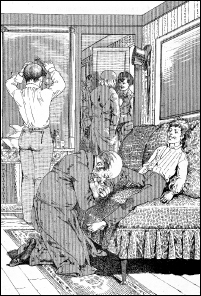
A nineteenth-century male brothel, from a French study of prostitution, where boys from the street are made available to clients. Here one man is passionately kissing a boy’s foot (1884).
Other politicians sailed close to the wind without falling foul of the legal system. For instance, George Canning, briefly Prime Minister back in 1827, was said to make advances to any pretty young man around the House of Commons, while future Prime Minister Benjamin Disraeli was, if not actually homosexual, then outrageously camp, noting in his novel Coningsby that ‘at school friendship is a passion. It entrances the being; it tears the soul.’5 Disraeli’s reference to ‘school’ is significant here. Institutionalized homosexuality had long been a feature of the English public-school system. Commenting on the fate of Oscar Wilde, the editor William Stead noted: ‘Should everyone found guilty of Oscar Wilde’s crime be imprisoned, there would be a very surprising emigration from Eton, Harrow, Rugby and Winchester to the jails of Pentonville and Holloway. Until then, boys are free to pick up tendencies and habits in public schools for which they may be sentenced to hard labour later on.’6 Despite the best efforts of individual headmasters to stamp it out, homosexuality was a recurrent element of public-school life.
The classical traditions which formed the basis of the educational curriculum extolled the virtues of love between young men – or a young man and an older one – as the ideal, in keeping with the original text of Plato’s Phaedrus. The Old Testament also supplied an example, in the relationship between David and Jonathan, which was considered ‘wonderful, passing the love of women’.7 On a more earthy level, the system lent itself to abuse, with its ‘fagging’ (not a reference to homosexuality but the tradition by which younger boys became the slaves of older pupils), flogging, ‘beating, buggery and boredom’ as Ronald Pearsall so eloquently expresses it.8 At Harrow, for instance, pretty boys were given girls’ names, such as ‘Nancy’, and became the ‘bitches’ of older boys. Very few boys had the strength of character, or the desire, to withstand the combination of social pressure and temptation, although William Gladstone, stalwart as ever, insisted that he did not succumb during his time at Eton. According to his biographer, he ‘did not stand aside from the harmless gaiety of boyish life, but he rigidly refused any part in boyish indecorums’. The harmless gaiety, for the record, consisted of playing chess and cards in the evenings, and taking a boat out on the river without authorization.9
While relationships between pupils were commonplace, affairs between pupils and teachers were not unknown. Dr Charles Vaughan, appointed headmaster of Harrow in 1844 in his late twenties, noticed early on that the boys were passing compromising notes to one another, and attempted to put an end to these activities by forbidding the use of feminine names and threatening his charges with flogging. But Vaughan himself was tempted: in 1858, he became involved with a boy named Alfred Proctor. Proctor confided in another boy, John Addington Symonds, telling him he was having an affair with the headmaster. Although homosexual himself, Symonds was so shocked that he eventually revealed this information to his tutor at Oxford, and Vaughan had to resign.10
Oscar Browning (1837–1923) experienced violent crushes at Eton. ‘Why I should love Prothero as I do I cannot tell, but I do love him and I believe that that love ennobles me and purifies me,’ he confided to his diary;11 and, a year later, he was in love with ‘Dunmore’, entranced by everything about him, from his eyes and his manner to the fact that he was a lord.12 Browning went on to become a master at Eton, where he became helplessly attracted to the young George Nathaniel Curzon, to such an extent that his ‘irrepressible attentions’ caused hilarity among the boys. As Pearsall tells us, ‘“spooning” [caressing and kissing] between master and boy was a subject for cruel jest, but it was also accepted as part of the order of things’.13
Obvious homosexual tendencies did little to harm Browning’s reputation. He went on to become a fellow and tutor at King’s College, Cambridge, and a member of the Apostles, the exclusive Cambridge debating society. Browning had found his niche. At Cambridge, he was fortunate enough to inhabit a realm in which institutionalized homosexuality flourished. Dons at Oxford and Cambridge were free to indulge their eccentricities. These ancient seats of learning were exclusively male (Girton, the first residential college for women, did not open until 1869) and the majority of dons were bachelors, as they were deprived of their fellowships if they married. The only women to penetrate the hallowed portals were bedders (chambermaids) and cooks. For intelligent, worldly, upper-class men, college life was a homosexual haven, a continuation of public school and an entrée to the establishment: the only requirement being that one must be reasonably discreet.
The homosexual scene in London was rather different. Instead of the Platonic ideal of master and boy, which flourished at Oxford and Cambridge, London had a ready supply of ‘renters’, or rent boys, and an avid clientele of men ready to take advantage of them. As the author of The Yokel’s Preceptor described the situation in 1855, ‘these monsters actually walk the streets the same as the whores, looking for a chance’. Fleet Street, Holborn and the Strand were favourite cruising grounds, and, according to the Preceptor, signs in the pubs around Charing Cross warned drinkers to ‘Beware of Sods’. The Preceptor was, of course, written as a guidebook for out-of-town homosexuals, and contained useful tips such as the observation that if you were actually going in search of a ‘sod’, the favoured signal consisted of ‘placing their fingers in a peculiar manner underneath the tails of their coats’ and waggling them about, which was apparently ‘their method of giving their office’.
In addition to being referred to as ‘sods’ (short for ‘Sodomite’), homosexuals were also known in vulgar slang as ‘margeries’ and ‘poofs’, while any homosexual act was referred to as ‘backgammon’, which must have proved confusing for those pub-goers who anticipated nothing more exciting than a board game. There were homosexual brothels, such as the one next to Albany Street barracks run by a Mrs Truman, and there were clubs, such as The Hundred Guineas, where, in the tradition of molly houses, the members were given girls’ names. For the most part, this twilight world flourished discreetly, but being a homosexual in London had its dangers, as the example of William Bankes MP has already illustrated. The stakes were higher: the illegality of the act made every homosexual a target for blackmail, either by his renter or a third party. Exposure meant public humiliation, family shame, exile or jail. As though predicting his own downfall, Oscar Wilde likened hanging out with his renters to ‘feasting with panthers’. And of course it was Wilde who was engulfed in the greatest scandal of all.
But before I turn to the trials of Oscar Wilde, let us consider three other cases which cast a bright and unwelcome spotlight on London’s homosexual underworld.
In April 1870, three men appeared in the dock of Bow Street Magistrates’ Court, charged with attending the Strand Theatre with intent to commit a felony. There was nothing unusual about such an event, although the addresses given by the accused were from the smart end of town: one of them lived in Berkeley Square, Mayfair; another resided at Buckingham Palace Road. What did make this scene unusual was the way two of these men were dressed.
Ernest Boulton, twenty-two, wore a cherry-coloured silk evening dress trimmed with white lace; his arms were bare, and he had on bracelets. He wore a wig and plaited chignon. The costume of Frederick William Park, twenty-three, consisted of a dark green satin dress, low-necked and trimmed with black lace, of which material he also had a shawl round his shoulders. His hair was flaxen and in curls. He had on a pair of white kid gloves. The third gentleman, Alexander Mundell, also twenty-three, was more conventionally attired.
Superintendent Thomson, of E Division, was called by the prosecution and stated that at half past ten o’clock on Thursday evening, he went to the Strand Theatre and saw the prisoners in a private box, Boulton and Park being in female costume. He noticed their conduct and saw one of them repeatedly smile and nod to gentlemen in the stalls. As they left the theatre the prisoners were arrested and taken to Bow Street police station. Thomson’s colleague Sergeant Kerley added that on their way to the station, Boulton and Park begged him to let them go and offered a bribe if he would listen to them, any sum he required. Boulton and Park were defended by a Mr Abrams who argued that the charge of felony was without foundation, and that the prisoners were guilty of nothing more than ‘having a bit of a lark’. For the prosecution, Mr Flowers retorted that they had indulged in this so-called ‘lark’ for a very long time, and that he suspected the prisoners had a more serious purpose, such as enticing gentlemen to their apartments to extort money from them. Mr Abrams denied this suggestion.14
The court case which followed demonstrated that this ‘lark’ had indeed been of a long duration, and the story itself was so bizarre that it attracted considerable attention. In May 1871, a year after their first appearance at Bow Street Magistrates’ Court, Boulton and Park made their debut in the High Court charged with ‘conspiring and inciting persons to commit an unnatural offence’. It was a big case, with the attorney-general and the solicitor-general appearing for the prosecution. The attorney-general started by saying that it was an unpleasant duty to have to conduct such a prosecution against such well-educated young gentlemen, but that he had no alternative.15 So who were these two well-educated young gentlemen, and how on earth did they end up in court?
Ernest Boulton came from a respectable background and was employed by his uncle, a stockbroker. He was an attractive young man with a good singing voice, described as a soprano. Frederick William Park, meanwhile, was articled to a solicitor. In their spare time, the young men enjoyed amateur dramatics, and their favourite activity was dressing up as women. This again seems to have been regarded as a relatively blameless pastime. The trouble was that these ‘larks’ began to dominate their everyday lives, and they started hanging around in music halls such as the Alhambra, in Leicester Square, and in the Surrey Theatre, south of the river. John Reeves, manager of the Alhambra, told the court that they had been summarily ejected for causing a disturbance by being dressed up as women and trying to pick up men.16
It emerged that a Mr Cox had flirted with Boulton in a City pub, mistaking him for a woman, and had even invited him back to his office to drink champagne. Thinking that he had pulled, Mr Cox admitted that ‘I kissed him, she, or it, believing at the time it was a woman.’17 This did not prevent Mr Cox from setting up another meeting, but at some point he realized that Boulton, who called himself ‘Stella’, was not all he seemed. Bumping into Boulton and his companion Lord Arthur Clinton in a pub in Covent Garden, he exclaimed: ‘You damned set of infernal scoundrels, you ought to be kicked out of this place!’18
Boulton, meanwhile, had been living with Lord Arthur at his house in Berkeley Square, and they had exchanged many explicit letters, which were read out by the prosecution for the delectation of the court. One typical example, written following a separation, read: ‘I am consoling myself in your absence by getting screwed.’ Frederick Park played the role of peacemaker during such lovers’ tiffs, and tried to mediate between the couple. Sounding like an old mother hen, he protested in one letter that he wanted to come over to see the couple but he needed an umbrella ‘as the weather has turned so showery that I can’t get out without a dread of my back hair coming out of curl’. Other more explicit letters must have titillated the court with their explicit references to homosexual activities: ‘I have as usual left a few little things behind, such as the glycerine, &c, but I cannot find those filthy photos, I do hope they are not lying about your room!’19
As well as hanging around theatres and music halls, Boulton and Lord Arthur enjoyed parading up and down the Burlington Arcade alongside the high-class whores. According to George Smith, the beadle (security guard), Boulton had been cruising Burlington Arcade for about two years, face covered very thickly with rouge and every type of cosmetic. Boulton always created such a commotion when he entered the arcade that it was impossible to miss him. He would wink and pucker up at the men, and even referred to the beadle himself as ‘you sweet little dear!’
The pair never made any secret of their shenanigans. During the trial, a large chest was brought into court. When it was opened, a gasp of amazement went up from the spectators as it contained sixteen silk dresses, twenty wigs and a variety of boots.
Alexander Mundell, who appeared as a witness at the trial of Boulton and Park, first met the couple at the Surrey Theatre during a performance of a play called Clam. On that occasion, they were wearing male attire but appeared so effeminate that Mundell believed they were women dressed as men. Completely taken in, Mundell even tried to give them instruction on how to be convincing ‘drag kings’, suggesting that they would seem more masculine if they were to swing their arms. Mundell arranged to meet them again, whereupon they turned up dressed as women.
Boulton told Mundell that they were really men, but Mundell treated this as a fine joke, and invited ‘Stella’ Boulton and ‘Mrs Jane Graham’ (as Park liked to call himself) out to dinner at the Globe, near the Haymarket. But time was running out for the pair. On 28 April 1870, they were followed by another detective, William Chamberlain, to the Strand Theatre, where they had arrived dressed as ladies. Park even visited the ladies’ room during the interval to have some lace pinned up on his dress. As they got into a cab outside the theatre, Chamberlain pounced. They were arrested and taken to Bow Street.
Following their arrest, Boulton and Park were examined by the magistrate and the police surgeon, James Paul. Dr Paul ordered Boulton, who was wearing knickers and silk stockings, to strip, then examined his anus for signs of buggery, noting ‘extreme dilation of the posterior’ and relaxed muscles, which he took to be evidence of anal intercourse. Dr Paul then examined Park and found what he told the court were ‘the same symptoms in these men as I should expect to find in men that had committed unnatural crimes’, although he admitted that he had no experience in the field of unnatural vice.20 Dr Paul’s cavalier attitude towards the prisoners irritated the judge, who called for an independent medical examination. Conducted by J. R. Gibson, surgeon to Newgate gaol, this found no evidence of buggery and concluded that the anal dilation could have been the result of natural causes. Boulton and Park went one further, and had another examination by Le Gros Clark, of the Royal College of Surgeons, who gave them a clean bill of health.
In summing up this curious case the judge, Lord Chief Justice Cockburn, was left with a dilemma. With no witnesses to give evidence of anal penetration, the offence of buggery could not be proved. The police surgeon had behaved in a crass and improper manner by subjecting Boulton and Park to a medical examination. George Smith, the beadle of Burlington Arcade, had admitted to taking bribes from shopkeepers to let whores into the arcade and had clearly turned a blind eye to the antics of Boulton and Park. There was no evidence that the pair had attempted to rob or blackmail their male admirers. They had been flagrantly open about their cross-dressing activities, but Park’s landlady testified to the effect that there had been no evidence of immorality.
So what was left? A couple of drag queens who enjoyed roaming the West End ‘for a bit of a lark’.21 Although in his summing-up the judge felt compelled to condemn the young men’s ‘frolic’ as ‘an outrage not only of public morality but also of decency, which would offend a member of either sex and ought not to be tolerated’, the jury returned a verdict of not guilty. Boulton and Park sank back into relative obscurity, although their case lived on in popular culture as illustrated by this limerick:
There was an old person of Sark
Who buggered a pig in the dark;
The swine in surprise
Murmured: ‘God blast your eyes,
Do you take me for Boulton or Park?’
Two years later, in 1873, London was rocked by another homosexual scandal, but this had none of the bizarre cross-dressing comedy of Boulton and Park. Instead, it was the tragic tale of Simeon Solomon, a gifted painter, who paid a high price for coming out of the closet – if indeed it could be said that he was ever in the closet in the first place.
Simeon Solomon, born in 1841, was the younger brother of the respectable Royal Academician Abraham Solomon. His father, an importer of hats, had been the first Jewish freeman of the City of London, and his friends included the Oxford don Walter Pater and the Pre-Raphaelite painter Burne-Jones. According to the poet Algernon Swinburne, Solomon’s paintings displayed ‘the latent relations of pain and pleasure, the subtle conspiracies of good with evil, of attraction and abhorrence’.22 By his own admission, Solomon was homosexual and an enthusiastic sado-masochist, confiding that ‘I will at once candidly unbosom to my readers, my affections are divided between the boy and the birch.’23
Solomon’s life consisted of a tragic decline from respectability, fame and financial security, to disgrace, infamy and poverty. He was the darling of the Pre-Raphaelites until 1873, when, on 11 February, he was arrested in a public urinal at Stratford Place Mews, off Oxford Street, for having sex with a sixty-year-old stableman, George Roberts. Both men were charged with indecent exposure and attempting to commit sodomy. They were both fined £100 and sentenced to eighteen months in prison, but Solomon’s wealthy cousin Mary intervened and his sentence was reduced to police supervision. Roberts, however, was not so fortunate and went to jail. Solomon headed for Paris, but was arrested there a year later on similar charges, although this time his companion was a nineteen-year-old. Sentenced to three months in prison, Solomon returned to find that he had been ostracized from polite society and his career was in ruins. Former patrons, galleries and friends shunned him, and the deaths of several family members followed in quick succession. Solomon became increasingly depressed and began to drink heavily. He even lost the support of Swinburne, having become, in the poet’s words, ‘a thing unmentionable alike by men and women, as equally abhorrent to either, nay, to the very beasts’,24 on the grounds that, heading for financial ruin, he had sold the letters Swinburne had written to him. This was an embarrassment for Swinburne as they contained ‘much foolish burlesque and now regrettable nonsense never meant for any stranger’s eye’.25
Solomon continued to paint, however, until the mid-1890s, although his later works express feelings of hopelessness, alienation and despair, as indicated by the titles: Love at the Waters of Oblivion (1891), Tormented Soul (1894), Death Awaiting Sleep(1896) and Twilight and Sleep (1897). Suffering from bronchitis and alcoholism, Solomon was admitted to St Giles’s Workhouse in Covent Garden as ‘a broken-down artist’, and died penniless in 1905, after collapsing in High Holborn. Solomon had flouted Victorian morality and had been punished for it, in the most Victorian of ways: he had faced financial ruin and loss of social status and, as a result, he died an outcast.
Victorian homosexuals faced further persecution with the passing of the Criminal Law Amendment Act in 1885. Designed to protect under-age girls, this Act had the further effect of outlawing consensual homosexual acts between men. The purity campaigners who had forced this legislation through regarded homosexuality as one variety of male lust run amok.
Section 11 of the Act reads:
Any male person who, in public or private, commits, or is a party to the commission of, or procures or attempts to procure the commission by any male person of any act of gross indecency with another male person, shall be guilty of a misdemeanour, and, being convicted thereof, shall be liable, at the discretion of the Court, to be imprisoned for any term not exceeding two years with or without hard labour.
There is no reference to homosexual acts between women, allegedly because when it was pointed out to Queen Victoria that women were not mentioned in this legislation, she replied, ‘No woman would do that.’26
Given the prevalence of homosexuality in public schools and at universities, a public perception developed that homosexuality was almost exclusively an aristocratic vice practised at the expense of honest working-class young boys who were corrupted by their rich patrons. The next scandal illustrates how this idea gained credibility.
In September 1889, a modest north London weekly broke the news that a peer of the realm was a regular customer at a male brothel which had been shut down by Scotland Yard in July. A follow-up story in November even hinted that the scandal could reach all the way to His Royal Highness Prince Eddy (Albert Victor, son of the Prince of Wales), and that the matter was being covered up by palace officials to protect the Prince’s reputation.
This sensational story had begun two months earlier, on 6 July 1889, when Inspector Frederick Abberline, who had previously been assigned to the Jack the Ripper case in Whitechapel, arrived at a house at 19 Cleveland Street, near Fitzroy Square, with a warrant for the arrest of thirty-five-year-old Charles Hammond. The warrant stated that Hammond and his eighteen-year-old accomplice Henry Newlove ‘did unlawfully, wickedly, and corruptly conspire, combine, confederate and agree’ to procure rent boys ‘to commit the abominable crime of buggery’. But he was too late: the house was locked and empty, and Hammond had fled to France. Inspector Abberline had more success with Newlove, however. He found him at his mother’s house at 1.30 p.m. and escorted him to the police station.
The Cleveland Street brothel had been discovered by pure chance after the police had been summoned to investigate the theft of cash at the Central Telegraph Office. During this routine investigation, it was found that a telegraph delivery boy was carrying 18 shillings on his person. Telegraph boys were forbidden to carry any cash of their own, in case it became mixed up with telegraph money; and this was a considerable sum, too, the equivalent of several weeks’ wages. When questioned, the boy, Thomas Swinscow, answered that he had earned the money working for a man named Hammond. When pressed to describe the kind of work he had carried out for Hammond, the boy hesitated for a moment and then blurted out the truth: ‘I got the money from going to bed with gentlemen at his house.’ According to Swinscow, another telegraph boy, Henry Newlove, had introduced him to Hammond. At Hammond’s house, he had sex with one man, and in exchange received 4 shillings. He only admitted to servicing two clients, but he named two other boys who he claimed worked for Hammond more often.
Under police questioning Newlove, Swinscow and the other boys named names. Newlove himself implicated Lord Arthur Somerset, head of the Prince of Wales’s stables, and two other prominent men, Henry Fitzroy, the Earl of Euston, and a British army colonel. As the investigation continued, the telegraph boys confirmed that Lord Somerset was a regular and hinted that Prince Eddy was involved too. Newlove was rewarded for his cooperation. When he and another accomplice were sentenced for gross indecency and procuring, Newlove received four months’ hard labour, while his more reticent colleague served nine. As for Lord Somerset, he had time to flee to a comfortable exile in Bad Homburg, a spa town in Germany.
At first, the story attracted no interest from the press. But then Ernest Parke, editor of the North London Press, picked up the story. The North London Press was a small radical weekly which usually covered council meetings and campaigned for better pay for the working man. But Parke was a first-class investigative journalist with a nose for a good story. He became intrigued when one of his reporters handed him a story about Newlove’s conviction in September, and he wondered why Newlove and his associate had escaped so lightly, when, just months previously, a clergyman from Hackney had been sentenced to prison for life for similar offences. This was clearly a case of one law for the rich and one for the poor. And how, Parke asked, did Hammond know that the police were coming in time to make good his escape? This had all the hallmarks of a conspiracy, and no mistake. Using his contacts in the Metropolitan Police, Parke discovered that the telegraph boys had named prominent aristocrats among their clients. On 28 September, Parke ran a story to the effect that ‘the heir to a duke and the younger son of a duke’ were involved in the scandal; on 16 November, he ran a follow-up naming the Earl of Euston and Lord Arthur Somerset, younger son of the Duke of Beaufort, and alleging that they had been allowed to leave the country to conceal the involvement of a personage even more ‘distinguished and more highly placed’.
This scoop would have been enough to impress Parke’s readers; it certainly irritated more conservative newspapers, such as the Birmingham Daily Post, which commented ‘the less that has to be said in these columns of the terrible scandal in London the better we shall be pleased’.27 One Tory MP even referred disparagingly to the case as ‘hideous and foetid gangrene’.
Although Lord Arthur Somerset had fled to the continent, Parke was mistaken when he wrote that the Earl of Euston had left the country. The Earl was still in England and had no intention of leaving. Instead, he launched a libel action against Parke on 26 October. Parke was not in the least perturbed and was convinced this was a case he could win. He knew that the Earl had visited Cleveland Street and that he had been acquainted with Lord Somerset.
The Earl had indeed visited Cleveland Street, but his account of the proceedings was somewhat different from that of the male prostitutes, or ‘renters’. According to the Earl, he had been walking in Piccadilly late one May evening, when he had been offered a card inviting him to a display of poses plastiques (striptease) in Cleveland Street. He had retained the card and, several nights later, called on the house to watch the said display. When he knocked on the door, he was asked for a sovereign, which he paid. And then the man who had answered the door made ‘an indecent proposal’. At this point, according to the Earl, he had called the man a scoundrel, threatened to knock him down if he did not allow him to leave and had stormed out of the house in a mood of self-righteous indignation.28 Several newspapers believed the Earl’s version. The New York Herald pointed out that several such gentlemen had probably visited the house in all innocence, curious to see what happened there and believing it to be a casino.
Parke was convinced that the jury would believe his version of events and that when he won this case, he would be striking a blow for the freedom of the press. Other newspapers had fought shy of the case, he observed. Notable scandal sheets such as William Stead’s Pall Mall Gazette and Lloyd’s Newspaper had remained silent; Reynold’s Newspaper had only quoted, reticently, the first stories of the North London Press. Parke could also take consolation in the fact that a ‘Fair Trial Fund’ was being raised on his behalf by H. W. Massingham (later one of the most famous journalists of his day) with signatories such as the Liverpool MP T. P. O’Connor, another journalist and a campaigner for Irish nationalism. Nothing could go wrong, could it?
The case opened in January 1890. Lord Euston was cross-examined, with the lawyers insinuating that there was something degenerate about his decision to go to watch a striptease act at his advanced age (Euston was then aged forty-one). Lord Euston replied with exasperation that such displays could be quite artistic, actually, and created the impression of being a suave heterosexual man about town. And then Parke’s witness was called. This was John Saul, a rather camp twenty-six-year-old with ‘a stagey manner and a peculiar effeminate voice’. Saul told the court that in May 1887 he had taken Lord Euston to 19 Cleveland Street, and he knew Lord Euston as ‘The Duke’.
But far from being the star witness, Saul was torn apart by the prosecution. Where, they demanded, had Saul come by the ring on his finger? Surely it must be worth a pretty penny. Was it a gift from a rich protector? No, replied Saul in some confusion, the ring was paste, and as to having a protector, he lived with a Mr Violet, a respectable man, in Brixton. And what about the silver-headed cane? Was that a gift from a grateful admirer? No, replied Saul, he had bought it for one and six in the Brixton Road. And finally, the prosecution wanted to know, what exactly was Mr Saul’s occupation? When Saul replied that he had been an actor at the Drury Lane Theatre, the prosecutor rubbed his hands in glee. As a witness, Saul appeared perverted, histrionic and unreliable. Parke, realizing that the case was not going his way, interrupted the proceedings and said that other witnesses could testify to events at 19 Cleveland Street. But when Lord Justice Hawkins invited him to bring them to court, Parke stalled: he could not produce these witnesses, he said, as this would mean betraying his sources.
Lord Justice Hawkins, in his summing-up, declared that Lord Euston was accused of ‘heinous crimes revolting to one’s common notions of all that was decent in human nature’,29 but invited the jury to come to their own conclusions and decide whether Parke’s allegations were correct. The jury’s verdict proved Parke correct: there was a conspiracy, and there was one law for the rich and one for the poor; Parke was found guilty of libel and Lord Euston was exonerated. Parke received a year’s imprisonment, regarded as harsh by the North London Press, which, without its editor, swiftly went under. Far from being acclaimed as a campaigner for free speech, Parke was condemned by other newspaper editors. He was ‘a miscreant’ who should be whipped at the cart’s tail from one end of London to the other, according to the People; and the Labour Elector, which had supported Parke’s campaign for better pay and conditions for dockers and postmen, complained that his sentence was not severe enough and ‘if Lord Euston had gone into the Star office and there and then physically twisted the little wretch’s neck, nobody would have blamed him’.30
Parke’s conviction exonerated Euston, but another trial began on 12 December that proved Parke’s conspiracy theory. The prosecutor charged Arthur Newton, Newlove’s defence lawyer, with obstructing justice by warning Hammond to flee the country. When the case went to trial, Newton was easily convicted. After the verdict was reached, the presiding judge addressed the court and concluded that Newton had helped Hammond escape to prevent him from testifying against his aristocratic clientele. Then, he sentenced Newton to six weeks in prison.
Henry Labouchère, the radical Member of Parliament who drafted the law against Gross Indecency in 1885, watched the Newton trial closely. He suspected that the cover-up went beyond a lawyer’s efforts to protect his clients and believed that the Prime Minister had arranged for Lord Arthur Somerset to be warned of his impending arrest to give him time to escape. Labouchère voiced his suspicions in Parliament on 28 February 1890 and moved that a committee be formed to investigate the government. The ensuing debate was so fractious and Labouchère was so provocative that he was suspended for a week, but his efforts to expose the government failed. By a vote of 204 to 66, Parliament rejected his motion. At the highest levels, the cover-up had succeeded.
The Cleveland Street affair gradually faded away as the English press and public turned their attention to more routine news stories, but the uproar had lasting effects on the public perception of homosexuals. The prostitutes were ‘innocent’ telegraph boys who had been ‘corrupted’ by Hammond in service of the unrestrained lusts of a wealthy aristocratic clientele. ‘Working men,’ proclaimed one radical, John Knifton, ‘are free from the taint’ (of homosexuality), although he did grudgingly admit that ‘for gold laid down our boys might be tempted to their fall’.31 However, the most significant impact of the Cleveland Street scandal was to intensify the hatred for homosexuality which culminated in the sensational trials of Oscar Wilde in 1895.
When Wilde arrived at Oxford in 1874, it was clear that a brilliant career awaited him. He had already made his mark, winning a scholarship to Magdalen College after studying classics at Trinity College, Dublin. An excellent scholar, he soon fell under the spell of Walter Pater, an eccentric don who had endured endless bullying in his youth on account of his wizened, hunch-backed appearance. Pater delighted in surrounding himself with attractive young men ‘of a remote and unaccustomed beauty, somnambulistic, frail, androgynous, the light almost shining through them’, among whom ‘exotic flowers of sentiment’ expanded.32 Pater was at the forefront of the Aesthetic Movement, which could be summed up in the phrase ‘Art for Art’s sake’. Aestheticism constituted a complete rejection of the Victorian notion that art should be pressed into the service of morality to provide edification for the middle classes and the poor. Instead, the role of the aesthete was to burn with a clear, gemlike flame, and turn his own appearance, personality and even life into a work of art. This artistic sensitivity went hand in hand with a Platonic appreciation of male beauty, particularly young male beauty. Exotic friendships flowered under these hot-house conditions, and being perceived as homosexual was no great drawback; indeed, Platonic tendencies were almost mandatory for young men entering aesthetic and artistic circles. The worst they had to fear was a mild form of gay-bashing consisting of being ‘debagged’ (having one’s trousers ripped off) by ‘hearties’ (jocks) and dumped in the college fountain. The young Oscar Wilde was kidnapped by such a group and deposited on a hill outside Oxford, but seemed to have been little the worse for it, confiding to his tormentors that he had enjoyed the experience and that the view was very charming.
Wilde threw himself into the aesthetic scene with characteristic gusto, decorating his college rooms with sunflowers and peacock feathers, growing his hair long and dressing flamboyantly in velvet coats with silver buttons, white stockings and buckled shoes. Just how far he went with his Platonic tendencies is debatable. Although he may have been aware of his own sexuality, Wilde was cautious enough to be shocked when he saw a fellow undergraduate, Charles John Todd, ensconced in a private box with a choirboy.33 And yet, just over a decade later, it was Wilde who threw caution to the winds and became Britain’s most scandalous homosexual.
In many respects, Oscar Wilde was the first modern celebrity. On graduating from Magdalen, his mission statement was: ‘I’ll be a poet, a writer, a dramatist. Somehow or other I’ll be famous, and if not famous, I’ll be notorious.’ In the words of Wilde’s rival, the painter James McNeill Whistler, it was a matter of ‘You will, Oscar. You will.’ But Wilde was to fall from grace like Icarus, flying too close to the sun. One of the first players of the fame game, Wilde was ignorant of the golden rule: Pride goeth before a fall.
Arriving in London with the intention of becoming a ‘professional aesthete’, Wilde soon found himself with a stalled career, two young sons from his marriage to Constance Lloyd, and increased financial responsibilities. Far from being an overnight success, he bowed to the inevitable, became the editor of a women’s magazine and seemed like many a middle-aged journalist, beaten into submission by domesticity and artistic failure. But Wilde was beginning to find satisfaction elsewhere. His flamboyant, charismatic personality ensured a devoted entourage, and in 1886, Wilde was introduced to a seventeen-year-old fan, a Cambridge drop-out named Robbie Ross who idolized Wilde and intended to seduce him. Somewhat embarrassed by Ross’s persistence, Wilde permitted him to do so. As for the sex itself, this would probably have fallen into the category referred to in the Criminal Law Amendment Act 1885 as ‘gross indecency’, for which read mutual masturbation and fellatio.
Once Ross became his lover, Wilde began to accept his own sexuality and have multiple male partners. He avoided sex with Constance by telling her that he had contracted syphilis. The affair with Ross provided more than sexual release; it inspired the novelThe Picture of Dorian Gray, published in 1890. This was a stylish tale of a hedonistic young man who retained his youthful beauty while his portrait, hidden in the attic, grew daily more hideous with every act of vice committed; it was also an aesthete’s handbook, every line endorsing Wilde’s world view, such as ‘all art is quite useless’34 and ‘there is no such thing as a moral or an immoral book. Books are well written, or badly written.’35
Dorian Gray became a best-seller, and Wilde attracted ever more besotted admirers. One of these young men was Lord Alfred Douglas or ‘Bosie’, an Oxford undergraduate who had been so enthralled by Dorian Gray that he claimed to have read it fourteen times. He first visited Wilde’s home in Tite Street in 1891, and Wilde was entranced by the combination of Bosie’s flaxen hair, alabaster skin and total infatuation. What Wilde did not realize at this point was that Bosie was a spoilt brat, a manipulative hysteric who enjoyed living in a permanent state of emotional meltdown. Far from being the love of his life, Bosie was to become Wilde’s nemesis.
Bosie proved to be Wilde’s bête noire in more ways than one. It was not merely his histrionic personality which brought trouble; it was also his subterranean private life. In the spring of 1892, Bosie was at his wits’ end, because an indiscreet love letter he had written to another young man had fallen into a blackmailer’s hands. Unbeknown to Wilde, Bosie was a regular customer of young male prostitutes. Many had police records, which should have been enough to deter him, but instead it only added to their appeal. As an experienced man of the world, Wilde knew exactly what to do. He instructed his solicitor to pay the blackmailer £100 and Bosie was rescued. It seems that at this point, they became lovers, but the pair were not exclusive, and soon Wilde found himself initiated into the twilight world of renters; Wilde was ‘feasting with panthers’ and enjoying the experience every bit as much as Bosie.
Bosie and Wilde were soft targets for the renters. Bosie was naive, and mistook the renters’ easy camaraderie for true friendship; he was also careless. When he gave one of the boys, Alfred Wood, one of his old suits, he had overlooked the fact that the pockets were stuffed with passionate love letters from Wilde. As soon as he discovered the letters, Wood planned to blackmail the pair, but Wilde was able to resolve the matter with a one-off payment of £30. This time, he did not involve his solicitor. There can be no doubt that Wilde enjoyed the additional frisson that criminality brought to his liaisons. Like his creation Dorian Gray, Wilde believed that he was leading a double life, indeed that he had almost elevated it to an art form. A wife and two sons formed an effective smokescreen. But Wilde’s personality was so flamboyant that rumours about his relationship with Bosie circulated around London, and worse was to come. One of the love letters to Bosie which Alfred Wood had discovered somehow found its way to Bosie’s father, the Marquess of Queensberry.
Wilde had observed that ‘a man cannot be too careful in the choice of his enemies’;36 he had certainly followed his own advice by offending John Sholto Douglas, 9th Marquess of Queensberry. An eccentric little man, so belligerent that his colleagues in the House of Lords would have nothing to do with him, Queensberry’s only claim to fame was to agree the Queensberry Rules for boxing championships, and to secure the adoption of weight differences, so that boxers might be evenly matched.37 Queensberry’s first wife had deserted him on grounds of cruelty and, just to complete the picture, he was a raving homophobe. Queensberry was the boyfriend’s father from hell. Queensberry’s relationship with his own son was scarcely any better. He regarded Bosie as a sissy, and he also suspected that his oldest son, Drumlanrig, was having an affair with the Foreign Secretary, Lord Rosebery. When Queensberry saw the love letter from Wilde to Bosie, he flew into a rage and demanded that Bosie break off the relationship there and then. Bosie, who also had a filthy temper, responded in kind, and an exchange of letters concluded with Queensberry threatening to thrash him and Bosie offering to take him on, with a pistol.
Queensberry believed that Wilde had led Bosie astray, whereas, of course, it was Bosie who had initiated Wilde into the delights of ‘feasting with panthers’. The relationship between father and son deteriorated, not helped by the fact that Bosie proved to be an indifferent student and dropped out of Oxford without sitting his Finals. In an effort to break up the relationship with Wilde, Bosie’s parents sent him abroad; but these trips did nothing to curb his appetites, as he spent his vacations in France and Egypt cruising for rough trade.
At one point, in 1894, however, it looked almost as if the Marquess had started to relent and accept the relationship between Wilde and Bosie. Chancing upon the pair lunching at the Cafe Royal, he was invited to join their table and was completely overwhelmed by Wilde’s charisma. As he got up to leave, the Marquess commented to his son: ‘I don’t wonder you are so fond of him. He is a wonderful man.’38 But this mellow mood did not last. The same day, he returned home and wrote to Bosie that his relationship with Wilde was ‘loathsome and disgusting’ and that it must cease or he would be disinherited.39 Queensberry had heard rumours that Wilde’s wife was planning to divorce him, and, if this was true, Queensberry felt that he would be entirely justified in shooting him on sight.40
Bosie, who could not tolerate even the mildest form of criticism, fired back a brief response in the form of a telegram ‘of which the commonest street-boy would have been ashamed’41 as Wilde put it. Addressed to his father, it read, simply: ‘WHAT A FUNNY LITTLE MAN YOU ARE.’ Provoked beyond endurance, Queensberry replied, threatening to give Bosie a good thrashing and warning that if he caught him again with Wilde, ‘I will make a public scandal in a way you little dream of.’42 Queensberry was as good as his word: it was a scandal of nightmare proportions.
Queensberry visited Wilde’s house in Tite Street unannounced on 30 June. Wilde later described the scene to Bosie: ‘in my library at Tite Street, waving his small hands in the air in epileptic fury, your father, with his bully, or his friend, between us, had stood uttering every foul word his foul mind could think of, and screaming the loathsome threats he afterwards with such cunning carried out’.43 Wilde faced him down on this occasion, and threw him out, commenting that ‘I do not know what Queensberry rules are, but the Oscar Wilde rule is to shoot on sight.’44 Queensberry was not to be stopped. He went from restaurant to restaurant, looking for Wilde, forcing him into a confrontation where Wilde would either retaliate ‘in such a manner that I would be ruined’ or ‘not retaliate in such a manner that he would also be ruined’. It is a real testimony to Wilde’s powers of concentration that, in the middle of such constant pressure, he was able to sit down and write his masterpiece, The Importance of Being Earnest. Far from being the flamboyant dilettante, Wilde had a strong dose of the Protestant work ethic. ‘Work never seems to me a reality,’ he wrote to a friend, ‘but a way of getting rid of reality.’45 As Wilde put the finishing touches to his production, Queensberry père grew more unhinged by the minute, planning to disrupt the first night of The Importance of Being Earnest by pelting the stage with rotten vegetables and inciting a protest which would lead to a press investigation into Wilde’s private life. Mercifully, his plans were detected in time and thwarted.
Events in October 1894 conspired to drive the Marquess over the edge. He was already in the throes of a divorce from his second wife, who accused him of impotence, when news came that his eldest son, Drumlanrig, heir to the title, had been found dead. The official verdict was a ‘shooting accident’, but the Marquess saw straight through this euphemism for suicide. Drumlanrig had killed himself after a blackmailer threatened to reveal his affair with Rosebery. In extremis, Queensberry’s attacks on Wilde escalated, culminating in a letter on 28 February 1895 addressed ‘To Oscar Wilde, ponce and sodomite’, or ‘posing as a sodomite’, as Queensberry later interpreted it. Finally, it appeared that Wilde had been forced to retaliate. But Wilde was a shrewd man. He was aware that the law of libel rests on one basic principle: if the allegation is found to be true, then it is not libel. If Wilde lost the case, and the allegation of his homosexuality was proved to be correct, he faced the loss of his reputation and two years in jail at hard labour, as spelt out in the Criminal Law Amendment Act. Although Wilde’s theatrical success had brought some wealth, he did not command the vast financial resources of the Marquess, who could afford to instruct the most experienced counsel. Wilde refused to take the matter to court, and it might have ended there, had it not been for Bosie. When Wilde complained that he did not have the funds to fight a libel suit, Bosie declared that he and his mother, the Marquess’s first wife, Lady Queensberry, would be delighted to pay the costs.46 Bosie also embarked on a campaign of scenes, sulks, tantrums and downright nagging which eventually drove Wilde into suing Queensberry for libel.
Wilde engaged his solicitor, Humphreys, to represent him, and instructed him that he was innocent of the charges. Humphreys, for his part, was somewhat naive. He cannot have been ignorant of Wilde’s sexuality, but he undertook the case as a great career move: what lawyer could resist a courtroom battle between two celebrities over a sensational sexual innuendo? Wilde was also confident that the prosecuting barrister, Edward Carson, would prove sympathetic, as he had been a fellow student of Wilde’s at Trinity College, Dublin. Surely the fact that they shared this august Alma Mater counted for something?47 Trusting that the case would go in his favour, Wilde whisked Bosie off to Monte Carlo, where they could forget their troubles in the casino, although a news story in the Observer claimed that they were thrown out of their hotel at the request of other guests.48 On his return, Wilde sought the advice of two good friends, the writer Frank Harris, and George Bernard Shaw. Over lunch at the Cafe Royal, Harris urged Wilde to drop the case. ‘You are sure to lose,’ Harris told him. ‘You haven’t a dog’s chance. Don’t commit suicide!’ Harris’s advice was for Wilde to depart for Paris immediately, taking Constance Wilde with him, and Shaw agreed. Wilde rose to his feet, ready to leave. He was convinced by their arguments and wanted to go home and pack, but, at the last moment, Bosie overruled his friends’ suggestions and persuaded Wilde to stay and fight.49
Events began to develop the ghastly momentum of a nightmare. On 1 April, like a sick April Fool’s joke, Wilde was shown Queensberry’s plea of justification for the charges he had made against him. The document was absolutely damning. Queensberry’s legal team had hired detectives to look into Wilde’s private life, one of whom, named Littlejohn, had spoken by chance to a West End prostitute during the course of his routine investigations. When asked how business was, she had replied, dourly, that it was bad for the girls at the moment as there was so much competition from rent boys, under the influence of Oscar Wilde.50 ‘All you have to do is break into the top flat at 13 Little College Street, and you will find all the evidence you require,’ she told him.
Littlejohn went to the flat, which turned out to be the home of Alfred Taylor, a former pupil of Marlborough College who had introduced Wilde to dozens of renters. Taylor was arrested, and the names and addresses of the renters found at his flat meant that they were easily tracked down, locked in a house, and ‘terrified into giving evidence against Wilde’.51 The resulting evidence consisted of fifteen different counts accusing Wilde of soliciting more than twelve boys, of whom ten were named, to commit sodomy. It is, however, noticeable that the alleged offences were not in date order, and that apparently testimony varied as to the number of offences and the number of boys involved, which suggests that much of the evidence was indeed faked or tampered with. There were so many holes in the prosecution case you could have driven a carriage through it, leading to the inevitable conclusion that Wilde was set up.
1. Edward Shelley, between February and May 1892.
2. Sidney Mavor, in October 1892. (Mavor testified that Wilde had done nothing wrong.)
3. Freddie Atkins, on 20 November 1892, in Paris. (His evidence was thrown out.)
4. Maurice Schwabe, on 22 November 1892. (Did not testify.)
5. Certain (unnamed) young men, between 25 January and 5 February 1892, in Paris.
6. Alfred Wood, in January 1893.
7. A certain young man, about 7 March 1893, in the Savoy Hotel.
8. Another young man, on or about 20 March 1893, in the Savoy Hotel.
9. Charles Parker, in March and April 1893.
10. Ernest Scarfe, between October 1893 and April 1894. (Did not testify.)
11. Herbert Tankard, in March 1893 at the Savoy Hotel. (Did not testify.)
12. Walter Grainger, in June 1893 in Oxford and in June, July and August at Goring [Wilde’s country house].
13. Alfonso Harold Conway, in August–September 1894 at Worthing and about 27 September in Brighton.
Any qualms Edward Carson might have had about prosecuting Wilde were dispelled by this wealth of evidence. Carson knew he would win this case, and it would be the making of him. As for Wilde, who had expected to go into court to defend his reputation as an aesthete and as the author of a handful of love letters, nothing could have prepared him for such a damning indictment. But, given the choice between leaving the country, which he regarded as a cowardly retreat, or going to court, Wilde resolved to face down his enemies. When he entered the courtroom on 3 April 1895, he knew that he had no chance of winning the case. But he embraced martyrdom with courage and wit, comparing himself with St Sebastian. Carson set out to demolish Wilde’s reputation by condemningDorian Gray as an immoral book, although Wilde had already countered that argument in print.
After reading an extract from the novel, Carson asked Wilde: ‘Did you write that?’ Wilde replied that he had the honour to be the author. Carson put down the book with a sneer and turned over some papers. Then he read out a verse from one of Wilde’s articles. ‘And I suppose you wrote that also, Mr Wilde?’ Wilde waited until you could have heard a pin drop in the court. And then, very quietly, he replied, ‘No, Mr Carson, Shakespeare wrote that.’52 Carson turned scarlet, and then read another extract. ‘And I suppose Shakespeare wrote that also, Mr Wilde?’ ‘Not as you read it, Mr Carson.’ There was such an uproar that the judge threatened to clear the court.
Carson regained his composure and returned to the topic of Dorian Gray being a ‘perverted’ book. Surely the nature of the book, and its sensational subject matter, might lead the ordinary reader to suppose that its author might have ‘a certain tendency’? Wilde responded that the novel would appear perverted only to ‘brutes and illiterates’; he had ‘no knowledge of the views of ordinary individuals’, a response which must have alienated many of his more conventional supporters. Carson persevered with his interrogation, but he was up against the most formidable wit in England. When he enquired, ‘Have you ever adored a young man madly?’ Wilde instantly hit back with: ‘I have never given adoration to anybody except myself.’ It was clear that Carson would never get the better of Wilde in this verbal fencing match. However, when it came to presenting the evidence, Carson gained the upper hand. As he began to enumerate the number of young men who had given evidence against Wilde, it was clear that Wilde would lose the case. The list of names was read out, with instance after instance of illicit sex with ‘homeless and shiftless boys’.53
As Wilde’s biographer Richard Ellman states, the panthers had been defanged by Queensberry’s men; toothless pussycats, they had been ready to say anything to stay out of jail. If they could not tell the difference between what they had done with Bosie and what they had done with Wilde, so much the better.54 Further damning evidence took the form of Queensberry’s letters to Bosie, in which he had pleaded with his son to end the relationship with Wilde, and accounts of Wilde’s relationships with Charley Parker, a valet, and his brother, a groom. When Carson suggested that a valet and a stable boy were strange companions for an artist, Wilde retorted that he had not known what they did for a living, but if he had known, he would not have cared. ‘I didn’t care twopence what they were. I liked them. I have a passion to civilize the community.’ Whatever the evidence he was confronted with, Wilde had a talent for discounting points against him which in different circumstances would have been the making of him as a Queen’s Counsel. Unfortunately, Carson had one card left to play, in the form of Walter Grainger, a servant at the house in Oxford where Bosie had rooms.
CARSON: Did you ever kiss him?
WILDE: Oh, dear no. He was a peculiarly plain boy. He was, unfortunately, extremely ugly. I pitied him for it.
CARSON: Was that the reason why you did not kiss him?
WILDE: Oh, Mr Carson, you are pertinently insolent.
CARSON: Why, sir, did you mention that this boy was extremely ugly?
Wilde had stumbled. He had as good as admitted that, had Grainger been an attractive youth, he would have made advances to him. In attempting to recover himself, he blustered and spluttered, before coming out with: ‘For this reason. If I were asked why I did not kiss a door-mat, I should say because I do not like to kiss door-mats. I do not know why I mentioned that he was ugly, except that I was stung by the insolent question you put to me and the way you have insulted me through this hearing.’55
After this cross-examination, Carson concluded with a reminder to the court that the Marquess of Queensberry had been motivated to condemn Wilde as a ‘sodomite’ in ‘one hope alone, that of saving his son’,56 whereas Wilde was guilty of consorting with ‘some of the most immoral characters in London’. While he had no proof that Wilde had had an improper relationship with Bosie (Queensberry was adamant that his son’s reputation must be protected), Carson proposed to bring in the boys who would testify to ‘shocking acts’ with Wilde. Alfonso Conway, in particular, would give evidence that Wilde had dressed him up in gentlemen’s clothes, so that he would appear a fit companion. Clearly, this last challenge to the class system was more than Wilde’s team could bear: Carson was taken aside by Wilde’s barrister, Sir Edward Clarke, and asked if he would accept a plea of ‘not guilty’ as in ‘not guilty of posing as a sodomite’, if Wilde dropped the charges. But Carson refused, and insisted that Queensberry was justified in calling Wilde a sodomite in the public interest.
Wilde himself was not in court. With the case going against him, he had been given the opportunity to make a dash for France. But he had been adamant that he would stay. Back in the courtroom, the judge instructed the jury to rule in Queensberry’s favour, which they did, instantly. The Marquess of Queensberry left the court to loud cheers, while the judge simply folded up his papers and left, but not before sending a message to Carson: ‘I never heard a more powerful speech nor a more searching crossXam [sic]; I congratulate you on having escaped the rest of the filth.’57 The case had been the making of Carson, and the destruction of Wilde.
With such damning evidence, Wilde could have been arrested straight away, but the police did not have a warrant ready. He retreated to the Cadogan Hotel, with Robbie Ross and his friends to console him. They urged him to leave for France while he could, but Wilde sat in a state of paralysis, almost unable to comprehend his fate as the last train for Dover left without him.
Wilde went on trial for gross indecency on 26 April 1895, careworn and anxious after a month in jail, and with his hair cut short. The proceedings covered the same ground as the Queensberry trial, with the same witnesses presented to testify that they had committed ‘indecencies’ with Wilde. The only strategy Wilde’s barrister, Sir Edward Clarke, could pursue was to discredit the witnesses, a plan which was doomed to failure.
One notable feature of this trial was that for the first time Wilde seemed to find his own voice and take the proceedings seriously. When, with reference to a poem by Bosie, Wilde was asked, ‘What is the “Love that dare not speak its name”?’ he finally dropped the posturing and posing and replied, from the heart:
The ‘Love that dare not speak its name’ in this century is such a great affection of an elder for a younger man as there was between David and Jonathan, such as Plato made the very basis of his philosophy, and such as you find in the sonnets of Michelangelo and Shakespeare. It is the deep, spiritual affection that is as pure as it is perfect…It is in this century misunderstood, so much misunderstood that it may be described as the Love that dare not speak its name’ and on account of it I am placed where I am now. It is beautiful, it is fine, it is the noblest form of affection. There is nothing unnatural about it. It is intellectual, and it repeatedly exists between an elder and a younger man, when the elder man has intellect, and the younger man has all the joy, hope and glamour of life before him. That it should be so the world does not understand. The world mocks at it and sometimes puts one in the pillory for it.58
Wilde had never sounded so superb. Here stood this man, frail and ill after imprisonment, who had been loaded with insults and crushed and buffeted, standing there sounding perfectly self-possessed, dominating the Old Bailey with his fine presence and musical voice. He carried the entire court away and had never experienced such a triumph as when the gallery burst into applause. It was Wilde’s defining moment, and his swan song. According to Max Beerbohm, Oscar stood up to hear the verdict looking magnificent and sphinx-like, only to be informed that the jury had failed to reach a verdict. The jury was still not convinced as to the evidence. A third trial was scheduled, and this time the prosecution checked the backgrounds of its witnesses and won guilty verdicts on eight of nine counts of gross indecency. On 24 May, the judge addressed the courtroom and complained that it was the worst case he had ever tried and that he felt compelled to pass ‘the severest sentence that the law allows’.59 With that, he sentenced Wilde to the maximum: two years’ hard labour. Wilde turned white and looked as though he might faint. As the warders seized him by the arms and led him away, he seemed to want to speak, but the judge ignored him. That night, the Marquess of Queensberry held a celebration dinner with two of Wilde’s former friends, Charles Brookfield and Charles Hawtrey, the men who had conspired to betray him.60
Wilde went into exile as soon as he had completed his prison sentence. There could be no return to his old life. He lost custody of his sons, and an attempt to patch things up with Constance ended in tragedy when she died after an operation on her spine. Shunned by his former friends, who were terrified of being associated with him, Wilde died in Paris in 1901, in the arms of Robbie Ross, whose ashes were later placed in Wilde’s flamboyant tomb at the cemetery of Père Lachaise. Even Wilde’s memorial was not without its element of black comedy: designed by Jacob Epstein, the tomb was inspired by Wilde’s poem ‘The Sphinx’, but looks less like a sphinx than an art deco angel, with genitals on proud display. The tomb, and particularly the angel’s genitals, became the object of veneration by Wilde’s legions of fans, some of whom chipped away and removed the impressively proportioned equipment. Speculation continues to surround their whereabouts.
Over a century later, it is possible to make a case for Wilde as our greatest sexual martyr, but it also seems as if he was punished for that great British sin of being ‘too clever by half’. Wilde’s subversive attitude towards institutions such as marriage and the law provoked the wrath of the establishment, as did his breathtaking arrogance and apparent lack of contrition. Few, if any, writers would take the stand against an eminent lawyer today. Wilde certainly remains the world’s most famous homosexual. With his exclamatory manner and witty putdowns, he established a stereotype for gay men which echoes down the years and found its expression in characters as diverse as Anthony Blanche in Evelyn Waugh’s novel Brideshead Revisited and the comic creations of Kenneth Williams and John Inman. Although it is tempting to deride these figures as unwelcome caricatures which expose the homosexual to ridicule, it is worth remembering that Wilde inadvertently paved the way for awareness, if not acceptance, of homosexuality in a way that it had never been recognized before. For this reason, Wilde deserves his status as a sexual martyr, a St Sebastian shot through with the last arrows of Victorian hypocrisy.