
10

The perverse pleasures of pornography
The last rites of many a Victorian gentleman involved a discreet fire at the bottom of the garden. As the smoke and ashes floated far above the rose bushes and the scent of burning paper filled the air, an observer might have wondered whether this was some obscure religious observance, or a pagan custom retained into the nineteenth century. They would have been wrong. The fuel for these bonfires consisted of pornography, systematically destroyed to protect the reputations of the recently deceased and their families; under the Obscene Publications Act 1857, mere possession of these smutty tomes merited a hefty fine or even a spell in jail.
Those books which survived the attentions of the collectors’ nearest and dearest are contained in the British Museum’s private cases, accompanied by notes from the gentlemen’s executors who, to a man, considered the British Museum to be the best place for them, away from the eyes of women and servants. The pornography which has been preserved offers an extraordinary insight into Victorian sexuality; books and magazines devoted to every facet of erotic behaviour, some familiar, some shocking and some decidedly perverse. As Pearsall has noted in The Worm in the Bud, pornography constituted another element of the mysterious, submerged world of Victorian sexuality.
Victorian pornography offered vicarious thrills for those who preferred their pleasures at second hand. The repressed and masochistic William Gladstone read pornography as a means of testing his resistance to sexual temptation, before he progressed to the greater challenge of keeping company with prostitutes. For the majority of Victorian gentlemen, pornography had a more obvious appeal in the form of escapism, forbidden pleasure and release from sexual tension. The genre has, after all, been described as literature to be read with one hand. Collecting ‘erotica’ or ‘curiosa’ was decidedly a gentleman’s pursuit, a fact reflected in the price of the books and magazines, which appeared in limited editions (around 300 copies was the average print run) and at a cost which put them well above the reach of the working man or the grimy fingers of leering schoolboys. Erotica was generally restricted to the upper classes and men of the Church, as it had been since the Renaissance. And it is at this point, perhaps, that a brief history of pornography will serve to put the genre in context.
Early erotica was printed in Latin, meaning that ordinary people could not read it. This way, ‘curiosa’ as it became known, was kept from the uneducated. The other consequence, of course, was that the greatest consumers of ‘curiosa’ consisted of those well versed in Latin: the priesthood.
One of the first pornographers was Pietro Aretino (1492–1556), an Italian author, affectionately referred to as ‘il flagello de principi’ (‘the scourge of princes’) for his satires against royalty and the Church. A cheerful individual, Aretino actually died laughing: he fell backwards off a chair and struck his head after hearing his sister tell a dirty joke. In 1524, Aretino wrote a series of sonnets to accompany the drawings of sixteen sexual positions by Giuliano Romano, a twenty-five-year-old pupil of Raphael. Together, they produced one of the most notorious works of erotica, the Sonnetti Lussuriosi, or ‘Sonnets of Pleasure’. The publication caused such outrage that Aretino had to flee Rome and was lucky to escape a prison sentence. The Church burned as many copies of the book as they could get their hands on, and no complete surviving copy is known to exist.
The first pornography in English became available during the sixteenth century, with English translations of classical texts such as Adlington’s 1566 translation of Apuleius’s The Golden Ass. This picaresque novel was originally written in Latin around the second century AD. In 1567 Arthur Golding translated Ovid’s Metamorphoses, which portrayed a dizzying array of classical deities engaged in a variety of sexual activities while disguised as animals. Christopher Marlowe, meanwhile, translated Ovid’s Ars Amatoria (‘art of love’, or more precisely in this context a celebration of extramarital sex), the original version of which resulted in the poet being banished from Rome.
While a restricted quantity of pornography circulated during the seventeenth and eighteenth centuries, the genre really took off with developments in printing in the nineteenth century. Collectors tended to be wealthy businessmen or Anglican clergy who filed their pornography under the heading of ‘anthropology’. As one genuine scholar at the British Museum remarked, in 1885, ‘Of late the demand for bawdy books has become startlingly large. If the study of “Anthropology” goes on at this rate, heaven only knows what we shall reach in the next generation.’1
From the 1820s onwards, the heart of London’s pornography industry was Holywell Street, off the Strand. Now long gone, it was demolished in 1901 to make way for the Aldwych and Kingsway. Holywell Street was otherwise known as Bookseller’s Row, because it was full of print and book shops. By 1834, there were fifty-seven pornography shops in this one street, all with a display designed to attract the attention of passers-by. Pornographic novels, erotic prints, etchings and catalogues for prostitutes that contained their specialities were all sold here. Also on sale was The Yokel’s Preceptor, an early guide to ‘gay London’, advising the best places to pick up homosexuals, disguised as a rantingly disapproving tract. As these shops sat alongside ‘respectable’ stores, Holywell Street drew a curiously mixed demographic of browsers looking for legitimate texts: lawyers from the nearby Inns of Court; professors from King’s College, on the Strand; medical students searching out textbooks – all rubbing shoulders and jostling alongside prostitutes, homosexuals and curious young women, pressing their faces up against the glass. The Daily Telegraph deplored the fact that the young of either sex were to be seen there, ‘furtively peering in at these sin-crammed shop windows, timorously gloating over suggestive title pages conning [reading] insidious placards, guiltily bending over engravings as vile in execution as they are in subject’.2
It was here that the cognoscenti might find publications devoted to every form of sexual pleasure, from representations of conventional copulation in numerous reprints and imitations of Fanny Hill to dirty comic verse such as:
I don’t like to see, though it’s really a lark,
A clergyman poking a girl in the park;
Nor a young lady, wishing to be thought discreet,
Looking at printshops in Holywell-street
I don’t like to see, coming out of Cremorne,
A girl with her muslin much crumpled and torn,
Arm in arm with a fellow who’s had the mishap,
To forget, when he shagged her, to button his flap.3
Holywell Street also offered literary and artistic representations of the more recherché delights of homosexual and lesbian sex, and flagellation, which has never gone out of favour in the British Isles and was particularly popular with the Victorians. Translations from French masterpieces and oriental sex manuals were also popular, some of which had been brought in from abroad with an ingenuity and resourcefulness which would put modern drug couriers to shame.
A typical example from the 1840s was the list of Henry Smith of 37 Holywell Street. This included early sex manuals and tales of sexual initiation such as: Onanism Unveiled, or the Private Pleasures and Practices of the youth of both Sexes exposed, The Connubial Guide, or Married People’s Best Friend (price 6d); The Royal Wedding Jester or all the Fun and Facetiae of the Wedding Night with all the good things said, sung, or done on that joyous occasion (reduced price 2/6); The Wedding Night or the Battles of Venus,4 while Venus in the Cloisters, or the Jesuit and the Nun revisited that old erotic standard, clerics behaving badly. The Jolly Companion, Woman Disrobed (‘a most capital tale’) offers similar content to a top-shelf magazine, while Adventures of a Bedstead, meanwhile, promises a variety of saucy escapades, as does Tales of Twilight: or the Amorous Adventures of a company of Ladies before Marriage (10/6, 8 fine coloured plates). The Spreeish Spouter or Flash Cove’s Slap-Up Reciter is more perplexing, with its encoded title of Victorian sexual slang, but it appears to be popular verse, intended to be recited, about the adventure of a pleasure-loving young man (the ‘flash cove’) the specific nature of whose enjoyments or ‘sprees’ involve ejaculation (or ‘spouting’). Something of the original charm is no doubt lost in translation.
‘Confessions’ were always a popular genre, and so our Victorian gentlemen could expect to sit back and find pleasure in tales such as Adventures and Amours of a Barmaid, a serial in a pornographic magazine entitled The Boudoir, in which our heroine picks up an elderly earl in Kensington Gardens, takes him home and enjoys watching ‘the variations of his face as picking up a decidedly naughty book he eagerly scanned its contents’.5
One of the most successful pornographers was John Camden Hotten (1832–73), a founder of Chatto and Windus. Hotten succeeded in maintaining a toehold in the respectable world of mainstream publishing, operating out of a shop in Piccadilly, while bringing out clandestine texts such as The Romance of Chastisement, a sado-masochistic classic which inevitably attracted the attention of one of Hotten’s most popular authors, the poet Algernon Charles Swinburne (1837–1909), who was a devotee of flagellation. It was suspected that Hotten blackmailed his author into producing pornographic verse alongside his more mainstream contributions, but such allegations did not prevent Hotten from gaining that final accolade, burial in Highgate Cemetery, marked by ‘a modest tombstone, erected in his memory by the London booksellers’.6
Hotten was considerably more respectable than William Dugdale, ‘one of the most prolific publishers of filthy books ’7, who, in the 1860s, traded under several aliases, including Henry Smith, Turner, Young and Brown. Dugdale was one of the first publishers to provide eye-catching blurbs, snagging jaded rack browsers with copy such as: ‘Nunnery Tales or Cruising Under False Colours – every stretch of voluptuous imagination is here fully depicted, rogering, ramming, one unbounded scene of lust, lechery and licentiousness.’ And all for two guineas. Dugdale was a twisted, unpleasant character, whose CV included forgery and plagiarism; one trick of his was to take existing texts and reissue them with new names or take sections or chapters from existing texts and reissue them as new. He even published books with racy titles, such as Confessions of a Ballet Girl, which turned out to be completely innocent.8 Dugdale’s publications included Raped on the Railway, in which a woman is raped and then flagellated on the so-called ‘Scotch Express’.9 By the 1870s, more specialist material was available, such as The Romance of Lust (1873), which features a man who has sex with his own sister, who also turns out to be his daughter; The Story of a Dildo (1880); Kate Handcock or A Young Girl’s Introduction to Fast Life (1882) and Laura Middleton, Her Brother and Her Lover (1890). Dugdale also republished The Lustful Turk, one of the original sources for the myth of ‘white slavery’, in which a young woman is kidnapped and taken to a brothel where she develops an infatuation with her abductor.
The pornography trade invariably attracted some eccentric and desperate characters. There was Edward Sellon, author of The Ups and Downs of Life (1867), who dabbled in Hindu literature and erotology, and wrote a treatise on snake worship. After losing his memory, Sellon became a fencing teacher, drove a mail coach between London and Cambridge and blew his brains out in Webb’s Hotel, Piccadilly, at the age of forty-eight.10
Gifted authors, desperate for money, also turned to writing pornography. They included young Arthur Machen, who was to become a celebrated writer of horror and science fiction, and the poet Ernest Dowson. Rejected from medical school but with some literary talent, the resourceful Machen earned a crust by spending his days in the reading room of the British Museum translating Casanova’s Memoirs and then Le Moyen de Parvenir (Table Talk) by Béroalde de Verville, the poor man’s Rabelais. This last was considered so obscene that the printers refused to go on typesetting it after eighty pages. Meanwhile, Dowson translated French erotica to eke out his modest income as a writer and critic. Sadly, the financial rewards were not sufficient to prevent Dowson, a tubercular alcoholic, from dying in poverty at the age of thirty-two, but not before he had bequeathed the quotations ‘days of wine and roses’ and ‘gone with the wind’ to the English language.
One of the most popular genres in Holywell Street was devoted to flagellation. According to the publisher John Cannon, this was ‘a letch which has existed from time immemorial’,11 and the trade certainly reflected the continuing fascination with le vice anglais.As our celebrated bawds have observed in previous chapters, a taste for flagellation appears to have been the inevitable legacy of a public school education. In the battle to maintain discipline over the future empire builders, few boys escaped the lash. Indeed, as Pearsall suggests, corporal punishment constituted one of the tribal rituals of the upper classes: one elderly correspondent to The Morning Post declared that, after being soundly beaten by Dr Keate, the headmaster of Eton, ‘I am all the better for it, and am, therefore – ONE WHO HAS BEEN WELL SWISHED.’12 The Old Etonian Algernon Swinburne was a devotee, his enjoyment of the vice having begun after one particularly savage flogging at school, from which he bore the marks for over a month. This formative experience led, in adulthood, to his patronizing a brothel in St John’s Wood where he could be chastised by rouged, golden-haired ladies who wielded the whip upon their gentlemen ‘guests’.13
Flagellant literature falls into a number of categories: from the accounts of elderly roués who require sexual stimulation from a briskly administered whipping, as documented by Cleland in Fanny Hill, to the well-connected and influential men who enjoy a sex game during which they are ‘punished’ by a dominatrix, while other parties look on, and even join in. This is a form of role play, with each participant assigned the character of ‘naughty child’ or birch-wielding disciplinarian, as in the following extract. This depicts a flogging enthusiast pretending to be an impudent young boy who has insulted his mother and is now being punished for it by the redoubtable ‘Mrs Trimmer’ while his ‘nurse’ or governess looks on. The mise-en-scène is highly dramatic, with appropriately blood-curdling language, but while there cannot be any doubt about the measure of pain inflicted upon the individual concerned, we are also left in no doubt that this is how he obtains his pleasure
‘Is it possible,’ said Mrs Trimmer, pulling [the victim’s] breeches down to his heels, ‘that your mistress suffered this tyrannical gentleman to insult her in the manner she has represented?’ ‘No indeed ma’am, I never insulted my mamma, upon my honour, I did not,’ roared the youth. ‘Indeed, Mrs Trimmer,’ replied the nurse, ‘there’s not so bold a boy in the parish.’
‘So, so, so I understand!’ said the mistress, (making him caper as high as young Vestris at every stroke of the rod.) ‘Yes, yes, I can see you are a wicked young rascal!’
As the rascal begs his assailant to stop, the attack becomes more vigorous, with the dominatrix declaring that ‘I’ll whip this bold backside of his till I strip every bit of skin from it…You may roar, and cry, and kick, and plunge, and implore, my pretty gentleman, but all will not do; I’ll whip you till the blood runs to your heels! You shall feel the tuition of this excellent rod!’14
Another popular sub-genre of flagellant literature added a lesbian twist by depicting the beating of young women by other young women, as in The Merry Order of St Bridget, which describes the erotic punishments within a closed order of nuns:
She instantly, by desire, assumed the character of Flirtilla’s Governess, and having stretched her, with some seeming reluctant struggles on the part of Flirtilla, on the bed, she uncovered to the waist the plumpest, fairest, and most beautiful posteriors that ever charmed mankind. Clarissa herself stood entranced at the lovely view, and suspended the rod, till Flirtilla, impatient for the delightful combat, cried out like a terrified child…15
While The Englishwoman’s Domestic Magazine featured a long series on flogging, with hoax letters coming in from all quarters testifying to the benefits of flogging one’s daughters, more extreme cases of sadism included the reflections of the brutal ‘Colonel Spanker’ (in reality one William Lazenby, 1825–88) whose Experimental Lecture revelled in the ‘exciting and voluptuous pleasures to be derived from crushing and humiliating the spirit of a beautiful and modest young lady’.16
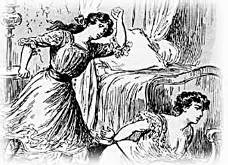
The lesbian proprietor whips young Sabrina in Charles Lubbock’s Madame Zuleika’s Sapphic Academy c. 1901.
Henry Spencer Ashbee, a Victorian collector and self-appointed pornography expert, found flagellation so distasteful that he had to recruit a specialist to write about it in his catalogue of erotica. For Ashbee, the practice was ‘the wild dream, or rather nightmare, of some vicious, used-up, old rake, who, positively worn out, and his hide tanned and whipped to insensibility by diurnal flogging, has gone mad on the subject of beastly flagellation’.17
According to the publisher John Cannon, flagellation was so popular ‘and so extensively indulged in London at this day, that no less than twenty splendid establishments are supported entirely by this practice.’18 London’s dominatrices swished their way to a fortune: Mrs James, of 7 Carlisle Street, Soho, retired to a life of luxury in Notting Hill, while many had handsome addresses: Mrs Emma Lee, of 50 Margaret Street; Mrs Phillips, of 11 Upper Belgrave Place; and Mrs Shepherd, of 25 Gilbert Street.19
While much of the literature of flagellation is either coy or brutal, there is an account by ‘Walter’ which is so realistic as to have the ring of truth about it. The anonymous author of My Secret Life witnessed this incident during a trip to Belgium, when he and his mistress, a prostitute he refers to as ‘Helen Marwood’, visit a specialist brothel, as Helen’s interest is piqued by the vice. It is a vivid but sordid description of a sexual encounter. Escorted by the ‘Abbess’, or dominatrix, who runs the brothel, Helen, wearing only her chemise, and ‘Walter’, in just his shirt and a mask, enter a room where they encounter a man kneeling on a large chair at the foot of the bed. The chair is draped with a towel to ‘receive his spendings’. As if this was not enough, the ‘patient’, as ‘Walter’ refers to him
is wearing a woman’s dress, tucked up to his waist, showing his naked rump and thighs, which strikes an incongruous note as he is still sporting men’s socks and boots. A woman’s bonnet is tied carefully over his head and adjusted to conceal any beard or sideburns, and he has a mask over his eyes, leaving his mouth free. Behind him stands a young girl, dressed as a ballet dancer, but in a far from conventional fashion, as she has a very short skirt, bare legs and naked breasts. She is also holding a birch, displaying dark, hairy armpits. A second woman with yellow hair completes the tableau. As she is naked apart from boots and stockings it is quite obvious that her hair is dyed, as evidenced by the dark brown fringes on her armpits and pudenda.20
The ‘patient’ asks to see ‘Walter’s’ penis – a request with which ‘Walter’ graciously complies, although he refuses to let the ‘patient’ touch him; the ‘patient’ also wants a look at Helen’s cunt, but is refused. After some backchat, the abbess takes up her switch and begins to whip her ‘patient’, as the two other girls, ‘Walter’ and Helen look on.
‘Walter’ decides to walk round to the other side to see if the ‘patient’ is responding to this stimulation, and describes his prick as ‘longish, pendant’ but not sufficiently aroused, despite the fact that the abbess is swishing away with a will. ‘Yellowhead’, the woman with dyed hair, takes hold of the ‘patient’s’ penis from behind, while the abbess winks at ‘Walter’. Despite escalating cries of pain, the ‘patient’ still cannot obtain satisfaction, gripping the bedstead and crying as his backside becomes increasingly red. There is a rest, and some whispering between the abbess and her ‘patient’ and then Yellowhead takes up the birch, as ‘Walter’ and Helen move round the bed to watch, ‘both of us excited, H’s face flushed with lust, I felt her cunt, and she my pego, now stiff’. The ‘patient’ livens up at this display. ‘Let me lick her cunt,’ he whispers, and at first Helen refuses, but, short of money as usual, she eventually consents, demanding £5 for the pleasure. ‘He’ll pay, he’s a gentleman,’ the abbess reassures her, and Helen settles down on the bed, although it takes several pillows to manoeuvre her into a position where the ‘patient’s’ tongue can reach the goal. But this is still not enough for the ‘patient’, who demands that ‘Walter’ ‘frig’ him. ‘Walter’ obliges, for a second, as the rod falls on the ‘patient’s’ backside and he continues to lick Helen. Eventually, Yellowhead takes hold of the ‘patient’, gives him one or two gentle tugs, and a shower of semen spurts out. As he collapses, all passion spent, the only unsatisfied person in the room is Helen. ‘Damn it,’ she exclaims, ‘I was just coming!’ ‘But the “patient” was lifeless,’ ‘Walter’ tells us. ‘All desire to lick her had gone.’21
‘Walter’s’ anecdote is an absurd and pitiful take on human sexuality, in which the protagonists appear pathetic and comical, from the punter trussed up in a frock to the frustrated Helen, deprived of her orgasm, while the voyeuristic ‘Walter’ looks on and relishes every detail. It is far removed from the cheerful role play of the ‘naughty boy’ being ‘swished’ by the draconian ‘Mrs Trimmer’ in an earlier extract; and it is also, as Steven Marcus has noted, so graphic and so factual in its depiction of sexuality as to prefigure the Modernism of James Joyce or D. H. Lawrence.
As far as mainstream pornography was concerned, anything ‘French’ was considered titillating and there was an insatiable demand for Gallic erotica. ‘My French Friend’, a short story which appeared in The Boudoir magazine, dealt with the adventures of a ‘pretty little morsel, ripe and melting as a plum, acquiescent and charming, ready to make the beast with two backs, to play the game of sixty-nine, to exercise the delicate manipulations of her soft fingers, or do the lolly-pop trick with her ripe lips at a moment’s notice’, who later proceeds to seduce her chambermaid.22 To satisfy the demand for French pornography, booksellers smuggled contraband into England, with the help of contacts based in Paris. One such bookseller was Frederick Hankey, who had moved to Paris to give himself up, body and soul, to sexual fulfilment and decadence, although as his friend Henry Spencer Ashbee observed, he was ‘a second Sade without the intellect’.23 An unprepossessing young man, Hankey was short, with a head like an orange and a mouth like a slit. He was also a necrophiliac. Sir Richard Burton, the explorer and orientalist, had promised him the skin of an African woman, preferably torn off a live one, during a campaign in Dahomey (now Benin), although he was disappointed in his sick wish. ‘I have been here three days and am grievously disappointed,’ Burton wrote to a friend. ‘Not a man killed, nor a fellow tortured. The canoe floating in blood is a myth of myths. Poor Hankey must wait for his peau de femme.’24 When he heard that there was to be a public hanging in Paris, Hankey and a friend took a couple of young women along to the execution so that they could have sex during the event.
For all his considerable shortcomings, Hankey was a committed publisher and would do anything it took to get the job done. When his bookbinder became difficult, Hankey discovered his particular fetish and procured young girls for him; the books were bound, but the man’s marriage was left in tatters. Hankey used couriers to smuggle the books into England, sometimes via the diplomatic bags of the British Embassy, thanks to his cousin’s valet. On more than one occasion, a Mr Harris of Covent Garden smuggled books in and out of England ‘in the bend of his back’.25
The need to smuggle texts in, combined with the prospect of fines and even imprisonment, had become a reality for pornographers thanks to the Society for the Suppression of Vice and the development of literary censorship. Up until the 1840s, censorship had been comparatively relaxed; a gentlemanly blind eye was turned to the excesses of pornography if it was distributed and enjoyed with discretion. The only law against sexually explicit material was King George III’s 1787 Royal Proclamation ‘For the Encouragement of Piety and Virtue, and for the Preventing and Punishing of Vice, Profaneness and Immorality’, including the suppression of all ‘loose and licentious Prints, Books, and Publications, dispersing Poison to the minds of the Young and Unwary and to Punish the Publishers and Vendors thereof’. This was policed by groups such as the Proclamation Society, which became the Society for the Suppression of Vice, instituted in 1802 to ‘check the spread of open vice and immorality, and more especially to preserve the minds of the young from contamination by exposure to the corrupting influence of impure and licentious books, prints, and other publications’, but this had little effect, because it had no power to destroy the material. However, purity crusaders were tightening their grip on the nation’s morals and gaining widespread support for their campaign to clean up Britain. The society mustered sufficient establishment support to drive legislation through Parliament in the form of the Obscene Publications Act 1857, which gave magistrates the powers to order the destruction of ‘any obscene publication held for sale or distribution on information laid before a court of summary jurisdiction’.26
According to the Society for the Suppression of Vice, anything ‘obscene’ was called ‘pornography’, literally, writings about or by prostitutes, or ‘porni’; according to the Oxford English Dictionary, the first use of this word in the English language dates from 1850.
The Obscene Publications Act was introduced in September 1857 by Lord Campbell, the Lord Chief Justice. William Dugdale was one of the first to be arrested. When he appeared in court before Lord Campbell, Dugdale defended himself by protesting his innocence, pleading for the sake of his children, and then threatening the court with a knife. As one might expect, this final gesture was not well received and Dugdale was found guilty and sentenced to a long term of imprisonment. He died in the Clerkenwell House of Correction in 1869. Also arrested was Mary Elliot, one of the few female booksellers in Holywell Street. Elliot pleaded guilty and promised never to sell pornography again, but she was still sentenced to a year of hard labour, even though she was forty-nine years old.
One of the chief opponents of the Act was Lord Lyndhurst, who initiated the long-running debate as to the meaning of the term ‘obscenity’: ‘but what is the interpretation which is to be put upon the word “obscene”?’ he asked. ‘I can easily conceive that two men will come to entirely different conclusions as to its meaning.’ Lyndhurst spelt out his objections by describing one famous painting thus: ‘a woman stark naked, lying down, and a satyr standing by her with an expression on his face which shows most distinctly what his feelings are, and what is his object’. This sounded like just the sort of smut available in Holywell Street, until Lyndhurst revealed that he was actually describing Correggio’s Jupiter and Antiope (1523), but his description also shows that one man’s Renaissance masterpiece is another man’s obscenity. And obscenity was to remain almost impossible to define far into the twentieth century, as attested by a number of controversial court cases.
Lord Campbell’s definition of obscenity was ‘intended to apply exclusively to works written for the single purpose of corrupting the morals of youth, and of a nature calculated to shock the common feelings of decency in any well-regulated mind’. His law was designed to eliminate the ‘sale of poison more deadly than prussic acid, strychnine or arsenic’, and would ‘protect women, children, and the feeble-minded’.27 The Act gave the police the power to search premises, but not people, where such publications were on sale, and permitted customs officers and Post Office officials to destroy consignments, and to prosecute offenders.
For all Lord Lyndhurst’s efforts, the authorities refused to draw a distinction between high art and smut. In 1872 the publisher Henry Vizetelly was fined £100 and bound over for twelve months for publishing the English translation of Zola’s La Terre. ‘Nothing more diabolical has ever been written by the pen of man,’ declared one Member of Parliament,28 but this did not prevent Vizetelly bringing out the book again and being sent to prison for three months. In 1875 the Society for the Suppression of Vice campaigned against ‘the book entitled Rabelais’, a translation of the French genius. This objection provoked an inspired rant in the pages of The Athenaeum from Swinburne. Given that even established French scholars could scarcely understand what ‘the book entitled Rabelais’ was about, asked Swinburne, what right had the Society to object to it? What, pray, he demanded, was the Society going to do about ‘the book entitled the Bible’ or ‘the book entitled Shakespeare?’29 Were they intending to suppress these pillars of English culture as well? When the Society responded that they had no plans to ban the Bible or Shakespeare, Swinburne responded ironically. What! Were they really going to continue to let Shakespeare be sold in public? In W H Smith’s stalls, on railway stations! What a shocking dereliction of duty.30
The Society for the Suppression of Vice did little to suppress the ingenuity and resourcefulness of Victorian pornographers. One method of avoiding prosecution under the Obscene Publications Act was to circulate books privately amongst the members of a society. This was the route taken by Sir Richard Burton, who created the Kama Shastra Society with Forster Fitzgerald Arbuthnot to print and circulate books which it would be illegal to publish in public. Burton’s translation of The Arabian Nights was printed by the Kama Shastra Society and circulated in a subscribers-only edition of 1000 with a guarantee that there would never be a larger printing of the book in this form.
Burton had developed a fascination with the sex lives of the different cultures he encountered during his career as an army officer and spy. Fascinated by Islam, he became the first Western man to enter Mecca, disguised as an Arab. One of the first real sexologists, Burton even recorded the measurements of the penises of various inhabitants in his travel books. He also described sexual techniques common in the regions he visited, often hinting that he had participated, breaking both sexual and racial taboos. If not genuinely homosexual, Burton may have engaged in homosexual acts in the spirit of observer participation. He never directly acknowledges homosexuality in his writing but the rumours began in his army days, when he was allegedly asked by General Sir Charles James Napier to go undercover and investigate a male brothel reputedly frequented by British soldiers. His report was said to be so detailed that some believed he had been a punter, but as no report survives this may have been one of the many examples of the self-aggrandizing myth-making which Burton so enjoyed. According to the damning obituary by the French novelist Ouida in the Fortnightly Review in June 1906, ‘he was ill fitted to run in official harness, and he had a Byronic love of shocking people, of telling tales against himself that had no foundation in fact’.
Burton’s 1885 unexpurgated version of The Arabian Nights should not be confused with Andrew Lang’s edition of 1898, designed for children. The Arabian Nights was one of the first English-language texts to address the practice of pederasty, which Burton claimed was prevalent in an area of the southern latitudes that he referred to as the ‘Sotadic zone’, a reference to Sotades, the Greek homoerotic poet. This increased the speculation and rumours about Burton’s own sexuality that were already circulating. Typically, Burton took the credit for a translation of the Kama Sutra which appeared in 1883, although the majority of the work had been undertaken by Indian scholars.
While many of the illustrations in the Holywell Street genre were indeed as crude in execution as they were in subject matter, the field did produce one bona fide artistic genius in the form of Aubrey Beardsley (1872–98). Beardsley was a gifted and distinctive illustrator who became art editor of The Yellow Book, a literary magazine which showcased famous writers and artists such as Sir Frederick Leighton, John Singer Sargent, Max Beerbohm and Henry James. Although notionally ‘decadent’, the ‘yellow’ wrapper having been borrowed from the yellow dust-jackets which Parisian publishers used to signify the ‘adult’ content of their novels, The Yellow Book was a highly respected publication. When Beardsley was sacked for obscenity, he collaborated with Leonard Smithers on the short-lived but influential magazine The Savoy, where his talents flourished. This led to a new development in British publishing, that of beautifully produced ‘erotica’ such as Beardsley’s illustrations for Pope’s ‘Rape of the Lock’, his own romance entitled Under the Hill and an illustrated retelling of Lysistrata, Aristophanes’ anti-war sex-strike comedy. These illustrations are fantastically delicate but sexually explicit renditions of naked young women reaching out to one another’s pudenda, naked dwarves with giant penises reminiscent of Priapic Roman statuary, and mysterious pagan rituals featuring satyrs and the great god Pan. A vein of wit runs through these exquisite visions, as in the depiction of the grumpy middle-aged woman stumping upstairs after a night out who, it transpires, is Messalina, Returning from the Bath, off to pester her husband after being left unsatisfied by a night in the stews.
As a delicate, sensitive and artistic young man, Beardsley was inevitably interrogated about his sexual orientation. When the critic Haldane MacFall questioned his virility, classing him with Oscar Wilde as ‘effeminate, sexless, and unclean’, Beardsley responded tartly: ‘As for my uncleanliness, I do my best for it in my morning bath, and if your critic has really any doubts as to my sex, he may come and see me take it.’31 Despite this unfortunate start to their relationship, MacFall later became one of Beardsley’s most devoted supporters.32 Beardsley was a consumptive; when the poet John Addington Symonds visited, he found the young artist ‘lying out on a couch, horribly white’ and wondered if he had arrived too late,33 while the poet W. B. Yeats encountered him at a party thrown by Smithers, ‘propped up on a chair in the middle of the room, grey and exhausted, and as I came in he left the chair and went into another room to spit blood’.34 While Beardsley’s friends and detractors wondered if he had even experienced any of the perverse erotic scenes which figured in his drawings, and speculated that his imagination exceeded his performance, Sir John Rothenstein denied that his ‘morbid tendencies’ were ‘expressed in his art alone. I have the best authority for believing this to be wholly untrue, for asserting that during one short period of his life he was very dissolute.’35 As well as the allegations that he was homosexual, rumours also circulated to the effect that he had an incestuous relationship with his sister, Mabel, which resulted in a miscarriage, one explanation for the disturbing images of foetus-like monsters which recur in his art.
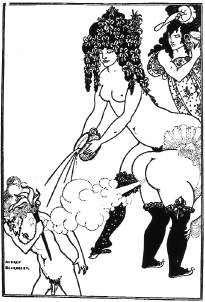
An illustration by Aubrey Beardsley for Aristophanes’ anti-war comedy Lysistrata, 1896.
Sadly, Beardsley did not live to fulfil his promise, but succumbed to tuberculosis in 1898, pleading with Smithers to destroy all his illustrations to Lysistrata ‘by all that’s holy’,36 after experiencing a deathbed conversion to Roman Catholicism. He was twenty-six years old. Fortunately for us, Smithers does not appear to have complied, and the illustrations remained in circulation.
Leonard Smithers (1861–1909), described by Oscar Wilde as ‘the most learned erotomaniac in Europe’, was a new breed of pornographer, a very different creature from the pathetic creep Hankey and the corrupt Dugdale. With his ‘singularly clear cut aristocratic features’, Smithers cut a dash in the shady world of dirty books; his authors included Oscar Wilde, Sir Richard Burton and Aleister Crowley, and Smithers did well out of them, acquiring a house in Bedford Square and a flat in Paris. He posted a slogan outside his Bond Street bookshop reading ‘Smut is Cheap Today’ and the money poured in. However, Smithers was not without his troubles. His wife became an alcoholic, and he himself dabbled in drink and drugs. In addition to this, he developed a taste for young girls. According to Oscar Wilde, ‘he loves first editions, especially of women: little girls are his passion’.37 He fell out with a colleague after being photographed having sex with his colleague’s wife in the basement of their house, and went bankrupt in 1900. In 1909, he was found dead in his shabby lodgings in Cubitt Street, Islington, which contained nothing but the bed he died on, two empty hampers, and fifty empty bottles of Chlorodyne, a patent medicine containing laudanum, chloroform and cannabis.
Not every pornographer met such an ignoble fate. When Henry Spencer Ashbee died in 1900, it was revealed that he had bequeathed his entire collection of 15,299 pornographic books to the British Museum. At first, this august institution demonstrated reluctance in the face of such largesse, but when it was made plain that the museum would also receive Ashbee’s outstanding collection of all the editions and translations of Cervantes’ Don Quixote the bequest was finally accepted.38 There was to be no bonfire at the bottom of the garden for Ashbee’s collection. Wisely, he had blackmailed the British Museum into taking it, rather than have it destroyed or broken up into lots and auctioned off by dealers.
Henry Spencer Ashbee was the Victorian pornography collector par excellence, as the scale of his collection indicates. As a London merchant whose business often took him to mainland Europe, he amassed a handsome fortune which enabled him to devote his spare time to travel and collecting books, some legitimate, some less so.39 In addition to accumulating the finest collection of Cervantes outside Spain and a selection of eighteenth- and nineteenth-century English watercolours, Ashbee had the most elaborate and extensive collection of pornography ever to have been assembled by a private individual. He also inherited a sizeable collection of sado-masochistic material from Frederick Hankey, after the latter’s death in Paris in 1882. But Ashbee was not simply a collector. He was also an author, publishing the Index Librorum Prohibitorum: Being Notes Bio-Biblio-Icono-graphical and Critical, on Curious and Uncommon Books under the pseudonym ‘Pisanus Fraxi’. Even taking into account the scatological nom de plume(‘Pisanus’ means ‘Piss anus’ while ‘Fraxi’ is simply from the Latin ‘fraxinus’ or ash tree) this tome does not at first sound promising, but when it appeared in March 1877 it transpired that this labour of love was an exhaustive survey of erotic literature, catalogued by the mysterious benefactor of Victorian pornography.
Ashbee’s stated intention was to illustrate how widespread pornography actually was, and what a vast field of human and aesthetic experience it covered, and to preserve it for future generations. After all, Ashbee remarked,
most of the books of this class are printed either privately or surreptitiously, in small issues, for special classes of readers or collectors…they do not usually find their way into public libraries…but are for the most part possessed by amateurs, at whose death they are not unfrequently burned; and they are always liable to destruction at the hands of the law…their scarcity is very much in proportion to their age; and as society is constantly at war with them, the natural course is for them to die out altogether.40
Ashbee’s cataloguing technique was systematic bordering on obsessive. Unlike other bibliophiles, he made it his rule ‘never to criticise a work which I have not read, nor to describe a volume or an edition which I have not examined’41 and was scrupulously methodical: ‘In treating of obscene books, it is self evident that obscenities cannot be avoided. Nevertheless, although I do not hesitate to call things by their right names, and to employ technical terms when necessary, yet in my own text I never use an impure word when one less distasteful but equally expressive can be found.’42 Ostensibly, Ashbee’s attitude towards pornography was objective, and detached. Writing as though he had no personal interest in the acts depicted, but was describing the effects of toxic chemicals, Ashbee warned readers that these books ‘should be used with caution even by the mature; they should be looked upon as poisons, and treated as such; should be distinctly labelled, and only confided to those who understand their potency, and are capable of rightly using them’.43 Most important of all, the books should be kept out of the hands of the young and the impressionable. Ashbee even made a somewhat spurious claim that pornography possessed a moral purpose, and that ‘immoral and amatory fiction’ deserved study on the grounds that it contained ‘a reflection of the manners and vices of the times, vices to be avoided, guarded against, reformed’, which sounds like a typical example of Victorian hypocrisy when Ashbee’s life and activities are considered in more detail.
One glaring omission was My Secret Life by ‘Walter’, published in Amsterdam around 1890, and therefore appearing too late to be included in the catalogue. It consists of eleven crown octavo volumes (a total of 4200 pages), rather poorly printed on handmade ribbed paper.44 Errors in typography, spelling and grammar suggest that it was set by a French compositor, while the identity of the author is kept secret by the omission of names, locations and dates. Although each title page bears the imprint ‘Amsterdam. Not for publication’, the work was clearly designed to be circulated to a select number of readers; subsequent owners of the books included Aleister Crowley, Josef von Sternberg, Lord Mountbatten and Harold Lloyd.
My Secret Life consists of the sexual memoirs of a Victorian gentleman, recorded over a period of forty years. It is the distillation of a lifetime of dissipation during which he has probably ‘fucked something like twelve hundred women, and have felt the cunts of certainly three hundred others of whom I have seen a hundred and fifty naked’. During the period he has had ‘women of twenty-seven different Empires, Kingdoms or Countries, and eight or more different nationalities, including everyone in Europe except a Laplander’.45 If not exactly well written, the book is an unflinching account of his sexual exploits, mostly with prostitutes. While ‘Walter’ does not emerge as an attractive man, his honesty and authenticity are refreshing, as are the occasional bouts of self-disgust, although his somewhat brutal approach is unlikely to appeal to female readers, as in the following example. After a three-way encounter with a prostitute and a drunken sailor, during which ‘Walter’ pays the couple to have sex while he watches (and then joins in), ‘Walter’ staggers home to find his wife is still awake: ‘On entering my room there sat she reading, which was a very unusual thing. I sat down wishing she would leave the room, for I wanted to wash; and wondered what she would say if she saw me washing my prick at that time of night, or heard me splashing…’
After going for a wash, and being kept awake by ‘fear of the pox’, ‘Walter’ finds the memory of the previous escapade so exciting that ‘my prick stood like steel. I could not dismiss it from my mind. I was so violently in rut. I thought of frigging, but an irrepressible desire for cunt, cunt and nothing but it made me forget my fear, my dislike to my wife, our quarrel, and everything else – and jumping out of bed I went into her room.
‘I shan’t let you, – what do you wake me for, and come to me in such a hurry after you have not been near me for a couple of months, – I shan’t, – I dare say you know where to go.’
But I jumped into bed, and forcing her on her back, drove my prick up her. It must have been stiff, and I violent, for she cried out that I hurt her. ‘Don’t do it so hard, – what are you about!’ But I felt that I could murder her with my prick, and drove, and drove, and spent up her cursing. While I fucked her I hated her, – she was my spunk-emptier. ‘Get off, you’ve done it, – and your language is most revolting.’ Off I went to my bedroom for the night.46
And even this is not enough to keep ‘Walter’s’ mind off the sailor.
After I had got over my fears I had a very peculiar feeling about the evening’s amusement. There was a certain amount of disgust, yet a baudy [sic] titillation came shooting up my bullocks [sic] when I thought of his prick. I should have liked to have felt it longer, to have seen him fuck, to have frigged him till he spent. Then I felt annoyed with myself, and wondered at my thinking of that when I could not bear to be close to a man any-where, I who was drunk with the physical beauty of women. The affair gradually faded from my mind, but a few years after it revived. My imagination in such matters was then becoming more powerful, and giving me desire for variety in pleasures with the sex, and in a degree, with the sexes.47
‘Walter’ turns a cold, appraising gaze on Victorian sexual activities, and has an eye and an ear well tuned to the nuances of London low life which makes him an invaluable social commentator. Every detail of every sexual escapade is clear, ‘the clothes they wore, the houses and rooms in which I had them…the way the bed and the furniture were placed, the side of the room that the windows were on, I remember perfectly’.48 And there is also a marked emphasis on the commercial transaction of paying for sex; on one occasion, he is rendered almost impotent by the fact that he cannot reciprocate a young woman’s advances after Derby Day because he has gambled away all his money at the races. Despite the girl’s response: ‘Never mind! Do me!’ ‘Walter’ is almost unmanned until he finds a spare half a crown. The girl pockets the money and moments later, ‘we stroked ourselves into Elysium’.49
Not for nothing was ‘spending’ his favourite term for ejaculation. ‘Walter’ was the ultimate Victorian punter, obsessed with ‘cunt’, and shows some grudging respect towards prostitutes but a rapacious attitude towards servants and young girls: as far as he was concerned, every woman had her price. The effect of reading ‘Walter’ for any length of time is one of monotony, as it is in the case of reading any obsessive author: the reader is almost bludgeoned into insensitivity, no matter how potentially arousing the subject matter, by the blunt instrument of the Anglo-Saxon sexual terms. Erotic prose is an art at which few English writers excel, as evidenced by the Pyrrhic victory of the ‘bad sex awards’ presented to British novelists in the late twentieth century. As Ashbee commented on another title, while comparing English erotic authors unfavourably with their French counterparts, ‘the copulations which occur at every page are of the most tedious sameness; the details are frequently crapulous and disgusting, seldom voluptuous…gross, material, dull and monotonous’.50
So keen was ‘Walter’ to conceal autobiographical details that little is known of the author’s public life, although his memoir offers some clues. Like Henry Spencer Ashbee, ‘Walter’ was born in London to a prosperous middle-class father and went into business. He inherited a small fortune on the death of his father, and, when the money ran out, married a rich woman whom he despised, and he evidently had some success in business. Ashbee founded and became senior partner in a firm of London merchants called Charles Lavy & Co., and married his partner’s daughter, Miss Lavy, a wealthy Jewish woman, while ‘Walter’ also married a Jewess, his boss’s daughter. It was not a happy union, although it did provide enough money to spend on prostitutes. ‘Walter’s’ wife died when he was thirty-five, much to his delight: ‘Hurrah, I was free at last!’51 ‘Walter’ then met Helen Marwood, a woman with whom he ‘did, said, saw and heard, well nigh everything a man and a woman could do with their genitals’,52 and who inspired him to keep writing the sex diary which he had begun in his twenties.
The parallels between the life and interests of Henry Spencer Ashbee and ‘Walter’ have been commented upon and more than one authority has suggested that ‘Walter’ may have been Ashbee. Although both writers demonstrate a certain obsessive-compulsive attitude towards matters of a sexual nature, the theory does beg one question: if Ashbee was ‘Walter’ then why, as a self-professed connoisseur of pornography, would he have taken refuge in a pseudonym? Was he, like Pepys, writing primarily for his own pleasure, so that he could dwell on his conquests in his old age? Did My Secret Life perform the function Oscar Wilde required of a diary, in that it was ‘something sensational to read on the train’? ‘Walter’ found himself one sympathetic reader in the form of Helen Marwood, who enjoyed telling him about her ‘former tricks’ in return for hearing about his own ‘amatory career’. ‘She had read a large part of the manuscript, or I had read it to her whilst in bed and she laid quietly feeling my prick. Sometimes she’d read and I listen, kissing and smelling her lovely alabaster breasts, feeling her cunt, till the spirit moved us both to incorporate our bodies.’53 It is a curiously domestic, even cosy, conclusion for a man whose preferred sexual encounters took place for money, with strangers, down dark alleyways.
While ‘Walter’ took a certain degree of homosexual play in his stride, never questioning his essentially heterosexual nature, the lives of genuine homosexual men continued to be overshadowed by prosecution and even death, as becomes evident in the following chapter.