
2

Sex, Church and State in medieval London
After a period of relative inactivity, prostitution in medieval London flourished once again, as it would continue to do over the following centuries, despite the depredations of the Norman Conquest, the Crusades and the Black Death, and despite the best efforts of Church and state to control it.
The booming sex trade indicated that Londoners were alive and kicking, whatever the horrors and upheavals that confronted them. And the allure of London’s ladies of the night sometimes proved so strong that their appeal was enough to prevent an attempted coup. When Earl Godwin, who had raised an army against King Edward the Confessor, was anchored off Bankside in 1052, it was noted that his band of loyal supporters diminished the longer it stayed, because they could not resist sneaking off to visit the ladies of the Bankside.1
Meanwhile, conditions in the sex trade had improved for the girls at the top of their profession. Overseas clients presented them with new clothes and jewellery, instructed them in manners and foreign tongues; the premises were built of stone, instead of mud and thatch. The girls enjoyed better working conditions than their predecessors in Roman times. Much of this was courtesy of the Church, which received a rich income stream from the properties it leased out to pimps and bawds. In addition to St Mary Overie, the Bishop of Winchester owned other properties in Chancery Lane and Fetter Lane.2 England’s royal family also dabbled in this form of investment: William the Conqueror derived an income from a series of brothels in Rouen, a fact which would not have occasioned comment during his lifetime.3
Whilst a modern reader may struggle to reconcile the Church’s attitude towards prostitution with its avowed injunction to chastity, the ecclesiastical authorities had no such reservations. Despite the official line about celibacy, the Church turned a blind eye. Taking to heart the comment of Saint Augustine that ‘Suppress prostitution, and capricious lusts will overthrow society,’4 the Church operated on the principle that prostitution fell into the category of ‘necessary evils’. St Thomas Aquinas himself compared prostitution ‘like unto a cesspool in the palace; take away the cesspool and the palace becomes an unclean evil-smelling place’.5 The Church then displayed a further level of hypocrisy by excommunicating any prostitutes who plied their trade while taking a share of the profits.
The Church was a calling to which resorted many who were incapable of making a living any other way, and there is a rich seam of anecdotal literature concerning the failings of the priesthood. Despite their frequent injunctions to others to turn away from sin, the men of God proved incapable of controlling their own sexual urges and their sexual excesses were legendary. The Dutch humanist Erasmus (1466–1536) complained that there were many monasteries where there was no discipline and which were worse than brothels, where a monk might be drunk all day long, go with a prostitute openly, waste the Church’s money on vicious pleasures and be a quack and a charlatan, and yet still be considered an excellent brother and fit for promotion to the role of abbot.6Many of the great cathedrals featured sculptures lampooning the sexual antics of the clergy. According to the Victorian historian of prostitution, Sanger, ‘in one place a monk was represented in carnal connection with a female devotee. In others were seen an abbot engaged with nuns, a naked nun worried by monkeys, youthful penitents undergoing flagellation at the hands of their confessor, and lady abbesses offering hospitality to well-proportioned strangers!’7
This outrageous behaviour went all the way to the top. At the Vatican, prostitutes lived in apartments owned by the Church and openly plied their trade. Pope Alexander VI, father of the infamous Cesare Borgia, was fond of holding family gatherings at the papal palace. On one occasion, fifty whores were hired to dance with servants and guests alike:
At first they wore their dresses, then they stripped themselves completely naked. The meal over, the lighted candles, which were on the table, were set on the floor, and chestnuts were scattered for the naked courtesans to pick up, crawling about on their hands and knees between the candlesticks. The Pope, the Duke [Cesare Borgia] and his sister Lucrezia all watched. Finally, a collection of silk cloaks, hose, brooches and other things were displayed, and were promised to those who had connection with the greatest number of prostitutes. This was done in public. The onlookers, who were the judges, awarded prizes to those who were reckoned to be the winners.8
From this and other accounts it can safely be deduced that the ancient Roman tradition of sexual excess had taken root and was thriving within the medieval Vatican. Given these examples, it is scarcely surprising that the populace had low expectations of their clergy. One writer, Guerard, related an anecdote from around 1065, concerning a kindly abbot who had rescued a young servant girl from the lewd attentions of a monk and offered her a bed for the night at his abbey. He was astonished to wake up the next morning and find the girl in his own bed. She had assumed that he had rescued her from the monk only because he wanted her for himself.9
Even the Crusades presented an occasion for sin. This series of holy wars fought between Christians and Muslims in Palestine, which began in 1097, saw thousands of women accompany the armies to the Holy Land, some as camp-followers attached to one particular man, some as cooks, cleaners and nurses, and many as prostitutes. Some women specialized in servicing the pilgrims bound for Jerusalem, while female pilgrims supported themselves by selling their favours along the way; some even abandoned a life of piety in favour of the oldest profession. English nuns were particularly prone to this change of career.10
Ecclesiastical mischief remained a standing joke throughout the medieval period. Back in London, the poet Geoffrey Chaucer exploited the yawning chasm between public piety and private misbehaviour to great comic effect in his Canterbury Talesverse sequence (c. 1386). These recognizable comic types reflect the popular perception of churchmen as a venal set, and it seems only appropriate that they set off on their pilgrimage from the Tabard Tavern in Southwark, already well established as a centre of low life.
Chaucer’s motley crew includes several stereotypes, among them a debonair monk, a pleasure-loving friar and a couple of depraved Church executives. The Monk, for instance, far from being buried away in a cloister or doing good works, is depicted as a burly, athletic man with a bald, shining head, grey, protuberant eyes and something of the thug about him.11 His main passion is hunting, animals and women, as his golden pin in the shape of a love knot indicates, and he is too busy chasing the birds, of the feathered and unfeathered variety, to drive himself mad studying theology.
The Friar, whom we meet next, is equally sophisticated: no hair shirts for him. Instead, he is a talented musician, a harpist and singer with a lisping voice, and better acquainted with the taverns of the towns he visits than the beggars and lepers who should be his natural constituents.12 The Summoner and the Pardoner, meanwhile, constitute a repellent couple. The Summoner’s job was to cite delinquents who appeared before the ecclesiastical court. Summoners had a reputation for corruption and abuse, even by the standards of the medieval Church, and this one is presented as a particularly vile specimen. His face is disfigured by leprosy, with scabby eyebrows and patchy beard, he is as lecherous as a sparrow (these birds were considered particularly lewd) and loose in his morals, willing to lend other men his concubines for up to a year without complaint, while he privately went after a ‘finch’ of his own, to use yet another analogy of birds and women.
Although the Summoner is nothing if not an equal opportunities lecher, Chaucer also insinuates that he fancies the Pardoner, whose task is to sell papal indulgences, many of which are fake. The Pardoner is effeminate, with long, lank yellow hair and no beard. ‘I trow he were a gelding, or a mare,’ Chaucer speculates, and mentions his high, sweet voice and talents as a singer, suggesting that he has been castrated, making him all the more attractive to the Summoner, who sings along with him, supplying the bassline or ‘burden’. At this point Chaucer takes the opportunity to make a really filthy double entendre as he watches the two of them together. The Summoner, according to Chaucer, looks at the Pardoner and ‘bears to him a stiff burden’.13
Convents, which should have operated as a sanctuary offering women a life of contemplation and prayer, were equally depraved. As the role of nunneries was chiefly charitable, rather than devotional, many of the inmates clung to the sophisticated manners they had learned out in the world, and no great effort was made to control their sexuality.
Chaucer’s nun is a good example. Madame Eglentyne, or the Prioress, models herself on the sophisticated French court (although her French is strictly East End, as spoken at Stratford at Bowe, and she is characterized by her soft red lips, beautiful clothes and the observation that she is certainly not underdeveloped.14 There is a mysterious man in her life, signified by the little gold brooch she wears, decorated with a crowned ‘A’ and inscribed with the Latin motto ‘Amor vincit onmnia – Love conquers all’. She has fancy table manners, keeps pet dogs and affects a ladylike sensibility, crying at the sight of a mouse in a trap and eating and drinking with great delicacy. Madame Eglentyne emerges as extremely refined when compared with real-life counterparts such as the Mother Superior at Amesbury, Wiltshire, during the twelfth century, who was so lewd that her nuns were quick to follow her example. The doors stood open day and night, and the building was more like a brothel than a convent.15
From time to time, the Church attempted to put its house in order and demanded that its clergy remain celibate. Hitherto, this requirement of clerical life had not been strictly enforced and priests had openly married or kept mistresses known as focarii, or ‘hearth girls’. As the Church attempted to enforce celibacy, former wives and lovers were left with no choice but to enter the convents and swell the ranks of the depraved nuns, or to become wandering whores.16
The Bankside brothels became known in colloquial terms as ‘the stews’, since they were located near the ponds which provided London’s supply of fresh fish. In 1161 King Henry II imposed his ‘Ordinance for the governance of the stews’ which in effect guaranteed the Bishop of Winchester’s right to exploit the brothels of Southwark for the next 400 years: as a result, many of London’s most attractive churches were actually built on the proceeds of prostitution. But Henry’s ordinance had other implications for London’s working girls. At a time when many European cities were attempting to banish prostitution, this ordinance represented an attempt to control the sex trade by creating an official red-light district in Southwark, the area that had been associated with prostitution ‘time out of mind’. Henry wanted to abolish the role of the madam and replace her with a male brothel keeper or ‘stewholder’. As Roberts says, this ordinance was both ‘prohibitive and protective’,17 as it laid down the rights of whores to follow their chosen profession but also curtailed their freedom of movement. The historian John Stow listed some of these rules:
NO STEWHOLDER or his wife to prevent any single woman from going and coming freely at all times she wishes to.
NO STEWHOLDER to keep any woman to board; she must be allowed to board elsewhere at her leisure.
NO STEWHOLDER to charge her for her room more than fourteen pence a week.
NO STEWHOLDER to keep his doors open on the religious Holy days: the Bailiff to ensure that they were removed from the parish.
NO WOMAN to be detained against her will if she wished to give up whoring: nor must the stewholder receive any married woman nor a nun.
NO WOMAN to take money to lie with any man, but she had to lay with him all night: and no man was to be enticed into the stewhouse; nor could any man be held for non-payment of his debt – he had to be taken to the Lord of the Manor’s prison.18
The whores were allowed to sit still in their doorway, but they were banned from importuning, and were not permitted to advertise themselves with gestures or calls, or to seize men by the gown or harness. Swearing, grimacing and throwing stones at passers-by were also discouraged, and the penalty for such activities consisted of three days and nights in jail and a fine of six shillings and eight-pence. The whores also had to leave the brothel during parliamentary sittings and Privy Council meetings, presumably so that politicians were compelled to attend them rather than seek consolation in the arms of loose women.
Further rules stated that the bailiff was to visit the house once a week and ensure that the whores were healthy and that none of them wanted to leave. And the ‘stewholder’ himself had to abide by certain rules: for instance, he was forbidden to keep a boat, to prevent him from rowing potential clients across the river.19 In an effort to curtail prostitution, citizens were banned from rowing across the Thames to Bankside after sundown, but this measure was ineffectual; resourceful men found a means of getting across, and other brothels inevitably sprang up on the north bank of the river. When King John was instrumental in building the new stone London Bridge in 1209, the law became impossible to enforce and the bridge became a royal road to the whorehouse.
Compared with French brothels and houses of ill fame elsewhere in the capital, the Bankside stews were dull, functional places. No entertainments were permitted, and it was forbidden to serve any ‘breed, ale, flesh or fyssh’ while ‘coles, wod or candel nor anie othere vitaill [necessity]’ were banned.20 Even the reference to the client staying all night had a practical function, to cut down on promiscuity and contain disease.
According to Stow’s Survey of London, there were originally about eighteen of these brothels. The exteriors were painted white, so that they were clearly visible across the river, and they had similar names to taverns: Ye Boar’s Hedde; The Castle; The Cross Keyes; The Cardinal’s Cap (accompanied by a suggestive illustration of a scarlet skullcap reminiscent of a foreskin) and, rather more poetically, The Half Moon; The Unicorn and The Blue Maid.21 That these institutions appeared similar to taverns was entirely intentional. Many places of entertainment operated in the shadowy half-world where legitimate inns also doubled as brothels, and many of the girls who worked in the taverns seized the opportunity for extra remuneration by entertaining their patrons. There was also plenty of scope for enterprising amateurs, married women who, feeling neglected by their husbands, repaired to ‘houses of assignation’ where they could satisfy their own appetites with willing paramours or turn a coin with a wealthy client looking for an upmarket girl.
While the taverns provided entertainment in the form of food and drink, the whorehouses effectively solved the problem of where to billet the large numbers of unattached men descending on London in search of work; they were the perfect municipal solution to overcrowding. One contemporary engraving of a medieval brothel shows us the kind of welcome a young man could expect: a handsome young noble is being attended by two young whores, watched by his jester, who looks horrified by the proceedings while slyly peeping through his fingers. The bed looks rather hard, but there are adequate refreshments. The girls appear somewhat coy, but the second is draped in a banner encouraging enticement to sin, designed to overcome the power of the cross worn around the young nobleman’s neck, while the first girl is administering manual stimulation.22 These brothels also supplied the ‘daughters of the city’ or civic whores who were rolled out to greet distinguished visitors, draped in suitably diaphanous raiment, although there is no evidence that the City of London followed the continental practice of actually hiring the whores for their guests.
Despite all attempts by the authorities to restrict the sex trade to Bankside, prostitution inevitably flourished in other areas of London, spreading gradually to encompass West Smithfield, particularly Cock’s Lane, outside Newgate. Records have revealed a maze of alleys in Moorgate and Cripplegate (near our contemporary Coleman Street and Guildhall) full of brothels. There was no mystery as to the trade that was conducted in these small streets, as one name indicates. The first mention of it appears in 1276, when a property belonging to Henri de Edelmonton was apparently located in the memorable thoroughfare of Gropecunt Lane.23 The Anglo-Saxon name indicates the most abject, desperate form of prostitution, with clapped-out, prematurely aged prostitutes catering for a desperate clientele who were charged a tiny sum in exchange for the opportunity to put their hands up their skirts.
Maiden Lane was nearby, along with Love Lane, full of ‘wanton maidens’ according to the historian John Stow.24 Gropecunt Lanes were not restricted to England. In Paris, the Rue Trousse Puteyne literally meant ‘the slut’s slit’. Back in England, Gropecunt Lane eventually became the more respectable ‘Grape Street’ and eventually ‘Grub Street’, the home of the literary hack (reminding all those who live by the pen that there is more than one way to prostitute oneself). Codpiece Lane became Coppice Lane, but there was nothing that could be done about Sluts’ Hole, which was transformed into Sluts’ Well before disappearing for ever into the Tenter Ground in 1700.25
The stews also represented another development in London’s sex trade: the return of the bath house. Bathing and washing had not been popular pursuits in early medieval London. Indeed, the Danish invasion back in 870 AD must have come as a relief for many women, amateur and professional, since Danish soldiers, unlike the Saxons, were famous for their good looks and high standards of personal hygiene. According to the medieval historian John of Wallingford (died 1214), the Danes represented a serious threat to jealous husbands and local lads. Not only did they comb their hair every day and take a bath on Saturdays, but they changed their clothes regularly. It was scarcely surprising that they were particularly successful in seducing married women, and even persuading the daughters of the nobility to become their concubines.26
Most Londoners of the period were careless of personal hygiene and did not regard cleanliness as being next to godliness. In some cases, indeed, the reverse was true. Consider this account of Thomas à Becket, murdered on the orders of Henry II in Canterbury Cathedral in December 1170. When his faithful acolytes went to recover the body, they peeled off layer after layer of garments to reveal a stinking hair shirt, hopping with fleas. Dirt and squalor ruled supreme. King John took a bath every three weeks and King Henry III would bravely ‘repair to the wardrobe at Westminster where he was wont to wash his head’, a decidedly hazardous procedure.
On rare occasions, for those higher up the social scale, wooden tubs were used as baths. In the summer months, some Londoners would bathe in the Thames, but this was scarcely a practice which could be adopted all year round. There were few lavatories, as such: brimming chamber-pots were emptied into the street and the contents carried off down the gutters into the nearest river or stream. In 1306 Ebbgate Street, near the river, just south of Thames Street, was choked with shit quarum putredo cadit super capitas hominum transeuntium – falling on the heads of passers-by.27 There were public latrines, or ‘necessary houses’, over running streams, with the human by-products then passing into the water supply and hence into the food chain. A cleansing team dispatched to Newgate gaol in 1283 consisted of thirteen workmen and took five days to clean the latrine, or cloacum. They were well recompensed for their labours though, receiving 6d a day, three times more than unskilled workers at the time. Particularly noisome streets were referred to as Pissing Lane, Stynkyng Alley or even Shiteburnlane.
But public bathing became fashionable once more when returning Crusaders brought with them their taste for the Turkish bath, or ‘hammam’. Public bath houses opened in France, Germany and eventually London. The enterprising owner would blow a horn to announce opening time, and locals would strip and walk to the bath house, stark naked during the summer months. Soon a taste for optional extras developed, and, just as in Roman London, ‘the stews’ became synonymous with brothels. Cleanliness also became desirable to the sex worker (and her client). Although few remedies were known, there was a recognition that venereal disease flourished in insanitary conditions, and being able to offer a clean whore and washing facilities were incentives.
The attitude of the authorities towards prostitution and licentious behaviour in London fluctuated according to who was in power. Despite the fact that the Church and the crown derived a considerable income from prostitution, their stance vacillated between tolerance and strict punishment according to the personal views of the reigning monarch. For instance, Richard I took a decidedly liberal view of prostitution, no doubt because he had great recourse to brothels himself, to such an extent that he was actually arrested in a brothel in Paris. When Richard’s brother, King John, succeeded him in 1199, he took no action against the stews. John’s son, King Henry III, grew up to be one of the most avaricious and close-fisted monarchs in history, notorious for his high taxes, but for some unaccountable reason the brothels escaped his attention.
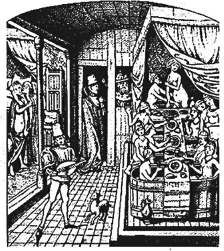
A medieval ‘stew’ or bath house. Note that hospitality extended to dining facilities in the tub.
But the mood changed significantly when Edward I came to power in 1272. A moral crusader (as well as a king levying taxes to pay for his part in the Crusades), Edward set about a clean-up campaign. In 1285 he ruled that ‘no courtesans nor common brothel keepers shall reside within the walls of the City, under pain of imprisonment’.28 Edward’s rationale was that the presence of prostitutes or ‘women of evil life’ attracted criminals and murderers, and that any common prostitute found within the city walls was to be imprisoned for forty days and reminded of the fact that she belonged beyond the city limits, in Southwark. As well as taking a firm line on prostitution, Edward I drove out the remaining Jews who had not already left England after the massacre unintentionally initiated by Richard I when he banned the Jews from his coronation on the grounds that he was a ‘Crusader’. This thoughtless gesture led to anti-Semitic riots, although Richard later punished the protagonists. Despite the fact that the royal family had relied on the Jews for their financial and medical acumen, they had long suffered exclusion and persecution. The Jews, and the ‘Turks’ or Muslims, were even excluded from visiting brothels. In 1290, Edward stated that: ‘those who have dealings with Jews and Jewesses and those who commit bestiality and sodomy are to be burned alive after legal proof that they were taken in the act and publicly convicted’.29 This was especially hypocritical on Edward’s part, as subsequent records reveal that, not only did the king derive an income from the stews of Southwark, but he had also issued a licence to run a brothel to Isaac of Southwark, one of the richest Jews in England.30
The pleasure-loving Edward II was content to let the brothels flourish, although his own tastes ran to boys. He was murdered, horribly, at Berkeley Castle in Gloucestershire, when a red-hot poker was rammed up his anus until it reached the intestines – a ghastly ‘punishment’ for weak governance and for his homosexuality. Edward’s greatest achievement was to found the Lock Hospital in Southwark in 1321. Originally intended for lepers (‘locks’ refers to the ‘locks’, or rags, that patients used to cover their lesions), it took on a new role centuries later in 1747, as the Lock Hospital on Hyde Park Corner, specializing in venereal disease, and generations of afflicted Londoners had cause to be grateful to its founder.31
When Edward’s son, Edward III, succeeded in 1327, he took an enlightened attitude to the brothels. In 1345 he reviewed the legislation of 1161 on the stews of Southwark recommending that the prostitutes wore a distinguishing mark in the form of a red rosette. A similar system operated in Avignon, France, while in Switzerland harlots wore a little red cap. Unfortunately, when it came to lewd and immoral behaviour, one law operated for the rich and another for the poor. Edward III’s Plantagenet court was characterized by immorality, with the royalty and aristocracy free to indulge their sexual proclivities to the full. There was even a brief fashion for female ‘topless jousting’ with scantily clad young women appearing at tournaments ‘dressed in a lascivious, scurrilous and lubricious fashion, with their breasts and bellies exposed’,32 according to one contemporary writer, while another described ‘ladies wearing foxtails sewed withinne to hide their arse’.33
While such frolics were tolerated with amusement in court circles, immorality lower down the social scale was dealt with more harshly. As one contemporary nobleman expressed it, ‘those that were rich were hangid by the purse, and those that were poor were hangid by the necke!’34 The street whores, or ‘nightwalkers’, received the most draconian penalties, such as the ‘cucking’ and ‘ducking’ stools.
A ‘cucking stool’ sounds inoffensive enough, but its origins are truly disgusting. According to Tacitus, in Germany, cowards, sluggards, debauchees and prostitutes were suffocated in mires and bogs by this method, along with ‘pests’ and useless members of society.35 ‘Cucking’ derives from the old Icelandic ‘kuka’; like the Latin ‘caca’ it means shit. Although it sounds like a joke to us now it was anything but. The unfortunate victim was fastened into a chair outside his or her own house and then wheeled to the location, where the chair was attached to a fulcrum and suspended over a deep pit of excrement into which they were lowered and where they would choke to death. The tradition lasted into Norman times, when it was used as a punishment for bakers and brewers who adulterated their products, and for ‘bawds’ (madams) and ‘scalds’, noisy and aggressive women who fought in the street.
The milder-sounding ‘ducking’ or gagging stool, where the miserable villain was dipped only in water, was not really preferable: although in theory the miscreant was dipped only two or three times to the point of suffocation, many mistakes were made, ending with the occupant of the chair being drowned, either by accident or intentionally.36
Then there was the ‘thew’, a special type of pillory like an upright crucifix, into which the victim’s head and wrists were locked. For an hour or two, this could be tolerated as a punishment by ridicule. But it developed into an instrument of torture, with victims being locked in the apparatus for days. While friends and relations might feed the victim, others would pelt him with bricks, stones, rotten vegetables and dung. The victims would inevitably defecate where they stood, fully clothed, to their infinite humiliation. Compared with this, the stocks, where only the legs were locked up, was comparatively tame.
At the very least, prostitutes did not escape being whipped at the cart’s arse, paraded through the streets and imprisoned in Newgate gaol, while their pimps received comparatively light sentences. One such was William de Dalton, imprisoned in 1338 for keeping a house of assignation in the city. Within two months, his influential friends had obtained his release, allowing him to set up shop elsewhere.37 In the same year, Robert de Stratford, a cordwainer who belonged to a powerful guild (a tradesmen’s organization), was charged with living off the immoral earnings of Alice Donbelly and Alice Tredewedowe and others. He agreed to be tried by jury, and was fined six shillings and eightpence, a comparatively small amount. His guild was no doubt influential in saving him from the humiliation and embarrassment of the common pimp’s punishment: being whipped at the cart’s arse and put in the stocks.38
Criminal prosecution seemed to have little effect on the flourishing trade. More brothel districts sprang up north-west of the city, including Moorgate, Cripplegate, Holborn, Shoe Lane, Fleet Street and Chancery Lane. In January 1340, one Gilbert le Strengmakere, along with Margery de Wantynge, Isabella Actone, Joseph Sewy and his concubine Salerna Livynge were charged with keeping disorderly houses and harbouring prostitutes and men of ill fame.39 The same charge sheet features two sisters, Agnes and Juliana, who were apprehended running a house of ill repute in Holborn, and Agnes, widow of Robert-at-Hale, for letting a house in Shoe Lane to ‘a woman of bad character’.40
One intriguing aspect of these documents is that many of the prostitutes have unusual names: for every Agnes or Alice, there was a Juliana or a Salerna. It was the custom for whores to use assumed names, partly to protect their identities and partly to make them appear more exotic. ‘Ionette’ was in fact ‘Janet’, from the stews of Southwark, while the exotic-sounding Petronella doubtless began life with a more sober moniker. Petronella was a favourite name with prostitutes for centuries.
Surnames were also adaptable. At this period, many people did not possess a specific surname, so the authorities would invent one. Some anonymous clerk of the charge sheet has given us the memorable Alice Strumpette (in order to distinguish her from other, law-abiding, Alices) and the delightful Clarice la Claterballock, whose speciality consisted of clattering her clients’ ‘ballocks’, conjuring up a vivid mental image of her particular technique.41
These records also remind us of the darker side of the criminal underworld and go some way to explaining why the authorities were so keen to crack down on prostitution. At Christmas 1339 an unpleasant incident occurred at the home of Ellen de Evesham, who kept a disorderly house just off Fleet Street. That week, ‘certain foreigners from her house attacked a man who was passing along the highway with a light, bound and beat him up, and carried him to the said Ellen’s house while she was present, with a lighted candle in her hand.’42 As well as this form of violence (which appears to have been an abduction or punishment for a client who had reneged on his payment), other aspects of the dark side of the trade emerge. Prostitutes have been mistreated by their pimps and madams from time immemorial; what is perhaps less well known is that such households contain other victims of abuse. How else to explain the curious story of one John Bunny, whose case came up in 1366? Bunny had been sold, with his master’s estate, to Joan Hunt, who kept a brothel on the far side of London Bridge. Joan had set him to hard work, treated him badly and starved him, and, through this hard labour, Bunny had developed physical injuries, probably a hernia. When Bunny complained, Joan’s lover, Bernard, physically assaulted him. When Bunny fell ill, she turned him out on the streets to starve. It is not known what punishment Joan received for her harsh treatment, but, mercifully, the story has a happy ending. The judge was so appalled by Bunny’s condition that he set him free.43
Another grim aspect of prostitution comes to light with an account from 1438, when a woman called Margaret was charged with: ‘Procuring a young girl named Isabel Lane for certain Lombards and men unknown; which Isabel was deflowered against her will in Margaret’s house and elsewhere, for certayne sums of money which Margaret collected, and then afterwards took the girl over to the common stews on the banks of the Thames in Surrey against her will for immoral purposes with a certain gentleman on four occasions against her will’.44
Margaret was a real hard case. In the same indictment she was also charged with taking a girl named Joan Wakelyn to a house in the parish of St Katherine Coleman as agreed with ‘a certain important Lombard’ who paid Joan 12d. For her ‘wicked and unlawful behaviour’, Joan had to give Margaret 4d from her earnings. And in turn Joan pimped Margaret, taking her, at dark, to the home of a ‘very prodigal Venetian’. The report concludes that ‘both women for a long time taking no thought for the safety of their souls had carried on this base and detestable manner of life…’45
Another explanation for the authorities clamping down on prostitution and other forms of lawlessness was the fear of imminent revolt. Among the disenchanted masses, political dissent was on the rise. Brothels, taverns and even church crypts proved handy meeting places for the disillusioned peasantry; largely illiterate, they could at least foment opinion, share their views and make plans for revolt, aided and abetted by organizers such as John Ball, the worker priest who preached equality for all men with the slogan ‘When Adam dalf and Eve span, Wo was thane a gentilman?’46 Unlike the prostitutes, whose ultimate goal was to earn a crust and eventually retire, these were potential revolutionaries, many of them former soldiers who had served in the Hundred Years War and remembered the horrors of the conflict, as described by Geoffrey Chaucer, ‘the thousand carrion corpses lying in the bushes with their throats slit, the towns burnt to the ground with nothing left standing’.47 They had arms in their cottages and they knew how to use them. They were violent agitators, who represented a real danger to the king.
But, before the rebels could organize sufficiently to overthrow the government, the land was plunged into crisis by a far more terrifying adversary than a crew of political agitators. The Black Death made its inexorable progress through England, Scotland and Wales, as vividly described by the Welsh poet Jeuan Gethin (died 1349):
We see death coming into our midst like black smoke, a plague which cuts off the young, a rootless phantom which has no mercy or fair countenance. Woe is me of the shilling in the arm-pit; it is seething, terrible, wherever it may come, a head that gives pain and causes a loud cry, a burden carried under the arms, a painful angry knob, a white lump. It is of the form of an apple, like the head of an onion, a small boil that spares no-one. Great is its seething, like a burning cinder, a grievous thing of an ashy colour. It is an ugly eruption that comes with unseemly haste. It is a grievous ornament that breaks out in a rash. The early ornaments of Black Death.48
The Black Death, which killed about half the population of England and one third to half of the population of London alone, inspired utter terror and desperation. Whilst one might be tempted to conclude that it also killed off sexual desire and put a temporary end to prostitution, nothing could be further from the truth. Instead of repressing desire, the Black Death created an extraordinary mood of sexual profligacy, with victims and potential victims giving themselves over to pleasure, despite the fact that crowding into taverns and brothels inevitably caused the plague to spread faster.
Many believed that victims of venereal disease could not catch the plague; others, that sexual intercourse prevented it. An obsession with marriage developed, with widows and widowers rushing to the altar while they still had the chance. And, since an urban myth sprang up that sex with a prostitute actually guaranteed immunity from this plague, trade had never been better.
Members of the oldest profession displayed a similar resilience in 1381, when years of unrest and economic decline following the Black Death finally culminated in the Peasants’ Revolt. When the rebel leaders, Wat Tyler, Jack Straw and John Ball, arrived in Southwark preparing to march on London, they ‘despoyled’ a brothel in the neighbourhood run by a Flemish woman (who leased the house from Walworth, the mayor of London). This was despite the fact that these institutions provided the only possible income for many of their ‘sisters’. The whores were not to be out-done, however. Just as, centuries later, such women threw in their lot with the French and Russian revolutionaries, the girls of the Bankside immediately grasped the potential of such a mass uprising. When, the following morning, on the feast of Corpus Christi, the rebels surged peacefully across London Bridge and into the city, the whores marched alongside them, offering comfort and support as they threw open the prisons. The revolt concluded in tragedy, of course. Richard II, having promised the rebels a pardon, arranged a meeting the following day with Wat Tyler at Smithfield; when he arrived, Tyler was seized and stabbed to death by Mayor Walworth, the latter receiving a knighthood for this act of betrayal.
As a response to the revolt, the climate of public tolerance towards all so-called sex crimes quickly began to erode. The streets teemed with spies, ready to apprehend ‘strollers’ and any woman who was not either handsome or rich enough to bribe the authorities to turn a blind eye was carted through the streets and publicly humiliated with great pomp and ceremony, her hair shorn as pipes and trumpets belted out. Later that same year, when John Kempe and Isabelle Smythe were found guilty of adultery, they were taken to the mayor’s court and charged a heavy fine.49
In another move to control the sex trade, a new dress code was enforced, designed to distinguish ‘ladies’ from ‘women’. Just as the Roman whore was officially banned from wearing the stola of her respectable counterpart, so ‘women’ were informed that they must not ape the dress of their female betters. ‘No such lewd [proletarian] woman shall be so daring as to be attired either by day or night in any kind of vesture trimmed with fur such as miniver, grey work [badger], squirrel, or any other manner of noble budge [fur] or lined with sendale, bokerames, samytes [rich silk] or any other noble lining, on pain of forfeting the said vestments.’ Instead, they were ordered to wear a hood of ray (striped cloth) and plain undecorated clothes, ‘that all folks native and strangers may have knowledge of what rank they are’.50 As Burford notes, this early form of apartheid operated for another couple of centuries and served to safeguard the status quo by prescribing in minute detail what might be worn by the nobility and the lower orders.
Despite the income derived from prostitution, the ecclesiastical authorities felt compelled to crack down on the sex trade, as did a succession of reigning monarchs. Henry V attempted to abolish the stews in a fit of self-righteous bigotry, while his son, Henry VI, ordered a commission of inquiry in 1460, during one of his last periods of lucidity before succumbing to insanity. The report of this commission of inquiry concluded that the stews were a social menace and attracted violent antisocial behaviour: ‘the number of prostitutes in Southwark and other places adjacent’ caused ‘many homicides, plundering and improprieties’ which the ecclesiastical authorities were incapable of containing.51
Within a year of this inquiry, Henry VI was dead, murdered in the Tower of London, and his son Edward IV, the pleasure-loving ‘sun in splendour’, took the throne. And once again, London’s moral climate changed.
It is tempting to regard this period as a grim catalogue of cruelty and abuse, but it is worth reminding ourselves that not every good-time girl came to a bad end. Indeed, many ‘whores’, amateur and professional, made enough of a success of their life on the game to retire and enjoy a healthy, wealthy old age. Their stories are untold: personal discretion, lack of historical records and the fact that until recently the lives of women were not considered worth recording account for this. But one documented case is the story of London’s first courtesan, Jane Shore, ‘harlot and heroine’, mistress of Edward IV, victim of Richard III, and resourceful survivor of one of the darkest periods of English history.52
Jane was not potential harlot material. Born Elizabeth Jane Lambert in 1445 to the London merchant John Lambert and his wife, Amy, Jane seemed destined to become a prosperous nonentity. She was married ‘ere she were ripe’, to a goldsmith, Matthew Shore, who was considerably older, but the marriage was not a success. According to Sir Thomas More, Jane was ‘not very fervently loved by her husband’ and the marriage was eventually annulled on the grounds of his impotence.53 Petite, curvy and round-faced, Jane was celebrated more for her personality and wit than her looks. But it was not long before she caught the eye of the king, Edward IV, and became his mistress. Edward was married, of course, and had a selection of mistresses, but his wife, Elizabeth Woodville (another great survivor), accepted her as the king’s chief mistress, and it is at this period that she took the name ‘Jane’, to appease Elizabeth and avoid confusion with the queen. Jane’s status changed with the death of Edward IV in 1483 and the accession of Richard III, who promptly consigned her to the Tower of London. Accused of being a harlot, Jane was sentenced by the Bishop of London to perform the traditional penance for that offence: she had to walk barefoot through the streets from St Paul’s in a procession led by a choir and a priest carrying a cross. Dressed only in her petticoats with her hair hanging down, she carried a lit candle and had to endure the attentions of a noisy and ogling crowd, something which she managed with great dignity. She won over the onlookers with her ‘womanliness and patience’ during this ordeal. Following her penance, Jane was incarcerated in Ludgate prison, where she met the king’s solicitor, Thomas Lyneham, who was so smitten that he proposed to her.
A question mark hangs over Jane’s subsequent fate. The popular perception is that she lived on, ‘lean, withered and dried up’, according to Sir Thomas More, and ended her days begging on the streets of London, and gave her name to ‘Shoreditch’, the spot at which she died. But it seems unlikely that Jane died in poverty. Thomas Lyneham was a wealthy man, and even Sir Thomas More, when he met Jane in old age, reported that she had a soft tender heart and that the remnants of her beauty still shone through the ravages of time. The less sensational facts are these: Jane died at the age of eighty-two, a considerable age in those days, and was buried in Hinxworth Church, Hertfordshire, where her effigy remains to this day. She was a remarkable woman, having survived the back-stairs politics of a savage age, when Richard III cut a murderous swathe to the throne and the first Tudor monarch, Henry VII, subsequently dispatched all Plantagenet opposition. To have married again, died of old age and be buried in a quiet country church was quite an achievement for our demi-mondaine, first of a long and fascinating line of celebrity mistresses.
As Jane breathed her last peacefully, far from London and the court, a new and terrifying development in London’s sexual history had made itself manifest: a mysterious, disfiguring and potentially lethal disease, against which the forces of both Church and state seemed powerless.