
3

‘Detestable Vice and Synne’
Henry VIII has never been associated with piety or sexual abstemiousness. Indeed, the notorious Tudor’s name is still synonymous with self-indulgence: hunting, dancing, eating, drinking and, most famously of all, wenching. And yet, in a move which now seems extraordinary, King Henry introduced two draconian pieces of legislation ostensibly aimed at curtailing the pleasures of the flesh. In 1546, he ordered the closure of London’s brothels. And prior to this, in 1533, he ensured that the Buggery Act would be steered through Parliament. In this chapter, we will examine Henry’s motivation for this legislation, and the success, or otherwise, of the venture.
First, let us turn to the attempt to close the brothels. In April 1546, Henry VIII issued a strict edict ‘putting down the stews’. This was announced in the streets by a herald at arms, accompanied by blasts on a trumpet. The proclamation stated that any brothel keeper who ran one of the distinctive whitewashed houses must cease trading immediately. He or she was banned from entertaining clients or selling victuals.1 And allied trades were destined to feel the pinch: in order to deter punters pouring into Bankside, Moorgate, Fleet Street and Chancery Lane, Henry VIII outlawed bear-baiting and dog fighting and closed the establishments where these entertainments took place. Bearing in mind Henry’s permissive personal life and taste for cruelty, it seems extraordinarily hypocritical to have deprived Londoners of their traditional pleasures, however barbaric these seem to modern readers. It appeared unlikely that Henry was bowing to pressure from his subjects regarding lawlessness and antisocial behaviour. He had not been noted for listening to the wishes of his people, let alone acting on them, and at that historical period it was unlikely that his decision was informed by a sudden revelation concerning the issues of sex slavery or animal rights. Moreover, Henry himself was a veteran of ‘Winchester Garden’, never missing an opportunity to frolic with the ‘geese’ procured for him by his pimp, the devious Archbishop Gardiner. So what was the real explanation for Henry’s decision to close the stews?
For the answer, we must travel to Renaissance Italy and enter the consulting rooms of Dr Pedro Pintor (1423–1503), physician to Pope Alexander VI, the ‘Borgia Pope’ (who, you will recall, was in the habit of getting prostitutes to crawl around the floor of his palace, squabbling over pieces of jewellery). Dr Pintor had identified an horrific sexual plague, the victims of which ‘languished’ with ‘an obscene disease: dire flames upon their vitals fed within, While Sores and crusted Filth prophan’d their Skin’.2Whilst Dr Pinto would have been familiar with gonorrhoea, or ‘the burning’, characterized by severe inflammation of the urethra causing severe pain on urination (hence the name), he now encountered a ruthless and ultimately deadly condition.
In March 1493, Dr Pintor had noted the first case of the morbus gallicus, or ‘French disease’, in Rome, and claimed that the French army had brought it into Italy. Over the next two years, the disease spread like wildfire across Europe, as the inevitable consequence of military campaigns. When the French army occupied Naples in February 1495, many French soldiers were infected, so they in turn decided to call it mal de Naples, ‘the sickness of Naples’. In August 1495, the Emperor Maximilian issued an edict referring to the disease as malum franciscum, and, when the French returned home in 1495, they spread it across their homeland. As Voltaire put it: ‘when the French went hotfoot into Italy they easily won Naples, Genoa and the Pox. When they were driven out they lost Genoa and Naples, but they did not lose everything, for the Pox stayed with them!’ ‘Pox’ (from ‘pocks’ on the skin brought about by the ravages of infection) remained the popular name for the disease for years after.3
The disease was officially recorded in Naples in January 1496; eight weeks later, the authorities in Paris made the first bid to control this menace to public health. But this proved impossible with promiscuous armies rampaging their way across Europe. Cesare Borgia caught it in France, and Pope Julius and many cardinals were also infected. The disease arrived in England around 1500. When it first occurred, doctors assumed this particularly vicious strain originated in the new American colonies, and had been brought back to Europe by Columbus’s sailors. But, in 1521, the Veronese physician Girolamo Fracastoro gave the condition a name in his poem Syphilis sive morbus gallicus (‘Syphilis, or the French disease’), which concerns the ordeal of a Greek peasant named Syphilus. Syphilus had angered Apollo and was punished with ill health and dreadful ulcers all over his body, which were later cured by Mercury, the god of medicine.
Fracastoro expressed doubt that the disease had come from America, and the controversy over its origins continues to this day, with some experts claiming that it originated in pre-Columbian America, whilst others argue that it originated in Africa and spread as the result of the slave trade. A third theory suggests that the disease mutated at the end of the fifteenth century and became virulent due to the unusual movements of populations in the Age of Discovery.4 Renaissance thinkers postulated a number of theories as to the origins of the disease, ranging from astrology to leprosy. The most bizarre theory of all was proposed by Francis Bacon in Sylva Sylvarum. According to Bacon, ‘the French do report, that at the siege of Naples [1495] there were certain wicked merchants that barrelled up man’s flesh (of some that had been lately slain in Barbary) and sold it for tunney [tuna fish]; and that upon that foul and high nourishment was the original of that disease. Which may well be; for that it is certain that the cannibals in the West Indies eat a man’s flesh; and the West Indies were full of the pocks when they were first discovered.’ In other words, Bacon is suggesting that syphilis originated from cannibalism.5
Whatever its origins, syphilis spread with deadly rapidity among a population with a low degree of immunity. This was compounded by the fact that it could be spread without sexual contact. A syphilitic barber, an infected cup or a kiss from a diseased person were all enough to pass on the disease.6 Tragically, it could also be spread by breast feeding, which in an era of wet-nursing presented a grave risk to infant health, and to the health of a nurse, who could be infected by a syphilitic baby.7 The strain of syphilis decreased in severity over the course of the sixteenth century, most likely, Fabricius tells us, as a result of improved standards of living. But it was still a peculiarly unpleasant condition.
The physician Thomas Sydenham’s description of the progress of the disease includes the graphic observations that the symptoms begin with a spot, about the size and colour of a measle, which appears in some part of the glans, followed by a discharge from the urethra. As the pustule becomes an ulcer, the patient experiences great pain during erections, followed by the development of buboes, swellings of the lymph nodes, in the groin. Then come splitting headaches, pains in the arms and legs, while crusts and scabs form on the skin. The bones of the skull, shin-bones and arm-bones are raised into hard tubers, and, worst of all, the cartilage of the nose is eaten away so that the bridge sinks in and the nose flattens.8 One author noted the case of a man who ‘being long sicke of the poxe had two tumours and an ulcer in his nose, at the which everie day there came foorth great quantitie of stinking and filthie matter’. This grim description depicts one of the most horrible lesions of syphilis, in which nasal bones are destroyed by gumma, or gummy tumours. Syphilis attacks the mucous membranes and soft tissue, eating away the nose and in serious cases exposing the brain to the air.9
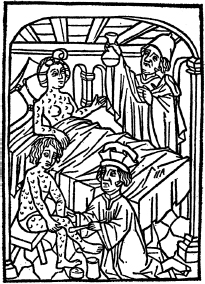
Treatment of a syphilitic couple with mercury balm, a common medication during the fifteenth century.
This was an extreme example of syphilis; just as disturbing were the symptoms that went undetected. Victims were not always aware that they had been infected, and the disease took time to reveal itself: patients might feel well for up to four months before the syphilitic symptoms appeared, in the form of a ‘dosser’ or syphilitic bubo, agonizing ulcers that ate away the skin. But treatment was just as painful. The traditional remedy for all skin diseases such as scabies, psoriasis and leprosy was mercury, orUnguentum Saracenium, an ointment invented by the Arabs (hence the name ‘Saracen’) and readily available in Europe.10 This was a primitive form of chemotherapy, in which the mercury burned off the skin tumours, although it was not an effective long-term cure, as it did not destroy the infection and it was highly toxic.
An alternative treatment came in the form of guaiac, a wonder drug from the New World which sailors claimed would cure syphilis without the gruesome side effects of mercury. This substance derived from the guaiacum tree, a heavy, ebony-like wood, as black as ink, and was administered in a tincture in a sweat room, with the patient confined in stinking conditions for up to a month. The other remedy, which involved excising the sores and cauterizing the wound, would have been excruciating. If the disease had got a hold, it became essential to seek out an expert surgeon for help. Dr Andrew Boord, a famous physician, advocated celibacy and abstinence: at the first stirrings of an erection, a man was advised to ‘leap into a grete vessel of cold water or putte nettles in the Codpeece about the yerde [penis] and the stones [testicles]’, an extreme but doubtless effective method of cooling one’s ardour.11
Scapegoats for the spread of syphilis were not hard to find. In 1530, Dr Simon Fish, a Protestant divine, even told Henry VIII that promiscuous ‘Romish priests’ were responsible for the spread of the disease, claiming that they ‘catch the Pockes of one woman and bear them to an other; that be BURNT with one woman and bare it unto an other; that catch the Lepry of one woman and bare it to another…’ The use of the word ‘lepry’ is significant here, as doctors at this time had difficulty in distinguishing the symptoms of syphilis from those of leprosy. Meanwhile, Dr Boord had established that ‘if a Man be BURNT with an Harlotte and doe meddle with an other Woman within a Day he shal BURN the Woman that he shal meddle withal’.12
Nobody was safe. Henry VIII himself was a sufferer, and many historians have attributed his volcanic rages and outbursts of paranoia to tertiary syphilis (end-stage syphilis). The pox was no respecter of persons, and men of the Church were not immune. In 1553, Henry’s pimp, Archbishop Gardiner, was afflicted with ‘the Burning’ while in 1556, Dr Hugh Weston, Dean of Windsor, was sacked for adultery, after being ‘bitten by a Winchester Goose and not yet healed thereof’. The gossip writer John Aubrey tells us that Francis Bacon’s mother made Sir Thomas Underhill ‘deafe and blinde with too much of Venus’13 when she married him, those symptoms being synonymous with sexually transmitted disease. And as for Sir William Davenant, the dramatist, the unfortunate gentleman ‘got a terrible clap of a Black handsome wench that lay in Axe-yard, Westminster, which cost him his Nose’, although the episode was not without its consolations, as the woman in question inspired the character of Dalga in the playGondibert.14
Prostitutes were inevitably held responsible for the spread of syphilis and condemned as ‘rotten filthy harlots’ by the male medical establishment. For the whores, sexually transmitted disease was an unavoidable consequence of their trade, given that they might have intercourse with over thirty men in a day. Regular inspections by the likes of Dr Boord did nothing to protect them. Perfunctory examinations, lasting only a few minutes, were carried out with unwashed instruments by doctors with dirty hands. These health checks probably did as much to spread syphilis as the sex act itself. As it swept through London, Henry VIII had only one option: to close the brothels in an attempt to contain the epidemic. Sadly, this early example of gesture politics was ineffectual. Behind closed doors, Jack continued to have Jill, the sex trade flourished, and Henry’s court became one of the most notorious in Europe, throbbing with intrigues, conspiracies and secret marriages. There was also a notable degree of male homosexuality. And yet, in 1533, Henry had instructed his adviser, Thomas Cromwell, to steer a new act through Parliament: it was referred to as ‘the Buggery Act’ and would make ‘buggery’ a capital offence, ‘because there was not sufficient punishment for this abominable vice, committed with man or beast’.15
To achieve some insight into Henry’s motivation, let us look at ‘buggery’ in its historical context. From the time of Henry I, ‘buggery’ had been downgraded from a criminal offence to a moral one, which required to be dealt with by the ecclesiastical courts rather than the judiciary. And to all accounts the offence was treated leniently, no doubt because buggery was so common amongst the priesthood, and was also prevalent at court. The Italian author and diplomat Castiglione, who had visited the court of Henry’s father, Henry VII, noted the ‘womanish’ men who, ‘seeing nature hath not made them women ought to be banished not only out of princes courtes but also out of the company of gentlemen’, while another commentator argued that sodomy was associated with following French fashion trends, and that courtiers in French dress were transvestites, proud and drunken ‘progeny of Lucifer’ who flew in the face of nature by committing lechery, abuse and other abominable acts.16
This condemnation derived from the biblical edict on same-sex activities: ‘If a man also lie with mankind, as he lieth with a woman, both of them have committed an abomination; they shall surely be put to death’ (Leviticus 20:13). Castiglione doubtless was aware that the vice was associated, as were other sexual peccadilloes, with his fellow countrymen; the Italians were regarded as being particularly given to buggery, hence the common insult of ‘back door Italian’, meaning one who enjoys anal sex (‘buggery’ derives from the Italian ‘buggerare’). Anal sex was also routinely practised by heterosexual couples as a form of contraception, as in the poet Guilpin’s observation that ‘Since marriage, Faber’s prouder than before, Yfaith his wife must take him a hole lower.’17
While Castiglione and his associates may have had certain reservations about homosexual practices, a reasonable degree of tolerance prevailed while England was still controlled by the Church of Rome. This tolerance was analogous to the acceptance of prostitution, a manifestation of the Roman Catholic belief that man was essentially impure and susceptible to the temptations of the flesh. However, after the Reformation, the climate of tolerance changed. To gain some idea as to the implications of this, let us analyse the meaning of the term ‘buggery’ in Reformation England.
For the modern reader, buggery means anal sex, but the Tudors interpreted buggery as any form of sexual deviation, including incest, bestiality and even witchcraft. This product of the peculiar Tudor mentality consisted of lingering medieval superstitions and ill-informed beliefs, including the idea that stillborn or deformed children were evidence of copulation with the devil. Bestiality was included because it was believed that buggery was not merely a sexual preference but associated with witchcraft and devil worship, the buggers in question copulating with the Prince of Darkness himself in animal form.
So, for the Tudors, buggery became a blanket term for sex crimes. The Buggery Act even contains one fascinating and bizarre reference to a noblewoman who, it was claimed, committed bestiality with a ‘Barbary ape’ and gave birth to a mutant offspring. Her crime was, it appears, too early for her to be prosecuted under the statute. Buggery was held to be such a vile crime that it actually constituted a form of treason. Committing buggery was a crimen laesae Majestatis, or a crime against the king, for which the only fitting punishment would be death followed by burial without religious rites. The Buggery Act was not a means of persecuting homosexual men. Instead, it represented a convenient method for disposing of anyone who represented a threat to the king, and its most famous victim died at the Tower of London on 19 May 1536. Executed as a heretic and a witch, she was Anne Boleyn, one of London’s greatest grandes horizontales and the most tragic.
Anne had been the star of the court during her affair with Henry. The original ‘It girl’, right down to the initial necklace (a golden ‘B’ for Boleyn surrounded by pearls), Anne was celebrated for her vivacity, intelligence, political acumen and dark good looks. Anne had married Henry VIII secretly in January 1533, following his divorce from Catherine of Aragon, but the marriage was not officially announced until June. The populace took against Anne, and soon allegations circulated that she was a witch with six fingers. Anne gave birth to one healthy child, the future Queen Elizabeth I, but then came two miscarriages; rumours flew around that the second foetus was hideously deformed.
By this time Henry was suffering bouts of impotence, which he blamed on Anne, since witches were believed to cause impotence by ‘overlooking’ unfortunate men. Meanwhile, Henry and his adviser, Thomas Cromwell, who had fallen out with Anne over policy issues, conducted a character assassination on a grand scale, discrediting Anne with allegations of ‘buggery’.
Towards the end of April, Anne’s musician, a young Flemish boy named Mark Smeaton, was arrested and tortured until he ‘confessed’ to having had sex with her, as were three other men, Henry Norris, Sir Francis Weston and William Brereton, despite the fact that the latter two were exclusively homosexual in their orientation. Finally, Anne’s own brother, George, was charged with incest, the stillborn baby being considered evidence of an unnatural union. The ‘evidence’ for these allegations would not withstand the scrutiny of a modern legal team, but the trumped-up charges were sufficient to see Anne’s four alleged ‘lovers’ executed on 17 May, while Anne herself went bravely to the scaffold two days later, and submitted to her fate with considerable dignity.18
Anne’s real crime was not ‘buggery’ in any of its manifestations. She did not commit adultery, or incest, or dabble in witchcraft. The mundane facts are that she fell out of favour with her husband, and alienated the powerful political operator Thomas Cromwell by opposing his proposals for the funds confiscated during the dissolution of the monasteries. In short, Anne was executed for being an infertile woman whose husband had tired of her, and who meddled in affairs of state.
The Buggery Act received royal assent in 1533 and became enshrined in English law as the Buggery Statute, with buggery remaining a capital offence until 1861. Four days later, ‘Walter’, Lord Hungerford (1503–40) was executed for infringing it. By all accounts Hungerford had been a violent and despicable man. He tried to starve his wife, Elizabeth, to death by locking her up in a castle for four years, and then tried to poison her.
Elizabeth wrote to their mutual friend Thomas Cromwell, concerning Hungerford’s physical and mental cruelty, saying she was willing to testify against him in court. Cromwell had previously ignored her pleas, finding it expedient to take Hungerford’s side. Subsequently, however, Hungerford found himself charged with exercising the ‘abominable and detestable vice and synne’ of buggery with his servants; William Maister and Thomas Smyth (his sons-in-law); and others at his house in Heytesbury, Wiltshire, and at ‘divers other places within the same county’. Hungerford also stood accused of having sexual relations with his own daughter, and practising witchcraft, ‘being seduced and led by the Devil, willing and desiring by all his wicked wit and power the mortal death and utter destruction of Your most royal person’. This consisted of attempting to predict how long the king had to live, with the help of Mother Roche, a notorious witch.
Another charge of treason stated that Hungerford had taken in a young priest and employed him as his chaplain. As the priest, William Byrde (a relative of the composer of the same name), was an out-spoken critic of King Henry, Hungerford was also guilty of treason. So, although the church registers kept by the Grey Friars record that Hungerford was beheaded for ‘bockery’, the real cause was treason.
Hungerford was executed on Tower Hill, and he did not die with dignity. According to Holinshed, at the time of his death, ‘he seemed so unquiet, that many judged him rather in a frenzy than otherwise’. As for Elizabeth, once her husband had been executed, she married Sir Robert Throckmorton, ‘with whom she spent many years of presumably happy life, and by whom she became the mother of several children’.19
Executed alongside Hungerford was the original instigator of the Buggery Statute, the very man who had led the plot against Anne Boleyn. Thomas Cromwell himself had fallen out of favour with the king, following the latter’s disastrous marriage to Anne of Cleves, and he now fell victim to the volatile monarch’s terrifying destructive rage.
Not every charge of buggery resulted in execution. Nicholas Udall (1504–56), a cleric and poet who had written celebratory verse on Anne Boleyn’s entry into London as a newly crowned queen, was also a Latin teacher at Eton College. By 1534, Udall had risen to the position of headmaster. But in March 1541, less than a year after Hungerford’s execution, Udall was accused of physical and sexual abuse and admitted buggery with two of his pupils. Udall was lucky to escape execution – thanks to the intervention of the Earl of Southampton. Because he had not committed treason, Udall’s sentence was commuted to imprisonment, and he was free within a year, but with his career in ruins. Who would employ a master who had sexually abused his pupils? However, after a period of rehabilitation which saw Udall as vicar of Braintree and vicar of Calborne, Isle of Wight, he returned to teaching, and ended his career as headmaster of Westminster School in 1555.20
The Buggery Statute was repealed by Queen Mary during her brief reign of 1553–8. As a Roman Catholic, Mary demonstrated tolerance towards sexual peccadilloes such as homosexuality and prostitution, but more than made up for this apparent leniency with her fanatical religious persecution.
When Elizabeth I took the throne, she renewed the law against buggery on the grounds that ‘divers ill-disposed Persone have been the more bold to commit this most horrible detestable vice to the High Displeasure of Almightie God’. One suspects, however, that Elizabeth, like her father, was using the Buggery Statute as a political measure, rather than a method of persecuting homosexual men. After all, the atmosphere at court was one of high camp, as the bewigged, bejewelled, enamelled Elizabeth peacocked about like a drag queen, surrounded by her coterie of mincing ministers. These included such notable homosexuals as Sir Francis Bacon and Henry Wriothesley, Earl of Southampton. The latter was Shakespeare’s most famous patron, dedicatee of ‘Venus and Adonis’ and ‘The Rape of Lucretia’ and possibly the mysterious male lover referred to in the Sonnets.
Elizabeth presided over one of the most magnificent outpourings of poetry and drama ever witnessed, in England or elsewhere, a considerable amount of which was composed by homosexual men. Much of Elizabethan literature is blatantly homoerotic, whether it be the passionate sonnets addressed by Shakespeare to the enigmatic Mr W H or the sex comedies with their innuendo-laden titles such as As You Like It, All’s Well That Ends Well and even A Midsummer Night’s Dream. Add to this titillating mix the fact that boys performed the role of girls dressed as boys and you have a plethora of transsexual teasing. No wonder the Puritans closed the theatres down.
Poets such as Richard Barnfield and William Drummond published manifestly erotic odes to Arcadian shepherd boys in the classical tradition, while Christopher Marlowe’s famous invitation to ‘come live with me and be my love’ was addressed to one of London’s ‘golden lads’, Lord Hunsdon, a favourite cousin of the queen, who was notorious for keeping a male brothel, described as a ‘bawdy house of beasts’, in Hoxton.21
This climate of happy tolerance existed in an era when there was no formal definition of male homosexuality, or a gay scene as it is understood today. Instead, behaviour which we would now categorize as homosexual was accepted as part of the spectrum of male sexuality, if it fell within certain socially acceptable boundaries. No shame attached to the young man about town who stepped out with his plump mistress on one arm and his ‘Ganymed’, or boyfriend, on the other.
Derived from the classical Greek tradition, it was permitted for a young man to have a pederastic relationship with an older mentor, which would then be discarded on marriage. George Villiers, for instance, was referred to by James I as ‘my sweetheart’ and shared James’s bed, although he was twenty-five years younger than the king. Francis Bacon (1561–1626) was a good example of an establishment homosexual, celebrated for his intellectual and artistic achievements and tolerated because of his privileged status. Even when his political career ended in disgrace, he spent only a few days in the Tower of London before re-inventing himself as a popular scientist and writer.
A fascinating and witty man, Bacon had ‘a delicate, lively, hazel eye, like the eye of a viper’22 and was excellent company. Despite being engaged to a young widow, Elizabeth Hatton, who called off the marriage, and later marrying Alice Barnham, a girl of fourteen, Bacon was ‘a Pederast’. According to John Aubrey, he was surrounded by his ‘Ganymeds’, who took bribes.
Bacon escaped censure in England, unlike his older brother, Anthony, who faced prison in France for buggery, after it emerged that he kept a houseful of young boys, one of whom penetrated another so forcefully that the victim screamed in pain. Anthony Bacon was lucky to escape with his life, as execution for sodomy was common across the Channel. An engraving by the Flemish artist Franz Hogenberg (1540–90) shows the execution of a group of Franciscan monks for ‘sodomitical godlessness’ in the town square at Bruges in 1578, and the same engraving comes with the inscription that three other friars had been burned for the same crime.
Prosecution for male rape in England was rare; the most notable instance was that of Humphrey Stafford, executed for this offence in 1608. Stafford’s trial and subsequent execution were sensational, attracting ‘a great throng and mass of people’. It will never be known whether Stafford was the unfortunate victim of a blackmailing scheme gone wrong, or a rapist, but his case caused a stir largely because it was so unusual. There are just two sources for this case; it was cited by Sir Edward Coke (1552–1634), the noted jurist, and became the subject of an anonymous pamphlet which circulated soon after Stafford’s execution.23
The two accounts differ wildly. Coke’s version rings with moral indignation and has the weight of Church and state behind it: ‘that Humphrey Stafford, Knight, a known paederastes (lover of boys) on 12 May 1606 in the parish of St Andrew, High Holborn, led astray by the instigation of the devil, did with force and with arms assault a certain R B a lad of about 16 years of age and at that time he did wickedly and in a manner diabolical, felonious and contrary to nature have sexual relations with R B and at the same time had sex with R and did perpetrate with R that detestable and abominable sin of sodomy’.24
The pamphleteer goes for a more factual approach, noting that Stafford was charged with raping two youths at once, which must have been difficult particularly as Stafford’s defence was inebriation. But the pamphlet provides more information about the boys themselves, naming them as Richard Robinson and Nicholas Crosse, aged seventeen and between thirteen and fourteen years respectively. According to the pamphlet, their parents complained to the law because the boys’ injuries were so severe that they ‘were forced to use the help of a surgeon for their care’, in other words needed to have their anuses sewn up. The parents would have been keen to claim that the boys had suffered injury, as otherwise they would have faced the death penalty for buggery themselves.
Once again, one is left wondering what really happened. In the absence of witnesses, one can speculate that if Stafford was as drunk as he claimed, how did he manage to control two fit and able young men, let alone assault them? Stafford maintained his innocence and argued that ‘if he had offended, it was in wine’ and that he had been too drunk to penetrate either boy: ‘I acknowledge that I have deserved death, but yet I could not perform mine intention,’ he claimed. His real crime, if anything, was making the boys drunk. It will never be known whether Stafford was a harmless homosexual who fell out with a pair of rent boys, or a dangerous rapist. Whatever the truth, his defence did not serve Stafford well. He was hanged in front of a huge crowd in June 1608. His death also marks a period when public attitudes towards sexual morality were changing, and punishment becoming harsher.
Female homosexual activity remained almost invisible at this time, at court and in the street. Although the modern reader will detect lesbian connotations in plays such as As You Like It and Twelfth Night, where young women fall in love with other girls, these episodes of gender confusion are always resolved in the last act, when it transpires that these ‘girls’ are actually boys in disguise and the heroines are revealed as reassuringly heterosexual.
A classical precedent for the love between women certainly existed in the poems of Sappho, the Lesbian writer whose native Greek island, Lesbos, gives this form of sexuality its name. Sappho’s poetry was translated by Renaissance scholars and inspired French poets such as Pierre de Ronsard (1524–85) and Pontus de Tyard (1522–1605), author of the 1573 ‘Elegy for One Woman Enamoured with Another’.25 Sappho was also introduced to an English audience through Turbeyville’s translations of Ovid, although in some accounts her biography was tweaked to appease male sensibilities. Although the poet was originally believed to have committed suicide on account of a female lover, the Renaissance chose to portray her as a woman finally driven over the edge, in Sappho’s case the edge of a cliff, for love of a young boy, Phaon. However, the poet John Donne, during his early, erotic phase, gives Sappho her due in the following lines. It is tempting to dismiss ‘Sappho to Philaenis’ as conventional girl-on-girl action pandering to the voyeuristic appetites of heterosexual men, but nevertheless Donne effectively conveys the power of same-sex desire:
Thy body is a natural Paradise
In whose self, unmanured, all pleasure lies,
Nor needs perfection; why shouldst thou then
Admit the tillage of a harsh rough man?
Men leave behind them that which their sin shows,
And are as thieves traced, which rob when it snows.26
‘Sappho’ then proceeds to tell her lover that they are so alike that making love to her is like looking in a mirror:
And oh, no more, the likeness being such
Why should they not alike in all parts touch?
Likeness begats such strange self flattery
That touching my self all seems done to thee
My self I embrace and my own hands I kiss
And amorously thank my self for this.27
Beyond the world of the court and neoclassical poetry, the nearest to anything approaching a recognizable lesbian role model is Mary Frith, or the ‘Roaring Girl’, immortalized in the 1611 play of the same name by Middleton and Dekker. (‘Roaring’ in this context meant a well-born but uncouth person, similar to today’s ‘Hooray Henrys’.) Mary was a boisterous ladette who dressed like a man, carried a weapon and embarked on a career as a petty criminal in direct competition with her male counterparts. This gloriously swashbuckling dyke was fêted in a number of broadsheets and dramas, turning the tables on the men and on one occasion even ‘getting the girl’ by marrying the female lead, who does not raise any objections when she discovers Mary’s true identity. Mary Frith was fortunate to be so celebrated; other cases of women caught cross-dressing resulted in a whipping or a spell in Bridewell, the assumption being that they were whores.
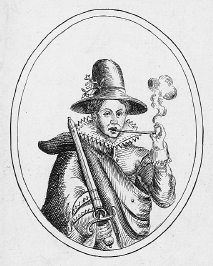
Mary Frith, aka Moll Cutpurse, 1589–1663, a notorious thief who dressed as a man.
Back at court, heterosexual sex flourished, behind closed doors. Whether Queen Elizabeth I enjoyed the benefits of sex, recreational or otherwise, will remain one of the great mysteries, but Elizabeth did take the precaution of branding herself as ‘The Virgin Queen’, an inspired piece of spin. Elizabeth was a political survivor, driven to extreme self-preservation following the fate of her mother, Anne Boleyn, and the constant reminder of mortality in the form of other noblewomen either murdered or killed by childbirth. Elizabeth’s actual virginity must be a matter for conjecture. Henry IV of France joked that there were three things that nobody believed: that Archduke Albert was a good general; that he, Henry, was a good Catholic; and that the Queen of England was a virgin. Elizabeth certainly experienced a series of passionate crushes on courtiers such as Dudley, Earl of Leicester, and Robert Devereux, 2nd Earl of Essex. How close these encounters came to consummation cannot be determined, but the fact remains that Elizabeth always slept alone.
Queen Elizabeth’s celibacy did not extend to the rest of her circle. While every man at court had to profess adulation for Elizabeth (or face the consequences), her admirers enjoyed tumultuous, indiscreet affairs. One such was Sir Walter Raleigh, whose company Elizabeth enjoyed because he was graceful and lively. As Aubrey tells us, ‘he was no Slug, without doubt he had a wonderful waking spirit’. Raleigh was popular with the ladies, and ‘he loved a wench well’.28
On one occasion, ‘[Raleigh] got one of the Maids of Honour up against a tree in a wood. This was his first Lady’ – as opposed to commoners, presumably. Initially, the young woman had reservations, and wished to preserve her honour. ‘Sweet Sir Walter,’ she exclaimed, ‘what do you ask of me? Nay, sweet Sir Walter! Sweet Sir Walter!’ But Raleigh proved a skilful seducer, and ‘as the danger and the pleasure at the same time grew higher, she cried, in the ecstasy, “Swisser Swatter, Swisser Swatter!”’29
Mary Herbert, Countess of Pembroke (1561–1621), came perilously close to infringing the Buggery Statute with her particular fetish. This noblewoman, a ‘beautiful Ladie with a pretty sharpe-ovall face’ whose ‘haire was of a reddish yellowe’, was very salacious. Her favourite activity took place during the springtime of the year: ‘when the Stallions were to leap the Mares, they were to be brought before such a part of the house, where she had a vidette (a hole to peepe out at) to looke on them and please herself with their Sport; and then she would act the like sport herself with her stallions’.30 There were also rumours that Mary had an incestuous affair with her brother, Sir Philip Sidney. ‘There was so great love between him and his faire sister that I have heard old Gentlemen say that they lay together, and it was thought the first Philip Earle of Pembroke was begot by him, but he inherited not the wit of either brother or sister.’31
Mary Herbert is a fine example of the type which Alan Haynes has described as ‘the privileged wanton’ in his fascinating study, Sex in Elizabethan England. Mary’s independent wealth and raft of supporters at court rendered her impervious to criticism. Although even this degree of freedom had its limits, as can be seen from the life of Venetia Stanley, who arrived at court at a slightly later date, during the reign of James I.
Venetia Stanley (1600–35), a ‘most beautiful and desireable Creature’ according to Aubrey, was a young beauty from Oxfordshire with a sweet face, brown hair and, most importantly, a strong constitution, an essential requirement for surviving life at court. When she arrived in London, Venetia caught the eye of the Earl of Dorset and they had at least one child together, for which he settled an annuity of £500 on her. Venetia soon developed something of a reputation, but this did not deter Sir Kenelm Digby, who married her secretly in the spring of 1625, against the advice of his mother, who insisted you could not make an honest woman out of a whore.
But, to all intents and purposes, the marriage was a happy one. Kenelm celebrated his wife’s beauty by commissioning portraits from Van Dyke and his contemporaries and having her face, hands and feet cast in plaster. Ben Jonson immortalized Venetia in verse, ‘sitting, and ready to be drawne…in Tiffany, silks, and lawne’. In return, Venetia provided Kenelm with three children and appeared to be a reformed character, even restraining herself when they dined with her old lover, the Earl of Dorset, who would stare at her passionately across the table but manage to restrict himself to kissing her hand. Aubrey’s own cousin Elizabeth stated that Venetia had redeemed herself by her strict living.
And then, at thirty-five years of age, Venetia was found dead in bed. Some people suspected she had been poisoned. ‘When her head was opened,’ Aubrey tells us, ‘there was found but little braine’, a condition which Kenelm put down to Venetia drinking ‘viper-wine’, which he believed would preserve her beauty. This is when the rumours started. Although Venetia might quite legitimately have been taking viper wine, a popular restorative made from adders and recommended for a range of ailments including hair loss, Venetia’s friends were convinced that Kenelm had murdered her with this substance, because he was ‘a viper husband who was jealous of her that she would steale a leape’ (have extramarital sex).
There is a sad little postscript to this story. Around 1667, Aubrey was walking through Newgate Street when he saw the bust from Venetia’s tomb for sale on a second-hand stall. It was in a wretched condition, the gilt ravaged by the flames of the Great Fire a year previously. Aubrey commented on the sight to his companion, but they never saw it again. Like Venetia, the bust suffered an ignoble fate. ‘They melted it downe,’ Aubrey noted, sadly. ‘How these curiosities would be quite forgot, did not such idle fellowes as I am putte them downe.’32 A sad end to the life of a beautiful and sophisticated court lady.
But what of the world beyond the court? For a taste of this, let us venture out into the streets of London.