
5

Sex in the Restoration
In order fully to understand the relaxing of sexual morals during the Restoration, we need to put this remarkable period in the context of the fifty, often tumultuous, years which preceded it, years which witnessed a decade of civil war, the beheading of King Charles I and the enforcement of puritanical sex laws under the dictatorship of Oliver Cromwell, the Lord Protector.
To see how this course of events unfolded, let us visit the court of King James, one of the most outrageous courts in English history. James I was an enthusiastic visitor to Holland’s Leaguer, as we already know. His regular trips to the Manor House of Paris Gardens reflected just one aspect of his appetite for life and the venal culture of his court, although in his defence it should be remembered that under his rule there was comparative religious tolerance (except in Ireland, where his legacy still proves turbulent today), and the lives of ordinary people were relatively calm and secure.
After a frugal and thankless period as King of Scotland, James arrived at the English court to inherit a wealthier and more organized kingdom. His response to this was to demand a higher level of personal attendance and service from his lords. The courtiers expected plenty of entertainment in return. James’s court became ‘extravagant and disorderly, frivolous and indecorous, with hard drinking common and immorality winked at’.1 It was also filthy; one lady complained that she always returned home from court lousy. James himself drank heavily and gambled, and was often to be seen at the Bankside theatres and bear gardens, his arm around George Villiers, his incompetent administrator, best friend and, so rumour had it, lover. As for those with a taste for women, they were spoilt for choice. ‘For concubines we need not travel as far as the Turk’s Seraglio’ wrote Heywood in his Gynaikeion. ‘And to find such as we call Sweet Hearts, Friends or Good-wenches should we but search any citizen’s garden houses and find plenty sufficient.’2
Under James’s rule, London’s sex trade expanded at a phenomenal rate, as the records indicate. Here are accounts of infamous characters such as Emma Robinson, who, in 1608, was described as ‘a notorious Common Queane’ and who sat outside her front door until midnight entertaining ‘lewd persons’; Ellen Allen was fined for being a ‘bad woman’ and seducing a Dutchman while her maid stole his dagger. One Elizabeth Basse was charged with keeping ‘a notorious bawdy house’ where murder was likely to be committed. By 1613, the bulging casebooks of the Middlesex Sessions show that prostitution had spread beyond the walls of the city as far as Enfield and Barnet.
Even the Sabbath day was no exception. One Robert Cutler of St Bride’s ‘had the use of Isabella Sowth’s bodie’ one Sunday, while Alban Cooke of Hoxton was indicted for buggery with a man under twenty years of age and Richard Walker of Castle Baynard was taken late in the night, ‘abusynge himself in an alehowse’.3 London became so scandalous that even the tolerant James was forced to issue an ordinance on 4 December 1622, ‘Touching on Disorderly Houses in Saffron Hill’. Saffron Hill, between Holborn and Clerkenwell, was particularly corrupt, teeming with ‘divers immodest lascivious and shameless women’ who sat outside their houses alluring and calling to passers-by, whom they would entertain in return for base and filthy lucre.
James also included a clause ‘for the prevention of connivance’ designed to prevent beadles being bribed by the prostitutes, but this ordinance made no difference. Despite mass raids, the situation deteriorated further and, in 1624, James was compelled to issue another ordinance. The extent of the red-light district is illustrated by the names of the areas which were raided: Cowcross, Cock’s Lane, Smithfield, St John Street Clerkenwell, Norton Folgate (now Bishopsgate), Shoreditch, Wapping, Whitechapel, Petticoat Lane, Charterhouse, Bloomsbury and Ratcliffe Highway. Curiously, there is no mention of the Bankside, or Paris Gardens here: presumably because of the extent of provision for lecherous Londoners without having to go south of the river.4
The following year Charles I became king. A man of high moral character, Charles made an attempt to address the issue during his first Parliament as an extract from the journals of the House of Commons on 9 July 1625 illustrates:
Mr Jordan moveth: That divers places, viz., Clerkenwell, Pickehatche (in Finsbury), Turnmill Street, Golden Lane, Duke Humphreye’s at Blackfriars are places of open bawdry.
Resolved: To acquaint the Lord Chief Justice with this complaint and to desire him to take some present Order for Reformation of it.5
By 1641, the Long Parliament ruled that prostitution was no longer to be classified as a crime but as a public nuisance, or gross indecency if committed in public. By enforcing Common Law, Parliament abolished a raft of medieval tortures and punishments for prostitution, which was an enlightened move, but times were about to become difficult indeed for London’s whores, thanks to the new Member of Parliament for Cambridge, one Oliver Cromwell.
There had been nothing like this since the days of John Ball and Wat Tyler. Southwark was a hotbed of revolutionary fervour, with various sects meeting clandestinely in the inns and taverns. The essential aspect of this conflict was that it was a war of ideas, where taking sides was a matter for one’s own conscience. Sir John Oglander reflected: ‘thou would’st think it strange if I should tell thee that there was a time in England when brothers killed brothers, cousins cousins, friends their friends, when thou wentest to bed at night thou knewest not whether thou shouldest be murdered before day’.6
When the Civil War broke out in late 1642, Southwark supplied thousands of men for the New Model Army and routed Prince Rupert and his Cavaliers when they attempted to enter London. Rupert withdrew to Oxford, never to return. On 30 January 1649, the day that King Charles was executed, life in the city continued as usual; the shops were open and the king had few mourners.7
Cromwell’s ascent proved disastrous for the sex trade. The Commonwealth’s attitude towards ‘sin’ was decidedly intolerant, as exemplified by William Prynne’s observation: ‘it hath evermore been the notorious badge of prostituted strumpets and the lewdest Harlots to ramble abroad to plays and to Playhouses wither only branded whores and infamous adulteresses did usually resort’.8 There was no understanding of the conditions which drove thousands of women into prostitution every year, or condemnation of the men who were their clients. The only concession to the view that prostitution provided a public service was the suggestion of one Dr Chamberlen who proposed to Parliament in 1649 that state-regulated bath houses with registered whores should be opened throughout the country.9 But this pragmatic solution was overlooked as the Puritans set about the destruction not only of London’s brothels but of all other forms of pleasure.
Parliament closed all the theatres and gaming houses and the actors were whipped at the cart’s arse. Seven bears were shot dead near the Hope Theatre, and the theatre itself was torn down in 1655. Heavy fines were introduced for swearing. Maypoles were felled on the grounds that they were ‘a heathenish vanity’ and ‘a stynkynge idoll’. Nude statues had their genitals covered with fig-leaves, and anything that profaned the sanctity of the Sabbath day was banned. The stews of Southwark, described as ‘church lands’, had already been sold off to developers for more than £4000. The whorehouses were being turned into warehouses by a rising affluent middle class, while the alehouses and taverns which had always been a favourite haunt of whores and their clients were frequently raided by the army. An honest whore found it difficult to make a living. The ‘doves of Venus’ and ‘birds of Youth’ who had flocked around the watering holes and enjoyed £20 suppers before the Commonwealth were now forced to make do on a diet of cheese and onion. ‘The ruination of Whoring was why the London Bawds hated 1649 like an old Cavalier.’10 One or two brothels remained open, discreetly, such as ‘Oxford Kate’s’ in Bow Street, chiefly because of their powerful and influential clientele.
As for the sexually promiscuous amateurs, they faced the death penalty. In 1650, the Commonwealth made adultery and incest felonies for which (on a second conviction) the penalty was death. To gain some idea of how sexual mores have changed, one has only to look at a conviction from the period: in 1653, a man of eighty-nine was tried and executed for adultery (these days he would be selling his story to the highest bidder). Eventually, even Puritan juries revolted against this draconian legislation, and subsequently refused to convict.11 For all his efforts to police the morality of his citizens, Cromwell himself was no killjoy: he permitted ‘music and frivolity and mixed dancing’ at his daughter’s wedding in 1657.12 And far from taking a hair-shirt approach to his own private life, Cromwell had a mistress in the form of Bess Dysart, a Scottish beauty and self-confessed harlot, who survived political intrigue to end her days as Duchess of Lauderdale.
Puritan interference in the lives of ordinary people bred resentment; the populace were force-fed religion until it sickened them. Far from being a wholesome new Commonwealth of God-fearing fundamentalists, the Puritans created a groundswell of popular opposition against state intervention in private morals. When Charles II arrived in London to claim the throne on Tuesday 29 May 1660, the city erupted into one giant party which was to last for the rest of his life. The festivities and prevailing mood of anti-clericalism were such that it was said that if Cain, the first murderer, had returned from the grave and arrived in London, he would have received a hero’s welcome. The most obvious manifestation of Swinging London was the erection of a giant maypole in the city. The draconian laws against prostitution and fornication were repealed and the court of Charles II and his entourage became one enormous brothel. There is no better summary of the decadence of court life than the Earl of Rochester’s poem ‘The Debauchée’:
I rise at eleven, I dine at two
I get drunk before seven, and the next thing I do
I send for my Whore, when, for Fear of the Clap
I come in her Hand and I spew in her Lap.
Then we Quarrel and scold till I fall fast asleep;
When the Bitch growing bold, to my Pocket doth creep;
She slyly then leaves me – and to Revenge my Affront
At once she bereaves me of money and cunt.
I storm and I roar and I fall in a Rage,
And, missing my Whore, I bugger my Page.13
Charles II had been reared at the French court and was accustomed to the frivolous entertainment and constant debauchery considered appropriate to his royal birth. As a king, he deserved nothing less. To quote Rochester, Charles II was ‘a merry monarch, who never said a foolish thing or ever did a wise one’.14 To discover just how merry Charles was, we should read more of Rochester’s satire, which earned him a temporary ban from court.
PEACE is his aim: his gentleness is such
And LOVE he loves, for he loves fucking much.
Nor are his high desires above his strength,
His Sceptre and his Prick are of a length,
And she may sway the one who plays with t’other
And make him little wiser than his Brother.
Poor Prince, thy Prick, like thy Buffoon at Court
Will govern thee because it makes thee Sport.
’Tis sure the sauciest Prick that e’er did Swive [fuck]
The proudest peremptoriest Prick alive.
Tho’ Safety, Law, Religion, Life lay on’t
’twould break through all to make way to Cunt.
Restless he rolls about from Whore to Whore
A Merry Monarch, scandalous and poor!15
Charles was a compulsive womanizer, and his pathological appetite for sex saw him rolling from the most exquisite court lady to the commonest whore. William Chiffinch, the royal pimp, supplied him with a constant stream of girls plucked from the theatres and brothels, while his high-profile mistresses included the aristocratic Barbara Villiers, Duchess of Cleveland, the coy Frances Stewart, the French courtier Louise de Kéroualle, and her famous rival, Nell Gwyn.16
On one occasion, Barbara Villiers and the Earl of Rochester tricked Charles into visiting a whorehouse in Hosier Lane, arranging for the king to have his pockets picked while he was enjoying himself with the girls. Rochester departed, leaving Charles to discover that he was penniless. When Charles asked the bawd for credit, she understandably refused. So the king pulled a ring off his finger and told her to send for a jeweller and have it valued. She accepted it reluctantly, but when the jeweller arrived and examined the ring he gasped that there was only one man in England who could afford this ring, and that was the king himself! The jeweller and the bawd fell to their knees, trembling with fear. After all, they could have faced the death penalty for treason. But Charles retained his good humour, and left, although history does not relate what he said to the Earl of Rochester, or Barbara Villiers, when he eventually got home.17
Charles’s affairs took up as much of his time as his affairs of state. As a result he often received his ministers while holding court with his whores, an arrangement which all parties had no choice but to accept. Charles’s example meant that a mistress was the latest must-have; any courtier without arm candy risked ridicule and derision. Once Charles’s philosophy was unleashed on the English court there was no vice or sexual peccadillo which was not encouraged. Chastity and virtue were considered to be hypocrisy: every man and every woman had their price.
This lax philosophy soon spread by example to all walks of life, and a climate of tolerance prevailed, as illustrated in this extraordinary anecdote from Samuel Pepys concerning the behaviour of Sir Charles Sedley MP, courtier and wit, who appeared naked on the balcony of ‘Oxford Kate’s’ in broad daylight ‘acting all the postures of lust and buggery that could be imagined’, and claiming, like a quack doctor, that he could make a potion ‘as should make all the cunts in town run after him’. As the crowd beneath swelled to over a thousand, Sedley ‘took a glass of wine and washed his prick in it and then drank it off; and then took another and drank the King’s health’.18 While such an outrageous episode from an MP today would lead to instant resignation and questions in the House, Sedley had nothing more to fear than a few weeks’ banishment from court, enabling him to sober up in the country in time for his next bender.
Londoners were more than robust enough to tolerate such antics with good humour. The ‘City’, in our modern understanding of the word, had arrived, in the form of an affluent merchant class to whom the government was forced to turn in times of crisis. This class made its own contribution to London, with gracious new houses filled with beautiful furniture; carpet, not rushes, covered the floor, and beds replaced straw mattresses. This class also required an army of domestic servants to tend it, consisting of women who were eternally at the mercy of their master, their master’s sons and the male servants.
Following a hard day’s trading, the new City men required relaxation and recreation, which they found at the theatre, revived after the long sleep of the Protectorate. The Theatre Royal Drury Lane and the Duke’s Theatre opened, and for the first time, nubile young women replaced boy actors on the stage. With the arrival of actresses, the theatres once again developed a reputation for wanton behaviour, as every aspiring young thespian set out to secure a rich husband or lover to elevate her to the ranks of the aristocracy. ‘Actress’ became synonymous with ‘whore’, an inevitable development according to the satirist Tom Browne: ‘’Tis as hard a matter for a pretty Woman to keep herself honest in a Theatre, as ’tis for an Apothecary to keep his Treacle from the Flies in Hot Weather; for every Libertine in the Audience will be buzzing about her Honey-Pot.’19
The theatre auditorium was divided along traditional class lines, as were the girls. In the orchestra stalls sat the fashionable and the aristocratic men, alongside the most upmarket prostitutes. (Conventional married women were discouraged from attending, as both the drama and its location were considered far too disreputable.) The top theatre prostitutes were known as ‘vizards’ after the black masks they wore. One evening the diarist Samuel Pepys sat next to one, and concluded in his entry for that night that ‘She is a whore, I believe, for she is acquainted with every fine fellow and called them by their name, Jack and Tom, and before the end of the play frisked to another place.’20 The dress circle was home to the professional middle class, with a suitable grade of harlots. The upper circle, or the gods, was for hoi polloi, and the common rub ’n’ tug whores also referred to as ‘punks’ and ‘trugs’. Dryden summed up the scene admirably:
The Playhouse is their Place of Traffick, where
Nightly they sit to sell their rotten Ware
Tho’ done in Silence and without a Cryer
Yet he that bids the most is still the Buyer!
For while he nibbles at her am’rous Trap
She gets the Mony: he gets the Clap!21
These theatres were noisy, sensational places with as much action off stage as on: actors were heckled, fist fights broke out, and the audience was uninhibited in its criticism if the play was not to its liking. This all added to the entertainment and a good time was had by all – apart from the playwrights, of course, who were understandably dismayed by such anarchic scenes. ‘Some there are,’ observed one writer, bitterly,
…who take their first Degrees
Of Lewdness, in our Middle Galleries:
The Doughty BULLIES enter Bloody Drunk,
Invade and grubble one another’s PUNK:
They Caterwaul and make a dismal Rout,
Call SONS of WHORES, and strike, but ne’er lugg-out…22
Among the turmoil, the ‘orange girls’ roamed with their baskets of fruit. The ‘china’ oranges were sixpence each, the girls a little dearer. They were organized, in a haphazard fashion, by an old bawd called ‘Orange Moll’, who sent them to trawl the new theatre at Drury Lane. Samuel Pepys had a weakness for orange girls, and one afternoon in January 1667 his actress friend Mrs Knipp introduced him to ‘a most pretty woman’. Her name was Nell Gwyn. Nell’s story provides one of the happier accounts of a whore’s life, the rags-to-riches tale of an archetypal tart with a heart of gold, the original Pretty Woman.
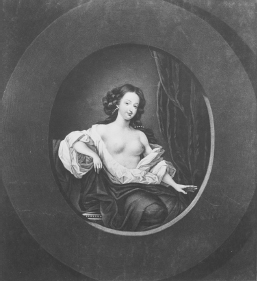
The celebrated Nell Gwyn, mistress of Charles II (1777).
Nell was born in a brothel in Covent Garden in 1650. Her mother, Eleanor Smith, was a bawd, and her father, Thomas Gwyn, had been a captain in the Cavalier army. Nell’s father disappeared early from their lives, and Mrs Smith took to drink. Nell herself may have been a child prostitute; she certainly grew up in ‘the life’, serving brandy to the customers in her mother’s house when still just a little girl. The Theatre Royal was just around the corner in Drury Lane, and by the age of thirteen she was working as an orange girl. Her good looks, charm and witty tongue were quickly spotted by the actors, and by the time she was fifteen, Nell had taken stage roles and her first lover, the actor-manager Charles Hart. Nell was a natural comedienne, and the sex comedies of the Restoration theatre provided the ideal vehicle for her talents. She was invariably cast as the attractive, sex-starved young wife of an impotent old man, romanced by a handsome young lawyer or parson, in productions such as The City Lady, or Folly Reclaim’d,An Evening’s Love, or The Mock Astrologer, The Husband his Own Cuckold or The City Bride.23 Samuel Pepys raved over Nell’s performance as ‘the Mad Girl’ in The Maiden Queen in March 1667:
so great performance of a comical part was never, I believe, in the world before as Nell doth this, both as a mad girle and then, most and best of all, when she comes in like a young gallant; and hath the motions and carriage of a spark the most ever I saw any man have. It makes me, I confess, admire her.24
Playing a masculine role gave young actresses the ideal opportunity to show off their figures in tight breeches. Since Nell had excellent legs, this proved to be a brilliant career move. King Charles had heard the rumours of her beauty and sex appeal, and soon he ordered her to give a private performance at the palace. After brief liaisons with Lord Buckhurst and his brother, the Earl of Dorset, Nell finally embraced her destiny in the form of the king and was installed as his chief mistress, regardless of the fact that, according to Bishop Burnet, she was ‘the indiscreetest and wildest creature that ever was in court’.25
Despite this, Nell remained Charles’s favourite until his dying day, and was maintained at great expense, receiving over £60,000 from the king. Valued for her high spirits and humour, Nell was ‘such a constant diversion to the king, that even a new mistress could not drive her away’. All this despite the fact that she called her lover ‘Charles the Third’ because she had had two lovers named Charles previously.26
Nell even saw off her chief rival, Louise de Kéroualle, who had been created Duchess of Portsmouth by Charles II. On one occasion, when Louise cattily remarked that Nell was dressed richly enough to be a queen, Nell shot back, ‘You are entirely right, Madam, and I am whore enough to be a duchess!’ The two women eventually became friends, when Louise was ousted by a new love, Hortense Mancin. They met regularly for tea and cards, although Nell was exasperated with Louise’s histrionic fits of despair, referring to her as ‘the weeping willow’. Nell’s wisecracks were legendary. When her coachman got into a fight with another man who had called her a whore, Nell broke up the fracas, saying, ‘I am a whore. Find something else to fight about!’ Nell’s most famous remark came about when she was passing through the streets of Oxford one day in her coach and the mob, mistaking her for her rival, the Catholic Louise de Kéroualle, started hooting and shouting at her. Nell put her head out of her window, smiled at the crowd and declared: ‘Good people, you are mistaken; I am the Protestant whore.’
Nell’s relationship with the king lasted until his death, seventeen years after their first encounter, and they had one son, Charles, later created Duke of St Albans. Charles himself was eager to provide for her, entreating his dour brother, James II, ‘let not poor Nelly starve’. Despite the fact that James had frequently been the butt of Nell’s jokes, he oversaw the provision of a pension of £1500 a year for life, as well as paying off all her debts. She also retained the estates and incomes which Charles had granted her during their relationship, including houses in Pall Mall and Windsor. By the age of fifty, this whore’s daughter from the backstreets of Covent Garden was worth £100,000.
Charles II’s infatuation with Nell did not make her a favourite with everyone. John Wilmot, Earl of Rochester (1647–80), took against her and characterized her as a Cinderella on the make in a vicious satire. But Rochester, who saw all Charles’s mistresses as potential rivals for his affection, offended every one of them, bribing palace officials to dish the dirt on Charles’s love life. To her great credit, ‘pretty, witty Nell’ proved admirably tolerant towards Rochester, who eventually befriended her, taking her side against the dreadful Louise.
Rochester had become the embodiment of Charles II’s court, and it is to Rochester that one must return for further insights into this extraordinary period. Tall, elegant and witty, he was wild even by contemporary standards. He graduated from Oxford at the age of fourteen, with a classical education that provided good training for his excoriating satires. Rochester served as a Royalist spy before the Restoration, and proved heroic in the war against the Dutch, when he rowed under heavy fire to deliver orders from the commander of the fleet after the latter was shot dead in his arms, an action which was ‘commended by all who saw it’. Rochester’s evident physical courage was as great as his wit; but, like many men of action, he missed the excitement of war in the dull days afterwards and compensated for it with a riotous lifestyle, drinking, quarrelling and fighting.27
Writing with ‘passionate colloquialism’,28 Rochester gives us a vivid picture of London and sex in the 1660s, as the following lines illustrate. It will come as no surprise to the reader that Rochester was an unregenerate bisexual whose play Sodom, or The Quintessence of Debauchery (1684) was censored by the government on the grounds of obscenity, primarily because of its homosexual nature. ‘There’s a sweet, soft page of mine, Does the trick worth forty wenches,’ he comments:
Nor shall our love-fits, Chloris, be forgot,
When each the well-looked linkboy strove t’enjoy,
And the best kiss was the deciding lot
Whether the boy fucked you, or I the boy.29
‘Link boys’, or torch bearers, ostensibly earned a crust by conducting the wealthy about the murky streets of London with flaming torches; an early form of rent boy, these lads frequently subsidized their meagre incomes by selling their sexual favours – and Rochester quite clearly enjoyed their attentions.
Rochester’s vivid poem ‘A Ramble in St James’s Park’, meanwhile, shows London in all its seedy glory; the author reflects on the action in this ‘all-sin-sheltering grove’, from buggeries to rape and incest, as Londoners of all conditions arrive looking for sex. Whores, great ladies, chambermaids, heiresses and drudges trudge towards the park to encounter ‘divines, great lords and tailors, prentices, poets, pimps and jailors, footmen and fops’. Rochester is there stalking his mistress, ‘Corinna’ (a nod to Ovid’s Ars Amatoria), who is being paid court by three men – a well-connected ‘Whitehall Blade’, a theatre critic and a young lad, enticed by ‘the savoury scent of salt-swollen cunt’. As Corinna disappears in a hackney coach with all three of them, Rochester reflects that she will come home later that evening, with her ‘lewd cunt drenched with the seed of half the town’.30 If this appears to be the embodiment of aristocratic misogyny, it is worth considering that these lines represent the shadow side of Rochester’s extraordinary talent. He could also prove sympathetic and insightful as in this observation of Corinna’s fate after he has discarded her:
Now scorn’d of all, forsaken and opprest,
She’s a Memento Mori to the rest:
Diseas’d, decay’d, to take up half a crown
Must mortgage her long scarf and manto gown:
Poor creature, who unheard of, as a fly
In some dark hole, must all the winter lie:
And want, and dirt, endure a whole half year,
That, for one month, she tawdry may appear.31
And Rochester could also write from a female perspective, as in this witty and sentimental declaration from ‘A Young Lady to her Ancient Lover’:
Ancient Person, for whom I
All the flattering youth defy,
Long be it e’er thou grow old,
Aching, shaking, crazy cold;
But still continue as thou art,
Ancient Person of my heart.
On thy withered lips and dry,
Which like barren furrows lie,
Brooding kisses I will pour,
Shall thy youthful heart restore,
Such kind show’rs in autumn fall,
And a second spring recall;
Nor from thee will ever part,
Ancient Person of my heart.
Thy nobler parts, which but to name
In our sex would be counted shame,
By ages frozen grasp possest,
From their ice shall be released,
And, soothed by my reviving hand,
In former warmth and vigour stand.
All a lover’s wish can reach,
For thy joy my love shall teach;
And for thy pleasure shall improve
All that art can add to love.
Yet still I love thee without art,
Ancient Person of my heart.32
Sadly, the Earl of Rochester never lived to be an ancient person of anybody’s heart. He was dead by forty, his constitution and talent destroyed by alcohol and disease. But he was not without redemption, as this observation from the playwright George Etherege illustrates. ‘I know he is a Devil,’ said Etherege, of this brilliant, conflicted man, ‘but he has something of the Angel yet undefac’d in him.’33
Like Rochester, the diarist Samuel Pepys enjoyed London’s low life to the full. But Pepys lacked the flamboyant Earl’s self-destructive streak. He also lacked Rochester’s patrician generosity and sexual charisma, arguing the toss with street whores and shamefully chronicling his many sexual failures. Pepys exemplified the middle-class approach to sex in Charles II’s London. When not molesting the servants, such as Mary Mercer, who allows him to touch her breasts, ‘they being the finest that I ever saw in my life; that is the truth of it’,34 or visiting his mistress, Betty Lane, with a bottle of wine and a lobster for dinner, Pepys was patronizing the dockyard brothels of the Ratcliffe Highway and singing along to bawdy ballads with lyrics such as ‘Shitten-come-Shite the Way to Love is!’35 An earthy attitude towards bodily functions is exemplified by a diary entry in which Pepys records that he was ‘struck with a looseness of the bowels’, dashed into a tavern, paid a groat for a pot of ale and defecated in the fireplace.
Pepys does not emerge as heroic or exemplary in his accounts of his sexual experiences, but, as his biographer Claire Tomalin has commented, his honest accounts of sexual failure and unrequited lust make him a sympathetic figure to modern readers. These exploits are written up with refreshing frankness, from an ‘experiment’ when he lay down on the floor of his boat while being rowed up the Thames and, by fantasizing about a beauty he had spotted at Westminster Hall, came to orgasm ‘without use of my hand’36 to a confession that he was so aroused by the queen and her retinue at Mass on Christmas Eve 1666 that he masturbated during the service.
Although Pepys was occasionally successful, as when he persuades young Betty Mitchell to touch his ‘thing’ on the pretext of securing promotion for her husband, he confesses that he is at a loss to emulate the sexual confidence of his colleagues and is shocked by the outrageousness of court life. The civil servant in him takes over as he is horrified not by Charles’s affairs but by his lack of discretion about them, and views Charles’s court as vicious, negligent and badly governed. King Charles plays with his dog or fiddles with his codpiece during meetings; chronic financial mismanagement means that on one occasion Pepys turns up to a meeting to find that there are no paper agendas on the table, because Charles has failed to pay an outstanding stationery bill for over £3000. On the same night that the navy is battling the Dutch fleet in the Medway, Charles and Barbara Villiers are more preoccupied with chasing ‘a poor moth’ around the dining room.
While living vicariously through the king’s sexual excesses, Pepys deplores his lack of management skills. But, as Tomalin states, this is what makes Pepys such a credible witness; his sexual encounters and fantasies take place between committee meetings and home improvement schemes designed to pacify his wife. Relations with his wife, Elizabeth, were difficult, which explains why Pepys felt the need to look outside their marriage for companionship and sexual release. Elizabeth suffered with a genital abscess three inches deep,37 which she found shameful and humiliating, and Pepys worried that he had infected her. This put a strain on their sex life; it was fourteen years into their marriage before Pepys could bring himself to put his finger ‘into her thing, which did do her much pleasure’38 but he confides in his diary that he hopes she does not get a liking for it. He had difficulty in accepting that women actually enjoyed sex, despite encounters with his robust mistress, Betty Lane, who brought ‘an unabashed enthusiasm’ to their love-making.39
Where Rochester was the ruthless rake, Pepys is a comical figure, lacking the self-confidence to woo the fine ladies he drools over, chasing the servants, finding fleeting satisfaction in a stolen kiss or slipping his hand under a petticoat, but not always with success:
18th August 1667: being weary, turned into St Dunstan’s church, where I hear an able sermon of the minister of the place. And stood by a pretty, modest maid, whom I did labour to take by the hand and the body; but she would not, but got further and further from me, and at last I could perceive her to take pins out of her pocket to prick me if I should touch her again.40
While Rochester and Pepys may have had very different degrees of sexual success, there is one item to which both had recourse, and that is the condom, attributed to the apocryphal Colonel ‘Condom’ who promoted it in 1665, though he could scarcely be said to have invented it as condoms in some form or another have been with us for centuries as a method of preventing pregnancy and as disease control. While the Romans made them out of leather, the Egyptians preferred linen, the Chinese carved them out of tortoiseshell and the Japanese rolled oiled silk around the penis to prevent disease.
In his treatise on syphilis, De Morbo Gallico (1564), the Italian anatomist Gabriello Fallopio claimed to have invented a linen sheath which, when dipped in a solution of salt and herbs, formed a protection against the disease. The sheath fitted over the glans and under the foreskin, and appears to have been impractical and highly uncomfortable, but it was superseded by a larger sheath, still made of linen, that covered the entire penis.
Condom’s breakthrough consisted of manufacturing sheaths out of animal gut. This process involved soaking sheep’s intestines in water for a number of hours, then turning them inside out and macerating them again in a weak alkaline solution, changed every twelve hours. The intestines were then scraped carefully to remove the mucous membrane, leaving the peritoneal and muscular coats, and exposed to the vapour of burning brimstone. Next they were washed in soap and water, inflated, dried and cut into eight-inch lengths. Finally, the open end was finished with a ribbon that could be tied around the base of the penis, and the condom had to be soaked in water to make it supple before use. After use, it could be washed out and hung up to dry, ready for another excursion. Despite this laborious procedure, gut condoms soon proved hugely popular, and were celebrated by Rochester in his 1667 ‘Panegyrick Upon Cundums’ which hailed this breakthrough as a protection against the horrors of venereal disease: ‘happy is the man who in his pocket keeps a well-made cundum, nor dreads the ills of shankers or cordes or buboes dire’ and as contraceptive, ruling out the appalling prospect of an ‘unknown big belly and the squalling brat’. This development, he assures the reader, would rule both the chaste marriage bed and the filthiest stews, ensuring endless sexual pleasure without unhappy consequences and no need to have recourse to the mercy baths of Leather Lane, where victims underwent painful and protracted treatment for venereal disease.
While Charles II’s court gained a reputation for profligacy, Restoration London proved its equal by offering an extraordinary catalogue of sexual pleasures. The sex trade, driven underground by Cromwell’s Protectorate, flourished more vigorously than ever, offering something for every man, from the glamorous, top-drawer Venetian girls to the ‘ambulant whores’ who roamed the streets in the distinctive white aprons which indicated that they were available for business. The Venetian girls were so expensive that they catered only to the aristocracy, as may be seen from this itemized receipt from John Garfield’s series of satirical pamphlets, ‘The Wandering Whore’:
|
Summa Totalis & Bill of Charges |
|
|
FOR Broaching a Belly unwemmed and unbored |
£1.0.0 |
|
ITEM For the Magdalena’s Fee |
10.0 |
|
ITEM For the Hectors Fee |
2.6 |
|
ITEM For providing a fine Hollands Smock |
10.0 |
|
ITEM For Dressing, Perfuming and Painting |
5.0 |
|
ITEM For occupying the most convenient Room |
5.0 |
|
ITEM For Bottles of Wine |
£1.0.0 |
|
ITEM For Pickled Oysters, Anchoves, Olives |
10.0 |
|
ITEM For Sweet Meats, Sugar-cakes, Peaches, Walnuts |
10.0 |
|
ITEM For Musicke |
£1.0.0 |
|
Summa Totalis £5.12.6d41 |
This does not include the courtesan’s own fee, which would have been at least £5, and the Holland smock would have been a present. But this represented the top end of the market with the best available girls, managed by a redoubtable circle of madams known as ‘the bawds’. These women, extraordinary characters in their own right, were quick to exploit their gullible clients and profit from the rich pickings available in the sex trade. The lives of the bawds are best illustrated by the stories of three forgotten women – Damaris Page, Elizabeth Cresswell and Priss Fotheringham – who met in prison and created an informal bawds’ guild, supporting one another through the trials and vicissitudes of the sex trade.
Damaris Page was born into a life of abject poverty in the East End, around 1620. She first enters the record books in 1655, charged with assaulting Eleanor Pooley, ‘she being with child, with an instrument from which the said Eleanor died’.42 This ‘instrument’ was described as a fork or prong with two tines, which had been thrust four and a half inches into Eleanor’s belly. In other words, Damaris had attempted to perform an abortion, and she was charged with manslaughter and sentenced to be hanged. Damaris pleaded for clemency on the grounds that she was herself pregnant. She gave birth to a stillborn child whilst in Newgate, before being pardoned by the Lord Protector, Richard Cromwell. Once freed, Damaris went back to the life and developed her own speciality, running brothels for sailors on the Ratcliffe Highway. There had been brothels in this location since Roman times, when the first galleys landed at Londinium and Damaris’s premises continued this ancient tradition, earning her the accolade of ‘The Great Bawd of the Seamen’ from none other than King James II. Damaris’s brothels offered basic fare of the sort enjoyed by Samuel Pepys: four girls on duty, taking each man as he came in on a ‘first cab off the rank’ basis and offering ‘a sturdy cunt for two shillings’. Damaris died peacefully in 1669 in her own bed, leaving a handsome estate, a testimony to her long-held belief that ‘Money and Cunny are the Best Commodities!’43
Elizabeth Cresswell was neither an aristocratic courtesan like Barbara Villiers, mistress of Charles II, nor a humble streetwalker like Damaris Page, and her origins come as something of a surprise. Despite being born into a comfortable middle-class household in Aldgate in around 1625, Elizabeth inexplicably embarked on a career as a street prostitute, operating in Aldersgate, Clerkenwell and Shoreditch. As her looks began to fade, she became a bawd without rival in her wickedness, using all her diabolical arts of seduction to entice young women into the trade, and exploiting her family connections to set up an upmarket brothel.44 Discretion was not Elizabeth’s strongest suit, however, and she ended up in court and in prison several times for keeping a disorderly house. On one celebrated occasion her brothel was raided on a Sunday when the constables found a group of a dozen reprobates drinking wine on the Lord’s day, the women stripped to the waist, and one young lady ‘proposing a health to the privy member of a gentleman’ and later ‘drinking a toast to her own private parts’.45 Once the Lord Protector, Richard Cromwell, had been replaced by Charles II, Elizabeth was free to pursue her career in an atmosphere of benign tolerance. Her most successful establishment was in Cripplegate, now the site of Moorfields underground station.
This was a house catering to the aristocracy, filled with girls of superior education, many of them the daughters of Cavalier families ruined in the Civil War. Known as ‘Countesses of the Exchange’, as they lived near the Royal Exchange, it was said of them that ‘they master your britches and take all your riches’.46 One commentator, Richard Head, an Oxford-educated conman, visited this establishment in 1663, and turned down the first girl he met there for being too expensive, even though she did touch his ‘needle’ and bartered with a second, bringing her price down to half a guinea, a considerable amount to pay for sex when two shillings was the going rate for a Ratcliffe Highway whore.
Elizabeth Cresswell’s establishments survived the Great Plague of 1665, and the Great Fire of 1666. What they did not survive with impunity was the Shrovetide riots of 24 March 1668. This was the occasion when thousands of London’s apprentices rioted and attacked the city’s brothels in an excess of moral zeal later referred to as the ‘Bawdy House Riots’. Such attacks were a typical feature of Shrove Tuesday, the day before Ash Wednesday, but on this particular occasion they also constituted a form of political rebellion against Charles II’s decadent court and represented a growing public unease with the economy; the soldiers and sailors went unpaid while public money was siphoned into the excesses of court life – or even embezzled. The troops were mustered and the riots went on all night, with the crowd roaring slogans such as ‘Reformation and Reducement’, which, according to Pepys, made the courtiers apprehensive, because ‘among the Rioters were many Men of Understanding that have been of Cromwell’s Army!’47Ten years after Cromwell’s death, the aristocracy were still unnerved at the mention of his name.
By daylight, Pepys was able to record the damage: ‘a great many brothels have been destroyed or damaged’, including the one belonging to Damaris Page, while two houses belonging to the Duke of York had been pulled down, which especially upset the duke as he had received £15 a year from each one for their liquor licences. As for the apprentices, their only regret was that they had attacked small brothels and not the great bawdy house at Whitehall: Charles II’s palace.
Charles did not take these attacks lightly; eight of the apprentices were subsequently executed. One particular target for public rage was Charles’s principal mistress at the time, Barbara Villiers, Lady Castlemaine, who was hated for being a Roman Catholic. Surveying the wreckage of the brothels, Elizabeth Cresswell took it upon herself to sponsor a seditious pamphlet directed at Barbara Villiers entitled ‘The Poor Whores’ Petition to Lady Castlemaine’.
This pamphlet, which may have been written by the diarist John Evelyn (who also hated Barbara Villiers), and was co-authored by Elizabeth’s lover, the anti-Catholic MP Sir Thomas Player, begs Lady Castlemaine to help the poor whores, her less fortunate sisters from Dog and Bitch Yard, Lukener’s Lane, Saffron Hill, Moorfields, Chiswell Street, Rosemary Lane, Nightingale Lane, Ratcliffe Highway, Well Close, Church Lane and East Smithfield, whose homes have been destroyed by the apprentices, calling on her for support as a fellow whore who should show some feeling for her sisters.
Unfortunately, this pamphlet infuriated Barbara Villiers, who was horrified at being compared with London’s common whores. It also catapulted Elizabeth into the limelight, the last place any self-respecting madam wishes to find herself. Elizabeth had bankrolled her MP lover, and suddenly all his debts were called in. Her girls were persuaded to give testimony against her by the authorities. As Elizabeth had been a cruel employer, this did not prove a hard task. After thirty years in the business, she was sentenced to Bridewell, where she died, aged sixty, in 1684. Elizabeth’s last request was that a sermon be preached at her funeral, for which the preacher would receive £10, but only if he could say nothing bad about her. Eventually a preacher was found who managed to deliver the following lines:
By the Will of the Deceased it is expected that I should mention her and say nothing but Well of her. All that I shall say of her therefore is this. She was born well, she liv’d well and she died well, for she was born with the name Cresswell, she liv’d in Clerkenwell and she died in Bridewell.48
The most notorious of our three bawds was undoubtedly Priss Fotheringham. Born in Scotland around 1615, Priss found her way to London and is first glimpsed in the records of Newgate gaol, after stealing some garments from a widow, Elizabeth Cragg. Already a prostitute, and scarred by smallpox, Priss was not without her charms. One acquaintance described her when young as ‘a cat eyed gypsy, pleasing to the eye in her finery’.49 Priss was also a highly resilient young woman: after being released from jail she set up as bawd of ‘The Six Windmills’ in Moorfields, which was to become known, infamously, as ‘Priscilla Fotheringham’s Chuck Office’. This is where Priss performed her pièce de résistance, an ‘abominable practice’ dating back to the days of ancient Rome, whereby the prostitute stood upside down with her legs spread apart, allowing customers to throw coins into her vagina. This was known as ‘chucking’ and was a real money-spinner. It also required considerable gymnastic ability on the part of the whore, although clients could be relied upon to secure the girl’s legs.
In her early days, Priss could perform this feat several times a day, standing on her head with ‘naked breech and belly while four cully-rompers chuck’d in sixteen half-Crowns into her Commoditie’.50 The Six Windmills drew a considerable clientele and proved wildly popular. As Priss grew weary with age and increasingly more disabled, she trained up new talent to perform, such as the Dutch prostitute known as ‘Mrs Cupid’, described here by Garfield:
When French Dollars, Spanish Pistoles and English Halfe-Crowns were chucked as plentifully as Rhenish Whine into the Dutch Wench’s two holes, the half crowns chuck’d into her commoditie did lesser harm than the Rhenish wine, for its smarting and searing quality, differing from the Sack poured in by such Cullies as at Priss Fotheringham.51
This episode led Garfield to conclude that ‘A Cunny is the deerest Peice of Flesh in the World!’52
A speciality of another kind was available at the ‘Prick Office’ over in East Smithfield. This brothel, also known as the ‘Last & Lyon’, was run by a pimp called Hammond, and his speciality was fellatio. He employed a number of women and his interview technique consisted of a request for oral sex: any girl who wanted to work for him ‘must buss the end of his Trapstick, as he lies naked upon his bed with his Tarse standing upwards’.53 According to Burford, this is the only reference to fellatio to be found in contemporary writing.
Priss Fotheringham died around 1668, worn out by age and disease, but wealthy, having made a small fortune from her exploits as a bawd and her extraordinary party trick. By this time, London’s oldest profession was in transition. After the depredations of the Great Plague of 1665, the Great Fire the following year and the destructive apprentices of 1668, the landscape of London was shifting and changing, and inevitably so was its sex trade. The days of the old brothels of Moorfields and Clerkenwell were numbered, and the trade was heading west, to the fashionable new district of Covent Garden.