
6

Covent Garden and The Harlot’s Progress
In 1630, the Duke of Bedford commissioned Inigo Jones to develop his land at ‘Convent Garden and the Long Acre’ west of the City. The architect responded by creating an imposing square or ‘Piazza’ in the Italianate style, inspired by Palladio. ‘Covent Garden’, as it became known, thanks to the Cockney glottal stop, swiftly appealed to the ‘quality’, who moved into the elegant two-storey houses and flocked to the newly built church of St Paul’s on the west of the Piazza. After the Great Fire of 1666, London’s street markets were relocated here and Covent Garden market became the most important in the country. Exotic items were carried up the Thames by boat and put up for sale, and taverns and coffee houses opened alongside the Piazza. Inevitably, sex soon joined the list of goods for sale, and the Piazza became London’s premier flesh market, ‘that great square of Venus’.1
As early as 1709, the Tatler was telling readers that every house in the district was inhabited by ‘nymphs of different orders so that persons of every rank can be accommodated’.2 By 1749, the keen student of vice could take a tour through London’s illicit heartlands, like this anonymous author who walked up from Fleet Street, past Charing Cross, and on through Drury Lane to Covent Garden. Charing Cross, he declared, had ‘little else but Concubines in all the Lodgings, and nothing but Lascivious Looks seen in the Chamber-Windows, from one end of the Verge to the other’.3 The ‘lodgings’ were the rented rooms where the poorer whores took their pick-ups. The scene gets even worse as he makes his way through Drury Lane,
where ev’ry half a dozen Steps he meets with some odd Figure or another, that looks as if the Devil had robb’d them all of their natural Beauty…for nothing can be read but Devilism in every feature; Theft, Whoredom, Homicide and Blasphemy peep out of the very Windows of their Souls…Turn your eyes up to the Chambers of Wantonness, and you behold the most Shameful Scene of Lewdness in the Windows even at Noon-day, some in the very act of Vitiation [copulation] visible to all the opposite Neighbours. Others dabbing their Shifts, Aprons and Headcloths, and exposing themselves just naked to the Passers by…My Dear, will you give me a glass of wine; take me under your Cloak, my Soul, and how does your precious C do? You hear at the Corner of every Court, Lane and Avenue, the Quarrels and Outcries of Harlots recriminating one another, Soldiers and Bullies intermixing, the most execrable Oaths are heard.4
This is an author who would have agreed with William Blake that ‘the harlot’s cry from street to street shall weave Old England’s winding sheet’, and echoed the same poet’s sentiment that the harlot’s curse would blight with plagues the marriage hearse, a reference, of course, to venereal disease.
The keen student of human depravity would then arrive at the Piazza in Covent Garden, where there were enough lewd women to form a colony, and where ‘the front windows of the Piazza are filled from seven at Night until four or five o’clock in the Morning with Courtezans of every description, who in the most impudent Manner invite the Passengers from the theatres into Houses where they are accommodated with Suppers and Lodgings, frequently at the expense of all they possess’.5 These ‘courtesans’ were out in all weathers, at all seasons, ‘sallying out’ at dusk, dressed in the most gaudy colours, thronging the streets. While the more sedate whores contented themselves with walking around until they were addressed directly, the more desperate girls accosted every man they saw, offering to take them home, even standing around potential punters in a crowd, overwhelming them with ‘caresses and entreaties’.6
A young German, Baron Zacharias von Uffenbach, was struck by the number of black women and men he saw ‘hawking their bottoms round the Strand and Covent Garden, the females in European dress, with uncovered black bosoms’.7 The majority of these black prostitutes had arrived in England as slaves, and been sold or abandoned by their white masters. Black girls were familiar enough on the scene for Hogarth to include a black prostitute in Plate 3 of The Rake’s Progress, where Tom Rakewell is carousing the night away in the notorious Rose Tavern.
Another notable feature in this teeming den of vice was child prostitution. In 1777, ‘Mother’ Sarah Woods, a well-known bawd, was charged with ‘harbouring young girls from eleven to sixteen, for the purpose of sending them nightly to parade the streets’. The charges came after the Watch had picked up a girl of twelve and the servant ‘parading with her’ to stop her running away with her clothes. Sarah Woods, it transpired, kept the girls hard at work all day cleaning her house, then sent them out as prostitutes at night, some half-naked and drunk.8
Given the desperate living conditions of the time, these children were easily coerced into prostitution. The writer George Alexander Stevens noted that he often saw young girls of twelve and thirteen lying on stalls outside shops,
in a most despicable condition; poor Objects with a Pretty face. A Pimp will pick them up and take them to a Bawdy-house wherein the poor Wretch is stript, washed and given Cloaths. These are called Colts. The Pimp gets paid a Pound or two for his trouble: the girls have thus been bought and must do as the Purchaser pleases. I have known a girl pay £11 [an exorbitant sum, equal to that paid by the highest class of prostitutes] for the use of a Smock and Petticoate which when new did cost only six Guineas. The girls are obliged to sit up every Morning until Five o’clock to drink with any straggling Buck who may reel in the early Morning and bear with whatever behaviour these drunken Visitants are pleased to use – and at the last endure the most Impure connexions.9
It was a desperate world of vicious cruelty for girls and boys alike. Those children who did not end up in the sex trade were forced into other criminal activities such as begging, stealing or working in sweatshops. Many were pressed into service as pickpockets, since Covent Garden was a den of vice. Criminals, big-time and small, from fraudsters and footpads to highwaymen, lived in the alleys off the Piazza, drawn to the area by the prospect of rich pickings. Their favourite haunt was the aforementioned Rose Tavern, near Drury Lane Theatre in Russell Street.
The Rose was notorious even by the standards of eighteenth-century London. Patronized by the most dissipated characters in town, from aristocrats to street whores, and from poets and playwrights to conmen and quacks, its clientele included Samuel Pepys (who enjoyed the excellent food) and the actors David Garrick and Sarah Siddons. It was a riotous venue, with bar-room brawls involving members of both sexes. Women would wrestle with each other, stripped to the waist, while customers placed bets on the likely winners.
The Rose was described by Thomas Brown as ‘that black School of SODOM’ where men paid a fortune to be flogged by a contingent of women known as ‘posture molls’. These women, who were not prostitutes and were greatly offended if they were asked for sex, consented to flog and be flogged in public. They demonstrated their charms by stretching out naked on the floor, or performing a variation on the ‘chuck office’ trick pioneered by Priss Fotheringham. Plate 3 of The Rake’s Progress joins our rake just as this variation is about to begin. In the background, the porter, Leathercoat, is carrying in an enormous pewter plate and a candle. In the foreground, a posture moll is stripping off in readiness. When the plate has been placed upon the table, the posture moll will dance naked, then lie down on her back with her hands clasped under her thighs, and simulate sex with the (lighted) candle as the customers crowd around; finally, she will snuff out the candle in a highly obscene and hazardous manner, to roars of approval from her audience.10
Although taverns were the traditional haunts of prostitutes, coffee houses had become a rival attraction since the late seventeenth century, when they had been introduced by the Puritans as an alternative to pubs, where men could meet to drink coffee and chocolate and share the news of the day. This new beverage was bad news for wives. In ‘The Women’s Petition Against Coffee!’ a complaint is raised against the ‘heathenish abominable liquor, the Puddle-Water’ which it was believed turned their husbands into eunuchs. ‘Men come home with nothing Stiff except their Joints!’11
Whatever the effect of caffeine upon potency, coffee houses offered great potential for whores, particularly the ambulant variety who, tired of traipsing through the streets on a bitterly cold day, could sit instead before a steaming cup of coffee and appraise the potential clients in this male preserve. ‘The unfortunate strumpet who had been starving in a garret all day long while washing her only and last shift, upon making appearance here, might probably meet with a greenhorn apprentice boy who could treat her with a mutton chop and a pot of porter.’12
One of the most famous coffee houses in Covent Garden was Moll King’s. Moll, or Mary, King opened her first coffee house around 1717, with her ‘husband’ Tom King, a Cambridge graduate who found the demi-monde of Covent Garden far more to his liking than the respectable professional career his parents had intended. The coffee house, initially a wooden shack along the side of the Piazza, soon proved so profitable that a second and then a third shack had to be built alongside, and even then business was so successful that it was difficult to accommodate all their patrons. Moll herself was a draw, ‘a fat priestess’ with an attractive voice and a jolly personality, and crowds flocked to admire ‘Tawny Betty’, her attractive black waitress. At Moll’s insistence, there were no beds, apart from hers and Tom’s in the attic. Moll had dabbled in prostitution in the past and the last thing she wanted was a visit from the law and a spell in Bridewell.
But curiously enough Moll King’s was equal, if not superior, to the adjacent brothels in terms of takings. The coffee house was a magnet for young rakes and their mistresses, who could rendezvous there; it was said that ‘every swain from the Star & Garter’ (the aristocracy) ‘could find a Nymph there’. It was here that one might meet anybody, high life or low, from the top whores, ‘dressed up fine and pretty and elegantly as if going to a Box at the Opera’, who were joined, after the performance, by the ‘Bucks and Bloods’ (Hellraisers and Hooray Henrys) the ‘All-Night Lads’ and the ‘Peep o’ Day Boys’,13 and the actress-whores who were known as the ‘Toasts of the Town’. The theatre still represented a successful method of social climbing for clever, attractive women, a showcase where they could display their ample charms to capture a rich husband or long-term lover. One successful ‘toast’ was Kitty Fisher, ‘indebted to nature for an uncommon portion of beauty, judgement, and wit, joined in a most agreeable and captivating vivacity’.14 Kitty, who posed for Sir Joshua Reynolds as Cleopatra, was well aware of her value: she charged a hundred guineas a night and she was never without admirers, including the Duke of York, who left £50 on her dressing table one morning, a tip she found so derisory that she refused to see him ever again, then stuck the banknote between two slices of bread and butter and ate it for breakfast.15 As for Lavinia Fenton (1708–60), she was a social climber extraordinaire. Born a bastard and raised in a pub, she became the mistress of a nobleman at the age of seventeen and then took to the stage, which proved the making of her. In 1725, Lavinia secured the role of Polly Peachum in John Gay’s The Beggar’s Opera at Rich’s theatre. The show was an overnight success, making ‘Gay rich and Rich gay’ and propelling Lavinia into the highest ranks of the ‘toasts of the town’. By 1728, she had become the mistress of the Duke of Bolton and finally married him in 1751, when his wife died, becoming Duchess of Bolton and ending her days wealthy and respectable.16
Lavinia’s was a success story; other ‘toasts’ were not so fortunate. Take the case of Sally Salisbury, born the daughter of a bricklayer in 1692. A beauty of considerable intelligence and wit, Sally was also a ‘madcap’, with a violent temper which was to prove her undoing. She was apprenticed to a seamstress at the age of nine, but ran away to be an orange girl in the Garden. By fourteen, she was working as a whore for the pious Mother Whyburn, a high-class bawd who had been seduced while at finishing school in Italy and completed her education in a more unorthodox fashion, by working in a seraglio. Mother Whyburn selected girls when they were little more than children and coached them in the social graces necessary to pull the gentry, dressing up her ‘kittens’ with paint and patches and claiming they were all parsons’ daughters or young milliners.17
Sally soon became Mother Whyburn’s star attraction, and her lovers included the Duke of Richmond, the Duke of St Albans (Nell Gwyn’s son by Charles II), the poet Matthew Prior and the Prince of Wales (later George II). Sally’s charges were so high that ‘shee made Folks pay vastly Dear for what they had but they paid the greatest Price for the Greatest Pleasure’.18 After a riot at Mother Whyburn’s, Sally ended up in jail, but not for long: her judge, Mr Justice Blagney, not only fell in love with her and secured her release, but was so infatuated he set himself up as her personal slave. When Mother Whyburn died in 1719, Sally went to work for the ill-famed Mother Needham. It was here, in 1722, that Sally stabbed her lover, Lord Finch, in a fit of temper. Convinced that he was about to die in her arms, his Lordship whispered, ‘I die at pleasure by your hand,’ although he later recovered. Sally was arrested and sent to Newgate, and, despite his injuries, her lover did all he could to console her with legal help and hampers of food. However, Sally developed ‘brain fever’, presumably as a result of venereal disease, and died in 1724. She was thirty-two years old.
With such a clientele at her coffee house, Moll King sailed pretty close to the wind. While not in effect a brothel, Moll King’s was a meeting place for Covent Garden’s bawdiest, such as Mother Needham and Mother Whyburn. In 1737 Moll and her husband Tom were charged with keeping a disorderly house but released on bail. A ‘disorderly house’, unlike a brothel, only merited a fine. But scenes such as the following did not help matters: ‘you might see grave looking men half mizzy-eyed eying askance a poor supperless Strumpet asleep on a Bench, her ragged Handkerchief fallen, exposing her bare Bosom on which these old Lechers were doating. This was the Long Room.’19
Despite the success of their venture, Tom King had drunk himself to death by 1739, after which Moll King’s became even more notorious, the haunt of the most outrageous and intemperate people from every walk of life; noblemen would appear in court dress with swords and richly brocaded coats and mix with chimney sweeps, gardeners and market traders. Widowhood altered Moll’s personality, and her sweet, tolerant attitude to life disappeared for ever, to be replaced by a simmering rage which earned her the nickname of ‘The Virago’. Moll’s grasp of her affairs vanished along with her good temper and, charged again in 1739 with keeping a disorderly house, she was unable to put up bail and spent three months in Newgate gaol, although she had a reasonably comfortable time of it owing to her ability to bribe her jailers and receive distinguished visitors. Moll eventually retired to a villa in Hampstead, where she died peacefully in her sleep, leaving a considerable fortune. Much missed, she was commemorated in a broadsheet entitled ‘Covent Garden in Mourning’ and remembered with affection for a generation.
The Bedford Head was another famous coffee house, ‘crowded every Night with Men of Parts, Politicos, Scholars & Wits’,20 who mixed with the stars and the low-lifes and the whores, decked out in their flamboyant clothes. The most outrageous coffee house was Weatherby’s, which attracted ‘rakes, gamesters, swindlers, highwaymen, pickpockets and whores’. According to the diarist William Hickey, Weatherby’s was ‘absolute hell on earth’; on his first visit, with friends and ‘brimfull of wine’, he observed with horror that:
the whole room was in an uproar, men and women promiscuously mounted upon chairs, tables and benches, in order to see a sort of general conflict carried on upon the floor. Two she devils, for they scarce had a human appearance, were engaged in a scratching and boxing match, their faces entirely covered with blood, bosoms bare, and clothes nearly torn from their bodies. For several minutes not a creature interfered between them, or seemed to care a straw what mischief they might do each other, and the contest went on with unabated fury.21
Tea gardens or pleasure gardens also offered opportunities for all sorts of frivolity, with a blind eye turned to bad behaviour. Designed to entice Londoners and visitors alike ‘to linger beyond the calls of business soaking up the atmosphere of urbane and civilised living’,22 there were in the order of 200 pleasure gardens around London, celebrated for their fishponds, fireworks, musicians and masquerades. Famous pleasure gardens included Sadlers’ Wells, Kilburn Wells, Bermondsey Spa, Hockley in the Hole (Clerkenwell), Pimlico, Lambeth Wells and Vauxhall Gardens. Shady Vauxhall with its secluded arbours was particularly louche; even Samuel Pepys was shocked by the behaviour he witnessed there. On 27 July 1688, he noted: ‘Over the water with my wife and Deb and Mercer…and eat there and walked; and observed how coarse some young gallants from the town were. They go into the arbours where is no man and ravish the woman there, and the audacity of vice in our time much enraged me.’23 According to the historian of prostitution Fernando Henriques, ‘those who purposely lost their way in the bushes did not bother to be discreet and made a tremendous uproar, no doubt added to by the screams of respectable women being raped’.24
The attractions of Ranelagh Gardens in Chelsea, opened in 1742, included grottoes, fishing, cream teas, skittle alleys, fountains and formal walks, spa waters and even bear-baiting. The gardens were described by the rakish novelist Tobias Smollet as being like ‘the enchanted palace of a genie, adorned with the most exquisite performance of painting, carving, and gilding, enlightened with a thousand golden lamps, that emulate the noon-day sun; crowded with the great, the rich, the gay, the happy, and the fair; glittering with cloth of gold and silver, lace, embroidery, and precious stones’.25 The main attraction was a rotunda with an orchestra in the centre and tiers of boxes all round. The wit Horace Walpole declared: ‘every night I constantly go to Ranelagh, which has totally beat Vauxhall’.
At ‘English Castle’ in Clerkenwell, visitors were promised a grand garden, golden and silver fish, an enchanted fountain and even a rainbow – and all for sixpence! At Lambeth Wells, one of the attractions was all-night music, resulting in the garden losing its licence in 1755 due to complaints by disgruntled residents and a series of drunken brawls. Inevitably, pleasure gardens became famous for pleasure of another kind. Cupid’s Gardens in Lambeth were celebrated for their ‘erotic ambience’, and the proprietor of the ‘Temple of Flora’ received a prison sentence in 1796 for keeping a disorderly house. Spring Gardens, later known as Vauxhall, opened in 1660, and could be reached only by boat at its location on the South Bank, adding to the romantic ambience. Vauxhall was one of the most famous pleasure gardens, where, for just a shilling, the visitors could enjoy orchestras, dazzling firework displays, dancing and the opportunity to indulge in a little flirtation in the decorated alcoves set aside for just such a purpose. In 1749, a hundred musicians entertained an audience of 12,000, causing traffic jams as far away as London Bridge.
Back in the Garden, another development was taking place: the return of the bath house, or ‘bagnio’. These bath houses were expensive, exclusive and devoted to anything but getting clean. The legendary Casanova tells us that during a trip to London he ‘visited the bagnios, where a rich man can sup, bathe and sleep with a fashionable courtesan, of which species there are many in London. It makes a magnificent debauch, and only costs six guineas.’26 The German historian Johann Wilhelm von Archenholz (1741–1812) provides a vividly detailed account:
In London there is a certain kind of house, called bagnios, which are supposed to be baths; their real purpose, however, is to provide persons of both sexes with pleasure. These houses are well, and often richly furnished, and every device for exciting the senses is either at hand or can be provided. Girls do not live here, but they are fetched in sedan chairs when required. None but those who are specially attractive in all ways are so honoured, and for this reason they often send their address to a hundred of these bagnios in order to make themselves known. A girl who is sent for and does not please receives no gratuity, the chair alone being paid for. The English retain their solemnity even as regards their pleasures, and consequently the business of such a house is conducted with a seriousness and propriety which is hard to credit. All noise and uproar is banned here; no loud footsteps are heard, every corner is carpeted and the numerous attendants speak quietly among themselves…In every bagnio there is found a formula regarding baths, but they are seldom needed. These pleasures are very expensive, but in spite of this many houses of the kind are full every night. Most of them are quite close to the theatres, and many taverns are in the same neighbourhood.27
James Boswell, biographer of Samuel Johnson, was one of the most famous enthusiasts of London low life. He expressed unabashed admiration for women such as ‘the civil nymph with white-thread stockings who tramps along the Strand and who will resign her engaging person to your honour for a pint of wine and a shilling’.28 A diary entry for 25 March 1763 reads:
As I was coming home this night, I felt carnal inclinations raging through my frame. I determined to gratify them. I went to St James Park and picked up a whore. For the first time did I engage in armour [a condom] which I found but a dull satisfaction. She who submitted to my lusty embraces was a young Shropshire girl, only 17, very well-looked, her name Elizabeth Parker. Poor being, she has a sad time of it!29
But he does not feel sorry for Elizabeth Parker for long. A few days later, on 31 March, he ‘strolled into the park and took the first whore I met, whom I without many words copulated with free from danger, being safely sheathed. She was ugly and lean and her breath smelt of spirits. I never asked her name. When it was done, she slunk off. I had a low opinion of this gross practice and resolved to do it no more.’30
That didn’t last long, either. On 17 May, Boswell picked up a girl called Alice Gibbs at the bottom of Downing Street and repaired to a shady spot down a lane, where he produced his ‘armour’. Alice begged him not to put it on, ‘as the sport was much pleasanter without it, and as she was quite safe’. On one famous occasion Boswell even had sex with a strong jolly young damsel on Westminster Bridge, and found ‘the whim of doing it there with the Thames rolling below us amused me much’.31
Despite his familiar use of prostitutes, Boswell was as vain and naive as the next punter. He recalls one girl, picked up on the Strand on 25 November 1762, who ‘wondered at my size and said that if I ever took a girl’s maidenhood, I would make her squeak’.32Boswell, like so many men, had obviously not realized that this is a stock line, a piece of harmless flattery intended to raise the spirits of all clients.
While Boswell was slumming it with pick-ups in St James’s Park, the luxury market had established itself at the fashionable end of town, close to the royal palaces of St James’s, the mansions of Mayfair, and of course the Houses of Parliament at Westminster. Further north, in Marylebone, the first generation of middle-class mistresses was being established. These women were the sexual carriage trade, catering to the higher echelons of society, attractive and accomplished girls from good families who had exchanged a life of genteel poverty for becoming the established companion of a regular, wealthy client. According to one commentator,
In the parish of Mary-le-bone only, which is the largest and best peopled in the capital, thirty thousand Ladies of Pleasure reside, of which seventeen hundred are reckoned to be housekeepers [homeowners]. These live very well, and without ever being disturbed by the magistrates. They are indeed so much their own mistress, that if a justice of the peace attempted to trouble them in their apartments, they might turn him out of doors; for as they pay the same taxes as the other parishioners, they are consequently entitled to the same privileges.33
It is this ideal position of ‘mistress’ that the fictional Fanny Hill briefly achieves in her celebrated Memoirs of a Woman of Pleasure, and Moll Hackabout experiences equally briefly in Hogarth’s satirical cartoon sequence, The Harlot’s Progress. These girls were at the top of their game, and, if shrewd and pragmatic enough to retain their lovers’ support and resist the urge to follow their hearts, they were as safely established as wives. Indeed, they had more security than wives, who at the time had no financial claim over their husbands.
One step down the scale from the mistresses were the ‘seraglios’ or high-class brothels of St James’s and Soho. These were modelled on French ‘houses’ which were characterized by a ‘seraglio’, or great salon, in which the girls sat around in a state ofdéshabillé, ready to advertise their services to prospective clients by striking dramatic poses. The girls had been trained in all aspects of the trade, allowing the seraglios to cater for all varieties of sexual deviation, from pornography and ‘slaves’ who could arouse the latent passions of the older man to a peep-room for voyeurs, and even a ‘chamber of horrors’ for sado-masochists. That epithet might have taken another two centuries to develop, but the pragmatic, worldly-wise bawds were familiar enough with those who equated pain with pleasure. One Mrs Goadsby, a frequent visitor to Paris, was mightily impressed by the French seraglios and opened her own ‘house’ in Berwick Street, Soho, in 1750, catering to all tastes at the most exclusive prices.
Another bawd, Miss Fawkland, actually trained her whores rigorously before they were allowed to work at one of her three adjoining houses in St James’s Street, decked out as ‘temples’. The first was the ‘Temple of Aurora’, which specialized in very young girls, aged between eleven and sixteen, who were, disturbingly, handpicked from crowds of little girls brought to Miss Fawkland by their parents.34 Here, elderly clients were permitted to fondle and slobber over the trainee whores, but officially go no further. After their training, the girls graduated to the ‘Temple of Flora’, which operated as a conventional luxury brothel, while the third house, or ‘Temple of Mysteries’, concentrated on more outlandish tastes and the sado-masochistic practices so popular with the upper classes.35
As one might have predicted, Miss Fawkland’s establishments were highly successful, and her clientele was drawn from the highest in the land, including as it did Lords Cornwallis, Buckingham, Hamilton and Bolingbroke, and the writers Sheridan and Smollet.
Mrs Charlotte Hayes’s establishment, meanwhile, offered an entertaining line in theatrical reconstructions. Having heard that Captain Cook had just discovered Tahiti, and reported that their handsome young men and lovely maidens copulated in public, Charlotte invited favoured clients to a ‘Tahitian Feast of Venus’ which would start at seven prompt, when ‘twelve beautiful spotless nymphs all virgins will carry out the Feast of Venus as it is celebrated in Oteite’ [Tahiti]. Charlotte would play Queen Oberea, and the maidens would be aged eleven and over. An additional attraction would be tableaux based on the drawings of the Renaissance pornographer Pietro Aretino, and twelve attractive young men had been hired to flank the aforesaid maidens. Twenty-three gentlemen ‘of the highest breeding’ including five MPs arrived punctually. The proceedings opened with each youth presenting his nymph with a dildo wreathed in flowers, after which they copulated enthusiastically, accompanied by appropriate music, until the spectators were so overcome with excitement that they invaded the floor and joined in. This ‘Cyprian Feast’ (‘Cyprian’ alluded to Cyprus, island of Aphrodite, the Greek goddess of love) lasted for two hours, after which everyone sat down to a hearty supper. Charlotte never repeated this particular event, but it was much copied by other bawds.36
A satirical ‘menu’ designed to ridicule some of the top-brothel patrons of the day gives some idea of the high cost of these diversions and the price charged for specific services:
Sunday the 9th January
A young girl for Alderman Drybones.
Nelly Blossom, about 19 years old, who has had no one for four days, and who is a virgin
20 guineas
A girl of 19 years, not older, for Baron Harry Flagellum.
Nell Hardy from Bow Street, Bat Flourish from Berners
Street or Miss Birch from Chapel Street
10 guineas
A beautiful girl for Lord Spaan. Black Moll from Hedge Lane, who is very strong
5 guineas
For Colonel Tearall, a gentle woman.
Mrs Mitchell’s servant, who has just come from the country and has not yet been out in the world
10 guineas
For Dr Frettext, after consultation hours, a young agreeable person, sociable, with a white skin and a soft hand. Polly Nimblewrist from Oxford, or Jenny Speedyhand from Mayfair
2 guineas
Lady Loveit, who has come from the baths at Bath, and who is disappointed in her affair with Lord Alto, wants to have something better, and to be well served this evening. Capt O’Thunder or Sawney Rawbone
50 guineas
For His Excellency Count Alto, a fashionable woman for an hour only. Mrs Smirk who came from Dunkirk, or Miss Graceful from Paddington
10 guineas
For Lord Pyebald, to play a game of piquet, for titillatione mammarum and so on, with no other object. Mrs Tredrille from Chelsea
5 guineas37
This menu covers almost the entire range of specialities available at a high-class brothel: masturbation, fondling without intercourse, defloration – of a soi-disant ‘virgin’ – flagellation and a stud for the female client, who is charged far more for this service than her male counterpart. This was by no means unusual: there was a demand for male prostitutes from wealthy female clients, and a well-run seraglio would offer them as well, so that man and wife could enjoy their pleasures without encountering each other.38 The prices are accurate for a top-class seraglio, and some of the names are satirical references to real people. ‘Lady Loveit’ was the ‘nymphomaniac’ Lady Sarah Lennox, while her lover was Lord William Gordon. ‘Alderman Drybones’, the elderly civic with a taste for virgins, was Robert Alsop, Lord Mayor of London in 1752, while ‘Lord Pyebald’, so elderly that he can do little more than fondle girls’ breasts, was Hugh, Viscount Falmouth.39
As for the soi-disant ‘virgin’, it was easy, through simply trickery, to persuade a punter that his girl was a first timer, as illustrated by this extract from Fanny Hill. Our heroine, directed by her bawd to spend the night with an elderly virgin hunter, puts up a convincing performance as a virgin with a sequence of complaints and refusals, until she finally allows the old man to have his way with her. While he sleeps, having become fatigued after his second ‘let-go’, Fanny’s nimble fingers spring the lock of a secret drawer which contains a bottle of red liquid and a sponge. It is but the work of a moment to squeeze this sponge between her legs and return the bottle to its hiding place, having produced manifest proof of her client’s ‘victorious violence’. He is completely taken in: ‘viewing the field of battle by the glimmer of a dying taper, he saw plainly my thighs, shift and sheets, all yet wet and stained with what he readily took for virgin gore, proceeding from his last half-penetration’.40
There were already black prostitutes working in London, including the curvaceous Miss Lowes of Upper Charlotte Street, Soho, and Miss Wilson of Litchfield Street, Soho, who was of very pleasing features and intelligence and frequently to be found at the theatre in the evening.41 But ‘Black Harriott’ or Miss Harriott was the only black bawd in London. Born in Guinea, Harriott – she does not appear to have had a Christian name – was shipped to Jamaica as a slave, where her beauty and wit captivated William Lewis, a plantation owner and captain in the merchant navy. Lewis married Harriott, educated her and prepared her for high society. He brought her to England, where they lived just off Piccadilly and moved in the most exclusive circles, until Lewis died in 1772, leaving Harriott penniless.
For all her intelligence, looks and education, it seemed as if Harriott would languish in debtors’ prison, but she was freed by a band of admirers and set up a brothel in St James’s which became wildly successful. A brothel guide of the time rather insultingly commented that Harriott had ‘attained a degree of politeness scarce to be paralleled in an African female’.42 Harriott’s top-drawer clientele included peers of the realm, and it was her proud boast that nobody spent less than ‘a soft paper’, in other words, a £20 note. Two of Harriott’s most famous clients were the hellraiser the Earl of Sandwich, famous of course for inventing that invaluable snack, and his one-time friend, the radical MP and journalist John Wilkes. When they fell out, Sandwich shouted at Wilkes, ‘Sir, you will either die on the gallows or of the pox’, to which Wilkes replied, ‘That, my Lord, depends on whether I embrace your principles or your mistress.’43 Harriott, sadly, fell hopelessly in love with a Guards officer and neglected her business. Her girls sold off the contents of her brothel and she ended up in debtors’ prison again, eventually dying of tuberculosis.
Despite regular moral panics and attempts to crack down on prostitution, a sentimental journalistic convention had developed by the 1730s which suggested that most prostitutes were innocent country girls, lured to the big city by the promise of fame and fortune and decoyed into immorality by wicked old bawds. This is the backdrop for both The Harlot’s Progress (1733) by William Hogarth, and John Cleland’s Fanny Hill or Memoirs of a Woman of Pleasure (1749). These famous accounts of prostitution bookend the popular perception of sex in eighteenth-century London. At first glance, the two young protagonists, Moll Hackabout and Fanny Hill, appear to have much in common, but in fact their lives and destinies are very different, as we shall discover when we compare their experiences of the seamy underbelly of city life.
John Cleland (1710–89) was an educated but impoverished London hack who wrote himself out of debtors’ prison with his genial erotic classic. Fanny Hill is essentially a titillating saga about a lively country girl who is forced to live on her wits in London by prostituting herself, and was accurately described by the lubricious James Boswell as ‘a most licentious and inflaming book’. Hogarth’s The Harlot’s Progress, on the other hand, represented a harsh satirical critique of London morality and the fate which awaited poor, deluded young women who were lured into the sex trade. To make his point, Hogarth folded in vicious caricatures of actual people, such as the bawd Mother Needham and Colonel Charteris, ‘Rape Master of Great Britain’.
The first plate of The Harlot’s Progress shows young Moll Hackabout arriving at the Bell Inn in Cheapside, just up from the country. Fresh and healthy, in her plain peasant clothes, she is seeking employment as a seamstress or a servant. Moll is based on a real person, one Kate Hackabout, who worked for Mother Needham. Innocent and modestly attired, she stands before the bawd, who is examining her youth and beauty beneath a cracked bell, a medieval symbol of fallen chastity. Mother Needham is immediately recognizable, a handsome middle-aged woman, well dressed in silks, simpering beneath the patches on her face, which are placed there to conceal the symptoms of the pox. Moll may well have been duped by a bawd, such as Needham, or one of her operatives, whose task it was to scour the countryside for talent, inviting naive or newly orphaned girls to come up to town with the promise of a glamorous life in London. Sir Richard Steele, one of the founders of the Spectator, remarked in 1712 that on a trip to the Bell, he saw ‘the most artful Procuress in Town examining a most beautiful Countrey girl who had just come up in the same Wagon as my Things’, while Tom Brown described Needham as haunting taverns so that she could pick off ‘fresh Countrey Wenches sound and plump & juicy’.44
Mother Needham was mentioned around 1710, running a luxurious brothel in Park Place, St James’s, a rich and fashionable area only yards away from the royal palace. She was a well-born woman, related to the Earls of Kilmorey, and her aristocratic connections, good looks and considerable management expertise made her almost immune to prosecution. With neighbours such as George Hamilton, Duke of Orkney, husband of William III’s mistress; George Montagu, Marquess of Halifax; and Barbara Castlemaine, Needham went unchallenged; the fact that the young Prince of Wales liked to drop by from time to time only enhanced her reputation. Needham was a strict and brutal employer, who hired out the very clothes on the girls’ backs and was quick to dismiss any harlot who did not adhere to her punishing work ethic. Girls who grew old or sick, or fell into disfavour, were summarily ejected, to debtors’ jail or the gutter.
Plate 1 of The Harlot’s Progress implies that Mother Needham may be acting on behalf of Colonel Charteris, who stands in the doorway to the right, fondling himself and eyeing up the new arrival, accompanied by his valet, Jack Gourlay. Over the years, Needham had sourced ‘above one hundred Maidenheads’ for Charteris, ‘which she picked up at the Carriers’. What Charteris liked were ‘Strong lusty fresh country Wenches that would make a dint in a wooden Chair & work like a Parish Fire engine at a conflagration’, and for which he was willing to pay £20 a time.
Charteris was a cashiered army officer who had prospered as a property developer and made a killing from South Sea stock. He owned several brothels, paid for with the proceeds of his gambling, and, of course, he cheated at cards. He once won £3000 from the Duchess of Queensberry by placing a mirror nearby so that he could read her cards. He was also a convicted rapist with a taste for young virgins. In collusion with his servants, he used false names and addresses to lure girls to his house, and he also arranged for the bawds to recruit suitable fresh-faced country girls. His methods were so violent and arrogant, even by the standards of the time, that he frequently came to the attention of the magistrates. In 1717, he raped a young virgin, Sarah Selleto, at the Scotch Arms Ale House in Pall Mall and was ordered to pay for her bastard child. Another victim of his was Isabella Cranston who fell into his clutches at the brothel run by Mrs Jolley in Suffolk Street, where she was decoyed under the pretence of being taken into service, though she did not become an official member of Mrs Jolley’s establishment. After she had seen Charteris a number of times – only Charteris, no other men – she became pregnant, was abandoned and had to apply for poor relief to the parish of St Margaret’s, Westminster, in 1729.
Charteris’s house in Scotland was little more than a brothel, run by a full-time matron, Mary Clapham, whom he treated violently and eventually dismissed after years of service. One Scots rape victim described him as ‘the huge raw Beast that in guid faith got me with Bairn. I know him by his nasty Legg for he has rapt it around my Arse mony a guid time.’45 So, here is Charteris viewing the latest arrivals and eagerly anticipating sampling the new goods. But nemesis awaits. That tumbling pile of pots on the left of the picture represents a tower of destruction, but not only for Moll. As to her immediate future, she is about to be sold to Charteris, with all the horror that implies.
Moll’s literary counterpart, Fanny Hill, can expect a more enjoyable introduction to the flesh markets. She is, after all, a ‘Woman of Pleasure’, and her initiation into erotic ecstasy is at the hands of another young woman, Phoebe, at the brothel to which she has been decoyed. Fanny is so naive that when Phoebe begins to seduce her, she reflects, ‘this was new, this was odd’ but puts it down to ‘pure kindness, which, for aught I knew, it might be the London way to express in that manner’. It is not long before Fanny is moved from tame and passive endurance of Phoebe’s advances to discovering that ‘her lascivious touches had lighted up a new fire that wantoned through all my veins’, to appreciating that Phoebe, ‘the hackneyed, thoroughbred Phoebe’, had found in her vocation of breaking in young girls ‘the gratification of one of those arbitrary tastes for which there is no accounting’. Following these Sapphic delights, Fanny is sold to a repellent elderly gentleman, over sixty years old, with a cadaverous hue, goggling eyes and ‘breath like a jakes’. Horrified, Fanny fights him off (to her bawd’s discomfort) and later surrenders her virginity in fine romantic style to a handsome young man, the love of her life. So far, so very different from the reality of life in the Garden and the grim world of Hogarth.
By Plate 2 of The Harlot’s Progress, Moll is at the top of her trade. As the mistress of a wealthy London Jew, she lives in a beautiful town house, complete with a black slave, mahogany furniture and a silver tea service, all symbols of the colonial wealth enjoyed by the mercantile class which Hogarth despised. But Moll’s protector has returned unexpectedly from the Exchange, almost catching Moll in bed with her aristocratic lover, and Moll has created a diversion, kicking over the table and snapping her fingers, so that her lover can creep out undetected. Moll’s protector is no fool, however: the viewer can judge from his expression that he is not taken in by this performance, and Moll’s days as his mistress are numbered. As are the days of her beauty: visible on her head and breast are two pox marks, indicating that she has already succumbed to venereal disease.
Although there is more than a touch of anti-Semitism in Hogarth’s Jewish merchant, Jewish punters were well regarded by prostitutes. The Sephardic Jews whose predecessors had arrived in England under Oliver Cromwell in 1653 were a familiar sight in the purlieus of Drury Lane and Covent Garden. By 1736, they were frequenting the whorehouses at the Garden three or four times a week, particularly on Sundays, with ‘upright gait, morose speech and pretty smooth Counternance’. Completely Anglicized, they were every bit as good as their gentile counterparts at foppery and lechery, except on Shabbos. But by sundown on Saturday night they were out there spending their money on drinking and loose living. Jews were generally popular among the whores, as they were good spenders and enthusiastic lechers but rarely heavy drinkers. They were also kind and courteous to women and not given to drunken brutality.
As one might expect, there were also Jewish bawds, such as Rose Marks, who, in a textbook example of chutzpah, pleaded poverty when charged with keeping a magnificently successful disorderly house at Duke’s Place, St James’s, and a Mrs Gould, who opened a bagnio in Bow Street in 1742, moving up to much better premises at Russell Street in 1745 which became a well-appointed seraglio with a quiet but distinguished clientele, mainly Jewish, consisting of merchants, bankers and brokers, who would come to her house on Saturday evenings and stay over until Monday mornings.46 In this quiet, well-disciplined, well-appointed brothel, ‘respectable gentlemen’ could escape from ‘the Noise and Stresses of the Exchange’. Even the girls were well behaved. There was no employment here for any girl who was ‘addicted to intoxication or who used any bad language’.47 A reference to Mrs Gould as ‘waddling’ suggests that success agreed with her, and by 1779 she seems to have retired with a handsome fortune. Fanny Hill, meanwhile, briefly becomes a Marylebone mistress, having been taken in by the arrogant but handsome Mr H, a middle-aged gentleman.
By Plate 3, Moll has gone downmarket. Having deceived her wealthy Jewish patron, she has been demoted to the position of a common prostitute and is living in a dingy garret in the Garden. Tankards on the floor show that she is drinking heavily, and the medicine bottles and black patches on her face indicate that her syphilis has grown more advanced; her maid’s nose is eaten up with lesions. Moll’s ‘sign’, a witch’s hat and a broom, appear on the wall above her bed, as does a picture of MacHeath, the popular anti-hero from The Beggar’s Opera, a symbol of lawlessness. But Moll still smiles on, staring out at us, unaware of the fact that she is about to be disturbed by a visitation from the forces of law and order in the form of Sir John Gonson, a Justice of the Peace and scourge of prostitutes, who has arrived with a deputation of men to arrest her.
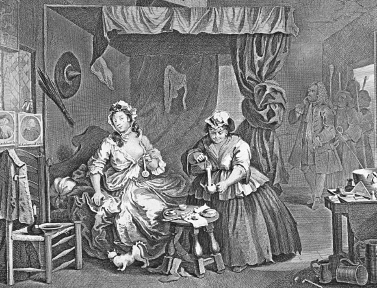
The doomed Moll Hackabout, from Hogarth’s The Harlot’s Progress, about to be arrested by a magistrate (1732).
Meanwhile, her literary counterpart, Fanny Hill, is in trouble, too. But not for long. Flung off by her lover after he found her having sex with a servant boy (Fanny’s response to finding Mr H en flagrante with the maid), she is taken in by the kindly Mrs Cole, a sympathetic bawd who runs a successful operation fronted by a dress shop. When the house is eventually raided, Fanny escapes into the night, unlike poor Moll, who is next seen, in Plate 4, as a prisoner at Bridewell, beating hemp. The change in Moll’s circumstances is illustrated by the discrepancy between her appearance, in her fine silks, and the cheerless prison. Meanwhile, Moll’s maid, nothing if not resourceful, is attempting to capture the attention of their jailer with a sly wink and a tweak of her garter.
By Plate 5, Moll is back in her garret in the Garden, and dying of syphilis, indicated by the shroud-like blankets which swathe her body to ‘sweat’ her. Two doctors are arguing about the effectiveness of their cures, while ignoring her evident distress, and her landlady is going through Moll’s trunk stealing her clothes, her witch’s hat, her mask and her high heels. By the fire sits a hapless victim of all this: Moll’s son, who seems doomed to enter the world of vice and crime.
Children were the innocent victims of prostitution, as is evident from this account of Mary David, born in Hertfordshire. Mary’s father died when she was a child, and her mother remarried a poor man. Mary was sent to London as a servant, and worked for two years for a family in Berkeley Square. The footman, although he was already married, seduced her under promise of marriage. She lost her place when she became pregnant. The footman helped her with the child at first, but then she took a place as a wet-nurse and put her own child out to nurse with a woman in Tottenham Court Road. The child she nursed was weaned, her milk dried up and she went to live in the house in Tottenham Court Road. The landlady was very civil, and allowed her to get into debt. Then, one night between eleven and twelve, her landlady came upstairs, ‘with manners totally changed, and swore with the grossest abuse, that she would turn her into the street, child and all, unless she brought her some pay’. When Mary asked how she could possibly do that, the landlady replied that ‘girls with worse faces than she often picked up a great deal’.
Mary now discovered that one other young lodger there was a kept mistress, and the house was, in fact, ‘though in a very private way, a bad house’. Mary took to prostitution, ‘driven out in bitter anguish’, and eventually found poor friends who took her in. She gave up her child to the parish workhouse, and returned to her mother, in the country. But then she found, ‘to her inescapable grief’, that she was pregnant again, ‘from the sad effects of the prostitution’. Her first child was now dead; the parish had refused to take it from the parish nurse and it had died with a black eye, a broken collarbone and whooping-cough. Mary managed to persuade the Foundling Hospital to take her second child, and from this her story emerges. And, since that story was not known in the country, she planned to return there after she had sold her milk in London.48 Mary’s subsequent fate is unknown, but, given her circumstances, likely to have been an unhappy one.
By Plate 6, the final, black frame of Hogarth’s sad story, Moll Hackabout is dead, and her fellow prostitutes are crowding around her coffin. The cautionary tale of Moll’s short life is unheeded by the girls taking the opportunity to ply their trade. The parson, staring into space, is slipping his hand beneath the skirt of Moll’s friend, while spilling his drink – a symbol of premature ejaculation – watched with resignation by Moll’s former maid. Moll’s friend gazes out of the picture with half-closed eyes and a faint smile on her lips, an expression reminiscent of Moll’s in Plate 3. The cycle of innocence corrupted, sex, decay and death will continue unabated.49
Fanny, meanwhile, survives to inherit a house in the country and is reunited with her first love. Fanny Hill is the Harlot as Heroine, an Enlightenment fantasy, with Fanny inhabiting a benevolent universe free of drunkenness and crime, almost entirely run by women, and where sex takes place in safe, indoor environments, and is a vice, more or less, of the middle and upper ranks of society.50
Comparing Hogarth and Cleland, it is obvious which version of fallen women was more accurate, and yet Fanny Hill is a wonderful piece of escapism, a classic of erotic fiction written by an author who appreciated the possibility of sexual enjoyment for women, although his graphic depictions of young men and detailed descriptions of their organs of generation suggest, at least to this reader, that his interests lay elsewhere.
Moll’s life ended unhappily; so did that of Mother Needham, who was arrested in March 1731 on Sir John Gonson’s orders, and sentenced to the pillory for her complicity in the rape by Colonel Charteris of the servant Anne Bond, having ‘frightened her into Compliance with his filthy Desires’ by holding a pistol to her head.51
Thanks to her friends in high places, Needham was permitted to lie face down on the pillory, which would protect her face. According to the Daily Courant, ‘at first she received little Resentment from the Populace, by reason of the great Guard of Constables that surrounded her; but near the latter End of her Time she was pelted in an unmerciful manner’. According to the Daily Advertiser, ‘notwithstanding the diligence of the Beadles and a number of Persons who had been paid to protect her she was so severely pelted by the Mob that her life was despaired of’. Several sources claim that she died of her injuries at the scene. But she appears to have been taken down, and committed to Newgate, where she died shortly afterwards.
As for Charteris, he stood trial for rape. The court was told that Anne Bond, who was unemployed, was sitting at the door of her lodgings one day when a woman appeared and offered her a job working for Charteris. The moment she took up her position, he laid siege to her. At seven o’clock one morning, ‘the Colonel rang a Bell and bid the Clerk of the Kitchen call the Lancashire Bitch into the Dining Room’. Charteris locked the door, threw her on the couch, gagged her with his nightcap and raped her. When she threatened to tell her friends, he horse-whipped her and took away her clothes and money.
Charteris’s rich and powerful friends filled the court to hear him sentenced to death for rape – but he spent less than a month in Newgate and received a royal pardon. Charteris had made himself immune to prosecution by cultivating friendships with some of the most powerful men in the land, including the Duke of Wharton (his own cousin) and the Prime Minister, Robert Walpole.52 But he was not immune to mob justice. After he was released from Newgate, a crowd set upon him, and, after yet another girl had been rescued from his house, in this instance by her sister, the neighbours stormed his house, bearing ‘Stones, Brickbats, and other such vulgar Ammunition’.53 When Charteris died of venereal disease in 1731, a jeering mob wrenched the lid off his coffin, threw dead dogs and cats into it and attempted to mutilate his body.
Covent Garden Piazza was indeed ‘that great square of Venus’, with a floating population of prostitutes offering a plethora of sexual possibilities to the voracious punters. While this chapter has concentrated on the mainstream erotic tastes, let us turn now to the more recondite, even bizarre activities that were on offer in eighteenth-century London.