
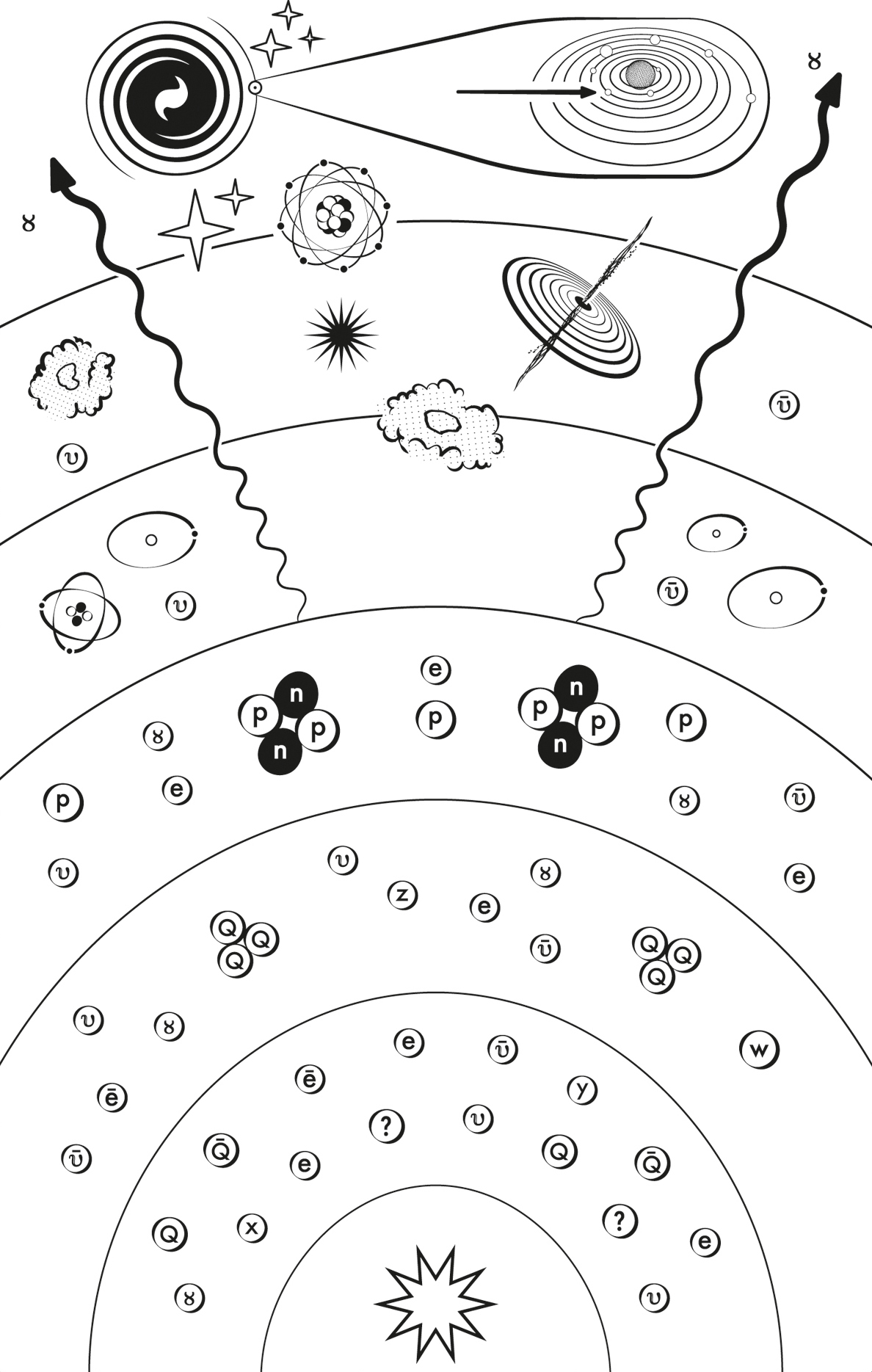
From the birth of the Universe as exotic fundamental particles, its biography continues as matter and dark matter in a dance of stars and galaxies, gathered into clusters.
Preface
The word ‘astronomy’ can mean both the activity through which astronomers discover what happens in the Universe and the science itself, in which the discoveries are described. A history of astronomy is usually a narrative about the first – the way that the science of astronomy developed throughout human history, from early times to the present. Although some of this history is recounted here, this book is primarily the story of the Universe – its birth and its growth – even if, as with the life of a historical figure, some chapters of its biography are obscure or missing.
The book paints a picture of what has happened in the Universe, starting from its beginning in the first milliseconds of the Big Bang expansion. In the Prequel (Chapter 13), I have also described some of the things that may have happened even before the Big Bang, and in a Sequel (Chapter 12) some of the events that are likely to happen in the future.
Like biographies in general, this one is broadly chronological, although sometimes it has made more sense to describe what happened in overlapping sequences – I have sought to write an understandable story rather than one that is strictly chronological. A time marker at the top of each right-hand page locates when the events described in the text of that sub-section took place.
Astronomy is, in its essence, the science of the very large, even though small interactions in its tiniest components – molecules, atoms and subatomic particles – cause its most dramatic events. As a result, despite it being the weakest of the forces, gravity plays more of a role in astronomy than in other sciences because it has great effects on large masses, like planets, stars and galaxies, even if they are separated by large distances. The Earth and the minor bodies of the solar system, such as meteorites, are the smallest astronomical bodies that I consider.
This is my selection of what I believe are the most important events, the greatest structures, the most powerful explosions, the largest ecosystems and the celestial bodies in the life of the Universe that are most relevant to our human story.
There are lots of billions in this book – billions of stars, billions of galaxies, billions of light years, and more. The word is formally not used in science, but in this book 1 billion is equivalent to 1,000 million.
1
The Universe was born about 13.8 billion years ago. If it had not been born, and if, therefore, it has existed for ever, this book could not have been written as a biography. There would have been no progression or development of the Universe over time and everything would always remain the same. But, gazing into the far distances of space, astronomers can see changes laid out in a timeline and this book is an attempt to put what they see into words, like a biography.

In the Big Bang, a soup of fundamental particles condensed into the matter that we see today, and dark matter that hides from us. After a period of darkness, stars and galaxies emerged into the Cosmic Dawn.
Why is the sky dark at night?
The dramatic birth of the Universe was a small, dense, hot explosion, the fireball of which is still visible as radiation everywhere. Galaxies condensed out of the outrushing material, a phenomenon that we see as the expansion of the Universe. Somewhere in that event and that material lie our own origins.
There is a simple fact that justifies the analogy between the history of the Universe and a human life, which ages after starting at birth: it is dark at night. In daytime, when we look up, our line of sight goes up to the sky. It may zoom straight out into space, but it may reach an air molecule and its direction may then be changed. The line of sight might end up on the Sun’s surface – it forms a route via the sky that links our eye and the Sun. As a result, the sky is bright. At night, our line of sight may also zoom directly into space; again, it may reach air molecules and be diverted, but the molecules will not be illuminated by sunlight. The line of sight will not then turn towards the Sun, but will extend out into space to end up somewhere far away in the Universe. Sometimes it will end up on the surface of a galaxy or star, but mostly it heads into nothing and, as a result, the night sky is dark.
If the Universe was infinite in extent and fully populated with stars, the line of sight would always end up on a star. If you stand in a large forest, surrounded by trees, no matter in which direction you look, eventually your line of sight ends up on a tree trunk. Likewise, in an infinite Universe populated by stars, your sight-line would always end up on the surface of a star and the night sky would be as bright as the surface of the Sun. Manifestly this is not so.
This contradiction is known as Olbers’ paradox, after the early nineteenth-century German astronomer Heinrich Wilhelm Olbers (1758–1840), who was not only a prominent doctor in Bremen, but also a keen amateur astronomer. As a student, he studied both medicine and mathematics, and it was said that he developed a new way to calculate the orbits of comets while sitting at the bedside of a sick patient. He installed a telescope in an upper room of his house, from which he observed comets. He survived on only four hours sleep at night and was thus able to pursue two careers: a busy professional life as a doctor and his passion as an astronomer. He has been called the greatest of amateur astronomers (and his work as a doctor seems to have been respected, too).
Bremen is a port in northwest Germany between Denmark and the Netherlands, near to the North Sea. Its climate is not ideal for astronomy, and it might have been while he waited for the clouds to clear that Olbers wrote an influential article in 1823, still important and the subject of much discussion in modern times, on the paradox of why the night sky is dark. His article brought attention to the paradox, although the question has a much older history, with a number of distinguished scientists having discussed it before him. Its importance as a help in appreciating the birth of the Universe was not rediscovered until 1960.
Olbers formulated the paradox as if the Universe was more or less uniformly populated by an infinite galaxy of stars, which was the common belief at that time. We now know that our Galaxy only extends to a distance of about 200,000 light years, but the Universe is more or less uniformly populated by galaxies out to a much further distance; the change from stars to galaxies does not change the essentials of Olbers’ argument. The solution to the paradox is that there must be long gaps between galaxies, sight-lines that pick their way through the galaxies like corridors so that we can see through the gaps to the empty region that is beyond them all. This is as if the trees, in the analogy above, were actually grouped in a small wood and between some tree trunks we could look out into the open countryside beyond.
What Olbers’ paradox implies is that at night, through the gaps that make sight-lines through the galaxies, we can see to the boundary of the Universe. There are no galaxies or stars beyond that boundary. So, the majority of sight-lines head towards nothing at all and that is why it is dark at night. This explanation is couched in terms that are easy to visualize, and the essence of it is true enough, but not the detail, because the Universe is not a collection of galaxies isolated in otherwise empty space. It is a curved and finite region that in its total has a large volume entirely filled with galaxies.
Olbers was limited by not knowing about the curvature of space because he lived a century before Albert Einstein, but he put together the important argument that the Universe is limited in its size. This has an even more significant consequence – the Universe must therefore also be limited in time because the limitation in size is set by its age. As our line of sight extends into the distance, it also penetrates back into the past because light travels at a certain speed. We see the image of the past carried to us by that light. Because the Universe was born, no light can reach us from a time before its birth – the age of the Universe sets a horizon in our view of space, beyond which we cannot see. The boundary of the Universe is at a distance corresponding to the distance that light has travelled since the birth of the Universe. The darkness of the night sky, as an observation interpreted with the speed of light in mind, compellingly puts forward the proposition that the Universe was born.
In general, the entire biography of the Universe is laid out backwards along a line of sight through space from here on Earth outwards – out to a certain, limited distance and back to a certain, limited time. Astronomers can witness the sequence of events over the time since the Universe was born by looking into the distance. In principle, if astronomers can view the entire Universe, they can view its entire lifetime. Of course, the earlier events are further away and less distinct than the nearby ones, so the more distant history is less clear than the nearer history. But that is true of all history. Moreover, the events witnessed out there in the past are not the actual predecessors of the events taking place nearby now. They are, however, events like the predecessors of events nearby.
The goal of having the lifetime of the Universe laid out like a timeline in large part explains why astronomers are obsessed with building ever larger telescopes. Everyone knows astronomers use telescopes to peer into distant space, but they also use them as machines to look back in time. The bigger the telescope, the further it can see, not only into space but also into time past (pl. II).
Why doesn’t the Universe collapse?
The Universe is a collection of galaxies spread out over space. They all attract each other by the force of gravity. Finding the solution to the obvious question – why do the galaxies not pile up into a big heap in the middle? – eventually led to the discovery that the Universe is expanding and therefore must have a starting point.
This question of collapse is one that worried the English physicist Isaac Newton (1642–1727), who discovered the force of gravity and realized that it was a force by which everything attracted everything else, no matter the distance by which they were separated. The story is that in 1665–66 an outbreak of the plague began to spread from London to cities and villages elsewhere in Britain, including Cambridge, where the young Newton was studying at Trinity College. The university locked down to reduce the exposure of its students and teachers to the epidemic. Newton left his rooms in college and returned to his home to self-isolate in a bubble with his family in the country, on a farm in Woolsthorpe in Lincolnshire, not far geographically from Cambridge but far enough from the contagion in the city. There he had time to think. According to an account given about 1727–28 by John Conduitt, a colleague and relative by marriage, Newton described the event that, at the age of twenty-three, inspired his thoughts on gravity:
In the year [1666] he retired again from Cambridge on account of the plague to his mother in Lincolnshire & whilst he was musing in a garden it came into his thought that the same power of gravity (which made an apple fall from the tree to the ground) was not limited to a certain distance from the earth but must extend much farther than was usually thought – Why not as high as the Moon said he to himself & if so that must influence her motion & perhaps retain her in her orbit, whereupon he fell a calculating what would be the effect of that supposition.
The apple tree, or more likely a descendant of the tree, is still there in Woolsthorpe, outside the farmhouse door.
Newton had realized that gravity might be a force that pervaded – indeed, dominated – the entire Universe. It kept the Moon in its orbit around the Earth, the planets in their orbits around the Sun – and presumably the stars in orbits around each other. It was a big thought to have been provoked by a falling apple, even if Conduitt’s story is not entirely reliable as a historical account, perhaps much improved by being retold repeatedly by Newton himself as he grew older. The French journalist Voltaire popularized the story of the falling apple and the Moon, which he had learnt from Conduitt himself, as a successful everyday image that conveys Newton’s ideas about the universal attraction of gravity.
In Newton’s greatest work, a book first published in 1687 and known as The Principia, he identified how the force of gravity between two attracting objects depends not only on their masses (the more massive each one is, the greater the force) but also on the distance separating them (the gravitational force lessens as objects get farther apart, diminishing according to the square of the distance between them). This is called the inverse square law.
Newton soon realized that his concept of gravitation created a problem for the sustainability of the Universe. If the Universe was some sort of container filled with (as he thought) stars (we would say galaxies), it would be unstable. It would soon collapse, gathered together by the mutual attraction of everything for everything else. Newton exchanged correspondence on the subject with Richard Bentley, a theologian with strong scientific interests, a controversial and tyrannical Master of Trinity College, Cambridge, with whom Newton formed an alliance (it was Bentley who took The Principia through the Cambridge University press). Newton wrote in a letter to Bentley in 1692:
As to your first Query, it seems to me that if the matter of our Sun & Planets & all the matter in the Universe was eavenly scattered throughout all the heavens, & every particle had an innate gravity towards all the rest & the whole space throughout which this matter was scattered, was but finite: the matter on the outside of this space would by its gravity tend towards all the matter on the inside & by consequence fall down to the middle of the whole space & there compose one great spherical mass.
Newton went on to sketch out one of his most prescient speculations, which we will see later came to describe the origin of galaxies in the outrushing material of the Big Bang:
But if the matter was eavenly diffused through an infinite space, it would never convene into one mass but some of it convene into one mass & some into another so as to make an infinite number of great masses scattered at great distances from one another throughout all that infinite space.
Today we call this process ‘gravitational collapse’, and it is a concept that, as we will see, is one of the most important ways that cosmic history developed.
Newton’s law of gravitation had other problems that made it difficult to understand – gravitational collapse was only one. Think for a moment about the inherent implausibility of the proposition that a force can be transmitted from one body to another through space, through nothing at all. Nevertheless, Newton’s law was amazingly successful in describing the motion of the planets, so it seemed to be right, or, at least, to do the right things. Even now, Newton’s discoveries are used to control the orbits of spacecraft through the solar system from one planet to another. Newton turned aside from the difficulties with his theory of gravity with the famous remark Hypotheses non fingo (‘I make no hypotheses’), published in some reflections that he added in the second (1713) edition of the Principia. He took an empirical view: his theory worked, even if he did not understand everything about it.
The difficult issue of why the Universe did not collapse was marked as an open question for two hundred years. Then in 1916, German-born physicist Albert Einstein (1879–1955) published his general theory of relativity, which was essentially a new theory of gravity, a refinement of Newton’s. However, when applied to the entire Universe, it produced the same result as Newton’s theory: the Universe collapsed. Einstein was bolder than Newton: he did make a hypothesis. He suggested in 1917 that there might be a kind of negative gravity that propped the Universe up, so that it was stable and could last indefinitely. Like Newton, Einstein did not say exactly what the force was, but instead worked out some of what would result if that was so, introducing an entirely empirical factor into his equations symbolized by the Greek capital letter lambda (Λ), which he called the cosmological constant.
Einstein’s solution to the problem of gravitational collapse was built on some incomplete mathematics, as was shown by the Russian mathematician Alexander Friedmann (see page 41). Clever though he was, Einstein had failed to map out all the possible outcomes of his own general theory. There was a way forward that avoided the outcome that the Universe collapsed and did not last forever without requiring the prop of the imagined cosmological constant Λ. Indeed, the new idea would have worked for Newton, too. The correction gave birth to the idea of an expanding universe. At first Einstein rejected the correction, but he came to accept it, and then reject it again. In reminiscing about these developments, he later came to regard his own idea about the prop as the ‘biggest blunder he ever made in his life’. For about a century afterwards, cosmologists worked out their theories of cosmology using the cosmological constant Λ, and then set Λ = 0. It was not until the 1990s that cosmologists in general came to believe that Λ was not zero after all (see Chapter 2).
The primeval atom: Lemaître’s model of an expanding Universe
It was Belgian priest and astronomer Georges Lemaître (1894–1966) who, in a series of papers written about 1930, brought the mathematical theory into a physical picture of the Big Bang. He studied engineering and fought heroically in the First World War as an artillery officer. After the war had ended (and perhaps in reaction to his experiences), he turned to more peaceful studies, both as a Jesuit priest and as a mathematician, pursuing an interest in astronomy and cosmology. In 1923, he studied at the University of Cambridge under the astronomer Sir Arthur Stanley Eddington (1882–1944). Eddington had been one of the first people to see the importance of Einstein’s general theory of relativity and encouraged Lemaître to discover more of what general relativity had to say about the life of the Universe.
Lemaître pursued Eddington’s suggestions when he returned to his own university in Leuven in Belgium, discovering how Einstein’s theory allowed the possibility, overlooked by Einstein himself, that the Universe was expanding. This implied that in the future it would become more and more rarefied and, effectively, end.
Neither Einstein nor Eddington liked this idea, both heavily influenced by a religious feeling, that, once it had been created, the Universe would last forever. This was thought to be most consistent with the biblical account of the Creation as recounted in the book of Genesis, and in the teachings of the Jewish, Christian and Islamic religions that God is boundless. Eddington and Einstein were both religious people, one a Quaker and the other a free-thinking Jew, and each man found repugnant the idea that the Universe was not eternal.
One might have thought that Lemaître, a Roman Catholic abbé, would have had a similar strong opinion about this question. However, he was a follower of Saint Thomas Aquinas (see page 270), and said: ‘It appeared to me that there were two paths to truth. I decided to follow both of them.’ Lemaître let his reason direct him to cosmological truth, whatever it was, and then to reconcile that aspect of the truth with his theological beliefs. The Big Bang emerged as Lemaître’s favourite explanation by science and reason of the origin of the Universe, giving a clear picture that the Universe started and will continue indefinitely. He was able to get to the same idea by following the path of faith as mapped out in the book of Genesis in the Old Testament, a canon of holy books accepted by all three of the Abrahamic religions.
Lemaître came to his concept of the expanding Universe through abstract mathematics but he provided a very specific interpretation in a form that was readily imaginable. If the Universe was now expanding, it evidently started off in a more concentrated form. He envisaged this starting point as a primeval atom that exploded. Lemaître thought of this atom as a dense assembly of all the atomic particles in the Universe, which, like a radioactive element, spontaneously disintegrated, setting off the life of the Universe. As the originator of the concept of an explosive start to the Universe and as a Belgian abbé, Lemaître doubly earned the honour of the title ‘Monseigneur Big Bang’.
The idea of a primeval atom was couched in terms of the cutting-edge science of the first part of the twentieth century. From the time of the Greek philosophers, atoms had been regarded as the fundamental particles of the Universe – the very word ‘atom’ is derived from the Greek, meaning ‘something that cannot be divided’. It is an immediate challenge for a scientist to hear someone say that they have got to the bottom of a problem, its ultimate cause or its fundamental origin; the scientist’s instinct is to ask why this is the beginning of the story, why there is not something behind the ‘ultimate’ reason.
In the early years of the twentieth century, scientists probed successfully into atoms and found that they are in fact composite, made of electrons, protons and neutrons. Each atom has a nucleus of protons and neutrons surrounded by clouds of electrons, which can be envisaged, in some ways, as being in orbits that step outwards from the nucleus, like a small solar system of planets orbiting their sun. For years these were regarded as the fundamental particles, and this was the way that Lemaître, who knew about the structure of atoms, envisaged his primeval atom. His Big Bang was an explosion of an accumulation of all the electrons, protons and neutrons in the Universe.
In the latter half of the twentieth century, even protons and neutrons have been discovered to have structure, and the phrase ‘fundamental particles’ now encompasses over three dozen distinct elementary particles. I name them to give an impression of their variety and the complexity of the science of the Big Bang explosion at this early stage: there are six quarks (with the names up, down, strange, charm, bottom, top), six antiquarks, six leptons (electron, muon and the tau particle, and their respective neutrinos), six antileptons, thirteen gauge bosons (eight gluons, the photon, the W+, W-, Z particles and the graviton) and one Higgs boson (see Chapter 13 for explanations of some of these particles) – all derived from something that was initially thought to be indivisible! The structure of these so-called fundamental particles is even now under discussion with theories that use entities called strings to build them up.
Fundamental particles are studied in terrestrial laboratories by generating them in an atomic reactor or by colliding particles in high-energy accelerators like the Large Hadron Collider at CERN near Geneva. In some ways, the Big Bang was a similar reactor or high-energy accelerator, but it was not disciplined by laboratory control and generated the entire range of possible particles. The ambitious goal of cosmologists is to start at the most basic components of matter, whether thought to be a single primeval atom, a collection of atoms, a plasma of fundamental particles or a spectrum of strings, and to write the biography of the Universe from that moment.
Has the Universe expanded?
Lemaître’s concept of the birth of the Universe in what came to be known as the Big Bang received immediate proof in a discovery in 1929 by the American astronomer Edwin Hubble (1889–1953). Hubble was a clever man, educated at the universities of Chicago and Oxford in mathematics, astronomy and jurisprudence, who thought he would take up a career in the practice of law. After the end of the First World War, however, he ‘chucked the law for astronomy’ (his own words) and began work at the Mount Wilson Observatory in California.
Hubble teamed up with astronomer Milton Humason (1891–1972), a man who started his association with the Mount Wilson Observatory by driving a mule train up the mountain with components for the 100-inch Hooker Telescope being built there. Having participated in the telescope’s construction, Humason stayed working in the same place, at first as a janitor and then as a scientific assistant. In this role he grew to understand better than anyone else how to coax the best out of the temperamental telescope. With Humason’s help with what was then the largest telescope in the world, Hubble gathered data about a number of galaxies and found a way to estimate their distance. He went on to look at the motions of the galaxies using measurements taken by astronomer Vesto Slipher (see page 258) at the Lowell Observatory in Arizona, and in 1929 discovered how they were moving. The galaxies were all receding from us with speeds that increased as their distance increased: the trend line is now called Hubble’s Law.
The natural interpretation of Hubble’s discovery is that the Universe of galaxies is expanding. If indeed this is so, and we live in a typical galaxy, we would see all the galaxies around us receding, with the more distant galaxies receding faster. Hubble had seen the evidence that the Universe had indeed exploded, as Lemaître had visualized.
Hubble’s interpretation of the evidence was that it confirmed the Big Bang theory and this was validated by further investigations. If there had been an explosion, the galaxies must have been packed tighter together in the past. This question could be investigated through the phenomenon of ‘look-back’. If we look at the most distant galaxies, we are seeing them as they were in the past and we can investigate whether they are packed closer together or not. Up to the 1950s, the distances to which optical telescopes could see were not so great that they could see the difference in density, but radio telescopes were discovering thousands of radio-emitting galaxies at large distances and the question could be addressed by radio astronomers.
The new technique of radio astronomy developed from the wartime technology of radar. When the scientists and engineers who worked on radar in the Second World War returned home to civilian life, several of them grouped into universities and research institutes to carry out such studies in Britain, America and elsewhere. In Britain, the organizations now known as the Nuffield Radio Astronomy Observatory of the University of Manchester at Jodrell Bank near Chester, and the Mullard Radio Astronomy Observatory of the University of Cambridge at Lord’s Bridge near that city, had their origins in this time.
It was appropriate that a new technique applied by newly created scientific groups would address the dramatic question of whether the Universe expanded or not. It was not an easy one to answer. Because the technology of radio telescopes was new, it was not properly understood and the results from different groups were inconsistent. Radio astronomers took up two sides over the issue. One camp was led by Martin Ryle (1918–1984) at the University of Cambridge; the other camp was a loose alliance of research groups in Australia. The cosmological question boiled down to a matter of counting the radio-emitting galaxies discovered by each group, but to count them you have to discover them. Ryle invented a new method to do this called aperture synthesis; in the countryside close to Cambridge, near a disused railway station, he used the straight and level railway line as a foundation to build a radio telescope to survey the sky. After the first experimental surveys, in 1955 Ryle published a catalogue of nearly two thousand radio sources called 2C (the second Cambridge catalogue of radio galaxies). It clearly showed a large overabundance of faint radio sources. Broadly speaking, ‘faint’ implies ‘far’ and ‘far’ implies ‘old’, so the conclusion was that the Universe was denser in the past. This favoured the Big Bang theory.
Although the Cambridge conclusion was correct, it was based on false evidence. Australian surveys showed a slight excess of faint sources but it was nothing like the excess found by Ryle. The Australians suggested that most of the faint sources in the 2C catalogue were spurious instrumental effects, not, in fact, real. In the Australian Journal of Physics in 1957, they did not shirk from a clear conclusion: ‘there is a striking disagreement between the two catalogues…discrepancies, in the main, reflect errors in the Cambridge catalogue and accordingly deductions of cosmological interest derived from its analysis are without foundation’. They were right. Ryle redoubled his efforts to find the real faint sources.
Eventually, the cosmological arguments were resolved through the new work, which produced reliable catalogues called 3C (see page 72) and, later, 4C. There was indeed an excess of faint radio sources that were at vast distances and look-back times. Galaxies were, in general, packed closer together in the past and radio astronomers had confirmed that the Universe has indeed expanded. Ryle was awarded the Nobel Prize in Physics in 1974 for ‘pioneering research in radio astrophysics…for his observations and inventions’. It is interesting that the prize was given for inventing the techniques, not for the cosmological discovery itself.
Since this work, there has been general consensus that the life of the Universe started with the Big Bang. Powerful modern optical telescopes like NASA’s Hubble Space Telescope have looked back and pictured some of the innumerable galaxies 90 per cent of the way back to the Big Bang or more and seen how they crowd together.
From the Big Bang into the future
Lemaître had an interesting idea of how the life of the Universe would unfold. It came to produce you and me, he thought, in a way that might not have been determinate. He based his idea on the then newly developing theory of quantum mechanics. Like atoms today, the primeval atom would have existed in some atomic configuration. It exploded from that state, the change governed by quantum mechanics. Quantum mechanics includes the uncertainty principle, according to which we do not know precisely how things will turn out until they do. The Austrian physicist Erwin Schrödinger (1887–1961) explained this principle by posing the famous question of the cat in a box (known as Schrödinger’s cat): when a cat is in the box with the lid closed, is it alive or dead? When we open the box, we know it is one or the other. But before that, inside the box, the cat is both alive and dead, indeterminate.
In an article in Nature in 1931, Lemaître expressed his thoughts on the way the explosion of the primeval atom led to ourselves in terms of the obsolescent technology of a phonograph (gramophone) and the vinyl discs that it plays: ‘The whole story of the world need not have been written down in the first quantum like a song on the disc of a phonograph. The whole mass of the world must have been present at the beginning, but the story it has to tell may be written step by step.’
We are a part of the history of the Universe and our origins lie in its birth. The history was indeterminate and might or might not have led to where we are today – we might have been alive or dead. We are in fact alive and we can trace the general steps by which the Big Bang created the environment in which we live, but there is no predestined path from the Big Bang to us.
Although Lemaître’s primeval atom is now regarded as a scientific metaphor, not a literal truth, the basic idea that the Universe was born from the explosion of an energetic, dense accumulation of subatomic particles has survived to the present day. The next page of the life of the Universe sets off from this thought towards what was, at the beginning, our uncertain future.