
12
This book is a biography of the Universe and mostly looks backwards, but a peek into its future life shows where we, our planet, our Sun and our Galaxy are heading.
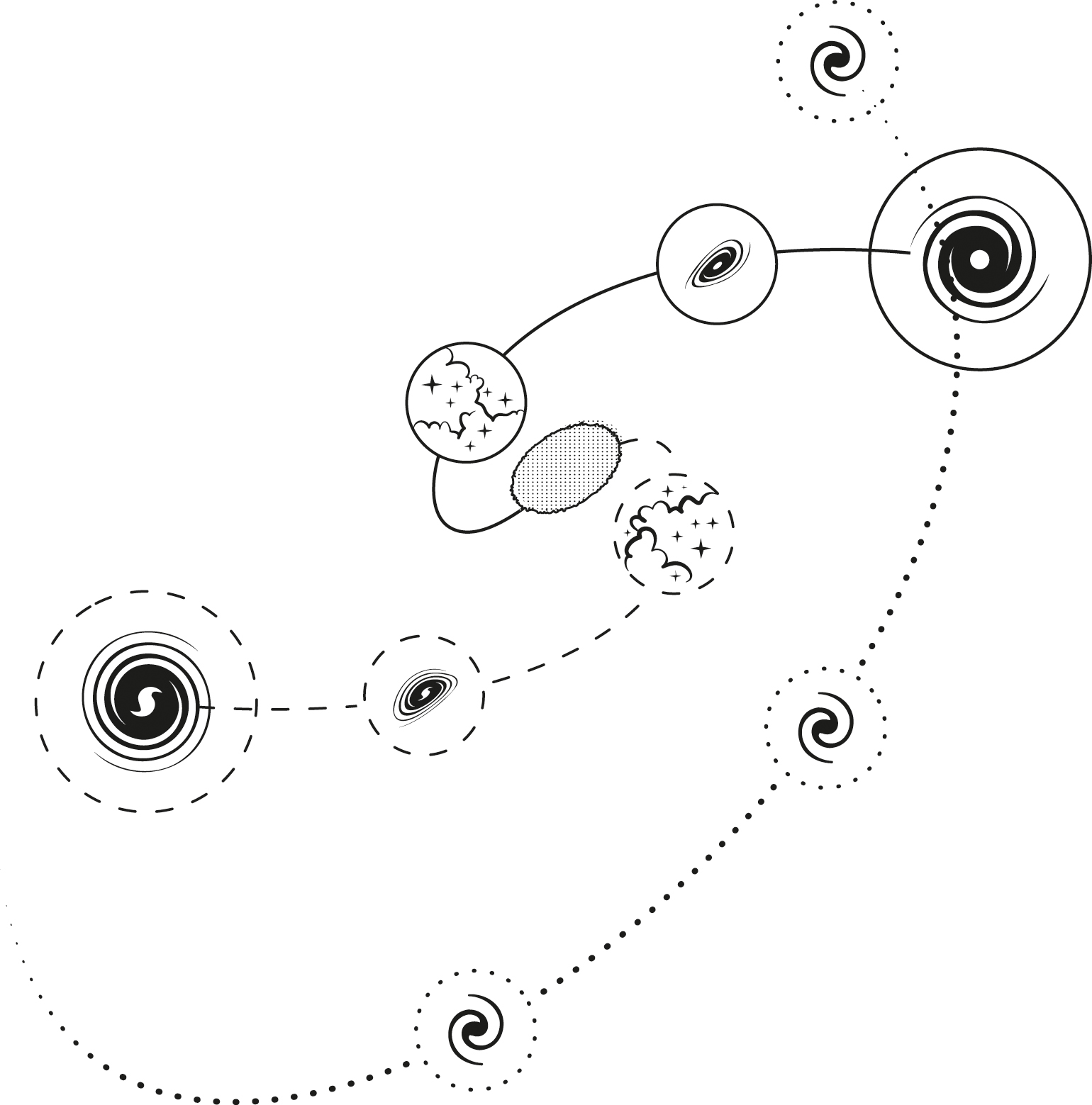
The Andromeda Galaxy (upper right) and ours (left) are approaching one other, each distorting and triggering the formation of stars in the other. They will collide in 4.6 billion years, merging to form a single, giant elliptical galaxy. The Triangulum Galaxy (top right), the bystander in the threesome, will curve in a trajectory past the two of them.
The near future on Earth
The same large effects that have occurred from natural astronomical phenomena over the past millions of years of the Earth’s life are also likely to occur in the future. Planet-wide volcanic eruptions and large meteor strikes at the scale of the events that have already occurred and provoked the mass extinctions of geological history remain possible, likely or even inevitable, but unpredictable. In addition, as described in the previous chapter, human beings have developed to become a powerful planetary force and we are already making a mark on other worlds through space exploration, leaving footprints and wheel tracks on the Moon, and abandoned equipment on many worlds. We may well imminently become a potent interplanetary force, the ultimate scale of which is the proposal to ‘terraform’ Mars, thus far science fiction but potentially a real engineering project. It would be intended to change Mars from a desert into a verdant, habitable planet (let us hope that the project is well thought through and has the desired effect). We may have to do something similar to Earth to reverse the effects of climate change – for example, to remove carbon dioxide from the atmosphere on a global scale and store it in the ground.
However, given that we are an animal species, history suggests that eventually our species will become extinct, presumably on a timescale comparable to the period during which we have evolved in the past. Our species has lasted a quarter of a million years and our distant ape-like ancestors lived only millions of years ago. If the evolutionary forces remain natural ones in the future, this suggests that, in a similar time, we will have descendants but they will be as different from us as we are from our ancestors. There are those who argue, however, that this transformation of our species and our environment will happen much more quickly, since changes are taking place at an accelerating pace, driven by rising population numbers and increasing technological capability.
The range of possible ways in which humans might self-inflict extinction is wide, including not least:
•widespread starvation and thirst due to unfulfilled demands by the increasing human population on agriculture and natural resources;
•pandemics like Ebola, influenza and Covid-19, caused by malpractices in animal husbandry and the crossing of viruses and other pathogens from wild animal and bird populations to human beings;
•release (accidental or otherwise) of toxic industrial products, such as the CFC chemicals that, until banned from use in refrigerators, depleted the ozone layer when they escaped;
•all-out nuclear war; and
•anthropogenic generation of carbon dioxide and methane that will, if unchecked, cause damaging global climate change.
The last-mentioned climate catastrophe is widely described as imminent: it is a matter for debate whether we will be able to generate the political will that can make changes on a scale and with a speed to control anthropogenic climate change. It seems certain that the Earth’s atmosphere will not be able to respond enough and quickly enough to mitigate the immediate effects of human activity, although there is some hope in James Lovelock’s Gaia hypothesis that life will, on a longer timescale, be able to adjust the environment to maintain itself (see page 242), although that may not favour humans.
Our species may thus become extinct rapidly, or at least have its capabilities reduced enough for humans to cease to dominate environmental changes. If so, the present Anthropocene epoch will be quickly over. In retrospect, as viewed by surviving descendants, it will be marked by the significant changes in the landscape that human beings made to favour their own activities like agriculture, mining and transportation, and the control of flowing water. Additional changes will have been made by the unexpected consequences of human activity, such as alterations of the coastline that will have shrunk the area of dry land as a result of the rise of sea level, itself the result of the increase in the amount of carbon dioxide in the atmosphere.
The geological characteristics of the epoch will include rather thin but distinctive layers in the Earth’s geological record. The strata associated with the Anthropocene will comprise human-made scrap, such as building rubble, worked metal and long-lasting plastic. Other components of the strata will include carbon ash from energy generation from fossil fuel, radioactive elements from nuclear bomb tests and the waste and accidental discharges from nuclear energy generation and from medicine, and, eventually, the decay products of plastic, both in localized earth-based deposits and in more widely dispersed, thin layers in sedimentary deposits at the bottom of the ocean.
When might this be? The Doomsday Clock is published by the Bulletin of the Atomic Scientists. It is an image of a clock-face that is ticking towards a symbolic midnight at the future moment of human-made global catastrophe. It is a concept that warns about how close we are to destroying our world with dangerous technologies of our own making. The metaphor uses the imagery of apocalypse (midnight) and the idiom of nuclear tests (countdown to zero). It is a reminder of the urgent perils that we must address if we are to survive on our planet.
The original setting of the Doomsday Clock in 1947 was seven minutes to midnight because of the threat from use of nuclear weapons. With the end of the Cold War, it was put back to seventeen minutes to midnight in 1991, its most optimistic setting ever. In 2007, the Clock’s adjustments began to be influenced by non-nuclear threats, particularly the threat of a climate catastrophe, and it has persistently neared the critical hour. In January 2020, the Doomsday Clock was advanced to one hundred seconds to midnight, the closest that it has ever been. It is maddening that the Clock is not (cannot be) calibrated, so we do not know how much time this really represents, and of course the purpose of the Clock is to prompt us to act to avert catastrophe, so that midnight never strikes. However, the symbolism suggests that we are worryingly close to the critical point.
The end of total solar eclipses
On a less worrying note, we can certainly predict the termination of one of astronomy’s greatest spectacles – total eclipses – because the Moon is getting further away. The Moon moves in an elliptical orbit, so its distance varies somewhat through a month, but it is at an average distance from the centre of the Earth of 384,400 kilometres (238,855 miles), which is 1.28 light seconds. A laser pulse transmitted from a telescope on Earth, reflected from mirrors left on the Moon by Apollo astronauts, and returned back along the same path to a detector in the same telescope, takes 2.56 seconds for the return journey. Measuring that travel-time accurately is how astronomers monitor the orbit of the Moon.
The Moon is spiralling outwards in its orbit. Its drift deeper into space has been happening for a long time, ever since its creation more than 4 billion years ago (see Chapter 10). This has been directly confirmed for the last half a billion years by analysis of the Moon’s effect on oceanic tides, which leave their traces in geology. Marine organisms such as coral, bivalves, brachiopods, cephalopods and stromatolites feed in tidal waters and show growth rings in which it is possible to see daily, monthly and annual periodicities, linked respectively to the Earth’s rotation, the Moon’s orbit around the Earth and the Earth’s orbit around the Sun. Analysis of fossils from 70 million years ago shows that, in the Late Cretaceous period, there were 372 days per year, so that the day was then about 23.5 hours long. Sedimentary rocks are likewise laid down with tidal rhythms, and that has made it possible to estimate that towards the beginning of the Cambrian period, 620 million years ago, the day was 22 hours long. Since that long ago, the Moon has retreated at an average rate of about 2.2 centimetres (0.9 inch) per year, about the same speed that fingernails grow.
At the present time, the Moon has accelerated to retreat at 3.8 centimetres (1.5 inches) per year and the ‘day’ has lengthened to 24 hours. The acceleration is thought to have happened because the Moon’s orbital energy is being dissipated more quickly. Continental drift, volcanic activity and geological forces in general have created seas that are the right size and shape to be resonant to the oscillation of seawater. The seas suck up energy in the tides, draining it from the Moon’s orbit.
It is a strange coincidence that the Sun and the Moon are the same size in the sky. The Sun is four hundred times the diameter of the Moon but it is four hundred times further away. From time to time the Moon passes exactly over the Sun, and we can experience the glory of a total solar eclipse. At other times the Moon is a bit further away than usual and, although the Moon and Sun line up, the Moon leaves a ring of sunlight around its edges – this makes an annular eclipse. This is not so glorious as a total eclipse because the sunlight left peeking over the Moon’s edge overwhelms the faint light from the Sun’s corona and prominences. The darkness on Earth as sunlight is completely cut off, the sudden revelation of the faint and streaky white corona and the beautiful scarlet prominences give a total eclipse its impact. By contrast, annular eclipses are interesting but underwhelming.
Because the distance of the Moon is increasing, annular eclipses are becoming more common and total eclipses are becoming fewer, at a slow rate of change. Eventually the Moon will be so far away that it will no longer be the same apparent size as the Sun, but will always fit inside the Sun’s shape so there will only be annular solar eclipses. The demise of total eclipses will not occur suddenly, because the Moon’s distance from Earth varies so much, but total eclipses will be progressively less frequent over the next 400 million years. As the Moon’s distance and other characteristics of its orbit change, total eclipses will be on-again, off-again for a further 400 million years. If, in spite of the earlier discussion about our impact on the planet, Earth is still inhabited, people living after then will have permanently lost one of the greatest astronomical spectacles.
The distant future of the Sun and Earth
The Earth’s surface will change its character when plate tectonics cease to push the continents about. This will happen when the outer layers of the Earth have cooled enough to completely solidify, perhaps in a couple of billion years. This will be the end of the mountain-building era on Earth, apart from the walls of craters made by occasional impacts of large asteroids. Mountain ranges will gradually wear away under the processes of erosion, becoming hilly plateaux. Individual volcanoes or clusters of them may grow for a while, building over weak spots in the crust, as they do in Hawaii and on Mars and Venus, two planets that, like the Earth in this future, do not have tectonic plates.
Even this reduced volcanic activity will cease as the Earth cools further. Earth will begin to die, with no more seismic activity from earthquakes or volcanoes. Eventually, its liquid iron core will solidify and its convection seize up. Our planet’s magnetic field will die away completely and permanently. Unlike the temporary loss of the geophysical magnetic field during the switches in its polarity (see page 227), this permanent loss will be catastrophic. Unimpeded, the Sun’s particles will eventually scour away the atmosphere. With no air pressure to keep water molecules from escaping from seawater, the oceans will vaporize, rainfall will cease and the land will dry out. In 1 billion to 2 billion years from now, the Earth will have lost its equanimity and become a quiescent desert land. Earth will have turned into Mars.
The present-day physics of the Sun, its structure and the nuclear energy that it generates are very well understood. Predictions of the Sun’s future based on the same physics have been made and published repeatedly. However, during its evolution the Sun grows in size, its surface gravity reduces and it loses mass easily. What happens depends critically on the way mass loss happens and this is not a very secure area of astronomy. In 2008, University of Sussex astronomers Klaus-Peter Schröder, Robert Connon Smith and Kevin Apps revisited the ‘Distant future of the Sun and Earth’ paying special attention to the mass loss. Their predictions started off in a familiar way but then started to differ significantly from what had been conjectured before.
Over the near future, the Sun will warm and brighten, increasing in luminosity by 1 per cent every 110 million years. In 1 billion years, it will be about 10 per cent brighter. The oceans will start to evaporate and the water vapour content of Earth’s atmosphere will increase substantially. Water vapour is a greenhouse gas, so runaway evaporation will cause the surface to become unbearably hot and the oceans to boil dry. In the stratosphere, solar ultraviolet light will break up the water molecules, which will gradually escape into space.
At the same time that the Earth’s magnetic field collapses, the Sun will be much hotter. It will be at its hottest 2.55 billion years from now, and at its brightest as a hydrogen-burning star 5.4 billion years from now, emitting nearly twice the energy that it did originally. This will put the Earth in the same position then that Venus is in now, so far as the flux of solar energy that Earth receives. This will cause the Earth to bake, at about the same time that it loses its magnetospheric defence against solar cosmic radiation. It is hard to see that life could continue on our planet. At the same time, however, the more distant parts of the solar system will also become warmer. Satellites like Jupiter’s Europa, where water is abundant but is currently solid ice, will become more habitable and those like Saturn’s Titan, where organic molecules abound, may feel the push in the Sun’s radiation to develop life. These satellites may turn into the Earth as it was 3 billion years ago in the Archaean Eon.
In 5.4 billion years, the Sun’s core will run out of hydrogen fuel and start burning helium. The Sun will both expand and cool as it becomes a red giant star. Its radius will grow as much as 250 times, and its rotation will slow from a period of a month to thousands of years. It will lose mass and that will decrease the gravitational attraction of the Sun for the Earth and cause the Earth’s orbit to move outwards. Earth will just keep ahead of the Sun’s surface as it expands to become a red giant star. Mercury and Venus will be swallowed, but not the Earth, although it will feel the effect of the Sun’s atmosphere.
The Sun will remain a red giant for 2 billion years. Its external layers will dissipate into space and altogether, its mass will diminish to about half what it is now. The tidal forces between the Earth and the Sun and friction of the Earth in its orbit through the Sun’s atmosphere will cause the Earth to spiral into the Sun in about 7.6 billion years in the future, unless something happens, like a close encounter with another star, to strip Earth out of its orbit.
Because of the loss of mass, the core of the Sun 7.7 billion years from now will become exposed. It will light up the mass that the Sun lost into the surrounding space. The Sun will be the central star for a planetary nebula. Some planetary nebulae are very spectacular but the Sun’s will be puny. It will be similar to the unspectacular IC 2149, a planetary nebula that also evolved from a star of about 1 solar mass. The planetary nebula will dissipate and the Sun will go on to become an unremarkable white dwarf, which fades and becomes even more unremarkable.
It may well be that the white dwarf will drag in crumbled remains of the Earth, if any of it survives. Terrestrial rocks will salt the white dwarf’s atmosphere and vaporize. As a proof that this actually happens sometimes, the remnants of exoplanets have been detected as chemical pollutants in the atmospheres of many white dwarfs. In one case, planetary fragments from a planet nearly the size of the Earth have fallen into and polluted the atmosphere of the white dwarf GD 61. If this happened in one event, it happened quickly, within the last hundred years, because this is the length of time that it takes for heavy elements to sink into the white dwarf’s atmosphere to such a depth as to become invisible. It was an event that foreshadows the likely fate of our own planet. If the Earth makes it to this stage of the Sun’s and the solar system’s evolution, the last evidence that the Earth ever existed will be detectable only for brief centuries as minor chemical constituents in the atmosphere of a fading white dwarf star.
Baked, dried, crumbled, engulfed, vaporized in the atmosphere of a fading star: the likely future of our fragile planet (pl. XVII) is a progressive path through successive stages of destruction on the way to oblivion.
The future of our Galaxy
In 1913, American astronomer Vesto Melvin Slipher (1875–1969) measured the speed of the Andromeda Galaxy along the line of sight – it was 310 kilometres (190 miles) per second relative to the Sun, the highest speed of anything known up to that time – and was coming towards us. When in 1929 Edwin Hubble examined the speed of forty-six galaxies as part of his discovery of the expanding Universe, it became clear that such a high speed was not at all unusual, but the Andromeda Galaxy was unusual in that it was approaching us, the only galaxy of the forty-six that was doing so. Galaxies’ speeds are proportional to their distances (Hubble’s Law; see page 20), so in general the further away, the faster they are receding, but there is some scatter in this relationship. Some of this scatter is caused by the motion of the Sun in orbit around our Galaxy, but even when this is taken into account, the Andromeda Galaxy is approaching our Galaxy. Analysing this situation in 1987, British astronomer James Binney and Canadian astronomer Scott Tremaine suggested that our Milky Way Galaxy will collide and merge with the Andromeda Galaxy in about 2 billion to 5 billion years.
There was a large uncertainty on Binney and Tremaine’s calculation, because, although it has been possible for a hundred years to determine the radial component of Andromeda’s velocity, it has been very difficult indeed to determine the speed of any galaxy across the line of sight because galaxies are so far away that angular displacements due to that motion over the duration of astronomical observations (decades to centuries) are tiny. This changed with the launch first of the Hubble Space Telescope, then of the Gaia space satellite (see page 100–102), which are able to measure such velocities to unprecedented accuracy, even during the few years’ lifetime of a space mission.
A large group of scientists led from the USA by Dutch astronomer Roeland P. van der Marel not only were able to determine from Gaia data in 2019 the fact that the Andromeda Galaxy is indeed falling towards the Milky Way at a speed of about 130 kilometres (80 miles) per second, but also were able to calculate some of the details of the future encounter (pl. XVI). Starting from the mass of the two galaxies, and the distance that they are apart, and their relative motion, the astronomers calculated their future trajectory – with some uncertainty because all those ‘givens’ are imprecise. The two galaxies will collide in 4.6 billion years, not head-on but with more of a glancing blow. The central regions of the Milky Way will pass through the disc of the Andromeda Galaxy. The team described what happens in the collision by modelling the distribution of stars in both galaxies and seeing what happens to them.
The arms of the galaxies will twist and fly outwards as they make their closest approach. Because the galaxies are effectively getting bigger, their energy of motion is fed into the motion of their constituent stars, so as a whole the two galaxies lose speed and on the outward journey after closest approach they will not separate by a large distance, but quickly come to a halt and fall back together. Over the following billion years they will move in and out a few times in (relatively) quick oscillations. Within the galaxies the stars will not in general collide but will stream through each other like the bands of guardsmen on parade. However, their gas clouds will collide; this will trigger the formation of new stars and there will be a number of bursts of star formation synchronized with the multiple oscillations. This will use up virtually all the hydrogen gas in both galaxies and star formation will cease. The stars of the two galaxies will get muddled up and they will merge, becoming a single elliptical galaxy.
The Milky Way and the Andromeda Galaxy belong to the Local Group of galaxies, with M 33 (the Triangulum Galaxy) being a satellite of Andromeda. It is carried along in the collision but survives in the outer reaches of the new elliptical galaxy.
It is not possible to predict what will happen to an individual star, like the Sun, in the galaxies in the collision. Depending on the exact timing of the collision, the Sun may or may not still have the Earth as one of its planets. In the turmoil of the collision, stars from both galaxies will whizz about in disorder. One may pass close to the Sun and possibly strip the Earth out of its orbit. In any case, the Sun will be a red giant soon after the start of the collision and, if the final years of its maturity are spent zooming out into intergalactic space, the nebula that it generates as it turns into a white dwarf might be something that can be seen from few other stars and planetary systems. The Sun’s end might be lonely. But another possibility is that the Sun might end up as a member of the halo of the elliptical galaxy, together with tens or hundreds of billions of similar stars, orbiting quietly in a well-populated celestial rest home. The galaxy’s lights will be turned off one by one as the individual stars die, the Sun among them, and become white and then black dwarfs. Aged thousands of billions of years, the merged galaxy will become a galaxy of completely dark stars.
Cosmic expansion
Will our Universe keep expanding forever or will the expansion halt after some time, reverse and become contraction, leading to a final ‘big crunch’? The answer to this question is helped by knowing how much matter and energy there are in the Universe. The more there are, the greater the gravitational pull they have on the expansion. (Energy has an equivalent mass, given by Einstein’s famous formula E = mc2.) The scientific way to pose this question is through the shape of the Universe: is it open (will expand forever) or closed (will fall back into itself), or flat (balanced between the two)? These are terms from geometry: the connection between geometry and cosmology is through general relativity, which talks about the curvature of space and time caused by the presence of mass.
The geometry of the Universe is measured by the density parameter, which is the ratio of the actual density of the Universe to the density of a flat Universe. If the Universe is flat and contains just the right amount of mass (and energy), the density parameter is exactly 1. If the Universe is open the density parameter is between 0 and 1; if the Universe is closed the density parameter is more than 1. If the density parameter is exactly 1, the Universe is flat and on the boundary between open and closed. The density of the Universe in this dividing case is called the critical density.
One way to go about addressing the issue is to look at how much mass there is in the Universe – for example, by seeing how many stars there are in how many galaxies, or how much hydrogen there is in intergalactic space. These methods of direct detection fail to find anything like the amount of mass needed to close the Universe.
Another method is to see how fast things like galaxies move, so you can tell how much mass is moving them through their cumulative gravitational pull. This method detects all of the matter in the Universe, dark matter as well as ordinary matter. Even with dark matter included, the total amount of matter detected by this method is still far short of the amount needed to close the Universe.
The best method found so far to determine cosmological parameters is to examine the statistics of the fluctuations in the CMB in combination with other key cosmological relationships. The average size of the spots is sensitive to the magnifying effects of the curvature of space: in a flat Universe, there is no magnification; in a closed Universe, the size of the spots appears larger than they really are; in an open Universe, the spots appear smaller. The Planck space satellite spent four years in orbit gathering ever more accurate data on the brightness of the CMB (see Chapter 2); its science team spent five more years analysing the data and concluded in 2019 that the density parameter is 1, to within 3.5 per cent.
The geometry of the Universe is thus flat and it will expand forever, with the galaxies fading and separating further and further apart. The remote past of the Universe before the Big Bang is the metaphorical darkness of ignorance, but the remote future of the Universe is literal darkness, punctuated from time to time only by the unheard explosions of merging supermassive black holes, radiating whisper-quiet gravitational waves.