

Figure 76 Map of Korean War
1950-1953
Background to Invasion
The Korean War is one of those almost-forgotten conflicts speckling the history of our planet. However, we need to remember Korea because it set the stage for the remainder of the twentieth century and established several foundational rules for the Cold War. America answered a direct challenge from the communist nations of China and the USSR while choosing to restrain the use of its available power. The Cold War had already started, tensions were soaring, and the stakes in Korea were high. The response of the United States of America, its allies, and the United Nations to this blunt challenge altered the course of history.
Before the invasion of South Korea, there were no negotiations, no demands, and no pre-war chest pounding—just pure aggression by way of an unannounced invasion. The United States could have ignored the plight of the small nation, but that would be an open invitation to more Hitler-like conquests. The experience of WWII filtered every decision of the Allies in the Korean conflict.
On June 25, 1950, the communist army of North Korea crossed the thirty-eighth parallel into South Korea beginning its bid to conquer the south. Stalin and Mao endorsed this move.[346] Stalin (leader of the USSR) and Mao (leader of Red China), both brutal murdering dictators, decided topush Western ideas and control off mainland Asia. The communist leader Ho Chi Minh would push the French out of Vietnam and then extend the assault to the rest of Indochina[347] thereby driving all Western control off the Asian mainland. In Korea, Soviet-trained troops and massive amounts of Soviet equipment would drive the South Korean army into the sea uniting Korea under communism. Both communist leaders thought America would not interfere in the puny peninsula’s fall. Statements by the American Secretary of State Dean Acheson in 1950 may have led the communist to this conclusion about Korea.[348] Even if America wanted to defend, the assault would overrun the peninsula in thirty days, before the United States could respond. The communist dictators further calculated that America would not use the atomic bomb because of moral impediments. No such moral impediments existed in the communist dictatorships.
The Red Empires Strike!
June 25, 1950
The attack on South Korea on June 25, 1950, was an unqualified surprise to American intelligence which had received but ignored information from Taiwan. Some additional clues about a massive buildup of arms and men reached MacArthur’s US Army staff, but it was thought to be unreliable. General MacArthur, who was running postwar Japan, did not even have his staff tell the South Koreans; thus, the Soviet buildup of North Korean forces went unnoticed. This kind of surprise would happen repeatedly over the years. The American intelligence services were nearly useless outside of aerial and satellite observation or electronic eavesdropping. Total defeats were imposed on the United States in the field of intelligence and counterintelligence decade after decade. For example, one man working for the US Navy in an extremely sensitive position was a Soviet spy, and he remained so for decades before his discovery. The amount of secret information delivered to the Soviets was beyond calculation, and it cost the lives of several Russians who were working with American intelligence. This disaster continues into 2010 and is a most important problem for the survival of America. Korea was a deep-seated failure for American intelligence organizations, and it should have been a wake-up call for improvement. Somehow, it was not.[349]
Communist success during the first days of the North Korean attack was so complete it appeared they would conquer the rocky peninsula in mere weeks. Truman moved at once and without a declaration of war from Congress to help the South Koreans. Untried American garrison units from Japan arrived to help stop the communist advance. Task Force Smith, one of the garrison units encountering the daunting communist attack, was shattered on first contact. Both American Army and South Korean infantry units were overwhelmed by North Korean human wave assaults supported by Russian T-34/84 style tanks that shrugged off American antitank weapons. Massive barrages from Soviet-supplied artillery swept the battlefield as the North Koreans tore through Allied defense lines scattering the defenders to the four winds.
Exhausted and battered, South Korean and Allied forces were brushed back to their last stronghold at the port city of Pusan. Within the tight perimeter, South Korean and American forces rallied to withstand communist attacks. Amid the rain of artillery, thunder of tanks, and crashing waves of screaming communist troops ripping at the defenders of Pusan, there was hope. From the sea came US Navy aircraft smearing the attackers with napalm. Tons of exploding steel flung from the guns of US warships cleaved enemy attacks, and reinforcements moved in to stitch tears in the Allied line. Japan’s airfields disgorged a mass of US Air Force bombers regurgitating death upon the brazen enemy. Far to the north, behind the Pusan perimeter, roads and bridges melted away under US bombardment, multiplying North Korean supply problems. The Soviet trained and supplied troops were not prepared for a US aerial armada projecting carnage and devastation deep behind their lines. Massive numbers of troops need massive amounts of supplies, and as the supplies dwindled so did the combat power of North Korea’s army (logistics . . . again). The Soviet preparation of their partners failed to include the impact of naval gunfire which dismayed and splintered the communist troops. North Korea’s leaders began to ponder the possible consequences of failure in the South.
The United Nations entered the war on a fluke. Normally, the Security Council of the United Nations must act before intervention in a war, and any member of the Security Council could veto such an intervention. The Soviet Union was a member of the Security Council and would have vetoed any action aimed at North Korea, but they were absent. The Soviets walked out of the United Nations in protest of another problem and were unavailable to file their veto when the war broke out. Thus, the United Nations could, and did, vote to intervene in Korea in accordance with the UN Charter to protect a nation from invasion. This was the first time the United Nations had acted with significant armed force to protect a nation invaded for the purpose of conquest. It was the best of “collective security” dreamed about by President Wilson after WWI. Unfortunately, it would also be the last until 1990.[350] For the most part, the responders were the Western Democracies. The United States of America, Australia, Canada, and the United Kingdom sent the most troops, but numerous other nations helped as well. Once again, even though it looked like the world was responding, it was the Western Democracies against the totalitarians of the East. So it had been since Marathon, so it was again.
The US Military was a shadow of its World War II self. The Truman administration had dismantled the world’s best invasion forces after the war. Ships were decommissioned and entire units were disbanded as soon as the war ended. President Truman and his secretary of defense Louis Johnson tried to eliminate the US Marine Corps. After they were through, the US Marines had 27,000 men and a few World War II landing craft. The Marine Corps had to call up its veteran reserve units to build an amphibious force, but they responded at once. These men were experienced warriors and well able to fight and win land battles in Asia. After the problems at Tarawa, the US Marines put large amounts of firepower at the squad level to repel the Japanese human wave suicide assaults (Bonsai attacks) and dig them out of caves and other well placed defensive positions. This additional firepower at the squad level would be critical in the fight for Korea. In addition, naval gunfire and close air support were familiar additions to marine operations. The marines were the first units at Pusan to have extensive previous combat experience in Asia which served them well as they were shifted from one hot spot to another to repulse North Korean assaults on the fragile perimeter.
The US Army also dissipated after WWII, and the men who had destroyed Hitler and Tojo were in civilian jobs by 1950. Many who remained in the army were garrison troops without combat experience or training for a land war in Asia. US equipment was in storage, much of it out of date, and it would take time to assemble. Somehow, against all odds, the US Army managed to get good units to Korea in time to save Pusan. But it was close, and the communists were on the verge of overrunning Korea.
The problems with the US ground and amphibious forces could be traced to the development of the atomic bomb, coupled with the arrogance of the US Air Force, plus the folly of decision makers in Congress and the Truman administration. The Air Force had become a separate service in 1947, and they decided ground and sea forces were no longer necessary because the atomic bomb made them obsolete. They made this pitch to Congress and the Truman administration. They believed it; thus, non-Air Force budgets were gutted so the new US Air Force could have the needed aircraft and atomic bombs necessary for mid 20th century warfare.
Since late in World War I, the air forces of the world wanted a new strategic role not a tactical role. Airmen did not fancy being “flying artillery” under control of ground units. The air forces even chafed at the reconnaissance role which had proved vital in both World Wars because it entailed assignments from ground units. The attitude of the US Navy airmen was poles apart. They felt bombing a ship or enemy units ashore was vital to the fleet, and finding the enemy fleet was accepted as critical to victory. This difference in attitude is explained by the differing corporate cultures and equipment of the two services. The main difference was that naval aviation was small compared to the Air Force, and naval aviation did not stress large bombers because they could not take off from aircraft carriers. In the naval aviation services sinking ships, reconnaissance, and close air support for marines ashore were the primary roles; thus, they did not have the equipment or the numbers to be a decisive factor in crushing a nation from the air. The Air Force thought they did have the equipment and numbers to defeat an enemy from the air.
Using theories developed in the 1920s, air force proponents claimed air units could bomb an enemy nation into submission. This was attempted in World War II, first by the Germans, then by the English in partnership with the United States. Thousand plane raids against the Third Reich and the Japanese empire did not deliver victory. The US Bombing Survey conducted after the war admitted that the bombing raids did not have the desired impact of causing the enemy to quit the war. Before the war, air theorists had opined that civilian morale would collapse under bombing raids and they would demand their government to stop the war at any cost rather than suffer the bombings that would shatter their lives and cities.[351] In fact, civilian morale did not fail and often the bombings stiffened the resolve of the nation to fight on against the heartless villains who destroyed their lives from the sky. Then the atomic bomb was developed and used for the destruction of two Japanese cities. Japan surrendered and millions of lives were spared. Now the US Air Force had its war-winning combination. If wars could be won with the A-bomb, why fund the other services? The US ground and naval forces were dramatically cut. Saving money after the worst war in the history of the world was important to the Western Democracies.
History has a way of bringing irrational hopes to an end rather quickly. The A-bomb was not going to end wars where it was not used, and the A-bomb did not end the need for ground troops or naval units. After the Soviets developed their own A-bomb, new worries about a nuclear war popped up to further dilute the concept that the atomic bomb had ended conventional wars. If no one could use the bomb then wars would go on. After all, who would risk the destruction of the world over a place like Korea? The Western Democracies had cut their militaries too much, and now their soldiers, sailors, and marines were going to pay the piper for the shortsighted decisions of their leaders (again, just like WWII).
General MacArthur had been put in charge of the UN forces after the invasion, and he hatched a brilliant but risky plan to change the course of the conflict.
The fighting around Pusan was as hard as any in history. General MacArthur realized trying to attack up the Korean peninsula from Pusan would be World War I all over again. A frontal assault on a numerically superior dug-in enemy in mountainous terrain would be costly, and winter was on the way. Take too much time moving north and the harsh Korean winter and rough terrain would make offensive action daunting. By using the amphibious ability of the US Navy and Marine Corps (or what was left of it), General MacArthur thought he could dramatically change the course of the war with a landing behind the enemy lines about half way up the west Korean coast near Seoul, the nation’s capital. The US Joint Chiefs of Staff thought the plan too risky and wanted to land farther south; however, MacArthur pointed out such a landing would accomplish little. By landing at Inchon near Seoul the Allies could deal the invaders a lethal blow and force a North Korean retreat without attacking at Pusan. President Truman sided with MacArthur, and the invasion was on. Both the Joint Chiefs and the president had missed one critical point in MacArthur’s plan. Heclearly said that after the capture of Seoul the troops would move north. This aspect of his plan should have been thoroughly discussed, however, because of the focus on the risk of landing at Inchon the other major risk—moving north of the thirty-eighth parallel—was ignored.
Inchon The UN Allies Strike Back
September 15, 1950
Far up the west side of the mountainous Korean peninsula was a port just to the west of Seoul. The port was Inchon, a very unusual place. The harbor’s tides were very high and mud flats appeared for hours every day when the tide went out, and these mud flats prevented ship movement. As the tide came back to cover the mud flats ships could once more move up Flying Fish Channel. MacArthur wanted to go ashore there and drive east to Seoul. Seoul was the road and rail junction for everything going south; thus, control of Seoul equaled control of all supplies trying to move south. Acute obstacles faced an amphibious assault at Inchon, and one severe problem was the condition of the once-mighty amphibious arm of the US Navy. Most of the assault craft and naval gunfire support ships were gone, and those that remained were in poor shape. Nonetheless, the navy and marines thought they could do it.
MacArthur’s plan was brilliant. Risky as it was, if it worked the achievement would be colossal. The war could be won in a month rather than years. The communist army to the south would be cut off by the invasion and then destroyed by an attack out of Pusan that would push them against the waiting army at Seoul. It was a classic hammer and anvil move which could totally destroy the foe. The problem was winning on the beach and pushing quickly to Seoul. If the communists could thwart the amphibious landing, the UN forces would face a devolving military and political situation.[352]
The US Marines landed at Inchon at 6:30 a.m. on September 15, 1950. Wolmi-Do Island at the center beachhead had to be taken, and the marines took Wolmi-Do in less than two hours. The soldiers of the sea held on while the tide was out, and after it rose once again other US Marine units landed on beaches to either side of the island. The landings were a complete surprise and a complete success. The US Marines and army units moved inland toward Seoul. Far to the south, UN units at Pusan simultaneously attacked the communist lines and broke through. The resulting rout was one of the greatest military victories of modern times. The Inchon landings with the coinciding counterattacks at Pusan eradicated the North Korean army.
UN forces quickly drove to the thirty-eighth parallel and then kept going. If they would have stopped at or near the thirty-eighth parallel, the war may have ended right there and then; however, MacArthur pressed on with the idea of punishing the communist north for its invasion. The US Government and the UN approved the push north, but they did not fully consider the reaction of the Chinese communists who would not stand by and let a client state be conquered (especially when they had agreed to the invasion), and the United States was devoid of accurate intelligence on the Chinese and their intentions.[353]
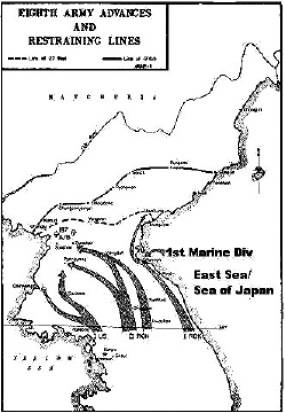
Figure 77 MacArthur’s Advance North
China Enters the War
October 1950
Now MacArthur matched his horrific errors in defending the Philippines during World War II. The advance north was haphazard. His advance was in four widely separated columns with a lot of space for infiltration, plus the columns were not mutually supporting. In addition, he ignored the fact that the Chinese were in the war even after his troops had captured numerous Chinese communist troops as they approached the Yalu River which separated China from North Korea. Chairman Mao, the tyrant leader of communist China, warned the United States through neutral nations that he would intervene if the United Nations approached the Yalu River. The nationalist regime on Taiwan warned the United States of Chinese intervention. All these warnings were ignored.
US Intelligence failed to recognize the potential entry of the Red China into the war.[354] The massive Chinese assault caught MacArthur completely by surprise. MacArthur would go from genius to idiot overnight. The UN forces absorbed a massive blow as Chinese forces rolled back the defenders of democracy like waves running up a California beach (so much for MacArthur’s concept of winter offensives being difficult). As the United Nations retreated below the thirty-eighth parallel, Seoul fell into communist hands again.[355]
Prior to the communist assault, the First Marine Division had landed near the Chosin Reservoir far above the thirty-eighth parallel, and when the Chinese offensive began they were trapped in the mountains by seven or more communist divisions intent on destroying them. In freezing weather, against thousands of fresh Chinese troops, the marines attacked toward the coastal port of Hungnam and deliverance.
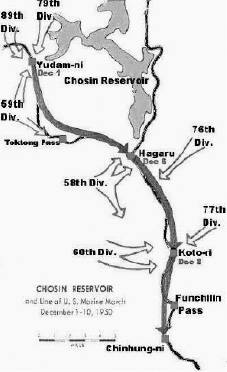
Figure 78 US Marine March from Chosen
Clear weather, at least clear enough at times, allowed US Navy and air force planes to bomb, napalm, and strafe communist belligerents attacking the marines. Air control and tough men were the key to getting the marines out. Chinese troops threw massed assaults at marine positions, but the extra firepower placed at the squad level by the marines paid off as Chinese attacks were repelled with staggering communist losses. The First Marine Division made it to Hungnam and embarked with their wounded, their KIAs, and their serviceable equipment. The Chinese communists subtracted nearly seven divisions from their order of battle because of casualties sustained trying to destroy the surrounded US Marines. For the rest of the war the Chinese would not frontally assault a US Marine position.
The UN line stabilized well south of the thirty-eighth parallel as the Chinese assault ran out of steam. It was impossible for the Chinese to keep their troops supplied since they were moving by foot and bicycle over mountainous terrain in the winter, mostly at night, and getting hit with constant air attacks. Nonetheless, they had recaptured the South Korean capitol and pushed the UN forces about two-thirds of the way down the snow-covered peninsula. The Chinese success centered on night assaults using infiltration tactics to disrupt the UN units’ group cohesiveness. Using this method, large groups of Chinese soldiers would get past UN front lines and attack at night from the flanks using submachine guns with large capacity magazines to spray the UN positions with rounds[356] while other units assaulted the front of the UN positions with submachine guns, grenades, and mortars. The frontal attack held the defenders in place while the flank attacks surprised the defenders, forcing them to guard several axes of advance at once. These tactics confused the troops and small units lost cohesion, often scattering under fire or hunkering down lessening the defensive firepower of the unit. At the same time these attacks on the front lines were proceeding, other Chinese troops got past the UN lines and placed themselves on routes used by reinforcements; thus, as the reinforcements moved forward they would be ambushed and have to fight their way to the unit they were supposed to be saving. It took some time for the UN soldiers to adapt to these tactics; however, once they did the communists had a far harder time achieving success.
After the stunning defeat, MacArthur began publicly calling for bombing Manchuria and perhaps going to war with China. President Truman loathed this because he wanted to limit the war, and he did not want his military commander publicly demanding different strategies. Truman also thought MacArthur had sabotaged a possible peace deal presented by the Chinese. After some acrimonious exchanges Truman fired MacArthur and eventually appointed General Ridgeway as the overall commander of the UN forces in Korea. This turn of events caused a public outcry in America. MacArthur was a favorite general, and many in America thought he was correct to question Truman’s strategy of limited war even if it did mean war with China.
MacArthur had blundered intolerably in defending the Philippines, costing the lives of thousands of men. For his efforts, he was given command of the Army’s Pacific Theater. He stumbled again in his defense and his original offensive actions in New Guinea, once more killing troops unnecessarily. Then he blundered in Korea by ignoring the warning of a Chinese offensive and failing to advance with mutually supporting formations, again costing thousands of lives. In spite of these egregious errors in judgment he remained in command. Only when he openly disagreed with the president was he dismissed. It would appear that slaughtering thousands of your troops isn’t much of a problem, but disagreeing with a politician is a titanic problem.[357]
After General Ridgeway took command of the UN forces he investigated the disaster. General Ridgeway was disappointed in the performance of US Army troops during the Chinese communist offensive. After some study solutions surfaced. Communist tactics were dissected and ways were fashioned to counteract their effectiveness through new training. Once the troops were told what the Reds were doing, and how to thwart enemy efforts, UN combat capability increased dramatically. Another problem was firepower at the squad level, so firepower was improved for the US Army squads. Once these flaws were remedied, the US Army performed well against the experienced Chinese troops who were veterans of the wars with the Nationalist Chinese. Other adjustments in artillery and air support also enabled outnumbered UN units to survive the Chinese and North Korean assaults as well as advance against fanatic resistance.
The New Air War
For the last years of WWII, the Allies dominated the skies, but Allied air superiority was challenged in Korea. The United States was not prepared for another war just five years after the end of WWII, and its equipment illustrated that lack of readiness. In the skies over Korea, the United States was at first flying World War II aircraft like B-29 bombers and P-51 mustangs. Out of nowhere, the communists showed up with jet aircraft that blew the propeller aircraft and jets of the United States out of the sky. The MIG 15, which first appeared over Korea, was an excellent aircraft.[358]The United States had jets (the F-80 Shooting Star, Panther, etc.), but they were no match for this communist jet. In addition, the MIGs were being flown by veteran Soviet pilots and well-trained Chinese pilots. The United States rushed to produce an aircraft to match the MIG 15 and quickly concocted the North American F-86 saber jet. This aircraft was a lucky combination of components that flew wonderfully and proved to be an excellent answer to the MIG 15. In the hands of US Air Force veterans it soon achieved a remarkable kill ratio (10:1 or better) against the MIGs. The challenge for control of the sky above Korea had been answered, and the US Air Force had won (on behalf of the United Nations, of course).

Figure 82 F-86 Saber
This marked the first time extensive air combat had occurred between jet aircraft. The new air war was like something out of a 1940s science fiction novel. Superfast swept-wing rocket-propelled aircraft streaked through the sky with their indomitable pilots wearing silver pressure suits, oxygen masks, heavy helmets with dark visors, and using advanced sighting systems to shoot at other aircraft. It was the start of a new age in aircraft design and production. The race for the air control fighter still goes on today between the world’s major powers, because air superiority is so critical to success on the battlefield,[359] especially for the normally outnumbered troops fighting for the Western Democracies.
UN Forces Move North—Again
With new firepower and offensive schemes, the UN forces soon retook Seoul and were near the thirty-eighth parallel. The communist Chinese decided they must achieve a decisive victory. To this end, they assembled a new army of impressive numbers and prepared to strike the American and British positions just north of Seoul at the Imjin River and east at Kapyong.
The communist spring offensive began on April 22, 1951 and involved well over 750,000 men. In a series of human wave assaults supported by artillery and tanks, they rammed the UN forces south from the Imjin River and Kapyong, thereby threatening to retake the still-smoldering city of Seoul. Even though UN forces were thrust out of their positions by swarming shadows in the night, this was no rout. While the United Nations gave back blood-soaked ground amid hails of lead and Red Army bugle calls, the new firepower and defensive doctrines were exacting an unexpected levy of death and dismemberment on the aggressors. The immense Red Army was suffering incredible casualties. American air power pulverized roads and bridges needed by the Chinese to bring supplies through the mountainous Korean terrain. US artillery and air power lay waste to attacking communist units. Remarkable stands at the Imjin River by British troops, and UN and American troops[360] at other locations, blunted Chinese attacks north of the capitol. The communist advance slowed and then stopped. The massive Chinese attack had literally bled to death.
Stalemate
July 1951 to July 1953
The United Nations started advancing again and retook the lost ground, finally stabilizing the front near the thirty-eighth parallel. Here a decision was made by the UN forces to stop the advance. The Chinese and Americans began frustrating peace talks atPanmunjom in 1951, lasting for years. Meanwhile, a brutal war of taking and losing hills along the thirty-eighth parallel continued. Eisenhower was elected president of the United States in 1952, and he wanted to end the Korean War. The endless talks accomplished nothing, and the Chinese stalling tactics were unfathomable. What China gained from the prolonged twilight war can never be known, although they argued endlessly over the repatriation of prisoners. The Chinese wanted all prisoners of war returned to each side, but the Americans argued that only those who chose to go back should be returned. Had the Americans learned from their WWII experience (mistake) of returning Soviet prisoners of war knowing death awaited them? Why did the Chinese care if a few of their men did not want to return? Whatever the reasons, the talks went on from July 1951 to July 1953, and all the while men were dying along the thirty-eighth parallel for a few yards of well-shelled dirt.
The Korean War may have continued because Stalin wanted the fighting to go on. The murderer was losing nothing, except some equipment and a few pilots, and he probably counseled the Chinese to keep fighting. As long as they were taking the casualties what did he care? About four months after Stalin’s death the cease-fire was signed.
Use the Bomb—or Not?
During the initial Chinese attack, as UN forces were overwhelmed, President Truman alluded to using the atomic bomb. It is questionable if he really considered its use, but a lot of preliminary moves were made that seemed to indicate its use was imminent.
The communist dictators had been correct in one assumption; the United States would not use the atomic bomb. Truman, the president in 1950, responded to the invasion with conventional forces thereby deciding the use of the A-bomb was inappropriate. Why Truman held back might be difficult to discover. An innocent nation was under attack and being overrun by a ruthless enemy. Thousands of innocent South Koreans were being murdered and the displacement of the South Korean population was an international tragedy. Why not use the A-bomb? Arguably, if Truman obliterated North Korea it might cause the USSR to obliterate South Korea, and who knew what would be obliterated next? Truman did not want this “small”[361] war to escalate into another world war. In addition, England and several other US Allies cautioned Truman against the use of the A-bomb, thus, the president’s decision to forego using the A-bomb in Korea.
This decision became precedent, and the United States has not used the atomic or hydrogen bomb in any situation. It should be noted that the USSR under Stalin, or China under Mao, would have used the atomic bomb without hesitation if the roles had been reversed. Because the United States has not used its nuclear weapons, thousands of US soldiers have died in combat to preserve friendly regimes under communist or terrorist attack, and those struggles have not been universally successful. The notion that using the bomb increases the chance of a wider war should be balanced against the idea that abandoning the bomb encourages despots to start wars with the United States because of its refusal to use all its available combat power. The thought of a nation failing to use a decisive weapon because of unilateral moral reasons would have dumbfounded Clausewitz and other philosophers of war. Remember, the precedent for abandoning the A-bomb was set in Korea when Truman decided to forgo the use of America’s most powerful instrument of war. This shows the importance of history on decision making. Decisions made long ago, and for different reasons, can impact the decisions of today.[362]
President Eisenhower, wanting to end the stalemate in Korea, decided to up the pressure on the Chinese and moved the bomber group armed with the atomic bomb to Okinawa which is near Korea. In addition, he leaked information to the Chinese that the atomic cannon would be sent to Korea. All this made it appear the Americans might launch offensives using nuclear weapons to blow holes in the Chinese lines or destroy vital rail lines and bridges over the Yalu River. Following these moves, the Chinese and North Koreans agreed to a cease-fire which stopped the fighting on July27, 1953. A peace treaty was never signed, so from the original invasion in 1950 until today (2010) the two Koreas have technically been at war.[363]
Analysis
The political fallout from the Korean War was minimal considering its cost. About 33,746 Americans died or were missing in action during the conflict (The New York Times Almanac, 2008), and the United States still has troops there to protect the South from another attack. Communist losses are unknown; however, it is estimated that the Chinese lost almost 1 million men in the war (official US estimate is over five hundred thousand), the North Koreans 215,000, and the USSR 300 plus. The South Korean civilians suffered the most from the war in that millions were killed or wounded, and their homeland was destroyed.
America was glad to be out of the war, but the failure to win was hard on many in the United States. Fighting to a draw was not the kind of war Americans liked to fight. It was a good start for the United Nations as it had successfully intervened and saved a small nation from conquest; however, this was tempered with the realization that the USSR had allowed it to happen by being absent on the day of the critical vote. This must have been a blunder by the Soviets, but we may never know. Since the Soviets had calculated the United States would not react to the invasion militarily, they might have assumed that the United Nations would play no part in actively resisting the invasion.
Eisenhower’s sub-rosa threat to use atomic bombs to defeat the Chinese, unknown for years, was one of the high points of his administration. At least he ended the fighting. A book entitled This Kind of War by Fehrenbach[364] warned America that Korea was the type of war it would face for the remainder of the twentieth century. The author meant amorphous and brutal wars seemingly without end and lacking traditional winners or losers. He was a prophet, correctly predicting the remainder of the twentieth century and the beginning of the twenty-first.
Americans cannot get used to the concept that they do not have to “win” these wars, they only have to “not lose.” This is one lesson the United States needed to learn from Korea. Winning was going to be so costly in Korea the United States decided to leave it a stalemate and live with it. The US rejected this concept, however, if the United States can achieve a stalemate in a faraway nation and prevent totalitarians from taking over the government, America has achieved “victory.” Not victory in a WWII sense, but victory by keeping a friendly government in power without committing thousands of troops and millions of dollars for an indefinite time.
Korea has faded badly into history; nevertheless, it was a clash of giants in which the stage was set for the rest of the 50 year Cold War conflict. Millions died, but millions are now free because the United States, the United Nations, and freedom’s allies acted. No Munich here. No appeasement. Korea was a victory in thwarting aggressors out to conquer the world one piece at a time. The lessons of World War II were learned . . . for awhile.
In 2010, the two Koreas are still a fact. The contrasts between the two should be studied. After the War, the South was devastated, but by 1965 the economy had recovered and the nation was thriving. By the year 2008, South Korea was one of the top 15 economiesof the world. The North is a repressive, vacuous prison where people starve unless given international aid. It seems the only export of the North is terror. They have spent their tiny gross domestic product acquiring nuclear technology to build and sell atomic bombs to terrorists and rogue states. Red China keeps an army on its border with the North just to keep North Koreans out of China.
In South Korea, democracy and capitalism built a vibrant economy with a gross national product on a par with the most economically successful nations in the world just a few years after total devastation. In North Korea, communism and dictatorship imprisoned its people in a trash-filled wasteland with an economy that cannot feed its own population. Both these peoples were, and are, the same in every way except for their governments. One side thrives, the other starves. This is the most realistic comparison of communismand capitalism ever devised. The two Koreas are the ultimate experiment in the true outcomes of governmental choices. Few talk about it, but here is the reality of the choice between capitalism plus democracy plus freedom, and communism plus the inevitable communist dictatorship plus a controlled economy. For some unfathomable reason, many people in the United States and around the world still think the choice of communism and a controlled economy is best. All they have to do to learn the truth is look at the two Koreas.