
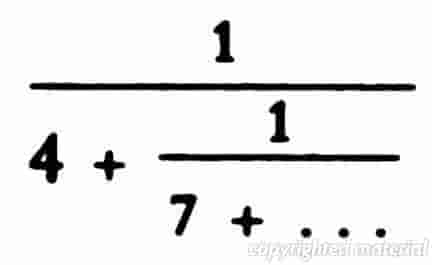
According to Simon Newcomb, the tropical year at epoch AD 1900 is equivalent to 365.24219879 mean solar days, approximately.* Hence, to the nearest fifth decimal place, the fractional part of the number of days in the tropical year is 0.24220. This can be expanded as a simple continued fraction.†

..........,
the first four convergents, i.e. successive approximations, being
1/4, 7/29, 8/33, 31/128,
respectively. The first convergent gives the Julian leap year rule, according to which every fourth year contains a leap day. The fourth convergent gives one fewer leap years in each period of 128 years, that is, 31 as against 32 Julian leap years, and would lead to an extremely accurate value for the average length of the calendar year, viz. 365.2421875 days, which is too short by about one second only. It is more convenient, however, to use the Gregorian calendar which gives 97 leap years in each period of 400 years, although it is less accurate, producing one too many leap years (776 instead of 775) in each period of 3,200 years. In fact, the Gregorian leap year rule gives the fractional part of the average number of days in the year as 0.2425 instead of 0.2422.
A somewhat more accurate approximation is given by the third
____________________
*
The tropical year decreases by about 0.00006 days in 1000 years. When the Julian calendar was introduced ( 45 BC) it was approximately 365.24232 days.
†
Simple continued fraction expansions tend to give much more accurate approximations than decimal expansions. The notation here used is more convenient than printing
convergent above, viz. 8/33. It corresponds to the suggestion attributed to Omar Khayyam of eight leap years in each period of 33 years,* which yields the decimal approximation 0.24242 for the fractional part of the average number of days in the year. This rule would not be convenient to use, however, particularly because some leap years would occur in even- numbered years and some in odd-numbered ones.
If the Gregorian calendar were slightly modified, so that in addition to the present rules governing leap years all years divisible by 4,000 were taken to be ordinary years, there would be 969 (instead of 970) leap years in a period of 4,000 years, giving an average length of 365.24225 days for the calendar year. This is only about four seconds too long, corresponding to one day too many in about 20,000 years.
____________________
*
The poet and mathematician Omar Khayyam was one of eight astronomers appointed, c. AD 1079, by the Sultan of Khorasan to reform the calendar.